

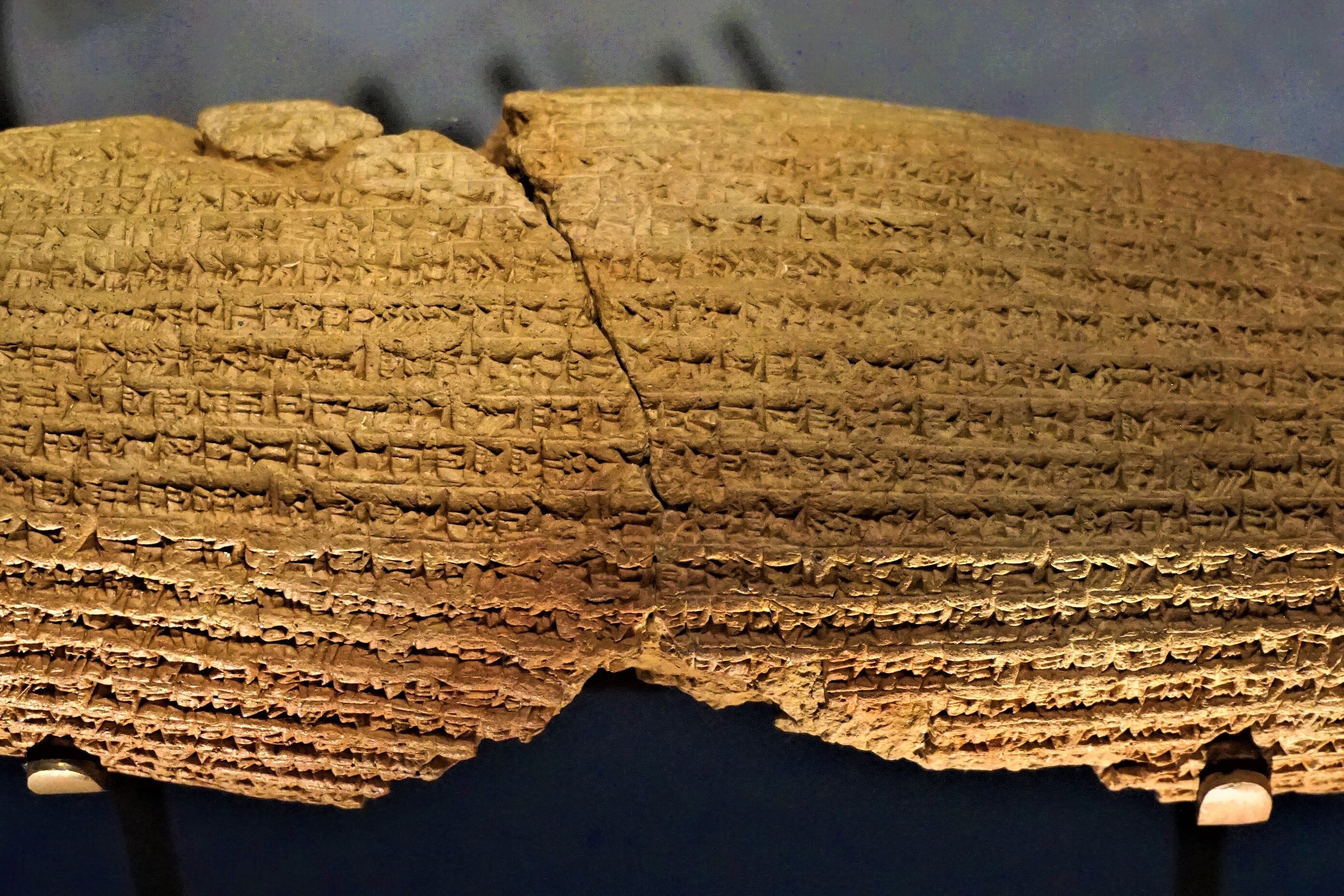
The Cyrus Cylinder | Babylon, after 539 BCE
British Museum | Photo Credit: Joyofmuseums via Wikimedia Commons

Overview
Israel’s story is told on the monuments of the empires that fought it, Assyria, Babylon, Persia, and Moab, in Rooms 6a, 10a, 52, 55, and 57 of the British Museum and the Levant rooms of the Louvre. 4 ideas organize this section, and each is an exam term.
Key Terms
Exodus · Babylonian Exile · Torah · Tanakh
Timeline
• 1208 BCE | Merneptah’s stele names Israel
• 841 BCE | Jehu of Israel pays tribute to Assyria
• 701 BCE | Sennacherib takes Lachish
• 586 BCE | Babylon destroys Jerusalem and the First Temple
• 539 BCE | Cyrus takes Babylon, and the Exile ends
Exodus | Out of Egypt, Into the Land
Between Mesopotamia and Egypt was the ancient land of Canaan. For Israel’s earliest centuries, the Bible is nearly our only written source, so this section tells the story as the Bible tells it. Israel’s first period is the age of the patriarchs, the fathers of the tribe: Abraham, his son Isaac, and his grandson Jacob. In Genesis, Abraham and his family are led out of Mesopotamia, from Ur of the Chaldeans, into the Land of Canaan. Ur was one of the great cities of its age, with its ziggurat and its royal tombs. A brick from that ziggurat sits in Room 1, stamped with the name of the king who built it, Ur-Nammu; look for the two dog’s paw-prints pressed into the clay while it was still wet. Abraham left because he was called, and the call came with a promise: a nation, a name, and a blessing. Then comes the land: “Unto thy seed will I give this land.” This is the Promised Land. Jacob is renamed Israel, and his twelve sons become the twelve tribes. The Exodus (Greek for “going out”) is when Moses leads the Hebrew people out of Egyptian bondage. At Mount Sinai they receive the Law. Forty years after the Exodus, Joshua leads the tribes into Canaan. Egypt’s records do not name Moses. They do name Israel. Pharaoh Merneptah’s victory stele of 1208 BCE carries the earliest mention of Israel in the archaeological record. Merneptah’s father was Ramesses II, and his colossal Younger Memnon fills Room 4 with the Egypt the Hebrews remembered; look at the hole drilled in his right shoulder by the French team that tried to carry him off and failed. The land the tribes entered had gods of its own. The Louvre’s Stele of Baal shows the Canaanite storm god striding with a thunderbolt in his raised hand, the rival the prophets would spend centuries denouncing; look for the small king standing beside his spear. A shepherd boy named David humbles the Philistines by killing their champion, Goliath, with a sling and a stone and later is made king. Once he is anointed (Hb. mashiach), David moves the capital from Hebron to Jerusalem, thereafter the “City of David.” His son Solomon builds the Temple there. After Solomon, the kingdom splits in two. The Mesha Stele in the Louvre was set up by a king of Moab around 840 BCE to boast that he had thrown off Israel’s yoke; it is the oldest stone outside the Bible to write the name of Israel’s God in its four Hebrew letters, and look for the name of Omri, the king of Israel whose house Mesha hated. Omri’s house fell to a general named Jehu, and Jehu is in Room 6a, on the Black Obelisk of the Assyrian king Shalmaneser III, bowing to the ground with his tribute behind him; look at the second panel from the top, because it is the only picture of a king of Israel that survives from his own age.
Babylonian Exile | Judah Between Empires
After Solomon, the kingdom splits in two: Israel in the north, Judah in the south. In 722 BCE, Assyria takes the Northern Kingdom. In 701 BCE Assyria came for Judah, and the siege of Lachish fills Room 10a. The Lachish reliefs once lined a room of Sennacherib’s palace at Nineveh: the Assyrian ramp goes up, the families of Judah come out, and the king sits on his throne to receive them; look for the prisoners carrying their children. Jerusalem itself did not fall that year. The Taylor Prism in Room 55 is Sennacherib’s own account, and it says of Hezekiah, king of Judah, only that he shut him up in Jerusalem “like a bird in a cage”; look at the six sides of close cuneiform, the fullest surviving edition of the king’s annals. In 586 BCE, Nebuchadnezzar II destroyed Jerusalem and Solomon’s Temple. Babylon resettled many of Judah’s people in its own lands, in an event known as the Babylonian Exile. Because the exiles came from the Kingdom of Judah, they were henceforth called Judeans (Hb. Yehudim), the root of our word Jews. The British Museum holds the event from three sides. The Lachish Letters in Room 57 are notes in Hebrew, written in ink on broken pots by an officer at an outpost as the Babylonian army closed in, and one letter from the same find reports that the signal fires of a neighboring town can no longer be seen; look at the script, which is the Hebrew of the prophets, written by a soldier. The Babylonian Chronicle in Room 55 is Babylon’s own year-by-year record, and under the seventh year of Nebuchadnezzar it says plainly that the king marched west, besieged the city of Judah, took it, and appointed a king of his own choosing. Beside it, the East India House Inscription is Nebuchadnezzar’s own boast of the temples and palaces he built in Babylon, the city where Judah’s people were taken. Then, in 539 BCE, Persia took Babylon, and Jewish scripture pays an astonishing compliment to a foreign king. The Persian Cyrus is the only foreign king whom the Bible calls God’s anointed. The Cyrus Cylinder, the anchor image above, is Cyrus’s own proclamation after the conquest, written in Babylonian: he returned the gods of the conquered peoples to their shrines and let the peoples go home; look at the barrel shape, made to be buried in a wall as a foundation record and read by no one but the gods. It does not mention Judah. The Book of Ezra does, and by about 516 BCE, the Second Temple stood in Jerusalem.
Torah | The Law & the Temple
The Torah (Hb. instruction) is the books of Genesis, Exodus, Leviticus, Numbers, and Deuteronomy, traditionally attributed to Moses. From the start, the Torah was a book to study. God charges Joshua to keep “this book of the law” close: “thou shalt meditate therein day and night.” Israel was not the first people in the region to write its law on stone. The Code of Hammurabi in the Louvre’s Room 227, cut centuries before Moses, opens with the king receiving his authority from the sun god and runs through 282 laws, among them that if a man destroys the eye of another, they shall destroy his eye; look at the top of the stele, where the god hands the king the rod and ring of justice, and then remember that in Exodus it is the whole people, not a king, who receive the law. Nearly every temple in this course so far was built as a house for a god’s image. The ziggurat of Ur lifted a shrine to the moon god Nanna. The Parthenon held Athena in gold and ivory, nearly forty feet tall. Rome raised its Pantheon to “all the gods.” Israel’s sanctuary was built around a box. In the wilderness, Moses receives a command: “let them make me a sanctuary; that I may dwell among them.” The sanctuary is a portable tent, the Tabernacle (Hb. mishkan, “dwelling”). At its heart stands the Ark of the Covenant: a chest of acacia wood about 45 inches long, overlaid with gold, holding the two stone tablets of the Ten Commandments. On its golden lid, the mercy seat, two cherubim face each other with their wings stretched over it. Between the wings, there is nothing. The empty space is the point. The second commandment forbids “any graven image, or any likeness of any thing.” Yet the same Torah demands fine art. Gold, woven linen, and carved cherubim were holy. An image of God was not. Solomon’s Temple held the Ark in the Holy of Holies, a perfect cube of 20 cubits, about 30 feet on each side, lined in gold. A temple that could not contain its God could not hold His statue either. The First Temple fell when it was destroyed by the invading Babylonians in 586 BCE. The Second Temple’s Holy of Holies stood empty, because no Ark was ever recovered. In 63 BCE, the Roman general Pompey took Jerusalem and walked into the one room only the high priest could enter, once a year, and Rome learned that the place stood empty, with no image of a god within. Nothing from either Temple survives in London or Paris. What survives is the law it was built to keep, and the walk from the Baal stele to the Hammurabi stele to the empty room is the walk the Torah asks its reader to take.
Tanakh | Torah, Prophets, & Writings
At the center of Jewish life is the Hebrew Bible, what Christians call the Old Testament. Jews call it the Tanakh, a name built from the first letters of its three layers, TA-NA-KH: the Torah (Hb. instruction), the first 5 scrolls of the Bible; the Nevi’im (Hb. Prophets), 8 scrolls of prophetic insight for Israel; and the Ketuvim (Hb. Writings), 11 other scrolls, poetic, wisdom, and histories. Two of the Prophets, Jeremiah and Ezekiel, belong to the same age as the Buddha and Confucius, and to the same years as the Lachish Letters and the Babylonian Chronicle: Jeremiah watched the siege those tablets record, and Ezekiel preached among the exiles in Babylon. The Ketuvim gather everything else: the Psalms, Proverbs, Job, Daniel, and the Teacher of Ecclesiastes, who tells his reader to eat his bread with joy. The text of the Hebrew Bible is almost entirely ancient Hebrew (98.8%), with the remaining 1.2% composed in Aramaic. Much of it took its final shape in the Exile, among a people with no land, no king, and no Temple, which is why a book, and not a building, stands at the center of Jewish life. Rome takes Jerusalem in 63 BCE, under Pompey, and thereafter rules through puppet-kings, Herod the Great chief among them. The First Jewish–Roman War (66–73 CE) ended in the Roman destruction of the Temple in 70 CE. Jewish sacrifice ended in 70 CE, because it could be offered only at the Temple, and a Third Temple was never built. With the Temple gone, Jewish life turned to the Pharisees, the party of the people: the Temple in Jerusalem was succeeded by synagogues (Gr. assemblies), the Temple priesthood was succeeded by rabbis (Hb. my teacher), and the Temple sacrifices were succeeded by the study of the Torah. In these ways, after the Temple, Rabbinic Judaism was born. The rabbis spent the next 400 years writing their tradition down as the Talmud, an enormous body of commentary that rules on the questions Jewish life put to the Torah. With the Temple gone, study became how Israel kept the covenant, and argument became how it studied. A famous story in the Talmud shows the whole method in one breath. A man asks the sage Hillel to teach him the entire Torah while he stands on one foot. Hillel answers: “What is hateful to you, do not do to your fellow. That is the whole Torah, and the rest is its commentary. Go and learn it.” The British Library shows Hebrew Bibles in its Treasures gallery from time to time, but it does not promise which, so none is linked here.
Go Deeper
Culture & Values, 8th ed., Chapter 6, Abraham and Judaism (pp. 189 to 198).
Where to Find These Artifacts
London
• Brick from the ziggurat at Ur: British Museum, Rm 1, Enlightenment, Wall Press 68
• Younger Memnon (Ramesses II): British Museum, Rm 4, Egyptian Sculpture, Bay 9
• Black Obelisk of Shalmaneser III: British Museum, Rm 6a, Assyrian Sculpture
• Lachish reliefs: British Museum, Rm 10a, Assyria: Lion Hunts & Lachish
• Taylor Prism: British Museum, Rm 55, Mesopotamia, Case 3
• Babylonian Chronicle (605-594 BCE): British Museum, Rm 55, Mesopotamia, Case 7
• East India House Inscription: British Museum, Rm 55, Mesopotamia, Case 5
• Lachish Letters: British Museum, Rm 57, Ancient Levant, Case 10
• Cyrus Cylinder: British Museum, Rm 52, Ancient Iran, Case 4
Paris
• Stele of Baal with the Thunderbolt: Louvre, Sully 0, Rm 301, Levant
• Mesha Stele: Louvre, Sully 0, Rm 303, Levant
• Code of Hammurabi: Louvre, Richelieu 0, Rm 227
Module II • Scripture, Faith, & Empire
Sec 6 • Ancient Israel
Sec 7 • Early Christendom
Sec 8 • Early Islam
Sec 9 • Holy Roman Empire
Course Page: Humanities: Study Abroad | London & Paris