4. Alto Lee Jerkins
Great-Grandfather | Foreman, Traveller
b. 28 Apr 1895, Dale Co. Alabama
d. 20 Jun 1976, Ft. Meade, Florida
Alto Lee was the youngest of 10 children. Orphaned at 18: his mother died in Dec 1913 and his father 6 weeks later. In Feb 1914, the Dale County chancery court declared him an emancipated adult so he could handle his own affairs. When his father’s 122 Alabama acres were divided, Alto gave his share to his brother Edward (my father calls it “Uncle Ed’s Farm”). He took to the road instead, finding work where he could and seeing the sights along the way.
He met Chellav McDonald, my Granny, at a church social. Before they spoke, he told his niece Nuna that he was going to marry her. He left town that same night and courted Chellav through letters from the road. Her family was wary of a man who traveled so much, so the couple tried to elope. Granny Woodham caught them, and they held the wedding at her house instead, 13 Aug 1924.
Alto found a job in Whiting, Indiana, and sent for Chellav. They moved to Chicago for a while, where he was foreman of a work crew during Chicago’s mobster years. Their first child, Sybil, was born in 1926 on the McDonald farm in Dale County, and mother and baby rode the train back to Chicago. When work grew scarce, they came home to a cottage on Uncle Ed’s farm outside Dothan. Alto raised crops there and still left for months at a time to work on the road. They had 7 children, including my Papa. They buried a newborn, a toddler, and a teenage daughter, Mabelene, who died in 1949.
The family lived in Alabama and in Panama City, Florida. When a son-in-law told them of work in the citrus groves of Central Florida, Alto went ahead, and the family followed. By 1950, they were settled in Ft. Meade, where Chellav began a long career in nursing homes. They were good, kind people who never knew a stranger. My father never knew Grandad Alto to make a racist or hateful comment. He enjoyed checkers and played catch with his grandsons. After Alto died in 1976, Granny served as the family matriarch until her death in 2002. My father gave her eulogy, and much of this story comes from it.
5. William Hamilton Jerkins
Great2 Grandfather | Farmer
b. 15 Nov 1851, Henry Co. Alabama
d. 27 Jan 1914, Midland City, Alabama
William Hamilton (went by “Ham”) grew up on his father’s farm near Abbeville, Alabama. He was 11 when his father left to join the 57th Alabama in May 1863, and 13 when the war ended. He was born too late to fight and too poor to own anyone. His father had held no one in slavery, and the wealth his grandfather built on enslaved labor never reached our branch.
He married Mary McLellan on 9 Dec 1875 at the home of her parents, Daniel “Mac” McLellan and Margaret Singletary. Ham’s brother John co-signed the $200 marriage bond. From everything I can tell, they were good, honest people. They had 10 children, including my great-grandfather Alto Lee (1895–1976). Two of their children died as infants.
The family left Henry County for new ground on the Dale County line. A homestead patent meant 5 years of living on the land and improving it before the government would grant title. Ham did that himself, and in Feb 1896 he received 41 acres next to his father’s 81. Around 1900 his father gave him the rest, and the two tracts became the 122-acre Jerkins place in Alabama. The 1900 census finds him there, a farmer who could read and write, with 8 children at home and the farm owned free of mortgage. His father had signed his name with a mark. His sons became farmers as they came of age, and most settled nearby.
Ham was a Freemason, an organization popular in my family. His last years were hard ones. His father died in Nov 1911 and his daughter Ida Belle in Sep 1912. Mary died on 16 Dec 1913, and Ham died of jaundice 6 weeks later, at 62. They share a Masonic monument in Pinckard Cemetery, which I photographed. Their youngest, Alto, my ancestor, was 18 when they passed.
6. Richard Singleton Jerkins
Great3 Grandfather | Confederate Soldier & Pensioner
b. 9 Feb 1822, Hancock Co. Georgia
d. 23 Nov 1911, Slocomb, Alabama
Richard came to Henry County, Alabama, as a young man and married Harriet Davis there on 8 Jun 1843. Their children were Catherine (1845–1928), Zack (1848–1931), John Hickman (1850–1914), William Hamilton (1851–1914), Mary (b. 1852), James (b. 1854), Thomas (b. 1859) and Hickman (b. 1859). In 1860, he was a farmer in Abbeville who held no one in slavery. In May 1863, at 41, he joined Company E of the 57th Alabama Infantry as a private fighting for the CSA. He served until 1865 and was discharged in North Carolina. Harriet died in 1888. He received a federal homestead patent for 81 acres in Alabama in Oct 1895, and Alabama approved his Confederate pension in Jun 1899. He spent his last years in Geneva County and is buried in New Teamon Baptist Church Cemetery, under a stone I photographed that calls him “an affectionate Father and faithful friend.”
7. Zachariah Jerkins
Great4 Grandfather | Deserter, Enslaver
b. 1799, Georgia
d. Nov 1854, Tallahassee, Florida
Zachariah grew up in Hancock County, Georgia. In Sep 1817, at 18, he deserted from an Army company at Fort Hawkins, and his captain posted a $20 bounty for him. He married Martha “Patsy” Faison on 13 Aug 1820 in Hancock County. Their children were Richard Singleton (1822), Susan (1828), Thomas (1829) and Martha (1830). By 1830, he was in Leon County, Florida, and in Jul 1831 he filed for divorce. He farmed 440 acres of cotton near Tallahassee and was a Freemason. Family tradition from his great-grandson Dr. William Lafayette Jerkins (1910), says Zachariah and his sons ran the first stage line between Tallahassee and Tuscaloosa. Jack Butler, a distant cousin and genealogist, found a twice-weekly mail stage on that route in the late 1820s, but no evidence tying a Jerkins to it.
Zachariah also enslaved people. Leon County taxed him for one enslaved person in 1848, three by 1851, and seven in 1854, the year after he married the widow Eliza Jane Forbes Mills. Only 3 are named in any record I have found. The court’s inventory of Jan 1855 lists Daniel, Webster, and Fanny and puts a price on each: $1,000, $1,000, and $600. Together, that was more than a third of the estate. After Zachariah’s death, the administrator hired all 3 out in Tallahassee, and the money went to the estate (ie. their infant child). Webster died in Apr 1857. Daniel was still being hired out in 1860, at $150 a year. I cannot trace Fanny after 1858. The other 4 people appear only as a number. If you know more about Daniel, Webster or Fanny, I would be glad to hear from you and to share the records.
Zachariah and Eliza both died in Nov 1854. Their infant son, Zachariah Holland Jerkins, was born that year, and the estate, appraised at $6,904.75, went to him ($268,000 in today’s dollars). My ancestor Richard inherited none of it.
8. Zachariah Jerkins
Great5 Grandfather | Soldier & Pensioner of the Revolutionary War
b. 18 Mar 1757, North Carolina
d. 1838, Florida
Zachariah is the earliest man from my direct line known to carry the Jerkins name.
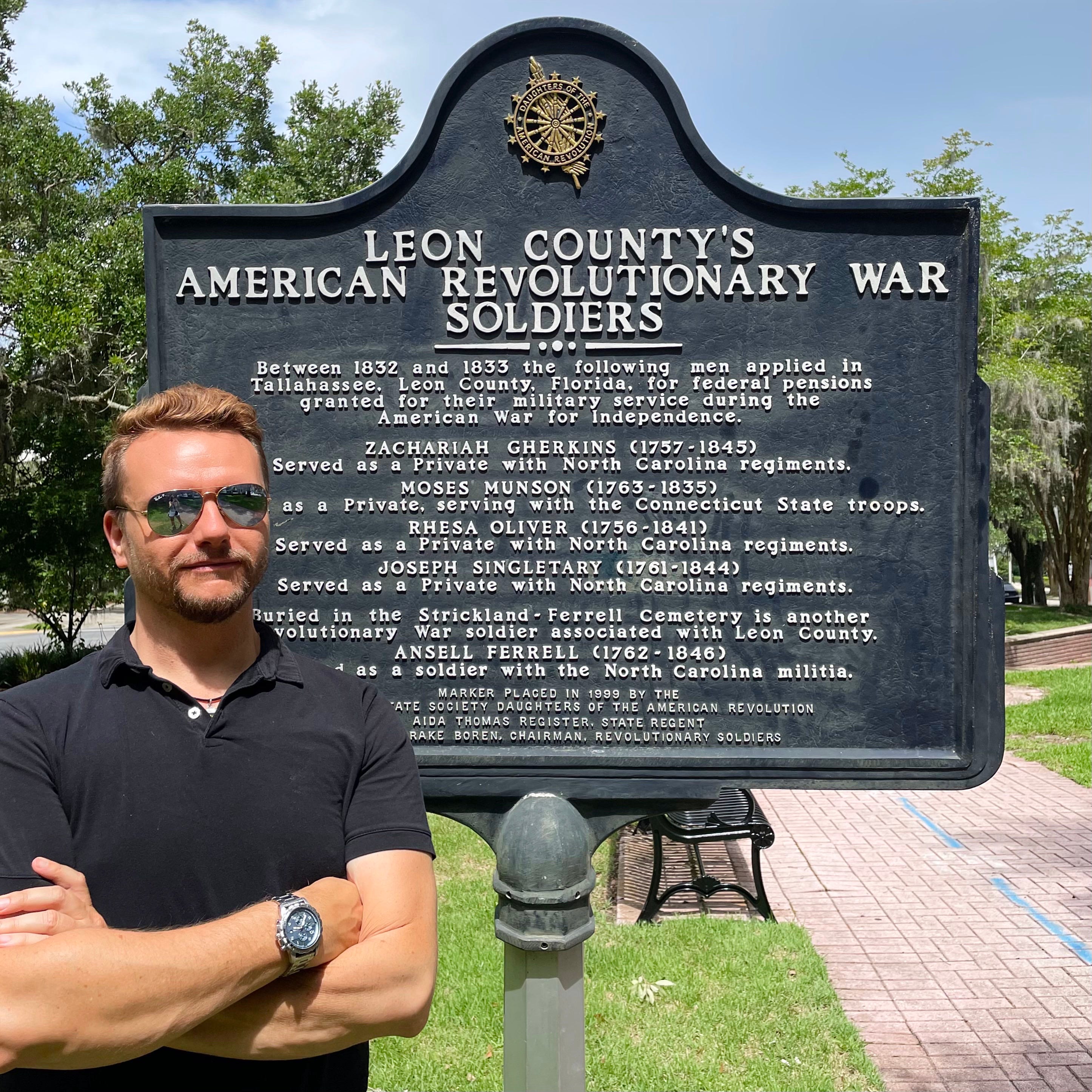
Clerks also wrote it Girkin, Gherkins, Jurkins and Judkins. He was 19 years old, living in Halifax County, North Carolina, when he enlisted in the Revolutionary War (1776). He spent most of a 6-month tour driving a supply wagon and served another in a mounted troop (riding his own mount). He sold 100 acres in Halifax in 1784 and was in Georgia by 1787. He married Sarah Bailey on 16 May 1797 in Bulloch County, Georgia. Their sons were Reason (1798–1840), Zachariah (1799–1854) and John Singleton (1804–1863). Sarah died about 1809 — after 12 years of marriage. Zachariah later married Catherine Sasnett; the children after Sarah’s death were James (1811), Henrietta (1813–1880) and Robert Wilson (1818–1889). By 1830, he had followed his sons to Leon County, Florida. But the following year, he was destitute. He swore that he could neither read nor write and owned nothing but the clothes on his back. His pension file is available at the National Archives. In Apr 1999, the Daughters of the American Revolution placed his name on a prominent marker in Bloxham Park, Tallahassee, which I visited several times during my time at Florida State University.
9. The Blount Father
Great6 Grandfather | Farmer
A North Carolina Blount, born before 1740
Here my surname and my Y-Chromosome part ways.
Zachariah the Revolutionary was raised a Girkin, but the Y-DNA of his male-line descendants belongs to the Blount family of North Carolina (branch R-BY67530). It is a scientific certainty that this male line is Blount, and the evidence points to Zachariah’s father. More narrowly, it points to the household of Benjamin Blount Sr. of Tyrrell County, whose land adjoined the Girkins’ land for several generations.
How do we know? The Y chromosome passes from father to son almost unchanged. Now and then a small mutation appears, and every male-line descendant inherits it, so each tiny mutation marks a branch of a male lineage. Testing with FamilyTreeDNA puts my own line on branch R-BY67530, the branch carried by tested descendants of Capt. James Blount (d. 1686). My Papa (Alto’s son) was also tested and his results agree with mine, so the line and testing is sound. Inside that branch, we sit on a unique twig called R-FTE31018, shared by only 3 tested lines: ours and 2 men named Blount (herein called Branch-mate A and Branch-mate B).
The mutations also work as a clock. As of Aug 2026, FamilyTreeDNA dates the common ancestor of the 3 lines to a birth around 1705 (68% range: 1601–1793). The documents tighten that. Capt. James reached Carolina by 1669, and Zachariah the Revolutionary was conceived in mid-1756, so the Blount father entered our line in Carolina between 1669 and 1756. That much is certain. The common ancestor cannot have been born after about 1739. And none of the 3 lines shares a later mutation with another, so they parted at 1 man or within a generation or two of him.
Parsimony does the rest. A tested descendant of Capt. James through his grandson Thomas Blount Jr. does not carry FTE31018, so the mutation arose below Thomas, in a younger line. Branch-mate B’s paper trail runs back, father to son, to Edmund Blount (d. 1754), a son of Benjamin Blount Sr. And Benjamin Sr. was the Girkins’ next-door neighbor: in 1718, one man deeded land to him and to an earlier Zachariah Girkin on the same day, calling each his son-in-law. So the simplest account that fits every fact is that FTE31018 arose in Benjamin Sr.’s house, and a man of that house fathered Zachariah the Revolutionary. Branch-mate A’s line is traced to Andrew Blunt of Kentucky (d. by 1825) and to a Reading Blount on the Virginia frontier from 1764. A Reding Blount was in Tyrrell in 1755–58. If he is the same man, all 3 lines meet in one household.
The Girkin house had lost its head in 1754 and its land in Mar 1756 — and Zachariah was conceived that summer. My working reading is that his mother was a Girkin woman and his father one of her Blount neighbors.
That leaves a rather short list I’m still researching. Benjamin’s sons are the top candidates: James Blount (1720–1762), Benjamin Blount (1725–1788) and Jacob Blount. Secondarily, there is a grandson of age, Edmund Blount (d. 1793). Two more are possible: Isaac Blount, a son known by name only, and Reding Blount, who was in Tyrrell in 1755 and gone by 1758. The generations above this one follow Benjamin Sr.’s line — each one known to have carried my same Y-Chromosome.
10. Benjamin Blount Sr.
Great7 Grandfather | Planter
b. 1688, North Carolina
d. 1740, Tyrrell Co. North Carolina
Benjamin was a son of Capt. Thomas Blount and Mary Perry. He was about 18 when his father died in 1706. His mother married Capt. Thomas Lee, and her will of 1716 left Benjamin and his brother Jacob the family’s Middle Plantation.
He was a planter on Kendrick’s Creek, on the south shore of Albemarle Sound. The ground was part of Chowan Precinct until Tyrrell County was formed in 1729. He married Elizabeth Everett, daughter of Nathaniel Everitt. On 25 Mar 1718, Everitt deeded 100 acres to Benjamin and, on the same day, 60 acres to Zachariah Girkin, calling each man his son-in-law. The two families were neighbors and in-laws from that day. The tax roll of 1719–1720 lists them a few lines apart, and a deed of 1722 describes land “adjoining lands of Benjamin Blount and Zachariah Girkin.” In 1719, Benjamin and Elizabeth sold 250 acres on Kendrick’s Creek. In Dec 1739, he served on a road jury with his son Edmund and with Zachariah Girkin.
Benjamin and Elizabeth had 8 children: James, Jacob, Isaac, Edmund, Benjamin, Esther, Mary and Sarah. He made his will on 1 Feb 1740. The home plantation went to his son Benjamin. James, Jacob, Isaac and Esther shared the cattle, and each received a bed, an iron pot and a ewe. Edmund, Mary and Sarah received 5 shillings apiece, the usual sign of children already provided for. Elizabeth was executrix. Zachariah Girkin witnessed the will at Benjamin’s bedside and swore to it in court that June.
11. Capt. Thomas Blount
Great8 Grandfather | Judge, Councilman, Vestryman
b. 1650
d. 1706, Chowan Precinct, North Carolina
Thomas was a son of Capt. James Blount and his first wife, whose name is lost. He was born in Virginia, and the family moved from Isle of Wight County to the Albemarle between 1660 and 1669. In 1680, he and his brother James proved their headrights and were granted land of their own.
He rose high in the young colony. He was a justice of the Chowan precinct court and its presiding judge in 1694. In 1696, he sat on the governor’s council, and from 1698 to 1701 he was a justice of the General Court. He served in the Assembly about 1696 and again in 1703. In Feb 1697, the Assembly, the council and the courts all met at his house in Perquimans. In 1699, he sat on a commission that investigated a murder charge against Indians and found it false.
Then came a fall. In 1701, his son James married Mary Tyler, the sister of his late wife, a match the Anglican church forbade. Thomas was accused of promoting it, and the General Court barred him from civil and military office for life. The church itself did not seem to mind: he sat on the vestry of St. Paul’s Parish, Edenton, from its founding in 1701 until his death.
He married twice. His first wife’s name is lost; their children were James, John, Sarah, Christian and Ann. In 1686, he married Mary Perry, the widow of Joshua Scott. Their children were Thomas, Benjamin, Jacob, Billah and Zilpha. He was also guardian to his young brother John and to his stepdaughter Grace Scott. By Sep 1701, he lived at the mouth of Kendrick’s Creek, the neighborhood that later became Tyrrell County, and he made his will there that month. It names his lands as the Middle Plantation and Cabin Neck, and it was proved on 28 Mar 1706. His widow married Capt. Thomas Lee, and her will of 1716 names “my Son Benjamin Blount.”
His son Thomas founded the Blounts of the Tar River, the line that produced William Blount, a signer of the U.S. Constitution. See his biography in the Dictionary of North Carolina Biography.
12. Capt. James Blount
Great9 Grandfather
b. 1620, England
d. 1686, Chowan Precinct, North Carolina
James is the founder of the Blount family of North Carolina. He was abroad by 1655, when his uncle’s will described him as “beyond the seas.” In Sep of that year, 3 servants were bound at Bristol to “James Blunt, planter, to serve in Virginia.” By 1668, he had settled on 300 acres on the north shore of Albemarle Sound, a few miles east of Edenton, land later called Mulberry Hill. He sat on the Albemarle council in 1669 and patented another 660 acres in 1684. He married first in England; his wife’s name is lost. By 1683, he had married Anna Willix, a widow. His children were James (d. 1716), Thomas (1650–1706), John (1669–1725), Anne and Elizabeth. His will is dated 10 Mar 1685 and was proved in Jul 1686.
13. James Blount, Esq.
Great10 Grandfather
b. 1594, Worcestershire, England
d. 1655, England
James was a son of Thomas Blount of Astley and Bridget Broome. In 1627, he took possession of the advowson of Astley, the right to name the parish priest. His wife was of the Clare family; her first name is lost. Their sons were James, who went to Virginia and Carolina, John (d. 1621) and Thomas. He was dead by 19 Dec 1655, when his brother Charles made a will leaving a legacy to “my cozen James Blount one of the Sonnes of my late brother James Blount Esquire deceased.”
14. Thomas Blount
Great11 Grandfather
b. 1564, Astley, Worcestershire, England
d. 30 Nov 1624, Astley, Worcestershire, England
Thomas was baptized on 27 Dec 1564. He was 8 when his father died and the manor of Astley came to him. He married Bridget Broome. His children were William (1585), James (1594), Thomas (1598), Charles, Christopher, Francis, Walter, Bazel, Kathrine, Marie, Anne and Margaret (d. 1621). He lived and died in Astley.
15. Robert Blount
Great12 Grandfather
b. 1540
d. 24 May 1573, Astley, Worcestershire, England
Robert held the manor of Astley and lands at Witley and Kidderminster. He married Anne Fisher. Their children were Thomas (1564–1624), Walter (1567–1633), Elizabeth (1570) and Margaret (1573). He died young, leaving an heir of 8.
16. Walter Blount
Great13 Grandfather
b. 1506
d. 3 Oct 1561, Astley, Worcestershire, England
Walter was the 3rd son of Sir Thomas Blount of Kinlet, and he founded the Astley branch of the family. He married Isabel Acton and held Glasshampton, in Astley, in her right. Their children were Robert, John (1548), Francis, Richard, Isabel, Anne, Elizabeth and Joyce. Isabel died 3 months after him, in Jan 1562. They share a monument in Astley church.
17. Sir Thomas Blount of Kinlet
Great14 Grandfather
b. 1455
d. 4 Jun 1524
Thomas succeeded his father at Kinlet, Shropshire, in Oct 1477. He was knighted after the Battle of Stoke in 1487, the last battle of the Wars of the Roses. In 1513, he was made knight banneret at Tournai, on Henry VIII’s campaign in France, where his son Edward served as his captain. He was steward of the royal manor of Bewdley and stood at the lying-in-state of Arthur, Prince of Wales, in 1502. He married Anne Croft. Their children were Sir John (d. 1531), Edward, Walter, Robert (d. 1580), Eleanor, Anne, Margaret, Catherine and Joan. His granddaughter Elizabeth Blount was the mother of Henry VIII’s son Henry FitzRoy. He asked to be buried in St Katherine’s Chapel in Kinlet church.
18. Sir Humphrey Blount of Kinlet
Great15 Grandfather
b. 25 Nov 1422
d. Oct 1477
Humphrey held Kinlet through the Wars of the Roses as a Yorkist; his effigy wears the Yorkist collar of suns and roses. He married Elizabeth Winnington. Their sons were Sir Thomas, John, Charles, William, Walter and Edmund. He made his will in Sep 1477 and was buried in the Chapel of St Katherine in Kinlet church, where his tomb survives, with his children carved along its sides.
19. John Blount of Deddington
Great16 Grandfather
b. 1395
d. 2 May 1443
John was an esquire with lands at Balterley, Fenton Culvert, Ramshorn and Biddulph in Staffordshire. He took his style from Deddington in Oxfordshire. He married Alice Delabere. His heir was Humphrey; the heralds also give him John, Edward, William, Margaret, Anne, Mary, Eleanor, Isabel and Winifred. After his death, 6 inquisitions were held on his lands.
20. Sir John Blount of Sodington
Great17 Grandfather
b. 1345
d. 4 Apr 1425
John was a boy when his father died in 1358, and he was raised as the ward of Nicholas Fitzherbert. When he came of age, he inherited Sodington, Timberlake and Mamble in Worcestershire, with lands in Staffordshire. He sat in Parliament. He married first Juliana, with whom he had a son John, and second Isabel Cornwall, the mother of John of Deddington. His brother, Sir Walter Blount, was the king’s standard-bearer, killed at the Battle of Shrewsbury in 1403.
21. Sir John Blount of Sodington
Great18 Grandfather
b. 1307
d. 8 Mar 1358
John was the 2nd son, and in 1337 he became heir to his brother William, Lord Blount. He fought in Gascony under Henry, Earl of Lancaster, in the first years of the Hundred Years’ War, and the earl granted him 2 manors for life. He married Iseult Mountjoy. Their sons were Richard, John, Walter and Thomas. He was lord of the manor of Sodington in 1356.
22. Sir Walter Blount of Rock
Great19 Grandfather
b. unknown
d. 1323
Walter was the 3rd son of William le Blount (d. 1280) and Isabel. Before 1294, he married Joan de Sodington, and through her the manor of Sodington in Mamble, Worcestershire, came to the family. He stood with the Earl of Lancaster’s party against Piers Gaveston in 1313, sat as knight of the shire for Worcestershire in 1318 and 1321, and was summoned in 1322 for service against the Scots. His sons were William, Lord Blount (d. 1337), and John. See the Victoria County History of Worcestershire.