

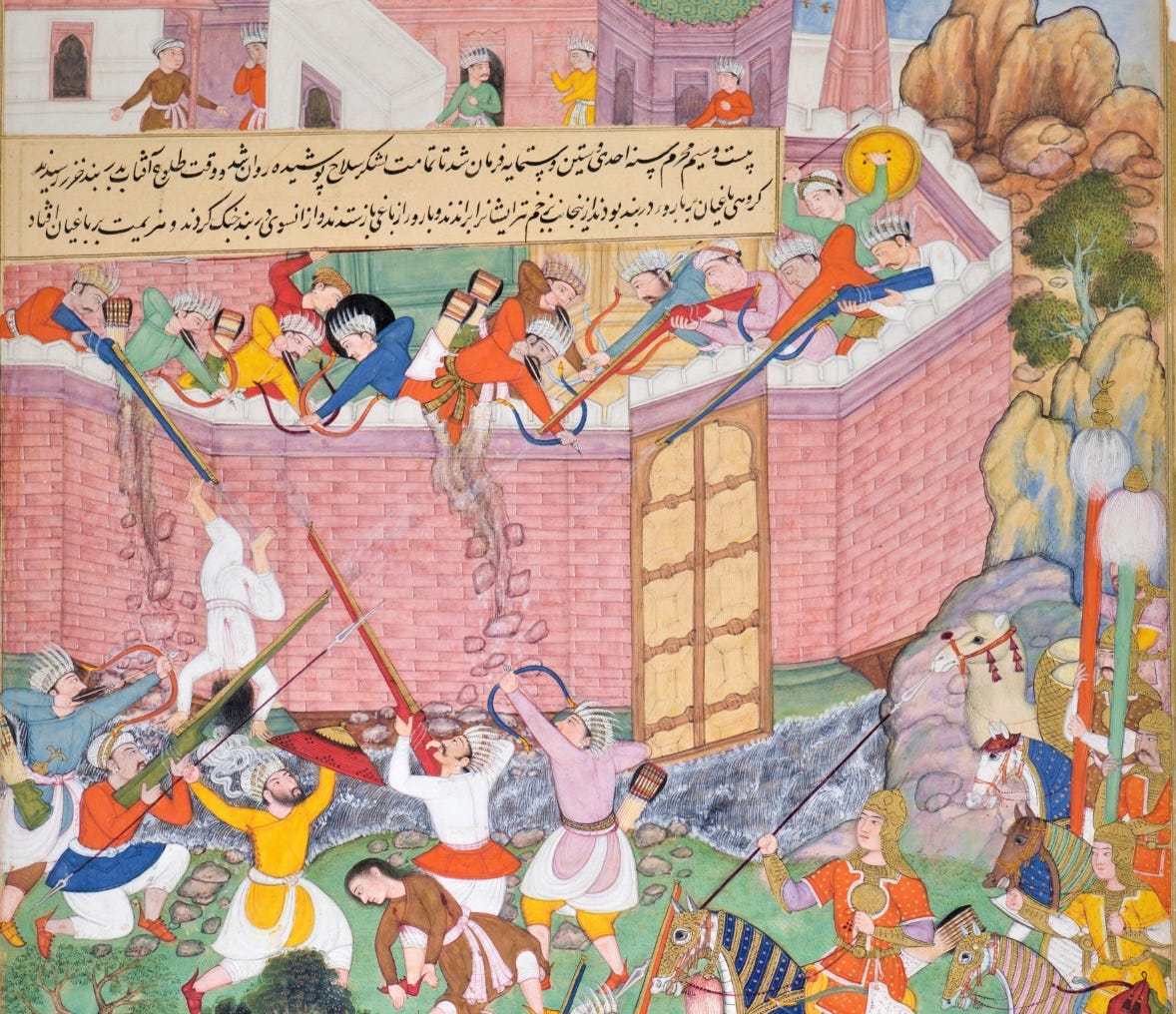
The Siege of Baghdad | Khem Karan, 1596
from The History of Genghis Khan (cropped)
Overview
A boot set on an emperor’s neck.
Fruit and ice sent to a sick enemy king.
A river running black with ink.
Part 9 built the empire. Part 10 climbed its two summits. Now, Part 11 closes the Golden Age itself, as the Islamicate world is besieged from two horizons at once, then again from a third. From the east come the Turks (first the Ghaznavids, then the Seljuks), who reshape the Middle World and shatter a Byzantine army at Manzikert in 1071. From the west come the Franj of the Crusades, marching through a fractured patchwork of rival caliphates toward Jerusalem. And from the farthest east come the Mongols, the al-Mughal, whose storm ends five centuries of Abbasid Baghdad in a single February. Along the way we meet the age’s two faces: the butchery of 1099 (told from the Crusaders’ own records) and the magnanimity of Saladin.
We describe the three invasions that closed the Golden Age, trace the Arabic exonyms al-Rum, al-Franj, and al-Mughal, and interpret how Muslims and Christians narrated one another across these encounters.
Assigned Reading
Ansary, Destiny Disrupted, chapters 8-9
Key Terms for this Section
al-Rum • Mamluk • sultan • Seljuk
al-Franj • Saladin • al-Mughal • Baybars
11.1 | The Coming of the Turks
Rome & the Middle World
A thousand years ago, the height of civilization from the Atlantic Ocean to the Great Wall of China was the Islamicate world. For centuries, Islam held together the Middle World, and to the Islamicate mind of the day, Muslims were not merely one of the earth’s civilizations — they were civilization.
And they had good reason to believe that.
In vast metropolises like Baghdad, Isfahan, and Córdoba, the knowledge of other lands and peoples was carefully documented. Jews, Christians, Turks, and other minorities lived and worked in these cities. And the Arabs in charge carried an air of superiority toward them — the help from less prosperous places.
It was well known that the learned Jews, respected as able physicians and bookkeepers, had lost their dominion over Israel centuries ago. But they were at least monotheists, holding to many of the same rituals and values as Muslims. Christians, on the other hand, were framed as a superstitious, odd, unclean people out of the dark forests of Europe. Stories of their barbarity entertained the Islamicate courts: they did not bathe, did not read, and still ate pork (like the Arabs in the Time of Ignorance).
When the largest towns of the Latin West held 25,000 souls, the Islamicate city of Córdoba dominated Europe with half a million citizens, and Baghdad, at the heart of the Middle World, held well over a million. Baghdad had more than a hundred shops for paper alone. Theirs was a world of public fountains and street lamps, of spice-laden bazaars, honest courts of justice, and libraries boasting hundreds of thousands of volumes. In a time when nearly every European was seen as a destitute peasant who could not read and would never travel more than ten miles from his birthplace, a townsman of Baghdad or Córdoba could generally read and write, dress in silk, and to travel across the world on the hajj.
In short, medieval Muslims saw themselves, with some justification, as the civilizing force of the world. It is against that towering self-assurance that the shocks of Part 11 must be measured.
A world so certain of its own centrality
had never imagined that it might one day be overrun.
There was, however, one vestige of European greatness the Islamic imagination never lost sight of: Rome, not the ruined city — the empire. The Islamicate world looked on the surviving Roman state, centered now on Constantinople, and called it al-Rum, as the Byzantine Christians living there called themselves Romans and their Christian realm Romania. These were the Greek-speaking Christians of Eastern Europe who, after the Great Schism of 1054, would split from the Roman Catholic West and become the known as the Eastern Orthodoxy.
For Muslims, from the Prophet’s day forward, al-Rum was the face of Christendom: a world with a capital at Constantinople, a mother tongue in Greek, and a religion in Orthodox Christianity. The Qur’an’s 30th surah is itself titled al-Rum. The Romans.
The Romans have been defeated in a nearby land, but after this defeat of theirs they will be victorious within a few years. Qur’an 30:2–4 (paraphrased)
The verses look out at the great war of Muhammad’s own lifetime (Christian Byzantium against Zoroastrian Persia), and the tradition remembers the first Muslims hoping the Romans would win, as fellow People of the Book.
Manzikert & the Steppe
In 1071 (463 AH), on the outskirts of Manzikert, a Turkish prince named Alp Arslan meets the Byzantine emperor Romanus Diogenes in battle. For four centuries the Islamic advance to the north had stalled at the foothills of Byzantine Romania. Now Arslan faces a Christian army (by the chroniclers’ count, a hundred thousand strong), and Arslan wins.
For the first time in history,
a Christian emperor is the prisoner of a Muslim commander.
Arslan asks the emperor what he would do if their places were reversed. “Perhaps I’d kill you,” the emperor replies, “or exhibit you in the streets of Constantinople.” The commander sets his boot on the emperor’s neck, and then sets him free.
Released, Romanus went home to be deposed and blinded by his own court (1072). The appeal to the West came a generation later, from another emperor, Alexios I (1095). Little did anyone know that twenty-six years after Manzikert, Crusaders from the West would come marching through the civilized Middle World like a natural disaster.
Alp Arslan was the great-grandson of Seljuk, the founder of the Turkish dynasty that bears his name. The story begins on the steppes of ancient Central Asia. Unlike the great river valleys to the south, east, and west, this was a land cold, dry, and infertile, a place that supported no agriculture and thus, in the classical sense, no ‘civilization’.
Its nomadic peoples excelled at two things: horsemanship and battle.
These horsemen turn up all across the map. To the south, tradition makes them ancestors of the warrior class of northern India. To the east, the Chinese walled them out: the Great Wall was raised against the nomads they feared as the ‘Xiongnu’. The same group were feared as the ‘Huns’ by Rome. About three centuries after the famous Hun invasion of Europe came the encounter between this Central Asiatic group of nomadic horsemen and Islamicate civilization.
By the medieval period, the nomads had settled into two great geographic groups.
The western nomads became the Turks (in Arabic, al-Atrak).
The eastern nomads became the Mongols — al-Mughal.
Mamluks, Sultans, & Seljuks
The Turks entered Islamic history much as the Germans had entered Roman history.
As history so often echoes and rhymes, when the Romans grew too decadent to serve in their own army, the emperors conscripted German barbarians, until the emperor’s own bodyguard was almost entirely German, drawn from the very tribes that most threatened Rome.
So too, when the Abbasid empire needed to fill its ranks, the caliphs of Baghdad turned to the barbarian Turks who constantly harried their borders. The caliph’s reasoning was that Arabs and Persians could not be trusted near the palace, where a caliph might die at an assassin’s hand at any time.
So the Abbasids took Turkish boys from the frontier (bought or captured) and forced them into imperial service. The caliph al-Mu’tasim built the first great Turkish guard at his new capital, Samarra (836).
A strange system of control grew up around the boys: they were raised in special military schools that taught nothing but total allegiance to the caliph. They had no family, no ethnicity, and no ties of any kind except to one another, to Islam (which they were forced to embrace), and to their master. When these children grew up, they entered a class of outsiders called Mamluks — slave-soldiers, from the Arabic mamluk, ‘owned, possessed’. With the caliph increasingly hidden behind an ever-growing bureaucracy, the fearsome Mamluks became the very face of Abbasid power.
That Arab bureaucracy, meanwhile, was largely staffed by Persian intellectuals, so that the empire was held together by Turkish/Mamluk strength, Persian intelligence, and Arab religion.
Because the Persian administration concentrated on the great cities, the Abbasids gradually lost their grip on the smaller realms along the frontier, and some of those Mamluk garrisons rose up, killed their masters, and founded dynasties of their own.
Such was the case of the ill-fated Persian Samanids of Bukhara, whose Turkish slave-general Alp Tegin broke away and seized the frontier town of Ghazni, in today’s Afghanistan (962). Out of his garrison grew the Ghaznavid dynasty.
Its most famous ruler was a conqueror named Mahmud of Ghazni, whose place in Islamic history rather resembles Charlemagne’s in the West. Mahmud is remembered as the first ruler to bear the title sultan — Arabic for ‘power, authority’, a word the Qur’an itself uses (14:22). And like Charlemagne and the Pope in the West, Sultan Mahmud understood himself as the sword arm of Islam, while the Abbasid caliph remained its religious figurehead.
Mahmud savaged the polytheist lands of India to the south (infidels, to his mind, ripe for the taking), and with the plunder he paid for hundreds of Persian artists, poets, and philosophers to adorn his court.
One of them was the poet Firdausi, author of the Shahnameh, the famous ‘Book of Kings’. It is an epic of 50,000 rhyming couplets and unmatched sophistication. The story goes that when Mahmud reneged on his promised payment, offering silver where he had pledged gold, the poet fled to a rival court. The Shahnameh was written just as Persian culture was beginning once more to eclipse Arab culture (cf. Part 9), and it sang of the long line of Iran’s ancient kings.
Arabs were eating crickets
in the wasteland, on the brink.
While in Mashhad [Iran],
even the dogs had ice water to drink.
The Shahnameh
After Mahmud, his son Masoud eventually rose as sultan, and by his day the Turkish horsemen had already pushed into the old Persian frontier at Khorasan. By 1040, at Dandanaqan, Masoud had lost all his western territory to Turks led by Seljuk’s grandsons, Tughril and Chaghri, and with the fall of the Ghaznavids the Turkish Seljuk dynasty began.
These early Seljuks could not read or write: they were the Vikings of the East. They had embraced Islam generations earlier on the frontier, and what they carried south was a rough approximation of Sunni Islam as they understood it.
A generation later it was the Seljuk prince Alp Arslan who faced the Byzantine emperor at Manzikert. A year after that battle his son Malik Shah inherited the sultanate, though the real brains of his reign belonged to his brilliant Persian vizier, Nizam al-Mulk. Together they took Syria and the Levant, so that Damascus and Jerusalem became Turkish cities.
And the frontier’s rough edges were already wearing smooth: in 1067 Nizam al-Mulk founded the Nizamiyya of Baghdad, the madrasa where al-Ghazali would one day hold his chair (cf. Part 10).
But unlike the cultured and tolerant Abbasids, the Seljuks brought their provincial religious attitudes with them, and reports began reaching Europe of Christian pilgrims harassed in the Holy Land. It never quite amounted to bloodshed, but the humiliations made for memorable tales back home, and to the Europeans who heard those tales, this was not Seljuk rural pride. It was, as they told it, Islamic hatred of Christians.
11.2 | 1099: The Crusades
al-Franj & the Three Caliphates
Enter Kilij Arslan, the ‘Sultan of Rum’ — that stretch of Anatolia that the Seljuks had taken from the Christian Byzantines (today, Türkiye). In 1096, word reached him of a ragtag ‘army’ that had entered his territory from the west, barely dressed for battle, announcing that it had come to kill Muslims and take Jerusalem, beginning with his land!
The members of this ‘army’ wore a little red cross stitched to the shoulder and called themselves pilgrims, men who had ‘taken the cross’. Later centuries would name their journeys from that cross: crusade, from the Latin crux.
So the Sultan of Rum did the obvious thing:
he sent his men to meet them and crushed them with ease.
Where were these odd people from? The only western kingdom of any repute whatsoever to the Islamicate world was that of the Franks — in Arabic, al-Franj. Paris, the homeland of many traveling pilgrims, was known to some of the more worldly scholars. The tiny cities of London, Dublin, and Cologne were barely known at all.
So anyone seen wearing a Latin cross in the Middle World was assumed to speak French, the tongue of unsophisticated ‘European barbarians’ (keep in mind, after 1066, not even the kings of England spoke English), so the Arabic word for a Westerner, a European, a Crusader, settled on al-Franj.
But the next wave would be different. The first had been laypeople whipped up by the preaching of Peter the Hermit, who felt no need to organize a capable military force because he had God on his side. The second wave was what the Pope himself had organized: great lords and landless knights with élite training, heavy cavalry, and archer support. They took Arslan’s city, as they had trained their whole lives to do, and turned south toward Antioch, on the road to Jerusalem.
Thus began the First Crusade.
It’s important to note here, that before the first Crusaders arrived, the Islamicate world had already been coming apart at the seams. Part 9 ended with Abd al-Rahman, the fugitive Umayyad who made himself master of Córdoba in 756. Well, in 929 his descendant went further and proclaimed himself caliph. By then, no one could pretend anymore that there was a single Ummah. From now on, the Abbasids ruled from Baghdad, and the reborn Umayyads ruled from Córdoba.
Meanwhile, in 909, Ismaili Shia (the ‘Seveners’, cf. Part 5) proclaimed a caliphate of their own in Tunisia, and in 969 its armies seized the grain supply of the Nile and took Egypt in the name of Shia Islam. They named their new capital Qahira (‘the Victorious’, the city we call Cairo) and called their state the Fatimid dynasty, claiming descent from Fatima as the self-styled representatives of the Party of Ali.
So, now there were three rival caliphates: Córdoba, Cairo, and Baghdad.
From Egypt the Fatimids ruled North Africa and dominated the trade of the Mediterranean. They controlled the Red Sea east to the ports of Yemen and reached into the Indian Ocean, trading with the East without having to bother with the nomads of Central Asia. This made them very rich, and though they had come to the game late, they proved every bit as ambitious and resourceful as the older powers.
For a century (929 to 1031), a traveler could cross three rival caliphates (Córdoba, Cairo, and Baghdad), each claiming to be the true successor of the original Rashidun caliphate, and each branding the other two as impostors. Add the rowdy Turkish Seljuks riding in after the Fatimids, and the Islamicate world of the 11th century was a patchwork of rival dynasties, petty kingdoms, and endless contentious families.
Then the Franj arrived.
Maarat & Jerusalem
In 1097 the Franj took Kilij Arslan’s city of Nicaea and headed south toward Antioch, another Seljuk stronghold. Would help come from fellow Seljuk royals in the area? In a word, no. Damascus wanted to help but dared not leave its own city undefended, lest its brother-rival in Aleppo seize it. Mosul agreed to help but fell to quarreling with Damascus. And so no one came, and Antioch fell to the Franj.
The Franj then laid a long siege against Maarat, and again no prince came to its aid. After a lengthy campaign the Franj offered to let the civilians go free if the guards would just open the gates, and because the siege had starved the city, the gates were opened — whereupon the Franj set about taking everything.
Then it got bad. The Frankish chronicler Radulph of Caen records that the Muslim adults were boiled in cooking pots, and that the children were impaled on spits and grilled over open fire.
I want to point out, this is not Muslim propaganda. The cannibalism at Maarat is a well-established fact drawn directly from the Crusaders’ own records. A second Frankish chronicler of the campaign, Albert of Aix, wrote that the troops did not shrink from “eating dead Turks and Saracens; they also ate dogs!” What is striking in that sentence is its implication: that eating a dog was somehow the greater scandal, as though a Turk were something less than human, a different species altogether.
The atrocity is real, documented by the men who committed it.
Two things become very clear from these early years of the Crusades. First, the Islamicate rulers of the region did not see the invaders as one side of a larger war between Christianity and Islam. It was not understood as a holy war at all. And secondly (and more to point), the Franj were seen by the rival Islamic leaders not as a rival empire but as a simple horde of dishonorable western barbarians, bent on destroying civilization for its own sake. There was nothing Christian about it.
Proper Christendom, to the Muslim mind, was al-Rum to the north, where the people spoke Greek and ruled from Constantinople. These filthy westerners were something else. More a plague than a rival power. Each Islamic kingdom tried, at their moment, to turn them against its neighbors. In the Middle World, Christians and Muslims generally lived in peace, and it was quite outside Muslim experience to imagine Christians who wanted the ancient territory of the Middle East for themselves alone.
It simply made no sense to them, until it was too late.
Amid all the confusion, the Fatimids managed to take the holy city of Jerusalem from the Seljuks. Rural Jews and Arabs fled from the smaller villages to its high walls, and the Fatimid rulers promised the Franj that they could now safely visit the holy city as pilgrims whenever they wished.
But the Franj ignored the invitation and besieged the city anyway.
After 40 days, on July 15, 1099 (492 AH), the walls of Jerusalem were stormed.
Then, by the account of the Damascus chronicler Ibn al-Qalanisi, the Jews of the city were herded into the central synagogue, and the synagogue was set on fire. The hands and feet and heads of the Arabs were piled in the streets, where (again by the Christian testimony of the chronicler Raymond of Aguilers) the blood of civilians ran knee-deep in the streets of the Holy City.
In the end, the Franj set up four short-lived ‘Crusader states’ at the heart of the discordant Islamicate world: the Kingdom of Jerusalem, the Principality of Antioch, and the Counties of Edessa and Tripoli. Many Franj died in them. Some were born and lived out entire lives in them. Yet there was never any sense of permanence. So why had the Franj come in the first place?
Clermont & the Jihad Reply
The single unifying political power of medieval Western Europe was the Catholic Church. In 800, the Pope had crowned the Frankish king Charlemagne emperor of a new ‘Holy Roman Empire,’ and throne and Church had risen together ever since. In 1054 came the mutual excommunications of the Great Schism.
Pilgrimage, meanwhile, remained big business. Pilgrims came home with lead badges and little flasks of holy oil (the souvenirs of the age), and the pilgrimage economy built churches, abbeys, and roads.
The Holy Land was the queen mother of all pilgrimages.
Then came Alexios’s appeal. At Clermont, on November 27, 1095, Pope Urban II preached the sermon that set the West in motion, speaking directly to Europe’s trained, armored, landless knights.
Let those who for a long time, have been robbers, now become knights.
Urban II at Clermont, 1095
The Pope’s call for crusaders was the solution to everyone’s problems at once.
• Help for Constantinople
• Safe roads for pilgrims
• Revenue for the Church
• and estates and glory for the knights
Best of all, the Pope sold it not as a war but as a pilgrimage, with remission of penance for all who went in true devotion. For many, that promise stirred sincere piety (crusading was ruinously expensive, and lords sold their lands to go). For others, it blurred into license to pillage and plunder.
Thousands signed on, and once Peter the Hermit’s amateur ‘People’s Crusade’ had spent itself, the real Crusaders went in and took whatever they could by any means that crossed their minds.
The four Crusader states did not last long. The first to fall was Edessa, in 1144, to the Seljuk lord of Mosul and Aleppo. This was thrilling to local Muslims, who had not seen a major victory against the Franj in decades. But something else was shifting, too.
More and more Friday sermons in the mosques began to speak of jihad against the western invaders. At first the idea seemed almost quaint: in living memory no Muslim had spoken seriously of defending Islam from an external enemy. Was the struggle against the Franj truly a battle for Islam? Was jihad now the right language for it?
Truthfully, the Seljuk lord of Mosul was a hard-drinking soldier with no great claim to piety (in 1146 a slave killed him, by most accounts as he slept off the wine). But his men liked his raucous Seljuk manner, the preachers were stirring the right energy in the people, and so the raucous lord let the jihad talk run.
When his son succeeded him, the tone changed entirely. Nuruddin was a genuinely devout man (perhaps overly so) who kept his father’s zeal for combat and turned it to a purpose, calling on all the Muslims of the Levant to embrace jihad as a way of life.
In the 1160s, Nuruddin sent his Sunni general Shirkuh to take Egypt from the Shia Fatimids (‘heretic hands,’ as Nuruddin saw them), lest it slip into the grip of the barbarian Franj. Shirkuh campaigned three times and finally seized the government in January 1169. Two months later he suddenly died, leaving his nephew, a Kurdish officer of about 31, almost by accident, as the vizier of Egypt.
That nephew was Salah al-Din Yusuf ibn Ayyub. The West knows him as Saladin.
11.3 | Saladin & Richard
Saladin the Untouchable
Nuruddin wanted his hold on Egypt (a far larger and wealthier prize than Syria) secured as quickly as possible, and every minute it was not made him nervous. He ordered Saladin to end the Shia Fatimid caliphate and establish Sunni Abbasid dominance. Instead, Saladin played it cool: he restored the Abbasid name to the Friday prayers (1171) and let the already sickly Fatimid ruler die of natural causes.
Nuruddin then demanded a meeting, so the two could settle who really controlled Egypt, but Saladin kept putting it off, again and again, until the aged Nuruddin himself died (1174).
That left Saladin the master of Egypt and soon of Syria (Damascus within the year, Aleppo by 1183). The savior of the Levant had arrived.
More pious than the father and more even-tempered than his son, Nuruddin, Saladin carried none of the cocksure swagger that had plagued the Seljuks. He also did not consider himself part of the Arab aristocracy at all. In fact he was ethnically a Kurd, and so he became the Kurdish sultan of Egypt and Syria. His name, Salah al-Din, means ‘righteousness of the faith’ and is indeed a fitting appelation.
Saladin’s wisdom made him famous, and his kindness made him a living legend.
There are dozens of stories of Saladin helping Christians, Jews, women, and orphans, so that by all accounts he would have been a great man in any man’s religion. After surviving two assassination attempts (by the Nizari Ismailis, the sect whose enemies call hashishiyyun, a hostile label English keeps as assassin), he became an almost mythic figure: Saladin the wise, Saladin the king, Saladin the untouchable.
Stronghold after Christian stronghold fell to Saladin’s army, and wherever he could he took them without bloodshed: he would encircle the Franj, cut off their supply lines, and bring them to the negotiating table, doing anything he could to stop unnecessary violence. His was a strategy of patience and pressure rather than slaughter (the very opposite of the reputation the Franj had earned at Maarat and Jerusalem), and it is largely why his name survives, in the West as well as the East, as the model of the chivalrous adversary.
Jerusalem & the Lionheart
Then Saladin set his sights on Jerusalem.
In July 1187 (583 AH), at the Horns of Hattin, he destroyed the kingdom’s field army in a single day. The aftermath belongs to the record too: the captured knights of the military orders were executed, and Reynald of Châtillon, the lord who had raided toward Mecca and Medina and attacked caravans in time of truce, Saladin killed with his own hand.
That autumn he asked the Christian knights to leave the holy city peacefully. For that, they could take their property. Those who wished to stay on as pilgrims could stay, all the Christian sites would remain unharmed, and pilgrims could come and go as his guests. The Franj, who had held Jerusalem for some 88 years, declined the offer.
So Saladin took the city — by siege, not by storm. After twelve days its defenders, led by Balian of Ibelin, surrendered on terms very like the ones Saladin had offered before.
There would be no plunder and no mass killing.
A ransom was set (10 dinars a man, 5 a woman, 1 a child), and when the ransoms were paid, the prisoners were freed. Saladin and his brother freed many more without payment. Thousands who could not pay (perhaps 15,000) were taken into slavery. Eastern Christians could remain in their homes, and Jerusalem was again open to all the people of God.
The Third Crusade followed soon after. Europe’s three greatest living kings (Barbarossa of Germany, Philip II of France, and Richard of England) answered the call to defeat Saladin. On the way, Barbarossa drowned in a few inches of water (true story). Philip took part in the battle of Acre and then went home exhausted. And so it fell to Richard alone to deal with Saladin and Jerusalem.
The two fought for over a year. Richard won the field battles (Acre and Arsuf in 1191, Jaffa in 1192), and at Acre, when the negotiations stalled, he executed some 2,700 Muslim prisoners. Saladin kept the city.
And when Richard fell sick, the chroniclers tell, Saladin sent him his own doctors, along with fresh fruit and ice. Still Richard demanded Jerusalem, but Saladin simply waited behind the high walls for Richard’s army to give up. They did, though not before Saladin promised to continue safeguarding the Christians inside the city, a promise written into the Treaty of Jaffa (1192): a three-year truce, the coast to the Franks, Jerusalem to Saladin, and the city open to unarmed Christian pilgrims. It was, in effect, a moral victory Saladin handed to Richard so that the English king could depart with his honor intact.
al-Franj Remembered
After Richard, the Franj would never again pose a real threat to the Middle World.
The Fourth Crusade did not even reach the Holy Land: it stopped at the Orthodox capital of Constantinople (1204), where Catholic Christians destroyed the holy places of their fellow Christians and sacked the ancient city so thoroughly that it never fully recovered.
And though we speak of ‘this crusade’ and ‘that crusade’ now, in truth there was always a steady stream of Western Europeans leaving to fight. They did not wait for the next official crusade but simply set out for Jerusalem when they came of age, so that for about two centuries the journey to go kill Muslims in the Holy Land was a normal part of a certain masculine identity. But the impulse never really recovered after Richard ‘the Lionheart’ sailed home in 1192.
The last Frankish stronghold in the Middle World fell to the Mamluks at Acre in 1291.
• 1187 (583 AH) | Jerusalem returns to Muslim rule
• 1192 | The Treaty of Jaffa ends the Third Crusade
• 1204 | The Fourth Crusade sacks Constantinople
• 1250 | Louis IX’s crusade is crushed in Egypt
• 1291 | Acre, the last Crusader stronghold, falls to the Mamluks
So what did the Islamicate world make of al-Franj? Not much. There was some cultural exchange between the two, but it ran almost entirely one way: from the Middle World out to Europe. The Franj carried home exotic spices, satin, silk, cotton, olive soap, better medicine, better food, and, in rare cases, better ideas, along with rumors of an almost mythical paradise of natural wealth called ‘the Indies’.
Conversely, to Muslim eyes, the whole affair was a minor inconvenience on a single shore of the civilized world. It barely touched al-Andalus as the East knew it, and the Franj never took Cairo or Baghdad, much less Mecca or Medina (the nearest they came was Mansurah, 1250, where Egypt’s slave-soldiers crushed the crusade of the French king Louis IX). In Yemen, in Morocco, in Persia, generations lived and died without ever once meeting or even discussing al-Franj.
For most of the Islamicate world living outside the Levant,
the Crusades were almost a non-event.
It is one of the quiet ironies of history that the Crusades, which loom so large in the Western imagination, left so faint a mark on the Islamicate memory.
11.4 | 1258: The Mongol Storm & Baghdad
Genghis & the Horde
Back on the eastern steppe of Central Asia, the Mongols (al-Mughal) had just about had enough of the Chinese Jin dynasty meddling in their tribal rivalries.
For years the Jin had understood that they could keep the nomads too busy to threaten China by setting one Central Asian tribe against another: Tatar against Mongol, Mongol against Tatar, and for a long time it worked. But a lowly nomad boy turned military genius, Genghis Khan, had a score to settle, for the Tatars had killed his father. With Jin funding he destroyed and absorbed the Tatar clans, then turned on his patrons and took the Jin’s own northern China (in a war begun in 1211), and with that the Mongols had reached the Pacific.
And that was only the beginning.
To be taken into Genghis’s army was usually good news for a warrior. It meant your side had lost (which happens to everyone), that he was not going to kill you (at least not yet), and that you were now limited only by your own ambition, strength, and imagination. Congrats, you are now a member of the greatest fighting force in the history of the world. Genghis did not care who your father was, whom you prayed to, or what you looked like. He cared about one thing — your ability on the battlefield — and he paid in the silk, gold, and plunder of the perfumed cities you helped him sack. The Mongols were not out to make the world a better place. They held that Eternal Heaven had granted them the earth, but they had no faith to spread and no religious calling.
They simply took whatever was not nailed down and burned what they could not carry.
Their war machine seemed to belong to mythology. Their composite bows, layered and glued, far outranged the weaker and more expensive solid bows of settled peoples. Their horses were bred small and grass-thrifty, so that a rider could hang off the flank or beneath the belly and shoot his arrows using the animal as a living shield. Many Persians honestly believed Genghis had bred horses with men. They were not far off.
The horsemen slept in the saddle as they rode. The old story says they never stopped to eat, but chewed raw meat tenderized under the saddle and drank the blood of their mounts when thirsty. People in the old world carried a fixed sense of how quickly an army could move from one city to the next, and al-Mughal always beat those numbers by days or even weeks, appearing where and when they could not possibly be. No one could stand against them — not the Turks, who fancied themselves a warrior class, and not the Chinese, nor India, nor Persia. To those who faced it, the horde seemed a supernatural scourge, a thing out of a nightmare rather than a rival army.
The spark came in 1218, at the border city of Otrar, where a governor of the Khwarazm-shah’s empire massacred a Mongol trade caravan. When Genghis sent an envoy to demand redress, the Shah killed him too. Bad idea…
Genghis moved through Afghanistan and Persia with terrible ease. Libraries were destroyed so completely that to this day we do not know all that was lost. Bukhara, Nishapur, and Balkh fell. Balkh (1220–21) was the city the boy Rumi’s family had fled just ahead of the storm (cf. Part 10). At Herat the chroniclers counted the dead in the hundreds of thousands. The fields, crops, and granaries were burned.
People had feared the Turks in the days of the Seljuk conquest, but it had never been like this. The great historian Ibn al-Athir confessed that for years he shrank from writing the Mongol chapter of his chronicle, wishing his mother had never borne him rather than live to record it. In Khorasan, an ancient network of underground water channels (the qanats) had irrigated the land into an agricultural paradise. The Mongols filled the channels with sand. To this day, some of that land has never recovered.
Baghdad, 1285
After Genghis died, his descendants carried the destruction outward across the world. One line of his heirs ruled Russia as the Golden Horde, one ruled Central Asia, and the homeland line produced the Great Khans. In the 1250s the Great Khan Möngke sent his brother Hulagu Khan, a grandson of Genghis, south to deal with the Middle World of Islam, and with the Abbasid power in Baghdad and its caliph, al-Musta’sim.
Their exchange of letters survives, preserved by the Persian historian Rashid al-Din. Hulagu demanded surrender. The last caliph answered with the serene confidence of a man who could not conceive of his world ending: “How are you going to capture a star?”
It took Hulagu Khan less than three weeks to wipe Baghdad from the face of the earth.
Everything was destroyed. As a courtly courtesy, the Mongols promised not to spill royal blood. So that rolled the Baghdadi royal family into carpets and trampled them to death. Absolutely no life was spared. And five centuries of libraries, the House of Wisdom’s among them (cf. Part 10), were thrown into the river until the water ran black with bleeding ink.
So ended the Abbasid dynasty.
Al-Mansur’s round City of Peace (cf. Part 9) came to an end after 496 years.
Goliath’s Spring & Conversion
Next came Egypt.
A decade earlier, as Louis IX’s crusade collapsed at Mansurah, the slave-soldiers had taken the Egyptian throne itself: the widowed queen Shajar al-Durr (and former slave) ruled briefly in her own name, and her new husband, the Mamluk commander Aybak, became the first sultan of the Mamluk dynasty (1250).
So in 1260 it was the reigning Mamluk sultan, Qutuz, who marched out to meet the Mongols at Goliath’s Spring: Ain Jalut, with the legendary general Baybars leading the vanguard. The spring’s name is the Qur’an’s own, for Jalut is Goliath, felled by the young David:
…and David killed Goliath, and God gave him sovereignty and wisdom.
Qur’an 2:251 (paraphrased)
At the spring where tradition set the duel, on September 3, 1260, David had met Goliath again. Only this time, by some Mamluk accounts, David did not bring a sling. He brought fire.
The mythic, seemingly centaurian Mongols turned out not to be unstoppable after all. The Mamluks won the day, and the Mongols never reached Egypt. It was the first defeat that ever halted the Mongol advance.
On the march home, Baybars and his fellow emirs killed the victorious Qutuz, and Baybars took the throne for himself. In the land of the pharaohs, the slaves would now be kings. And theirs would be no ordinary dynasty, for like the Mongols the Mamluks ruled by merit: the sultan would not, as a rule, be the son of the sultan but the greatest warrior among them — a pattern that anchored an Egyptian ascendancy in the Arab world that has more or less continued into the modern era. It was Baybars’s dynasty that swept the last Crusader states into the sea.
Nor was the slave-throne of Egypt the only way the world had turned upside down. Three years before the battle at Goliath’s Spring, a Mongol khan had converted to Islam: Berke, lord of the Golden Horde — and Berke was so outraged by his cousin Hulagu’s destruction of Baghdad that he allied with Mamluk Egypt against him.
Within a few generations most of Hulagu’s own descendants embraced the faith of the people they had conquered. In Persia, Hulagu’s line ruled on as the Ilkhanate (ilkhan, ‘subordinate khan’). In 1295 his great-grandson Ghazan converted, and Islam became the dynasty’s faith: the dynasty under whose rule a Sufi order at Ardabil would begin its slow rise toward the Safavid throne (cf. Part 12) and, in time, the ascendancy of modern Iran.
The storm that had ended the Golden Age was, in the end, absorbed into the very world it destroyed.
Last Section: Islamic Intellectualism & Mysticism
This Section: Invasions East & West
Next Section: Europe & the Gunpowder Empires (1300-1850)