

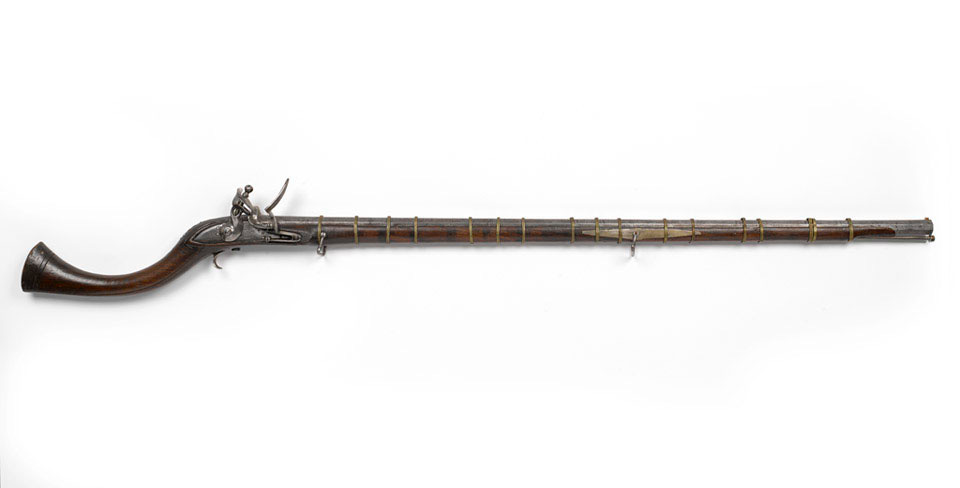
Jezail musket common to the Gunpowder Empires | South Asia, ca. 1800
from The UK National Army Museum
Overview
For a thousand years the Islamicate world had looked west and seen only barbarians.
Unwashed, unlettered Franj, huddled in the dark forests of Europe.
This section tells the story of how that judgment came due.
Welcome to Module IV, where Islam meets modernity.
While the Middle World rested on the well-worn caravan routes of its own success, Europe reinvented itself almost from scratch: the armored knight gave way to money and merchants, the merchant’s bench (banca) became the bank, competing kingdoms funded universities and ships, and the search for a way around the great Islamic empires launched the Age of Discovery (and, with it, the Atlantic slave trade). Now this reborn Europe turns east, toward the three great Islamic powers of the age: the Ottomans of Asia Minor, the Safavids of Persia, and the Mughals of India. We will watch each rise to magnificence and then unravel, and we will consider the obvious question: why did the West rise while the Middle World fell?
We describe the birth of European modernity, trace the native etymologies of parliament, bank, sulahkul, and Czar, situate the three Gunpowder Empires at their height, and interpret the internal and external pressures that brought them down.
Assigned Reading
Ansary, Destiny Disrupted, chapters 10-12
Key Terms for this Section
Ottomans • Suleiman • Safavids • Mughals
sulahkul • Sikhism • the East India Company • the Great Game
12.1 | Europe Reborn: Banks, Ships, & the Age of Discovery
Knights, Longbows, & Parliament
In Europe it had been 1300 years since the birth of Christ. The last Christian knights had been expelled from the Middle World by the Egyptian Mamluks (cf. Part 11), but they were still organized for conquering, and so various orders of knights now took over whatever principalities they could closer to home in Europe.
And in Spain there was a crusade of another name, the Reconquista (the “reconquest”), which would end Muslim rule on the peninsula in 1492 (cf. Part 9).
Less than 50 years after the Crusades officially ended, England’s knights were mired in the Hundred Years’ War back home (ie. Joan of Arc‘s war). English nobles felt the Frankish lands belonged to them, and so they did the obvious thing and sent in the knights. Except that the Hundred Years’ War became a kind of arms race. Its great surprise was the English longbow: a cheap ranged weapon fired by cheap peasants, and it could kill a fancy knight in full armor with ease. Overnight, the whole idea of an expensive armored knight became silly. The war then ended at Castillon, in 1453, where French cannon won the day — the very year Mehmet’s cannon took Constantinople. By the 1500s, the knight’s day was over.
Conversely, in the east, Constantinople was now an Islamic, Ottoman city. Islamic Spain was about to become a united Christian kingdom. And by the end of the century the whole of Europe would set its sights not east, as it had in the medieval period, but west, on the New World. The Islamicate world would not. Why? What led to Europe’s meteoric rise?
In a word: modernity.
With the whole institution of armored knights gone, the focus landed on noble wealth. Money, not land and title, was what mattered now in this new modern world, because money could buy peasants cheaply and train them into expendable soldiers, whom a noble could then send in with cheap longbows and pikes to take over foreign territory and people. So a king had to hold a meeting (in French, a parliament, from parler, “to speak”) with the lords of his realm before he could raise the taxes for his wars. Without parliamentary funding the king could do nothing, and out of that dependence, in time, grew modern democracy.
Banks, Ships, & the Slave Trade
So how did the nobles stay rich? One way was the old way, squeezing the peasants who worked their land. But there was a safer and less bloody way to grow wealth: merchants.
The whole idea of a merchant class arose in Italy, where in the 1300s it did not much matter what land you owned or who your father was. What mattered was how good you were at making a deal. The Italian city-states now had merchants funding boats to bring in staggering quantities of trade goods from the Islamicate world and neighboring Christian states. Individual merchants would sit together on a bench and strike a deal, often borrowing money at interest. The Italian word for that bench was banca. So Italian families became Europe’s first great commercial bankers, and it was early modern banking that funded the great artists and writers of the Renaissance.
What did this new merchant class love to invest in above all else? Ships! Faster ships beat the competition. Stronger ships defeated the competition (along with Mediterranean pirates). And better-educated shipwrights designed better, faster, and stronger ships still. But shipbuilding required very complex mathematics, and navigation required astronomy, and trade deals required legal documentation and advanced reading — and all of that required higher education.
Enter the modern university, an outgrowth of the medieval cathedral. The once-Islamic city of Toledo, taken by Castile in 1085, ran a thriving industry translating Arabic books into Latin (Avicenna‘s Canon of Medicine among them, cf. Part 10), and some of those books drifted north into the churches of Italy and France, where the more scholarly clergy prized them for their logic, and soon for their ideas (cf. Part 10). Competing schools like Notre Dame in Paris and Oxford in England grew into powerhouses of knowledge. This was why the new European ships were like nothing ever seen: they could sail farther, faster, and better defended than anything on earth.
Which was terrific for the nobles, for three big reasons: Africa, Asia, and America.
Since the end of the 1200s, Europe had lost its trade routes to Asia (to India, to China, and to the spice islands beyond India, ie. the “East Indies”). Standing in the way were the Mamluks of Egypt and, after 1453, the Ottomans, so that when Italian ships put in at Egyptian ports, the prices for the exotic treasures of the Orient were hugely inflated. Yet it was worth the struggle, because this new merchant class (much like the middle class today) set itself apart precisely by buying such trade goods. The fancier and more exotic, the better. Wealth had become status. It still is today.
So if you wanted to skip the expensive Islamicate ports and cash in on the European hunger for affordable status symbols, there were basically two options: the difficult one and the crazy one. The difficult option was to send a ship south around Africa into the Indian Ocean. The crazy option was to send a ship west, around the entire world.
Thus began the European Age of Discovery.
What began as a search for an African route to India became, within a century, the African slave trade. The Portuguese did eventually find their way around Africa, and they got their spices. But in the meantime every European country that could send a ship began to trade in African slaves. The west coast of Africa was soon dotted with names like the Gold Coast and the Ivory Coast. Over the next few centuries, some 12 million people would be kidnapped, sold, and shipped to Europeans as slaves from West and West-Central Africa, many of them Muslim. Those shipwrights from the lofty new universities were now asked to design ships with bigger, sturdier holds to traffic human beings (often unable to turn their bodies during the long voyage), to be traded as commercial commodities. Much of the success of the West was built on the backs of West African slaves (cf. Williams, 1944).
Meanwhile, King Ferdinand and Queen Isabella were toasting the successful end of the Reconquista of Spain. Granada’s Muslims had been guaranteed their faith by treaty, then were forced to convert to Christianity anyway. Spain’s Jews were expelled in 1492, and many resettled in the Ottoman Empire, where the sultan welcomed them. The royal couple then invested in an Italian sailor’s crazy scheme to reach the East Indies by traveling west. In 1492 his three ships famously landed on the gorgeous, untapped islands of the Indies. Only he was wrong: the “Indians” he met were not in India at all.
Columbus had made it to the Caribbean, and Europe had just sailed to the New World.
European merchants and nobles lost their minds over the news that India and China, while still important, were now second-place prizes. In the New World, there was no gunpowder army to fight and no Islamicate empire to navigate around, and within a century of European contact, in many regions, up to 90% of the native population had died of European diseases. Here lay, as Europeans saw it, a mostly empty reservoir to plunder: a paradise, a fresh start, a New Eden. Spain poured all its attention into developing “New Spain” in the Western Hemisphere and grew so rich on New World gold and silver that it crashed its own economy. Then in 1588 the English defeated the Spanish fleet and began their own rise as the Atlantic’s great sea power.
The first English colony, Jamestown (1607), was a business venture, and refugees like the Puritans soon followed. In this way, the New World of the 1500s and 1600s became what the Middle World had been in the 1100s and 1200s: the place a wealthy second son would go to make his fortune, now on former Indian land and often using African slave labor.
By the late 1700s, these European colonials would be calling themselves Americans.
Why the West Rose
So why did none of this happen in the Islamicate world? Why did the West rise while the Middle World fell to a lower station? There were several reasons.
First, the shift from a landed aristocracy to a mercantile middle class caught on very late in the east. For example, the modern Ottoman constitution didn’t happen until 1876 (cf. Part 13).
Second, the need to navigate around the Islamicate empires (the very thing that drove the western obsession with great ships) simply did not exist in the east, where Muslims went on using the well-established Silk Road and the ancient caravan routes. Why would they need to sail around the world? Nor was there any appetite for European goods after the Crusades. The cultural exchange of that era had run one way only, from the Middle World out to Europe (cf. Part 11). Europeans missed the ‘exotic tastes of the Orient.’ The Middle World missed nothing about the ‘barbarian invaders.’
Third, the Islamicate world had no windfall of African and American gold, so it could not fund the huge expendable armies and the military research that combined to let Europeans conquer anyone their navies could reach. By the time England controlled the Atlantic, no Muslim power had any need to cross it. They had, quite literally, missed the boat.
And that leads to the biggest difference of all: timing.
For the Islamicate world, its very best ideas had come at the worst possible time. For Christendom, its best ideas came at the best possible time. Islamicate scholars had produced astonishing findings — al-Razi in medicine, Ibn Sina in physics, al-Haytham in the study of light and color, the last more or less anticipating Kepler and Newton. But all of it was done within a medieval worldview. These premodern thinkers would never have imagined their work as part of a larger paradigm shift outside religious thought, and as the societies that funded them crumbled, their ideas were set aside as curiosities. The timing argument even has its own monument: Taqi al-Din‘s great observatory at Istanbul opened in 1577, and was torn down in 1580. In the modern West, the timing was different, and the moment was right for a genuine shift.
The new trouble in Europe was Protestantism: the conviction of Martin Luther (1517) that a person needed no Catholic priest to speak to God — “the priesthood of all believers.” Since late antiquity the Roman Catholic Church had been the social institution most responsible for keeping order in Western Europe, but that order came at a price: everyone had to agree totally with the Church’s monopoly on knowledge and power. The Church had crusaded against heretics and built an Inquisition. The Protestants, for their part, drowned Anabaptists and burned a dissenter in Calvin’s Geneva (1553). The mid-1500s and 1600s engulfed Europe in wars of religion between Catholics and Protestants. Neither side would let up. A third of Germany was killed. And the very future of Christianity lay in the balance.
The end came through an ingenious stroke of geopolitics. The Peace of Augsburg (1555) had already decreed that Europeans would now belong to the religion of their own ruler: Swedes were Protestant because the Swedish king was, Spaniards were Catholic because the Spanish king was. The Peace of Westphalia (1648), which ended the Thirty Years’ War, extended that rule — and it is remembered as the birth of modern Europe: the idea of the sovereign nation-state. There was now a nation called France and another called England. These nations were rivals, often at war, but no longer over creed, and they shared knowledge through a thriving network of universities while building wealth from their colonies. It was no longer religion alone that held Europe together.
This was the milieu in which European scientists, philosophers, and artists thrived.
The Reformation had empowered ordinary Europeans to work out their own ideas about the world, so that when they read those old, dusty Greek and Latin books in their new universities, they no longer read them through a strictly religious lens but with completely open minds. Copernicus could assert that our world is not the center of the universe. Francis Bacon could assert that knowledge comes by observation and experiment. And René Descartes could assert that doubt is the road to certainty, and that the world is a machine in a whole new field of inquiry called science. And the new scientific method changed everything.
• Alchemy gave way to modern chemistry
• The old bad-air theory would give way, in time, to the germ theory of disease
• Robert Boyle’s studies led toward the laws of thermodynamics.
• and Isaac Newton invented calculus (when he was not busy with gravity)
All of this was eagerly funded by competing secular nation-states bent on charting the unknown and colonizing the world.
12.2 | The Ottomans: the ‘Sick Man’ of Europe
Along the Frontier
When these colonial Europeans arrived in the lands of the Ottomans (Asia Minor), the Safavids (Persia), and the Mughals (India) — the three Gunpowder Empires — the Muslims there had no idea what was about to happen. 16th century Muslims had grown up believing the Europeans to be inferior and barbarous. Instead, the modern Europeans were well-funded, well-educated, organized nationalists who were technologically superior in every way. They did not know it at the time, but these three great Islamicate empires were now living in a much smaller, modern world.
• 1501 | Ismail is crowned at Tabriz
• 1517 | Selim takes Egypt and the Holy Cities
• 1526 (932 AH) | Panipat: Babur takes Delhi
• 1598 | Isfahan becomes the Safavid capital
• 1683 | the second siege of Vienna
And what did that early modern Islamicate world look like at its height?
At its peak around the year 1600, just before the major European incursion, an astute and monied traveler could sail into Ottoman Alexandria in Egypt, then travel by camelback to the bazaars of Baghdad, continue to Tabriz, the first Safavid capital, and down to beautiful Isfahan, then further east to Mughal Lahore and south into the Indian interior, to Delhi — and all the way he would meet a stunning coherence of Islamicate early modern culture. The highest military posts tended to be held by Turks. The language of clever, fashionable city-dwellers was Persian, its classics known from the Balkans to Bengal. Every city had its ulama and the Arabic call to prayer spilling from the minarets. Sufi mystics recited poetry (Rumi among them, cf. Part 10), calligraphers and artists were for hire, books were prized by all, merchants hawked wares from as far as China and sub-Saharan Africa, and the members of the royal court existed in a class all their own. As far as the citizens of the Ottoman, Safavid, and Mughal empires knew, they were living in the world’s one great civilization. The Mughal economy alone was about as large as all of Western Europe’s, which is why they took so little notice of Europe.
However, all of that was about to dramatically change.
The Anatolian peninsula, where the modern Republic of Türkiye stands, is where the post-Mongol rebirth of Islam began. This was the ancient frontier between the Islamicate world and Christendom, and on that wild frontier the nomadic Central Asian Turks felt at home as they had nowhere else. As on any frontier, strange and extraordinary people thrived here. A great many Sufis flourished in the region unsupervised by any regular ulama, and the dervishes, who took vows of poverty, were often the ones who converted the Turks to Islam. In this way, Turkish Islam had a rather zealous and passionate streak. Its people embraced the zeal of the poets without necessarily bowing to the strict doctrines of the ulama.
Mehmet, Suleiman, & the Caliphate
XXX
Vienna, Lepanto, & the Sick Man
XXX
12.3 | Safavid Iran & Mughal India
Ismail & Shia Iran
XXX
Babur & Akbar
XXX
The Taj & Aurangzeb
XXX
12.4 | The East India Company & the Great Game
Qajar Iran & the Powers
XXX
The Company & the Nawabs
XXX
The Czar & the Great Game
XXX
Last Section: Invasions East & West
This Section: Europe & the Gunpowder Empires (1300-1850)
Next Section: Islamic Responses to Modernity