

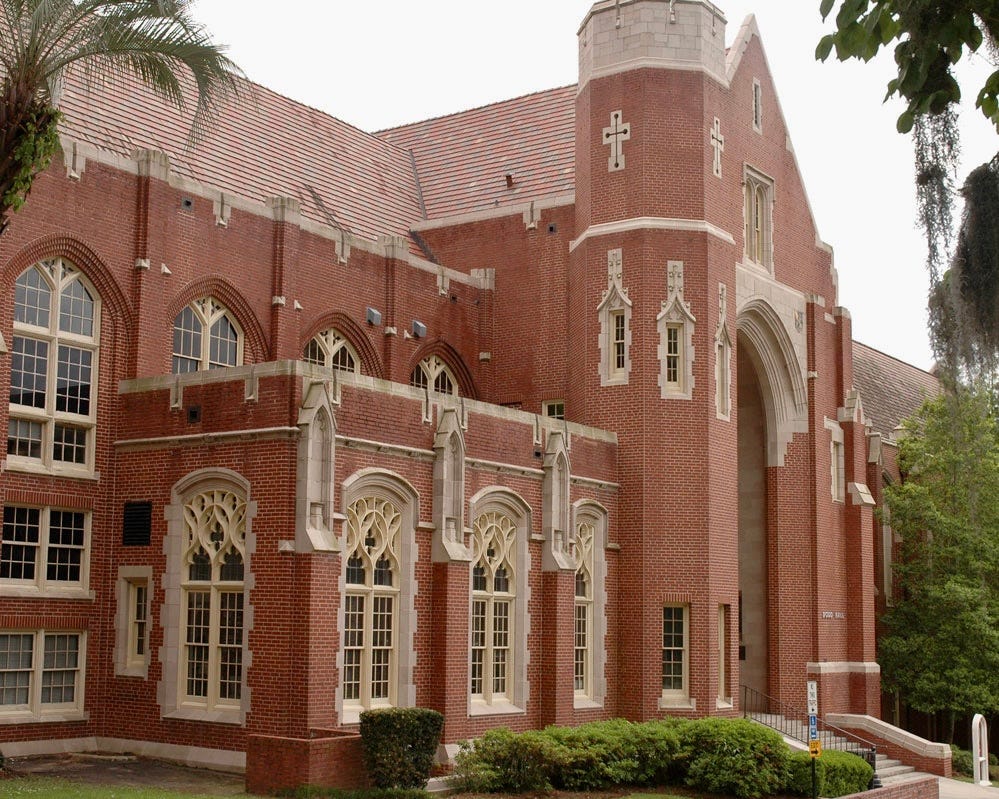
Pictured: Dodd Hall, my Alma Mater, Florida State University
Overview
Before we cover any of the world's traditions, we will separate the nonsectarian point of view from the sectarian — scholarship from theology — and knowledge from belief. We meet the tests a claim must pass before it counts as scholarly knowledge, the insider/outsider problem, and the distinction between describing what a tradition is and prescribing what it ought to be. Then we turn from the scholar’s method to the scholar’s first discoveries: how knowledge passed across generations becomes culture, and how every human community lifts certain objects, places, and practices out of ordinary life and sets them apart as sacred.
Key Terms for this Section
Theologian · Scholar of Religion · Normative/Descriptive claim
Functionalism · Culture · Sacred · Totem · Taboo
1.1 | Religion in a Public College
An Introduction to this Series
This is a survey of the world’s religions: their histories, their ideas, and the civilizations they have built. No foreknowledge of any tradition or any of their languages is required. Assigned readings come from Boston University’s Stephen Prothero, whose Religion Matters carries the narrative spine of the course. There are 14 sections divided into 4 modules (listed below). Each section’s theme will be divided into 4 lessons (eg. Sec. 1.1, 1.2, 1.3, and 1.4).
The four modules of this course are:
The Scholarly Approach to Religion
Religion in Asia
The Abrahamic Religions
Religion and Modernity
This project represents the culmination of decades of study and teaching experience, including work with the renowned Dr. John Dominic Crossan at the University of Central Florida (2007), a teaching fellowship in the Religion Department of Florida State University (2009–2011), my own course development and travels abroad, mentorship from various scholars, and my current positions teaching religion at Tyler Junior College (since 2012) and the University of Texas, Tyler campus (since 2019).
The world’s religions are not built on a single institution, or a single denomination, and are not sets of practices frozen in time. From the very beginning, the adherents of every tradition we will study have disagreed with each other: about politics, theology, law, interpretation, and religious authority. Those disagreements are not an inconvenience we need to smooth over. They are the history of religion. That means we’ll be careful with phrases like “Buddhism says” or “Christians believe” when often what we really mean is that a particular denomination says something, or a particular teacher says something, or that Catholics in one century said something that Protestants in another rejected. Learning to pull those apart is not a prerequisite to learning the subject. It is the subject.
Our job is never to decide which of them is the “real” Jew, Muslim, Buddhist, Hindu, or Christian. As scholars, our endeavor in this course will be to understand what people practice and believe in a specific time and place, how those beliefs developed, and what those beliefs have meant in practice.
Which brings us to the one rule this whole course runs on: We are here to study religion, not to practice or prosecute religion.
I do not allow proselytization — for or against a religion — in my classes. This rule isn’t in place to protect any tradition from scrutiny, or anyone’s faith from history. It’s there so that every student (of any faith or no faith at all) can look directly at the same millennia of information without wondering whose side the professor is on. The material is far more interesting than any verdict I could render on it.
So the first question we ask is not “Is this religion true?” That question belongs to someone else, and we’ll meet him shortly. Our question is: “What can we know about religion?” That is the question the scholar brings into the room. The rest of Section 1 builds the toolkit for answering it.
Sectarian vs. Nonsectarian
The first and most fundamental piece of our method is a word you must know to make any sense of the academic study of religion: nonsectarian. Nonsectarianism is the attitude that secular institutions of higher learning (like ours) take toward the study of religion. What this means in practice is that we do not take sides in religious debates. We don’t rank one religion above another, and we’re not in the business of proving or disproving any tradition’s tenets. We don’t favor Catholic over Protestant, Sunni over Shia, Theravada over Mahayana.
So what does nonsectarian scholarship look like? Take American History as an example, a subject we’ve all sat through. A good history teacher can give you a detailed account of American politics without making one party the good guys and the other the bad guys. That doesn’t mean the teacher has no political opinions. It just means her classroom isn’t being used to advance them. The opinions are not the method.
This stands in stark contrast to a sectarian center of learning — a religious private school, a Sunday school, a madrassa, or a seminary. Again, the difference is simple: a sectarian program of study picks sides, while a nonsectarian course like ours does not. And “sectarian” is not an insult here — a seminary that refused to say what Christians ought to believe would be failing at its job! Ours is simply a different purpose housed in a different space.
And in a publicly-funded institution, this isn’t merely a preference. It’s the law.
In the 1960s, scholars of religion developed a legal rationale for the academic study of religion that is encapsulated in the 1963 US Supreme Court case Abington v. Schempp. In essence, the ruling set the precedent that public schools cannot establish a particular religion. Therefore, in accordance with US law, Supreme Court precedent, and the best practices of the American Academy of Religion, this course does not seek to establish, reproduce, or legitimize any particular or sectarian view of any of the world’s religions. For example, we will not legitimize a Mahayana Buddhist view over a Theravada view, a liberal Sunni view of Islam over a conservative Shia view, or a 17th-century Calvinist view of Christianity over an ancient Catholic, Coptic, or Gnostic view. If we favor one view, then, at best, we lose the nuance to which nonsectarian scholarship reaches, and, at worst, we become guilty of promoting a sectarian view of religion on the public’s dime — which runs counter to the Establishment Clause of the First Amendment of the Constitution. In a public college — funded by conservatives and progressives, Baptists and Buddhists, Muslims and atheists — we take as our highest duty the role of a nonsectarian scholar.
So please consider this your invitation to approach the academic study of religion with both curiosity and respect — whether you arrive with firm personal convictions, no religious background at all, or somewhere in between.
What a Theologian Does
In an academic setting, we distinguish between two different roles when exploring religion. On one side is the Theologian (cf. “Confessional Theology“), such as a pastor, rabbi, imam, or monk — someone who is devoted to a particular religious tradition and serves as a representative of that tradition. On the other side is a Scholar of Religion (cf. “Religious Studies“), who does not take a public position on the rectitude of any particular group’s beliefs or practices.
Theology is the discipline of belief — literally, from the Greek, the study (logos) of God (Theos). It’s the job of theologians to make religious truth-claims (eg. there is only one God), and part of their job is defending those claims and contesting the rival claims of others. Theology also has an institutional home: walk into a church, a mosque, or a synagogue, and you will find the theologian’s whole world in one room: where someone stands up and tells the assembled not what a community does believe, but what it ought to believe. That’s the job of a theologian. This course will describe everything that happens in that room. But it will never perform any of it.
One more thing, because people sometimes assume that “academic” means “skeptical,” or that “nonsectarian” means “anti-religious.” Neither is true. The line between scholarship and theology runs between jobs — not people: a Buddhist can be a first-rate scholar of religion, and so can a Christian or an atheist. The question is never what the author believes when she goes home. The question is which chair she’s sitting in when she writes.
At first glance, it might look like theologians and secular scholars are rivals — two parties fighting over the same territory. They’re not, and the reason is simple: the two jobs have two completely different audiences and goals. The theologian’s work is directed toward a religious community: preserving a tradition, defending its beliefs, separating orthodoxy from error. The scholar shares peer-reviewed scholarship with students and scholars while making no claim whatsoever about metaphysical or absolute truth.
The theologians question is: What should you believe?
The scholars question is: What can you know about what people believe?
Neither question cancels the other. The roles, properly understood, are complementary. The difference is in the final goal: the theologian hopes to guide adherents toward what they see as ‘Truth,’ while the scholar hopes to illuminate the breadth and complexity of religious life without choosing which belief is ‘right.’
Like most people, your humble professor has deeply held religious beliefs. But you will not find them in this course. (As the former president of a synagogue, I certainly have them.) For some, that restraint is a challenge. For many of my students, however, it’s a breath of fresh air. A chance to learn about the world’s religions with no one trying to convince you into or out of a religion while informing you.
Key Terms for this Lesson: Theologian · Scholar of Religion
1.2 | The Scholar’s Toolkit
In Defense of Scholarly Knowledge
To get at the fundamental differences between the theologian and the scholar, we have to understand the epistemic difference between belief and knowledge. The difference between those two is not a difference in subject matter. It’s a difference in justification. All of us carry beliefs — about God, politics, the arts, family, etc. — and many of those beliefs are held with enormous confidence. But that does not make them knowledge.
The knowledge of a scholar must be logical, falsifiable, and precise. Our personal beliefs don’t have to meet any of these conditions.
Knowledge is logical when it’s limited to rigorous, valid, evidence-based reasoning. “Force equals mass times acceleration” counts as knowledge as it is valid, not yet disproven, and tested by an enormous variety of experts.
Compare the above scientific statement with, “the president must be a great banjo player, because great musicians make great leaders.” A person may sincerely believe this. But it does not count as knowledge. Knowledge is falsifiable when there is some logical way to show it’s wrong. The claim “Ottawa is the capital of Canada” can be checked. “The Mona Lisa is the most beautiful painting in the world” cannot, as there is no empirical test for the prize most beautiful. That may be a meaningful personal judgment. But again, that’s a belief, not knowledge. And knowledge is precise when it isn’t assembled out of arbitrary parts. When a guru claims that one’s “well-being” depends on their overall “balance of energy,” it may sound like knowledge until you ask for rigorous definitions of those terms.
Now watch how those tests behave the moment religion enters.
“I believe God exists” is a rather common belief. While “most early Israelites acknowledged the existence of other gods while holding Yahweh supreme” is an historical claim about a belief, checkable against ancient texts, archaeology, and millennia of scholarship (and we will check it later in this very lesson). The kind of claim is entirely different. The theologian deals in the first kind; the scholar deals only in the second. And before you walk away thinking we’re looking down on beliefs, let me be clear. Beliefs are a great deal of what makes a life meaningful! None of us would be who we are without them.
But my beliefs are still beliefs. As smart as I am, my beliefs do not count as knowledge.
In fact, it’s important to note that one’s religious beliefs and faith commitments neither qualify nor disqualify anyone from studying a religion. A century ago, this was called the insider/outsider problem. Out of an abundance of precaution and care, scholars used to ask if someone needed to be a member of a religion in order to study it. Should only Mormons study Mormonism? Only Muslims, Islam?
To answer this pressing question, let’s consider the next three points.
Who counts? To elevate insider voices, someone has to decide who the insiders are, and that judgment belongs to a theologian. The scholar has no instrument for measuring the sincerity of anyone’s faith, and no business building one. In the end, ‘who speaks from with the community’ is a theological decision.
Who gets the last word? If the subjects of a study can simply object to its findings and have them revised to their liking, it is hardly a scholarly study at all. Letting the people under examination dictate what may be written about them isn’t scholarship. It’s public relations. As the University of Chicago’s Bruce Lincoln argues, “No one who hands their tools over to their subject can honestly be called a scholar.”
Information from inside a community is complicated by the fact that one’s consciousness is itself a product of that system. Or, as the old line has it: whoever coined the concept of water probably wasn’t a fish. Because a fish doesn’t notice the water they constantly swim in . The deeper inside a community you are, the harder it is to stand back and clearly see its shape.
So the solution is not to crown the insider, or the outsider. The solution is scholarship — the method that makes every claim, whether you’re on the inside or outside, answer to evidence and survive the criticism of other scholars.
As an example, if I imagine I want a scholarly, rigorous view of George Washington, I’ll read American and non-American authors alike, set aside books that advocate too warmly for him, skip the politicians who use him to prop up their own positions, and insist on peer review, because I want to see the whole man.
Now substitute the Buddha for Washington, Buddhist for American, and theologian for politician. That’s a taste of what we’re doing here in this course.
Optional Video: Scholar of Religion explains why you don’t have to be religious to study religion (auto-generated CC).
Two Kinds of Claims
So how does a scholar talk about religion without accidentally falling back into theological claims?
The line between the two is called the Normative/Descriptive distinction.
This is the essential tool for understanding the different aims of theology and religious studies.
A descriptive claim explains something as it is: “The average adult has 32 teeth.”
A normative claim tells you what you ought to do: “If you want healthy teeth, you should floss every day.”
One statement reports. The other prescribes. And when religion enters the picture, normative statements become theological. Consider these examples:
A Christian should not serve in the military.
A Jew doesn’t eat shellfish.
A Muslim should not eat pork.
A Hindu believes in many gods.
A Buddhist cannot eat meat.
Each is a theological “line in the sand” that defines how a religion should be practiced according to specific theological authorities: on this side is our religion, and on that side is not. And here’s where it gets genuinely difficult. Normative claims are very good at dressing up as descriptive ones. “That group isn’t practicing real Christianity” — see, it looks like a report. It has the grammar of a scholarly report. But there’s no fact in the world it corresponds to; it’s a judgment about who belongs, while wearing a scholar’s tweed jacket. Watch for the tells: when a claim talks about real, true, authentic, proper, genuine. When one of those words shows up in front of the name of a religion, somebody is drawing a boundary and hoping you won’t notice. (Scholars have a name for this move; we’ll meet it soon, in Section 2.)
One more pair to test our understanding.
Johnny is a good person.
This is normative, as it presumes the speaker knows what makes a person good.
Bob claims Johnny is a good person.
This is descriptive, as it simply reports on what Bob said. The scholar’s sentence is almost always the second kind.
Let’s put it to work on a live dispute. Imagine two Christian families, the Smiths and the Joneses — both identify as Christian, but the Smiths oppose the war while the Joneses support it. (Remember: a Christian theologian compares good Christianity with bad Christianity — that’s his job.) Think about the theological claim: “The Smiths are good Christians because they are pacifists, but the Joneses are bad Christians because they support the war.”
That is a normative, theological claim. It sorts. It ranks. It tells the reader which family to admire. But a descriptive claim is the only kind scholars of religion are interested in making. A scholar makes no claim as to who is and isn’t a “true” Muslim, a good Jew, or a bad Christian — she instead pays attention to people making such claims and reports them as historical and cultural facts. The scholar may report, “While both the Smiths and the Joneses identify as Christians, the Joneses agree with the war, while the Smiths do not.” Read those two versions back to back. The second claim preserves the disagreement instead of resolving it for you — and it leaves the theological question exactly where it found it: with the theologians, who have the job of arguing it out.
Essence vs. Function
A World Religions course from a century ago would have looked quite different than how scholars study religion today.
After the First World War, academic courses in “Comparative Religion” spread to meet the need for Americans to better understand the other side of the world. By 1933, the phrase “World Religions” had appeared as a book title. Early courses generally attempted to identify one overarching “essence” of each tradition — Judaism as law, Christianity as love, Buddhism as mysticism — and compare those essences against one another. The scholarly assumption under Essentialism was that each religious tradition has an essence that can be compared to the essence of another. Today’s scholars have pointed out that this framework oversimplifies our lived reality. Judaism has its own rich history of mystical practice (Kabbalah) and expressions of love (Lev. 19:34). Christianity has always contained legal and liturgical dimensions of its own. In American Christianity today, some congregations permit women to lead services, others do not (now multiply those differences across Russia, Egypt, and China, and thousands of years of theology!). This is not a flaw in religious life — it’s a natural feature of any long-standing social institution. Just as languages and cultures shift over time, so do religious ideas and practices.
How, then, do today’s scholars approach these diverse traditions without flattening them into neat, flawed categories? Today, Functionalist scholarship focuses on how a religion functions within a specific context (ie. its place and time) without recourse to the judgment of theological comparison. Rather than saying, “Buddhism is mystical, and Judaism is legalistic,” a functionalist asks, “How did Buddhism shape community life for certain groups in Medieval China?” It turns out, religion can be understood in terms of what it does and how it operates in a given environment without recourse to theological argument or comparing problematic ‘essences.’
For this series, we will utilize the Functionalist approach by asking 4 basic questions of each tradition:
Formation | How and where did the tradition arise, and who shaped it as it changed over time?
Internal Logic | What are the tradition’s own categories? What problem does it name in the world, and what counts as the good?
Texts & Practices | What written and oral works, rituals, and disciplines carry the tradition, and how do different communities use them?
The Modern Age | In our last module, we’ll investigate how these traditions function in the modern world and in American life.
You will see these four questions answered in every tradition we study. They are the course’s standard model, and an excellent template for your own notes.
What does descriptive scholarship actually produce? Let’s watch the toolkit in action. Note carefully what the scholarship below is claiming — a description of how ancient Israelites worshipped, drawn from archaeology and scripture, and what it is not claiming. It makes no theological judgment about whether God exists, whether the scripture is true, or how anyone today ought to believe. That judgment belongs to theologians.
Example: The God of Israel
From their ancient beginnings, archaeologists report the Israelites worshipping a variety of Canaanite gods. Chief among them was El, referenced in the tribal name “Israel,” and the god Yahweh with his queen consort, Asherah. This arises from their shared monolatry: the ancient Israelites acknowledged the existence of other gods but claimed Yahweh was supreme. Eventually, when Babylon took Jerusalem in 586 BCE, the Israelites were taken into exile. It was there, in Babylonian Captivity, that the archaeological evidence for monolatry ends and the written Torah — where Jews proclaim one God — is formed. From that point forward, Jewish monotheism prevails in the written and archaeological record.
Notice what just happened: the scholarship traces how worship changed across centuries, reports the tradition’s own categories, follows the evidence, and made no ruling on any modern person’s faith. This is the normative/descriptive distinction at work, and it is the model for everything we do in this series.
In short, good scholarship is neither pro- nor anti-theology. These fields operate in different yet complementary spheres. Theology nurtures the faith community from within, offering normative guidance, while scholarship seeks to describe and understand religious communities as historical and cultural phenomena. By keeping these roles clear, we preserve the integrity of both academic inquiry and private religious life.
This approach can take some getting used to. But if you remember that descriptive claims belong in the academic realm and normative claims belong in the theological realm, you’ll find that each has its rightful place. If you ever find yourself crossing that boundary in this course — often by making implicit judgments about what is or isn’t correct belief or practice — take a step back. Ask: “Am I dispassionately giving a religious claim the proper historical context, or am I implicitly telling people what they should believe or do?” Recognizing the difference is at the heart of the normative/descriptive distinction, and it’s one of the most important lessons we can learn in a public institution studying the world’s religions.
Key Terms for this Lesson: Normative/Descriptive distinction · Functionalism
1.3 | Before Religion
Prehistory
Having gone over the Scholar’s Toolkit, let us now endeavor to understand how the concept of religion came to us.
Although our societies have engaged in diverse ritual practices for tens of thousands of years, the term “religion” as we use it today did not exist in the same sense throughout most of history. It was only in the last few centuries that Western thinkers began separating “religion” from other aspects of life, labeling certain beliefs and ceremonies as “religious” while labeling others as “social,” “political,” “cultural,” “ethnic,” etc. (we will delve into this more in Sec. 2.3).
The key text for this exploration (not a required reading for our course) is Brent Nongbri’s Before Religion (Yale University Press). Briefly put, before the modern era, most cultures had a broad set of practices, traditions, and communal stories that blended into daily life without a separate category labeled “religious.”
To make sense of this, we now shift our attention to prehistory — that stretch of time before writing was invented — so we can glimpse the earliest roots of what would later be called ‘religious’ life. Anthropologists estimate that humanity began migrating out of Africa approximately 140,000 years ago. For thousands of years, small communities formed traditions, shared stories, created meaningful art, and participated in group rituals. These customs and artifacts are among the signs that hint at the beginnings of ceremonial life.
Even though there are no ‘prehistoric texts,’ we can still look to the record of archaeological evidence for clues to their stories.
For instance, researchers have found decorative bones in South Africa that date back tens of thousands of years, cave paintings in France depicting animals and abstract symbols, and fertility figures in places like Austria that seem to have served some ritual purpose. Because writing only began about 5,000 years ago, nearly all of our knowledge about the earlier eras must be pieced together through these kinds of artifacts. These findings reveal that long before people had written scriptures or formal religious hierarchies, humans already had the capacity to share stories, honor the mysteries of life, and mark significant events with group activities.
Culture & Meaning Making
One of our most helpful concepts for understanding these communities is Culture. For scholars, culture is social information that is transmitted from one generation to the next. Think of it as everything from how people cook their food to the stories they tell around the campfire — any knowledge, practice, or custom that can be passed down within a society is part of its culture.
For prehistoric people, culture developed alongside practical survival skills. Early humans needed effective hunting strategies, which were learned collaboratively and taught to future generations. Hunting in groups made it easier for us to bring down large animals while reducing the risk of injury. Similarly, the invention of sharper spears or more durable tools meant taking down larger game, whose hides kept us warm and dry. The ability to start and control fires was an especially powerful advancement, offering warmth, protection from wild animals, and a means to cook food so it could be eaten and stored more safely.
Over time, these advances became cultural milestones.
The engaging, instructive, even humorous stories that hunter-gatherers would tell around the fire — about close calls with predators, or legends of how they discovered certain edible plants — gradually shaped each group’s identity. In this sense, culture was not limited to practical know-how. It also framed how we came to see the world — values that created group cohesion, and even early attempts to cope with life’s profound mysteries, like birth, death, and the sublime forces of nature.
By the time writing systems emerged (around 5,000 years ago) in places like ancient Mesopotamia, Egypt, and China, much of humanity’s cultural foundations were already in place. With the advent of written records, societies could preserve more detailed laws, myths, genealogies, and rituals. Yet the building blocks of these later civilizations still rested on thousands of years of oral traditions, trial-and-error learning, and accumulated cultural memory.
The Raw & the Cooked
The famed anthropologist Claude Lévi-Strauss once used the contrast between “raw” and “cooked” food to illustrate how culture works (cf. The Raw and the Cooked, 1964). In its natural or raw state, a plant is simply another part of the environment — no different from a wild shrub or a piece of driftwood. But the moment a human decides to gather, prepare, and cook that plant, it transitions from the realm of nature into the realm of culture.
Think about a raw potato. If you plunk a dirty, raw potato onto a table, few people will be tempted to eat it. In that state, it barely resembles what many of us call “food.” But if you give that potato to someone in England, she might put it in a shepherd’s pie. In India, that same potato might be used in a spicy curry. While a Jewish family might transform it into a kugel. In Texas, you could see it mashed and covered in a creamy, pepper gravy. The fact that we can take a simple, raw ingredient and make it into so many distinct dishes tells us a lot about cultural expression.
But Lévi-Strauss’ metaphor goes beyond just cooking. It highlights how humans constantly take raw data from nature — plants, animals, minerals, even experiences — and shape it according to learned traditions. Over generations, this process evolves into what we recognize as “culture.” When people from different regions develop their own cooking styles, art forms, mythologies, and social norms, they demonstrate the many ways culture diverges over time. No single group’s method of cooking or storytelling is necessarily “better” or “worse.” Rather, each one reflects a creative and historical adaptation passed down through the ages.
The same principle applies to the origins of what we now call religion. We might see figurines or cave paintings from prehistoric contexts and label them “religious artifacts.” Yet these items were part of an entire cultural framework — a way for people to relate to their environment, commemorate significant life stages, and honor supernatural forces they experienced. What we term “religion” in modern parlance evolved from these early impulses to organize the raw elements of nature into something deeply meaningful, shared, and instructive for group survival.
Understanding culture as dynamic — always shifting, layering the old with the new — enables us to see how religion also changes over time. Culture, in all its forms, provides the foundation upon which later religions are built. And the first thing a culture builds on that foundation is a boundary: some things are ordinary, and some things are set apart. That boundary is where we turn next.
Key Term for this Lesson: Culture
1.4 | Sacred, Totem, & Taboo
Understanding the Sacred
When scholars examine artifacts from the past (pottery, weapons, texts, etc.), they pay special attention to how these objects were treated by their human owners. A single tool or ornament can reveal much about the priorities and customs of its original community, even when no written language exists to explain its purpose. By looking at burial sites and early settlements, researchers see how prehistoric and ancient groups sometimes set particular objects apart from daily life — a sign that these people saw certain items as symbolically special, not simply as helpful or harmful objects.
Before the invention of writing, early humans encountered a truly mysterious world.
We gave meaning to our experiences by creating symbolic interpretations of the environment around us. We humans have evolved to be natural meaning-makers.
Example: walk into an unfamiliar room.
You will immediately notice if the room is large and inviting or small and cramped. Whether it is filled with warm light or covered in looming shadows. You might notice odors that are pleasing, unpleasing, or even remind you of a particular place. You may notice shapes on the walls that recall a specific style of decoration. Even though the space could be an empty, windowless cube, you assign meaning to its features. A bathroom, a department store, and a church sanctuary all bring very different emotions and considerations to the humans who walk into them.
The awareness of the social, symbolic meaning of our surroundings is an inborn feature of our existence. It has helped not only keep us alive but to thrive as a species.
In early cultures, certain items were reserved for use in places like graves, social gathering places, or the homes of leaders. These objects were understood to be significant in ways that went beyond their practical usefulness. They were considered sacred (from the Latin for “set apart”). The English word “holy,” Germanic in origin, carries this same meaning. Once a group decided that an object, symbol, or practice was symbolically special, they treated that object as belonging to a higher social category. As this course moves forward, we will explore how different communities have identified what they consider sacred and set apart from everyday life.
Totem & Taboo
Archaeologists and anthropologists who analyze early societies found that items considered sacred can be divided into two major categories: sacred objects, actions, or ideas that benefit the community and sacred objects, actions, or ideas that are forbidden or harmful. Scholars term the beneficial kind a totem, while the harmful or forbidden kind is called a taboo. These terms describe how a society marks objects or behaviors as symbolically meaningful in either a positive or negative way.
Consider how this classification works today. Americans see the bald eagle as an honored national symbol. And we identify the U.S. flag as another symbol worthy of our utmost respect and care. These symbols are American totems insofar as they are set apart symbolically from our ordinary use (ie. that’s not just an ordinary bird or a meaningless piece of cloth to us). There are also taboos related to how the flag can be treated. Americans are taught the flag should never touch the ground and that it should be folded in a prescribed, respectful way. In our culture, we also drape the flag over the coffins of fallen soldiers. Again, these sacred actions flow from the idea that the flag is no ordinary piece of cloth. It stands for something that the community reveres. The flag represents us.
Although we may not consciously think about totems and taboos every day, they shape our actions in ways we often take for granted. These practices help form the boundaries of our social life: knowing which objects and practices should be treated with respect, and which behaviors are discouraged, tells members of a society who belongs and who doesn’t.
For prehistoric groups, totems include special animals, artifacts, and designs. Taboos include prohibited foods, cursed locations, and contact with outsiders and people who had broken social customs. Each of these categorizations helped structure the community’s identity (ie. gatekeeping). They distinguishe ordinary objects and actions from the extraordinary or dangerous. Such distinctions add layers of meaning to (and often define) their respective cultures. In some traditions, a certain food is classified as taboo, meaning consuming the food marks one as an outsider (eg. try adding beans to chili in a Texas chili cookoff — it won’t go well for you).
The Sacred Across Traditions
Every tradition you will meet in this course has drawn this same line between the ordinary and the set-apart.
For the Diné, the hogan is not merely a dwelling but a home built on a sacred pattern. Hindus honor the temple and the waters of the Ganges. Buddhists circle the stupa, a mound holding sacred relics. Daoists ascend sacred mountains. Jews rise when the Torah scroll passes and leave written prayers in the Western Wall. Christians set the altar apart at the front of the church. And Muslims turn in prayer, five times a day, toward the Kaaba. Seven traditions, one shared move: something is lifted out of ordinary life and treated as belonging to a higher category.
We all want to belong somewhere. And every community in the history of our species has used the sacral nature of totems and taboos to define that belonging.
But sacred objects do not guard themselves. Marking, honoring, and transmitting the sacred is itself a formal practice.
And that practice, ritual, is where Section 2 begins.
Optional Video: Scholar of Religion explains what religion is (auto-generated CC).
Key Terms for this Lesson: Sacred · Totem · Taboo
This Section: Religion in a Public College
Next Section: What is Religion?