

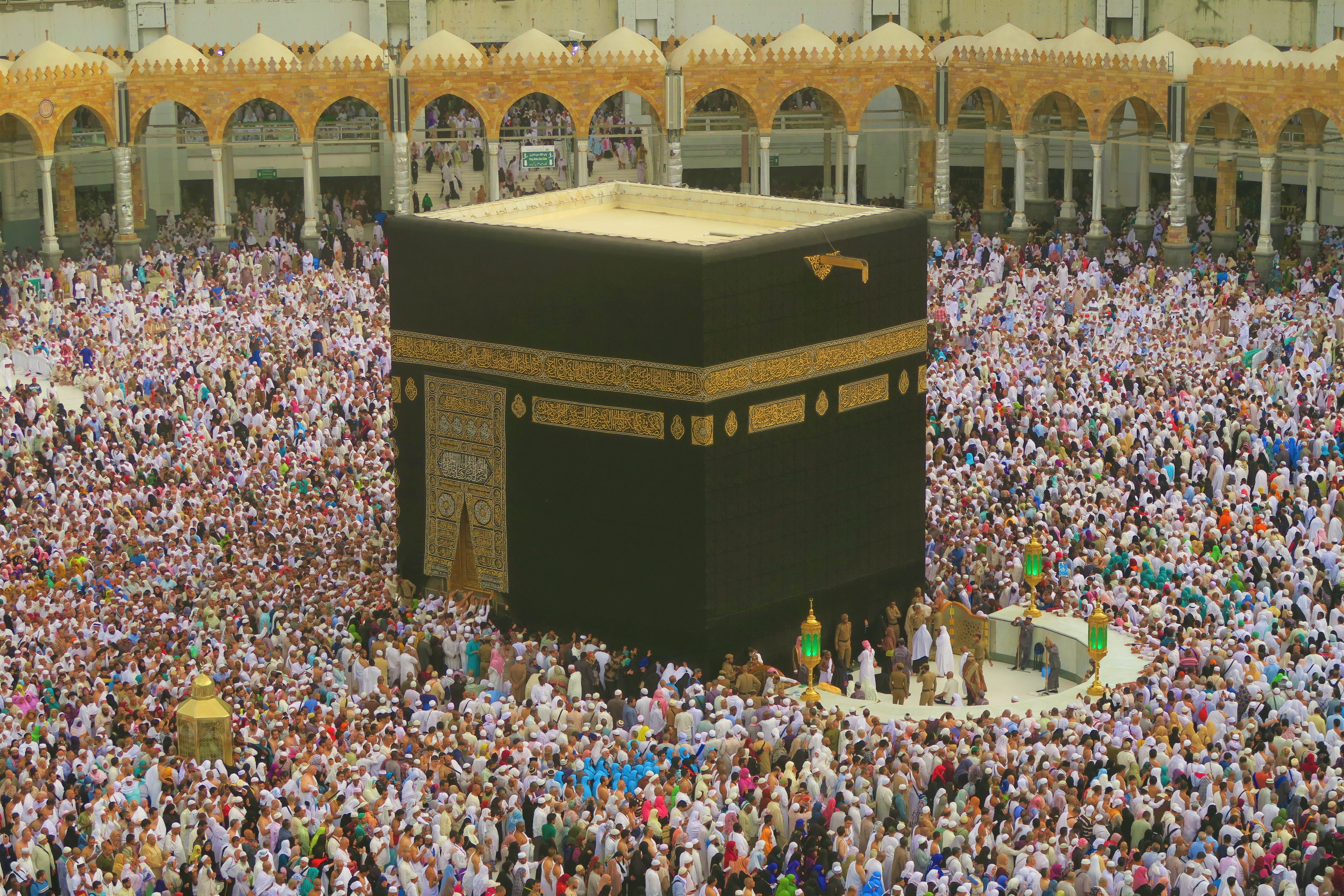
The Kaaba | Mecca, Saudi Arabia, 2018
Key Terms for this Section
Kaaba · Hijra · S-L-M root · Qur’an
Sunni & Shia · Sharia · The Five Pillars · Mosque
10.1 | Arabia & the Messenger
Arabia & the Kaaba
Arabia in the 500s was a world unto itself: a vast desert rimmed by trading coasts, wedged between the two superpowers of the age — the Christian Byzantine Empire lay to the northwest and the Persian Empire to the northeast. Along the western caravan road, the Hijaz, sat two towns that matter for the rest of this section:
Mecca, and, to its north, the older town of Yathrib, soon renamed Medina.
• 610 | The first revelation happens in a cave on Mount Hira (cf. 10.2)
• 615 | Persecuted followers of Muhammad find refuge under a Christian king
• 622 | The Hijra, the community migrates to Medina. Year 1 of the Islamic calendar
• 630 | Muhammad and the Believers return to Mecca and clear out the idols
• 632 | Muhammad dies in Medina with no clear line of succession
Islam did not arrive in an empty desert. Long before Muhammad ﷺ, Mecca was a pilgrimage and trading city built around an ancient shrine, the Kaaba, a cube-shaped sanctuary that Arab tradition held had been raised by Abraham and his son Ishmael, the ancestor (in that tradition) of the Arab people. It will become the shrine toward which all Muslims face in prayer.
This phrase, which follows the prophet’s name at the beginning of this section, is the Arabic blessing “peace be upon him.” It is the honorific observant Muslims traditionally add to their prophets, notably to Muhammad. It is placed here, once, so you’ll know what it is when you see it elsewhere online.
Arabia knew the God of Abraham.
However, Arabia was also a polytheistic society to its core. In the late 500s, the Kaaba housed 360 idols. Meccan prosperity ran on those idols. Arab culture and honor code let warring tribes trade in peace on holy ground, and Mecca had every idol in the peninsula. Everyone was welcome to trade!
During the Jahiliyah (the ‘time of ignorance’ before Muhammad), The families who kept the Kaaba grew very wealthy from the trade in their area. The Qur’an, the scripture of Islam, remembers the arrangement. It’s 106th surah is named for the Quraysh, the tribe that kept the shrine.
For the security of the Quraysh, their security on the journeys of winter and summer, let them worship the Lord of this House, who fed them against hunger and made them safe from fear. Surah Quraysh, Qur’an 106:1–4
Scattered through Arabia were Jews, some with communities reaching back to the First Temple era, and many more arriving after Rome destroyed the Second Temple in 70 CE (Secs 7–8). Three Jewish tribes (the Qaynuqa, the Nadir, and the Qurayza) lived in Yathrib in Muhammad’s day. There were Christians, too, of several rival kinds, some of whom honored Jesus as a prophet rather than as God. And there were the hanifs, Arab monotheists who worshipped the God of Abraham and rejected the idols without belonging to either older tradition. One of them, Waraqa, cousin of Muhammad’s wife, will reappear in a moment.
Mecca & the Messenger
The Prophet Muhammad was born around 570 into the Arab clan of Banu Hashim (part of Mecca’s leading tribe, the Quraysh). But his road was one of hardship, not Quraishi wealth. Orphaned young, he was raised first by his grandfather and then by his uncle Abu Talib (d. c. 619). Muhammad worked the caravan trade, earning among Meccans the nickname al-Amin, “the Trustworthy One.”
In his 20s, his excellent character caught the notice of Khadija (d. 619), a self-made older woman and widow, who ran her own caravan business. She hired Muhammad, and later proposed marriage. Their marriage would last about 25 years, until her death. The marriage brought Muhammad security and standing and, by the tradition’s account, a settled prosperity that only sharpened his unease at the gulf between Mecca’s haves and have-nots. He took to spending nights alone in a cave on Mount Hira, above the city, in prayer and reflection.
There, in 610, Muslims hold that the angel Jibril (Gabriel) came to him with a single command, “Recite,” and that what he began to recite was the word of God (cf. Sec. 10.2). He came down from the mountain shaken, and it was Khadija who first believed him. Among the earliest to follow were his young cousin and son-in-law Ali (d. 661) and his friend Abu Bakr (d. 634).
The message Muhammad began to preach was unsparing and, to Mecca’s establishment, dangerous: there is only one God, the idols are nothing, and the rich and powerful must answer for how they treat the poor. If Mecca took that seriously, the whole idol-and-pilgrimage economy (and the families who ran it) stood to lose everything.
The Quraysh leadership answered the first Muslims with ridicule, then pressure, then persecution. In 615 some Believers were driven into exile across the Red Sea to Christian Abyssinia, while Abu Bakr spent his wealth buying the freedom of enslaved converts. Then, in 619, Khadija and Abu Talib both died. Muslims remember it as the Year of Sorrow, and with his uncle went the clan protection that had shielded him.
To Medina & Back Again
When a delegation from the Arab-Jewish city of Yathrib invited Muhammad north to arbitrate an old feud between two of the cities tribes, the Believers went with Muhammad. In 622 CE the community migrated from Mecca to Yathrib in a moment known as the Hijra (Ar. emigration). This event now marks Year One of the Islamic calendar (1 AH), a reckoning the caliph Umar instituted circa 638. Yathrib became known to the tradition as Medina, “the City.”
At Medina, the movement became a community. Muhammad drew up the Constitution of Medina, a compact binding the town’s Muslims, Jews, and others into a community defined by mutual-defense and aid. The years that followed brought open conflict with Mecca, remembered in the battles of Badr (624) and Uhud (625).
In 630 CE Muhammad returns to Mecca at the head of 10,000 followers and takes the city with little bloodshed.
A general amnesty is declared for the whole city. He and Ali went straight to the Kaaba and cleared it of its idols, restoring it, in the tradition’s understanding, to the worship of the one God for which Abraham had first raised it. Then the Believers circled it seven times, as Muslims on pilgrimage still do.
Two years later, in 632, after a final illness during which Abu Bakr led the prayers in his place, the Prophet died at Medina. Muslims hold him to be the last — the Seal of the Prophets (Qur’an 33:40). Over the decades that followed, the recitations he had delivered were gathered into a single book, the Qur’an.
Key Terms for this Lesson: Kaaba · Hijra
10.2 | The Qur’an & Its World
Recite & Salaam
According to Islamic tradition, while alone in the cave, Muhammad experienced a transformative event. The angel Gabriel (the same messenger who came to Daniel and to Mary) visited him and commanded that there is only one God. Moreover, Muhammad was told to go to the people of Mecca, renounce their idol worship, and recite the word of God to them. The first words he was given were these:
“Recite! In the name of your Lord, who created — created humanity from a clinging clot. Recite, for your Lord is Most Generous — who taught by the pen, taught humanity what it did not know.” Qur’an 96:1–5
He came down from the mountain shaken, and was comforted by his wife Khadija, who took him to her Christian cousin Waraqa, a man who knew the earlier scriptures (Sahih al-Bukhari 3). Waraqa confirmed that Muhammad bore all the signs of prophethood. For the next 23 years, until his death, Muhammad continued to recite the words as he received them.
The Arabic word for “recitation” is Qur’an. It shares its root (Q-R-ʾ) with the angel’s first command, iqra’ (recite).
While we’re on Arabic etymology, it would benefit us to also look to the word root for Islam and Muslim. Both words share an S-L-M Semitic root (س ل م). From this same root, we derive:
• Salaam, peace (also a greeting)
• Salamah, safety
• Salim, whole/unbroken
Because all triliteral Semitic roots share a family of meaning, we may best understand Islam as invoking peace (salaam), safety/refuge (salamah), and wholeness (salim). In Arabic, if you add “mu-” to the beginning of a word, it means ‘one who does.’ So “mu-SLM’ simply means one whose aim is ‘S-L-M’ (peace/safety/wholeness/Islam).
In short, the Islamic tradition takes its own name from the Arabic root for peace.
The Qur’an & Its Guardians
The Qur’an, the chief scripture of Islam, is about the size of the New Testament,
and it defies most of our literary expectations.
The Qur’an has little narrative continuity and almost no chronological order. It is made of 114 chapters called surahs arranged (after the short opening) mostly from longest to shortest. Surahs are not arranged by story or theme. Each surah is labelled as Meccan or Medinan, according to where Muhammad was when the message was revealed. There are 86 earlier Meccan and 28 later Medinan surahs.
Mary, the mother of Jesus (Ar. Isa) is the only woman the Qur’an names, and Surah Maryam is the only surah named for a woman, a measure of her honor in the tradition. To many Muslims, the fact that the Qur’an is not shaped like an ordinary book is part of the point: its form is held to be beyond human convention.
Two features matter most for understanding how Muslims hold their scripture. First, the language is the revelation. The Qur’an was revealed in Meccan Arabic, and Muslims hold that the Arabic is the scripture. That is, any translation is regarded as an interpretation — useful but secondary. That is why the Qur’an is recited in Arabic in mosques from Indonesia to Ohio, whether or not the worshippers speak Arabic as their first language.
To memorize the entire Qur’an in Arabic is among the most honored achievements in a Muslim life. Doing so earns one the title hafiz, “guardian.” There are millions alive today, many of them children. It is a text that could survive the loss of every printed copy and still be recited.
Finally, the text was standardized early. Within a generation of Muhammad’s death (ca. 650), under the caliph Uthman, a single authoritative written version was established and copies sent across the growing community.
The Qur’an & the Bible
The Qur’an alludes to and sometimes retells stories from the Bible, rather than introducing them whole cloth.
Adam, Noah, Abraham, Moses, and Jesus all appear as prophets in its pages, though many times without details a Bible reader might expect. For example, the Garden’s serpent and the visit of the shepherds to Jesus go unmentioned. This is due to the Qur’anic interest aiming for the moral of the account, not its chronology or details.
Jesus (Isa) is particularly honored in the Qur’an.
The Qur’an affirms the virgin birth (19:20) of Jesus, calling him Messiah and prophet (3:45). On the crucifixion, the Qur’an reads the story differently than the Gospels do: “they did not kill him and did not crucify him, but it was made to seem so to them” (4:157). The next verse reads:
Rather, Allah raised [Jesus] up to Himself. And Allah is Almighty, All-Wise.
Qur’an 4:158
What the Qur’an will not grant is that Jesus is God’s son in the Christian sense. Its deepest insistence is the one it shares with the Jewish tradition: God is one, without partner or equal. In theological moments like this, where the Bible and the Qur’an differ, Islamic teaching holds that the earlier texts were altered in transmission over the centuries (tahrif), and that the Qur’an is the final, unaltered clarification.
The disciplined study of the Qur’an’s meaning (verse by verse, drawing on Muhammad’s example and the Arabic itself) is called tafsir. This tradition of commentary compares well to the Talmudic commentary Section 8 described concerning the Torah.
Speaking of comparison: there is a well-worn warning given to students focused on interfaith dialogue and understanding. At first, it may seem that the Qur’an is to Muslims what the Bible is to Christians, but this is not the case. Rather, each of the three Abrahamic traditions has a central ‘miracle’ that holds it together.
• The central miracle of Judaism is the Promised Land, Israel
• The central miracle of Christianity is Jesus, the Son of God
• The central miracle of Islam is the Qur’an (framed as the perfect text of God’s word)
Just as Christians hold that God entered the world in a person, Muslims hold that God’s word entered the world as a recitation. God’s speech made audible to humanity.
The Qur’an remains unchanged from its original Arabic across 1,400 years and 5 continents. A book you can put on a shelf can gather dust, but a recitation lives only in being spoken. It opens with seven verses, spoken at least 17 times a day by every practicing Muslim:
In the name of God, the Most Compassionate, the Most Merciful. All praise is due to God, Lord of all worlds — the Most Compassionate, the Most Merciful, Master of the Day of Judgment. You alone we worship, and You alone we ask for help. Guide us along the Straight Path — the path of those You have blessed, not those who have gone astray. Al-Fatiha, the opening of the Qur’an
Key Terms in this Section: S-L-M root • Qur’an
10.3 | Divisions, Law, & the Golden Age
Sunni & Shia | 632-680
From the death of Muhammad in 632 to the abolition of the caliphate in 1924, the community’s story opens out to the whole Mediterranean and Near Eastern world: Damascus, Baghdad, Córdoba.
• 632 | The Succession Crisis: Abu Bakr becomes the first caliph
• 680 | Muhammad’s grandson Husayn is killed at Karbala, Iraq
• 750 | The Abbasid Revolution occurs wherein a new dynasty takes the caliphate
• 1258 | The Mongols sack Baghdad, ending the Abbasid Golden Age
When Muhammad dies in 632, there is no written rule of succession. The community divides over the question that day, and has never recovered. The larger group held that leadership should pass to the most capable and respected of Muhammad’s Companions. They accepted Abu Bakr, and then a line of early leaders known as the Rightly Guided Caliphs (the Rashidun), as his rightful successors (Ar. khalifa, “successor,” and so caliph). This caucus became the Sunni (the ‘majority’).
A second group held that leadership belonged by right within Muhammad’s own family, beginning with Ali, his cousin and son-in-law, and passing through his descendants, the Shiatu Ali, (the ‘Party of Ali’), today known as the Shia.
The division was sealed in grief. What happened?
In 680 at Karbala, in Iraq, Muhammad’s grandson Husayn (d. 680), Ali’s son, was killed with his small band by the forces of the Umayyad caliph Yazid. For Shia Muslims, Husayn’s death is the defining sorrow of their history, mourned every year on Ashura.
Today, the Islamic Community is roughly 90% Sunni and about 10% Shia. The Shia are the majority in Iran, Iraq, Azerbaijan, and Bahrain, and Sunnis nearly everywhere else. But do not lose sight of the fact that Sunni and Shia are two branches of one religion.
Both revere the same Quran and the hadith, the reported words and deeds of Muhammad.
Sharia & Fiqh
Within a generation of Muhammad’s death, the young caliphate needed exactly what the Qur’an does not supply: a codified set of standards for conduct. So, the community turned to the customs and practices of Muhammad and the early days. By combining Islamic belief (Sunnah) and behavioral norms (Hadith), the community was able to build a set of Islamic moral conventions called Sharia.
Sharia is not a set of laws. In Islam, Sharia is an ideal: perfect justice, perfect peace, centered on a perfect religion. But because it’s an ‘ideal,’ true Sharia has never been attained. Rather, the set of Islamic laws that arise from debates about Sharia are called Fiqh. In brief, Fiqh is what imperfect scholars, arguing with one another, have made of religion. They may be doing their best, but it is far from perfect.
Put another way: Sharia is the horizon. Fiqh is the walking.
As to Fiqh (ie. Islamic Law), Sunni Islam classically recognizes four schools of law: the Hanafi, the Maliki, the Shafi’i, and the Hanbali, each named for an 8th or 9th-century jurist. Shia Islam has its own: the Jafari school. And running alongside these branches of Fiqh are devotional and reform movements, Sufism and Salafism among them, that are not ‘schools of law’ but orientations toward it.
So, what do the schools argue about?
Above all, Islamic sources. Did the Prophet really say this? Did he really do that? The study of answering is isnad — the chain of transmission from Muhammad down to the reader, and the schools differ sharply in how strong a chain of custody they demand. Some accept only the most rigorously attested reports. Others admit weaker chains or supplement them with theological or historical reasoning.
There are many fiqhs. There is one sharia.
One further distinction settles a question American readers often ask. Sharia has two dimensions: religious duties and legal codes. It’s only religious duties that bear on Muslims living in the United States, and for a reason internal to Sharia itself. Sharia holds that Muslims are to obey the law of the land in which they live. The legal-code dimension governed medieval Córdoba; it has no standing in Texas, and Muslim jurists say so. Recall the Constitution of Medina, in which Muhammad’s community guaranteed freedom of religion to the Jews of the city in exchange for their loyalty. The reciprocity runs the other way too: wherever freedom of religion is promised, the Muslims who live there owe that government their allegiance. That is not a modern accommodation. It goes all the way back to Medina.
The Islamic Golden Age | 636-1258
The century after Muhammad’s death saw one of the most rapid expansions in history.
Arab-Muslim armies held Damascus by 636 and took Jerusalem in 638, then Egypt, then North Africa, and in 711 crossed the strait into Iberia (Spain). Conquered Jews and Christians, called “People of the Book,” were generally granted protected status (dhimmi). They kept their religious traditions and governed their own communities in return for a special tax (the jizya) and a subordinate legal standing.
What the conquests built was one of the world’s great intellectual civilizations: the Islamicate civilization (scholars call Islamicate those lands and cultures defined by Muslim rule); this is set apart from Islamic, the religion. The Umayyad dynasty ruled from Damascus from 661. The Abbasids who followed took power in 750, and in 762 Baghdad was founded and became the intellectual capital of the world.
In Baghdad, at the House of Wisdom, scholars gathered and translated the learning of Greece, Persia, and India, and then evolved past it. Al-Khwarizmi (d. c. 850) gave his name to the algorithm and his book’s title, al-jabr, to algebra. In Persia, Ibn Sina (Latinized Avicenna, d. 1037) wrote a medical encyclopedia, the Canon of Medicine, used in Europe for some five centuries. Ibn Rushd (Averroes, d. 1198), in Córdoba, wrote the commentaries on Aristotle that would reintroduce the philosopher to the Latin West.
The Greek philosophy Europe had largely lost came back to it through Arabic, by way of translators at Toledo in reconquered Spain, and it arrived in time to set European thought alight. In Muslim Spain, Córdoba at its height was a city of libraries, street lamps, and physicians. The long era Spain remembers as convivencia, the centuries between 711 and 1492 when Muslims, Christians, and Jews shared the peninsula, was both a real and remarkable coexistence and an unequal one.
And the tradition suffered as well as flourished. In 1258 the Mongols sacked Baghdad, slaughtered its people, and threw the libraries of the House of Wisdom into the Tigris until the river ran black with ink.
Key Terms for this Lesson: Sunni & Shia · Sharia
10.4 | The Pillars, the Mosque, & Muslims in America
The Architecture of a Muslim Life
So what does a Muslim actually do? The answer, everywhere in the world, rests on five practices: the Five Pillars of Islam. They are not a creed to be argued but a life to be built, and a Muslim in Jakarta, Cairo, Lagos, or Dearborn builds it from the same five.
Shahadah • The Declaration of Faith
Rooted in the Arabic "to testify," the Shahada is the Islamic creed: There is no god but God, and Muhammad is His Messenger. It states the absolute monotheism of Islam and names Muhammad as the last of the prophets. It is the first thing whispered to a newborn and the last thing a dying Muslim hopes to say; to say it sincerely, before witnesses, is to become a Muslim.
Zakat • Almsgiving
Rooted in the Arabic "to purify," zakat is the yearly giving of a portion of one's accumulated wealth: customarily 2.5 percent of one's excess wealth (nisab) to those in need. It is not a tax (it does not fund a government) and not a tithe (it does not fund a religious institution). It is alms, redistributed to the poor, the debt-burdened, and the traveler. It is the direct counterpart of the Jewish tzedakah Section 8 taught, giving understood not as optional charity but as an obligation of righteousness.
Sawm • Fasting
Through the month of Ramadan, Muslims fast from dawn to dusk. No food, drink, or bodily indulgence is permitted during daylight, as a discipline of gratitude, self-restraint, and solidarity with the hungry. The fast is eased for the sick, the traveling, the pregnant, and the young. Ramadan ends in the feast of Eid al-Fitr, one of the two great festivals of the Muslim year.
Hajj • Pilgrimage
Once in a lifetime, every Muslim (who is able) is to make the Hajj, the great pilgrimage to Mecca, in the pilgrimage month. Pilgrims put on ihram, plain white garments that erase every mark of wealth and rank, and circle the Kaaba seven times, walking between the hills of Safa and Marwah, and cast stones in a symbolic "stoning of the devil." About 2,000,000 pilgrims converge on Mecca each year, the largest annual gathering of human beings on earth.
Salat • Prayer
Five times a day — dawn, midday, afternoon, sunset, and night — a Muslim stops and prays, facing Mecca, in a sequence of standing, bowing, and prostration, with recitation from the Qur'an at each step. Prayer is preceded by wudu, a ritual washing. The five daily prayers are the "tent pole" of Islam, the structure the day is pitched around, and a small daily rehearsal of all five pillars at once.
The Mosque
The building where Muslims gather is the mosque (Arabic masjid, "place of prostration"). Its layout is functional and spare: a tower, the minaret, from which the adhan — the famous call to prayer — is sounded five times a day; and inside, a niche in one wall, the mihrab, marking the direction of Mecca that all prayer faces. Leading the congregation is the imam a prayer leader and teacher, not a priest. He performs no sacrament and holds no power to mediate between a worshipper and God. In Sunni Islam especially, the imam is simply the one who stands in front, often the most learned or respected present. There is no clergy in the Christian sense standing between the believer and God.
Islam in America
Islam is not new to America, nor is it foreign to it.
Of the approximately 12.5 million Africans who arrived in America as slaves, about one-third of them were Muslim. Islam has been a part of the African continent’s history from the time of Muhammad in countries like Senegal, Mali, Guinea, Sierra Leone, Ghana, Benin, and Nigeria. It is not Muslims who are new to America. Rather, it is the recognition of their contributions that is new.
American politicians like James Oglethorpe (GA), Thomas Jefferson (VA), and John Quincy Adams (MA) all spoke with and wrote about Black American Muslims who came to our country as slaves. They observed 19th-century African-American Muslims in Islamic prayer, abstaining from pork, and covering their heads in traditional Islamic regalia. Some carried hard-won Islamic talismans brought from Africa on slave ships, like amulets and gris-gris bags, some of which are still being passed down.
The majority of African-American slaves who could read were Muslim and were often given supervisory roles on plantations. Some literate Muslims like Ayuba Suleyman Diallo and Abdul Rahman Ibrahima Sori wrote letters to secure their freedom. Diallo eventually met the British royal family after securing his freedom. Similarly, Sori, a prince, penned a letter in 1826 that reached President John Quincy Adams, resulting in his freedom as well. Millions more, of course, were not so lucky.
Of the millions who remained in America, some maintained their Islam. Omar ibn Said was an Islamic theologian who feigned conversion to the Christian religion of his masters while continuing to write and instruct on Islam during his enslavement in North Carolina. His is the only autobiography written by a Muslim American slave. The vast majority of African Muslim slaves were forced to convert to Christianity. While the Christian Bible does speak of freedom, a Slave Bible was published in 1807 and distributed to plantations. In it, the Biblical verses extolling freedom from captivity were removed.
While several expressions of Black Muslim identity developed independently in the United States, the 1960s Civil Rights leader Malcolm X is recognized as the first theologian to encourage African Americans to return to Islam. Many African-Americans followed Malcolm (ie. Malik el-Shabazz) on his journey to Sunni Islam. Today, 20% of the Muslim population of America is African-American (half of which are converts), while only 3% of African-Americans are Muslim (Pew Research).
We close Module 3 here, with the youngest of the Abrahamic traditions taking its place beside the two we met before it. The same one God, the same Abraham, the same insistence that how we treat the poor is the measure of our fidelity, told a third way. What every one of these traditions faces next is the modern world: the pressures of science, the nation-state, reform, and revival that have reshaped all of them.
Key Terms for this Lesson: The Five Pillars · Mosque
Recommended Sources
Michael Sells, Approaching the Qur’án: The Early Revelations
Jonathan A. C. Brown, Muhammad: A Very Short Introduction
Marshall G. S. Hodgson, The Venture of Islam, Vol. 1
Edward E. Curtis IV, Muslims in America: A Short History
Seyyed Hossein Nasr, The Heart of Islam
Last Section: Christianity, Pt. 1
This Section: Islam
Next Section: Christianity, Pt. 2: Reformed