

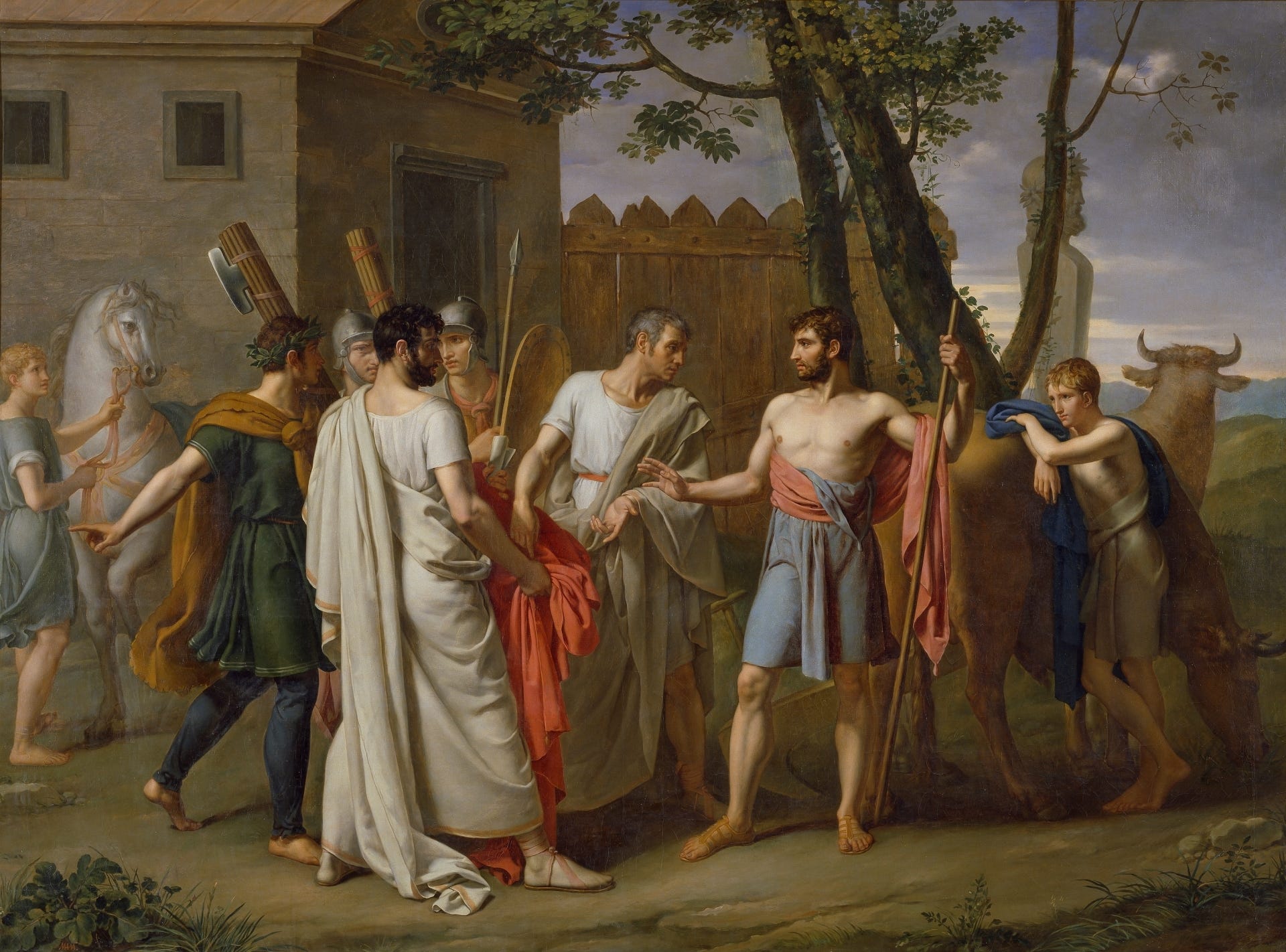
Cincinnatus Leaving the Plough | Juan Antonio Ribera, ca. 1806
Key Terms for this Section
Arete · Telos · Eudaimonia
Golden Mean · Kakia · Akrasia
4.1 | Personal Character
Central Question: What is the moral importance of character?
Character & Moral Formation
Our modern concept of character comes from the ancient Greek word kharasso, meaning “to engrave.” Ancient Greeks like Aristotle thought of one’s character as the deep mark or impression one makes on one’s own soul. This depth of character accrues over a lifetime of choices. It’s not at the surface — like how beautiful, popular, or on-trend you are. Character isn’t a tattoo, a meme, or shallow virtue signaling. It’s deeper. It’s a fundamental part of you that’s earned by making hard choices that influencers and the crowd often shun. Because seeking popularity (which usually requires embracing a kind of nihilism) is rarely a road to good character. Think of Hollywood actors. It’s unusual to find a celebrity who’s a genuinely good and selfless person. But you might be thinking, I want to be popular! I want to be an influencer! Why? For the vapid validation of a crowd who would turn on you in an instant if it helped grow their own popularity? We are taught these days to follow any dream we can imagine. But we are rarely taught to imagine a more moral version of ourselves. I am asking you to imagine that now.
For Aristotle, morality is less about what one should do in isolated moments, and more about what kind of person one becomes over time.
The ancient Greek conception of character emphasizes depth rather than appearance. It refers to the stable dispositions that govern how a person reasons, desires, and acts across situations. These dispositions are formed gradually, through repeated choices that leave a lasting imprint on the moral self.
This understanding rejects the idea that moral life is episodic or accidental. A single good action does not establish good character, just as a single failure does not necessarily corrupt it. What matters is consistency across time. Character emerges through habit, not impulse. Ethical evaluation, therefore, must look beyond isolated actions and examine the internal patterns that generate them.
Aristotle’s approach shifts moral attention inward without becoming subjective. Character is not a matter of feeling good about oneself or expressing sincerity. Rather, character is a structured moral achievement, shaped by education, discipline, and practical reasoning. Ethics, on this account, concerns the cultivation of stable excellence rather than compliance with external commands.
Virtue & Human Excellence
Aristotle names the central moral achievement of character Arete, the state of moral excellence in which a person fully realizes their human capacities through reasoned, habitual action. The term is often translated as “virtue,” but its meaning is broader than moral niceness or personal goodness. Arete refers to excellence of function: performing one’s distinctive human capacities well.
This concept assumes that human beings have a nature (much like Natural Law Theory). To say that a person can be excellent or deficient implies that there is something they are meant to do. Just as a knife is good when it cuts well, a human being is excellent when they reason, desire, and act in ways appropriate to rational creatures living in community. Virtue is not invented by culture or preference; it is discovered through reflection on what human flourishing requires.
Crucially, Aristotle denies that virtue is innate. No one is born good or evil. Instead, moral excellence is acquired through practice, education, and habituation. This distinguishes virtue ethics from simple ‘self-improvement’ efforts. Excellence is neither quick nor easy. It’s not an app you download or a group you join. It is earned through sustained alignment of your own judgment and desire.
Virtue also differs from mere rule-following. A person may obey rules without understanding them or act correctly for the wrong reasons. Such behavior does not constitute excellence of character (ie. one can’t be good on accident). For Aristotle, virtue requires that actions arise from sound reasoning and well-ordered desires. Acting well by accident, coercion, or calculation does not count as moral excellence.
In this way, virtue ethics presents morality as an integrated human achievement. Reason informs desire, desire motivates action, and action reinforces character. Ethical failure, conversely, occurs when these elements fall out of alignment. Moral evaluation must therefore attend to the internal structure of agency, not merely external compliance.
Reason, Desire, & Moral Action
Aristotle identifies three interrelated dimensions of moral life: reasoning, desiring, and acting. These elements must function together for genuine virtue to emerge. A failure in any one dimension compromises moral excellence, even if the outward action appears acceptable.
Reason provides moral discernment. It allows agents to deliberate about circumstances, assess ends, and choose appropriate means. Without sound judgment, action lacks moral direction. A choice made without understanding its significance cannot be fully virtuous, regardless of its outcome.
Desire supplies motivation. Human beings are not simply rational calculators; they are also creatures of appetite, emotion, and inclination. For virtue to be possible, desires must be educated rather than suppressed. Acting well while desiring what is base reflects internal conflict rather than moral harmony. Excellence requires that desire itself be shaped by reason.
Action completes the moral process. Reasoned desire must culminate in deliberate conduct. However, not every outwardly good action reflects virtue. Actions performed from fear, convenience, or external pressure lack the internal coherence that virtue demands. Moral excellence requires intentionality and consistency, not isolated correctness.
This integration explains why Aristotle treats ethics as a lifelong practice rather than a decision procedure. Moral development involves training reason, disciplining desire, and reinforcing action through habit. Over time, these elements coalesce into stable character. The virtuous person does not merely act well; they are disposed to act well because excellence has become second nature.
By grounding morality in character, Aristotle provides a framework that explains moral reliability. A person of good character does not need constant rule consultation or outcome calculation. Their dispositions guide action appropriately across varied circumstances. Ethics, on this view, aims not at perfect compliance but at dependable moral agency.
Optional Video: Introduction to Aristotle’s Ethics (auto-generated CC).
4.2 | Finding Our Purpose
Central Question: What does it mean to ‘live well’?
Purpose & Human Action
Aristotle begins his ethical inquiry with a claim about human action itself: actions are not random. Human beings act for reasons, and those reasons point beyond their actions to some further aim. Eating, studying, working, forming relationships, and participating in civic life are not ends in themselves. They are pursued because they are thought to lead to an even greater end.
Aristotle names this orientation toward an aim as Telos, the end, goal, or purpose toward which an activity or life is directed. To speak of a telos is not discussing mere intentions; it’s a complex web of actions taken toward goals in the service of some final goal. For this reason, Aristotle claims an activity only makes sense when seen in light of what it is for. Without a goal, an action isn’t just a failure, it literally doesn’t make sense as a rational action.
This applies not only to particular actions but to one’s entire life. People routinely explain their choices by reference to longer-term aims: security, fulfillment, stability, achievement, or greater meaning. Even when these aims conflict, they reveal an underlying assumption that life itself is oriented toward something worth pursuing.
Importantly, Aristotle does not treat purpose as a matter of personal preference. A purpose is not whatever an individual happens to desire. Some desires are instrumental, valued only because they lead to something else. Others are temporary or mistaken. To identify a genuine purpose, Aristotle asks which aims are intrinsic (sought for their own sake) rather than merely instrumental toward some other end.
This distinction allows Aristotle to narrow the ethical inquiry. If many actions are pursued for the sake of something else, then ethics must concern the highest end — the aim that organizes all others. Ethics, therefore, becomes the study of what ultimately makes a human life successful rather than merely busy or productive.
The Highest Human Good
Aristotle argues that human desires form a hierarchy. Money is desired for what it can buy. Status is desired for the opportunities or recognition it brings. Pleasure is often desired for the satisfaction it provides. These goods are valuable, but their value depends on what they contribute to something further.
At the top of this hierarchy stands Eudaimonia, the condition of deep human flourishing achieved through living well over the course of a complete life. Though often translated as “happiness,” the term does not refer to a fleeting feeling or emotional state. It names a stable condition of life going well as a whole.
Eudaimonia is sought for its own sake. It is not a tool for achieving something else, nor does it require justification beyond itself. When people ask why they want wealth, success, or pleasure, the answer eventually terminates in some version of “because it will make life go well.” Aristotle identifies that endpoint as eudaimonia.
Crucially, eudaimonia is not reducible to “pleasure.”
A life filled with comfort but lacking integrity, purpose, or excellence would not qualify. Nor is it reducible to success or recognition. A person may be admired and yet live poorly. Eudaimonia concerns the quality of a life as measured by how well human capacities are realized, not by how pleasant or impressive that life appears.
This explains why Aristotle insists that eudaimonia cannot be assessed in isolated moments. A single good day does not establish flourishing, just as a single failure does not negate it. Flourishing is evaluated across time, requiring stability, coherence, and consistency. A life may only be judged flourishing once it has taken shape as a whole.
By identifying eudaimonia as the highest human good, Aristotle gives ethics its direction. Moral inquiry is no longer about maximizing pleasure or obeying rules in isolation. It becomes the study of how a human life ought to be lived if it is to succeed on its own terms.
Purpose, Reason, and the Good Life
Having identified the highest end, Aristotle asks what kind of activity realizes it. Human beings share many functions with other living things: growth, reproduction, sensation, and appetite. None of these, however, uniquely define human life. What distinguishes human beings is our capacity for reason.
A flourishing human life, therefore, must involve the excellent use of reason. This does not mean abstract thinking alone. Reason governs deliberation, choice, desire, and action. To live well is to bring these elements into alignment over time, guided by sound judgment rather than impulse or social pressure.
This is why Aristotle links eudaimonia directly to character. A person cannot flourish through occasional good actions disconnected from the rest of life. Nor can flourishing be achieved through external goods alone. Wealth, health, and friendship may support a good life, but they do not constitute it. The core of flourishing lies in how a person lives, chooses, and acts.
Purpose, then, is not discovered solely or even primarily through introspection, as is often thought. Rather, Aristotle argues that our purpose is revealed through activity. A life oriented toward eudaimonia must be structured around practices that cultivate excellence rather than undermine it. Repeated choices shape habits, habits shape character, and character determines whether a life coheres around its highest end.
This framework explains why ethical evaluation extends beyond intentions. A person may sincerely desire happiness while pursuing it through means that frustrate it. Short-term pleasure, unchecked ambition, or avoidance of difficulty may feel attractive, yet they can erode the very conditions required for flourishing.
Aristotle does not promise fulfillment without effort, nor does it reduce the good life to compliance. It presents human flourishing as an achievement — one that requires time, discipline, and the cultivation of excellence.
With the concepts of telos and eudaimonia in place, the structure of Virtue Ethics is complete. The remaining lessons in this section will clarify how excellence is maintained through moderation, how it can fail, and how different kinds of moral character relate to the pursuit of a flourishing life.
4.3 | Aristotle’s Golden Mean
Central Question: How do we find virtue?
Virtue as Moderation
Having established that moral excellence concerns character and that human flourishing is the goal of ethical life, Aristotle turns to a practical question: how is excellence maintained in action? His answer rejects both excess and deficiency. Moral failure, on this account, arises from wanting too much or too little of the right thing.
Aristotle describes virtue as a form of moderation. This does not mean compromise or mediocrity. Moderation refers to proportion and balance — responding appropriately to circumstances rather than reacting impulsively or rigidly. Moral excellence requires sensitivity to context, not mechanical rule-following.
To capture this structure, Aristotle introduces the Golden Mean, the morally appropriate midpoint between two opposed vices, one of excess and one of deficiency. The mean is not an average and not identical for everyone. It is determined by reason, circumstance, and the nature of the action involved.
Example Virtues with a Golden Mean (between two opposing vices)
( too little ) Balance / Virtue ( too much )
cowardice —> COURAGE <— recklessness
indulgence —> TEMPERANCE <— weakness
pride —> MODESY <— excess humility
secrecy —> HONESTY <— won’t be quiet
apathy —> COMPOSURE <— anxiety
This conception distinguishes virtue ethics from ethical frameworks that treat right action as uniform across moral agents and situations. Aristotle does not deny that some actions are always wrong. Rather, he claims that most moral qualities (like courage, generosity, or patience) come in degrees. Virtue consists in getting those degrees right.
There are, of course, wholly good virtues like wisdom and prudence. You can never have too much wisdom, just ignorance. You can also never be too good at decision-making (ie. prudence). Justice works in much the same way. There’s no such thing as “too much justice,” only justice denied. As to absolute vices, yes, those exist too. You can never have any amount of theft, racism, or murder, for example. Some things are just terrible.
But for most virtues, the Golden Mean provides a framework for moral judgment without reducing ethics to mere calculation. It does not instruct agents to split the difference between extremes, but to identify what is fitting in light of reasoned judgment. Moral excellence lies in appropriateness, not symmetry.
Vices of Excess and Deficiency
Aristotle holds that most moral failures can be understood as distortions of otherwise valuable traits. Fear, desire, confidence, anger, and generosity are not inherently problematic. They become problematic when they are misaligned with reason. The Golden Mean allows Aristotle to map moral error systematically.
Consider courage. A deficiency of fear results in recklessness (ie. acting without regard for danger or consequence). An excess of fear results in cowardice (ie. failing to act when action is required). Courage lies between these extremes, involving appropriate fear and appropriate confidence in light of circumstances.
The same structure applies across one’s moral life. Excessive desire becomes indulgence; deficient desire becomes apathy. Excessive self-assertion becomes arrogance; deficient self-assertion becomes servility. In each case, virtue preserves what is valuable while avoiding distortion.
Importantly, Aristotle emphasizes that the aim (or ‘mean’) is relative to the moral agent. What counts as ‘appropriate generosity’ for a person with limited means differs from what counts as ‘appropriate generosity’ for a person with vast resources. Moral judgment must therefore account for context without collapsing into subjectivism.
This relativity does not undermine objectivity. The Golden Mean is determined by rational assessment of facts, roles, and consequences, not by personal preference. A generous action is generous because it fits the situation, not because it feels generous to the agent.
By framing vice as excess or deficiency, Aristotle explains why moral failure often feels tempting or justified. Vices often exaggerate genuine goods. The Golden Mean restores proportion, allowing virtue to remain stable rather than extreme.
Reason, Practice, and Moral Stability
The Golden Mean requires cultivated judgment. Aristotle insists that reason must guide emotion rather than suppress it. Fear, desire, and anger are not eliminated in virtue; they are educated. Moral excellence lies in feeling the right things, toward the right objects, for the right reasons.
This is why Aristotle emphasizes practice.
One does not calculate the mean abstractly and then apply it flawlessly. The mean is learned through habituation: by repeatedly acting, reflecting, correcting, and refining judgment. Over time, appropriate responses become second nature.
Consistency is essential. An isolated moderate act does not establish virtue. Virtue requires reliability across situations. A person who acts generously only when observed, or courageously only when confident of success, has not achieved moral stability. The Golden Mean must be embodied, not occasionally approximated.
This framework also explains why moral development is gradual. Early efforts often overshoot or undershoot the mean. Excessive rigidity or excessive indulgence may appear while a young person’s judgment matures. Aristotle treats these missteps as part of moral education rather than as definitive failure.
The Golden Mean therefore functions as a stabilizing principle within Virtue Ethics. It protects against moral extremism without encouraging complacency. It requires attentiveness rather than formulas, and judgment rather than impulse.
With moderation in place, Aristotle can now account for moral success and moral breakdown. The final lesson in this section will classify different kinds of moral character based on how reason and desire interact in practice.
4.4 | Four Kinds of People
Central Question: Why do people act against their better judgment?
Character & Moral Alignment
Having explained moral excellence, purpose, and moderation, Aristotle turns to moral psychology. Not all people relate to virtue in the same way. Some act well with ease, others with struggle, and others not at all. These differences are not superficial. They reflect deep alignments (or misalignments) between reason, desire, and action.
Aristotle therefore classifies moral character types based on how these elements interact. The classification is not meant to shame or label individuals permanently. Rather, it explains why moral advice works for some people and fails for others. A person who struggles to act well requires different guidance than a person who does not recognize virtue at all.
This typology assumes that moral character is formed through habit. People become what they repeatedly choose. Over time, these choices shape not only behavior but also desire and judgment. Eventually, acting well or poorly feels natural. At that point, moral differences become structural rather than situational.
Aristotle’s account also clarifies why ethical disagreement is often intractable. People do not merely disagree about actions; they differ in what they perceive as good, tempting, or worth resisting. Moral reasoning cannot proceed identically for all agents because agents themselves are differently formed.
The four kinds of people Aristotle describes mark stages and conditions of moral development. They explain moral failure without denying responsibility and moral success without idealizing perfection.
Vice & Moral Weakness
At the lowest end of moral character is Kakia, a condition of vice in which a person’s reasoning and desires are corrupt and oriented toward the wrong ends. The “vicious” person (how kakia is often translated) does not merely act badly; they endorse bad action as appropriate. What appears immoral to others appears justified, reasonable, or even admirable to them.
This condition is the most severe because it involves distorted judgment. The vicious person does not experience internal conflict when acting wrongly. Their desires align with their actions, but toward harmful ends. As a result, moral correction is difficult. Appeals to reason often fail because reason itself has been misapplied for so long. Importantly, recall that for Aristotle vice develops through habituation, just as virtue does. Repeated rationalization of wrongdoing reshapes judgment until harmful actions no longer appear harmful. Over time, vice becomes stable.
Distinct from vice is Akrasia, the condition of moral weakness in which a person knows what the good is but fails to act on that knowledge due to disordered desire. Unlike the vicious person (kakia), the “weak” person recognizes the right course of action, desires it (at least in part), yet acts against that judgment.
Akrasia is embroiled in deep internal conflict. Reason points in one direction while appetite pulls in another. The resulting action contradicts the agent’s better judgment. Unlike the vicious person, the weak person experiences regret, guilt, or frustration after acting. Importantly, the weak person recognizes their moral failure as failure.
This distinction matters because moral weakness is recoverable. Since judgment remains intact, education and habituation can realign desire with reason. The weak person does not require moral reorientation so much as moral strengthening.
By separating vice from weakness, Aristotle avoids treating all wrongdoing as identical. Some failures reflect deep corruption; others reflect instability. This is an important distinction in ethics.
Moral Strength & Excellence
Between weakness and excellence, Aristotle identifies the morally strong person. This individual desires wrongful actions but resists them through effort and self-control. Reason governs action, but not without strain. The good is chosen, though temptation remains active.
This condition demonstrates moral progress but not completion. The strong person acts well, yet acting well is difficult. Desire has not yet been fully educated. Moral life involves vigilance rather than ease.
At the highest level stands the virtuous person. Here, reason and desire are fully aligned. The virtuous person does not struggle to choose the good because the good is exactly what they want. Action flows naturally from character. Moral excellence has become stable.
This does not imply perfection or infallibility. The virtuous person can err. However, such errors are exceptions rather than patterns and are recognized quickly as deviations from character. With this, we’ve now come full circle in Section 4.
Herein we’ve explored how moral development progresses, why moral advice varies in effectiveness, and how moral failure differs in kind rather than degree alone.
Most importantly, we’ve learned that morality is not primarily about isolated actions, but about the kind of person one becomes over time (ie. one’s character).
Optional Video explaining the marshmallow test (auto-generated CC).
This Section: Personal Character | Aristotle
Next Section: Epicurus & the Stoics