

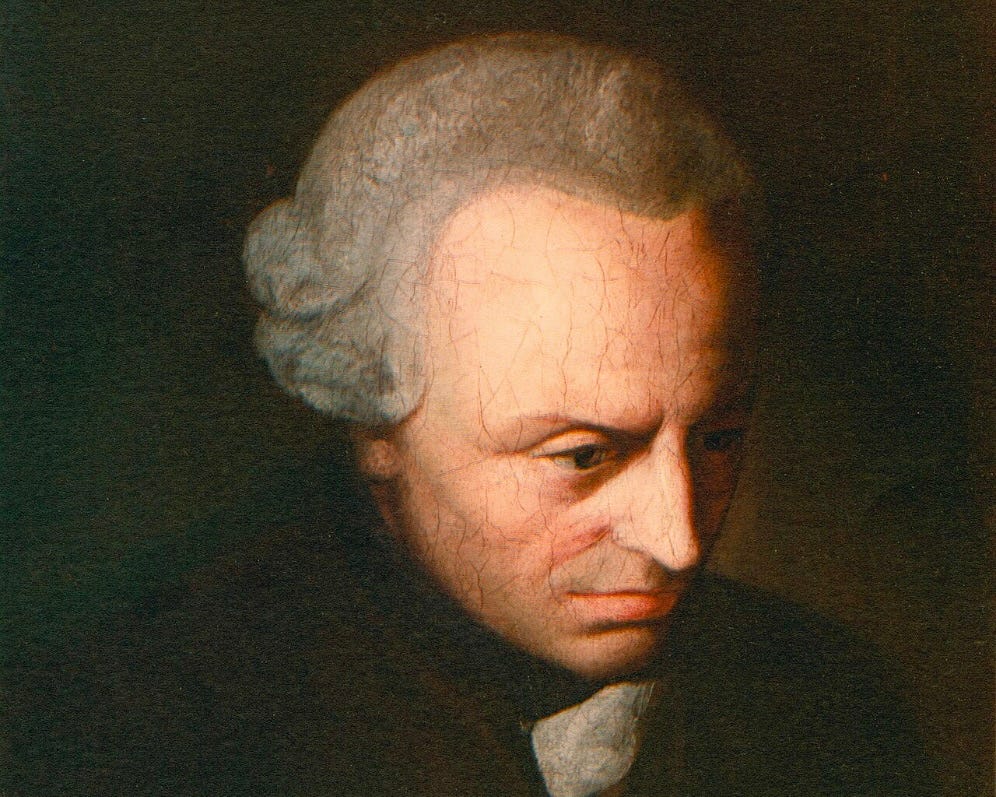
Immanuel Kant | Gottlieb Doebler, ca. 1791
Key Terms for this Section
Moral Absolutism · Maxim/Axiom · Categorical Imperative
Moral Pluralism · Prima Facie Duties
7.1 | Universal Ethics - Spinoza
An Ethics for Everyone?
According to Thomas Hobbes (d. 1679), ethics is dependent on the culture in which one lives. That is, the “social contract” that I live under in Texas is notably different from the rights and laws of North Korea. In North Korea, it is illegal to speak against the nation’s leader. But in Texas, political criticism is defended by the First Amendment. In this way, our Constitution is the supreme social contract Americans have with one another. But as we saw in Sec 5.1, imagining ethics being dictated by one’s culture leads to a number of problems. Not only does cultural relativism halt moral progress, but it denies the existence of human rights. So, as the early modern Wars of Religion came to an end and the modern world shrank in size, moral philosophers looked for ways to ground ethics in universal, absolute conditions outside of the Church (cf. Sec. 6.1).
The principle behind Universal Ethics is Moral Absolutism — the notion that there are objective moral rules applicable to all moral agents. Surely, we can understand the appeal of such an idea. If everyone followed the same ethical norms, we could eliminate unjust practices like favoritism, nepotism, and discrimination. Is such an idea possible? Well, despite our many cultural and geographical differences, we can see that most societies share fundamental values such as protecting children, promoting truth-telling, and prohibiting harm to individuals without just cause.
To make an absolutist moral claim, there must be an objective basis for determining right and wrong. The three most notable Ethical Frameworks that aim for this are Divine Command Theory (Sec. 5.4), Deontology (Sec. 7.3), and Utilitarianism (Sec. 8.3). In Divine Command Theory, whatever the gods command is good because the gods are objective and wise. Deontology, which we’ll be looking at closely in Sec. 7, argues that individuals ought to act based on their universalizable duty. And Utilitarianism, which we’ll be exploring in Sec. 8, argues that actions ought to be chosen based on the most optimific outcome (ie. what makes the most people happiest).
While each of these moral frameworks has its strengths and weaknesses, they all share in the fundamental idea that there is a universal moral good that all individuals should follow. The central claim of Universal Ethics is that by adhering to universal principles, we ensure that our actions are based on objectivity and reason, rather than subjective opinions or cultural biases. The aim of this view is to engender a more just and equitable world for everyone.
Developing Secular Ethics | Spinoza
From the Crusades to the birth of the United States, two Jewish philosophers stand apart — the medieval Maimonides, the Great Eagle of the Talmud, and the early modern Dutch master, Baruch Spinoza (d. 1677). In Sec. 3.1, we see how Maimonides (d. 1204) focuses on the use of reason to understand both God and the natural world, arguing that natural law and divine law are ultimately the same. After the Renaissance and the turn toward European Rationalism, Spinoza retains the high place of reason as the keystone of human understanding. However, Spinoza secularizes the concept — finding moral truths in nature itself rather than divine revelation. How?
Well, take for example St. Aquinas (d. 1274). The medieval monk claims that moral principles are an inherent part of the structure of reality, discoverable through reason (cf. Sec. 5.5). Fair enough — Spinoza thinks so, too. But where St. Aquinas says that these natural laws are ordained by a transcendent God, Spinoza doesn’t agree. Spinoza counters St. Aquinas by claiming that belief in a personal God is an anthropomorphic error. That is, we humans project our insecurities onto a divine Father and declare Him our Lawgiver. But Spinoza claims this unnecessarily limits God. For Spinoza, there is not a bearded, male, jealous Deity Who creates nature, prescribes our behavior, and judges morality like the saints describe. Rather, for Spinoza, God is transcendent and impersonal — manifesting Godself through the natural order and structure of reality. In other words, God and Nature are the same.
For Spinoza, God is the structure of the universe and the ultimate cause of everything that happens. Everything in nature follows the same necessary laws as an expression of God. So, to his thinking, praying for miracles makes no sense because this would be an aberration from God’s own natural law. Rather, our task as rational thinkers is to discover natural laws (cf. Sec. 3.5), including the ethical principles embedded therein.
We can see this same appeal to rationalism in Spinoza’s contemporary, René Descartes (d. 1650). Descartes argues that reason alone reveals universal truths about reality. Spinoza extends Descartes’ rationalism into moral philosophy — asserting that human beings can discover the inherent, universal moral laws of nature through reason.
The Modern Ethical Project
In Hobbes’ work, the Leviathan (1651), the English philosopher and contemporary of Spinoza seeks to ground moral and political obligations in the framework of the social contract, removing them from the realm of religious authority (cf. Sec. 6.1). To review, Hobbes finds human beings to be fundamentally selfish and driven by self-preservation, which leads them into conflict in the state of nature. To avoid this chaos and violence, we enter into a social contract (ie. a government), agreeing to obey a powerful king who ensures our peace and security (cf. Sec. 6.2). In Hobbes’ view, moral laws are not divine commands but agreements made to avoid the destructive consequences of unrestrained human behavior. Thus, ethics for Hobbes is rooted in political control and the enforcement of order rather than religious authority.
However, in Spinoza’s Ethics (1677), the Jewish philosopher veers away from Hobbes’ reliance on coercive political authority. In brief, Spinoza is a far more optimistic political thinker than Hobbes. For Hobbes, the purpose of government is to make sure we don’t kill each other. Spinoza is also concerned about the religious wars and religious persecution of 17th-century Europe — especially as a religious minority in the Spanish-owned, Protestant Netherlands. However, Spinoza claims that governments exist primarily to promote the necessary conditions for developing our reason to our fullest potential. In his Tractatus Theologico-Politicus (1670), Spinoza posits that rational citizens who understand their own nature and interests would logically support the collective good. No Hobbesian coercion necessary.
And so, after the passing of Europe’s Jewish and Anglican moral juggernauts — Spinoza (d. 1677) and Hobbes (d. 1679) — Europe was left with a secular ethical project in which:
• Morality is discoverable through reason (Aristotle, d. 322 BCE)
• Moral laws are embedded in the fabric of reality (St. Aquinas, d. 1274 CE)
• People of all religions wish to limit harm to themselves (Hobbes, d. 1679)
• Discovery of universal, secular laws is both possible and necessary (Spinoza, d. 1677)
• All people have natural rights to liberty, autonomy, and political consent (Locke, d. 1704)
• And state laws must be subordinate to the general will of the people (Rousseau, d. 1778)
This is how Immanuel Kant inherits the modern ethical project and writes his second critique of Modern Philosophy, The Critique of Practical Reason (1788).
7.2 | Ethics after Hobbes
Criticizing Hobbes
The Social Contract Theory found in Hobbes’ 1651 Leviathan is a selfish, goal-oriented ethics. If you want to remain in our city, then you must follow our rules. Hobbes imagines this to be the basis of morality. Kant strongly disagrees.
When criticizing Hobbes, we could have a go at the implicitness of the consent Hobbes is promoting (ie. do natural-born citizens actually sign a contract stating they’ll abide by the Constitution?). Locke argues this when he explicitly states that lawful governance only arises from the consent of the governed. Or, we could argue that Hobbes doesn’t explain how we should address disagreements in our society — particularly between minorities and the ruling majority. That is, if a minority group disagrees with the majority’s decisions, should they simply accept the majority’s will, or should they be allowed to form their own contract? Or, we could dive into the quagmire that is Hobbesian mutual benefit. To wit, Hobbes states that citizens obey laws in exchange for the government’s protection. But this quid pro quo formula clearly marginalizes vulnerable populations that cannot reciprocate — such as infants, animals, recent immigrants, or future generations. Hobbes gives us no reason to be good to those who can’t benefit us — which would render ethics into nothing more than a transaction.
Yet Kant starts somewhere even more fundamental. For the Prussian philosopher, Hobbes’ entire ethical project of goal-oriented ethics is wrong from the start. Kant dismissively refers to goal-oriented ethics as following hypothetical imperatives. The “hypothetical” in this phrasing refers to “if/then” thinking. In other words, in a hypothetical imperative, a person is motivated by a reward. But this isn’t ethics, Kant says.
“If you want good grades, then you should study. If you want to lose weight, then you should diet. If you want to maintain a good reputation, then you should act well.” These are all examples of hypothetical imperatives. And Kant hates them all. After all, if a person is only behaving because they don’t want to get in trouble, we can hardly call such a person ‘good.’ The ‘good’ person isn’t the person who slows down at the sight of a patrol car or the person who puts their phone away when the usher goes by in a theater. That’s just the self-serving behavior of someone who doesn’t want to get caught. Instead, Kant wants us to think about how our duties should shape our behavior before we ever consider how the outcome affects us.
A Duty-Based Ethics
Deontology is a form of Universal Ethics that focuses on the study of moral duties rather than moral virtue or consequence. The word deontology comes from the Greek words “deon” (Gr. duty) and “logos” (Gr. reason). You’ll recall from our study of Aristotle (Sec 5.2), that teleology is the philosophical study of goals or ends. Well, some, like John Stuart Mill (Sec 8.3) will take a teleological view of ethics — focusing on the ends or consequences of moral actions. But deontology is different than these two. In a deontological view of ethics, one focuses on the moral principles that underlie the fulfillment of one’s duties. That is, in contrast to character (cf. Aristotle) or outcome (cf. Mill), the deontologist concentrates on the reasoning that grounds our duties.
The Centrality of Duty | Kant
Let’s return now to Hobbes’ goal-oriented duties (ie. hypothetical imperatives).
If you’re just being good to get a treat, then you’re not really a moral person after all (cf. Hobbesian selfishness). Behaving well for a tasty treat is how we train animals and toddlers. Goal-oriented, hypothetical imperatives like this are conditional. If you want this, then do that… But that’s not how ethics works, according to Kant. We should do right solely because it’s the right thing to do. The same goes for punishment. If we only behave out of fear of punishment, then we’re not good at all — in such a moment, we’re only working with duty, not from duty. See? If your neighbor refrains from throwing eggs at your car out of fear of the police, does that make her a good person? Of course not. Or if your partner helps you bring groceries into the kitchen so you’ll later watch the show they like, was their assistance a morally praiseworthy act? Not at all.
Here, we see that our motives (ie. reasons for acting) are essential to living ethically. What Kant wants from us is to do the right thing out of a sense of duty. In this way, we are good when we act out of a sense of moral duty, not out of personal gain or self-interest, as Hobbes would have us do. When you think about it, there are many actions that could be considered good but be performed for the wrong reasons — like picking up trash, joining a volunteer organization, or taking your grandmother grocery shopping. If you do them because it’s the right thing to do, then Kant thinks that’s great! But if you’re picking up trash because you owe the city community service hours, or you’re volunteering to earn a scholarship, or helping grandma so she’ll keep you in her will — well, you’re not doing anything good, really. The only way to truly be a moral person, according to Kant, is to act from a sense of duty.
Now, you may ask, “Is it still acting with duty if I enjoy doing it? What if I like to shop for groceries for my partner? What if I like taking my family to church? What if I like volunteering at the animal shelter?” Yes, this is ok for Kant. But we must be clear — the underlying motivation for performing an action must begin from a sense of moral obligation to have moral worth. In other words, the fact you enjoy it or possibly get something out of it must be incidental.
In other words, you’d be doing it whether you enjoy it or not, as it’s the right thing to do.
7.3 | Maxims & Reason - Kant
Good Maxims | Kant
For Kant, the worth of a moral action cannot be derived from its purpose or outcome but only from the moral axiom that it follows. This means that even if an action’s outcome or purpose seems positive (eg. it saves a life), it does not have moral worth unless it was done out of a sense of duty. By prioritizing the duty to do the right thing, Kant places emphasis on the importance of personal responsibility and ethical behavior regardless of external factors.
So what is a moral axiom? Here, Kant is using the German word maxim (Lt. axiom). A maxim is a principle of action for a moral problem. This principle determines the action’s moral worth. That is, if an action arises from a good maxim, then the action is praiseworthy. If an action arises from a bad maxim, it is not praiseworthy.
For example, let’s say that we live by the maxim that “lying is wrong.” So when someone asks our opinion about their new haircut, we’re honest about it. In general, Kant would say such honesty is morally praiseworthy when it arises from a sense of duty to the truth (ie. our action arises from a good maxim, namely that “lying is wrong”). But if you tell your boss that you like his haircut to curry favor with him, then this would be wrong. Why? Because your action arose from a bad maxim (ie. “I should manipulate my boss, so he looks on me favorably”). In another situation, let’s say a friend is going through some difficult stuff and gets a bad haircut. He then asks your opinion. The maxim, “lying is wrong,” may do more harm than good here. So, we might amend our maxim to, “lying is wrong, except when it’s a little white lie to boost a sad friend’s feelings.” Such additional details can aid in building better maxims (ie. the principles by which we act). Just keep in mind — the moral worth of an action (eg. praising someone’s haircut) is determined by whether the action arose from a sense of duty and whether its maxim is sound.
Bad Maxims | Kant
But suppose your friend works in the back kitchen of a busy restaurant. One night, a kitchen fire breaks out, and he goes running for the exit. On his way out, he attempts to push another guy out of his way but accidentally pushes the guy out the door to safety. Was this a morally praiseworthy action for Kant? In a word: No. The consequence or outcome of your friend’s reckless behavior was that the other guy’s life was saved. Sure. But, saving the guy’s life was not on your friend’s mind when he went running for the exit. In short, your friend didn’t push the guy out the door from a sense of duty. He saved a life totally by accident! Here, your friend was operating from a maxim that says, “If there’s a kitchen fire, push people down if you have to in order to reach safety.” This is clearly not a moral maxim. So, a deontologist would call your friend’s pushing immoral because it arose from a bad maxim, even though it also incidentally saved a life. Note here that a consequentialist (cf. Sec 8) will think the action praiseworthy because the outcome (which is their focus) was saving a life.
Commanded by Reason | Kant
In ancient times, we were commanded by the gods (ie. Divine Command Theory). But since the time of Hobbes and Spinoza, we’ve walked away from God-talk in normative ethics (cf. European Wars of Religion). Still, Kant thinks there’s something to those ancient commands or ‘imperatives.’ He thinks ethics works best when focused on commands, but neither divine commands nor goal-oriented, hypothetical imperatives are sufficient (cf. Sec 7.2). Kant thinks there’s a more reasonable, modern answer.
Unlike Hobbes, Kant insists that ethics is never conditional on your selfish, subjective goals. Instead, Kant maintains that ethics is an absolute, immutable part of our reality. For deontologists like Immanuel Kant or W.D. Ross (cf. Sec 7.5), ethics is not something we agree upon but is instead a deep-set part of reality that is as undeniable as the speed of light or the theory of gravity. We don’t agree on ethics. We discover ethics. For Kant, ethical principles have the structure of immutable universal laws. Chief among these laws is the ultimate, absolute law from which all other laws arise: the Categorical Imperative.
If our ethical imperatives are based on universal principles, consistent and applicable to everyone, then there can be no stench of self-interest or favoritism in our maxims. In fact, the only maxims (ie. principles of moral actions) we ought to follow are those we can also impose equally on everyone else. This is what Kant refers to as the Categorical Imperative. In Kant’s words, “Act only according to that maxim by which you can at the same time will that it become a universal law.” Kant’s Categorical Imperative has four formulations. In the following lesson (ie. Sec 7.4), we will discuss two of these formulations.
7.4 | Deontological Principles - Kant
The Categorical Imperative: Kant's Principle of Universality
At the very core of Deontology is the claim that everyone must be treated equally in ethics. There cannot be exceptions in Universal Ethics (otherwise, they wouldn’t be universal!). Taking into consideration all we’ve discussed, we may then understand Kant as claiming: I know right from wrong because of the duties that reason can determine should be universally applied [equally and to everyone].
The Categorical Imperative is the ultimate law of ethics for Immanuel Kant. One of its four formulations (ie. the Principle of Universality) involves testing the morality of an action to see if it can be made into a universal law. This involves three steps.
) Determine the maxim of the action. For example, imagine someone is running late to pick up their friend and decides to speed down the highway. Their maxim would be, “It’s ok to speed if you’re late picking up a friend.”
) Imagine everyone adopts this maxim. In a world where speeding is ok if you’re late picking up a friend, our roads would become irrevocably dangerous. This is far worse than what we have now.
) Ask if it’s reasonable to will this maxim on the world. Would it be reasonable to will onto the world the maxim “it’s ok to speed if you’re late picking up a friend,” given that this would make our roads far more dangerous than they are now? No! Well, then, you have your answer. Logic commands you not to speed to pick up your friend because you cannot reasonably will everyone else to behave that way.
The rational person is commanded by reason to accept only the ethical principles that can be universalized. Through the Categorical Imperative, Kant provides a framework for testing the morality of our actions. Because, unlike Hobbes’ contention that ethics is conditional on our own self-interest, Kant says that ethics is absolute and universal — in part because we’re all of equal moral worth. So why can’t we speed down the road to pick up our friend? Because it would be illogical.
Why illogical? If we submit that ethics is universal, then that means everyone must be treated the same way (ie. the Principle of Universality). If everyone must be treated the same, then logically, I cannot make an exception for myself. So if everyone can’t speed down the road, then I shouldn’t either. In this way, reason commands us to share the road safely, as it would therefore be illogical for any one person to speed. If we treat anyone as being above the moral law (including ourselves), then we have acted inconsistently (and therefore illogically!) with the universal nature of ethics.
The Categorical Imperative: Kant's Principle of Humanity
A fundamental modern notion of Kant’s is that we are “autonomous” (cf. Locke) — from the Greek for self (auto) governing (nomos). This notion arises from the Lockean claim that we can act from our own reason, rather than being forced to behave by some overbearing external force — like a king or a priest (cf. Hobbes). Whereas the lords and land barons of the medieval world thought little of our value beyond its instrumentality for making them money, Kant argued human beings have inherent worth. Where we common people were once treated as merely a way to make the aristocracy money (ie. a means to an end), in the modern age Kant says we must demand to be treated better! Because when we are treated only as a means to an end, our intrinsic value as human beings has been violated.
In a word, a human being does not have a price. A fellow human being has dignity.
Kant argued that all rational beings should be treated as ends unto themselves. This is because our value as humans is intrinsic and not instrumental. You’ll recall from our discussion on Aristotle that intrinsic means “for its own sake.” Something has intrinsic value when it is valued for its own sake. Something has instrumental value when it is wanted for some other purpose. For example, a diamond only has instrumental value because it can be traded for other things of value. A diamond doesn’t have intrinsic value because it has no inherent worth (ie. it’s just a lump of common carbon). But humanity functions in an entirely opposite way. A person has intrinsic value because human life is cherished for its own sake.
Because of our intrinsic value as humans, Kant argues it would be illogical (and therefore immoral, as this is a question of ethics) to treat humans merely as objects of instrumental value. Accordingly, a good Kantian must recognize and respect the inherent dignity of all humans and resist the temptation to use people as mere tools to achieve personal goals or desires. In this way, we may understand the Kantian Principle of Humanity as saying: I know right from wrong because of the duties that reason can determine should be universally applied [wherein people are treated as ends unto themselves].
Essentially, this formulation of the Categorical Imperative (ie. the Universal Moral Law) recognizes and lifts up the autonomy and agency of the individual, emphasizing that she is to be treated with the utmost dignity and respect. Remember, the seventeenth and eighteenth centuries are when we started arguing for our Natural Rights (cf. Hobbes). Questions like “how much is a human life worth?” are obscene to thinkers like Hobbes and Kant. Why? Because human life cannot be quantified in such a way — we have intrinsic value! (Note: J.S. Mill and the Consequentialists will feel very differently about this.) Ethically, we cannot be traded or sold. Constitutive to our identity as humans, we logically should treat one another humanely. This means never letting ourselves forget the inborn, intrinsic value of our fellow persons.
Is it ever OK to Treat People as a Means to an End?
Actually, yes. And I hope you do! We treat waitstaff at a restaurant as a means to receive our food. We treat employees as a means to build wealth. And we treat professors as a means to earn a college degree. It would be weird if we acted like it was beneath the dignity of our waiter to bring us dinner, or our employees to show up to work. Don’t make it weird. What’s at stake here is the word “mere” in Kant’s formulation. He says, “Act in such a way as to treat humanity as an end unto themselves rather than a mere means to an end.” See, Kant isn’t saying it’s outright wrong for us to treat employees as a means to build wealth. That’s fine if that’s what they chose. What would be immoral, however, is if we only treated employees as a mere means of building wealth. We must first and foremost treat people as having intrinsic value — as an “end unto themselves.” So, yes, your waitress does indeed have instrumental value insofar as she takes your order and delivers your food. However, let’s never lose sight of the fact that before she’s your waitress, she is also an emotional, inspired, beautiful human being — whose radiance and intrinsic value lie far, far beyond the banality of your dinner plate. Please treat her accordingly.
7.5 | Prima Facie Duties - Ross
Kant's Major Problem: What about Conflicting Moral Duties?
Deontology is a modern voice of reason in a sea of callbacks to monarchy and tradition. Yet there is a systemic problem with the kind of deontology Kant espouses. What’s the problem? So Kant wants us to follow our universalizable maxims (ie. our duties). Sure. But what happens when we have overlapping or conflicting duties? For example…
1.) Should I lie about a runaway slave to save a life, or report them honestly to the authorities?
These are two conflicting duties: save a life vs. my duty to the truth
2.) Should a doctor respect his patient’s confidentiality, or warn others he’s a danger?
These are two conflicting duties: the doctor keeping her word vs. saving others
3.) Should a friend keep a promise, or break it by sharing their friend’s infidelity?
These are two conflicting duties: maintaining a friend’s trust vs. ending an affair
4.) Should an officer follow orders, or cease to violate someone’s civil rights?
These are two conflicting duties: obeying his orders vs. obeying his conscience
The central problem of Kant’s Deontology is its reliance on Moral Monism: the position that there is a single, overriding rule about morality. In Kant’s case, this single rule is the Categorical Imperative. The same problem exists for Utilitarianism as well. Neither deontological ethics (Kant, Sec. 7) nor teleological ethics (Mill, Sec. 8) provide any guidance for how to deal with moral contradictions. While there is much to respect about Kant’s efforts, this remains his fundamental flaw.
Take, for example, the concept of lying. Once logic dictates our duties, we must follow them universally and unconditionally, right? Well, truth-telling intuitively seems like a fairly important duty. As lying violates our logical, moral duty to tell the truth (logically, lying undermines relationships, contracts, legal testimony, etc.). But aren’t there situations when we have a higher duty to lie? What about lying to prevent harm or to save a life? If we had a neighbor, whose barn was part of the hallowed Underground Railroad, would we not lie to the authorities to save the lives of runaway slaves? Yet Kant’s Moral Monism can provide no moral justification for such situations and will insist flatly that lying is never permitted.
Moral Pluralism
If you’re thinking now that Kantian Deontology is insufficient for the complexity of our moral landscape — you’re not alone. Kant’s strict prohibition against lying has certainly caused many to question the validity of his moral framework. At the very least, we can say that Deontology needs some nuance added to its moral decision-making apparatus. Enter: Moral Pluralism.
When our moral duties conflict (eg. lying to save a life), Moral Monism gives no clear guidance for how we ought to prioritize one duty over another. For this reason, many turn to Moral Pluralism. Moral Pluralism is the view that there are multiple moral goods, so a plurality of moral values should be simultaneously considered when making moral decisions. Because of the sheer complexity of the moral landscape, no single ethical solution exists that can satisfy every ethical problem or moral obligation. With Moral Pluralism, we find a more flexible, context-specific approach to ethics.
Prima Facie Duties | Ross
Nearly two hundred years after Kant, the British World War I veteran and philosopher W.D. Ross (d. 1971) came to reassess and reinvent Kantian Deontology with a form of Deontology all his own. In his 1930 work, The Right and the Good, Ross rejects Kant’s adherence to the single, overriding moral principle of the Categorical Imperative. Instead, the war veteran Ross finds that our duties must be considered in light of multiple, often contradictory principles. Right and wrong are not as clear-cut as Kant naively believed. Europe’s First World War proved this to Professor Ross (cf. Sec. 6.4). So, instead of the inflexible monism required of Kantian Deontology, Ross proposed we instead take a pluralist view of the obvious duties for which all critically thinking people are responsible. He called these Prima Facie Duties. To wit, in Ross’ framework for Prima Facie Duties, the moral agent considers a list of “obvious” duties (ie. prima facie) and compares them against each other to determine which moral possibility fulfills a plurality of duties.
The first of Ross’ duties is Fidelity, which refers to our duty to keep promises, contracts, and agreements. For instance, when we return a borrowed item to its owner, fulfill a contract or a promise we made, or keep a secret we are acting with fidelity. The duty of Fidelity allows individuals to hold themselves and others accountable for their actions, ensuring that promises and agreements are kept and honored. Another Prima Facie Duty is Reparations, which is our duty to compensate others for harm done to them. People should be held accountable for their harmful behavior, right? Repairing or replacing damaged property, apologizing for offensive or hurtful behavior, and accepting punishment for wrongdoing are examples of Reparations. By fulfilling this duty, individuals can make amends for the harm they have caused and help restore justice to our community. Ross also included Gratitude as one of the Prima Facie Duties, which refers to our duty to express thanks for the kindness of others. Helping someone who has helped you, supporting a cause or group who has helped you, and simply saying “thank you” are examples of Gratitude. By acknowledging the kindness of others, we build stronger relationships, promote a positive community, and foster an environment of mutual respect and understanding.
Justice was also on Ross’ list of Prima Facie Duties. Justice involves our collective duty to distribute benefits and burdens fairly and equitably in our society. This includes maintaining fair courts of justice where the law is adjudicated impartially, giving equitable opportunities to individuals regardless of their gender, race, or other factors, and limiting the scope of retributive justice to “an eye for an eye.” Another important Prima Facie Duty is Beneficence, which is our duty to promote the well-being of others. This includes helping someone in need, providing education, healthcare, and opportunities to our community, and volunteering our time and resources to charitable causes. Ross claims that we have a duty to help others, especially those who are less fortunate, and to contribute to the betterment of society as a whole. Ross also felt that Self-Improvement was a Prima Facie Duty. This duty insists that we aspire to be our best selves and work to be our highest selves. This includes taking classes to become better thinkers and citizens (yay!), practicing our craft so that it benefits those around us, and never, ever settling or giving up on yourself. Self-improvement is important because it helps us to become better people and to contribute more effectively to society. If I’m not my best, how can I raise someone else up to find their best? Finally, Ross posited a shared and obvious duty not to harm others or Non-Maleficence. The war veteran Ross insisted we must avoid causing undue harm to others by refraining from undue physical violence and avoiding emotional distress through deceit or fraud. Additionally, we must not cause harm to the environment.
Example: Keep a Friend’s Promise or Warn Others of Harm?
Now that we’ve explored the seven Prima Facie Duties that Ross says we must consider, let’s apply them to a dilemma. Suppose a friend has asked you to keep a terrible promise. He has told you he’s going to hurt a group of people in a spate of revenge. Let’s examine how each of our Prima Facie Duties might come into play here.
Fidelity. This duty tells us that we have a duty to keep our friend’s promise.
Reparations. This duty tells us that we should aid others when they’ve been harmed. If keeping the promise would lead to harm, then we should prioritize the duty of reparations and warn others.
Gratitude doesn’t have any obvious bearing here.
Justice tells us that we should aim for a fair and equitable distribution of benefits. If breaking the promise would lead to a more just distribution of benefits, then we should prioritize justice over fidelity.
Beneficence is our duty to promote the well-being of others. If breaking the promise would prevent harm, then we should prioritize beneficence over fidelity.
Self-improvement doesn’t apply in this situation.
Non-Maleficence tells us that we should avoid causing our friendship harm. Or is it the harm of the group we should consider?
So, if we tally these up, we see there are — at best — only two votes for keeping the promise. Non-maleficence could go either way. But there are three very strong arguments for warning others that your friend has threatened their safety (cf. our duty to reparations, justice, and beneficence). So, according to Ross, our overall duty is clear: warn those folks that your friend intends to hurt them.
7.6 | Respect & Consent
The Categorical Imperative: Kant's Principle of Autonomy
For many, Ross breathes new life into Deontology. Herein, morality is still centered on duties. However, we can better navigate the complexity of the moral landscape with someone like Ross, who appreciates the trouble with conflicting moral duties. Gratefully, Ross has shown us a way forward with Deontology. From here, we will continue to explore modern, applied ethics from a Deontological point of view. But to do so, we must have one last conversation with Kant.
As discussed in the previous section (Sec 8), Kantian Deontology’s central claim is that everyone must be treated equally. So when we arrive at Kant’s third formulation of the Categorical Imperative, it comes as no surprise that he is raising questions about the autonomous nature of his fellow moral agents. In essence, his third formulation claims: I know right from wrong because of the duties that reason can determine should be universally applied [as if by a legislator of universal laws].
In summary, Kant sees the Categorical Imperative through four formulations.
• The Principle of Universality: wherein our maxims must be universalizable (cf. Spinoza)
• The Principle of Humanity: wherein we cannot treat people merely as a means to an end (vs. Hobbes’ Social Contract)
• The Principle of Living as if in a Kingdom of Ends, which we didn’t go over, but essentially says we can’t privilege one person or group over another (cf. Rousseau)
• And the Principle of Autonomy, which we will endeavor to unpack below... (cf. Locke)
Autonomy, derived from the Greek “auto” (self) and “nomos” (govern), refers to self-governance and the ability to make independent choices. It is fundamental to moral philosophy, emphasizing personal freedom, agency, and responsibility (cf. Locke). Autonomy, as defined by Kant, is the capacity to act according to reason and moral law, not merely following external rules. Kant claims we can recognize moral truths through rationality (cf. Spinoza), so as to act authentically when following universal laws (cf. the Categorical Imperative).
Kant’s Principle of Autonomy suggests we should follow moral laws as if we created them (ie. any rational person would do the same). Today, we understand autonomy to include three preconditions: independence (freedom from external coercion), competence (ability to reason and understand moral choices), and authenticity (acting in accordance with one’s true values). These elements are necessary for someone to be considered a morally responsible agent.
Lastly, moral responsibility is diminished when autonomy is compromised. For instance, a person acting under duress, such as a bank teller threatened by a robber, lacks independence and is not fully accountable. A child lacks competence and is not morally responsible for actions they do not understand. Authenticity is compromised when someone acts against their values, such as an addict stealing to feed their addiction. Autonomy defines the degree of moral responsibility — with praise or blame attributed based on the agent’s level of autonomous decision-making.
The Moral Concept of Respect
The concept of respect is another key element in the moral evaluation of actions. A fundamental question often asked in moral dilemmas is whether the agent violated the autonomy of another. According to Kant’s Principle of Humanity, all autonomous beings are owed moral deference and respect. The level of respect we give others is informed by their level of autonomy. Animals are generally given the lowest priority since they are not moral agents, and non-autonomous individuals like children or people suffering from dementia are afforded a kind of respect, but this respect is necessarily paternalistic. The highest, co-equal level of respect is owed to your fellow moral agents, who are capable of reason (like you) and must be respected for their autonomy, which they must also respect in you.
In moral dilemmas, the level of respect owed is determined in part by the level of autonomy of the entity or person involved. Consider the following scenarios and try to imagine the kind of respect (nonexistent, paternalistic, co-equal, etc.) owed to each situation.
• Empty beer cans are left along a path in the woods. We owe a kind of paternalistic respect to nature by not littering, as nature is not an autonomous agent.
• Your child refuses to brush her teeth and throws her wet toothbrush on the carpet. Lacking full autonomy, the child requires paternalistic respect to teach them good behavior.
• A comatose loved one who lacks autonomy must have an important medical decision made for them. If she made the decision while autonomous (before she was in the hospital), we should respect her autonomous wishes. However, if she left the choice to others, we must respectfully make the choice that we feel is in her best interest.
• A drunk friend at a party is demanding you give him back his keys. Obviously, he is compromised in his current state and lacks the autonomy (temporarily) to drive without endangering others.
• A romantic partner is caught in a lie while trying to spare your feelings. Herein, the two of you are co-equal moral agents. Both of you must traverse the situation respecting each other’s ability and right to choose for yourselves what you want and need.
The Moral Concept of Consent
Consent is a crucial concept in moral philosophy. Consent is the voluntary agreement or permission given by one moral agent to another to engage in an activity that falls under their purview. Consent is at the very heart of autonomy and can only be given if certain preconditions are met — such as both parties being moral agents (able to think and act morally), independent (making their own choice, free from control), competent (of the relevant facts, consequences, and values), authentic (ie. reflective of and endorsing the action to take place), and duly respected (ie. not coerced or violated). Consent is required in many ethical situations, including sexual relations, medical procedures, social research, sharing personal information, using someone’s image or voice, sharing privileged information, and ALL physical contact. Violating someone’s autonomy by not obtaining their consent is not merely immoral — it goes against the very fundamental principles of ethics.
It is crucial to ensure that both parties involved are fully aware of the situation and have given their explicit consent before proceeding with any activity befitting the need for consent. Consent cannot be coerced, and it is the responsibility of the person seeking consent to ensure that all preconditions are met. Obtaining consent is not only a moral imperative but also a legal requirement in many situations.
If you learn nothing else from this section, learn this — No one should ever coerce you or make you do something you don’t feel comfortable doing. If you read this and feel like you need to talk with someone, please reach out to the relevant support services at TJC. And if you don’t know where to start, or need someone to help you get started, my email address is jae.jerkins@tjc.edu. Please do not ever hesitate to ask for help.
This Section: Deontological Ethics
Next Section: Consequentialist Ethics