

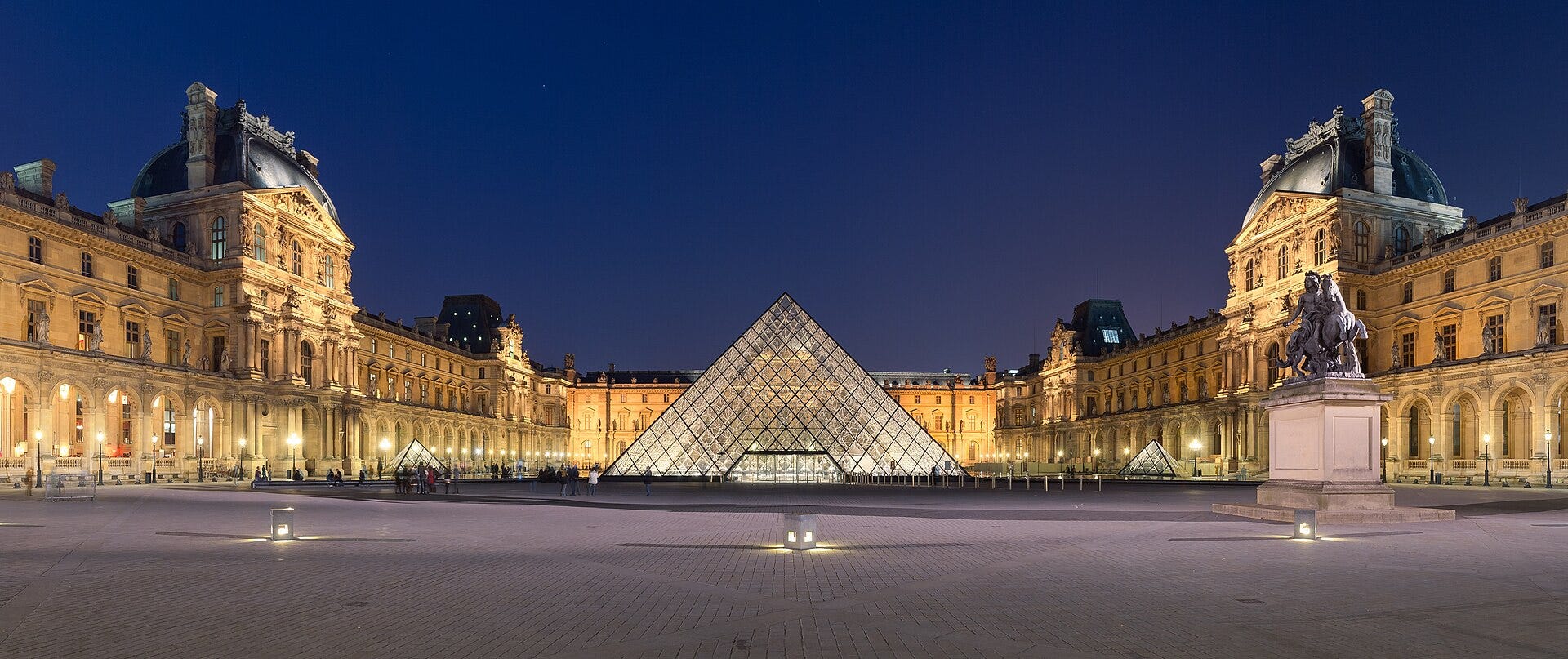
The Louvre Pyramid at Night | Cour Napoléon, Paris, 2010
Louvre | Photo Credit: Benh Lieu Song via Wikimedia Commons, CC BY-SA 3.0

Every artifact linked in the course, grouped by the day we see it and then by the online Day that teaches it. Each name links to the museum's own page.
Wed | 6 Jan
British Museum
Prehistory & Mesopotamia • from Day 1
• The Ain Sakhri lovers: Rm 51, Ancient Europe, Case 2
• The Mold Gold Cape: Rm 51, Ancient Europe, Case 8
• The Jericho skull: Rm 59, Ancient Levant, Case 1
• The Standard of Ur: Rm 56, Mesopotamia, Case 17
• The lyre from Ur: Rm 56, Mesopotamia, Case 19
• Hammurabi's foundation tablet: Rm 56, Mesopotamia, Case 24
• The flood tablet: Rm 55, Mesopotamia, Case 16
• The brick of Ur-Nammu: Rm 1, Enlightenment Gallery, Wall Press 68
• The lion hunts of Ashurbanipal: Rm 10a, Assyria: Lion Hunts, Section C
Ancient Egypt • from Day 2
• The Younger Memnon: Rm 4, Egyptian Sculpture, Bay 9
• The Rosetta Stone: Rm 4, Egyptian Sculpture, Central Saloon
• The Gayer-Anderson Cat: Rm 4, Egyptian Sculpture, Bay 10
• Nebamun hunting in the marshes: Rm 61, Egyptian Life & Death, Case 2
• The Book of the Dead of Hunefer: Rm 62, Egyptian Afterlife, Case 24
• The Gebelein Man: Rm 64, Early Egypt, Case 15
India & China • from Day 3
• Stamp seal from Mohenjo-daro: Rm 33, China & South Asia, Case 45b
• Fragment of an Ashoka pillar: Rm 33, China & South Asia, Case 47b
• Drum-slab from Amaravati: Rm 33a, India: Amaravati
• Shang ding: Rm 33, China & South Asia, Case 3b
• Kang Hou gui: Rm 33, China & South Asia, Case 4b
• Bronze bell: Rm 33, China & South Asia, Case 7
Ancient Greece • from Day 4
• Elgin Amphora: Rm 13, Greece 1050-520 BC, Case 1
• Sophilos Dinos: Rm 13, Greece 1050-520 BC, Case 9
• Strangford Apollo: Rm 15, Athens & Lycia
• Portrait bust of Pericles: Rm 15, Athens & Lycia
• Bassae frieze slab: Rm 16, Bassai Sculpture (upstairs)
• Dionysos, east pediment of the Parthenon: Rm 18, Parthenon
• Horse of Selene, east pediment: Rm 18, Parthenon
• South Metope XXVII: Rm 18, Parthenon
• North frieze, Block XLVI: Rm 18, Parthenon
• Caryatid from the Erechtheion: Rm 19, Athens
• Townley Discobolus: Rm 1, Enlightenment, near Wall Press 64
• Portrait head of Alexander: Rm 22, World of Alexander
• Apotheosis of Homer: Rm 22, World of Alexander, wall
Ancient Rome • from Day 5
• Sarcophagus of Seianti Hanunia Tlesnasa: Rm 71, Etruscan World, Case 15
• Ides of March coin of Brutus: Rm 70, Roman Empire, Case 3, no. 14
• Marble head of Augustus: Rm 70, Roman Empire
• Portland Vase: Rm 70, Roman Empire, Case 12
• Bust of Marcus Aurelius: Rm 70, Roman Empire
• Altar to Gaius & Lucius Caesar: Rm 70, Roman Empire, Case 15
• Bronze Lar: Rm 70, Roman Empire, Case 15
• Portrait head of an old man: Rm 70, Roman Empire, Case 6
• Isis-Tyche: Rm 69, Greek & Roman Life, Case 34
• Mithras slaying the bull: Rm 69, Greek & Roman Life
• Head of Hadrian: Rm 49, Roman Britain, Case 14
• Head of Nero: Rm 49, Roman Britain, Case 14
• Vindolanda tablet (Claudia Severa’s invitation): Rm 49, Roman Britain, Case 2
• Military diploma of Reburrus: Rm 49, Roman Britain, Case 9
Ancient Israel • from Day 6
• Brick from the ziggurat at Ur: Rm 1, Enlightenment, Wall Press 68
• Younger Memnon (Ramesses II): Rm 4, Egyptian Sculpture, Bay 9
• Black Obelisk of Shalmaneser III: Rm 6a, Assyrian Sculpture
• Lachish reliefs: Rm 10a, Assyria: Lion Hunts & Lachish
• Taylor Prism: Rm 55, Mesopotamia, Case 3
• Babylonian Chronicle (605-594 BCE): Rm 55, Mesopotamia, Case 7
• East India House Inscription: Rm 55, Mesopotamia, Case 5
• Lachish Letters: Rm 57, Ancient Levant, Case 10
• Cyrus Cylinder: Rm 52, Ancient Iran, Case 4
Westminster Abbey
High Middle Ages • from Day 10
• Westminster Abbey: Henry III’s rebuilding of 1245 in French Gothic, with the tallest nave in England at 102 feet; Henry VII’s Lady Chapel, 1503 to 1519, with its fan vault.
Artifacts to come as the later Days are built.
Thurs | 7 Jan
British Library
Artifacts to come as the later Days are built.
National Gallery
Artifacts to come as the later Days are built.
Sat | 9 Jan
Notre-Dame Cathedral
High Middle Ages • from Day 10
• Notre-Dame de Paris: begun in 1163 under Bishop Maurice de Sully and completed in 1345; among the first churches to use flying buttresses; reopened in December 2024 after the fire of 2019.
Artifacts to come as the later Days are built.
Louvre
Late Middle Ages • from Day 11
• The medieval Louvre: Philip Augustus’s fortress of about 1190, rebuilt as a palace by Charles V in the 1360s; the moat and tower bases survive beneath the Sully wing.
Prehistory & Mesopotamia • from Day 1
• The Stele of Hammurabi: Richelieu, Rm 227, Near East
• The Victory Stele of Naram-Sin: Richelieu, Rm 228, Near East
• The beaker painted with ibexes: Richelieu, Rm 232, Near East, Case 2
• Ebih-Il: Richelieu, Rm 234, Near East
• The clay tablet from Uruk: Richelieu, Rm 236, Near East, Birth of Writing case
• The Ain Ghazal statue: Sully, Rm 303, Near East
Ancient Egypt • from Day 2
• The Seated Scribe: Sully, Rm 635, Egyptian Antiquities, Case 10
• The Book of the Dead: Sully, Rm 319, Egyptian Antiquities, Case 2
• The mastaba of Akhethetep: Sully, Rm 333, Egyptian Antiquities
Ancient Greece • from Day 4
• Dame d’Auxerre: Denon -1, Rm 170, Preclassical Greece, Case 26
• Rampin Horseman (head): Denon -1, Rm 170, Preclassical Greece, Case 43
• Kouros of Paros: Denon -1, Rm 170, Preclassical Greece
• Metope of Heracles & the Stymphalian birds: Denon 0, Rm 407, Olympia
• Plaque of the Ergastines: Denon 0, Rm 347, Salle de Diane
• Venus de Milo: Sully 0, Rm 345
• Borghese Gladiator: Sully 0, Rm 348, Salle des Caryatides
• Winged Victory of Samothrace: Denon 1, Rm 703, Daru staircase
Ancient Rome • from Day 5
• Sarcophagus of the Spouses: Sully 1, Rm 663, Etruscan Antiquities, Case 32
Ancient Israel • from Day 6
• Stele of Baal with the Thunderbolt: Sully 0, Rm 301, Levant
• Mesha Stele: Sully 0, Rm 303, Levant
• Code of Hammurabi: Richelieu 0, Rm 227
Sun | 10 Jan
Musée d'Orsay
Artifacts to come as the later Days are built.
Panthéon
Neoclassical
• The Panthéon: Jacques-Germain Soufflot’s church of Sainte-Geneviève, 1758 to 1790, a Greek temple front and a Roman dome in answer to the Gothic; turned by the Revolution into a mausoleum for the great. Foucault’s pendulum hung here in 1851.
Artifacts to come as the later Days are built.