

Mark announces God's victory at the exact moment Jerusalem is on fire. That timing is not a mistake — it's the argument.
Lesson 1 of a five-part reading of the Gospel of Mark, continued.
Last time: how Mark stole the word “good news” straight off Rome’s monuments. Here, the harder question — not which words he took, but when.
In my last post, I argued that gMark opens by stealing Rome’s imperial language — evangelion, “Son of God,” the whole grammar of announcing a new lord to the world — and hanging it on a crucified Galilean. That’s the what. Now the when: of all the moments in history to stand up and proclaim the good news of God’s victory and the arrival of peace on earth, gMark chooses one of the worst. The text announces God’s triumph at the precise moment that Jerusalem is burning.
To see it, you have to hold onto a year: 70 CE.
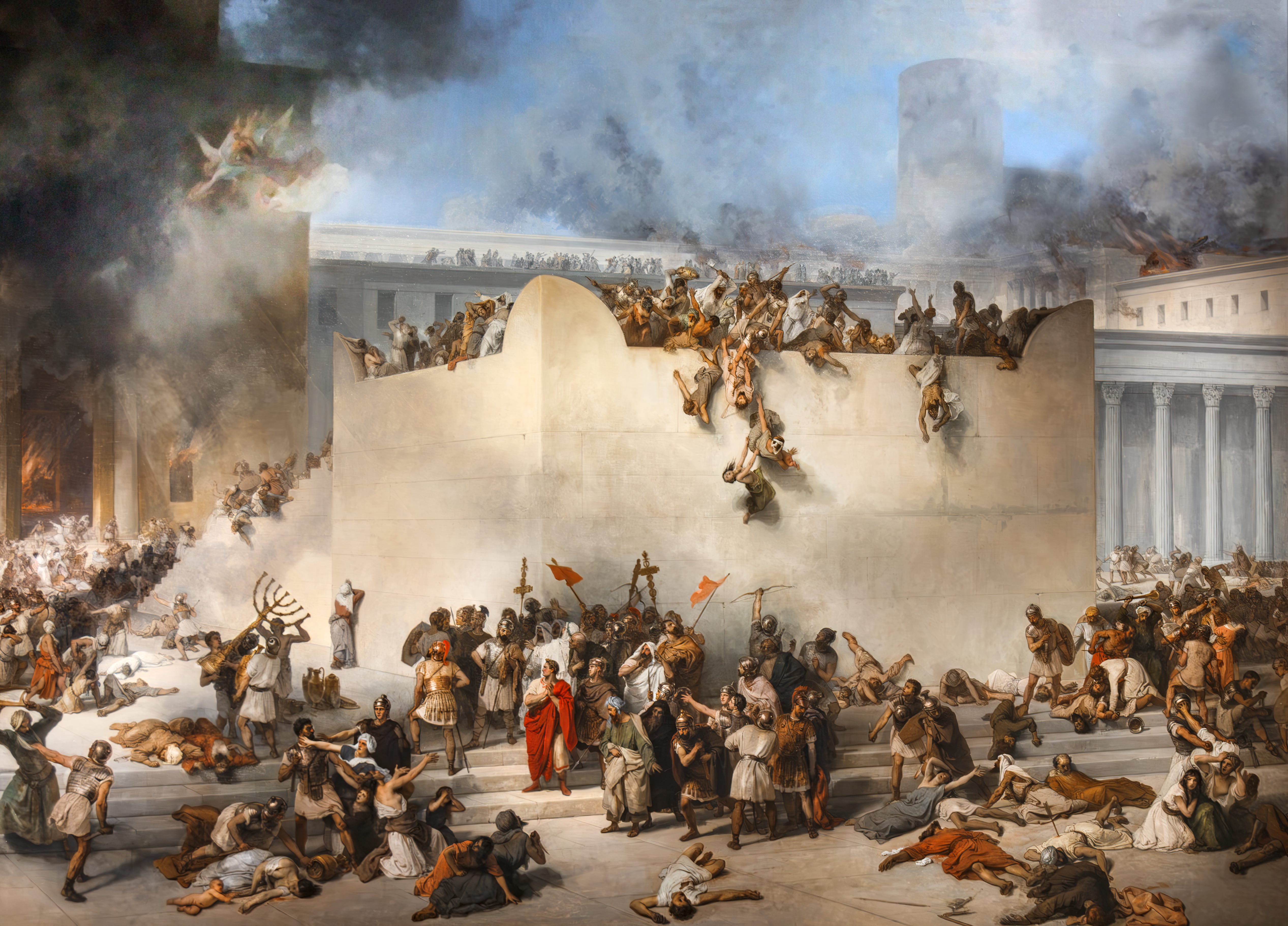
Here is how we got there. In 66 CE, about a hundred and thirty years after Pompey of Rome first took the city, Israel rose up in open revolt. It went about as well as a provincial uprising could be expected to go against the most efficient war machine the ancient world ever built. By 70 CE, the legions had retaken Jerusalem and burned the Jewish Temple to the ground. And you have to understand what the Temple was to feel the immensity of that loss. It was not merely the building that housed the Holy of Holies — it was the beating heart of a people. The one place on earth where heaven and earth were said to meet; where the pilgrim feasts gathered the tribes; where sacrifice and prayer and memory and identity all lived together in one house of stone. The House of God.
And Rome burned it down in the year 70.
The Gospel of Mark is written in the gravity well of that catastrophe. Not in a calm theological academy at a safe distance from Roman power. gMark is written in the smoke and ash of Roman violence. Once you see that, the opening line starts sounding far more dangerous.
Look at how gMark writes about the Temple’s fall in Mark 13, in the passage scholars call his “little apocalypse.” From the Mount of Olives, Jesus looks back at the great building and describes its ruin. Not one stone left upon another. A desolating sacrilege standing where it ought not. People fleeing to the hills — pregnant women, nursing mothers, caught in it — the warning not even to go back inside for a coat. This is not vague, cosmic, end-of-the-world poetry. This is reportage. It reads like someone describing a fire they can still smell.
And in the middle of it, gMark does something telling: he breaks the fourth wall. At the most charged line — that “desolating sacrilege standing where it ought not” — he cuts in with an aside. Let the reader understand. Over the heads of the characters in the scene, directly to you. That little parenthesis only makes sense if his readers are watching the very thing he’s pointing at, in real time. You don’t elbow people to “understand” a prediction about the distant future. You elbow them about a headline they are living through. Even the phrase is loaded: “desolating sacrilege” reaches back into the book of Daniel, where it once named an earlier defilement of the Temple centuries before. gMark takes the oldest word Jewish memory had for the holy place violated and reactivates it for the Roman violence happening in his own streets.
So here is where I plant my flag. The simplest and most honest explanation for why Mark 13 describes the fall of Jerusalem in such precise and terrified detail is that gMark is written inside it, or in the raw aftermath, right around 70 CE. The scholarly consensus is that this Gospel is a product of the Roman-Jewish war. gMark is not forecasting a distant future. The text dates itself, with great precision, into a present and ongoing catastrophe.
And now something easy to miss, which changes the tone of the whole chapter…
gMark is not stoking the panic. The text is managing it. Listen again to what Jesus says in the thick of the chaos: you will hear of wars and rumors of wars — but the end is not yet. Do not be alarmed. When someone runs up shouting the Messiah is here, the moment has come — do not follow them. That is a pastor talking a traumatized congregation down off a ledge. The Temple has fallen, false messiahs are multiplying, everyone is certain the world is ending — and gMark reaches for all this apocalyptic imagery for the express purpose of telling the people to keep their heads. It uses the language of the end to contain the fear of the end.
This opens the question that holds this whole Gospel together. If gMark is shaping these words inside the rubble of 70 CE, what was Jesus himself doing, forty years earlier, out in Galilee?
Here is the distinction that holds this whole lesson together: there are two levels to this Gospel, and they are not in competition. On the first level is what Jesus did — and what Jesus did, in the best historical reconstruction we have, was enact a kingdom that was already breaking forth. Present tense. Here and now. Healing bodies, dining with the wrong people, tearing down the walls between who was in and who was out. That is the ground floor. On the second level is what gMark, decades later, built — taking that present-tense proclamation and wrapping it, framing it, setting it inside the trauma of the Jewish community watching their Temple burn. The urgency, the apocalyptic pitch, the sense that the cosmos itself was cracking apart: that is the gospel writer’s editorial hand, writing for people who needed to know that God had not been defeated when Roman violence beat Judean courage.
So when I refer to this as a “Crisis Gospel,” and in the same breath tell you the kingdom Jesus announced was present and immediate — those are two floors of the same house.
If you carry a single sentence out of this lesson, carry this: Jesus enacted a kingdom that was already happening; the Gospel of Mark later wrapped that kingdom in the crisis of the Roman-Jewish war. Hold both floors at once, and this Gospel stops being a prediction and becomes something far more useful to us today — a word of hope, written in the dark, for people who were certain the monsters had won.
We have the stolen words, and now we have the terrible timing. One piece is still missing, and it’s the strangest of all. Next time, who gMark casts to speak it and I promise you’ll have underestimated him.
—
The Gospel of Mark · Lesson 1: Mark & the Good News ·
Post 2 of 3. Previous: “The Stolen Word.” Next: “The Roman Witness.”