

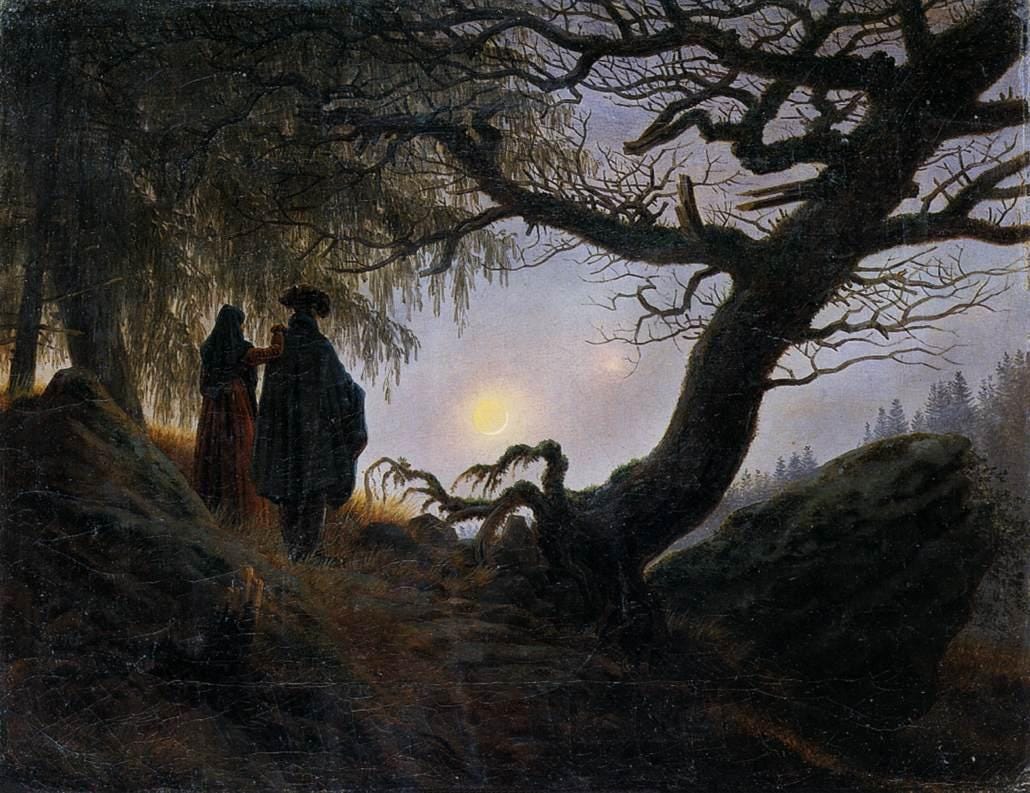
Man and Woman Contemplating the Moon | Caspar David Friedrich, 1824
Hello! Thank you for having me back!
So, I spent this summer thinking about how I play in my discipline (as that’s our colloquium’s theme). And, after a lot of thought, I’ve decided today that I’m going to talk with you about love.
What you’re going to see me do is engage in a kind of intellectual play,
with love at its center.
Here’s where I want to start. You were taught to drive. Somebody sat in the passenger seat and made you practice parallel parking until you hated them, right? And you were taught to cook, to multiply, and how to write a paragraph. Maybe someone taught you how to tie a bow or speak another language. But nobody taught you how to love. Perhaps you were shown love. Sure. But then you were told that later you would “just know love” when you felt it.
No guidance. No context.
You got thrown into the deep end with your hopes, and desires, and hormones.
Now, I’m not the first to make that observation. A contemporary Swiss-British philosopher named Alain de Botton has spent a career on it, starting with a book he wrote at 23 called Essays in Love. His point is simple, if a little unnerving: we treat everything else in life as a skill, while we treat love as if it’s an instinct, and that assumption can bring great ruin and tragedy.
So today, we’re going to engage with love through philosophy. The word philosophy means the “love of wisdom,” and it stands for a particular kind of engagement with the world. The first thing that philosophy does is it tries to find and articulate the bad assumptions we carry into our thinking. So, we’re going to start by looking at the word love and what it might mean.
When we use the English word love, we deploy it in all kinds of different contexts. You may say you “love” pizza. Or you “love” your country. If you’re fortunate enough, you may “love” your mother. But these are completely different kinds of love, right?
C. S. Lewis notices this in 1960, in a short book called The Four Loves, and he pointed out that the Greeks would never have put up with our conflation of these categories. They had four separate words for love.
• Storge, the love of the familiar: your family, your dog, the town you’re from
• Philia, brotherly love or friendship
• Eros, being in love. Desire. Chemistry. That whooshing feeling…
• And agape, the love that gives and asks for nothing in return
Now, my guess is that some of you are in love right now, maybe for the first time. And some of you, if you’re honest, have never been in love at all, and you might wonder whether this wisdom and hour is for you. I want to say this early on: this talk is for you. By Lewis’ count you have already felt at least two of the four forms of love, and you’ve felt them in your bones.
So, here’s how our philosophy hour will work.
If wisdom can be thought of as a palace, then I am going to guide you through five of its great rooms today.
In each room, you will see philosophers fighting about a problem that seems to have nothing to do with love. And in every room, somebody solves it, and the solution turns out to be about love. Nobody plans the way wisdom unfurls into the world. And that’s why it’s so fun to engage in! In each room, I’ll stop once and say, “Here’s the move,” because that move is the play. A philosopher doesn’t win by knowing the answer. A philosopher wins by what she does with the problem in front of her, and I want you to see just how engaging, relevant, and amazing a rigorous engagement of philosophy can be in your life.
So, again. Five rooms. Five central problems.
And in the first room sits the oldest question we have in philosophy.
Room 1: What is the Good Life?
We start in the Greek city-state of Athens, about 2,400 years ago.
The government has condemned a man to drink poison because he’s asking too many questions. I can relate.
Recall that the Greeks had four words for love. They also had a question that came before all four, and they thought it was a question worth dying for: “What is the Good Life?” Socrates asked it at every dinner party in the city, and the city eventually asked him to stop. When he wouldn’t, they killed him for corrupting the youth.
Now, first, I want you to notice this doesn’t seem to have anything to do with love. What is the good life, the one actually worth living? Is it pleasure? Then cows have it, Aristotle will say, and they seem content. Is it honor? Then your life depends on what other people think of you, and Socrates found that unsatisfying. Wisdom? Closer. But what the hell are we making ourselves wise for?
That is the game in this first room. It’s the one all the best parties in ancient Athens are playing. So let me reframe this for today. Think about the first person you text when something good happens to you. The first person you’d tell.
Now ask yourself why that person. Hold onto that name for later…
Well, 50 years after Athens kills Socrates, his student’s student Aristotle sits down to answer the question properly. He’s the most systematic mind the ancient world produces, and he writes a book called the Nicomachean Ethics. His answer to the question is: eudaimonia. We don’t have a good word for this in English, but it means something like, to flourish within your design. A life going well, the way a tall tree has grown well or a smoldering hot fire burns well. And the highest form of human flourishing, he says, is theōria. Contemplation. We are the thinkers of the animal kingdom: homo sapiens (the thinking ones). So it follows that a life spent deeply considering what is most worthwhile is what we are built for. The biologists in the room will tell you that your brain only weighs about 8 pounds, but it consumes about 20% of your oxygen and glucose. It is the most intricate machine in existence. It is the only thing that ever named itself. So we contemplate. That’s what we are.
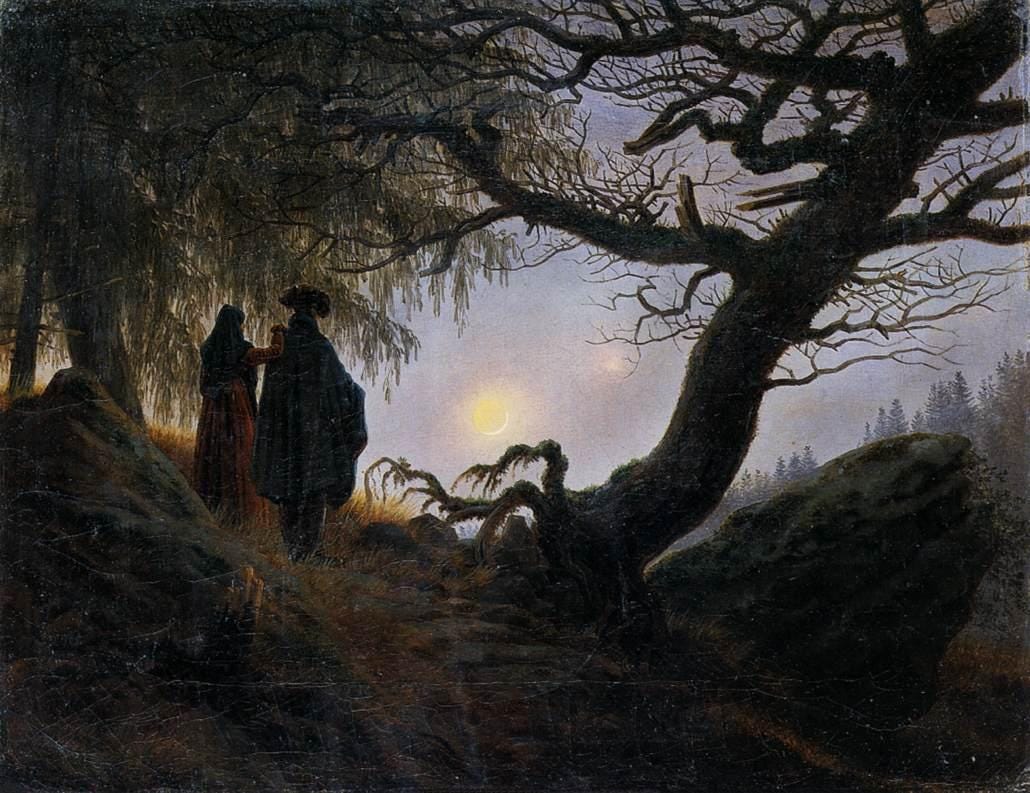
Now I want you to look at the screen. Two people with their backs to us. The painting is titled, “Man and Woman Contemplating the Moon.”
Now I’ve taught Aristotle’s book for nearly 20 years. He has a whole system that would threaten much of our world if you sat and actually read it. Today, we will limit our reading to a more benign entry. In Book 8 he asks, does a man need friends in order to flourish? Because if the good life is defined by contemplation, then surely a person with every other good could sit alone on a hill and gaze upon the moon and be complete.
Aristotle, who spent a lot of his time alone, wanted this to be the case.
He wanted solo contemplation to be the logical answer. But it didn’t bear out that way.
I quote Book 8 directly for you now:
“Without friends no one would choose to live, even if he had all other goods.”
Why? Because, as this room proves, contemplation is not something you can do completely by yourself. You need someone next to you, to push back and question your assumptions and ideas.
This other person is fundamental to contemplation and knowledge of self. How? Because, to quote Aristotle, “The friend is another self.” Across from Greece, in Israel, the Proverbs add, “As iron sharpens iron, so one person sharpens another” (27:17).
An other self. Not your mirror. Someone special, as you are special. Aristotle then sorts friendships into three kinds, and this is worth your attention because you have all three on your phone already.
• Friends of use, who are there for what they can get from you.
• Friends of pleasure, who are there as long as it’s fun.
• And friends of virtue, the rare ones, who are there for you, for the person and not the supply. The Greeks had a word for that third kind, and it’s one of Lewis’s four: philia.
So here’s the philosophical move. Aristotle had his answer, and he argued against it anyway. He wanted the answer to be a man alone on a hill. He tested it, and he let it lose. Because a friend can question, reinvigorate, and finally renew the whole system of your thinking.
Now look at Friedrich’s couple one more time with me. He painted this in Germany around 1824, and he almost never painted a face. His figures turn their backs to us. Her hand rests on his shoulder, and neither of them is looking at the other. That’s the whole argument of this first room. The good life is found in the looking, but the looking needs a second person, not to look at, but to look with.
Put simply: you cannot have the good life alone, because we flourish best with someone next to us contemplating the same moon through their own experience.
A question for you now. Which of your relationships is the third kind? Which of your friendships go out of their way to encourage you to be better? Which of your friends care about you attaining to virtue? If there are none, go make better friends.
All this raises a problem for our next room.
If the good life needs another self, what happens when the Medieval Church tells us there is only One love worth loving?
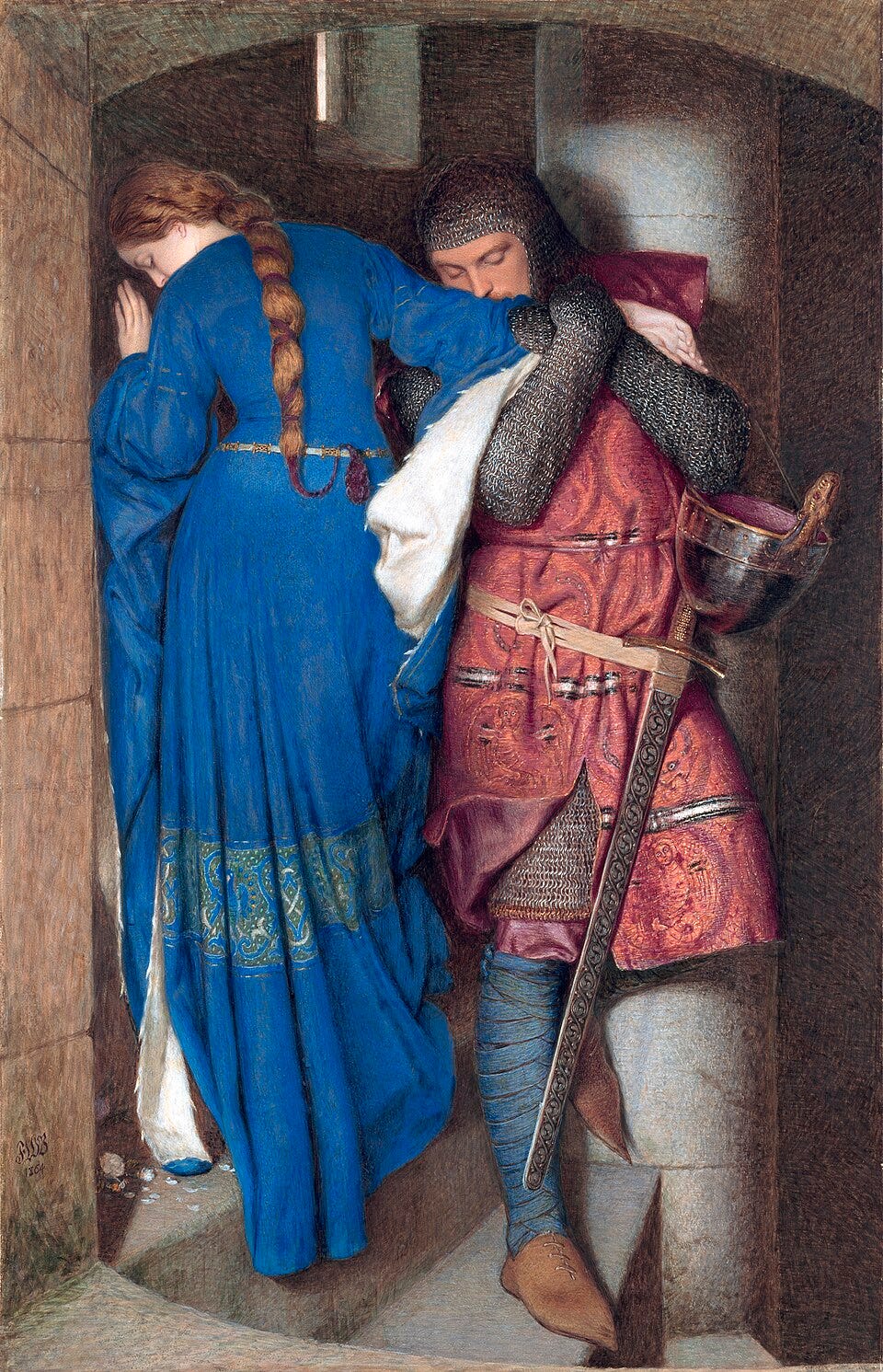
The Meeting on the Turret Stairs | Frederic William Burton, 1864
Room 2: Can you Love a Creature for Its Own Sake?
We go now to a town on the coast of North Africa. We’ve moved 700 years ahead of Aristotle. It is the beginning of the Middle Ages, and a Christian bishop is writing a book about his own life. It’s the first time any Westerner has ever done that, and he’s in the chapter where he attends a friend’s funeral.
The author’s name is Augustine, and his book is the Confessions, the first autobiography ever written. I strongly recommend it. In Book 4, he tells us about a friend he had growing up. They grew up together in the same small town. They read the same books, they argued about the same things (much as we’ve talked about good friends doing), and Augustine says he felt that his soul and his friend’s soul were one soul in two bodies. He borrows a beautiful line from the ancient poet Horace:
“He was half my soul.”
His other half now rests in a grave in North Africa. The friend got sick and died, and Augustine could not bear to be any place they had been together. He says he became a question to himself. Have you ever come to the end of a road and felt that way? He says the whole town turned into a kind of torture, because everything in it said “he’s just right around the corner.” But he wasn’t.
And out of that grief Augustine writes a rule that the next thousand years of Christendom will fight over. He says there are two ways to love. You can love someone on the way to something else. Or you can love for its own sake. And, for this Christian theologian, there’s only One in the world Who may be enjoyed for their own sake, and that’s God. According to St. Augustine, everything else, everyone else, is to be loved in God, or on the way to God. Love a creature for its own sake, and you have made an idol. That was the answer around which St. Augustine questioned his grief over his lost friend. The death was overpowering his ministry, and St. Augustine felt guilty over it.
So, in this second, Medieval room we are asked:
Can you love another fully for its own sake? Augustine says no…
So let me reframe this for today. Every one of you has had the person you’re not gonna text first. The one whose online Story you watch every day and never reply to. The one you can’t have, for whatever reason, and they take up more room in your head than anyone who actually texts you back. Augustine would say that’s exactly the danger. Something that was supposed to be on the way has become a dead end.
So, by now, we’ve visited two rooms who’ve given us two different names.
The one you’d share your feelings with. And the one you can’t.
Now, we move forward to late Medieval Provence, in the south of France. We’ve moved ahead another 700 years from Augustine, to around the year 1100. A duke named Guilhem of Aquitaine, who owns more of France than the king of France, starts writing songs. And the songs do something the Church’s theory says you cannot do. They take a human being, a lady in this instance, and treat her in ways forbidden by St. Augustine. She is served. She is adored. She is sighed over. The man who loves her is made better just by loving her.
He even calls her, in the songs, midons, which means “my lord.”
Not “my lady.” My lord.
And by the rules of this late Medieval game, she must remain unreachable. Those rules were actually written down about eighty years later, by a man named Andreas Capellanus. There’s 31 rules to Medieval Love Songs, and while I’ll leave that discussion for whoever takes Humanities with me this spring, I’ll say here that Medieval Romantic love was measured by what could not be. The unattainable.
And, of course, there’s rules like this today. Don’t double-text. Don’t dare be the one who says it first. Wait at least as long as they take to reply. Capellanus would have approved.
The late Medieval songsmiths whose songs swayed above and below these rules were called troubadours. They are the rule-breakers of our hour together. About 2500 of their songs survive today. They were the first pop artists. In this corpus of work, they happily broke Augustine’s rule in the open, on purpose, to the applause of swooning courtly ladies across all of Europe.
Look at the painting again. Burton, an Irishman, painted this in 1864, 700 years after Provence, from a Danish ballad, and it is the troubadour’s love story exactly. She’s a princess. He’s her father’s bodyguard. Her brothers are waiting to kill him at the bottom of the stairs, and he knows it. He doesn’t kiss her. He presses his face into her sleeve. The whole of courtly love is in that sleeve: everything, and nothing, expressed by a man who will be dead by sunrise for the love he could no longer deny.
So, St. Augustine, in his grief, says we cannot love for its own sake, and that rings true for some. Then the troubadours sing of such love and move the hearts of Europeans to ecstasy heretofore unknown to European literature. In the Medieval era the philosophers and the Church were pretty much the same institution. This is why a man of the Church sets up this problem for us in the 390s and another saint solves it in the 1270s.
St. Thomas Aquinas says that in charity is found a friendship with God, and inside that friendship your neighbor is loved for her own sake, and for God — together. Not one or the other, as Augustine plotted them. It is both at the same time.
This pivot is opened by St. Aquinas but is closed by another Italian thinker: Dante.
Dante sees a passing girl when he is 18. They both marry others in arranged marriages, but Dante can’t get over her beauty. She dies tragically at 24 and becomes, for Dante, the epitome of the forbidden, courtly love that troubadours sing their guts out for, to packed-out houses. So, instead of spending a lifetime with the late Beatrice, Dante honors her by placing her at the center of his book series, history’s greatest work of Italian literature, The Divina Commedia.
In this work, the lovely Beatrice comes down from Heaven to bring Dante across the Inferno, Purgatorio, and finally Paradiso. Hell, Purgatory, and Heaven. Herein, Beatrice is loved for her own sake. She leads Dante upward, toward Heaven, precisely by being loved. Love is the rocket fuel that moves the protagonist forward through the spheres of the Afterlife. For Dante, love is the path to God. And at the very top of that path, Dante looks into the light and sees the whole universe bound by love into a single book. We’ll come back to that book at the end.
So, in our Medieval Room, we find agape: the love that gives and asks nothing in return. What the troubadours did was smuggle eros in underneath. And what Dante made clear for us is that agape and eros are not at all opposed to each other the way St. Augustine had previously claimed.
So here’s the move. Augustine said you can love God or the creature.
Aquinas said its both, at the same time.
Before we move on, let’s have one more look at this painting.
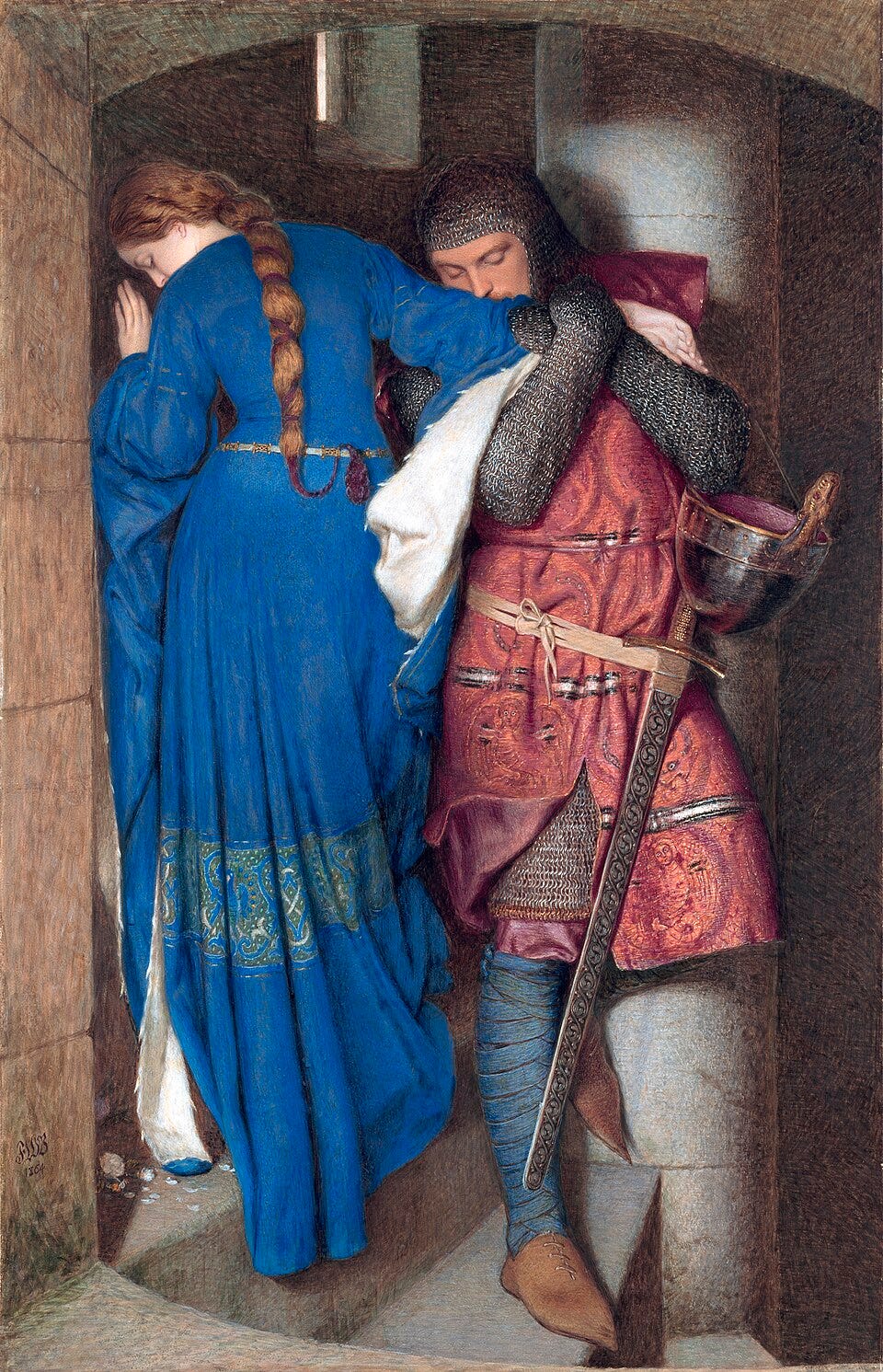
She’s looking away. And of course, everyone notices that. But look at what she does with her arm. She doesn’t pull the sleeve back. She lets him. The painting is the exact moment between the rules of courtly love and the breaking of those rules.
Let me say that a different way: loving a person can be a road to the Good Life or a dead-end stop from where you need to be. The difference isn’t how intensely you feel. It’s where the love takes you. The knight in this painting isn’t going to fight in spite of the love in his life. In the ballad, he cuts her brothers down one by one, and when she begs him to spare the last one, he does, and his stayed hand kills him. He dies of obeying her, because it is the last, final way he can show the level of his adoration.
So, I have a second question for you now. Think now on your love. Does loving them take you somewhere good? Or is it a dead-end that stops you on your journey?
All this, by the way, raises a problem for our next room.
Dante’s road to the Good was guided by a beautiful woman. But a Frenchman hiding in Holland is about to question one of Dante’s underlying assumptions. How do you know she’s even in there?
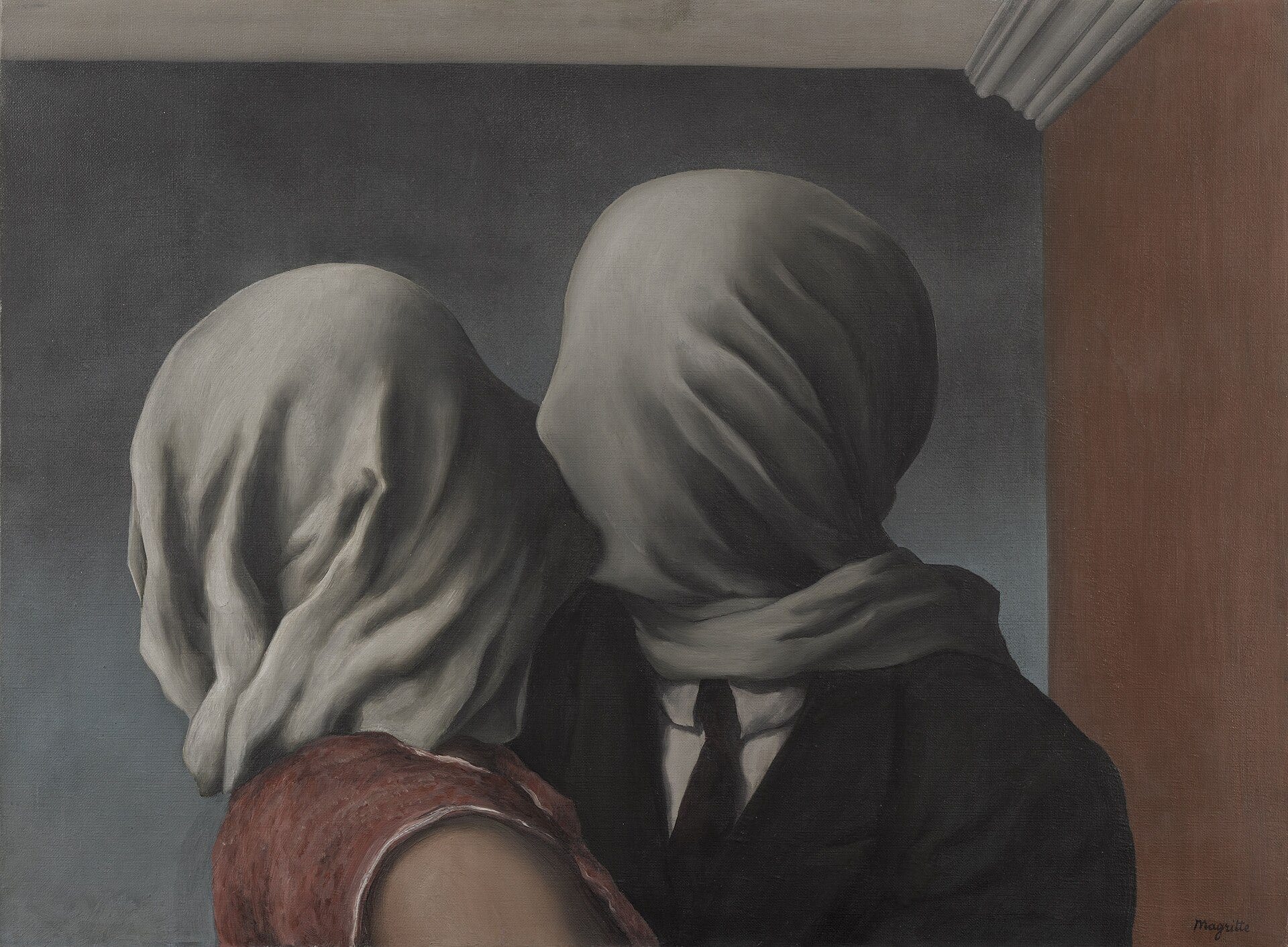
The Lovers | René Magritte, 1928
Room 3: Is Anyone Else in There?
We go now to Holland in 1641. A Frenchman who moved there for the quiet has just doubted the existence of everything. Including Holland.
His name is René Descartes, and his book is the Meditations. Now, René is playing a very dangerous game. For a thousand years, the Church has treated doubt as a road to sin. We must not doubt our saints, our traditions, or the holy Church, for therein lies heresy. Yet René feels compelled to question. Now, up until his time, the Medieval Church kept a list of all the questions it liked to answer. Just, whatever you do, don’t veer off the script, right?
Well, here comes René, who wants to know something without the aid of the Church. So he starts down a road of doubt. He doubts everything. He doubts all he can see, because maybe we live in a dream! He doubts logical proofs like mathematics, because maybe an evil god has deceived us and 2+2 really equals 5. Unlikely, but its theoretically possible, says René. He doubts everything he possibly can until he gets to the root of it all:
He cannot doubt that he is doubting.
Which gives us the poetic conclusion: I think, therefore I am.
Herein, Descartes has proven his own existence as a self-evident truth outside of the confines of the cathedral. He is, in many ways, the first modern man. Descartes is the first to dare to know things for himself, since the closing of Plato’s Academy in 529. To find a self-evident truth is to claim something that relies on no higher authority and cannot logically bend to a higher authority. Because it is, itself, its own evidence.
And if you want to know what a self-evident truth can do, think on this: “We hold these truths to be self-evident. That all men are created equal.” 130 years after Descartes, we invented America on a set of self-evident truths that a divinely-appointed English king could not argue.
That’s the power of philosophy.
So, in Dante we see the road going all the way up with a spellbinding woman guiding us. Descartes then tears that road down so he can build it back up with self-evident truths that don’t rely on theology, but he never comes back for the rest of us he threw off the road. In his Second Meditation, the doubting Descartes looks out a window and says in a lovely French accent, “I see men crossing the square. But what do I see, except hats and coats, which could conceal automata [robotics]?”
In other words, Descartes has made the point that YOUR mind exists, but in the same breath he made everyone else’s mind unprovable. “I think, therefore I am. But I couldn’t tell ya about the fella over there…”
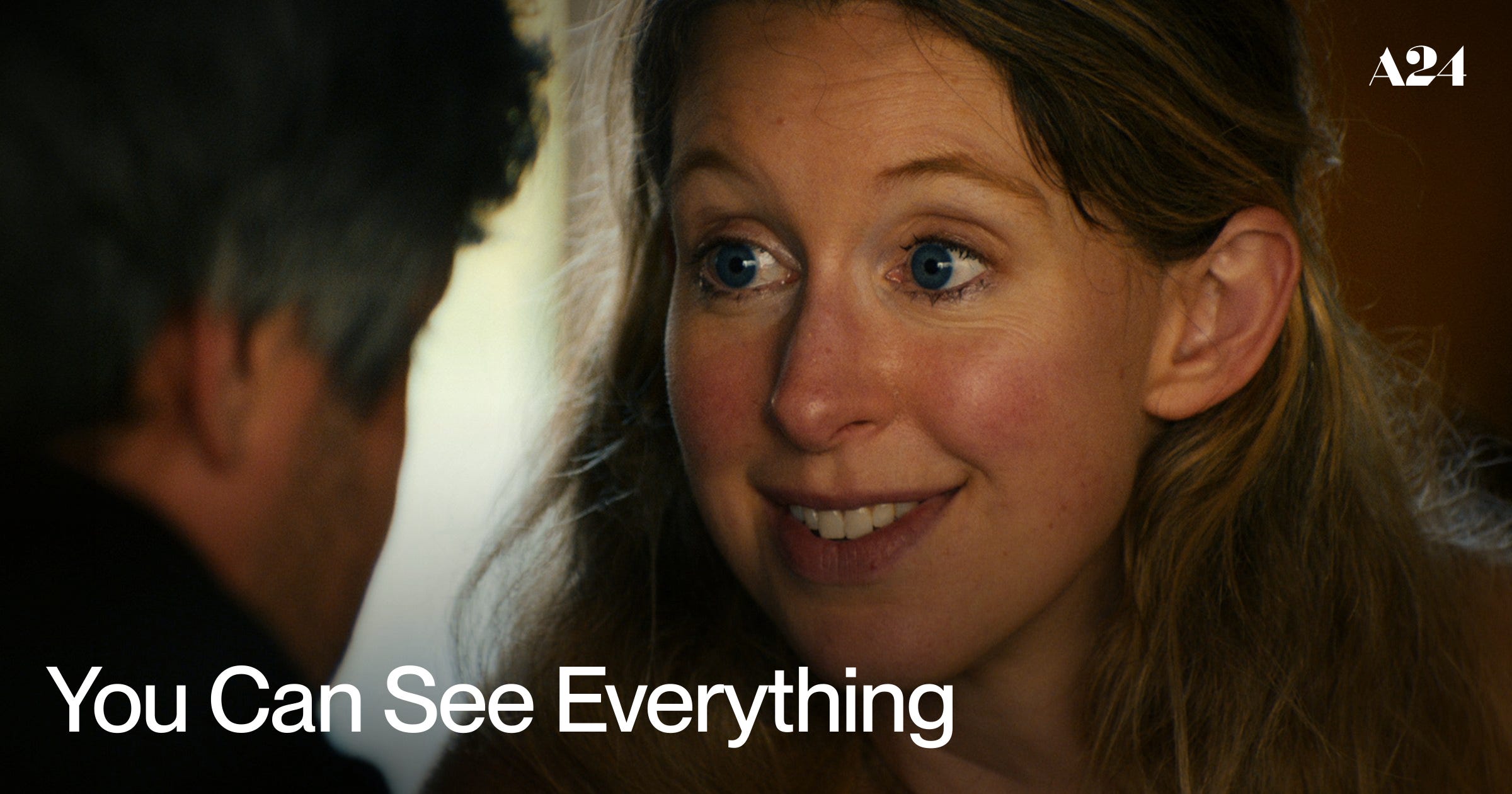
For all I know, you may be nothing more than an automaton. A machine. Philosophy calls this the problem of other minds. Nathan Fielder’s new film, “You Can See Everything,” has some folks imagining this as a new problem. Do we trust the enigmatic smile of Silicon Valley’s Elizabeth Holmes or not? But this is not a new question. This is a game Descartes started playing in 1641. It asks us: Is anyone else in there?
So let me reframe this for you today. Back to your second name. Let’s say you broke Capellanus’ rule. You texted first. Now your phone says “seen.” But it’s been 45 minutes. What the hell is even happening on the other side of that word? You have no idea. You will have no idea. All we have to go on, really, are our own Cartesian thoughts.
So who answers Descartes?
We turn now to a Dutch Jew who got thrown out of his synagogue at 23
for asking too many questions.
Baruch Spinoza grew up a few blocks down from Rembrandt, in the Jewish Quarter, the son of Inquisition refugees. Spinoza read Descartes closely, and took notes in the margins. And one note he made I will now quote in English:
“Love is joy, accompanied by the idea of an external cause.”
The line will not be published in his lifetime.
That happens much later in a book too heretical to exist during the author’s own days.
Let me translate that line again a different way.
“Love is your joy, plus your idea of what caused it.”
Now, the cloth Descartes hung between us still exists. Yes, we are each of us still a separate mind that we can know without a doubt exists. BUT! Spinoza moves the love of the other to your side of the cloth. We never reach the other mind. And we don’t need to. Because our joy is real, the idea of her is real in my mind.
And that is what love is for Spinoza.
For Descartes, I would be remiss if I did not bring up a letter of his from 1647. He confessed that, as a boy, he had loved a girl with a squint, and for years afterward he was drawn to every squint-eyed woman he met.
It turns out, Descartes had a type. He felt a whoosh when he saw a certain set of eyes. This is eros, “chemistry,” the Greek word for a love that attracts you with a hold that you may never totally understand. We’ll return to eros at the end of the hour. For now, we see that Descartes uses doubt as a toolset for getting at self-evident truths. Then Spinoza comes along and shows us that the question Descartes left us — do other minds exist? — never really mattered. Our joy over the other is real nonetheless.
So, Spinoza moved love to your side of the cloth.
Descartes had hung a cloth between you and the world. On your side, a mind. On the far side, bodies, including the one you can’t stop dreaming about. In 1643 a princess about your age, Elisabeth of Bohemia, asked Descartes a question. If a mind has no size and no place, how does it reach a body? He wrote back about a gland in the brain. The answer was nonsense, and Elisabeth called it such. Descartes then died without a second reply.
Later, Spinoza refused the same question. Mind and body, he said, are one cloth with two sides. There is no far side to cross. So he looked at your side and wrote down what he saw. Love is joy, with the idea of what caused it. Someone makes you more alive, and you know who did it. That is the love enough.
It was never across the room. It was in you. That’s what makes love real.
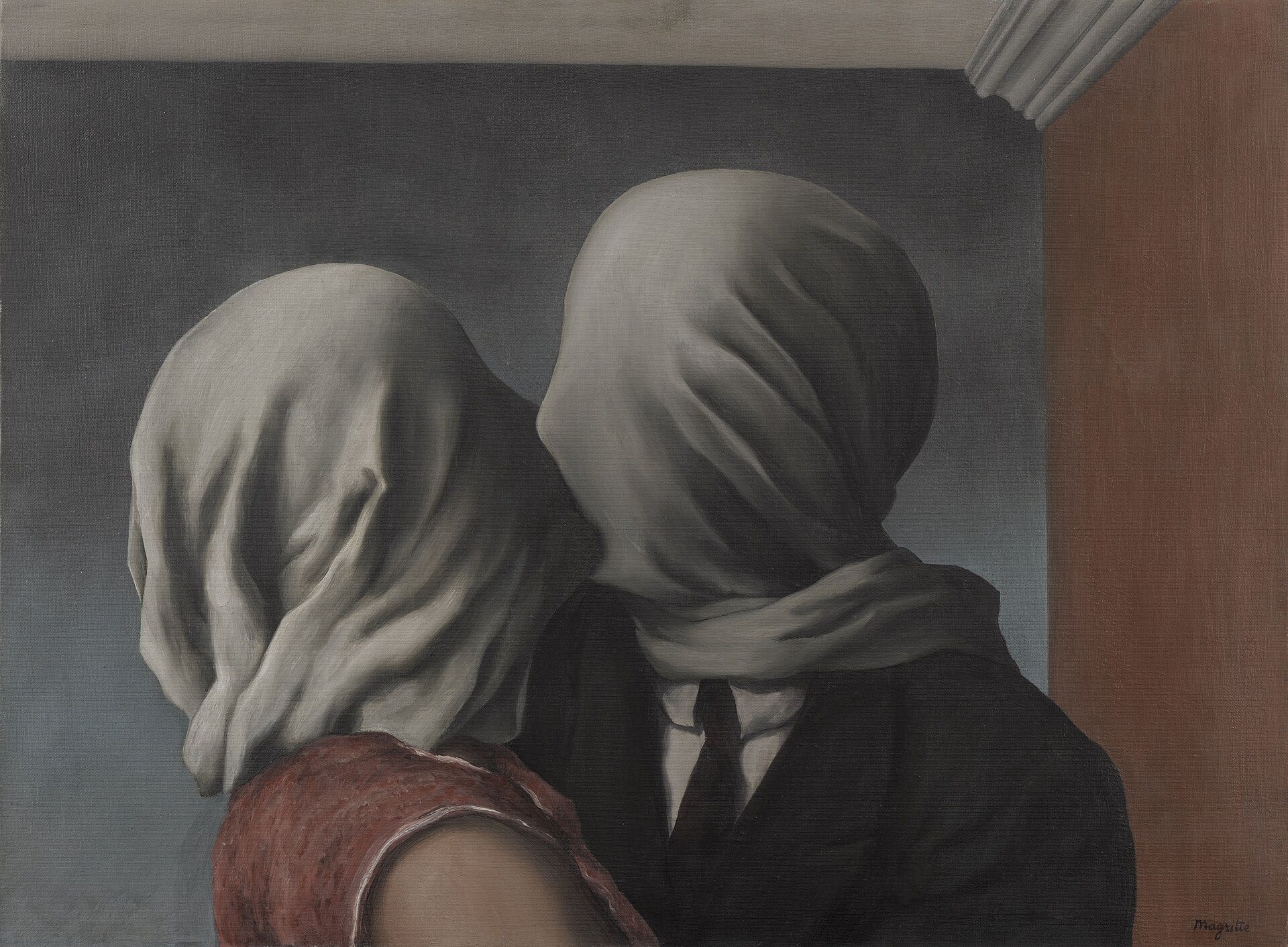
So, why this 1928 painting by Magritte? If you secretly hate it, you’re not the only one. Two heads, each wrapped in cloth, kissing through it. Magritte never said what it meant, but I’ll tell you what I see. An honest picture of love. Descartes’ problem and Spinoza’s answer, in one frame. The kiss across the cloth.
Put simply: you never get behind the veil. Your love happens on your side of it,
and all you can do is hope the other person feels the same way.
So here’s the question this 17th-century room poses to us. Whose joy have you been the cause of? Not who do you love. Spinoza turns it around. Who, when they think of you, feels joy? It may be your mother. It may be your dog. It may be the man you’ll wake up next to for the next 50 years. Who do you cause joy for?
For about a hundred years, we were settled with Spinoza and Descartes. Until a man in Prussia who never left his hometown looked up at the sky and asked some very important questions about modern life. Much like Aristotle before him, he will more or less reinvent how we think about thinking forever.
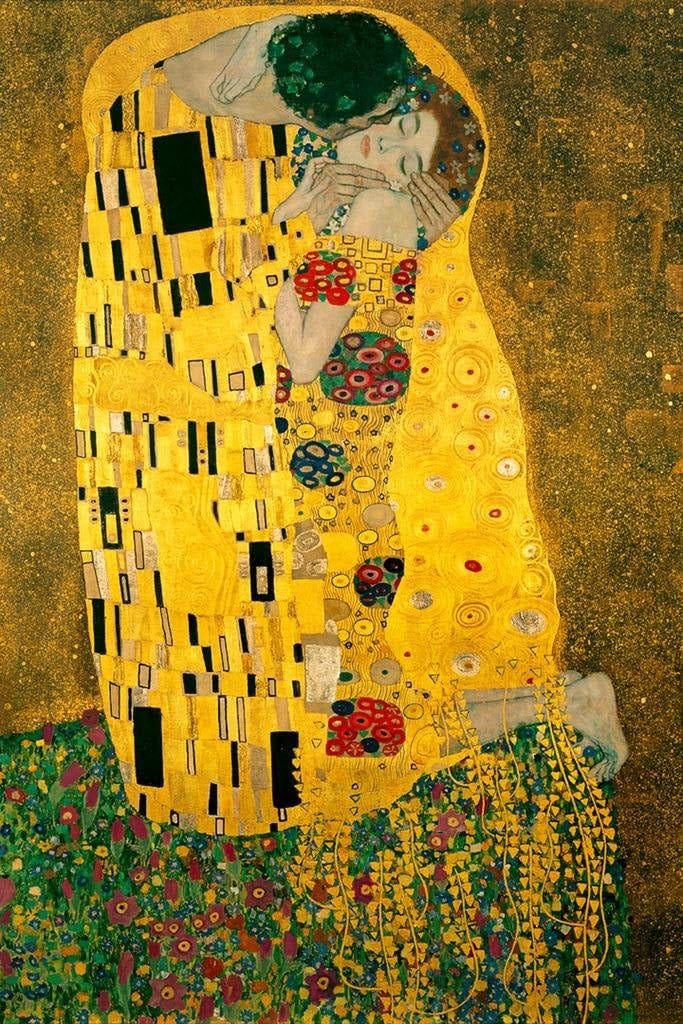
The Kiss | Gustav Klimt, 1907-08
Room 4: What Do You Do with What Exceeds You?
We’re now on the Baltic Sea, in the year 1790.
There is a professor here in his sixties who has hardly ever left home. Over the years he has lectured on logic, on geography, on the stars, and once, for a room of Russian officers, on fireworks. The story goes that he took the same walk at the same hour every afternoon, and the neighbors set their clocks by him. His name is Immanuel Kant, and he is more or less the grandfather of Modern Philosophy.
For nine years he has been doing to the whole world what Descartes did to other minds. You never see anything as it is in itself, Kant says. You see it the way a human mind is built to see it: in space, in time, in causes and effects. You see things only through the lens of your own perspective and experience.
And then, in 1790, he defined the game for this new, fourth room. It is a question that artists, songwriters, and theologians have been trying to answer for over 200 years.
What happens to a mind when it experiences something too big for it?
This question was one of the main highways I took into the study of philosophy. Standing on the porch when a storm is coming. Or laying out in a field, with the sky filled with the Milky Way galaxy. I’ve seen the moon here, and I’ve seen it surrounded by a whirling array of worlds standing in the middle of the Najd in the Arabian Desert. In those moments, something happens in your chest. It isn’t fear exactly, and it isn’t pleasure. It’s a whole other Kantian category that the pre-modern world did not have words for.
I’ve had it happen back home in Florida, standing next to the sea. The thunderheads are stacked a mile high, and lightning blooms throughout its massive, livid structure. You try to take it all in, but this is impossible. Your mind reaches for the edges, and there are no edges. Your reasoning fails you — Descartes be damned. Your eyes can’t take it all in at once. While you cannot see ‘infinity,’ you are left with a special kind of experience of it.
In this moment, you are lifted up beyond yourself. Das Erhabene, for Kant.
You have had an experience of the Sublime.
The sublime is found in the encounter you cannot measure, an encounter that is massive and awe-inspiring. Counter-intuitively, the sublime is not in the storm. It’s actually in you.
The ocean is still the ocean. The desert is still the desert when you’re not there.
But the sublime is the mind that met the ocean or the desert and didn’t break.
Ok, so let’s put Kant’s sublime next to Spinoza.
Spinoza says that love happens on your side of the cloth. Kant says the same thing about our biggest immeasurable experiences. The cloth is still there. But it’s in the immeasurable otherness of both the lover and the storm that we find our own measure.
Later, in a small university town in the middle of Germany, a few friends about your age are reading Kant and publishing a magazine about what they read. History will remember them as the “Romantic Circle of Jena.” One of them is a young man named Friedrich von Hardenberg. By day, he inspects salt mines for the Saxon government. But at night, he publishes under the pen name, Novalis.
So here’s the question Novalis comes to while reading Kant.
If a storm can do all of this to a mind, what can another person do?
Remember Descartes’ hats and coats. Remember Elizabeth Holmes.
How can you know for sure?
The Romantic Novalis answers that when he beholds his beloved, he finds in them the one thing that refuses to be a thing like all other things.
“My beloved is an abbreviation of the universe,
and the universe is the elongation of my beloved.”
An abbreviation is a whole idea packed into a few, brief letters. Novalis claims herein that the person across the table is the whole universe, writ briefly, to fit a face.
And the universe is that person, drawn out as far as the stars.
So the Romantics answer Descartes here. The other mind is not a locked room. It’s a room you can never finish exploring. Yeah, sure, you never truly get behind the cloth. Magritte is right and so is Spinoza on that account. You can only get farther in…
But there is always farther in. And farther. And farther…
Now, behind the Romantics there is an even older German door, and I want to open it now, because I imagine many of you have been through it without knowing its name. In 1600, a German shoemaker named Jakob Böhme beheld a beam of sunlight reflected in a pewter dish and, he said, in that moment, he saw into the heart of all things. He was not schooled at all. But he described his encounter with the sublime as best as he could (200 years before Kant’s vocabulary), showed it to his pastor, and was thereafter forbidden to speak at church for 7 years.
So he kept writing. A few centuries later, the German Romantics found Böhme’s journals and this began a line of research into German Christian mysticism going back centuries. In the early 1300s, a German preacher named Meister Eckhart told his congregation, “The eye with which I see God is the same eye with which God sees me. My eye and God’s eye are one eye, one seeing, one knowing, and one love.”
Now, as a Religion professor of some 17 years, I can tell you that mysticism is a human capacity: like laughing or dancing. The mystics are simply those who have encountered the Infinite directly and have come back to describe it. And what they describe at the top of the climb is a moment when the One who knows and the one who is known stop being two. The self that started climbing is not the person found at the summit.
Now, what does this have to do with love?
Well, those of us who’ve been in love can forget ourselves in moments.
It’s laughing without caring how it sounds. It’s dancing as if no one is looking. The Christian mystics had a model for this in King David. When the Ark of the Covenant was brought to Jerusalem, King David was so overjoyed that he began dancing in the streets. His wife looked down with discontent from a window, thinking his vulgar display in little more than a loincloth was undignified for a king. Yet this contrast — the king moved to ecstatic dancing in front of his people — was the highest register of language the Israelites had for the profundity of the moment when Jerusalem became the world’s most famous city. To dance like David. To write like Beethoven.
To laugh like Robin Williams.
The mystics say these are the moments when we come closest to the Divine.
Now, let’s look at this painting.
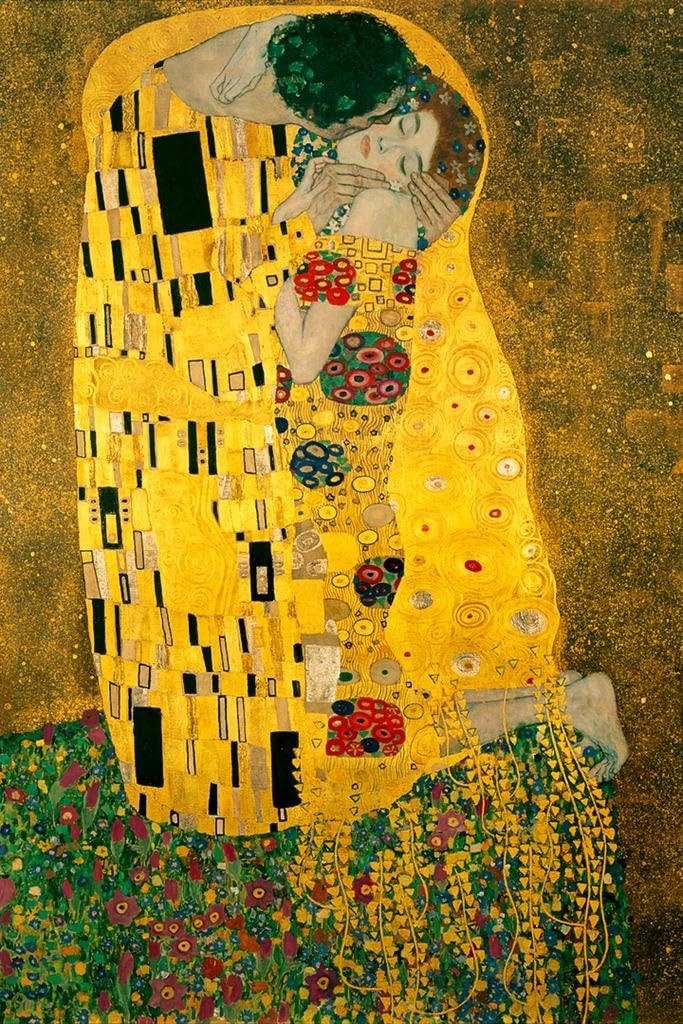
Gustav Klimt painted this in Vienna in 1907 and ’08. The gold is real (his father was a gold engraver). In 1903 Klimt went to Italy and stood under the Byzantine mosaics in the Church of San Vitale, where an empress and her court float on a field of gold. In an icon, gold isn’t a color. It’s where the painter puts the Infinite: no sky, no horizon, no place — only the ground of all things.
There are two people in this painting and one shape. His robe is black and white rectangles, hers is circles and flowers, and the gold closes around both of them until you can’t say where one stops. So, in Klimt, we see Eckhart’s one love, reimagined in a lovers’ embrace.
So let’s go back now to 1843, Denmark.
A young, brooding man spends a rather large inheritance on a short book called Fear and Trembling. The title is from Paul the Apostle. It’s about Father Abraham on Mount Moriah, with his son bound up and Abraham holding the knife that will sacrifice him.
Søren Kierkegaard says Abraham was a great man who no one really understands. In Genesis, Abraham almost sacrifices his son, but he can’t explain this to himself, his wife Sarah, or his son. In fact, he says nothing. When standing at the edge, Kierkegaard says, there is no reasoning. There is no final, certain answer. Every rational argument has an end. So, in the end, we must all take a leap of faith. If you’ve ever heard that phrase, you can thank this brooding Danish Christian.
Kierkegaard read the Romantics. He was a fanboy. Much of his doctoral dissertation focused on their work. In that text, he describes the mystical climb toward the sublime as going on forever, which can be a problem. A person can spend a lifetime longing for the immutable, infinite, perfect thing, and never once actually commit to an action.
Back to your Messaging App now… They replied. It took them two hours, but they replied, and it is now three months later, and you are in the talking stage.
You’ve been there. The talking-stage situationship that never lands. The person who keeps every option open (because choosing one means denying all other choices). There’s always another profile, right? Always another match on the apps or stranger in a bar. Kierkegaard defined this problem in 1843.
At some point, you have to stop climbing and just jump in.
You have to take a leap of faith.
Four years after Fear and Trembling, Kierkegaard publishes Works of Love, and at the center of that text are three words: You shall love. This is agape, the last of the four notions of love, the love that gives and asks nothing. And Kierkegaard’s claim about it is simple. We are commanded by love. It is the central commandment of the human experience. Here, in agape, love is something you do. It is not a feeling (that can fleet away). It is the unction of the heart in the Face of the beloved.
Now, remember I promised the half in this room who’ve never been in love that this hour was still for you? Well, here it is. Kierkegaard shows us that the love that lasts is not a feeling that arrives. It is a commandment on the heart to take action, starting today, with whoever is in front of you.
So here’s the move. Kierkegaard stopped climbing and jumped.
The Romantics built a mountain with no top, and Kierkegaard had read every page.
He loved the Romantics! Then he set their endless pursuit aside and jumped anyway.
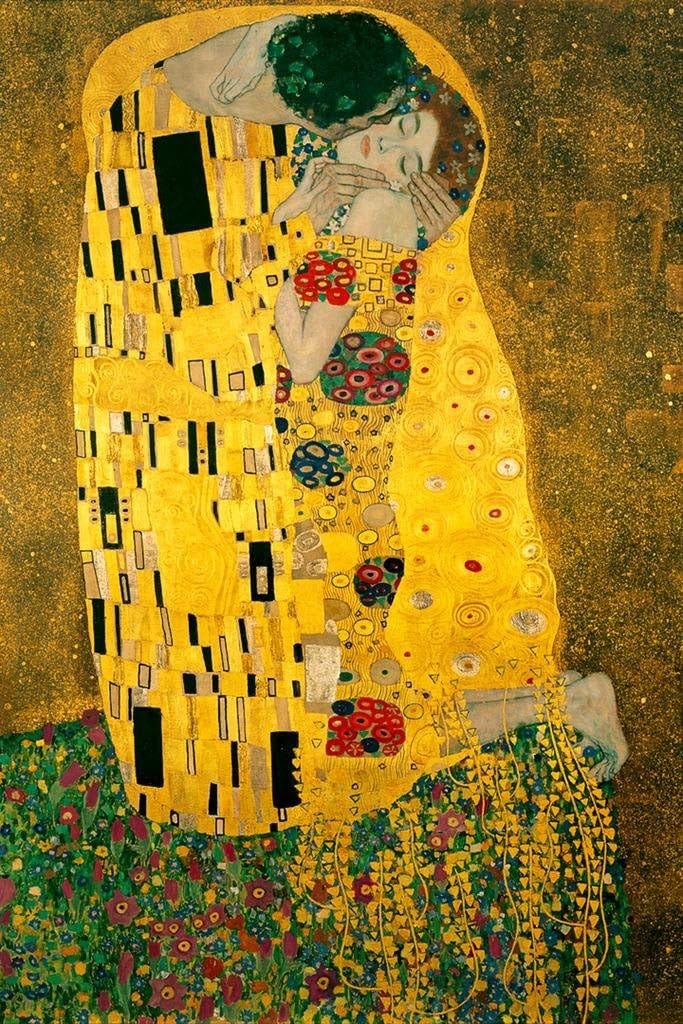
One last look at Klimt, by the way. Look at her knees. The meadow they’re kneeling on ends. Right there, under her feet, it stops, and below it there is nothing but gold. Her toes are curled over the edge. She isn’t swooning. She’s at the last step, and the gold, the infinite otherness, is what’s on the other side.
Put simply: anyone you ever love will be bigger than your idea of them. You never finish exploring them. At the top of that mountain of inquiry, if you’ve worked very hard, you will forget yourself.
And the last step is one you take without any rational proof or evidence.
So here’s the question that the 19th-century is asking you. What is that last step you haven’t taken? Not the big one. The small one. The text you haven’t sent. The thing you haven’t said out loud. Go — with fear and trembling, perhaps — but, go!
Life is for the living! While shallow, mechanical men make artificial noises with AI and hide behind the collective groupthink of memes, just go tell her how you feel! Your heart and your journey are worth the leap. And you can’t lose. The lover, the one who loves with their whole heart, can never lose. Because love is the point. To love is to be human. That’s what your smartphone will never understand. You are not a college transcript, or an algorithm, or a number. You are light, dancing on a pewter dish. You are a magnificent, incalculable wonder who has squandered too much time already.
Which takes us now to the 20th century — to our final room today.
After we’ve read Kierkegaard and the Romantics, and we find that love exceeds every concept I can calculate and put forth, what then is left to be said? And what would its value be? What does “I love you” actually mean and do?

Mobile Lovers | Banksy, 2014
Room 5: What does “I Love You” do?
About a hundred years ago, a man gets off the 5:15 train from London, and the most famous economist in Britain, who has come to meet him at the station, writes home that night: “God has arrived.”
The man who wrote that was the 20th century’s most famous economist, John Maynard Keynes. And the man on the train was Ludwig Wittgenstein, who was coming back into philosophy after a ten-year absence. He had read Kierkegaard, and called him the deepest thinker of the 19th century. And the one book he had already written, which he finished as a soldier in the First World War, ends exactly where the mystics did. I’ll quote it here:
“There are, indeed, things that cannot be put into words.
They make themselves manifest.
They are what is mystical.”
The last sentence of this book, the most famous sentence in 20th-century British philosophy, says simply: “Whereof one cannot speak, thereof one must be silent.”
That is where the last room leaves us.
Some things exceed our ability to reason with them at all, so we grow silent.
Dante knew this 600 years before Wittgenstein. In his first canto of Paradiso,
he wrote that: “To go beyond the human cannot be put into words.”
Then he wrote 33 cantos about it anyway.
So just like the previous four rooms, this last room isn’t about love either.
It’s about words.
So let’s look at words like Wittgenstein did. We generally assume a sentence is a kind of report. “The cat is on the mat” reports a cat, right? Ok. So, what is “I love you”? A report on an inner state? If it is, then every problem of the last four rooms comes back at once:
• you can’t see the state (that’s Descartes’s cloth)
• you can’t prove it (Spinoza didn’t even try)
• and the thing it names is bigger than every concept you have (that’s Kant’s storm).
The sentence “I love you” should be theoretically impossible.
And yet people say it every day.
So let me reframe this puzzle of words. It’s late at night. Remember that name you came up with? Well, you’ve typed “I love you.” You’ve looked at it sitting there in the Message Box, and you’ve deleted it, because you had no idea what saying this would do out in the world. Which is why the most frightening question in your vocabulary is three words long.
What are we? That isn’t a question about feelings. It’s about what the words have done.
It took Wittgenstein the rest of his life to ask it properly. The man who wrote “Whereof one cannot speak, thereof one must be silent” spent the next 20 years taking it apart. Words, he finally decided, don’t work by pointing at things. For most of what we say, the meaning of a word is its use.
Think about what that does to our puzzle. If “I love you” were merely a label on a feeling, you would have to see the feeling to check the label, and we spent two rooms learning that you can’t.
So, we make a categorical mistake by asking what “I love you” means.
Rather, we would make more sense by asking what “I love you” does.
An Oxford philosopher named J. L. Austin took that conclusion and ran with it across the pond to the United States. In 1955, he gave a series of lectures at Harvard with the amazing title, How to Do Things with Words. His point was this: some sentences don’t describe anything. They do something.
“I do,” at the altar, is not a report on a wedding. It is the wedding.
“I promise” doesn’t describe a promise. It makes one.
Austin called these performatives, and they’re all over the place!
Think about that Messages Box again. Sending those three words won’t report anything. It will make something true that wasn’t true a moment before. Which is exactly why you deleted it. And “What are we?” has an answer now, and it’s a short one: you are whatever has been said out loud.
Here’s the move. Austin stopped asking what the words mean and asked what they do.
It’s the smallest move of the five, one verb traded for another, and it took “I love you” out of the box and put it back in the world.
So, “I love you.” While the English are schooling the Americans on language as performance, the French are busy staring at the same question. In 1977, Roland Barthes publishes a strange and wonderful little book called A Lover’s Discourse, and it is organized like a dictionary of what lovers say. The entry for “I-love-you” is hyphenated. On purpose. “I-love-you” isn’t a sentence, Barthes says. It’s one word. It carries no information at all. Rather, it is best understood as a primal cry, and the only possible answer to it is the same cry back.
Or to leave the message “seen” in the text thread. God forbid…
And now, our final philosopher of the hour, and the one I’ve been saving. His name is Emmanuel Levinas, and he is my favorite. He was a Jew born in Lithuania in 1906, he went to Germany as a young man to hear Husserl and Heidegger lecture, he became a Frenchman, and he spent five years of the Second World War as a Jewish POW. In 1961 he publishes a book called Totality and Infinity, and in it he does something nobody in our five rooms has done.
Think about where every philosopher in this hour has been sitting. Aristotle, Augustine, Descartes, Spinoza, Kant, Kierkegaard, Wittgenstein, Austin. Every one of them is sitting where you’re sitting: inside your own head, looking out, wondering about the other person. Is she in there? Can I reach her? What will my words do?
Levinas turns around. His question is what the other person’s face does to you, before you’ve said a single word. And his answer is three words long.
“The face speaks.”
Before you’ve judged the person across the table, before you’ve decided anything about their kindness, or their humor, or their eyes — their Face has already addressed you. It is already asking something of you. You can refuse it. You can leave “seen” on your phone. But you cannot un-hear it, and you did not start it.
Now, this answers a question most of us have asked. Do you love the person, or do you love the qualities? The kindness, the humor, the eyes. If it’s the qualities, then when those fade you should trade up! Yes — when the ick comes, just trade in the old for the new, right?
But Levinas has a line about that too. He says, “The best way of encountering the Other is not even to notice the color of his eyes.” The color of the eyes is a what. The Face is a Who. Descartes, you’ll remember, spent his whole life chasing a squint. That was a what, and it never have answered him because a what cannot answer a whom like you. If you’re looking for a similar feeling, similar eyes, or a similar laugh that you had previously, you will not find it. Because you didn’t love their whats or its.
You loved their Face. And you can love again.
A Face is not a thing you can use because it is an identity. That is what Aristotle meant by the friend who aims you toward virtue, and it is what Augustine was afraid of when he warned us about idols. You cannot use a face, and you cannot own one. It calls to you as a manifestation of the other — and either you answer the call or you deny it.
It is a face is on the other side of Magritte’s cloth, and Levinas concludes the cloth between lovers never comes down. Levinas read the mystics too, and he parted ways with them. The pathos of love, he wrote in 1947, is an insurmountable duality of beings. The two never become one. Magritte was right. So was Novalis: farther in, and farther, yet never finished.
So go back to the Messages Box one last time. The three words you deleted. You thought you were starting something. Levinas says you had it backwards. The Face speaks. It spoke before you typed anything, maybe months ago, and everything since has been you deciding whether to answer. The conversation started without you. What’s in your Messages app is simply your acknowledgement or denial of it.

Now let’s look at this artwork behind me. Banksy stenciled this on a doorway in Bristol, England, in April 2014, next to a boys’ club that was about to close. Two people holding each other, and each of them is reading a phone over the other’s shoulder. The club’s director pried it off the wall with a crowbar, Banksy gave him his blessing, and it sold for £403,000, which kept the club open. Now look at the faces. They’re a few inches apart. Both of them are reading a what. Everything Levinas wrote is on that wall. The Face is right there, speaking, and neither of them is answering.
Put simply: “I love you” is a deed,
and that deed is a reply to a Face you can never cease exploring.
Our last question. What have you made true by saying it?
What are you keeping from being true by not saying it?
So... Two people on a doorway, reading their phones. A woman at a cliff’s edge in gold. A kiss through cloth. A sleeve on a turret stair. Two people looking at the same moon.
Five problems, and I promised you answers. What a word does: it’s a deed, and a reply. What exceeds you: anyone you love, and the last step toward them is always a leap of faith. Whether anyone’s in there: your joy is real either way. Whether you may love a creature for its own sake: you may, what really matters is where it takes you. What the good life is: not something you can build alone. Not one of those was a question about love. But every one of them answered it.
Do you see the philosophy at play? Aristotle had his answer, yet he argued against it.
St. Augustine said God or the creature, and St. Aquinas said both, simultaneously. Spinoza moved love to your side of the cloth. Kierkegaard stopped climbing and jumped with his faith into the great unknown. Austin stopped asking what the words mean and asked what they do. That is the discipline of philosophy in five sentences, and every one of them is play. That is what I meant at the start. This is how a scholar, someone who has invested in texts, and time, and mentors, and colleagues can play. I’ve been doing it for nearly twenty years. I’ve asked every professor in this room one penetrating question or another, and I am the better for it. I’d rather jump into the deep end of the pool and look foolish, than to coolly sit in the safety of the sidelines of life. I’m sorry, but I can’t do it. I’m not gonna be a hack, and I thank God for that.
So if you take one sentence out of this room, take this one.
Love is not a feeling you wait for. It’s something you do, with your whole heart, for someone you will never stop exploring. She is the one you will treasure, the one will lay down your life for, the one you listen to with fear and trembling.
If there is someone special, tell them how you feel.
While there is no Book of Love, there is Dante and I end with his line. Once he made it to the top of Heaven, he looked into the light and said: “In its depth I saw gathered, bound by love into one volume, what lies scattered in pages through the universe.”
There are pages in the world with your name on them. Go find them.
She’s counting on you to do so.
You can find more at scribespark.com, including my college courses and public talks.