

Intro
Good evening. Thank you to the Alliance, and to all of you, for sharing an evening with a philosopher. It’s a generous invite, especially on a weeknight. So, here is what I was asked to do — I was asked to speak about modern fascism: its history and its qualities. Now, first and foremost, I distrust the word fascism. Not because it has no meaning, but because that word is used with unabated surety. We all seem certain we know fascism when we see it.
And that certainty can be a problem.
That certainty is, in fact, my focus tonight. Because the words we are most certain of are often the ones we stop thinking about. And that lack of concern, that lack of creative suspicion, can later be used against us if we’re not careful.
So, tonight I’m not going to hand you an easy definition and a list of villains you can denounce over social media. Here, tonight, I’m going to do something slower and more useful… I’m going to take one of the most overused and misunderstood words in our political language and render it strange again — and then, having made it strange, we can understand and see it more honestly, as one of the genuinely great and terrible achievements of the modern age.
I suspect I know why a room like this gathers together in a public library to hear a philosophy professor talk about fascism. You probably came suspecting that fascism is not bound up safely in the past. You may want a name for something you think you see, right now, out there. But as a scholar, I’m going to ask you to hold that desire, just for tonight. Because if I point at the world here tonight, you can argue with my finger, while missing what I’m pointing at. So, tonight I’m not pointing fingers. Instead, I aim to leave you with something far more valuable as you enter the fray. I’m going to fashion a lens (as carefully as our hour and my skill set will allow), and when you go home tonight, you may take that lens and perceive and report on the world with a depth that cannot be easily dismissed.
Tonight, I will cover three basic questions, each descending deeper than the last.
1. What are we even talking about when we say fascism?
2. Where did the thing come from, and why then?
3. And the last one, the one that matters most — why does it work? What is promised to the man who says yes to fascism?
Part I: What are we talking about when we say Fascism?
1.1 A Worn-Out Word
Our story begins in the ancient Roman forum, where it was unlawful to carry proper weapons next to politicians. So, what guards would do instead is tie a bundle of wooden rods together and carry that bundle while protecting government officials. This Roman bundle was called a fascis, the Latin word for bundle. So, you knew someone important was walking in or out of the forum when you saw a man carrying a fascis before him. Over time, the fascis came to have a kind of political meaning: Romans pointed out the symbolism of the many rods bound as one. In this way, the fascis became a totem of Roman power and authority.
Today, a similar bundle or fascis is carved into the arms of the great stone chair that President Lincoln sits in, forever watching over our most sacred civic plot of land in DC. The fascis was also on the back of the American dime until 1945. Some of you probably have one in a jar at home. However, it was the Italian dictator Benito Mussolini who took that Italian word — fasci, the bundle — and named his Italian political movement after it. So, how does the Roman symbol of the ‘many-bound’ become synonymous with the death of freedom? What happened?
Well, part of what happened with this word is what happens with all words eventually — it evolved from its ancient origins. In the midst of World War II, the author George Orwell (of 1984 fame) was already exasperated with its overuse. He noticed that “fascist” had become almost purely a term of abuse: people flung it across every dispute. One man’s fascist was another man’s patriot — until the word had been rendered, for Orwell, “almost entirely meaningless.” The word fascist had become a kind of noise. A bellow you make in the general direction of one’s political enemy.
Today, fascist is one of the most damning words of our political landscape — the one we keep in the glass case marked break in case of political emergency. So the first point to be made tonight is this: today, the word fascism holds two jobs at once: it is both a rhetorical insult and the name of a movement — with the insult having long ago outmoded the name. Which, of course, leaves us a choice: we can keep using it as a kind of definition-less snarl — or we can investigate whether there’s still a real thing underneath the noise. I vote we investigate!
1.2 The Experts Can’t Agree
You would think (I certainly thought, as a young grad student) that the historians and political theorists would be able to hand us a nice, clean definition. You know: a paragraph — here is what fascism is, here are its features, let’s check them off! But that’s not what one finds in such an investigation. I know! I looked!
Instead, what you’ll find at the university library is not a definition but a running argument — decades long, that more or less falls into 3 camps. The first camp uses the checklist. Its most famous version is by the novelist Umberto Eco, who grew up under Mussolini, in an essay he called “Ur-Fascism.” Herein, Eco lists 14 features: the cult of tradition, the worship of action for its own sake, an obsession with enemies both too strong and too weak. Etc. But here’s the punchline: Eco concludes that his checklist can’t be made into a system; any one of his 14 features can be present without fascism forming. They have what the philosopher Wittgenstein called a family resemblance — the way cousins look related without sharing any particular feature in common.
That’s somewhat useful to us. But a family resemblance is not a definition.
That’s just us squinting at politics.
A second camp says: stop cataloguing symptoms, and instead name the core. The historian Roger Griffin does this in one phrase when he names the core of fascism “palingenetic ultranationalism.” Palingenesis is from the Greek for palin, again; and genesis, birth. So: it’s a Rebirth. Griffin claims that at the mythic heart of every fascism sits one story — the nation has fallen from greatness into decadence, and through struggle and purification it will be born again.
For Griffin, at the core of fascism is the death and resurrection of a people.
And yet a third camp says both of those attempts are too abstract. The historian Robert Paxton argues that fascism has no fixed doctrine. Rather, you understand it better by what it does than what fascism says, and fascist movements will often contradict their own stated principles the moment power is near, because the doctrine was never the point. Watch what the fascist does, Paxton says, not what the fascist says.
And then there’s a response I personally trust over all three, from the US Holocaust Memorial Museum, which exists largely as a result of the fascist activities of the European mid-20th century. I invite you to walk its halls. You will leave changed. Fascism, it says, is an ultranationalist, authoritarian political philosophy — fixated on national decline (real or perceived) and drawn to violence as something redemptive and purifying. Here, our national Holocaust Museum compresses the argument in tandem with the second camp. And yet, there’s still a fundamental problem lurking under all four responses: is the word “fascism” even naming a single, particular thing?
Mussolini’s Italy may have given the movement its name — but was Hitler’s Germany the same animal, or a darker cousin the one word only smudges together? We will discuss Germany more in a few minutes, but here is what I want us to focus on: our second point. Even the museum’s definition describes the thing from the outside — and the experts still can’t close the argument. Not because fascism is inexplicable. It’s because fascism is not a set of propositions you can discuss on a whiteboard.
No, pinning down fascism seems difficult because it was never a set of propositions to begin with. It’s operating on a completely different register.
1.3 Argument vs. Experience
In 1932 the Italian Fascist regime finally produced something like an official statement of belief, “The Doctrine of Fascism,” signed by Mussolini himself, though its philosophical spine was written by an actual scholar, Giovanni Gentile. And Gentile was no philosophical lightweight: his “actualism” was a real and demanding system of thought — ‘proof’ (if you wanted it) that fascism could attract a first-rate mind. But watch when the scholar was called in. Not before the movement to write a founding document. No, Gentile was called after the death squads, after the marches, after Mussolini had gained unmitigated power — to compose a doctrine for a thing that had already won without a central text. And the revealing thing about that document — the closest thing fascism has to scripture — is that it half-confesses it has no scripture. It says, more or less, that fascism was not born of a doctrine worked out in advance; rather, it was born of a need to act, and the doctrine came afterward, to explain away what the action had already done.
Consider some of the alternatives.
Political Liberalism has a well-worn scripture: John Locke. Mill’s 19th-century On Liberty. Marxism has Das Kapital, with a thousand pages you can attack premise by premise. America’s founding has the Federalist Papers. Every serious modern movement left a book — a case, made in rational, logical claims that the careful reader can argue with. Now, fascism was not wordless; I want to be fair. It did leave a jailhouse memoir called Mein Kampf, My Struggle, swollen with Hitler’s self-congratulatory drivel — shallow on poetry, history, or common decency. Or, in Winston Churchill’s more apt words, it was a text “turgid, verbose, [and] shapeless.”
No one was ever reasoned into fascism by reading Mein Kampf.
While other political forms were developed with particular arguments, Fascism developed in a particular atmosphere. By design, fascism is as thin on argument as it is overwhelming in experience — it never tries to persuade your intellect.
Instead, it aims for something subconscious: a feeling of belonging to something deathless and sublime. Something that offers a beautiful death. You have invited a philosopher tonight to discuss fascism, when, in fact, fascism isn’t a philosophy at all. It is a mythology.
You cannot refute the sublime experience of fascism with a librarian’s footnote. Throw your accusations and definitions at it; they will simply bounce off. The knowing youth will simply laugh and shake his head. So, what are we talking about when we talk about fascism? It isn’t a text-bound philosophy like Liberalism or Conservatism. It is an atmospheric experience that persuades one’s heart toward militant service to the state and its leaders.
Part II: Where & When did it Come From?
2.1 The Tinderbox
Now, a myth doesn’t just fall from the sky. This myth certainly didn’t.
A century of European thinking laid the tinder: three pieces of it, and you can’t understand how it lit modern Europe on fire without knowing how it began.
I want to take us back to the European Enlightenment, an area of which I have had some interest over the years. Voltaire, Kant, the whole 18th-century project bet everything on something called Universal Reason — one human nature, everywhere the same, sharing in one set of human rights. That claim built the modern world, including the great American Experiment. But that idea also had enemies, called the Counter-Enlightenment. To those authors, there was no such thing as a “man” in the general sense — only the Frenchman, the German, the Russian, each formed by a particular soil and a particular past. And what some called Universal Reason was just one tribe’s customs proclaimed from a powdered wig.
So, let’s not fall to sophistry and abstractions, they intoned. Trust the blood. Trust the soil that binds that blood. For therein lies one’s definition and belonging. Now, an idea was loosed upon modern Europe — that men are defined by blood and soil. This is the first piece of the puzzle.
The second piece is a name handled rather carelessly by many undergrads: Friedrich Nietzsche. Nietzsche was no fascist; he was, in fact, contemptuous of German nationalism, laughed at antisemitic claims, and at one point burned his passport. However, in his last years, he was rendered bedridden and speechless, and his sister Elisabeth — an antisemite and later admirer of Hitler — took control of her brother’s manuscripts, edited them, and sold a Nietzsche that suited Nazis. Hitler’s regime loved this edited version. The will to power, the scorn for herd morality, the overman beyond good and evil. In Nietzsche’s hands, these were necessary provocations; but handed to a nationalist movement, his edited text became a permission slip for cruelty.
The third piece comes from a French engineer named Georges Sorel. In 1908, in Reflections on Violence, he asked what actually moves masses of people to act, to sacrifice, and to fight. Not arguments, he decided. Not social programs. It’s myths that move man — filled with galvanizing images of a shared struggle. This gives us more clarity on how to see fascism. Because you don’t judge a myth true or false, Sorel argued. You judge a myth by what it does. Now here’s the irony: Sorel meant his text for the revolutionary French Left, but within a decade the men building fascism picked it up, and, like Nietzsche, used Sorel’s work for their own ends. Mussolini certainly did.
All this to say that some of Europe’s most powerful minds had been assembling the case that the nation runs deeper than reason, that great men forge their own morality, and that politics is moved by national myth. This was the set of rhetorical tools waiting for someone in the 20th century to use.
2.2 The Crucible
The hinge of our story is the First World War. Ten million dead. A generation of young men fed into machine guns and industrial artillery, for years, over a few miles of poisoned mud. And later, the ‘survivors’ came home into societies that could not absorb what had happened to them — or to language, or to even meaning itself.
The historian George Mosse called what the war did the ‘brutalization of politics.’ Something in the trenches broke the old horror of violence — four years where killing happened daily, where the nation demanded death and called it holy, where the man in the opposite trench was an enemy in the most total sense, his very existence a threat to yours. Most who came home wanted nothing but an ordinary life. But a scarce minority did not want to put his weapon down. After all, he had been someone in the trench — part of a band, a purpose, an intensity — and peacetime, with its shops and parliaments and endless compromises, felt like a betrayal.
A kind of grey humiliation of the spirit.
A line drawn between neighbors — you belong, you do not, and your ‘not-belonging’ is an existential threat — does not stay long on paper. As a combat veteran, I watched what speeches brought to a war-torn Sarajevo, where neighbors hated neighbors for the way his neighbor acknowledged God. It was a horror beyond words. It is, in part, why I address you this evening.
Well, after the First World War came the reactive movements — and notice, this is Paxton’s point returning. They came for a feeling, not an argument. In Italy, before Mussolini, came the Futurists: artists led by the poet Marinetti, whose 1909 manifesto glorified speed, technology, youth — and war, which he once referred to as “the world’s only hygiene.”
Then another poet, D’Annunzio, seized the city of Fiume in 1919, and ran it for over a year as a proto-fascist pageant: with loud balcony speeches, call-and-responses from the crowd, matching black shirts, and the famous Roman salute. Just about the whole choreography of fascism was invented there, by a poet, as a kind of theater, three years before Mussolini took power.
Not surprisingly, fascism was an aesthetic before it was a movement.
Then Mussolini gathered it up. His movement took the name — the fasci, the bundle held together with a nod to Ancient Rome. His squads carried the trench violence of the Great War into domestic politics, beating and burning Italians. And in 1922, Benito Mussolini came to power. But here’s the part most people get wrong. His march on modern Rome was mostly theater; the king could very likely have stopped it with the army, but chose not to try. Mussolini was invited — handed the government by the respectable Italian élites, as they were frightened of the left and thought they could use him and control him.
In other words, those in power thought Mussolini to be a kind of useful, popular ornament for their own backroom agendas. Here, I want to point out that both Italian Fascism and German Nazism share the myth we’ve been tracing: the fallen nation, the ache for rebirth, the enemy who must be purged so the body can be clean. But watch who the enemy is. For Mussolini, the enemy was mostly political — the liberal, the leftist, the soft modern man who would not help Italy regain her former glory. However, for Hitler, the enemy was not merely ideological but biological. Nazism took the rebirth-myth and fused it to a doctrine of race — the nation was not a shared story one joins, but blood that had to be kept pure. And once you have defined your enemy by blood instead of belief— a conclusion follows with the cold logic of a proof. A political enemy can recant, convert, be argued down, be outvoted. But a racial enemy can do none of these things. She cannot stop being what she is. She can only be removed from the land.
That single step — from the enemy you argue with to the enemy you must eliminate — is the path from a bombastic figure on a balcony to a railway platform at Auschwitz.
Of course, 11 years after Mussolini, the German conservatives made the exact same bet in Berlin, with precisely the same confidence — that they could use this man as an ornament of their own designs. One of them said it aloud, “We’ve hired him.” But they had not hired him.
Fascism did not break down the door. Respectable, frightened people opened it — which is the single most uncomfortable fact in this whole talk. Please remember it.
Now, it would be a comfort to file all this under history — a century’s-old European fever of the twenties and thirties, burned out and safely behind us. I want to take that comfort away, because one more thinker saw, even as it was happening, that this was not a one-time accident.
2.3 The Door in the Floor
His name was Ernst Cassirer, and his last book is the one I find difficult to teach — because it burdens the story every teacher lives by. Cassirer was a scholar of the Enlightenment, a believer in reason and culture — and a Jew, who fled Germany when the Nazis came, taught in exile, and died in 1945, in America, as the war was ending. The book, published after his death, is called The Myth of the State.
In it he makes sense of what he has just watched consume his world. We told ourselves a story about progress, he says — that humanity climbed up out of the darkness of myth into the daylight of reason, and that the climb was permanent. That story was false. Myth was never defeated by reason. It was suppressed — and suppressed is not defeated. Defeated is gone. Suppressed is underground, dormant, waiting. And in times of extremity — collapse, humiliation, fear, the sense that the ordinary world has failed — the old mythical thinking comes back up, with all its ancient force, now armed with modern technology and the modern state.
Reason, Cassirer is telling us, is not our natural resting place. It is an achievement — thin, recent, and reversible. Under enough pressure, human beings do not default to argument. We default to myth: the tribe, the strong man, the cleansing of the enemy, the promise of rebirth.
Fascism, in that light, is not an aberration. It is what a frightened, humiliated modern society reaches for when reason seems to have failed it. A door in the floor — always there, under the carpet, waiting in every single one of us.
So here it is: Fascism is not a European disease from a distant decade. It is the shape the human animal takes under enough fear — and that shape is available in every generation, because the door in the floor is built into the architecture of the mind, not into the history of the Italian peninsula.
So finally, I ask: what does fascism offer the human heart that makes us, again and again, willingly open to it? That’s the last question of our evening.
Part III: Why Does Fascism Seem to Work?
3.1 The Pull
Everything so far has been, in a sense, from the outside — the word, the history, the ideas. Now I want to reach inside.
Most people who’ve lived under fascism never embraced it. They complied. Out of fear, out of habit, out of the ordinary wish to keep their job and their family safe. That machinery — the secret police, the informer, the boot — is real; whole books are written about it, and it is not my subject tonight. My subject is stranger. Not why people obeyed — obedience is easy to explain; fear explains it. I want to investigate why some believed — why did some weep with joy, why did they give everything? Because it is the believers, not the frightened, who tell us what the thing actually offers the heart.
We first have to acknowledge that the believers were not a separate species. They were the ones who said yes to a pull that millions more felt in those same years and finally refused. It is the pull I am after tonight — not the surrender. The surrender is rare. The pull is not.
Many will ask why fascism is wrong. That’s the easy question. The hard one is why it is so attractive. Knowing the horror, why do human beings keep saying yes to fascism?
The best answer I know comes from Hannah Arendt, who did not write about fascism in general. She wrote about its most extreme form, totalitarianism — the kind of fascism that wants not your obedience but your soul. The kind Nazi Germany built and Italy, for all its cruelty, never quite achieved. And she traces it through the hatred of the Jew, and the reach of empire, down to the taproot — the quietest thing she found, and the most universal: loneliness.
Not solitude — solitude can be rich and deeply beneficial. Loneliness hits different. If you’ve ever felt unnecessary in a crowded room, you already know the difference. It is the experience of not belonging to the world at all, of having no place among others, of lacking the confirmation of others — of being, in the deepest sense, unnecessary to a world. Modern society manufactures this loneliness at a grand scale: it uproots people from village and church and craft and class, from the whole web that used to tell them who they were and that they counted, and leaves millions atomized, each alone in the crowd, each privately suspecting they are no one.
Fascism makes an offer no liberal society thinks to make. It says: you are not ‘no one.’ You are a son of an eternal people, a cell in an immortal body. You were never alone — you had only forgotten who you were. Come home! To someone with an aching, nameless hole where belonging should be, that is water in the desert — the thing they have wanted their whole life and could never name. Powerful is the man who promises this.
But belonging alone doesn’t explain the intensity — the tears, the ecstasy, the grown men weeping at Nazi rallies. Belonging is warm; this was more than warm. It was transcendent…
3.2 A Religion for a Disenchanted Age
To see its transcendent, sublime nature, you must stop thinking of fascism as politics and start thinking of it as a kind of religion. The historian Emilio Gentile (no relation to the earlier philosopher) saw it like this: he calls fascism a political religion. Not every historian buys that frame, but I find it a useful heuristic.
Fascism took the whole apparatus of religion, which Europe was rapidly losing in an age Max Weber called the disenchantment of the world, and moved it onto the nation. Here, fascism made the nation sacred: its saints, who were the movement’s martyrs; its holy days and processions; its rituals of blood and sacrifice. To a God-emptied modern person, it offered the one thing modernity had taken away — the sense that a life, and a death, might mean something eternal.
The philosopher who saw this most clearly was Walter Benjamin, another German Jew. In 1935, thinking about how mass reproduction was changing art and aesthetic value, Benjamin wrote a sentence I have never been able to shake. He said that fascism doesn’t offer the masses what they need, but a chance to express themselves— a role in a magnificent spectacle. Expression is being seen. Justice is being served. Fascism understood that you can starve a people of the second so long as you drown them in the first. In this way, fascism is the introduction of aesthetics into modern political life. And with it, politics became a means of expression rather than debate.
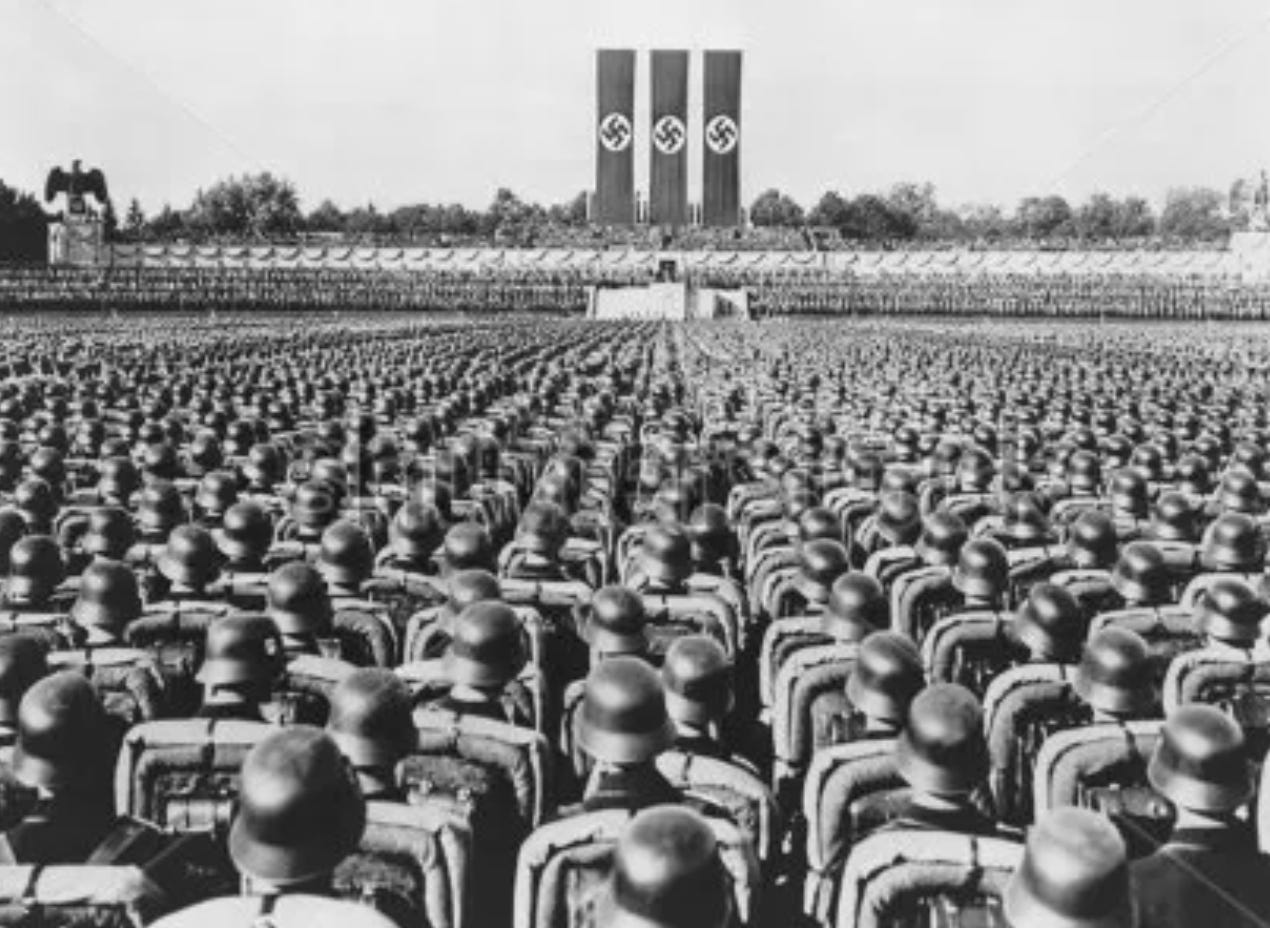
Think on it. One hundred thousand human beings in perfect ranks in a great square at night. Pillars of light — searchlights fired straight up into the dark, a cathedral of light with no ceiling. Ten thousand torches. Banners the height of buildings. Every face turned the same way, every voice in one chant — and the terrible relief of it: the individual, that lonely, anxious, unnecessary little self, dissolving into something vast and deathless and eternal and sublime.
It is indeed transcendent. That is the honest word, and I use it here on purpose. We may flatter ourselves that fascism is ugly — that we’d see it coming, because it would repel us. But the aesthetic of fascism was never ugly. It was sublime. It gave people the most beautiful and moving experience of their lives.
So, perhaps now you can see why every fact we throw at fascism bounces off. You cannot argue a person out of a religious experience — you cannot refute a cathedral of light with a policy paper. Benjamin understood that the enemy of fascism is not a better argument, because fascism was never standing on the plane of rational discourse. Strip everything else away: fascism works by giving lonely, disenchanted people belonging, and beauty, and the feeling of eternal meaning — a religion for an age that had lost its religion — which is why you can never defeat it with facts alone.
3.3 The Ever-Present Temptation
So, with everything I’ve described tonight — the longing to belong, the hunger for meaning, the exhaustion with the burden of freedom, the pull toward a strong, simple story that makes all our other stories make sense — none of that is German. None of it is Italian. None of it belongs to the 1930s. Every one of those needs is permanent, because they are not the needs of a nation. They are the needs of a human being.
The psychoanalyst Erich Fromm — another refugee from Hitler’s Germany — not only understood this, but used it as a title: Escape from Freedom. His argument begins when the modern individual was cut loose from the fixed medieval world, the village and guild and church that had once assigned him a place and a meaning, and found himself free, and terrified, in the same instant. And Fromm’s thesis is almost unbearable in its honesty: that freedom, which we all say we want, is also our great modern burden. It is heavy. It is lonely. It throws you back on yourself, makes you responsible, and leaves you exposed.
And so there lives in us — in all of us — a permanent temptation to escape from freedom: to hand the weight of our own selfhood to a knowing leader, a movement, an effervescent crowd, and feel the sweet relief of no longer having to be a separate, responsible, solitary self. Fascism is the most complete offer of that escape ever devised. And it stands open in every generation, because the burden it relieves is the permanent burden of simply being a modern person.
Now look back at the guides who’ve walked us through this. Hannah Arendt, who taught us about loneliness — fled the Gestapo, was interned in a French camp, escaped, and got out through Lisbon. Ernst Cassirer, who taught us that myth is only sleeping — died in exile, the war not yet won. Erich Fromm — driven out. And Walter Benjamin ran for the border in 1940 with the Gestapo closing behind him, was turned back at the frontier, and took his own life that night rather than be handed over. These were not scholars safe in a library. Every one of these people theorized the fire as they were running from it. They dragged these insights out of the wreckage of their own world, at the cost of their homes, and for some of them their very lives. And they’ve handed their stories to us. So that we would be able to recognize the shape of the thing, if it ever came for us.
So I will end where I began: with a caution.
The word we started with — fascism — is too important to waste as an insult, and too real to lock safely away in the past. Hold it with care. If you cheapen it and throw it at everyone you disagree with, you will wear it out— and it will not serve you later, with its deft sharpness, on the day you truly need it.
But, then again, tell yourself that fascism is only history, that it could never happen here, and you will not see it coming — because you will be scanning the horizon for jackboots and torches. And you will miss how it actually arrives: in the ordinary clothes of one’s own time, speaking of rebirth, and belonging, and enemies not of our blood and land, in a voice that sounds like home.
I was asked to give you a philosopher’s view of fascism. What I hope I have done is given you a lens — grounded by a century of the hardest experience human beings have ever had to endure, and by the exiles who paid for it with everything they had. I have deliberately not told you where to point that lens. That is not my work tonight. But the lens is yours now nonetheless.
What you build with it, out there, together, with other people, by the slow argument of fellow citizens — is your work, and it is the real work, and it is not mine to script. All I ask is that when you raise the lens I have offered you, that you dare to look through it honestly. Not only outward, at the people you already fear. But inward — at the pull you may feel in your own chest, toward the warm and the simple and the call to belong. Because that pull is where it always begins.
Thank you, God bless you, and God bless the United States.
---
Shared with the East Texas Invisible Alliance at the Longview Library