

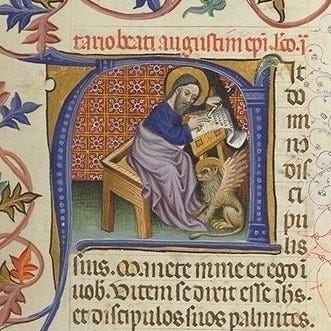
This is the first entry in a five-Sunday reading of the Gospel of Mark. I’m drawing throughout on three scholars who would happily argue with one another all afternoon: Amy-Jill Levine, the Jewish New Testament scholar who keeps me honest to a first-century Jewish point of view; John Dominic Crossan, my old undergraduate mentor, who taught me to hear the Kingdom Jesus announced as present and immediate — here, now; and the late Marcus Borg, who taught a generation to take the gospel seriously without necessarily taking it literally. A Jew, a former Dominican monk, and a Protestant theologian. Every one of them has helped me read gMark more closely.
The Gospel of Mark | Part 1 | Part 2 | Part 3 | Part 4 | Part 5
εὐαγγέλιον
evangelion • from eu (good) and angelos (messenger)
Evangelion is the public announcement a herald carries home from a won war
Central Question for Part 1
What kind of Good News (evangelion) is this?
Lesson One · The Stolen Word
I’m a professor, so I’m professionally obligated to open with the following observation: the Gospel of Mark begins with an act of plagiarism.
Almost every important word in gMark’s first line, “good news,” “Son of God,” even the simple impulse to announce a new ruler to the world, had been written before. The author stole them. And I’m fairly sure he wanted you to know he stole it. Because the source he stole from was the Roman Empire itself.
That’s the puzzle I want to hand you. Why would a writer announcing what he believes is the most important news in human history reach deep into the mouth of his enemy, and lift the words from the empire to say it?
Let’s start with the world in which gMark is written. First-century Israel is a Jewish state under European occupation, and has been for generations. Pompey marched into Jerusalem sixty-three years before the common era, and after him came the client kings, the Roman governors, the soldiers, etc. Occupation was not a neutral arrangement. Taxes flowed outward to Rome and to a Temple aristocracy that often managed the relationship on Rome’s behalf. It meant a governor could nail you to a post by the roadside the moment you became politically inconvenient. And underneath all of this ran a Messianic hope: a deep and widespread Jewish conviction that God would not leave his people under the Roman boot forever. That God would act in history. That God would send an anointed one and set the world right.
Now the word itself. On its native soil, evangelion — the Greek that opens gMark, the word your Bible may render “good news,” or “gospel” — was not a religious word at all. It’s a battlefield word, and the Romans loved to hear themselves say it! When two armies met, and one broke the other, the victor sent a runner home: a herald, an evangelos. What he shouted as he came through the gate was the evangelion, the good news that the enemy was beaten, the war was won, and the victory was ours! That is the home address of the word. It announces imperial conquest as a gift to the conquered. We’ve beaten you. You’re Roman now. You’re welcome.
There is a stone that brings this to crystal clarity. Scholars call it the Priene Calendar Inscription, after the city in present-day Türkiye where it was found, and it was carved about 9 years before Jesus was born. It records a decision by a council of Greek cities so overcome with gratitude to the Roman emperor that they reorganized their entire calendar to make the year begin on his birthday! And they explained the change in writing. The birthday of the god Augustus, the stone says, “signaled the beginning of good news for the world.” The beginning of good news. In Greek, the beginning of evangelion — the same word that opens gMark.
Moreover, “Son of God” was no metaphor in the pre-Christian Roman world; it was a royal title with a paper trail. Augustus’ adoptive father, Julius Caesar, had been formally voted a god by the Roman Senate after his death, which made Augustus, officially, Divi Filius, Son of the Divine. Carried east and rendered into Greek, that became Theos Huios in Israel: a Son of God. Across the empire, and especially in the cities of Asia Minor, where the Priene stone was carved, there were temples to the divine Augustus: altars, sacrifices, and festivals on the imperial birthday. An entire civic religion of the emperor: stitched into the calendar, the marketplace, and the public square. You did not have to privately believe Caesar was divine to be swept up in it. In the Mediterranean world, there was simply no getting out of its way.
And this claim was not empty. Augustus really had ended a century of civil war; the Pax Romana was a visible daily fact, stamped on the statute in the town square and the coin in your hand. To the unwashed millions under the Roman eagle, it was the greatest story they had ever been told: a “good news” that stretched from Persia to Spain and stood on the twin pillars of civic religion and imperial power.
That is the “good news” gMark sets out to contradict.
So when the gospel writer lays those exact words: the victory word and the emperor’s title, at the feet of a crucified rabbi from Galilee, the audacity is almost hard to feel from this distance. As of the opening line of this Gospel, there are now two lords. One on a throne. The other on a cross.
But watch what gMark does next. Having stolen Rome’s vocabulary, the gospel writer turns immediately to the Jewish prophet Isaiah — a voice crying in the wilderness, prepare the way. The words are lifted from Rome, but the authority is claimed from Israel’s scripture. From the very first sentence, the text is fighting the empire in the empire’s own language, but on Israel’s home ground.
The beginning of the good news of Jesus Christ. As it is written in the prophet Isaiah, “See, I am sending my messenger ahead of you, who will prepare your way, the voice of one crying out in the wilderness: ‘Prepare the way of the Lord; make his paths straight…’” MARK 1:1–3
Here is what I want you to carry out of this first lesson. The author of gMark did not invent a religious word. They repurposed a deeply political one. And that single choice, made before they’ve told you anything Jesus did, is already a treasonous argument.
We have the stolen words now. The stranger question comes next: not which words the writer took, but when he chose to walk out the door with them. Because of all the moments in history to announce the good news of God’s victory and the coming of peace on earth, gMark picks just about the worst one imaginable.
Lesson Two · The Year the Temple Burned
The gospel writer’s timing may be even stranger than his vocabulary.
Of all the moments in history to stand up and proclaim the good news of God’s victory and the arrival of peace on earth, gMark chooses one of the worst. It announces God’s triumph at the precise moment that Jerusalem is burning.
To see it, you need to hold onto a year: 70 CE. Roughly 40 years after the crucifixion.
Here is how we got there. In 66 CE, about a hundred and thirty years after Pompey first took the city, Jerusalem rose in open revolt against Rome. It went about as well as a provincial uprising could be expected to go against the most efficient war machine the ancient world ever built. By 70 CE, the legions had retaken Jerusalem and burned the Jewish Temple to the ground. And you have to understand what the Temple was to feel the size of that loss. Not merely a building that housed the Holy of Holies. It was the beating heart of God’s people. The one place on earth where heaven and earth were said to meet; where the pilgrim feasts gathered the tribes; where sacrifice and prayer and memory and identity all lived together in one house of stone. The House of God. And Rome burned it down.
gMark is written in the gravity well of that catastrophe. Not in a calm theological academy at a safe distance from Roman power, but in the smoke and ash of the Jewish capital. Once you see that, the opening line stops sounding like church and starts sounding like something far more dangerous.
Look at how the gospel writer describes the Temple’s fall, in the passage scholars call the “little apocalypse.” In Chapter 13, Jesus is preaching on the Mount of Olives, looking back at the great building and describing its ruin.
As he came out of the temple, one of his disciples said to him, “Look, Teacher, what large stones and what large buildings!” Then Jesus asked him, “Do you see these great buildings? Not one stone will be left here upon another; all will be thrown down.” … “But when you see the desolating sacrilege set up where it ought not to be (let the reader understand), then those in Judea must flee to the mountains.” MARK 13:1–2, 14
Not one stone left upon another. A desolating sacrilege standing where it ought not. People fleeing to the hills — pregnant women, nursing mothers, caught in it — the warning not even to go back inside for a coat. This is not vague, cosmic, end-of-the-world poetry. This is reportage. It reads like someone describing a fire they can still smell.
And in the middle of it, the writer does something telling: he breaks the fourth wall. At the most charged line — that “desolating sacrilege standing where it ought not” — he cuts in with an aside. Let the reader understand. Over the heads of the characters in the scene, directly at you. That little parenthesis makes the clearest sense if his readers are watching the very thing he’s pointing at happening in real time. You don’t elbow people to “understand” a prediction about the distant future. You elbow them about a headline they’re living through. Even the phrase is loaded: “desolating sacrilege” reaches back into the book of Daniel, where it once named an earlier defilement of the Temple centuries before. The author takes the oldest word Jewish memory had for the holy place violated and reactivates it for the Roman violence happening in their own time.
So here is where I plant my flag. The simplest and most honest explanation for why Mark 13 describes the fall of Jerusalem in such precise and terrified detail is that the author is writing inside it, or in the raw aftermath: right around that year we’re holding onto, 70 CE. The scholarly consensus is that this Gospel is a product of the Roman-Jewish war. So, gMark is not forecasting a distant future. It dates itself, with great precision, into a present and ongoing catastrophe.
And now something easy to miss, which changes the tone of the whole chapter...
The writer is not stoking the panic. They are managing it. Listen again to what Jesus says in the thick of the chaos: you will hear of wars and rumors of wars — but the end is not yet. Do not be alarmed. When someone runs up shouting the Messiah is here, the moment has come, do not follow them. This is a pastor talking a traumatized congregation down off a ledge. The Temple has fallen, false messiahs are multiplying, everyone is certain the world is ending, and gMark reaches for all this apocalyptic imagery for the express purpose of telling its people to keep their heads. It uses the language of the end to contain the fear of the end for third-generation Christians.
This opens the question that holds the whole Gospel together. If these words are being shaped inside the rubble of 70 CE, what was Jesus himself doing, forty years earlier, out in the Galilee?
Well, there are two levels in this Gospel working together. On the first level is what Jesus did — and what Jesus did, in the best historical reconstruction we have, was enact a kingdom that was already breaking through. Present tense. Here and now. Healing bodies, dining with the wrong people, tearing down the walls between who was in and who was out. That is the ground floor. On the second level is what the gospel writer, decades later, built — they took that present-tense proclamation and wrapped it, framed it, set it inside the trauma of a community watching the Temple burn. The urgency, the apocalyptic pitch, the sense that the cosmos itself was cracking apart: that is the editorial hand, writing for people who needed to know that God had not been defeated when Roman violence beat Judean courage.
This is why I refer to gMark as a “Crisis Gospel,” and in the same breath tell you the kingdom Jesus announced was and is present and immediate. These are two floors of one sacred house.
So here it is: Jesus enacted a kingdom that was already happening; gMark later wrapped that kingdom in the crisis of the Roman-Jewish war. See both floors at once, and this Gospel stops being a prediction and becomes something far more relevant: a word of hope, written in the dark, for people who were certain the monsters had won.
We have the stolen words, and now we have the strange timing of the Gospel of Mark. One piece is still missing, and it’s the most fascinating of all. A claim this size needs someone to say it out loud.
Lesson Three · The Witness
A claim this enormous needs a speaker. That an executed Galilean rabbi is the “Son of God,” the true Lord, the “good news” of the world. A claim that cosmic, that baffling, has to be said out loud by someone. So do something for me: cast the part in your mind. In a Gospel written to contradict the empire about who really rules the world, who would you choose to finally make the pronouncement? Who gets the line?
Hold your guess. I think the gospel writer may surprise you.
Then Jesus gave a loud cry and breathed his last. And the curtain of the temple was torn in two, from top to bottom. Now when the centurion, who stood facing him, saw that in this way he breathed his last, he said, “Truly this man was a Son of God!” MARK 15:37–39
Did you catch that?
It’s not Peter. Back in Chapter 8, Peter gets the name right and then immediately gets everything else wrong (we’ll spend a whole lesson on Peter later in this series). It is not the disciples. By now, they’ve run off like cowards, leaving Jesus’s mother and a few brave others to weep before his bleeding body. It’s not the crowds, not the religious authorities, not a sympathetic bystander. The one person in the entire Gospel who looks at Jesus and says, aloud, Son of God is a Roman soldier. A professional centurion of the army occupying Israel. The empire’s own instrument, standing at the foot of a Roman torture device, looking at an insurrectionist Rome has just killed.
Yes, please remember what the Roman cross was: the slow death, the public one, the humiliating one. A man stripped and raised beside a road. This was the execution Rome reserved for slaves and insurgents. Rome was explicit about why this particular man was up there. The charge nailed over his head read King of the Judeans. A pretender, a would-be king, a political threat to Caesar. So the execution frames itself, by Rome’s own hand, as a contest of kingship: Caesar’s authority against this Galilean. This is precisely the fight gMark picks in its opening sentence.
Now sit in the irony, because the writer built it on purpose, and it gathers up everything we’ve traced so far. The title Augustus claimed, Son of God, is confessed, in this Gospel, by Rome’s own soldier. Here, the circuit is completed. The author takes the empire’s vocabulary, the words lifted in the very first verse, and sets them in the mouth of the empire’s man at the exact moment the empire believes it has won.
The criminal is dead.
The execution is complete.
Rome’s power looks total.
And that is precisely where, and precisely from whom, the truth is proclaimed.
The Greek is slipperier than English here. The centurion’s words carry no definite article: he says, literally, “this man was a son of god,” exactly the way a Roman soldier would have spoken of Caesar. For two thousand years, the church has read the centurion’s line as the first true confession: the hardened soldier broken open by what he has watched, the one man at the foot of the cross who finally sees. That reading is beautiful, and it may well be right, but I want to complicate it here. Scholars argue over what’s in the writer’s voice in this statement. Is it conversion, a hard man undone? Is it awe? Or is it one more sneer: the same mockery the soldiers had been spitting all afternoon: sure, there’s your “son of god,” nailed to a cross…
gMark doesn’t tell us. And I’ve come to think the ambiguity is not a gap in the story but is in fact part of its genius. Because, in the end, it does not matter which one the soldier means. Sincere, stunned, or sarcastic — the gospel writer presents the empire’s own man proclaiming the empire’s own word over the body of the crucified. The irony is built at the level of the storyteller. It does not need the centurion’s faith. It only needs his Roman voice.
Watch what that does to the shape of the whole Gospel. “Son of God” rings out at the very beginning: verse one, and again from the torn-open heavens at the baptism, and then it does not land on a single human pair of lips again until here, at the foot of the cross. The entirety of gMark is framed between two proclamations of this single stolen, Roman title.
One last bit of Greek here. gMark uses one particular verb at exactly two moments, and it is a violent word: schizō, to tear or rip open. The first time is at the baptism, where the heavens are torn open. The second and last time is here, at Jesus’ death, where the great curtain of the Temple, the veil screening the Holy of Holies, the place of God’s own presence, where only the high priest could go, and only on Yom Kippur, is torn in two, top to bottom. The same rare, brutal verb tears the sky at the start and tears the veil at the end. Torn open. Torn open.
What that means, I’m going to make you wait for. We’ll need it on the last Sunday of this series, and if I’ve done my work, it will braid the whole thing together.
So this is the kind of good news the Gospel of Mark means to share. Caesar’s word and Caesar’s title, announced by Caesar’s own man, over the body of an executed Jew. The plagiarism was never a scandal. The plagiarism is the message.
The Gospel of Mark · 1st of 5 Sundays: Mark & the Good News.
Next Sunday: “Wilderness, Baptism, Demons & Authority.”