

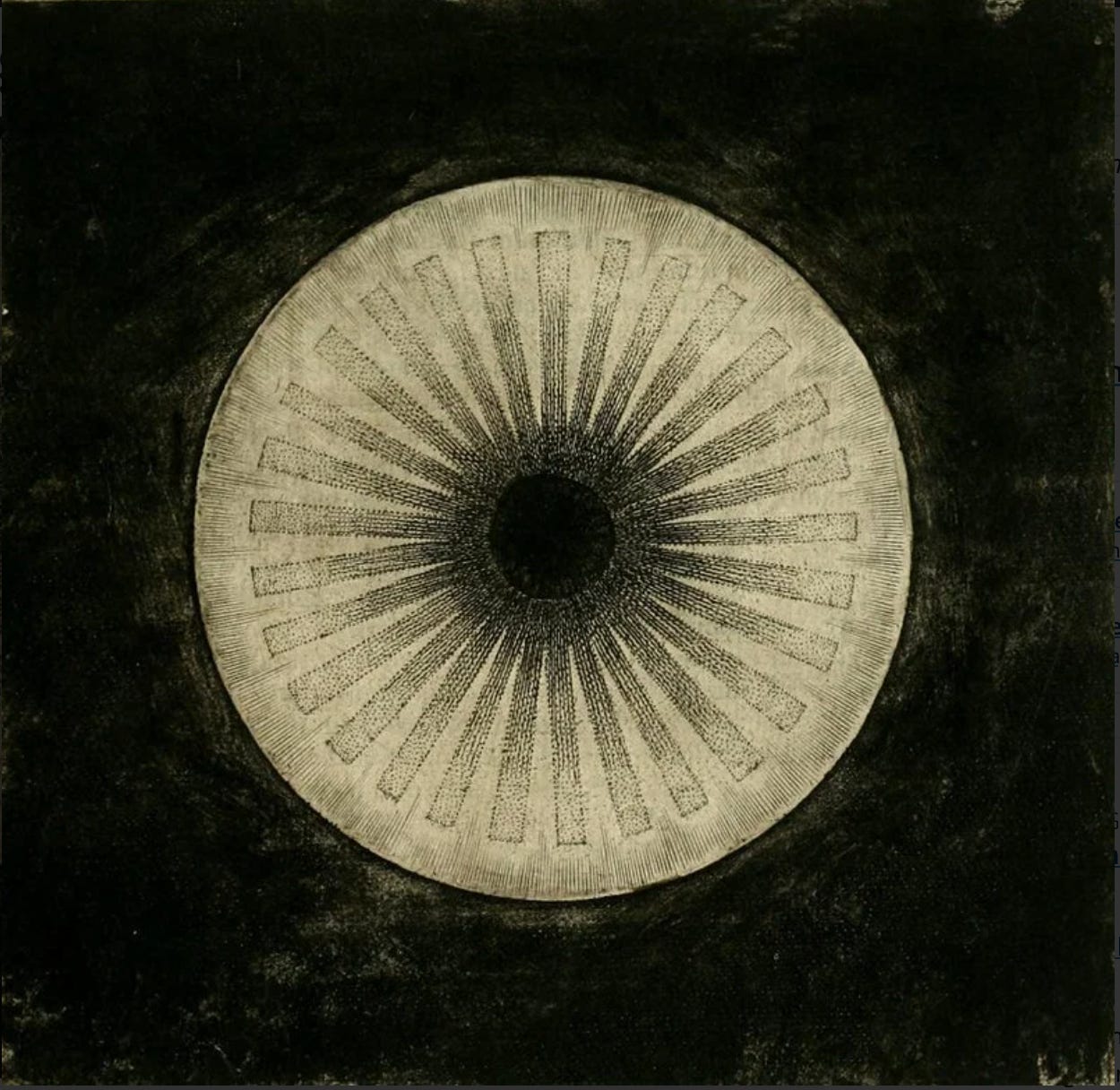
Pictured: Light Flowing Forth from the Blackness | Robert Fludd, 1617
Delivered to Temple Beth El
Yom Kippur 2017
Good Yontif.
Someone asked me recently how I got started down the path of serious Jewish study. The honest answer is a single course. In 2005, at the University of Central Florida, I enrolled in Dr. Ken Hanson’s History of the Jewish People, Part 1. (Spoiler: Part 2 has completely different characters, and it’s a lot funnier.)
That course almost 20 years ago was my first deep look at the Jewish story, and I fell in love with it. At the time I had no idea I would go to graduate school. No one in my family had done so, and no one I knew well. Even if I’d known, I couldn’t have told you what I would study.
But that course settled it. Thank you, Dr. Hanson.
I was that student. I did the readings. I asked too many questions. I asked for more readings. When the term papers came back, amid a good deal of grumbling around the room, mine carried a 100. The professor had told us plainly that he never gave 100s. So, naturally, I went to ask him about it.
The conversation that followed changed my life. By now it has changed the lives of hundreds of my own students.
We got to talking about Jewish philosophy and what it means to study Torah. Like so many young academics, I was hunting for the Truth, with a capital T. I wanted to know what was really the case. How did history really shake out? What was the meaning and purpose of scripture?
We were talking about the Talmud, and the long chain of commentary that has grown out of it, when he leans back in his chair, holds his arms wide, and says simply, “Jae, there’s no bottom.”
There’s no bottom to Jewish thought. You never arrive. No one closes the book and says, “Oh, I get it now.” The discussion continues. The truth, as it were, keeps being revealed.
Until that moment I had thought of wisdom as the guarded secret of old men. Somewhere, in some ancient book, the answers must lie hidden. Somewhere high in the mountains, or across some far desert, someone must have it all figured out.
Jewish wisdom doesn’t work that way at all.
For Jews, wisdom comes out of conversation and debate. “As iron sharpens iron,” says Proverbs, “so a man sharpens the wit of his friend” (27:17).
The Talmud is that proverb built into a library. Page after page, the Sages set their opinions side by side, and each is tested for its logic and its consistency. Often, in the ancient world as now, two rabbis reach views that are each internally sound and still contradict each other. If Judaism held only one Truth, that would be a crisis. But in this tradition, it is the expected outcome. When the schools of Hillel and Shammai argued for three years, the Talmud records a heavenly voice declaring that both were “the words of the living God,” though the law, in the end, follows Hillel (Eruvin 13b). Ask two Jews a question and you’ll get three opinions.
This is why there’s no bottom.
In the synagogue, we ask the hard questions, and we ask them of God. Abraham, bargaining for the lives of Sodom: “Shall not the Judge of all the earth deal justly?” (Genesis 18:25). Moses, after Pharaoh has made the people’s labor harsher still: “O Lord, why did You bring harm upon this people?” (Exodus 5:22). Jeremiah: “Why does the way of the wicked prosper?” (Jeremiah 12:1). The habit is written into our very name. Israel, often rendered “one who wrestles with God,” was the name given to Jacob after a night of wrestling, “for you have striven with beings divine and human, and have prevailed” (Genesis 32:29).
Out of this comes a culture unlike any other: a “stiff-necked people” who ask a great many questions. Every spring, at the Seder, we invite our children to ask what the night means. To the child who asks, we answer. For the child who doesn’t yet know how to ask, the Haggadah tells us to open the question ourselves. The lesson is plain. Asking is a righteous act.
The physicist Isidor Isaac Rabi, who won the Nobel Prize in 1944, was once asked why he became a scientist rather than a doctor or a lawyer like the other immigrant kids in his neighborhood. As a friend later retold his answer, every other Jewish mother in Brooklyn asked her child after school whether he’d learned anything that day. Rabi’s mother asked something else: “Izzy, did you ask a good question today?” That difference, he said, made him a scientist.
In the Mishnah, Ben Zoma asks, “Who is wise?” His answer: “One who learns from every person” (Pirkei Avot 4:1). A mentor of mine at UT Dallas, the Holocaust scholar David Patterson, ends every semester the same way: “It was a pleasure learning from you.” He means it. I try to teach in that spirit, and the highest praise I give in my own classroom is simply, “That’s a really good question.”
An old friend once asked me why the Jewish people have endured for thousands of years while so many other peoples died out or were absorbed. First, that’s an excellent question. My answer is that we have been willing to ask hard questions and to face them, without assuming there is one great big Truth out there that fits everyone.
Sometimes a student hears this and mistakes rigorous openness for moral relativism. “So, anything goes in Judaism?” Here is how I’ve come to answer.
The Torah is the foundation of all Jewish wisdom. Think of it as the space between 7 and 8. Between those two numbers lie an infinite number of points. None of them is 9.
There are countless readings of the Torah, and countless more still to come.
None of them permits idolatry, or theft, or murder.
The great sea of Jewish tradition may have no bottom.
But it has a shoreline.
Plumbing the depths of the Jewish tradition has been one of the great privileges of my life as a scholar, and I hope you’ll keep plumbing your own. We have a great deal to learn from one another. My own spiritual path has been strengthened by people who never once thought of themselves as teaching me anything.
That’s how it goes. “From strength to strength.” “As iron sharpens iron…”
Yom Kippur is the day we turn the hardest questions on ourselves. So on this day of all days, I want to leave you with a reminder: we are the heirs of a singular wisdom tradition. In my darkest moments and on my most difficult days, I am steadied by the sheer depth of Jewish questions, and by the roaring sea of answers that keeps rising from them.
In God in Search of Man, Rabbi Abraham Joshua Heschel warned against the day faith becomes “an heirloom rather than a living fountain.” His warning holds. The truth isn’t an heirloom waiting in a drawer to be found, as I once thought it to be. It’s a living fountain, and all of us draw from it and add to it.
Good Yontif.
You can find more of my sermons and reflections at scribespark.com.
My college courses and public talks can also be found there.