

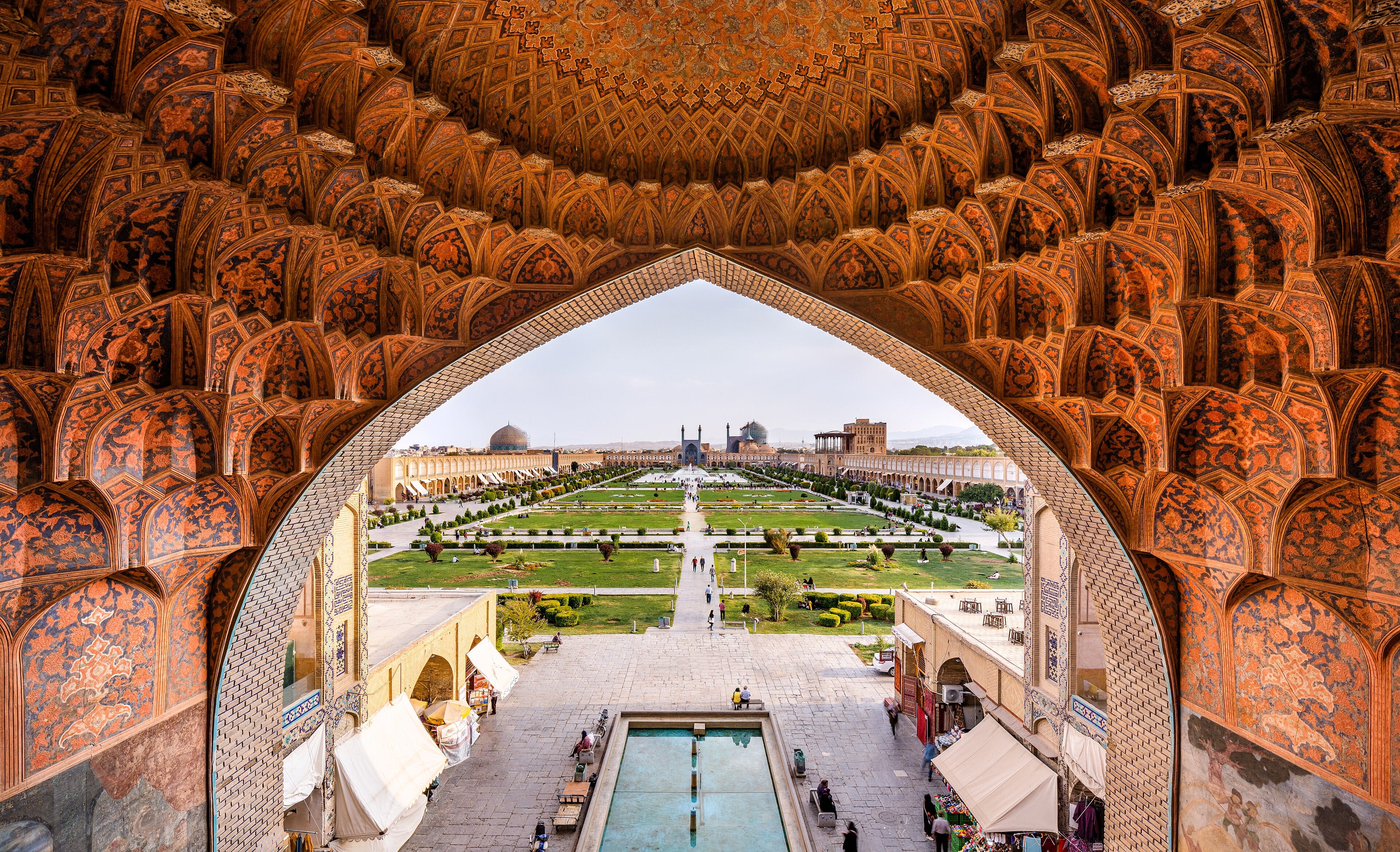
Pictured: Naqsh-e Jahan Square, the Qeysarie Gate • Isfahan, built 1598–1629
Photo Credit: Amir Pashaei via Wikimedia Commons, CC BY-SA 4.0 (cropped)
Overview
Before we cover any Islamic content, we will separate the nonsectarian point of view from the sectarian — scholarship from theology — and knowledge from belief. We meet the three tests a claim must pass before it counts as scholarly knowledge: the insider/outsider problem that has occupied scholars of religion for a century, and the distinction between describing what a tradition is and prescribing what it ought to be — the distinction every later section depends on.
Assigned Reading
None for this Section.
Key Terms for this Section
Islam · Mosque (Masjid) · Madrassa · Nonsectarian · Theologian
Scholar of Religion · Insider/Outsider Problem · Normative/Descriptive Claims
1.1 | Welcome to the Scholarly Study of Islam
An Introduction to this Series
This is a survey of Islam: its history, its literature, its thought, and the civilizations it has built. No foreknowledge of Islam or Arabic is required. Key Arabic terms are introduced and taught as we go, and by the end you’ll carry a working vocabulary of several dozen of them.
Here’s the map.
Module 1 | The Rise of Islam. We begin with method (this section), then move to the socio-political world into which Muhammad ﷺ was born, the Ka’ba, the tribal order of pre-Islamic Arabia, the monotheisms already circulating through the peninsula.* We follow Muhammad’s life, his revelation, his flight to Medina, his war with Mecca, and then the succession crisis that fractured the community within thirty years of the Prophet’s death.
Module 2 | The Qur’an. A close reading. How an oral recitation became a written codex, what the text says about war and tolerance, about evil and mercy, about paradise and judgment, and how Muslims have argued for fourteen centuries over how to read the foundational text of 2 billion adherents.
Module 3 | The Golden Age. Baghdad. Philosophy, medicine, mathematics, mysticism. The centuries when the Islamicate world was the intellectual center of gravity for half the planet, and the invasions (Turkish, Crusader, Mongol) ended them.
Module 4 | Islam & Modernity. Empire, colonialism, secularism, nationalism, oil. How the Islamic world met the modern West, and the range of responses it produced.
Three principal writers guide us. The first is Reza Aslan (Iran), whose No god but God carries the narrative spine of the early centuries. The second is Tamim Ansary (Afghanistan), whose Destiny Disrupted tells world history from the inside of the Islamic world looking out — a genuinely disorienting experience if you learned history the other way around. The third is the University of London’s M.A.S. Abdel Haleem (Egypt), whose scholarly descriptions and translation of the Qur’an are unparalleled.
Note: ﷺ (“peace be upon him”) is a traditional honorific for Muhammad in religious circles. It’s used sparingly in this course to illustrate its usage in the printed and digital world. But as this is a scholarly endeavor and not a religious one, it will not be used throughout.
About Me
Today, I serve as an adjunct professor of religion at the University of Texas at Tyler, where I’ve taught World Religions, Intro to Islam, and Islamic Philosophy since 2019. I’m also the Department Chair of Philosophy, Humanities, and Foreign Languages at Tyler Junior College, where I’ve been a full-time professor since 2012. This series is the culmination of that teaching. (Link to CV)
Before that, I held a teaching fellowship with the Religion Department at Florida State University (2009–2011). At Florida State, I studied Islam at the graduate level under Dr. Adam Gaiser, himself an alum of the University of Virginia’s prestigious Religion program. His mentor was Dr. Abdulaziz Sachedina, a renowned scholar who advised the writing of the 2005 Constitution of Iraq. My research with Dr. Gaiser prepared me to publish a 2012 article, “Islam in the Early Modern Protestant Imagination (1528–1588),” in the ERAS journal of Monash University, one of Australia’s “Group of Eight” top-tier universities. It’s available online, and it has been cited internationally.
I also had the opportunity at Florida State to assist in a course called “Introduction to Islamic Culture,” and that experience had a lasting effect on my ability to teach this material to an undergraduate audience. On the strength of it, I taught my own sections of World Religions for Florida State’s Religion department through 2010 and 2011. In 2019 I published “Forgiveness in Judaism” in The Philosophy of Forgiveness (Vernon Press), and in 2020 I received the Thomas H. Shelby Jr. Endowed Chair for Teaching Excellence at Tyler Junior College. I’m happy to note that students have consistently lauded my treatment of Islam in this course.
Defining this Project
Islam is the name of the religious tradition that emerges in 7th-century Arabia through the teachings of Muhammad.
It is not a single institution, not a denomination, and not a set of practices frozen in time. From the very beginning, Muslims have disagreed with each other: about politics, theology, law, interpretation, and authority. Those disagreements are not an inconvenience we need to smooth over. They are the history of Islam, and several of the most consequential ones will occupy us for entire sections.
That means we’ll be careful with the phrases like “Islam says” or “Islam believes.”
Sometimes it’s perfectly appropriate. But often what we really mean is that the Qur’an says something, or a particular scholar says something, or that Sunni Muslims in one century said something that Shia Muslims in another rejected. Learning to pull those apart is not a prerequisite to learning the subject. It is the subject.
Along the way you’ll encounter Muslims praying in a mosque (masjid), studying in a madrassa (Islamic religious school), reading the Qur’an, practicing Sufism, interpreting Islamic law, and disagreeing vigorously with one another about what Islam requires. Our job is never to decide which of them is the “real” Muslim. Our job is to understand what people believe in a specific time and place, why they believe it, how those beliefs developed, and what those beliefs have meant in practice.
Which brings us to the one rule this whole series runs on:
We are here to study Islam, not to practice or prosecute Islam.
All are welcome to study in my courses. But I do not allow proselytization — for or against a religion — in my public courses. This rule isn't there to protect Islam from scrutiny, and it isn't there to protect anyone's faith from history. It's there so that every reader — Muslim, Christian, atheist, or none of the above — can look directly at the same fourteen centuries of evidence without wondering whose side the author is on. The material is far more interesting than any verdict I could render on it.
So the first question we ask is not “Is Islam true?”
That question belongs to someone else, and we’ll meet him shortly.
Our question is: “What can we know about Islam?”
That is the question the scholar brings into the room.
The rest of this section builds the toolkit for answering it.
1.2 | The Scholar’s Toolkit
Sectarian vs. Nonsectarian
The first and most fundamental piece of our method is a word you must know to make any sense of the academic study of religion: nonsectarian.
Nonsectarianism is the attitude that secular institutions of higher learning take toward the study of religion. What it means is that we do not take sides in religious debates. We don’t rank one religion above another. We’re not in the business of proving or disproving any tradition’s tenets. We don’t privilege Sunni over Shia, traditionalist over reformer, mystic over legalist. This series is not “pro-Islam” or “anti-Islam,” any more than it is pro-Christian or antisemitic. This series, proudly, is a nonsectarian study of Islam fit for all readers.
So what does that look like in practice?
Take History, a subject we’ve all sat through. A good history teacher can give you a detailed account of American politics without making one party the good guys and the other the bad guys. That doesn’t mean the teacher has no political opinions. It just means the classroom isn’t being used to advance them. The opinions are not the method.
This stands in stark contrast to a sectarian center of learning, like a religious private school, a Sunday school, a madrassa, or a seminary. What’s the difference?
It’s simple.
A sectarian program of study picks sides. A nonsectarian course like ours does not.
And notice that “sectarian” is not an insult here. A seminary that refused to say what Christians ought to believe would be failing at its job! A madrassa that refused to promote Islamic theology and law would be failing at its job too. These are institutions with a theological purpose, and their purpose is a legitimate one: adherent formation within a religious tradition. I have friends and family who’ve paid good money to attend such institutions, and would be upset if it didn’t take a theological side.
However, ours is a different purpose. And with Islam, the nonsectarian method earns its keep quickly. The tradition contains enormous internal diversity, which means a scholar is constantly standing between Muslim communities that disagree about what Islam requires of Muslims. A theologian may resolve that disagreement. A scholar studies it. For us, the disagreement is not an obstacle to the subject; it is the subject.
What a Theologian Does
That brings us to Theology: the discipline of belief.
Literally from the Greek for the study (logos) of God (Theos).
In a sectarian setting, a theologian — an imam, a pastor, a rabbi — will generally tell you that their view of religion is correct and try to persuade you of it. (There are notable exceptions.) It’s the job of theologians to make religious truth-claims (eg. there is only one God), and part of the job is defending those claims and contesting the rival claims of others. Whether God exists, what God is like, which reading of scripture is correct, what the faithful ought to believe and do: this is theology’s home turf, and Islam’s theological tradition is long, internally contentious, and extraordinarily sophisticated. We will study those arguments with real admiration.
Theology also has an institutional home. Walk into a mosque, and you will find the theologian’s whole world in one room. Prayer. Counsel in a crisis. Instruction. Community. The Friday sermon, delivered from a raised platform, where someone stands up and tells the assembled what God requires of them this week. A church and a synagogue are doing the same work in a different setting. And notice what the person on that platform is doing: not reporting that a community believes something, but telling the community what it ought to believe. That’s the job of a theologian.
This series will describe everything that happens in that room.
It will never perform any of it.
One more thing, because people sometimes assume that “academic” means “skeptical,” or that “nonsectarian” means “anti-religious.” Neither is true. The scholar doesn’t have to reject a religious claim to study it; she simply can’t treat her own acceptance or rejection of the claim as evidence about it. The line between scholarship and theology runs between jobs — not people. A Muslim can be a first-rate scholar of Islam. So can a Christian, and so can an atheist. A theologian can also be an excellent historian (some of them are better historians than the “historians”). The question is never what the author believes when she goes home. The question is which chair she’s sitting in when she writes.
Why They Don’t Compete
At first glance, it might look like theologians and secular scholars are rivals.
Two parties fighting over the same territory.
They’re not, and the reason is simple: they have different goals.
The theologian’s work is directed toward a religious community: preserving a tradition, defending its beliefs, reforming its practices, separating orthodoxy from error. A nonsectarian scholar does something else entirely. I share peer-reviewed scholarship while making no claim whatsoever about metaphysical or absolute truth. The foundation of a nonsectarian claim is empirical evidence and the evolving consensus of scholars worldwide — which is exactly why researchers of every nationality and religious affiliation can sit at the same table and study Islam together. They aren’t trying to prove or disprove Islam’s truth-claims. They’re fascinated by the subject and want to add to what we know about it.
Consider prayer, since we’ll spend some of Section 5 on it.
A theologian teaches a Muslim how to perform the daily prayers correctly — according to his school, and not the school down the road. A scholar asks how daily prayer developed historically, why the schools disagree about its performance, and why the practice looks different in Indonesia, Nigeria, Turkey, Iran, and Texas. Both are looking at the same prayer. But they are asking different questions of it.
The theological question is: What should we believe?
The scholarly question is: What can we know about what people believe?
Neither question cancels the other. Keeping them separate helps make both useful.
Now here’s the part readers sometimes find strange. Like most people, your humble professor has deeply held religious beliefs. But you will not find them in this series. I don’t intend to convince you of my religious beliefs or dissuade you from yours. Your beliefs are likewise not the subject. For some, that restraint is a challenge. For many, it’s a breath of fresh air — a chance to learn about Islam with no one trying to convince you into or out of a religion while informing you.
1.3 | Knowledge & Belief
The Three Tests
To get at the real differences between the theologian and the scholar, we have to get at the epistemic difference between belief and knowledge. And the difference between those two is not a difference in subject matter. It’s a difference in justification.
All of us carry beliefs: about God, politics, beauty, family, and the world. Some are deeply considered, some inherited, some born of experience, and many are held with enormous confidence. None of that, by itself, makes any of them knowledge.
The knowledge of a scholar must be logical, falsifiable, and precise. Beliefs don’t have to be any of the three. Let’s take them one at a time.
Knowledge is logical when it’s limited to rigorous, valid, evidence-based reasoning.
“I know force equals mass times acceleration” clears the bar.
The conclusion follows from the premises (valid)
There’s no counter-evidence against it (undisproven)
It’s been tested by an enormous variety of experts (scholarly consensus)
Compare the above scientific claim to this: “I believe the president must be a great banjo player, because great musicians make great leaders.” Not tested. It’s invalid, as the conclusion doesn’t follow. And there’s abundant evidence against it (ie. there are successful former presidents who cannot play the banjo). A person may believe this sincerely. But it does not count as knowledge.
Knowledge is falsifiable when there is some conceivable way to show it’s wrong — the criterion the philosopher Karl Popper put at the center of scientific reasoning, and it does just as much work in history. “Ottawa is the capital of Canada” can be checked. “The Mona Lisa is the most beautiful painting in the world” cannot be checked against anything, because there is no empirical test for the prize most beautiful. That may be a meaningful personal judgment. Which makes it a belief, not knowledge.
Knowledge is precise when it isn’t assembled out of arbitrary parts. “A calorie is the energy needed to raise 1 gram of water by 1 degree Celsius” — precise. Now consider a spiritualist’s claim that “a person’s well-being depends on their overall sense of unity and balance.” What is specifically meant by well-being? Balance of what measurable thing? What evidence would even bear on it? The sentence sounds impressive right up until you ask it to mean something.
Watch how the three tests behave the moment religion enters.
“I believe God exists” is a belief, and a common one. “Muslims have believed in one God since the emergence of Islam in 7th-century Arabia” is an historical claim about a belief, checkable against texts, evidence, and fourteen centuries of scholarship. While the subject is religious in both cases, the kind of claim is entirely different. The theologian deals in the first kind; the scholar deals only in the second.
Now, before you walk away thinking we’re looking down on beliefs… Beliefs are a great deal of what makes a life meaningful, and none of us would be who we are without them. Your humble professor has beliefs about God, about his country, about his community, and about family and friends.
But they’re my beliefs. As smart as I am, my beliefs do not count as knowledge.
The Insider/Outsider Problem
Here’s a question that has occupied scholars of religion for a century:
Do you have to be a member of a religion to study it?
In our case: do you have to be Muslim to study Islam?
Let’s grant the insider his due first. An insider brings something to the table no training can supply: lived experience. A Muslim scholar may understand from the inside why a particular prayer matters, what Ramadan feels like in a practicing household, why a theological distinction that looks like hair-splitting on paper carries real spiritual weight. And the outsider has plenty of ways she can fail if not careful: she can mistake unfamiliarity for irrationality, or confidently assign a ritual a meaning its practitioners would laugh at.
So the naive answer — only Muslims should discuss Islam — at least starts from something true. But follow the next three steps, and it collapses.
First: who counts? To privilege insider voices, someone has to decide who the insiders are. Imagine a professor saying: “We’ll cite Omar, because he’s a real Muslim — but not Yusuf, because although he calls himself Muslim and attends the mosque, he doesn’t act like a Muslim.” That judgment belongs to a theologian. The scholar has no instrument for measuring the sincerity of anyone’s faith, and no business building one.
Second: who gets the last word? If the subjects of a study can simply object to its findings and have them revised to their liking, it is hardly a study at all. Letting the people under examination dictate what may be written about them isn’t scholarship. It’s public relations. And an eager, advocating outsider falls into the same pit from the other side: reproducing the image of a community most desired by those in charge of it. What he produces may be perfectly respectable. It just isn’t research.
Third (and this is the sharpest point), as the University of Chicago’s Bruce Lincoln argues, information from inside a community is complicated by the fact that one’s consciousness is itself a product of that system. Or, as the old line has it: whoever coined the concept of water probably wasn’t a fish. A fish doesn’t notice water. The deeper inside a community you stand, the harder it is to see its shape.
This is one of the real strengths of nonsectarian scholarship — not an apology for it.
So the solution is not to crown the insider, and not to crown the outsider. The solution is scholarship — the method that makes every claim, from either side of the line, answer to evidence and survive criticism.
Let’s run the whole argument back through History, where the stakes feel lower, and the logic is identical. Say I want to know President George Washington…
I’ll read books by Americans and non-Americans alike, and I’ll dismiss anyone who claims a non-American can’t write about Washington. I’ll set aside books that advocate too warmly for him, because I want to see the whole man — his strengths and his faults. I won’t rely on books by politicians, who’ll primarily use Washington to prop up their own positions. And I’ll be wary of texts about Washington produced where the press isn’t free, and peer review isn’t real, because I want my Washington vetted by Washington scholars across the globe.
Now go back through that paragraph and substitute Muhammad for Washington, Muslim for American, and theologian for politician.
That’s what we’re doing here.
The Aslan Interview
Among nonsectarian scholars, there is no assumption that an expert on a religion is a member of that religion. It is, at best, a non-issue.
A famous cable-news interview (I won’t link it here) illustrates the point well. Dr. Reza Aslan — the scholar of religion who wrote the first book on our reading list — had published a scholarly study of Jesus of Nazareth. The interviewer opened by asking why he, a Muslim, would write a book about a Christian topic.
Aslan’s visible bewilderment is what made the exchange famous.
The question didn’t compute for Aslan. He’s a scholar of religions. He holds advanced degrees in the subject and has studied Christianity’s history for decades. That he happens also to be a Muslim is, to every other scholar in the field, completely beside the point — the way it would be beside the point to ask a non-Roman why she studies Ancient Rome.
For scholars, the question is never who are you?
The question is what do you know? For any scholar of any subject, the primary question is: What do you add to the sum of what we understand about this subject?
And notice that this cuts both ways. The insider/outsider problem is not an argument that outsiders make better scholars. It’s an argument that the question is simply the wrong question. Aslan is a Muslim who writes about Christianity — and a Muslim who writes about Islam, and neither fact qualifies or disqualifies him. Some of the finest scholarship on Islam has been produced by Muslims, and some of it by people who’ve never set foot in a mosque except to take notes. The tradition doesn’t belong to its critics, and it doesn’t belong exclusively to its adherents. It belongs to whoever does the work.
What the scholar owes, in either case, is the same: evidence, argument, and a willingness to be corrected.
Which is why I can write this series, and why you can read it.
1.4 | Normative & Descriptive Claims
Two Kinds of [Dental] Claims
So how does a scholar talk about religion without turning into a theologian?
Here’s the machinery.
A Descriptive claim describes what something is.
A Normative claim tells you what something ought to be.
A dentist might tell you, descriptively, that the average adult has 32 teeth. That same dentist might tell you, normatively, that people with good teeth floss daily — if you want good teeth, you ought to floss. One statement reports. The other prescribes.
The distinction is quite old. The philosopher David Hume (d. 1776) warned against sliding from is to ought, and philosophers still call it the is–ought problem — and it is absolutely essential to everything that follows in this series. Get careless with it and you’ll find yourself making strong normative claims about Islam, at which point you’ve stopped doing scholarship and started doing theology.
Now consider these:
A Christian must not serve in the military.
A Jew must have a Jewish mother.
A Muslim woman must cover her face in public.
A Hindu shouldn’t eat beef.
A Buddhist should meditate every day.
Every one of them is normative, because every one draws a line in the sand: on this side is our religion, and on that side is not. They are theological statements, and notice that whether any of them is true isn’t the issue. The issue is what kind of work the sentence is doing.
Here’s where it gets genuinely difficult. Normative claims are very good at dressing up as descriptive ones.
“That group isn’t practicing real Islam” — it looks like a report. It has the grammar of a report. But there’s no fact in the world it corresponds to; it’s a judgment about who belongs, wearing a scholar’s tweed jacket. Watch for the tell: real, true, authentic, proper, genuine. When one of those words shows up in front of the name of a religion, a normative claim is almost always hiding behind it. Real Christianity. True Judaism. Authentic Islam. Somebody is drawing a boundary and hoping you won’t notice their pencil.
One more pair, stripped of religion entirely:
Johnny is a good person.
Bob claims Johnny is a good person.
The first is normative — because it presumes the speaker knows what makes a person good. The second is descriptive, because it simply reports a fact about something Bob said. The scholar’s sentence is almost always the second kind. Not “that isn’t real Islam,” but “this community regards that practice as illegitimate, and here is the argument they make.” Same information about the dispute. None of the refereeing.
The Ahmads & Haddads
Let’s put it to work on a live dispute.
Imagine two Muslim families: the Ahmads and the Haddads. Both identify as Muslim. But the Ahmad family believes Muslims should oppose a particular war, while the Haddads support it.
A Muslim theologian compares good Islam with bad Islam — that’s his job, and he does it in the open. He might say: “The Ahmad family are good Muslims because they are pacifists, but the Haddad family are bad Muslims because they support the war.”
That is a normative, theological claim.
It sorts. It ranks. It tells the reader which family to admire.
But a descriptive, historically defensible claim is the kind nonsectarian scholars are focused on. A scholar of religion makes no claim about who is a “true” Muslim, a good Jew, or a bad Christian. Instead, she pays attention to the people making such claims and reports them as historical and cultural facts. So the scholar may write:
“While both the Ahmads and the Haddads identify as Muslim,
the Haddads support the war, while the Ahmads do not.”
Read those two versions again, back to back. The second one tells you more. It preserves the disagreement instead of resolving it. It treats both families as Muslims because both families say they are. And it leaves the theological question exactly where it found it: with the theologians, who have the standing to argue it out.
This is the tool we will reach for at every moment of live sectarian tension in the weeks ahead. When Sunni and Shia accounts of the same afternoon diverge, when a practice one community treasures is called an innovation by another, when a reformer says a tradition must change and a traditionalist says it cannot: as nonsectarian scholars, our work is to describe both sides as accurately as possible. You’ll see that sentence again.
Not a verdict.
A description accurate enough that both parties would recognize themselves in it.
Which is harder than it sounds, but scholars think it's worth the trouble.
Long Live Theology!
Let me be unmistakably clear about something. None of the above is a criticism of theology. In fact, it’s a defense of it!
Theological training belongs in a religious institution — a private school, a madrassa, a seminary. That’s what those institutions offer and what their tuition buys. A public college has a different purpose: it proudly serves people of many beliefs and none, all of whom have decided together that greater knowledge of religion serves everyone’s interest. So my task is a survey of Islam from a nonsectarian standpoint. I never presume to tell my readers what is and isn’t proper Islam. I leave that work to my friends on the minbar (the pulpit) at the head of the mosque.
The scholarly approach may feel irreverent — especially when scholars discuss a tradition you’re personally invested in. If that happens, remember our objectives. This is an academic study of religion — not a religious course. And no scholar of religion is trying to replace anyone’s theologian.
Consider the limits of my office.
A nonsectarian scholar can’t lead a prayer in a mosque.
A nonsectarian scholar can’t marry a couple.
A nonsectarian scholar doesn’t counsel the grieving in the middle of the night.
A nonsectarian scholar doesn’t exhort you to repent.
A nonsectarian scholar can’t tell you the secrets of the universe, and wouldn’t dare try.
A nonsectarian scholar works neither to bring someone to Islam nor out of it.
A nonsectarian scholar doesn’t take sides on the divisive questions within Islam.
A nonsectarian scholar doesn’t work to shape Islamic doctrine.
Theologians are not only permitted but expected to do all of these things and more!
So we both have jobs. Both of us are looking at religion, though our methods and our goals are entirely different. Some people have use for one. Some for the other. Some for neither. And some of us, myself included, find real value in both — reading scholars and theologians alike while never confusing the two.
That’s the toolkit.
Nonsectarian, not theological. Knowledge, not belief. Description, not prescription.
Now, with that toolset in front of you, we go back 1,400 years to a dusty settlement in the Arabian desert built around a single cube of stone, to the age the tradition itself remembers as the Jahiliyyah, and to an orphan born there who will change the world.
Salaam.
This Section: Normativity & Religion
Next Section: Pre-Islamic Arabia & Muhammad