

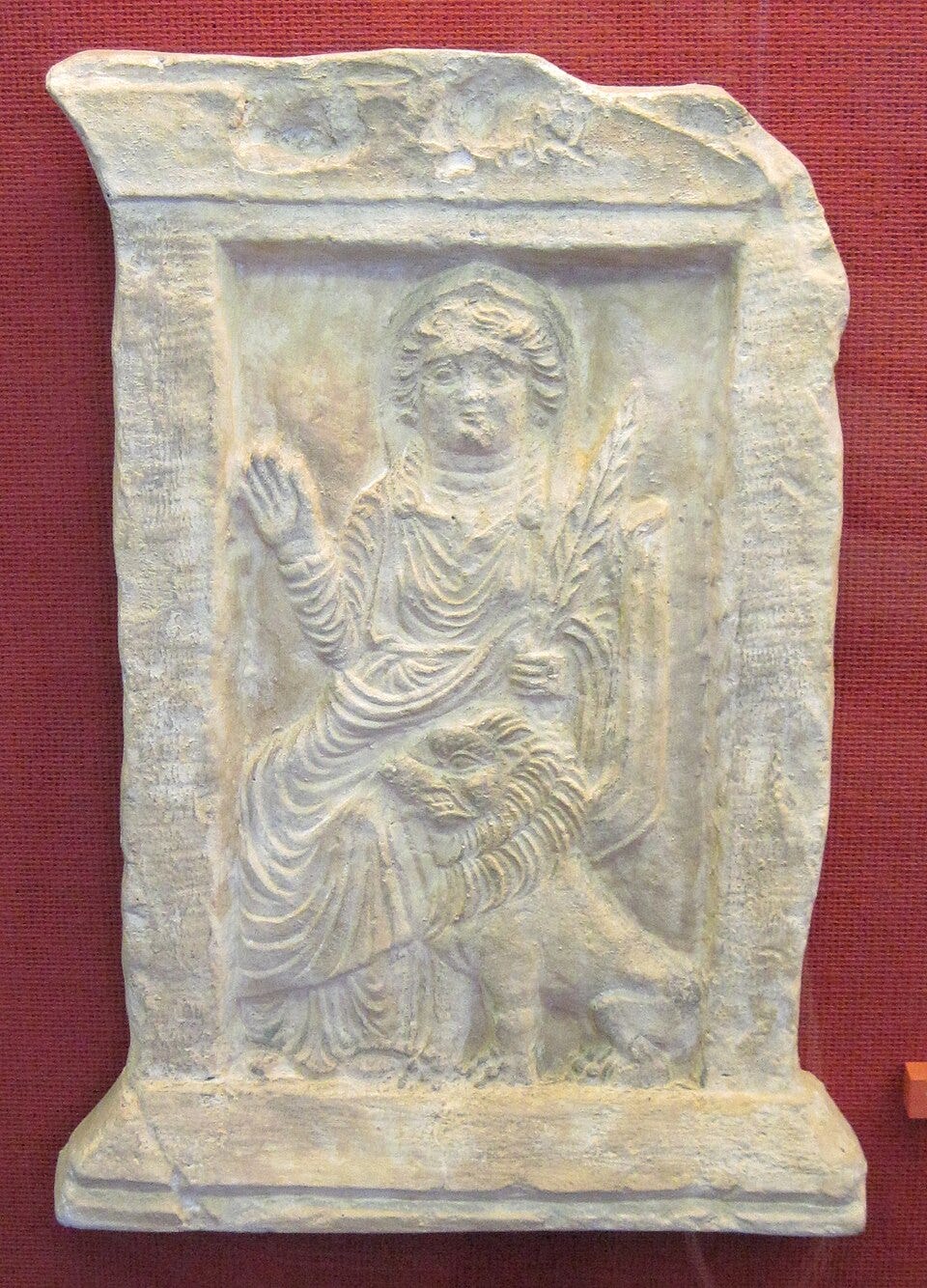
Pictured: Allat, Pre-Islamic Goddess of Arabia (2nd century)
Overview
This section introduces the world into which Muhammad ﷺ was born and the first thirteen years of his prophetic career. We situate the Ka'ba and the town of Mecca within the religious landscape of pre-Islamic Arabia (the Jahiliyyah) and trace the monotheistic currents already moving through the peninsula: Jews, Christians, Zoroastrians, and the Arab seekers called hanifs. We then trace Muhammad's early life, his wife Khadija, the revelation of 610 CE, the earliest Qur'anic verses, and the conflict with the Quraysh elite that ends with the Companions’ flight from Mecca.
Assigned Reading
Reza Aslan, No god but God, chapters 1–2
Key Terms for this Section
Ka'ba · Jahiliyyah · Allah · Quraysh ·
Muhammad · Khadija · Abu Bakr · The Shahadah
2.1 | The Ka’ba & the Age of Jahiliyyah
The Sanctuary City
1400 years ago, the Arabian town of Mecca was an ancient, dusty settlement in the desert interior — its value marked less by what it produced than by what it protected. At its center stood a single cube of stone, the Ka’ba, the only masonry structure in a town of mud and straw. The shrine housed a copy of every idol worshipped across Arabia — some 360 of them, a god for every tribe that came to trade. Among the images, Aslan notes, were figures of Jesus and his mother Mary, standing next to the gods of the Arabian desert.
Pilgrims came from across the peninsula to walk the tawaf — the sevenfold circling of the shrine, a rite whose rhythm some scholars connect to the wheeling of the stars overhead. The Meccan leadership could boast that each visitor to their town could find, somewhere in that crowd of idols, the god of his own tribe, and so each had reason to come and safely trade. Beside the Ka'ba lay the well of Zamzam, whose waters Islamic tradition binds to the Jewish story of Hagar and her son Ismail (the Ishmael of Genesis), who were cast into the wilderness, the boy near death from thirst, until, as Genesis tells it, God opened Hagar's eyes to a well of water that saved them both (Gen. 21:19). The well made Mecca livable. Its shrine made it sacred. Together, these two pillars provided the inner circle of Mecca with tremendous wealth. Tradition held that the Ka’ba’s foundations reached back to the very beginning of the Genesis narrative. In Islamic tradition, Adam raised the Ka’ba first, Noah knew of it, and Abraham rebuilt it with Ishmael at his side. Now, a word of scholarly caution: these are stories meant to convey what the Ka’ba means, not a historical record of where it came from — the sacred biography of a place is not its archaeology. As scholars, we can describe what the tradition holds without passing judgment on whether it happened.
What is certain, however, is that custody of 7th-century Mecca was the most valuable office in all of Arabia.
Tradition credits a figure named Qusayy with gathering the scattered clans of the region, seizing the guardianship of the shrine, and settling his people around it, becoming the “Keeper of the Keys” — the one who held the right to open the Ka’ba, water the pilgrims, and take a share of the trade that flowed through the sacred precinct. His descendants would inherit that right, and one branch of that group would become the Quraysh. The whole arrangement rested on a fragile and ingenious custom: the sacred months. For part of each year, raiding and blood feud were suspended by common agreement, so that caravans could move in safety and old enemies could meet at the pilgrimage fairs without violence. In a land governed by feuds, those months of truce were the closest thing to desert law. They allowed a great market to gather in the shadow of the shrine — and whoever controlled the shrine controlled the market. That is how a well and a stone cube in a barren valley became a town worth protecting and fighting for.
The Jahiliyyah
The word Jahiliyyah is usually translated as the “Age of Ignorance” in Arab and Islamicate history. It is not a neutral historical label but the tradition's own retrospective theological name for the pre-Muhammadan era. It does not mean the pre-Islamic Arabs were uncultured or stupid — they had poetry, genealogy, law, and a rich spiritual imagination. In the Islamic reading, what their forebears lacked was divine guidance: they were living in the time before Muhammad’s message came.
Religious life in the Jahiliyyah was split along the same line that divided Arabian society itself: on one side was a barren desert, on the other side were the scattered Arabian towns. For the nomadic Bedouin, religion traveled light. What mattered was the tribe, its ancestors, and the code that kept both alive; the gods were local, portable, and consulted as needed. The settled tribes of the towns and oases lived differently — anchored to shrines, sacred stones, and fixed holy places, with cults that could accumulate wealth, custodians, and prestige. Mecca, built around the most successful shrine of them all, was the settled pattern at its logical zenith.
Running through both worlds of desert and civilization were the Jinn — unseen spirits woven through the landscape, inhabiting the sandy wastes, the ruins, and whirlwinds. Aslan compares the Jinn to the nymphs and fairies of Greek and British lore, and the comparison is useful: like those figures, the Jinn occupied the space between gods and demons — powers to be respected, occasionally bargained with, and blamed when things went wrong. Poets were said to draw their verses from them; madness was attributed to their touch. They made the Arabian landscape a crowded spiritual place long before any theology organized it.
The whole pre-Muhammadan situation followed what the 19th-century scholar Max Müller coined henotheism: where one highest god presides over a pantheon of lesser gods beneath him. Note: this is not monotheism, which denies that other gods exist. Instead, early Arabia had a hierarchy with one figure unmistakably at the summit. This was the religious architecture of the Jahiliyyah. Allah sat at the top, remote and rarely addressed directly, while the tribal gods and the “daughters of Allah” handled the daily traffic of petition and offering. When Muhammad (Persian: Mohammed) begins to preach, the high god is already installed. His work will be clearing out everything beneath him.
1400 years ago, there was no single “Arab religion” in any organized sense — no scripture, no priesthood, no creed binding the tribes together, and no institution to enforce belief. Instead, we find a kind of pluralist ‘pagan’ society: a scattering of local cults, each tribe with its own idols, its own sacred stones and trees and springs, and its own bargains struck with unseen powers. In the Jahiliyyah, piety was largely transactional. One made an offering and expected a return; one honored the gods of the shrine one happened to be visiting, and thought little about the gods of anyone else. This is part of why the Ka’ba could hold hundreds of idols without contradiction.
In a world with many gods, one more shrine simply meant more gods to bargain with.
What held a person’s life together, then, was not doctrine but a code — muruwah, the ideal of manliness and tribal virtue. Aslan lists the demands of Arab muruwah:
• bravery in battle
• loyalty and honor
• hospitality to the stranger
• the justice owed to one’s own kin
In the ancient, harsh world of the open desert, muruwah did real work. It bound the tribe together against a merciless environment and obliged the strong to protect the weak within it, because the survival of each depended on the survival of all. But the ancient muruwah code assumed a world of scarcity and shared fate — and an ever-growing Mecca was no longer part of that world. As caravan wealth pooled in a handful of powerful clans, the old obligations began to fray. Honor thinned into the privileges of the rich; hospitality became display; and the protection once owed to every member of the tribe narrowed quietly to those who could pay for it. The widow, the orphan, and the debtor fell through the gaps. It is precisely this erosion — a proud code hollowed out by cynical greed — that Muhammad’s earliest preaching will name and condemn.
2.2 | Monotheism in 7th-Century Arabia
God & His Daughters
Today, the holy Arabic name Allah (used by Muslims as well as millions of Arabic-speaking Christians and Jews) is a contraction of al-ilah, and it means, simply, “the God.” Where gods like Zeus and Marduk use personal names, Allah is a title — the definite article (al/the) fused to the common Arabic noun for deity. Interestingly, the name Allah did not arrive with Muhammad. It was already in the air of pre-Islamic Arabia. Rather, Allah had been the title of the remote high god of the Arabian pantheon who, in the Jahiliyyah, held court over the lesser Arabian gods who scurried about the daily business of local Arab shrines.
But a god at the summit is still a god far away.
The high god of the Jahiliyyah was understood to be too exalted and distant to be approached directly by ordinary worshippers — a creator acknowledged in principle but bypassed in practice. When an Arab needed rain, a safe journey, or a son, he did not petition Allah, the god at the summit. Instead, he went through channels. And the most important of those channels were three goddesses remembered as the banat Allah — the “daughters of Allah.”
Now, when these goddesses are called Allah’s “daughters,” it was primarily to rank them as derived from the high god, beneath the high god, and belonging to the high god. The powers of the Arabian goddess-daughters flowed downward from the top as they stood below. Each had her own cult, her own sanctuary, and her own tribal following. There was Allat, whose name is the feminine of the divine title itself — al-ilat, “the Goddess” to her father’s “the God” — venerated especially southeast of Mecca. There was al-Uzza, “the Mighty,” who commanded particular devotion from the Qurayshi tribe. And there was Manat, the goddess of fate and eldest of the sister-goddesses by most accounts, whose sanctuary lay north of Mecca. For centuries, their images were among the most honored in the peninsula, and their names appear in the Qur’an itself, which asks the Meccans directly, “Have you considered Allat, al-Uzza, and Manat, the third, the other?” (Qur’an 53:19–20). For 7th-century Meccans, this was a rhetorical question posed precisely because everyone listening knew exactly who these three Arabian goddesses were.
So let’s try to unpack what’s going on here. One did not choose the daughters over Allah. Rather, one prayed to them as divine intermediaries, sending a message up the chain toward a god presumed too high to be reached on one’s own, the way a petitioner approaches a king through the members of his court. When Muhammad’s message eventually declares that God needs no intermediaries and has no daughters (Qur’an 53:21–23 presses this point immediately after naming them), it severs the channel through which most of Arabia did its praying — and with it the intercessory system on which shrines like the Ka'ba, and the fortunes built on them, depended.
Jews & Christians in Arabia
But let's not imagine ancient Arabia (ie. the Jahiliyyah) as a world sealed off from the rest of what the Afghan-American writer Tamim Ansary calls the “Middle World” (ie. the lands between the Mediterranean and India, knit together by overland trade). Competing religious identities surrounded 7th-century Arabia and the Middle World. The most ancient of these communities had long been the Jews. Jewish life in the Arabian Peninsula reached back at least to the Babylonian Exile of 587 BCE — more than a thousand years before Muhammad. By the time of the Jahiliyyah, the biblical patriarchs had deep roots in Arabian imagination; Aslan writes:
“Adam, Noah, Abraham, Moses, and Aaron were all in one way or another associated with the Ka’ba long before the rise of Islam.”
Reza Aslan, No god but God
Jewish presence in the Arabian Peninsula only deepened after the Roman destruction of Jerusalem in 70 CE, as new waves of settlement pushed south. Jewish tribes put down roots at oasis towns like Yathrib (see Sec. 3) and at Khaybar, where they farmed the date palms, worked as smiths and jewelers, and took a share of the caravan trade. Over many generations, their Judean Aramaic shifted into Arabic as Jews assimilated to the customs of their Arab neighbors. These ancient Arabized Jews organized into tribes, made alliances, and took part in blood feuds just like all the Arab tribes around them. But the social pillar that remained untouched was Biblical monotheism — it was definitive, old, and long settled for Jews. Jewish monotheism stood firmly apart from Arab henotheism. This will matter greatly in the next section (Sec. 3.1), when Muhammad arrives in a Yathrib whose population includes several powerful Jewish clans.
Christianity was also present in pre-Islamic Arabia,
though within that umbrella term were a variety of rival theological positions.
South of Mecca, the city of Najran and parts of Yemen held long-established ancient Christian communities with their own churches and bishops. To the north, the Ghassanid Arabs served as a client kingdom of the Byzantine Empire: Arabic-speaking Christians allied to Constantinople (the capital of Eastern Christendom), along the desert frontier. But the Christianity the Arabs encountered was not a single, unified Church. Across the desert lay a variety of rival theological camps.
Those rivalries deserve a moment, because they represent what an Arab trader would have identified as ‘Christian.’ Christian orthodoxy — from the Greek ortho (right) and doxa (belief) — was a relatively recent construction. For Christianity’s first three centuries there was no single scriptural canon and no institution strong enough to enforce one; each region curated its own scriptures and its own account of who Jesus was and what Jesus taught. The imperial Roman Church settled the question of orthodoxy at Nicaea in 325: Jesus as fully human and fully divine. But many 4th-century Christians did not accept Rome’s Nicene Creed. Arian Christians (followers of Arius; no relation to “Aryans”) held that the Son was a created being, subordinate to the Father. Miaphysite Christians taught that Christ’s divine and human natures were united as one (their opponents called them “Monophysites,” a label their heirs in the Coptic, Syriac, and Armenian churches reject today). Nestorian Christians kept the two natures of Christ so distinct that critics accused them of preaching two persons. And these disputes mapped onto the politics of the age. The Ghassanids, Constantinople’s own Arab allies, leaned Miaphysite against the imperial creed. They compare well to the Lakhmid Arabs of al-Hira: eastern clients of the Persian shahs, whose capital grew into a major center of the Church of the East, the tradition outsiders called “Nestorian,” and whose last king converted to it.
An Arab caravan could pass through three rival Christianities in a single season’s trade. And make no mistake: each of these rival positions thought itself the true heir of Christ’s teachings.
However, while European Christianity (eg. Rome and Constantinople) was heir to the teachings of St. Paul (ie. the Pauline epistles of the New Testament), the oldest Christian tradition in the Arab world came from the remnants of the original Jewish-Christian movement once led by St. James, the brother of Jesus. From St. James’ Jerusalem church came a Christian group historians call the Ebionites (from Heb. evyonim, “the Poor Ones”), who were scattered across the Near East. Ebionite Christianity remained closer to Judaism and was strictly monotheistic. They kept the Sabbath, circumcised their sons, and, while they honored Jesus as Christians, they denied that Jesus was God. Some earlier scholars, struck by how closely this resembles the Qur’an’s own portrait of Jesus, argued that such communities reached Arabia and prepared its hearing. More recent scholarship is skeptical — there is (as yet) no firm evidence of Ebionites in the peninsula, and the Qur’an’s account of Jesus is now widely read as engaging with European Nicene Christianity. For our purposes, the dispute matters less than the solid fact beneath it. In the Middle World, there was a long-standing monotheistic reverence for Jesus (as prophet rather than God), and Arabia’s traders and herdsmen would have been familiar with this position centuries before the Qur’an.
Other Monotheists: Zoroastrians & Hanifs
From Persia came the Zoroastrians, and with them a set of concepts and ideas that would echo through the Middle World: a heaven and a hell awaiting the soul, a universal savior yet to come, and history bending toward a final cosmic battle between the forces of good and evil. If we place these neighboring traditions side-by-side, a clear picture emerges: centuries before Islam, the Arabian peninsula was already thick with discussion of one God, of moral judgment, and of a life beyond this one. The materials of monotheism were everywhere in Muhammad’s Arabia. What was missing was an Arab prophet to gather them together.
Lastly, against this background of Persian Zoroastrians, Arabized Jews, and competing Christian sects stood a much smaller group called the hanifs — Arab seekers who had turned away from their traditional idols while not attaching themselves to any established religion as they reached toward a single God on their own. They were not Jews or Christians, but they had absorbed much of these worldviews, and from the memory of Abraham that all Christians and Jews shared. The figure to remember here is Zayd ibn Amr, whom the Islamic tradition recalls as a kind of forerunner to Muhammad. Zayd renounced the worship of the goddesses outright, declaring that he would serve neither Allat nor al-Uzza but only the one God (Allah), and he took to leaning against the wall of the Ka’ba and calling openly on the God of Abraham — a public rebuke to the idols all around him. There were other hanifs, too, like the poet Umayya ibn Abi as-Salt who longed for a “religion of Abraham,” and Waraqa, a cousin of the woman Muhammad would marry, who had studied Christian scripture, who moved in these same circles of seekers.
All of this to say: when Muhammad began preaching about one God, called Allah, he was not introducing a wholly foreign idea into a peninsula that had never heard it. He was stepping into a centuries-old conversation Arabia had been having, restlessly and inconclusively, for a very long time.
2.3 | 610 CE: Muhammad, Khadija, & the Call
The Stratified City
Picking back up from Lesson 2.1, 7th-century Mecca was a thriving center of trade, built of concentric circles of mud and straw dwellings. The closer one’s home was to the center of the city — to the Ka’ba, the only structure made of stone — the more social power and prestige one had. The most powerful tribe in Muhammad’s youth was the Quraysh, known as the “Tribe of God.” They controlled the Ka’ba, and therefore trade in the city of Mecca.
The Quraysh were the ‘Keepers of the Keys.’
Merchants running the caravan route between Yemen and Syria often went out of their way to visit Mecca. (Earlier scholarship assumed they came because Mecca sat at a crossroads of international trade; the historian Patricia Crone dismantled that assumption in the 1980s, and we follow her lead on this.) The merchants came for the shrine. The Ka’ba was a uniquely universal sanctuary in ancient Arabia as it housed a copy of every Arab idol — all 360 of them — giving Mecca a universally recognized religious prestige, which led to an economic supremacy that rivaled anyone else on the peninsula.
The #2 religious spot in the Middle World was a great cathedral, al-Qalis, commissioned by the Christian ruler, Abraha. It sat south of Mecca in Sana’a (Yemen), and it was built in the hopes of drawing the pilgrim economy south. The economic rivalry between Christian Sana’a and pagan Mecca came to a head in the Year of the Elephant, when Abraha marched on Mecca in a failed attempt to destroy the Ka’ba. That year was 570 CE. Islamic tradition holds this as the year of Muhammad’s birth.
The Mecca that Muhammad grows up in is an intensely stratified city.
Over the generations, the powerful Quraysh took every economic advantage they could and made themselves excessively wealthy. In traditional Arab culture, the Shaykh, the elder of one’s clan, maintained order by ensuring each member of the tribe was protected. His most useful tool was the ancient Law of Retribution: an eye for an eye. If a man’s goat was stolen, he was owed another goat. A slain pregnant camel was worth two camels. And a man’s life was worth roughly a hundred camels. This was frontier justice, without a fixed law code, and it carried two immediate problems. First, there was no such thing as a crime outside one’s tribe. Killing or stealing from someone beyond the tribe did not concern the Shaykh, so long as it did not affect the tribe. Second, there is no real justice left when wealthy tribesmen can simply pay their way out of their crimes. The result was that the Quraysh grew so rich as to be untouchable by anyone else in Mecca. They did what they wanted. They taxed the Ka’ba’s pilgrims while the city’s Shaykhs prospered and stopped caring about the poor, the widow, and the orphan.
An Orphan in Mecca
This is Muhammad’s reality, and he enters it already at its margins.
Muhammad’s father died before he was born. His mother died when he was 6. His grandfather, who took him in, died soon after. He was raised, finally, by his uncle Abu Talib, the Shaykh of his clan, the Hashemites (Banu Hashim). It was an upbringing on the edge of a wealthy world, close enough to see its comforts and dependent for protection on the goodwill of family and friends.
When he was old enough, Muhammad eventually found work in the caravan trade. In his early adult years, he set his sights on a woman he hoped to marry, but she declined. Muhammad persevered, and his reputation as an honest and reliable caravaneer grew. He earned the nickname al-Amin in Mecca, “the Trusted One.” Over time, he moved from the back of the caravan to the front, operating as a Caravan Master for the Meccan wealthy. One such patroness — an older, self-made woman named Khadija — proposed marriage to him.
Their marriage would last about 25 years, until her death in 619.
Marriage to Khadija brought Muhammad into the highest levels of Meccan society. But creature comforts could not settle him. Muhammad spent the next fifteen years struggling with his own complicity in an economic system that enriched the powerful on the backs of the poor. He took to leaving the city for the desert hills and kept to a practice of solitary retreat the sources call tahannuth: nights of vigil and reflection in a cave on Mount Hira, above Mecca. He did not like the Qurayshi system. As Aslan reads him, social injustice clearly weighed heavily on his mind.
God Calls Muhammad
Islamic sources recount that in 610 CE, on one of those nights at Hira, something overwhelming comes upon him. A presence presses against a 40-year-old Muhammad in the dark (this was later understood to be the angel Gabriel), and a Voice commands him to “Recite!” (Iqra’ [اقْرَأْ] – this can be rendered “recite” or “read aloud” in English). Muhammad — terrified — asks what he should recite. The Voice comes again, and again, the pressure tightening until he thought he could bear no more. And then, the Islamic sources say, the words were pressed upon his heart.
Recite! In the name of your Lord who created:
Created humanity from a clot of blood.
Recite, for your Lord is the Most Generous One
Who has taught by the pen;
Taught humanity that which it did not know. QUR’AN 96:1–5
Muhammad flees the cave, shaking. The tradition recounts that he feared he had gone mad or been seized by an evil spirit, and that in his terror he came close to ending his own life on the mountain before the vision returned to steady him. He comes down to Khadija trembling and asks her to cover him with a cloak. It is Khadija who calms him, and Khadija who first believes him. To settle her husband’s doubts, she brings him to her cousin Waraqa (the Christian seeker we met earlier, among the hanifs) who listens and confirms that Muhammad had indeed received a true revelation, calling him “a prophet of this people.” And so it was that in 610 CE, Muhammad understood himself to be called as a nabi (prophet) and as Rasul Allah: the Messenger of God.
A long silence followed the first revelation. Islamic sources call it the fatra, the pause, and it fed Muhammad’s self-doubt and the doubts of those around him. Finally, at his lowest, he was called again to be the Messenger of God.
You are not, by God’s grace, a madman: you will have a never-ending reward — truly you have a strong character — and soon you will see, as will they, which of you is afflicted with madness. QUR’AN 68:2–6
Muhammad then began to recite the Qur’anic verses to his closest friends.
The Early Verses
The verses of this earliest period fall into one of two themes: religious verses and social verses. The earliest religious verses speak of the power and glory of God, but they do not yet press an authoritative case for monotheism against the reigning polytheism and henotheism of the day — that confrontation comes later. And monotheism, in any case, is hardly news to the Meccans. The Jews, Christians, and hanifs have spoken of one God among them for generations, and a caravan city hears every creed that passes through it. So Muhammad's earliest focus lies elsewhere, on ground where the Quraysh are genuinely vulnerable: the mistreatment of the weaker and forgotten members of Meccan society.
So do not be harsh with the orphan and do not chide the one who asks for help.
QUR’AN 93:9–10
And he warns the powerful about their greed.
Woe to every fault-finding backbiter who amasses riches, counting them over, thinking they will make them live forever. QUR’AN 104:1–2
Such teachings were a direct threat against the Meccan elite. Live with compassion, free those you have enslaved with debts, and feed those who cannot feed themselves, or you will burn in the holy fire. (Paraphrase of Qur’an 90:13–20).
2.4 | The First Muslims & the Eve of the Hijra
The First Muslims
Khadija, Muhammad’s wife and most loyal companion, is the first person to accept his message. The first child to accept it is Ali (the son of Muhammad’s uncle Abu Talib, who grew up in the same house with Muhammad). Ali will one day marry Muhammad’s daughter and, in time, inspire a new branch of Islam: Shia Islam. Muhammad’s slave, Zayd, soon accepts Muhammad’s message and is freed. Abu Bakr, a powerful Qurayshi merchant, follows, and his story is a striking one — after his conversion, he makes himself poor by spending his fortune to buy the freedom of enslaved believers. Muhammad continues to draw followers from the wealthy elite and, surprisingly for the time, from among women as well. Altogether, the early Companions (Sahabah) of Muhammad number about 30-40.
Those without the shield of a powerful clan pay the highest price for their conversion. In the tribal order, a person’s safety rests on the certainty that harming them will bring retribution from their kin. But converts from the lower ranks of Meccan society — the enslaved, the poor, the clanless — have no Shaykh to avenge them, and as the movement grows and the Quraysh grow angrier, that makes them easy targets. The elite cannot touch Muhammad himself so long as Abu Talib (his Shaykh) lives and the Hashemites stand behind him; so the pressure falls instead on the followers who have no such protection: in beatings, in economic ruin, and worse.
The persecution grows heavy enough that, by 615 CE, Muhammad sends a group of his most vulnerable followers out of the city altogether: across the Red Sea to the Christian kingdom of Abyssinia (today: Ethiopia). There, the Christian king grants Muhammad’s followers refuge and, tradition recounts, refuses Qurayshi demands to hand them back. The scene is worth pausing on: Muhammad’s early followers found shelter under a Christian king, in the very years the two faiths are first taking each other’s measure. This crossing is remembered as the first hijra, the first flight of the believers from persecution, and it foreshadows the far greater flight that will one day reshape the whole movement.
The Break with the Mighty Quraysh
Three years into Muhammad’s ministry, in 613 CE, his message becomes more religiously focused. We find that focus in the Shahadah, the Islamic profession of faith.
لَا إِلَٰهَ إِلَّا ٱللَّٰهُ مُحَمَّدٌ رَسُولُ ٱللَّٰهِ
There is only one God, and Muhammad is His Messenger.
Strict monotheism is now fundamental to the movement, and it’s spreading across Mecca and beyond. What enrages the powerful Quraysh is not the claim that there is only one God — they do enough business every day with Jews, Christians, and hanifs to have heard that claim many times before. What the Quraysh cannot abide is that Muhammad claims to be God’s Messenger. While the other monotheists preach about Abraham (a man most Meccans honor), Muhammad claims to be a prophet equal to Abraham! He is the new Abraham! Muhammad is not asking the Quraysh for their blessing or their permission. He claims to be without equal, answerable only to God! This goes against all ancient and (seemingly) eternal Arab tradition, and it is a direct challenge to the power of the Qurayshi elite.
Muhammad’s first target is the very source of Qurayshi economic power: the Ka’ba.
The story goes like this. Merchants go out of their way to visit the Ka’ba in Mecca because it houses every Arab idol, which makes it safe and sacred ground for all Arabs, which in turn makes Mecca the most lucrative center for peaceful trade in the region. Forget your long-standing blood feuds — come to Mecca and trade with enemies and friends alike! All one has to do is pay a tax to the powerful Quraysh, who run the city at the expense of the Meccan poor. So how does Muhammad turn this upside down? Well, if there is only one God, and Muhammad is His Messenger, then all the idols are worthless, which makes the Qurayshi-run Ka’ba worthless, which strips every bit of power, money, and influence from the abusive Qurayshi elite!
But wait, were the Quraysh actually pagan believers? Tellingly, the Qur’an never quotes the Quraysh as professing belief in their expensive idols. It seems, rather cynically, that idol worship was simply good for business.
Muhammad upends Mecca’s status quo by preaching his message directly before the Ka’ba at the next pilgrimage fair, and from there it spreads throughout Arabia. Unable to silence him while his clan protects him, the Quraysh answer with a decisive boycott of Muhammad’s entire clan (the Hashemites), most of whom make their living by trade. No Meccan is to buy from them, sell to them, or intermarry with them. For roughly three years the ban grinds on, and it devastates the clan. Families go hungry, businesses collapse, and the innocent are punished alongside the believers. Yet the boycott fails: the sheer cruelty of it turns popular sympathy toward the struggling Companions rather than against them, and in time it is shamed into collapse and lifted.
Then comes the hardest year.
Just as the boycott ends, in 619 CE, Muhammad loses the two people who anchor his life. He loses his wife Khadija, his first believer, the one who covered him with a cloak and steadied him after the first night at Hira, his partner and his refuge for a quarter century. He also loses his uncle Abu Talib, who, as Shaykh of the Hashemites, has shielded Muhammad from the worst the Quraysh can do. Islamic tradition remembers this as the Year of Sorrow. The losses are deeply personal for Muhammad. Central to our study, they are also strategic: the new Hashemite Shaykh despises Muhammad for the boycott his preaching provoked, and he withdraws all clan protection from him. Devastated and legally unprotected, Muhammad is now a man anyone can attack without fear of retribution. His position in Mecca has become impossible. And so, at last, he and about 70 of his growing number of ‘Companions’ withdraw from the city under cover of night and set out for Yathrib (today: Medina), a remote cluster of villages hundreds of dangerous miles to the north. Muhammad is now a wanted man, hunted by the rich and powerful who fear his message.
Little do they realize that he will one day return to Mecca
with an army of 10,000 followers.
Last Section: A Primer of Method
This Section: Pre-Islamic Arabia & Muhammad
Next Section: Jihad & the Holy City of Medina