

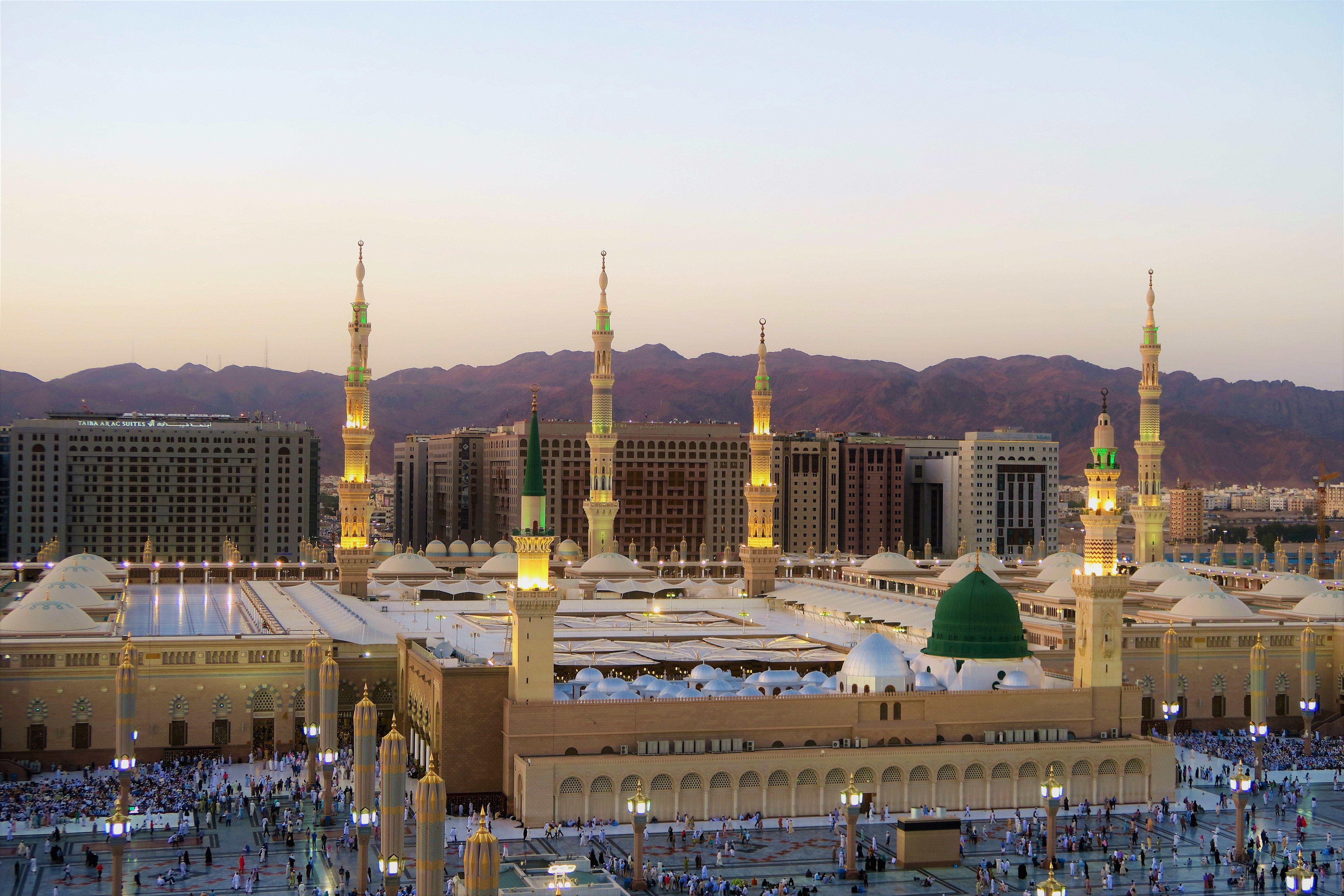
Pictured: Al-Masjid an-Nabawi | The Prophet’s Mosque, Medina, Saudi Arabia
est. 622 CE, expanded many times, last major expansion 1994 CE
Overview
In this section, we trace the Hijra: the emigration that marks Year 1 of the Islamic calendar (AH), and describe the founding of the Ummah at Medina. We situate Muhammad's social reforms within 7th-century Arabian society: the Constitution of Medina, the reform of the ancient Law of Retribution, zakat, and the changing status of women. We then describe the war with Mecca (at Badr, Uhud, and the Trench) and trace the two doctrines of jihad that emerge from this period. The section closes with Islam's early relationship to the Jews and Christians of Arabia: the dhimmi, the jizyah, and the Qibla (direction of prayer).
Assigned Reading
Reza Aslan, No god but God, chapters 3–4
Key Terms for this Section
Hijra · Ummah · Zakat · Hijab · Hadith · Jihad · Dhimmi · Jizyah
3.1 | The Hijra & the Constitution of Medina
The Secret
In 622, the weeklong exodus of Muhammad's Sahabah (Companions) to the distant city of Yathrib was a well-guarded secret in Mecca.
Known as the Hijra, the flight of the Sahabah was as dangerous as it was alienating. In all, about 70 Meccans left the comforts of home and family for the promise of Muhammad's profound message. These 70 Companions are known as the Muhajirun — those who have made the flight. And those who received them in Yathrib and assisted them became known as the Ansar — the Helpers. Together, Muhammad establishes the first masjid (Arabic word for mosque), which is also his home, in Yathrib. Eventually, the loose collection of villages of Yathrib will become known as Medina, literally the City (Madinat an-Nabi, the City of the Prophet), and will become the capital city of the initial Muslim community. This period is so central to the story of Islam that it marks Year 1 of the Islamic Calendar (“After the Hijra,” A.H. 1).
Muhammad, Settler of Disputes
When Muhammad arrives in Yathrib, he is effectively the Shaykh of the Muhajirun — the political clan leader of the new Meccan émigrés. As such, he is one of several Shaykhs in Yathrib. He also makes a name for himself as a Hakam — a settler of disputes between the clans.
Of course, to his 70 or so followers, Muhammad is much more than a mere Shaykh or Hakam. For them, Muhammad is Rasul Allah — the final Messenger of God.
The prevailing political and economic authority of Yathrib was a loose confederation of about 20 Jewish-Arab clans. The Jews of Yathrib, who numbered in the thousands, were craftsmen, weaponsmiths, and cultivators of dates and wine, while the nearby pagan Bedouins herded sheep and camels. These two strata — the settled Jewish Arabs and the nomadic Bedouins — benefited each other in Yathrib’s oasis. Five of these clans held an especially large share of that wealth, including the Banu Qaynuqa, who also controlled the oasis’s only marketplace, along with the Banu Nadir and the Banu Qurayza. But (Aslan is careful to note this), for the most part, the Jews and Arabs of Yathrib lived in relative peace, bound together by strategic alliance and economic interdependence. The real fault line ran between the Arabs themselves: the rival confederations of the Aws and the Khazraj, locked in a feud whose origins had been long lost to memory by Muhammad’s time, and which even the ancient Law of Retribution had failed to settle. By the time Muhammad arrived in Yathrib, the eternal quarrel had spread among the Jewish clans as well. The Jewish Nadir and Qurayza clans sided with the Bedouin Aws, while the Jewish Qaynuqa sided with the Bedouin Khazraj. This split the oasis in two. What Yathrib needed was an outsider — a Hakam and Shaykh — with no kin and no old grievance in Yathrib to answer for.
Muhammad was the right man at the right time, now in the right place to help bring an ancient blood feud to an end.
The Birth of the Ummah
In Yathrib, Bedouin Aws and Khazraj tribes see Muhammad as a wise Hakam — an outsider brought in to end their feud. To the wider oasis, he is one Shaykh among many, and leader of a small clan of outsiders. But to the Muhajirun (those who left Mecca) and the Ansar (the Helpers), he remains Rasul Allah, the Messenger of God.
This is where the Ummah begins.
Not yet an Islamic nation.
Not yet a regional power the Quraysh in Mecca need fear,
but a community of common belief.
Today, the Ummah specifically refers to the international Muslim community. But it’s important to note, as the scholar Frederick Denny shows, that this term has evolved from its Medinan beginnings. The Arabic word ummah (أُمَّة) can be traced at least as far back as Genesis (25:16), where it’s used in Ancient Hebrew to mean tribe. In Muhammad’s 7th-century Arabic use, the ummah came to mean those who agreed to the Prophet’s message. Moreover, Denny ties the ummah to political and theological decisions Muhammad makes as his standing in Medina firms up — decisions this section will follow, including the day he turns the direction of prayer away from Jerusalem and toward the Ka’ba in Mecca.
3.2 | The Medina Reforms: Women & Hadith
The Lawgiver
Over the last 1400 years, the Ummah of Medina has remained the classical standard for Islamic society. Why? Because it was there that Muhammad was finally able to enact the radical social reforms he had once dreamed of pursuing in his native Mecca.
First, he collapses the ancient Arab tribal offices — Elder (Shaykh), Judge (Hakam), Warlord (Qa’id), and Mystic (Kahin) — into one: Lawgiver. And Muhammad, like Moses before him, takes on the mantle of Lawgiver of his people.
No pre-Islamic Arab ever held all four at once; the Arabs were too wary of concentrated power to allow it. The Elder carried the least formal authority but the most moral weight: elected as first among equals, his sole job was to guarantee the protection of every member of the tribe, especially those who could least protect themselves, and his standing rested on a personal oath of loyalty (bay’ah) that could be withdrawn the moment he failed. The Judge was the neutral party brought in to arbitrate disputes the tribe’s Law of Retribution left unclear — his rulings, accumulated over years, hardened into a tribe’s Sunna, its body of unwritten legal precedent. The Warlord led the tribe in battle. And the Mystic held the Kahin‘s office, the tribe’s one sanctioned channel to the divine.
Muhammad now held all four titles in a single person, the Lawgiver.
As Lawgiver to the Ummah, Muhammad opens the tribe to new members. Under the old system, you were born into a clan. Now anyone may join the Ummah by swearing an oath of allegiance, the Creed (called the Shahadah in Arabic): “There is only One God, and Muhammad is His Messenger.”
This makes the Ummah a new kind of tribe — one that can accept anyone and expand forever.
Within the Ummah, the Law of Retribution (ie. an eye for an eye) is reformed. Muhammad implores his followers to grant forgiveness instead — a Jewish and Christian custom — which, he maintains, God will reward (Qur’an 42:40). And where the Law of Retribution is followed, everyone in the Ummah is now treated equally. A Shaykh’s eye is now worth the same as a destitute orphan’s.
The Women of the Ummah
As Lawgiver, Muhammad also makes reforms for women without precedent in Arabia.
After a decisive battle in 625 (cf. Sec. 3.3), the widower Muhammad ensured that the widowed women of the Ummah had the right to inherit their husbands’ property and to keep their wedding dowries as their own. He also limits the number of wives a man may marry, and he grants women permission to divorce their husbands (and keep the dowry!). No doubt this deference to women owes much to the abiding love Muhammad carried for his late wife of 25 years, Khadija.
And what about the men who came to the Prophet complaining about a woman’s traditional place? Muhammad’s answer is simple: those who do not honor these reforms will burn in Hell forever (Qur’an 4:14). End of discussion.
Over his 10 years in Medina, the widower Muhammad will marry nine different women. Generally, these are unions with a political framing — paralleling European aristocratic practices well into the 20th century. In short, marriage was a political act for most of history. It certainly was among the élite of 7th-century Arabia. His betrothal to Aisha (Ayesheh) links him politically to Abu Bakr, while his marriage to Hafsah links him to Umar (Omar) — both central figures of the early Ummah. He joins a powerful Meccan clan by marrying Umm Salamah. He also marries both a Jew and a Christian, Rayhana and Mariyah. He even marries an elderly widow, Sawdah, as an example to other men to marry those in need.
As wives of the Prophet, living in a house that also served as a mosque to countless guests, these women covered themselves with a veil (ie. hijab) to preserve their modesty among visitors in a holy place. In this way, taking the veil — darabat al-hijab — became a way of saying, “married to Muhammad.” She has ‘taken the veil.’ Conversely, in the Qur’an, the term hijab is only ever applied to the Prophet’s wives and to no other woman in the Ummah. (Compare this to the Christian teaching in
I Corinthians 11:5-6, which instructs all Christian women to cover their heads.)
Traditionalist Islamicists read the Qur’an’s modesty verses (24:31; 33:59) as extending the practice of hijab to all Muslim women — and their reading remains authoritative across much of the Islamicate world today. As non-sectarian scholars, we can describe both readings without adjudicating between them.
Almsgiving & Hadith
Muhammad also outlaws interest loans (ie. usury) — the practice the Quraysh had used to keep the poor of Mecca poor. In the Prophet’s City, the market is tax-free, and loans carry no interest. In their place, Muhammad redistributes wealth through zakat: 2.5% of a person’s accumulated wealth, given to the poor.
And make no mistake: zakat is not charity. Islamic almsgiving is a holy obligation, second only to prayer. Every capable member of the Ummah must do this to be a Muslim.
After Muhammad’s eventual death (cf. Sec. 4), a great variety of religious questions (like the hijab) continued to need answers. The Ummah will look first to the early Companions (Sahabah), and their stories will become the beginnings of the Hadith: the oral accounts of the life, deeds, and words of Muhammad not found in the Qur’an.
The practice of looking back on the accounts of eyewitnesses* to Muhammad becomes a research skill in and of itself. Sussing out the authenticity of a teaching’s chain of transmission — its isnad — will become a subject of great study and debate in Islamic theology. Entire schools of thought will swing on the hinge of an Islamic teaching’s credibility via its isnad.
*Especially important to scholars of Hadith is how a teaching was transmitted: sami'tu (direct, as in, “I heard [him say]”), or 'an (the more ambiguous, “on the authority of”). An 'an-report from a trustworthy narrator is generally accepted, but from a narrator with a record of concealing his sources, the vague form can be grounds for theological rejection. The Hadith collectors even disagreed on how much proof of contact between narrators an 'an required.
3.3 | Jihad & the War with Mecca
Jihad: History & Caricature
For years, there has been an unfortunate stereotype of Islam: a horde of savage warriors with scimitars raised, charging on camelback, hellbent on world domination.
Reza Aslan traces this caricature of the “warrior religion” to the Middle Ages, when the leaders of Christendom sought to take the Holy Land (and the lucrative trade roads to China) from the Islamicate world. Whether it’s King Richard fighting Saladin for Jerusalem, the Holy Roman Empire against the Turks, or the Allies seizing oil fields in the modern Middle East, Aslan argues there has always been an economic incentive in the West to draw the Islamic world as a caricature of evil barbarity.
As scholars, our interest is in looking past the headlines, the speeches, and the propaganda to ask how this image actually developed.
7th-century Islam came about in an era of great socio-religious empires. To the north lay the Christian Byzantine Empire — inheritors of the Roman world, from Constantinople to Jerusalem. To the east lay the ancient Zoroastrian Sassanian Empire — descendants of the mighty Persians of Biblical and historical legend. All else was little more than desert and ocean.
The early Islamic attitude toward religion ran parallel to that of their Byzantine and Sassanian neighbors:
“Your religion was your ethnicity, your culture, and your social identity; it defined your politics, your economics, and your ethics. More than anything else, your religion was your citizenship.” Reza Aslan, No god but God
As such, the early Ummah was not out to force converts (despite how it is often otherwise portrayed). Conversion for non-Arabs was, in fact, a complicated matter. It’s more accurate to say the Arab Muslims formed a kind of aristocratic clique in the lands they conquered, slow to accept outsiders.
So, was Islam a “religion of the sword” as is often claimed?
Actually, this is the wrong question — or, at least, a question posed in bad faith. Why?
Because the early Ummah had swords just like the Christian Byzantines, the Zoroastrian Persians, the kingdoms of India, the Daoists of China, the Vikings, the Saxons, the Welsh, the Mayans, the Pueblo, and every other culture living in the 7th century. Calling early Islam a “religion of the sword” pretends it is different than their 7th-century Christian, Zoroastrian, and pagan neighbors who also carried swords. Calling it another religion of the 7th century, that also had swords like everyone else, is certainly more fitting.
The fact is, Islam would not have survived the Meccan Quraysh — much less the Byzantines or the Sassanids — without the sword.
Now, what the question of Islam being a “religion of the sword” is often really asking is what role jihad (جِهَاد) has in Islam. Jihad (meaning “to struggle”) may be the most misunderstood concept in all of Islam and is worthy of our attention here, before we start counting off battles in which the Prophet Muhammad engaged.
There are two forms of jihad (struggle) in the Qur’an.
The Greater Jihad is the internal struggle to overcome sin and the obstacles standing between oneself and God — analogous to the “narrow way” Jesus describes in his Sermon on the Mount (Matt 7:14). The Lesser Jihad is the outer struggle to secure the peace and welfare of one’s community. When the community comes under attack, the lesser jihad takes the form of defensive war.
The theological logic here is simple. If the battle is defensive, it is just. If the battle is offensive, it is unjust (Qur’an 2:190). This is why Aslan argues that there is no concept of “holy war” in Islam — only the struggle for peace for one’s community (ie. the lesser jihad) and peace for one’s own soul (ie. the greater jihad).
Such is his normative, modern Islamicist view. But the concept has been put to other uses by other Islamicists. Since the Medieval era of the Crusades, a stream of thought has developed that Aslan calls the “Classical Doctrine of Jihad.” In this way of thinking, the world splits in two — the Islamic world (dar al-Islam) who fights the World at War (dar al-Harb). Here, the former must fight the latter until it yields to Islam. This is the view of breakaway, Islamist groups like ISIS and Al-Qaeda.
However, the backlash among Muslims to the so-called Classical Doctrine cannot be overstated. The medieval theologian and jurist Ibn Taymiyya undermines the Classical Doctrine with the Qur’an itself:
“There is no compulsion in religion.” QUR’AN 2:256
Nevertheless, leaders like the Ayatollah Khomeini, Abdullah Yusuf Azzam, and Osama bin Laden have used the classical doctrine of jihad to justify modern campaigns of violence and terror in the name of Islam. While the vast majority of their victims have been other Muslims.
Two Fronts, One Victory
In 7th-century Medina, Muhammad comes to understand two things about his prophetic work.
First, the success of the Ummah has shown him that the larger world could benefit from his message (Qur’an 12:104). His vision of a radically egalitarian society could reach millions.
Secondly, it immediately follows from the first point that there will be no expansion of the Ummah so long as the powerful Qurayshi elite control Arabia’s dominant religious and economic center, the Ka’ba in Mecca.
This is why Muhammad comes to confront Qurayshi power on two fronts.
First, Muhammad declares the city of Medina itself a ḥaram — a holy sanctuary — placing it in direct competition with Mecca. Merchant caravans now have a choice: trade in Mecca, or trade in Medina, 300 miles to the north. (This declaration will later be written into the Constitution of Medina, once Muhammad has the standing to make it official.)
Secondly, Muhammad sends members of the Ummah on caravan raids. In 7th-century Arabia, this was a legitimate and traditional way for small clans to take a share of the riches of the super-wealthy. It rarely ended in bloodshed; merchants counted such petty thievery as a normal cost of doing business on the frontier. But Muhammad isn’t aiming to be a nuisance; he does this to disrupt Meccan power.
And it works!
Caravans begin skipping Mecca for Medina, and the Quraysh take decisive notice.
The first flashpoint comes at the Battle of Badr in 624 (AH 2). Nearly 1,000 Qurayshi warriors surprise 300 of Muhammad’s men along a caravan road. After days of eyeing each other across the valley, Muhammad will not allow his men to fight until they are attacked (cf. jihad). In fact, he continues his prayers even after the fighting starts — until Abu Bakr insists he rise and join the fight. Muhammad then leads his men to a 3-to-1 stunning victory! The Quraysh lose about 70 men, among them several key leaders. Muhammad loses 14.
For the Believers, Muhammad’s triumph shows that God has clearly blessed His Messenger. His 3-to-1 victory at Badr signals that the new Ummah has a real chance at eventual victory over the mighty Quraysh — and beyond them, perhaps the entire Arabian Peninsula! From that day until now, the Islamic Ummah controls the desert region of the Hijaz. And Yathrib becomes known as Medina. The City [of the Prophet].
From Badr also come the first principles of Islamic Just War. Unlike the pre-Islamic Quraysh, Muhammad acknowledges moral differences between combatants and non-combatants, and between offensive and defensive war. Later Islamic teaching will expand on these themes — prohibiting the torture of prisoners, the mutilation of the dead, sexual violence, the destruction of property, and protecting religious sites.
The Constitution of Medina
Victory changes everything, including what Muhammad can claim at home.
Islamic tradition places the Constitution of Medina at the very start of his time in Yathrib, drafted almost as soon as he arrived. But scholars like Reza Aslan and Michael Lecker date the document after the victory at Badr. The powers therein make little sense coming from a recently arrived Shaykh, while they fit well with a Lawgiver returning home with a defensive victory enjoyed by all.
It is often held up as history’s first written constitution. The Constitution of Medina binds the Companion émigrés, the Helpers (Ansar), and the rest of Medina’s clans — Jewish, Christian, and pagan alike — into a single pact of mutual defense. Each community keeps its own faith tradition outright: “to the Jews their religion and to the Muslims their religion.” But every signatory, Jewish clans included, now owes the others loyalty against outside attack. And the document grants Muhammad authority no mere Hakam had ever held: sole arbiter of every dispute in Medina, its recognized war leader (Qa’id), and — the Constitution states plainly — the Messenger of God.
The historian Moshe Gil reads it more bluntly still: less a ‘peace treaty’ than an early exercise in ‘sorting friend from foe’ before the war everyone sees coming. And the Constitution comes to immediate relevance: when Muhammad comes to suspect the Banu Qaynuqa (one of Medina’s most powerful Jewish clans) of breaking their sworn protection, the Constitution is what gives him the grounds to act. What that action looks like, and what it costs, picks up on the other side of Mecca.
3.4 | Jews, Christians, & the Return
Protected Peoples & Jizyah Tax
As the Muslim world expanded after Muhammad into Christian (northwest) and Zoroastrian (northeast) lands, the Jews the Ummah encountered generally received better rights and treatment than they had under their previous rulers. Put plainly: for Jews in the Middle Ages, trading a Christian ruler for an Islamic ruler was historically a net positive — both in terms of safety and prosperity.
Medieval Christians persecuted Jews for their beliefs, forced conversions on them, or killed them outright. The Muslims generally did not. Under Islamic law, Jews and Christians alike were known as dhimmi — protected peoples — because they were also the ones who brought the Bible and the knowledge of the prophets to Arabia and the wider world. The tradition recounts Muhammad’s warning: He who wrongs a Jew or a Christian will have me as his accuser on the Day of Judgment.
Because they were not Muslims, the dhimmi did not pay zakat. Instead, they paid a (now controversial) protection tax: the jizyah. In exchange, Jews and Christians received religious autonomy and an elevated social status in the Islamic world. Facing the Christian antisemitism to the north, Medieval Jews came to call the Islamicate world “an act of God’s mercy.”
All of this arises from a central tenet of Islam: Muhammad’s message is indistinguishable from the message of Abraham, Isaac, Jacob, the People of Israel, Moses, and Jesus (Qur’an 3:84). As Moses brought the Torah (al-Tawrat), David the Psalms (Al-Zabur), and Jesus the Gospel (Al-Injil), so Muhammad — the Seal of the Prophets — brings the Qur’an. When Jews speak of the Jewish prophets, and when Christians speak of Jesus, Muslims happily honor these forebears of their own religion of Islam.
Muhammad takes special care to align the Ummah with the Jewish people. He first sets the Qibla (the Islamic direction of prayer) toward the Temple Mount in Jerusalem, the same direction as Jewish prayer, then and now. He mandates an Islamic fast to coincide with Yom Kippur, the Jewish Day of Atonement. He sets the hour of Muslim congregation called “Jummah” at midday Friday — early enough not to interfere with the Jewish Sabbath at sundown. He adopts many of the Jewish dietary and purity laws. And he encourages his followers to marry Jews, as he has done.
However, as Islam develops its own features and traditions, the Qibla is eventually turned to face the Ka’ba in Mecca (as it is now), and the annual fast is moved to Ramadan (Ramazan) — the month in which the Qur’an was first revealed. But the esteem Muhammad placed on the Jewish people never wavers. To this day, after Mecca and Medina, Jerusalem remains the third holiest city of the Islamic world.
As for the Christians: Muhammad holds Jesus in great esteem. The Qur’an confirms that Jesus was born of a virgin (3:47), performed miracles (3:49), was the promised Messiah (3:45), and will judge humanity at the end of time (4:159).
The principal Islamic theological disagreement is specific to the Christian doctrine of Trinitarianism. As we covered in Sec 2.2, there were centuries-old communities of Christians, in Arabia and elsewhere, who honored Jesus as a holy prophet but not as God. Trinitarianism, by contrast, is the belief that God the Father, Jesus the Son, and the Holy Spirit are all God. And this belief in particular — that a flesh-and-blood man could also be God — was anathema to Jews and Muslims alike. The Qur’an’s 112th surah answers it directly:
“Say, ‘He is God the One, God the eternal. He begot no one nor was He begotten. No one is comparable to Him.’” QUR’AN 112:1–4
And yet the Qur’an does not encourage bickering among the three sibling religions:
“People of the Book, let us arrive at a statement that is common to us all: we worship God alone, we ascribe no partner to Him, and none of us takes others beside God as lords.” QUR’AN 3:64
Allegiances & War
After Badr, the Jews, Christians, Hanifs, and growing Muslim population take sides.
Many flee Mecca and the surrounding region for Medina and join the Ummah. Others, particularly the Hanifs who disagree with the new prophet, head south to the Ka’ba and the Quraysh — seeking the way things used to be.
Amid the great exchange of allegiances, Muhammad comes to suspect that the Jewish Qaynuqa in Medina are in secret contact with the Quraysh in Mecca. Following a two-week siege, Muhammad exiles the Jewish Qaynuqa from Medina (Arab custom demanded their deaths, but Muhammad chose a lighter sentence). Their view was simple: the Quraysh were their primary financial partners, and they did not expect an upstart like Muhammad to win.
History proves them momentarily right. The next fight, the Battle of Uhud, proves an unmitigated disaster. Mid-battle, Muhammad’s undisciplined archers break ranks to take spoils from the field. The break opens his forces to be flanked by the Qurayshi army, and Muhammad barely escapes with his life.
This is all the proof the Jewish-Arab élites of Medina need to prove that Muhammad is unfit to lead. A second Jewish clan attempts to assassinate him. The plot is discovered, and Muhammad once again exiles the conspirators. Many veterans of Uhud are enraged at the mercy of this decision. They want blood — as custom demands.
Two more years of skirmishes follow, and neither side gains ground. So the Quraysh send a 10,000-strong Bedouin army to lay siege to Medina, and Muhammad answers with engineering: he orders a trench to be dug around the city.
The trench protecting Medina holds.
After a month, the besiegers run out of supplies and abandon the fight.
Then comes the darkest episode of the Medina years. It turns out that during the siege, a third Jewish-Arab clan — the Banu Qurayza — had been supplying the Bedouin army. For the Ummah, this is the last straw. They again plead with Muhammad to have the conspirators killed. Muhammad recuses himself, asking another Hakam to render the final judgment. The decision sides with ancient Arab custom: the men are killed, the women and children are enslaved, and their property is divided.
Aslan figures this involves about 1% of Medina’s Jewish population, alongside hundreds of fellow Arabs; after which, thousands of Jews continued to live peacefully with Muhammad in Medina throughout his life. To be clear, the Banu Qurayza were killed for their wartime alliance with a besieging army — not because they were Jews. It is later, under the caliph Umar (after Muhammad’s death), that the Jews of Medina are collectively exiled* from the Hijaz.
*It should be noted here that from the time of Umar until the 20th century, hundreds of thousands of Jews continued to thrive in Yemen, Iraq, Iran, and other Muslim regions.
Return to Mecca
Which brings us, at last, back to Mecca.
In the midst of a protracted war with the Quraysh, Muhammad makes a surprising announcement: he and 1,000 followers plan to go on a pilgrimage to Mecca. He will enter the holy city unarmed. And he will circumambulate the Ka’ba.
This decision confounds everyone. Just before his arrival, the Quraysh sign the Treaty of Hudaybiyyah with Muhammad, offering him and the Ummah an empty sanctuary the following season. He agrees. And when the Ummah return the next year as peaceful pilgrims, the people of Mecca see their character with their own eyes.
The treaty also lets other tribes across Arabia ally with either side without joining the war themselves — and it's this clause that ends up breaking the peace. Some ally with Muhammad while others choose the Quraysh. Two years later, a rival tribe attacks one of Muhammad's allies — with Qurayshi backing, chasing survivors into Mecca's own sacred sanctuary, where violence is supposed to be forbidden. It's a direct violation of the treaty: an attack on Muhammad's ally is an attack on Muhammad. The attacked tribe sends word to Medina pleading for help. The Quraysh, realizing what they've done, send their chief, Abu Sufyan, to Medina to try to salvage the peace, but Muhammad refuses to see him. Instead, the Ummah marches on Mecca with 10,000 warriors. Moreover, the people of Mecca have seen the quality of Muhammad's character first-hand. They know the truth about him, his message, and his community. And the people of Mecca accept Muhammad with open arms.
There are no forced conversions.
In total, only 10 Meccans are put to death.
Contrary to Arab custom, a general amnesty is declared for the whole city.
Even the slaves are freed.
At the city center, Muhammad and his son-in-law Ali approach the Ka’ba. One by one, Muhammad removes the pagan idols, raising them over his head, and smashes them to shards before a cheering crowd. The tradition recounts that the only image he spares is a Christian icon of Jesus and Mother Mary.
The last idol to go is the great Syrian god Hubal — in whose name so many of Muhammad’s enemies had hunted the Ummah. For Hubal, Muhammad draws his sword and hacks the idol to pieces. The shards are then refashioned as a doorstep to the Ka’ba. One now steps on Hubal to pray to Allah.
On the day Muhammad emptied the Ka’ba of Mecca, a new universal faith was declared, Islam. Today, two billion Muslims — roughly a quarter of our species — now celebrate the Ka’ba as the holy House of God.
North of Mecca, in the city of Medina, the small mosque that was once Muhammad’s home has grown over the centuries into the mighty al-Masjid an-Nabawi — the Prophet’s Mosque — raised over the site of that first structure and Muhammad’s tomb. It is the second holiest site in the Islamic world, after the Great Mosque of Mecca, and it draws millions of visitors each year.
And, to think, all of this started with a prophet on the run and a few dozen followers.
Last Section: Pre-Islamic Arabia & the Prophet
This Section: Jihad & the Holy City of Medina
Next Section: After Muhammad