

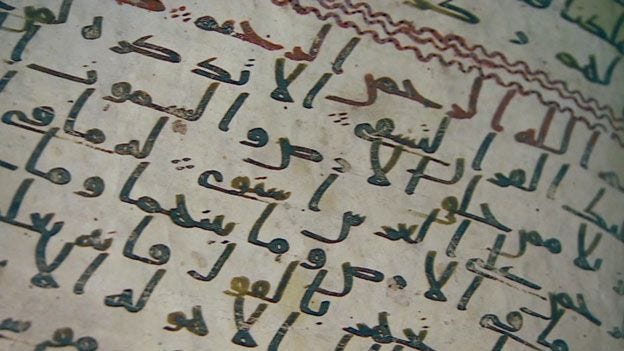
Pictured: Folio from the Birmingham Qur’an, 20th Surah • 7th c.
Overview
In this section, we describe the crisis that followed Muhammad's death in 632: the invention of the Caliphate, the office built to answer a question the Ummah had never had to ask. We trace the reigns of the first four caliphs — the Rashidun — from Abu Bakr and the Riddah Wars, through Omar’s conquest decade, to Uthman's canonization of the Qur'an and the contested rule of Ali. We then situate the factions whose quarrel over succession broke into open civil war (fitnah) at the Battle of the Camel and at Siffin. The section closes with the Umayyad turn of 661 and the origins of the divide between Sunni and Shia Islam.
Assigned Reading
Reza Aslan, No god but God, chapter 5
Tamim Ansary, Destiny Disrupted, chapter 4
Key Terms for this Section
Caliph · Rashidun · Ali · Uthman (Osman) · Ulama · Kharijite
Fitnah · Shia (Shi'atu Ali)
4.1 | The Succession Crisis
The Prophet is Dead • 570-632
Mecca is safeguarded, the idols are broken, but Muhammad does not stay long.
Many in Arabia assumed he meant to make himself King of Mecca. But he had no such political ambition. He wanted change, not power. And once change came to the Arab world, he wanted to go home, to his true home, in Medina. It’s there, two and a half years after the emptying of the Ka’ba, that Muhammad rests his head against his wife Aisha’s (Ayesheh) lap and dies quietly in his home — finally at peace, in Islam’s first mosque.
It is the Jewish year 4392, the Christian year 632, and the Muslim year 11.
After the Prophet’s untimely death, the Ummah comes apart at the seams. His old friend Umar (Omar), a large, hot-tempered man who had spent a decade defending the Prophet with his fists, simply refuses to accept his death. He stands in the mosque loudly insisting Muhammad is not really dead and threatening anyone who says otherwise. It falls to Abu Bakr, who had been leading prayers during the Prophet’s illness, to calm and put the death into perspective for a grieving congregation:
“If anyone worships Muhammad, Muhammad is dead. If anyone worships God, God is alive, immortal.” Abu Bakr
It is, in a sentence, the whole problem of the next thirty years. The message survives its Messenger. But who leads, and by what right?
The Prophet Muhammad had named no successor, and (this is the part that matters) he left no procedure for choosing one either. He had collapsed every office of Arab authority into himself — Elder, Judge, Warlord, Mystic — and above them all, Lawgiver and Messenger of God (cf. Sec. 3.2). Now all of those seats were suddenly vacant. The position of Messenger — of Rasul Allah — was sealed forever.
For context, consider the Biblical alternatives known to Muhammad. In the Torah, Moses lays his hands on Joshua before the whole assembly and transfers his authority in public (Num. 27:18-23). In the early Church, when the Apostles replace Judas, the community assembles and casts lots (Acts 1:15-26). But, for reasons lost to the sands of time, Muhammad left the Ummah without a prescribed method of succession. Instead, a grieving Ummah had to find a method on the spot.
The pressure to choose Muhammad’s successor was felt both inside Medina’s mosque and in tribal meetings far away. Client tribes concluded their agreements had been with Muhammad personally, not God, and ended their zakat payments. Additionally, copycat prophets began to spring up in Yemen and eastern Arabia who tried to imitate Muhammad and reproduce his social programs. Some drew real followings.
But perhaps the worst problem the Ummah now faced was the ephemeral nature of Muhammad’s teachings. At the time of his death, there was no Qur’an. Instead, the teachings of the Prophet survived in the memories of his Companions and on the occasional scrap of parchment. The Ummah had no legal code, no settled theology, and no institutional religion. And now, there was no longer anyone to ask.
Successor to the Messenger of God
The argument begins immediately, and it begins over geography.
Should the new leader of Islam come from Medina, the Prophet’s City that had sheltered the movement? Or from Mecca, home of the Ka’ba and of the newly converted Quraysh? Maybe one of each, sharing power?
The debate eventually settles on continuity: the succeeding man should be one of the Companions who had made the original Hijra ten years earlier, and a Meccan of the Quraysh. After hours of heated argument at the shura (the ancient Arab tribal council), the assembly lands on the calming voice that had taken over when Muhammad fell ill and had steadied the community at the funeral. The majority choose Abu Bakr.
But what to call Abu Bakr? This was a political, theological, and philosophical problem that required nuance. He could not be called “prophet,” as the holy revelation had ended with Muhammad (he was very clear on that point). The community decided on the rather modest title of Khalifat Rasul Allah — the ‘Successor’ to the Messenger of God. Caliph for short.
The word is worth pausing on, because it defines an office that governs the rest of this course. A caliph is a successor, a deputy. He’s never a prophet, and never a source of revelation. Abu Bakr inherits Muhammad’s political authority: Shaykh, Hakam, Qa’id. He inherits none of his religious authority. That falls instead to the Ulama — the Learned Ones — (alim in the singular), the scholars who would carry the religious direction of the Ummah forward.
This split — caliph as political successor and alim as theological successor — is the single most consequential piece of institutional design in early Islam. Nearly every fight throughout Section 4 will be about the line between these two forces.
As Caliph, Abu Bakr tells the assembled Muslims in his inaugural address:
“As long as I obey God and the Prophet, obey me; if I neglect the laws of God and the Prophet, I have no right to your obedience.” Abu Bakr
Think about that for a moment. The caliph’s legitimacy comes from the consent of the governed — and it can be withdrawn! Not from bloodline, not from conquest, not from divine appointment. Aslan points out that nowhere else in the 7th-century world had such an experiment in popular sovereignty even been imagined. And the practice the shura embodies is not an Arab political habit the Ummah merely carried forward. The Qur’an lists it among the marks of the faithful, set directly alongside prayer itself:
“…respond to their Lord; keep up the prayer; conduct their affairs by mutual consultation…” QUR’AN 42:38
But consent has a shadow side: somebody has to be left out of the room.
The most obvious alternative to Abu Bakr was Ali — Muhammad’s cousin and son-in-law, raised in his home, the first child to accept his message, and the one who had stood beside him at the Ka’ba. Ali was also a Hashemite, of Muhammad’s own clan. And, interestingly, the Hashemites were not present at the shura when Abu Bakr was chosen by the majority.
The Qurayshi answer was blunt and, on its own terms, principled: no one wanted the whole authority of the Ummah consolidated into one small family. If this community was going to be a new kind of tribe — one anybody could join — it could not become the private property of the Prophet’s relatives. Prophethood and the Caliphate, Abu Bakr and Umar both insisted, cannot live in the same clan.
But the Hashemites, with plenty to lose, simply did not accept this. Neither did the Ansar of Medina, who resented watching a Meccan take the office in their own city. Umar eventually went to the house of Ali and Fatima (Fatemeh) — Muhammad’s own daughter — and threatened to burn it down unless they submitted to the new authority. But Abu Bakr restrained him at the last moment. This was the level of tension around the choice of caliph. Umar’s threat was withdrawn, but the message was still received. In the end, Ali would swear his allegiance to the new caliph.
The Ummah had its caliph. It also had its first faction.
The Riddah Wars
Abu Bakr was the first of the Rashidun — the Rightly Guided Ones, the four caliphs who ruled from Muhammad’s death to 661.*
Abu Bakr’s reign barely lasted two and a half years, and he spent nearly all of it at war.
The campaign is remembered as the Riddah Wars — the Wars of Apostasy — and it was aimed at both problems at once: the copycat, rival prophets and the tribes who had stopped paying zakat. The fighting was led by the formidable general Khalid ibn al-Walid, whom our second author, Tamim Ansary, calls the “hero of the Apostate Wars.”
Abu Bakr’s reasoning is the hinge of the whole episode. The deadbeat tribes, he argued, had not made their agreements with the Shaykh of Medina; they had made their agreements with God Almighty. Refusing zakat was therefore not a broken contract or a tax dispute. It was treason against the Ummah and a sin against God — and the penalty for treason was death.
Abu Bakr won his wars against the apostates. Arabia held. But Aslan notes the long shadow the victory cast: by treating the refusal of zakat as apostasy, and apostasy as treason, the Riddah Wars welded the two together in Islamic thought for centuries to come — pay zakat or die by the sword. The Qur’an, by the way, never taught this.
For Abu Bakr’s administration, there was one more piece of critical domestic business. He wanted to check Hashemite influence for good. So Abu Bakr announces an official ruling on inheritance: ‘the Prophet Muhammad left no heirs.’ The widows of Muhammad — the “Mothers of the Faithful,” including Abu Bakr’s own daughter Aisha — would be provided for directly by the Ummah instead. And, as a father and caliph, he kept that promise scrupulously.
Muhammad’s daughter was heartbroken. Fatima (Fatemeh) had lost her father’s estate by decree, and she never spoke to Abu Bakr again. When she died a short time later, Ali washed and buried his wife himself, the daughter of the Prophet, quietly, at night, without informing the caliph. One can imagine his sadness and anger.
It is a small, personal act of protest. 1,400 years later, it is still remembered by those with allegiance to Ali.
*A word of caution on the term. “Rashidun” is not a neutral historical label; it is the Sunni tradition’s own retrospective judgment that these four reigns, and only these four, were rightly guided. Shia Muslims do not read the period this way at all. We use the term because the sources do, not out of deference to either side.
4.2 | Omar’s Conquests & Uthman’s Codex
Commander of the Faithful
When Abu Bakr died in 634 (13 AH), he did something the shura had not authorized: he named his own successor. Ali’s popularity had grown considerably in the two years since the Prophet’s death, and Abu Bakr and Umar remained convinced that the Hashemites must not inherit the office.
So Abu Bakr named his protégé, Umar, as second Caliph of the Ummah.
It has to be said, though, that naming him settled nothing by itself. Umar could not rule without the consensus of the Ummah — the same requirement Abu Bakr had faced. And, like Abu Bakr, he was granted it.
The loud and powerful Umar styles himself Amir al-Mu’manin — Commander of the Faithful. He was an enormous, bald, physically intimidating man, and under his command the Ummah expands at a rate almost impossible to wrap your head around. He personally meets both superpowers of the period in the field of battle and beats them decisively. Damascus, Jerusalem, Egypt, Libya — they fall like dominoes.
In 636, at Yarmuk, the Muslim armies destroy the main Christian Byzantine field army in Syria. Against the Sassanid Persians near Qadisiya, there is a famous parley in which the Persian commander dismisses the Arabs as poor and starving, comparing them to a mouse that gorges itself until it is too fat to escape its own hole — trapped by its own greed. The Arabs were unimpressed. Within a few years, the Persian capital of Ctesiphon falls. Under Umar, the Ummah destroys the Sassanid (Persian) Empire.
Jerusalem surrendered too. The story goes that the caliph traveled to accept the surrender of the holy city with a single servant and a single donkey, the two men taking turns riding and walking, so that when they finally arrived the waiting Christians mistook the servant for the caliph. “No pomp,” Tamim Ansary writes. “That was Omar’s style, according to legend.”
These were Christian cities, and not incidentally so. Damascus was a Byzantine provincial capital built around the Cathedral of St. John the Baptist; Muslims and Christians would share that site for two generations before it became an Umayyad Mosque. The Jerusalem once burned by the Romans had been rebuilt as a Christian pilgrimage city over centuries of imperial patronage. Egypt was Christian, too.
And Caliph Umar took each of these wealthy Christian provinces as his own. So why didn’t the Eastern (Byzantine) Christians fight harder for them?
Recall the theological fractures we traced back in Sec. 2.2. Most of these Christians were the wrong kind of Christian by Byzantine standards. Syria leaned Miaphysite. Egypt was overwhelmingly Coptic Miaphysite. These were precisely the communities the imperial church in Constantinople had spent centuries pressuring to conform — the losing side of Nicaea’s long aftermath, taxed and legislated and occasionally persecuted by their own emperor for believing the wrong things about Christ.
So consider the arithmetic from a Miaphysite doorway in Damascus, or a Coptic one in Alexandria. Trading a Byzantine emperor for a Muslim caliph was not an obvious downgrade — and, in tax terms, it was frequently a huge win (ie. the jizyah discussed in Sec. 3.4 was often more favorable than eastern imperial Christian tax requirements). Historians still argue over how much this actually accelerated the early Islamic conquests, and we won’t settle it here. But either way, an army at the gate isn’t always a loss for those inside.
To problematize the image of the ‘conquering Islamic horde’ further, consider how Umar garrisons his men. The caliph would deliberately set his standing army apart from conquered populations, rather than letting soldiers settle among them. His standing orders to new regional governors emphasized slow change. And, interestingly, he worked to treat non-Arab Muslims as the equal of Arabs — just as the former began to outnumber the latter.
Back home, in an attempt to make amends with Ali’s clan, he offered to give the Hashemites full control of Muhammad’s Medina estates. He also married Ali’s own daughter, and consulted Ali, now his father-in-law, on matters of state. But the one political reality on which Umar would never move was his and the late Abu Bakr’s position: that the Prophethood and the Caliphate cannot reside in the same clan.
The Deathbed Shura
In 644 (23 AH), Umar is stabbed in the mosque at Medina while leading prayers.
The once hot-headed man who had refused to believe the Prophet was dead had evolved into a shrewd, if not disciplined, ruler. In his final act as caliph, Umar refuses to name a successor — so that the Hashemites, his wife’s clan, cannot be slighted a second time. Instead, he summons the six leading candidates to his deathbed and instructs them to settle it among themselves in the ancient form of the shura, with the Companion Abd al-Rahman ibn Awf serving as Hakam — their neutral arbitrator.
They narrow it down to two: the Hashemite Ali, and the Umayyad Uthman (Osman).*
*A note on spellings. Arabic and Persian render the same names differently.
Arabic Umar is Omar in Persian and Turkish. Arabic Fatima is Fatemeh.
And Arabic Uthman is Osman: the name of the Turkish dynasty in Sec. 12 — the Ottomans.
Uthman was an early convert who had known Muhammad personally. He was wealthy, well-connected, and mild-mannered to the point of utter dullness. In fact, his dullness was his chief qualification. He was the exact opposite of the passionate, brilliant, uncompromising (and, thus, deeply polarizing) Hashemite, Ali.
The Hakam put two questions to each man. The second was whether, as caliph, he would follow the precedents set by the first two caliphs. Uthman said yes. Ali, insulted, said no.
Uthman was then endorsed by the Ummah as the third caliph.
Predictably, the Hashemites went into a rage — not because Uthman was dull, but because he was an Umayyad. The Umayyad clan was among the most powerful of the Qurayshi tribe. In life, they were among Muhammad’s most bitter enemies. Their clan’s part in the Meccan war was devastating — Uthman’s uncle had led the Qurayshi armies against the Prophet and the Ummah! Now, the clan of Muhammad (Ali and the Hashemites) was being asked to bend the knee to the clan of Muhammad’s enemies (the Umayyads), all in the name of Islam.
Then Uthman made it worse. Much worse…
After taking office, he replaced most of the regional governors with members of his immediate family and began handing his relatives enormous sums from the public treasury. And he adopted a bizarre new title: Khalifat Allah, the Successor to God.
Abu Bakr had been Successor to the Messenger of God, and had pointedly refused anything grander. Uthman now presented himself as successor to God Almighty.
The Uthman Codex
All of this has to be set against the other side of Uthman, who was genuinely and strenuously pious. When his wives refused to accept Islam, he divorced them and married two of Muhammad’s daughters. When a group of persecuted Muslims fled to Abyssinia, he went along as their financial backer. In Medina, he expanded the Prophet’s Mosque and bought the community a strategic well out of his own pocket.
But all of this is a small footnote to what he did next.
Uthman set the Ulama, the Learned Ones, to the holiest and most critical task left after the Prophet’s death: to produce one authoritative written edition of the Qur’an.
Until then, the revelation had been preserved chiefly by the Qurra, the Prophet’s authorized reciters, and committed to writing only piecemeal: verses scratched onto pieces of bone, scraps of leather, and the flat ribs of palm leaves. Written verses were collected from across the Islamicate world. Surviving Companions were interviewed. Discrepancies among early local Islamic traditions were resolved.
Around 650 CE, a single binding text was authorized — and the variant collections, tradition states, were rounded up and burned.
Objections came at once, from Iraq, Syria, and Egypt. But note what the objectors were not saying. Their specific complaint, Aslan carefully observes, was never that the local Qur’ans were better or more accurate. It was that Caliph Uthman had overstepped the bounds of his secular authority in dictating the sacred text. Which is to say: the fight over the codex was another fight about that line between political power and religious authority — the line Abu Bakr had drawn on his first day in office, and that Uthman had now stepped across in the most conspicuous way imaginable.
Uthman’s authorized edition arranged its surahs roughly by length, which is how they stand today. And the result is extraordinary. The Qur’an that Uthman held in his hands, in the original Meccan Arabic, is the same recited by nearly two billion Muslims this morning.
4.3 | The First Fitnah
The Murder of Uthman, Successor to God
Uthman made enemies at a rate that would have alarmed a less confident man: not just the old enemies of the Umayyad clan, but senior Companions, and eventually even the Hakam who had handed him the office in the first place.
By 655 (34 AH), eleven years in, revolts are breaking out across the Islamicate world — and the grievance is nearly always the same: the corruption and incompetence of the caliph’s relatives in the provinces. The anger reaches into the Medina mosque itself, where the elderly caliph is pelted with stones during Friday Jummah prayers and knocked clean off the minbar (pulpit) onto the floor.
Several Companions urge him to repent publicly of his nepotism and make amends. But his kinsman and adviser Marwan talks him out of it. Uthman holds his course.
Two of his kinsmen governed the richest provinces in the empire, and both were notorious. From Damascus, Uthman’s cousin Mu’awiya (Mo'aviyeh) was enriching himself at great expense to his subjects. And in Egypt, Uthman’s foster brother Abdullah ibn Sa’d was squeezing his once Coptic Christian province dry.
Prominent Egyptians write to the caliph and get no reply. So they send a delegation to Medina in person, and are joined en route by delegates from Basra, Kufa, and elsewhere. Uthman hears them out and agrees to replace the Governor of Egypt. The delegation starts for home satisfied.
And then, on the road, they intercept a letter. It is carried by one of Uthman’s own slaves. In the letter, Uthman instructs the Governor of Egypt to arrest and execute the delegates the moment they arrive.
Some historians claim the letter is a forgery. Uthman swore he never wrote it, and both of our scholars, Aslan and Ansary, record the judgment of later historians that its likely author was, in fact, Marwan. Honestly, though, it made no difference. The petitioners march back to Medina and arrive as an angry mob. They demand the caliph abdicate his throne. He refuses and goes back to reading his Qur’an.
Touchingly, among Uthman’s defenders were Ali’s sons. Hasan helps to hold the door, as Husayn (Hossein) carries water through the siege. Uthman himself forbids his supporters from shedding blood on his behalf.
Nevertheless, the mob breaks into the house, smashes Uthman’s belongings, and then beats the old leader to death. The tradition remembers his blood soaking into the pages of the open Qur’an he had been reading.
The Party of Ali
Ali was at prayer when word reached him.
His first thought was for Hasan, who had tried to shield the caliph from the mob.
The day after the murder, a congregation gathers at the mosque and begs Ali to take the Caliphate. After twenty-five years of watching other men hold the office, he still says no. The assassination was appalling; the mob still controlled Medina, and to accept the office from them was to accept rule from a mob.
But the support for Ali kept building: the Hashemites, the Ansar of Medina, several prominent Companions, a few Qurayshi clans, and many of the non-Arab Muslim communities. Collectively, these supporters became known as the Shi’atu Ali, the Party of Ali. More commonly known today as the Shia.
Ali finally accepts and takes his oath in the mosque before all of Medina. Believing that Uthman’s bizarre antics had tainted the word itself, he refuses to be called “Caliph,” taking Umar’s old charge instead: Commander of the Faithful. Ali then declares a general amnesty for the mob, and he removes the problematic Umayyad governors, replacing them with qualified local men.
Both decisions were defensible. Both were catastrophic.
By this point the Ummah has sorted itself into four distinct positions on what the Caliphate even is — and it is worth discussing them, because the next thirty years are, by and large, these four arguments conducted with weapons.
The Party of Uthman, led now by Aisha and carrying the convictions of her late father Abu Bakr and his protégé Umar: the caliph’s power should be confined to political matters, with religious questions left to the Ulama.
The Party of Ali, the Shia: Ali and the Hashemites, as the family of the Prophet, should govern both the political and the religious destiny of the Ummah.
The Kharijites, a smaller faction within Ali’s own camp: the most pious living Muslim should lead the divinely ordained Ummah, irrespective of tribe, lineage, or ancestry. At the moment, that man was Ali. But it need not stay Ali. This group also grew obsessed with labeling those who disagreed with them kafir: unbeliever.
The Party of Mu’awiya: the Umayyad clan, who had run Arabia’s economy from Mecca for generations and now held a claim to the office through the murdered Uthman, should rule the expanding empire. To that end, the Umayyad Governor of Damascus was already raising an army on Egyptian taxes.
By Ali’s time as leader of the Caliphate, the neo-tribal dream of Muhammad is all but gone. Larger financial and imperial ambitions have flooded into his Ummah. And the future of Islam is about to be decided on a battlefield.
The Camel & Siffin
Aisha, Muhammad’s youngest widow and Abu Bakr’s daughter, goes to Mecca to raise an army against Ali (her own stepson-in-law, if you’re counting).
Aisha’s position was that of her father’s, held consistently for 24 years: the clan of Muhammad cannot hold both religious and political authority over the Ummah. It is too much power for one family. She rallies the Meccan elite, and with a group of Meccan warriors she rides out to meet Ali in the field, leading the cavalry herself from the back of a camel.
It is remembered as the Battle of the Camel (36 AH), and it is the Ummah’s first taste of fitnah — their first civil war. Muslims are now killing Muslims over the question of who should be their leader.
Talha and Zubayr, two of Ali’s most prominent opponents, both Companions of the Prophet, are killed. Aisha herself is wounded by an arrow. Ansary reckons the field left some 10,000 Muslim dead.
When it’s over, Ali pardons Aisha (his stepmother-in-law and late wife's stepmother, if you’re counting). She lives out her days as a revered teacher and transmitter of the tradition, and her authority in the Hadith remains considerable to this day.
Ali then moves his seat of government to Kufa, in Iraq, to reward the city’s loyalty. He will never return to Medina. Instead, Ali turns west, toward his enemy Mu’awiya — who had by then been parading the alleged bloody shirt of Uthman from town to town, asking local leaders to join him in a coup against Ali.
The two armies met at the Battle of Siffin.
The battle opens with Mu’awiya’s forces trying to block Ali’s army from reaching the river, and then settles into months of stalemate before the real fighting begins. When it comes, the slaughter is staggering: some sources, Ansary hedges, put the toll as high as 65,000 Muslims dead over four blood-soaked days.
Ali tries repeatedly to stop it. He asks Mu’awiya to negotiate, again and again. There was even an offer to settle the Caliphate by single combat — both in their mid-50s — a slender, battle-ready Ali agreed, while a rich and portly Mu’awiya declined.
Then, with the battle apparently turning in Ali’s favor, Mu’awiya orders his soldiers to fix pages of the Qur’an to the points of their lances.
It was a cynical maneuver, and everyone knew it. The Kharijite faction pushes Ali to ignore the stratagem — to cut down the rebels, the kafirs, for their insubordination. He does not. Facing the Qur’an on the field, Ali grounded his refusal in the Qur’an’s own rule of restraint:
“if [the enemy] desists, then you must also cease hostilities.” QUR’AN 2:193
So Ali calls for a parley. A Hakam led lengthy negotiations, and with tens of thousands already dead, the best that could be agreed was a partition: Mu’awiya and the Umayyads would hold Egypt and Syria. Ali would keep everything east.
Ali had obeyed his scripture. It cost him everything.
4.4 | The Umayyad Turn
No Judgment but God Alone
The Kharijites regard Ali’s agreement to arbitration as a grave sin.
Their thinking was, if the Caliphate is a divinely ordained office, then submitting its disposition to a panel of human negotiators is a categorical error. God’s judgment is not the sort of thing men arbitrate.
Crying “No judgment but God alone!” the Kharijites abandon Ali on the blood-soaked field. To their view, Ali forfeited his office the moment he agreed to discuss it.
Three years later, in the mosque at Kufa, Ali is at prayer when a Kharijite named Ibn Muljam pushes through the crowd. “Judgment belongs to God, Ali, not to you!” he shouts, and kills the fourth and final Rashidun caliph with a poisoned sword.
The Kharijite movement itself eventually dwindled into an historical footnote. But what remains of them was their penchant for declaring another Muslim an unbeliever, and treating that declaration as a license for violence. This Kharijite view has resurfaced in every century since, and Muslim critics of modern extremist groups routinely reach for exactly this comparison, naming ISIS in particular as the Kharijites coming round again.
Hasan Steps Aside
Ali’s supporters then turn to his eldest son, Hasan, to take up the Hashemite claim.
He declines.
And Hasan’s reasoning is the epitaph for the whole era. Like it or not, the Caliphate was now a global empire, stretching from the Zagros Mountains of Persia to the desert sands of Libya. It was no longer the holy egalitarian community it had once been dreamed to be. To claim the office at this point, Hasan judged, would be little more than a power grab — one more round of court intrigue ending in the deaths of tens of thousands of Muslims.
So he steps aside. And with that, the first era of Islamic history was over.
In Ali’s place, Mu’awiya — Uthman’s cousin, the Governor of Damascus — moves the seat of power from Kufa in Iraq to Damascus in Syria, and, in 661, inaugurates the Umayyad Caliphate — just 40 years after the Hijra.
The first Islamic empire. Not a shura. Not a community of consent. A dynasty, seated in a Roman provincial capital, that would pass from father to son.
Sunni & Shia
The question that opened this section — who leads the Ummah, and by what right? — was never actually settled. Not at the Camel, not at Siffin, not at Damascus.
In a real sense, it is still an open question,
as the two great Islamic traditions grew out of it.
Sunni Muslims (the Majority) hold that the community was right to choose its leaders by consensus, beginning with Abu Bakr, and that the Rashidun era is the model of legitimate succession. Shia Muslims (the Party of Ali) trace their name to the Shi’atu Ali and hold that leadership belonged by right to Ali and to the family of the Prophet, and that the community, however sincerely, chose wrong in a courtyard in Medina in 632. As non-sectarian scholars, our work is to describe both readings accurately and to leave the adjudicating to those who hold to them.
What is striking is how much the two share. Ali is revered across both branches. For Sunnis, he is the fourth of the Rightly Guided Caliphs. For Shia Muslims, he is something considerably more — the first Imam.
Today, roughly two billion people are Muslims. About 90% are Sunni. Nearly all the rest are Shia, concentrated in Iran, Iraq, Azerbaijan, Bahrain, and Lebanon. Think about that — a quarrel among a few thousand people over who should lead a desert oasis community now defines the religious lives of a quarter of our planet.
And it only gets worse from here. Because what makes the Shia claim really burn, what turns a political grievance into a theology of martyrdom and suffering, has not happened yet in our telling. It will take place 20 years later…
In a dusty plain in Iraq called Karbala.
Last Section: Jihad & the Holy City of Medina
This Section: After Muhammad
Next Section: Kalam & Shia Islam