

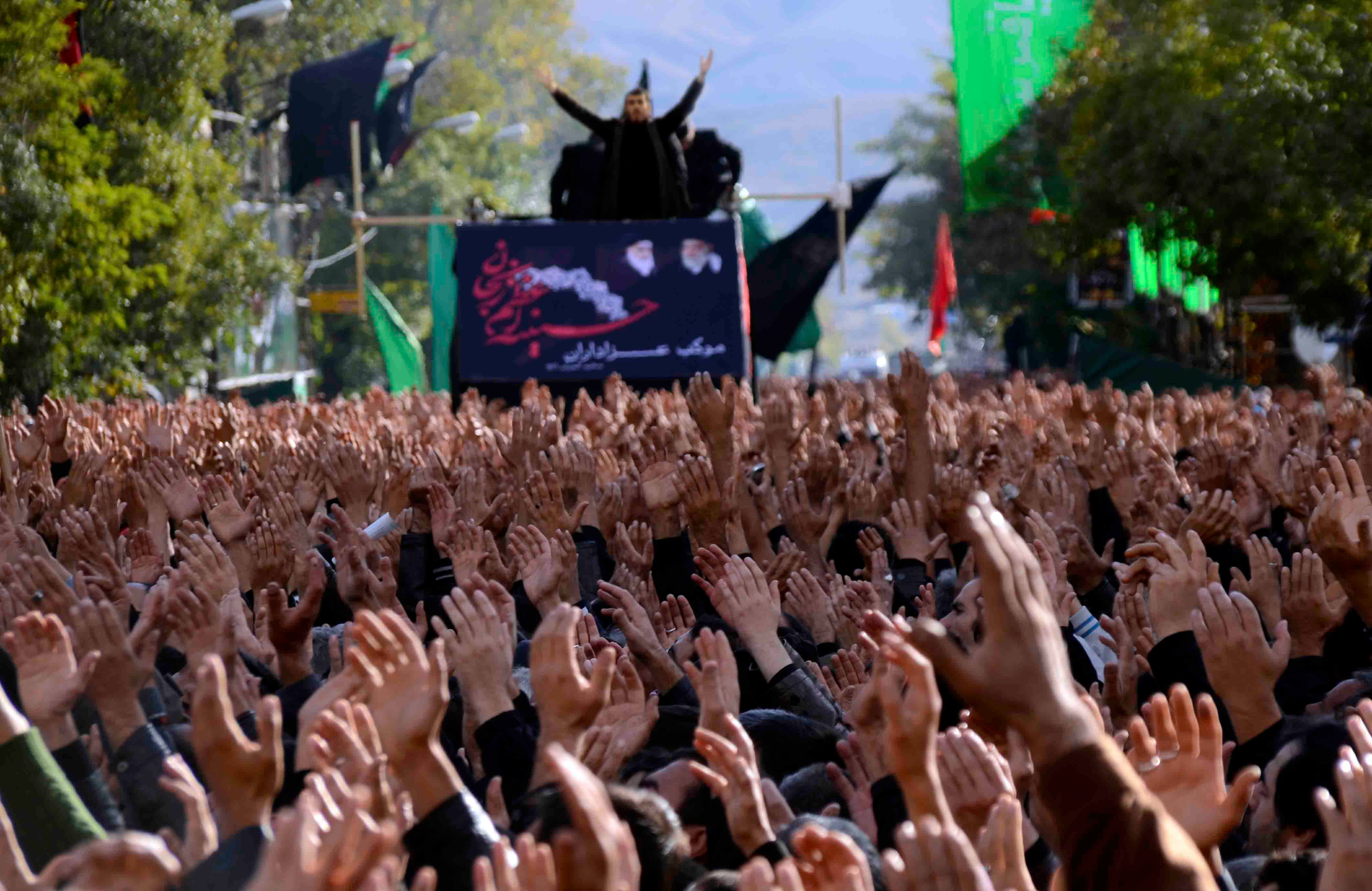
Pictured: Shia Muharram mourning gathering in Iran • Nov 2014
Photo Credit: Payam Moein via Wikimedia Commons, CC BY-SA 4.0 (cropped)
Overview
In this section, we pick up where Section 4 left us: on a plain in Iraq in 680, standing next to the Prophet's grandson, Husayn. We trace how that afternoon turned a political faction into a religious tradition — through the Penitents, the mourning of Ashura, and the doctrine of the Imams — and follow that tradition forward to the Mahdi, to Safavid Iran, and to the Islamic Republic. We then turn from what divides the Ummah to what unites almost all of it: Islam as an orthopraxic tradition, in which Islamic theology (kalam) is inseparable from Islamic law (fiqh), and the Five Pillars by which a Muslim builds a life. The section closes with Salat, the communal prayer that encompasses the other four pillars.
Assigned Reading
Reza Aslan, No god but God, chapters 6- 7
Key Terms for this Section
Karbala · Fatima (Fatemeh) · Imamah · Sunni · Tawhid · Sawm · Hajj · Salat
5.1 | Karbala
Iraq • 680 🇮🇶
It is the Christian year 680 CE.
The Muslim year 61 AH. 61 years since the Hijra to Yathrib (Medina).
Muhammad’s dream of a free, peaceable, egalitarian community of believers has become so much dust in the desert, and in its place sits a new Islamic empire ruled from Damascus by the sons of the men who once hunted the Prophet.
Here, on a dry plain in Iraq called Karbala, the Prophet’s grandson is about to die.
Husayn (Hossein) is the son of Ali and Fatima (Fatemeh), leader of the Hashemite clan, and, to a great many Muslims, the rightful heir to the Caliphate. Against him rides Yazid, the 33-year-old son of Mu’awiya (Mo'aviyeh), the second Umayyad caliph. Here in Iraq, the sons are fighting their fathers’ war. Ali and Mu’awiya had settled nothing at Siffin (cf. Sec. 4.3); they had only partitioned the disagreement and postponed the war.
The two forces are nowhere near evenly matched, and everyone knows it. Husayn bravely rides out with fewer than a hundred followers, his own family of women and children near him — back at the camp. Yazid meets Husayn with a large, well-paid, mounted Syrian army. What follows is not a battle. Over three days, without water or food, it is the slaughter of a family in the open Iraqi desert.
Husayn’s 18-year-old son, Ali Akbar, dies armed on the field. So does his brother’s 14-year-old son, Qasim (Ghasem). Even Husayn’s infant son is killed, shot in the neck by a soldier’s arrow as Husayn carries the child toward the Syrian lines to beg for water.
Bloodied, and with few left to hear it, Husayn calls out to the riders closing on him:
“Do you see how Fatima’s son fights? Do you see how Ali’s son fights?
Do you see how the Banu Hashim fight despite three days of hunger and thirst?”
These are the last words of Husayn, son of Ali, Grandson of the Prophet, Master of Martyrs. Moments later, Yazid’s general decapitates Muhammad’s grandson and carries his head away as a prized trophy. The new Umayyad Caliphate in Damascus celebrated this as the beginning of the first Islamic empire. And it was. But it also gave rise to a rival tradition that fervently mourns the Battle of Karbala to this day.
The Penitents
Husayn had ridden out to Karbala from Kufa, in Iraq: a city of freed slaves and Persian converts, where his father Ali had governed as the fourth Rashidun caliph.
Kufa was the heart of the Party of Ali (Shi’atu Ali, cf. Sec. 4.3). Its people had written to Husayn, promising him an army. But when Husayn came, almost none of them went with him to Karbala.
Four years later, a small group of Kufans gathers at the site of the massacre. They are remembered as the tawwabun, the Penitents. They blacken their faces. They tear their clothes. They weep openly, in public, for a man they had failed. They name their own failure as the reason he died.
This is the moment the Party of Ali stops being a political faction and becomes the religious tradition of Shi’ism. Not at Siffin, where the argument was about who should govern. Shia Islam is born where the argument became about what we owe the one who suffered for us, and what it means that we did not go.
At the heart of Shia Islam is a 1,400-year-old grief. Reza Aslan puts the theology plainly: Shi’ism rests on the conviction that the righteous believer sacrifices himself in the struggle for justice, as Husayn did in the face of his oppressors. He went to Karbala knowing — that’s the whole point. He was not ambushed. He was not outmaneuvered. Husayn chose certain death rather than swear fealty to the Umayyads.
And the Shia reading places that choice in a very long line
The sacrifice-theology of Shia Islam begins in Genesis with Abraham (Ibrahim) raising the knife over his son and ends with Husayn’s brave and willing sacrifice at Karbala. Between those historical bookmarks were the Lawgivers: Moses (Torah/al-Tawrat), Jesus (the Gospel/al-Injil), and Muhammad (al-Qur’an). For the Shia, what starts and completes this circuit is the sacrifice: opened by Abraham and closed by Husayn.
Ashura: Honoring Martyrdom
Every year, on the 10th of Muharram, the largest act of communal devotion in Shia Islam takes place.
Ashura is the anniversary of Husayn’s death. It is less a commemoration and more of a public atonement. The tears that should have been shed at Karbala, by the people of Kufa who stayed home, are shed now, to redeem the tragedy. Hence the Shia saying: a tear shed for Husayn washes away a hundred sins.
The observance takes many forms. Congregations gather for majlis, lamentation assemblies where the story is recited and the room weeps together. In Iran and South Asia, communities stage ta’ziya, passion plays that put Karbala on a stage — one of the very few dramatic traditions in the Islamic world. Processions carry black banners through the streets. Mourners beat their chests in rhythm (latm). And in some communities, a minority practice of ritual bloodletting with blades or chains (tatbir) has drawn cameras (out of all proportion to how common it is), and has been discouraged or forbidden by major Shia authorities, including Ayatollah Khamenei in Iran and Grand Ayatollah al-Sistani in Iraq, who direct the faithful toward blood donation instead.
Many Sunni Muslims regard the mourning rites as bid’ah, an innovation with no warrant in the Prophet’s practice. That objection is old, sincere, and widely held among the Sunni. At the same time, Sunnis keep the 10th of Muharram too, as a fast, for completely different reasons. Tradition states that Muhammad, arriving in Medina, found the Jews of the city fasting and fasted with them (cf. Sec. 3.4).
So the same date is, in one tradition, a fast for a people delivered, and in the other, a public mourning for a family who were not. As non-sectarian scholars, our work is to describe both as accurately as possible.
For the Shia, one does not understand Islam without Karbala.
5.2 | The Imams
Imamah
For the Sunni, nothing stands between the Believer and the Message. But for the Shia, there is a critical link: salvation comes through Muhammad, through his son-in-law Ali, through his grandsons Hasan and Husayn, and through the line of successors the Shia hold to be legitimate. That line is the Imams, and Ali is the first.
There are two basic uses of the word imam.
The word imam (إمام) comes from a Semitic root meaning to go before. The first use of imam is as a title for the Muslim who stands before the congregants at the Friday prayers (analogous to a pastor or rabbi). But there’s nuance in this first form that informs the second. The Qur’an also uses this title for Abraham, an “imam for humankind” (2:124). In honor of this Quranic precedent, the Sunni world honors its four great jurists with the title Imam (Imam Abu Hanifa, Imam Malik, Imam al-Shafi’i, and Imam Ahmad). For those great men, English translators use a capital “I” for Imam.
Following this, the Shia world uses the vaunted Imam for the twelve figures after Muhammad who define their tradition. So, if you visit a Sunni mosque for Jummah on a Friday afternoon, you can meet the imam. For them, imam is a job. Every major American city has imams. But an Imam (capital I) in Shia Islam is a wholly other thing.
For the Shia, the Imams are specific members of Muhammad’s family who are ismah — morally protected from error (like God’s prophets and angels). This doctrine is called Imamah, and it is the theological engine of the entire tradition.
In Shia tradition, a Prophet (eg. Moses, Jesus, Muhammad) transmits the message, while an Imam (eg. Ali, Hasan, Husayn) translates the message.
Abraham transmitted monotheism. His sons carried it.
Moses transmitted the Torah. His brother Aaron established it.
Jesus transmitted the Gospel. Peter built the Church around it.
For the Shia, Muhammad transmitted the Qur’an. The Imams translated it.
Which is why the Imams are said to possess what no one else does. They carry the living spirit of the Prophet. They know the secret name of God. And where the rest of the Ummah reads the Qur'an through tafsir (standard meaning), the Imams alone can perform ta'wil (fathom the esoteric meaning), tracing a verse back to the hidden meaning beneath its surface. Humanity is made from the dust of the earth; the Imams, tradition holds, were made from light.
The Twelfth Imam
The line of Imams begins with Ali (1), then to his sons Hasan (2) and Husayn (3), then Husayn’s son Ali (4), then his son Muhammad (5), and his son Jafar (6).
Jafar as-Sadiq (Sadegh, d. 765) is the most consequential figure in this list after Ali himself. He formalized the rites of Karbala. He founded the school of law the Shia still follow — Jafari fiqh — which recognizes the teachings of the Imams alongside the Sunnah of the Prophet. And, critically, his school built reasoned interpretation into the machinery of Shia law. As the Shia legal scholar Hossein Modarressi renders the principle: whatever is ordered by reason is also ordered by religion.
That principle has a name — ijtihad, independent legal reasoning — and it produced a powerful Islamic institution. Those qualified to practice it are mujtahids. The highest rank of mujtahid is an ayatollah, a title meaning the sign of God. The title takes decades to earn, and few ever reach it. Those who do gather followers are bound by their rulings (a strong contrast to the Sunni, who have no such practice).
The line continues, and then it splits. Jafar’s eldest son Ismail (Esmail, 7) was to succeed him but died first — or did he?? A small sect of Ismaili Shia, the Seveners, hold that Ismail did not die but entered concealment, and will return at the end of time.
However, for the vast majority of Shia, Jafar’s son Musa (7) succeeded him, followed by Rida (Reza, 8), Jawad (Javad, 9), and then Hadi (10) and Askari (11) — two Imams the later Abbasid caliphs (cf. Sec. 9) feared so thoroughly that they spent most of their lives under guard. Which is why the twelfth, Muhammad al-Mahdi, was hidden from public view almost from birth.
The Twelver Shia — the overwhelming majority of Shia Muslims today — hold that the Twelfth Imam did not die but entered occultation: hidden, living, ever-present in the world. He is the Mahdi, the one who guides divinely, and he will reveal himself at the end of days to restore justice to the world.
For the Shia, Muhammad* al-Mahdi, the twelfth Imam (*not to be confused with the Prophet Muhammad), is the summation of history, morality, and Islamic theology. At the end of time, he returns to fill the earth with justice as Jesus the Messiah (Isa al-Masih) descends to pray behind him before hunting down and killing the antichrist (Dajjal). For Sunnis, almost none of this is settled. The Mahdi may be (a) identified with Jesus outright, (b) folded into prophecies of black banners out of Khorasan, or (c) set aside entirely.
As the Mahdi appears nowhere in the Qur’an, if you ask ten Sunni theologians about the Mahdi, you may get ten different answers. Ask a Twelver, and you will get one.
Quietism vs Khomenei
According to Shia tradition, the Imam is alive today, divinely appointed, and thoroughly unavailable to the Islamic world. He is God’s answer to every hard question, but no one can reach him to ask him.
Every argument about religious authority in Shia Islam for the last 1,100 years descends from this problem.
During the Lesser Occultation (ca. 874-941), the Hidden Imam is held to have communicated through 4 successive named deputies, one after the other. Questions went in; rulings came out. Then the fourth deputy died, naming no successor, and the Greater Occultation began. From that point on, there is no one with a direct line.
What develops instead is the doctrine of niyaba — deputyship. If the Imam appoints no individual, then the qualified jurists together stand as his general deputies, and this is precisely why an ayatollah’s rulings bind his followers in a way no Sunni scholar’s do. He is not merely learned. He is standing in for someone.
But standing in for him for how long and how far? That question has never been settled among the Shia, and the tradition’s two answers are genuinely far apart.
The quietist reading is the older and, for most of Shia history, the majority one: the jurist’s deputyship covers law, worship, and the care of the community — and stops there. Politics is not the Imam’s portfolio to lend out. The world will be set right when he returns and not before, so no government, however pious, may claim his authority. On this reading, a cleric who takes power has misunderstood his own office.
The activist reading pushes the argument the other way. If the jurist truly deputizes for the Imam, then he inherits what the Imam held — including the right to govern. This is referred to as the guardianship of the jurist, and it is the contemporary doctrinal core of what 20th-century scholars called Khomeinism.
Ayatollah Ruhollah Khomeini (d. 1989) worked his namesake doctrine out while living in exile in Najaf: the quietist capital (6 miles from Kufa) where Ali lies buried. Ironically, the most consequential argument for clerical rule in modern Islam was written in the city most opposed to it.
By 1979, in Qom, Iran, Khomeini’s activist reading was penned into a modern Constitution, fusing three things that had never sat together: Twelver theology, a modern state, and an ayatollah as its Supreme Leader. Meanwhile, also from Najaf, Ayatollah Ali al-Sistani continues the quietist reading of Shia governance and has trained generations to carry it forward — a Shia scholarship entirely free of Khomeini’s politics.
Two cities, Najaf and Qom, led by two ayatollahs, utterly opposed in their view of what the hidden, Twelfth Imam requires of the awaiting Shia Muslim population.
5.3 | Orthopraxy & the Five Pillars
Right Belief, Right Practice
Every religious tradition is held together by two poles: orthodoxy (Gr. ortho “right” and doxa “belief”) and orthopraxy (Gr. ortho “right” and praxis “practice”). Every tradition has both. No tradition weights them equally.
Focused on belief, Christianity is an exemplar of orthodox religion.
Christian practice varies greatly across the world. A Pentecostal service in South Texas and a Russian Orthodox liturgy share almost no choreography; what makes someone a Christian is what they believe about Jesus. Creedal claims have been the primary Christian instrument. The Council of Nicaea was a fight about belief (cf. Sec. 2.2).
Judaism sits at the opposite pole.
Jewish identity is bound far more tightly to what one does: an observant Jew walks Halacha (the Path), a body of practice covering food, time, labor, and speech. Theology, in Judaism, has never been the membership test.
Broadly writ, Islam belongs closer to the Jewish side of this distinction. While belief matters enormously to Muslims, correct practice has generally been the greater concern of Muslim communities. So much so that the Ulama (Learned Ones) took to calling Islamic theology kalam, from an Arabic word meaning talking — and ahl al-kalam, “the People of Talking,” is what critics called the speculative theologians. The label stuck, which tells you how the argument went.
With this attitude in mind, it comes as no surprise that questions of kalam (theology) are always bound to fiqh, Islamic jurisprudence. In other words, the great theological questions of Islam are always aimed at a practice question: how should a Muslim live?
The Sunni, over 90% of Muslims today, frame their responses along a moral architecture they refer to as the Five Pillars* — Shahadah, Zakat, Sawm, Hajj, and Salat.
With these five building blocks, a person builds a penitent Muslim life.
*The Shia add to these Five Pillars with five beliefs (all but one shared by the Sunni) and six more obligations (two not shared by the Sunni). The Shia belief in Imamah (explained above) and special Shia obligations to Muhammad’s family (loyalty to him and his descendant Imams and disavowal of their enemies) are not shared by the Sunni.
The Shahadah
The first pillar is a sentence. The creed of the Islamic tradition.
لا إله إلا الله محمد رسول الله
There is only one God, and Muhammad is His Messenger.
The Shahadah is where Islamic belief and Islamic practice meet, because saying it is the doing of it. One performs this belief out loud.
Its first clause is the whole of Islamic theology compressed. In the Qur’an’s language, the Oneness of God is tawhid — literally, to make one. Tawhid is not a claim Islam introduced; it is central to the 5,000 year-old claim of the Jewish Shema in Deut 6:4.
שמע ישראל יהוה אלהינו יהוה אחד
Hear O Israel, the Lord our God is One.
For Muslim and Jew alike, God is indivisible and without equal.
God has no parts, personhood, or children. There is no essence of God that a human sentence can hold. Whatever one can image God to be, the Islamic response is always, Allahu Akbar, God is Greater. Not great. Greater. Greater than the thought you just had.
The 10th-century al-Tahawi put it in five words: imagination does not reach Him.
So the tradition reaches for metaphor and knows it is doing so. The Qur’an calls God Compassionate and Merciful in nearly every surah, and among the ninety-nine names are the Sacred (62:1), the Peace and the Omnipotent (59:23), the Creator (6:102), the Eternal (59:24), the Forgiving (20:82), the Provider (51:58), the Omniscient (2:158), and the Gentle (22:63). Ninety-nine names, and the tradition’s own position is that all ninety-nine fall short.
The opposite of tawhid is shirk: worship directed anywhere but to God. On its face, that means idolatry, and in Islamic theology it includes the Christian Trinity. The claim that Jesus is God, or part of God, is shirk by definition.
But the concept stretches, and the stretch is where it gets interesting. Shirk comes to name anything a person puts between themselves and God. Greed is shirk when the alms go unpaid. Pride is shirk when the ego takes the first seat. Even piety is shirk when it is performed for an audience. One can commit shirk in a mosque!
Which reframes the sentence entirely. To say There is only One God is not to pass a theology quiz. It is to concede sovereignty over every part of one’s own life — and to keep conceding it as a practice of daily living.
The second clause does different work. Muhammad is Rasul Allah, the Messenger of God. The Qur’an he recited is the final revelation — his example is the path — and there is no prophet coming after him. Note what the sentence does not say. Not Muhammad and others. Not Muhammad was. Muhammad is the Messenger — present tense, permanently.
And this sentence is the door. Say it sincerely, before witnesses, and you are a Muslim — no clergy, no committee, no ceremony. It is your choice; it cannot be made for you, and it cannot be taken from you.
Zakat, Sawm, & Hajj: The Great Levelers
The next three pillars all have the same job, but from different angles.
They level the world in the spirit of Muhammad’s teachings.
Zakat is obligatory almsgiving for the poor. The great economic leveler.
For each Muslim, 2.5% of their excess wealth is paid to those in need. This does not include income or homeownership. If you owe more in credit card debt than you have in the bank, you pay nothing. Muhammad built the Ummah as a community that carried its burdens collectively. Simply put, zakat is the debt society owes one another. If a prosperous Muslim lets their neighbor go hungry, it is a sin. How? That Muslim has put their wealth in front of God. Can a Muslim be wealthy? Many are, and zakat is in place to purify their wealth. In fact, the word zakat literally means to purify.
Sawm is an obligatory annual fast. The great hunger leveler.
During the holy month of Ramadan (the first month of the first revelation), from dawn to sunset, physically capable Muslims abstain from food, drink, smoking, and physical pleasure. Children, the sick, the elderly, travelers, and pregnant/nursing mothers are exempt. Islam’s fast has Jewish roots: in the earliest Medina years, Muhammad had the Ummah fast on Yom Kippur (cf. Sec. 3.4), and the Qur’an is explicit that the practice is inherited — fasting is prescribed for you, just as it was prescribed for those before you (2:183). How does it level society? It guarantees that every observant Muslim on earth, prince and poor alike, knows exactly what it feels like to want food and not have it.
Hajj is an obligatory pilgrimage to Mecca. The great class leveler.
Once in a lifetime, every able Muslim is to travel to Mecca and to enter the Grand Mosque. Once there, every pilgrim, of every nation and class and station, must put on the same plain white cloth. There are no social classes on Hajj. This was Muhammad’s dream, made visible for one week of the year.
At the center stands the Ka’ba, the same sacred cube, now emptied of its 360 idols, draped in black (cf. Sec. 3.4). Pilgrims circle it seven times, retracing the circuits Muhammad walked 1,400 years ago. They run between two hills (cf. Hagar), stand at Mount Arafat (cf. Adam and Eve), and throw stones at three pillars representing the Devil. It ends with an animal sacrifice — the meat given to the Meccan poor.
For a quarter of humanity, the Ka’ba is the axis mundi — the center point every Muslim on earth faces to orient themselves to each other and God. So a pilgrim standing at the shrine (whether they be Sunni or Shia) is faced from every direction at once: from the west, Muslims in the Americas; from the south, African Muslims; from the east, Iran, Pakistan, and Indonesia; from the north, Europe, Russia, and the Levant.
Afterward, the pilgrim puts his ordinary clothes back on and returns to the world a Hajji. But he keeps the white cloth. He will wear it once more as his burial shroud.
5.4 | Salat: the Tent Pole of Islam
Du’a & Salat (Namaz)
This leaves the fifth pillar: prayer (salat).
Islam distinguishes two kinds of prayer. Du’a is the informal prayer of an individual. Any words, any time, at any place where the believer speaks to God directly. Salat is something else: formal, communal, choreographed prayer, performed five times daily: at dawn, midday, afternoon, sunset, and night.
Here’s a link to those times in major US cities.
The name tells you what it is. Salat comes from a root meaning to bow, bend, or stretch. It is named for what the body does. Not for what the mind intends, not for what the heart feels, but for the social posture.
The Friday midday prayer, Jummah, is the congregational gathering of the week: the structural counterpart to the Jewish Shabbat service on Friday evening and the Christian service on Sunday morning. Three siblings, three days, one weekend.
Wudu (Vozu) & Prostrations
Like the other four pillars, Salat has sacred conditions.
The worshipper must be modestly dressed, physically clean, and in a clean space. Then comes wudu, ritual ablution: washing the hands, mouth, nose, face, arms, hairline and neck, ears, and feet, in order.
Outside, the muezzin turns toward Mecca and calls the adhan (azan) — the Call to Prayer — traditionally from a tower so the whole city hears it. It is easily the most recognizable sound in the Islamic world, and it has marked the hours in Damascus and Cairo and Istanbul for well over a thousand years. Translated, it says:
God is Greater. (x4)
I testify there is no god but God. (x2)
I testify Muhammad is the Messenger of God. (x2)
Come to prayer. (x2) Come to salvation. (x2)
God is Greater. (x2)
There is no god but God.
What follows is a far more physical practice than what most Christians or Jews do in worship. Hands rise and fall together. The congregation goes to hands, then knees, then forehead to the floor — and rises again shoulder to shoulder, in ranks, in time. Qur’anic verses are recited throughout, and God is Greater punctuates the movements.
Allahu Akbar.
Consider what that costs a person. Five times a day, you stop what you are doing, wash, and put your face on the ground in a room full of people doing the same thing at the same moment. There is nothing private about it and nothing convenient about it. Salat is a physical decentering of the self — a body trained, several times daily, to be one rank among many rather than the center of anything.
There are few sacred rituals today more thoroughly opposed to the casual, entertainment-centered instincts of the modern world.
The Tent Pole
So why is salat the greatest of the pillars?
Because salat contains all five pillars at once.
In prayer, the Shahadah is recited. The first pillar, nine times a day over five prayers. The five prayers take roughly half an hour out of 24 hours, which is about 2.5% of the day: the Zakat proportion — in time instead of money. Throughout, the worshipper abstains from food, drink, and physical pleasure — a Sawm in miniature. And every prayer is performed facing Mecca, in rank with other believers — a brief Hajj, made from anywhere a Muslim may find herself.
One pillar, a tent pole, holding the other four inside it.
We opened this section on a plain in Iraq, with a family dying from a question over who should lead. A question that has not been settled in 1,400 years and will not be settled here. Nevertheless, at dawn tomorrow, roughly two billion people will wash their hands and faces, turn toward the same draped cube in the same desert valley, and put their foreheads on the ground in submission to God. Sunni and Shia. Najaf and Medina. The same words, under the same sun, in the same direction.
The Ummah may never agree on who leads.
It has never once disagreed about which way to face.
And the words recited in every one of those prayers — the same verses, in the same 7th-century Arabic, from Jakarta to Dallas — are the subject we take up next.
Last Section: After Muhammad
This Section: Kalam & Shia Islam
Next Section: Hermeneutics & the Qur’an