

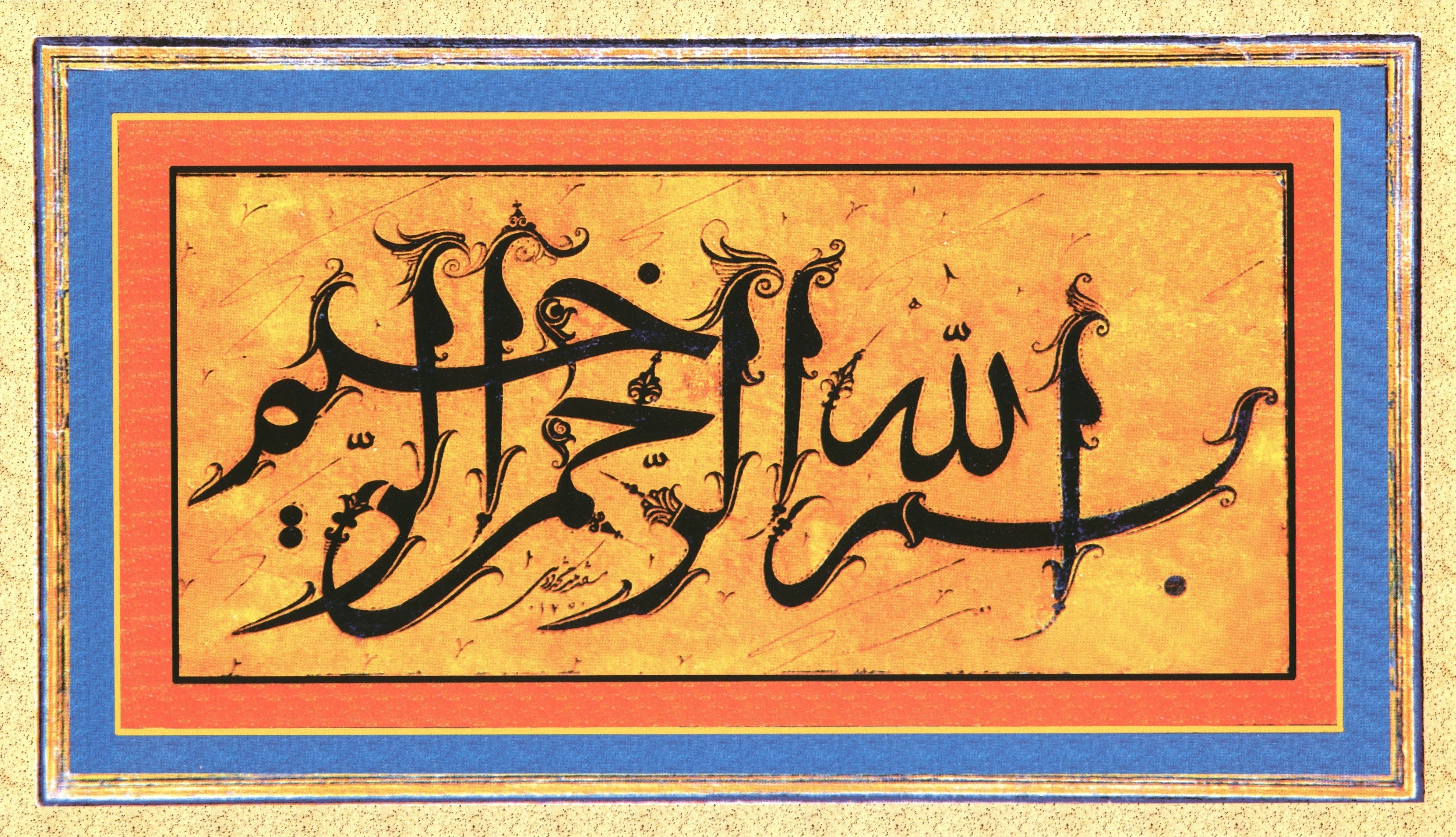
Pictured: A Panel of Foliated Calligraphy, Qajar-era Iran
Malik Muhammad Qazvini, 1835
Overview
Part 5 ended in the prayer hall, on the words every Muslim recites in every one of the day’s prayers. This section opens the book those words come from. We describe how the Qur’an was shared, memorized, and gathered into a codex, and we trace its long and sometimes strange road into English. We then closely read the Qur’an’s opening chapter, and we follow one Arabic root, face, from the ordinary, to the divine, to an unexplained verse that will become the fault line of the section’s second half: the argument between Rationalists and Traditionalists over how God’s speech is to be read, and the machinery of Sharia and fiqh by which Muslims have sought, for 14 centuries, to turn a book into a life.
Assigned Reading
Haleem, Understanding the Qur'an, chapters 1, 2, and 9
Reza Aslan, No god but God, chapter 6
Key Terms for this Section
Qur’an · surah · Al-Fatiha · Rationalism · Sharia · Fiqh · Sunnah · ijtihad
6.1 | The Qur’an as Text
The Recitation
Seventeen times a day, a practicing Muslim bows through the cycles of Salat (Namaz), and in each cycle the same seven verses are spoken aloud. We promised in the last section to read those verses. Before we can, however, we must know what kind of book they open.
The Arabic “Qur’an” does not mean “book.” It means Recitation, from the same Arabic root as “Read!” The command in Sec. 2.3 that the angel gives Muhammad in 610 CE. Taken from their etymological bases, The Jewish Torah is a teaching. The Gospels are good news. And the Qur’an is a recitation of messages from God to Muhammad.
The Qur’an was heard before it was ever read as text. The Ummah today still largely holds that, at its fundament, the Qur’an is a sound: the exact words, language, and cadence of God’s final and authoritative message.
The Qur’an did not descend from a single volume. Islamic tradition holds that it was “sent down” (this phrasing is repeated over 200 times in the Qur’an) in installments across 23 years of Muhammad’s ministry. Roughly, this works out to about two pages a month. With each installment, Muhammad “recited” the new verses to his Companions (Sahabah), who memorized and recited them to others.
Critically, the written text came after Muhammad’s life. The gathering of testimony, notes, and scraps of paper into one authoritative codex under the third caliph Uthman (Osman) is told in Sec. 4.2. By 650 CE, there is one text, Al-Qur’an.
The textual form of Al-Qur’an is “mapped” in a very specific way: the ulama (learned ones) sorted the 114 chapters of the text by the location where they were revealed.
The Meccan revelations lay out the basic theology: one God, earlier prophets teaching the one God, and a coming judgement. Later, the revelations from Medina (when Muhammad was governing a city) expand on society, its laws, and governance (this will be essential to know for Part 7). As to those earlier prophets, its crucial to point out that the Qur’an does not claim to be a new religion. The Bible, ‘properly understood’ according to Islam, is still holy. What the Qur’an does claim to be is the final, authoritative voice of the Biblical tradition. The Torah (al Tawrat), the Psalms (al Zabur), and the Gospel (al Injil) are honored by Muslims as genuine revelations from genuine prophets. However, according to Islamic theology, the original Biblical text suffered tahrif — corruption and alterations over time. For the Muslim, the Qur’an is the final correction of the Biblical narrative.
It is not chronological like the Torah. It is not genealogical like the Gospels. Nor is it an anthology of earlier scripture. Rather, the Qur’an is presented as what the earlier scriptures said all along, before their (claimed) corruption and alteration.
Surahs & Signs
The Qur’an is divided into 114 surahs (typically smaller than a book of the Bible, but larger than a Bible chapter). Qur’anic surahs run from about forty pages down to a single line. Each surah is made of ayas (meaning “a sign from God”). For the Muslim penitent, every line of the Qur’an is a signpost to righteousness. The surahs are not arranged in the order they were revealed. Roughly speaking, the longest come first and the shortest last, which means a reader who starts at the beginning is reading Medina before Mecca — the laws before the thunder.
And with one exception, the ninth surah, every chapter opens with the same line:
In the name of God, the Compassionate and Merciful.
QUR’AN 1:1
The Qur’an is also the first book of the Arabic language.
Before it, Arabic was the colloquial speech of a peninsula, kept alive in poetry recited around fires. After it, Arabic became the liturgical language of an empire. It reshaped neighboring Persian, then the Turkish of the Mediterranean, then Urdu in South Asia, Indonesian in the islands, and Swahili on the East African coast. Wherever the Qur’an went, its vocabulary went with it and shaped the people reading it.
And because it is a recitation, it is still recited. The Opening is spoken at least seventeen times a day by every practicing Muslim on earth. A hafiz (the word means guardian) is a person who has committed the entire Qur’an to memory, all 114 surahs, and can recite any passage on request. There are millions alive today, many of them children. Think about what that means: this is a text that could survive the loss of every printed copy and still live on.
The Qur’an in English
The first English translation appears in 1649.
It is a century and a half after Columbus lands in the Americas. Virginia has been an English colony for a generation. The Crusades ended centuries in the past, and yet, by 1649, no living person has ever read the Qur’an in English.
Alexander Ross changes that, and he does it badly. His title tells you everything about his intent: The Alcoran of Mahomet, the Prophet of the Turks … newly Englished for the satisfaction of all that desire to look into the Turkish vanities. Ross does not read Arabic. He is translating a French translation. In his introduction he warns his readers about the “heresy of Mahomet” and calls the book in their hands a “dangerous book.”
In other words, the first English Qur’an was published to inoculate England against it.
This pattern holds for 200 years. Rodwell’s translation of 1861 and Bell’s of 1937 both set out, in different ways, to disprove the Qur’an in Christianity’s favor. But alongside the polemic runs a second, quieter tradition, and it is the one that ultimately wins. George Sale (1734), E. H. Palmer (1880), then the two renderings Muslims themselves came to admire for their beauty: Marmaduke Pickthall in 1930, an English convert, and A. J. Arberry in 1955, the Cambridge Orientalist who tried to carry Arabic’s cadence into English.
Which brings us to the translation this course uses. M.A.S. Abdel Haleem, the Egyptian-born scholar at the University of London, memorized the Qur’an as a boy before he ever studied it as a scholar. He is, in other words, a hafiz who became a philologist. His Oxford translation (2004) reads like it. When this course quotes the Qur’an, it is generally Haleem’s English you are hearing. And it is Haleem who will now walk us through the first seven verses.
6.2 | Al-Fatiha & the Face
The Opening
Al-Fatiha simply means the Opening. It is how the Qur’an begins.
29 words in seven verses, recited in every unit of every daily prayer, learned by billions of Muslims. Haleem claims that these 29 words are a condensed summary of the whole Qur’an, and that they move in three deliberate steps:
• Invocation
• Affirmation
• Petition
The invocation is the line we saw in 6.1. In the name of God, the Compassionate and Merciful.
The Muslim beginning her prayer, or her reading, or her meal, is declaring the purpose of the act: it is done for God, not for herself, her nation, or any other power. “Allah” is simply al-ilah — “the God” — and Haleem observes that it is the only personal name for God in the entire Qur’an. In the Qur’an, every other name is a description, and the two that open every surah are the descriptions the book uses most: ar-Rahman and ar-Rahim, both from the root for mercy, the first of them reserved in Arabic for God alone. We built the doctrine behind this in Sec. 5.3 (tawhid, the 99 names, al-Tahawi’s warning that imagination does not reach Him). All praise belongs to God, the second verse says, and the next three describe the God to Whom it belongs.
Then the affirmation: It is You we worship; it is You we ask for help. Notice the logic. Once the God of the first four verses has been described, worshipping Him alone follows as a matter of course, and asking Him for help presupposes something the verse takes for granted: that He can. This is not a ‘necessary’ Creator bound up in the language of philosophy. The God of the Opening of the Qur’an is imminent, real, and able to act.
And finally the petition: Guide us to the straight path. The path is the one walked by those God has blessed, and the last verse defines the blessed by contrast: those who have not incurred anger and have not gone astray. Haleem reads that verse as covering all of humanity, sorted into two camps, on the path and off it. And here the Fatiha does something a suspicious reader might miss. The blessed, in the Qur’an’s own cross-references, include Moses and Aaron, shown “the straight path” (37:118), and Jesus, counted among the righteous (6:85). The daily prayer closes, “Peace be to us and to the righteous servants of God,” followed by a blessing on the family of Abraham. When a Muslim asks seventeen times a day to be guided on the straight path, she is asking, on Haleem’s reading, to walk where the Jews and Christians before her walked.
Al-Fatiha in a Life & Death
The Opening is the first passage of the Qur’an a Muslim child learns. It is what a Muslim student recites before an exam. It is read aloud at the ceremony before a Muslim marriage contract is signed, and in much of the Islamicate world it is read before a business deal closes, because a promise made over the Fatiha is a promise people are reluctant to break. It has nicknames. Some call it al-Shafia, the Healer, or al-Kafiya, the Sufficient, and recite it over the sick. It is the most common text in Islamic calligraphy, on the walls of homes and the domes of mosques, sometimes whole, more often a single verse: the first, the second, or the fifth.
And its opening phrase has escaped the surah entirely. The Bismillah — “In the name of God” — is the grace before a meal. It is said stepping out of the house and stepping back in, before a speech, before sleep. When a Muslim woman gives birth, tradition has the midwife say it over the child. And Islamic tradition holds that when the dead rise from their graves on the Day of Judgment, the first words in their mouths will be the same ones: Bismillah.
Freedom & the Face
Since we’re talking about petitioning, let’s look more closely at the Qur’anic view of human agency. In the Biblical story of Fall, Eve reaches for the fruit first and is singled out for it. But the Qur’an tells the story differently.
In the Qur’an, Adam and Eve are admitted to the garden together, warned together, deceived together, and Eve is not made the cause of the fall, implicitly or explicitly. What the Qur’an’s version puts in the foreground is choice. From the beginning, Haleem writes, “man was meant to live on earth and even to have both the moral capacity to judge between good and evil and the freedom to choose between them, so that his success or failure are of his own making” (2:30; 76:3; 90:10; 91:8–10). In Islam, human beings are not the objects of a fate handed down to them. They are agents, and the weight of what they choose is their own.
The governing principle fits in half a verse:
There is no compulsion in religion. QUR’AN 2:256
While guidance is offered (the whole Fatiha is a request for it), it remains for each Muslim to take that guidance and walk (or not). And because the choice is real, so is the bill. Accountability is freedom’s other face.
Islam does not make this claim alone. Judaism ties freedom to destiny in a single verse, “I have set before you life and death… therefore choose life” (Deuteronomy 30:19). Christianity makes free response central to salvation, though it frames that freedom inside a long argument, sharpest in Augustine, between the initiative of grace and the reality of choice. What all three share, however, is the conviction that a moral life requires a free agent to live it. For Islam, that conviction had to be won against the fatalism of the Jahiliyyah, the pre-Islamic sense of qadr, a lot parceled out by the old gods and by Time itself, against which a man could do little. The Qur’anic call to responsibility stands over against that. It is context, not the last word. How far human freedom reaches, and how it squares with God’s sovereignty, is exactly what Muslim theologians would spend centuries arguing. That argument is 6.3.
But first, the face. Why might a chapter about human freedom end there?
Because the face is where freedom becomes visible, the point at which an inner agent takes an outward direction. And in Arabic that isn’t a metaphor. It’s a root.
The root is و ج ه, w-j-h. In ordinary Arabic, as in ordinary English, the face is the seat of a person’s identity and presence. We deal with one another ‘face to face.’ A person’s face, Haleem writes, “stands for what he projects himself to be,” which is why the Arabic for a hypocrite is dhu’l-wajhayn, the man with two faces. The face carries dignity. To lose one’s honor is, in an old idiom, to “spill the water of one’s face.” From the same root, wajih comes to mean a chief, a notable, a person whose face commands respect. When the angels bring Mary the news of her son, they promise he will be wajih, ‘illustrious’ in this world and the next (3:45). In Arabic, wajh is face. Wijha is direction. Ittijah is orientation. Face and direction are, quite literally, the same word.
The Qur’an uses the idiom directly, and with urgency:
Set your face to the religion as one of pure faith… before there comes a day which may not be put off against the will of God. QUR’AN 30:30, 43
To set one’s face to something is to adopt a course, and the choice of course, the verse warns, cannot be deferred forever. The same picture carries the accountability that opened this beat: on the day of resurrection, the faces of those who lied about God will be seen “darkened” (39:60). A face wears the record of the direction its owner chose. And to surrender one’s face to God is to go where He directs, which the Qur’an names the surest sign of righteousness.
Who has a better religion than he who surrenders his face to God, does what is right, and follows the faith of Abraham? QUR’AN 4:125
Then the word climbs from the human to the divine. The Qur’an speaks of God’s own Face: when everything on earth has perished,
the face of your Lord will endure forever. QUR’AN 55:27
But is that Divine Face literal or figurative? Does God have a face as a human being has one, or is “face” a way of speaking about God’s enduring presence and honor? The Qur’an does not directly say. And that silence, how such language about God is to be read, is the question that split Muslim theology into two great camps.
6.3 | Rationalists & Traditionalists
Created or Uncreated?
We defined kalam in Sec. 5.3: the discipline of theological argument. This is its first real fight.
By the 800s, two camps of Ulama had formed around the question of hermeneutics (ie. how to interpret scripture) and the Qur’an. Reza Aslan calls these two camps the Rationalists and the Traditionalists. In later Islamic thought the Rationalist position came to be represented most clearly by the school called the Mu’tazila, and the Traditionalist position by the Ash’ari. (The Ash’ari school takes its name from a theologian who died in 936, so the labels are a little later than the fight.) As nonsectarian scholars, our job here is not to pick a winner. It is to understand why serious people found each position irresistible.
The Rationalism of the Mu’tazila starts from tawhid and follows it all the way down.
If God is perfectly One, nothing can be co-eternal with His essence. Not His attributes. Not even His speech. The Qur’an, therefore, is created: it is God’s word, but a word comes after the one who speaks it. And once the Qur’an is a created thing, standing apart from God, something else must be the final arbiter of theology, and the Mu’tazila said it was reason. A perfect God is a rational God, and reason is the surest road to Him. Where a religious text contradicts reason, the text is telling you to read it again.
The Traditionalism of the Ash’ari makes the opposite claim: the Qur’an is uncreated. It is not a message about God — it is God speaking. The Traditionalists distrusted rational proofs as limited and fallible, and they enjoined Muslims to read the Qur’an zahir, according to its plain and literal sense, as the perfect voice of God. Religious truth is to be accepted, not audited.
Two sets of hermeneutics. Two ways to see the scripture.
Bila Kayfa: Without Asking How…
Let’s look at the Rationalist method first.
If a verse is consistent with the rest of the Qur’an, with the basic tenets of Islam, and with scientific and historical fact (that is, with reason), a literal reading is justified. However, if a contradiction arises, the verse is to be read poetically or morally instead.
For example, the Qur’an speaks of “the hand of God” (48:10). But God has no body. The literal reading contradicts a doctrine every Muslim holds, so the phrase must be read as figurative: God’s power, God’s generosity, God’s grip on events. Reason and revelation, the Rationalists said, work hand in hand.
Now bring the Traditionalist to the verse that ended 6.2. The face of your Lord will endure forever (55:27). God has no parts. And yet God has a face, because the Qur’an says so. How can both be true? The Traditionalist answer is two words: bila kayfa, “without asking how.” The apparent contradiction is not ours to resolve. It simply stands, and to demand an explanation would itself be a sin, a refusal to take God at His word. Where the Rationalist turns the Face into a figure of speech, the Traditionalist turns the question away in the name of reverence.
On either road, rationalism or traditionalism, the Qur’an makes claims about God that press against the Qur’an’s own doctrine of God — and often does not tell the reader how to hold the two together. Someone has to decide. Two ways of deciding became two competing theologies, and the theologies became, over time, two ways of reading Islamic scripture.
Tafsir & Ta’wil
In Sec. 5.2, we found that tafsir is interpretation concerned with the plain, literal, contextual meaning of the text, while tawil is concerned with its hidden or esoteric meaning. Here, we will see how the two theological camps use them.
Because the Rationalists reject an uncreated Qur’an, they often contextualize the scripture in history. A created text has a context, and its meaning cannot be grasped without serious study of the language, the events, and the politics of 7th-century Arabia. And the Rationalist draws the implication the Traditionalist most bristles against — what was appropriate in the 7th century may not be appropriate in the 21st century.
However, for the Traditionalists, the Qur’an is eternal and perfect, so the Qur’an should interpret the Qur’an. Verses explain other verses. Where more is needed, look next to the authenticated Hadith, then to the Companions who knew Muhammad, then to the generation immediately after them. For the Traditionalist, context is a ladder that climbs toward the Prophet, not outward into history.
And ta’wil, the esoteric reading? Both camps agree the Qur’an contains hidden teachings. The book says so of itself (3:7). But neither camp is much interested in them. The Rationalists concentrate on what reason can reach by analysis, and the Traditionalists remain at the surface the text presents.
Indeed, the search for the Qur’an’s inner meaning will pass to a tradition — the Sufis, whom we’ll meet in Section 10.
6.4 | Sharia & Fiqh
Sharia Is Not a Law Code
Next to jihad, “sharia” may be the second most misunderstood word in Islam. Here, we will explore what sharia is and how it came about.
Within a generation of Muhammad’s death, the young caliphate needed exactly what the Qur’an does not supply: a codified set of standards for conduct. So, the Ulama turned to the Sunnah, the customs and practices of Muhammad and the first Ummah, the record of how the Prophet actually lived. There exists a sharp line here between Sunnah and Hadith: the Hadith are what a Muslim believes (ie. the Prophet’s specific teachings), while the Sunnah governs how a Muslim behaves. Over centuries of interpreting the Qur’an and Sunnah together, a body of moral conventions was gathered to guide Islamic life: Sharia.
But Sharia is not a set of laws.
Rather, sharia is the ideal Islamic form of righteousness: perfect justice, perfect peace, centered on a perfect religion. Because it’s perfect, sharia has never been attained. But Muslims aim at it anyway. The word itself refers to a path to water — the distant thing a desert traveler steadfastly reaches for. When a newspaper column warns that Muslims want to “implement sharia law,” it has made a category mistake before it has made a political one, because sharia is not the kind of thing that gets implemented. It is the horizon a Muslim reaches for.
The ‘walking toward the water’ also has a name.
Fiqh is Islamic jurisprudence: the all-too-human, fallible, endlessly revised effort to derive practical rules from the sources. Put simply, sharia is perfect. Fiqh is what imperfect scholars, arguing with one another, have made of it. The closest Jewish analogue is halacha: a body of religious practice under continual interpretation, with a living argument at its center.
Sharia is the horizon. Fiqh is the walking.
Fiqh: Schools of Law
Because fiqh is a human effort, it has produced not one system but a family of them (and the family tree is worth learning because it will reappear in most sections after this).
Sunni Islam classically recognizes four schools of law: the Hanafi, the Maliki, the Shafi’i, and the Hanbali, each named for an 8th or 9th-century jurist. Shia Islam has its own: the Jafari school of the Twelvers, which we met in Sec. 5.2 as the fiqh of Iran and Iraq, and the schools of the Ismaili and Zaidi traditions. The Ibadi school of Oman stands apart from both. And running across all of them are devotional and reform movements, Sufism and Salafism among them, that are not ‘schools of law’ at all but orientations toward it.
So, what do the schools argue about?
Above all, Islamic sources. Every school builds on the Qur’an and the Sunnah, but the Sunnah reaches us through Hadith, and Hadith have to be vetted. Did the Prophet really say this? Did he really do that? The study of answering is isnad — the chain of transmission from Muhammad down to the reader, and the schools differ sharply in how strong a chain of custody they demand. Some accept only the most rigorously attested reports. Others admit weaker chains or supplement them with theological or historical reasoning.
There are many fiqhs. There is one sharia.
One further distinction settles a question American readers often ask. Sharia has two dimensions: religious duties and legal codes. It’s only religious duties that bear on Muslims living in the United States, and for a reason internal to Sharia itself. Sharia holds that Muslims are to obey the law of the land in which they live. The legal-code dimension governed medieval Córdoba; it has no standing in Texas, and Muslim jurists say so. In Sec. 3.1 we read the Constitution of Medina, in which Muhammad’s community guaranteed freedom of religion to the Jews of the city in exchange for their loyalty. The reciprocity runs the other way too: wherever freedom of religion is promised, the Muslims who live there owe that government their allegiance. That is not a modern accommodation. It goes all the way back to Medina.
How Islamic Law Is Rendered
How, then, does a jurist get from a 7th-century text to a ruling on a question the text never imagined? The tools are medieval, and every one of them is still in use.
The first was analogy (qiyas). Because no case will ever match a Quranic situation exactly, early medieval Islamic jurists reasoned by resemblance: surely one story of the Prophet would be similar enough to draw a line from. As the dense web of clever analogies grew, its density irritated the Traditionalists (who preferred a Qur’anic answer to a clever one). Over time, the weight of that web gave way to something sturdier: ijma, the consensus of scholars and judges. For Sunni Muslims, consensus is the third source of law after the Qur’an and the Sunnah, and its power cannot be overstated.
Consensus is also what keeps any single voice in check. A qualified scholar may issue a personal legal opinion (a fatwa). But a fatwa is nonbinding. An opinion may be disregarded, and it is disregarded if the consensus of other scholars does not endorse it. There is no pope of Islam. There is no Islamic office that decides for everyone. The need for consensus across so many questions, geographies, and centuries is exactly what produced the schools: the Hanafi consensus governed medieval Baghdad while the Maliki spread from North Africa into Spain.
However, consensus has a shadow. Over the centuries, the schools hardened into precedent, and later jurists began to follow their predecessors rather than argue with them. The practice of repeating earlier rulings without fresh reasoning is called taqlid (imitation), and Muslims today mostly say the word with a grimace. Against it stood the jurists who prized independent thought. Where no consensus yet existed, a qualified jurist was free to reason for himself, and that act has the name we introduced in Sec. 5.2: ijtihad.
Then, the tradition says, the gates closed. With the rise of Traditionalist attitudes in the late Golden Age (a story we follow through Module 3), the “gates of ijtihad” were declared shut. Imitation was encouraged over independence. Whether they were ever really closed is another matter. The legal historian Wael Hallaq argued in the 1980s that the “closing” is more legend than legal fact, and that jurists went on reasoning independently the whole time. Either way, the reopening of ijtihad is the rallying cry of Islamic Modernism, and we take it up in Sec. 13.
In closing, Muslims generally agree that every source of Islamic law except the Qur’an is the work of human hands. It is therefore unreasonable to treat the whole apparatus as the infallible, binding law of God.
There are, sadly, draconian laws against women and religious minorities written in the name of Islam. But the majority of Muslims decry such laws as not reflecting sharia (and do their best to change the system from within, or leave the system in favor of a freer set of laws elsewhere). Further, when a fatwa is issued by a militant in Tehran, it may rightly draw the ire of Western media — but it has no standing for a billion Muslims who do not recognize its authority. That’s simply not how Islam works.
Rather, Islam operates as a system of consensus (ijma), analogy (qiyas), and independent reasoning (ijtihad) in a never-ending argument aimed at the Qur’an’s highest ideals. As nonsectarian scholars, we do not adjudicate that argument. We only note that it is an argument conducted in good faith by the quarter of our species who call themselves Muslims.
Last Section: Kalam & Shia Islam
This Section: Hermeneutics & the Qur’an
Next Section: Qur’anic Ethics: War & Tolerance