

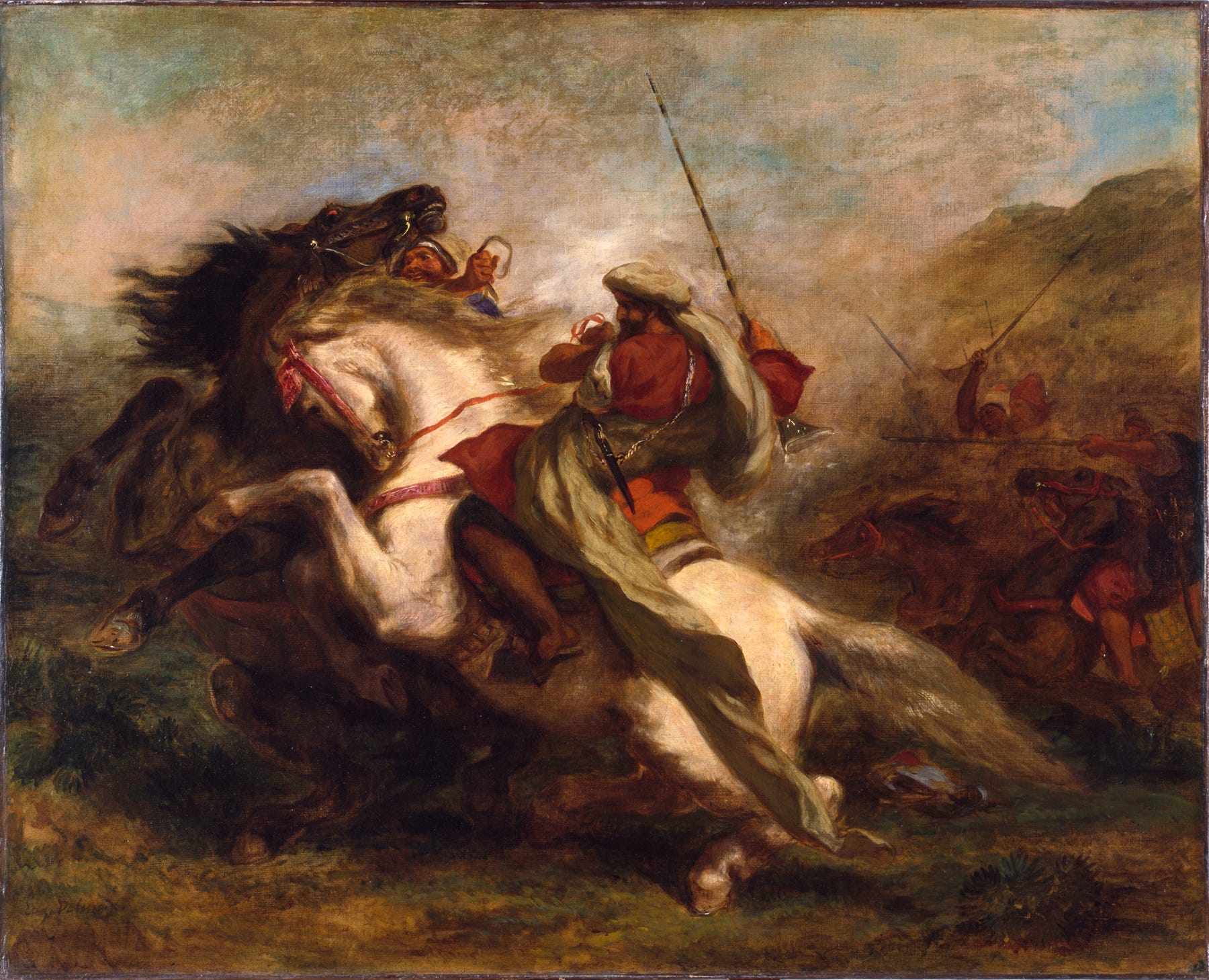
The Collision of Moorish Horsemen | Eugène Delacroix, 1844
Overview
Most folks think they know what Islam says about war. That’s the first problem.
Many come to Islamic Ethics with an already settled picture before any serious reading actually starts. A religion of the sword, carried by conquest, hostile to the outsider by design. However, Part 3 argued that the question behind this picture is posed in bad faith. Here, in Part 7, we look to the verses in question specifically. We will also look to the concept of religious tolerance and how Qur’anic language frames this question.
Assigned Reading
Haleem, Understanding the Qur'an, chapters 5 & 6
The S-L-M root • salaam • fi sabilillah • Just War Theory • tasamuh
People of the Book • antisemitism • apostasy
7.1 | Peace as the Social Norm
The Missing Sword
It comes as a surprise to many: the word ‘sword’ does not appear in the Qur’an.
Not even once...
Moreover, the Qur’an acknowledges war as a hateful enterprise, ordained for believers though hated nonetheless (2:216). The Qur’an also acknowledges that the world is filled with a wide variety of peoples, traditions, and folkways. This variety is not condemned by the Qur’an; it is acknowledged as God’s very intention (5:48). Further, the Qur’an flatly denies the goal of enjoining everyone into one community (11:118). In sum, religious differences are not a failure of Islam. According to the Qur’an, religious differences are part of God’s plan.
It is good, the Qur’an teaches, for different tribes to know one another (49:13).
However, the Qur’an also acknowledges the difficulties that can arise when encountering tribal differences (6:65). When those encounters come to war, the scripture promises tranquility for those who keep the faith when under attack (24:55). In any event, the Qur’an is clear that Islamic war is a contingency, permitted only in self-defense and to check an evil that would otherwise spread unchecked (2:251). Scripturally, war is forbidden as a tool of empire or acquisition. To wit, there is, in the Qur’an’s own terms, no such thing as a ‘holy war’. The phrase makes no sense in Arabic (as Part 3 argued at length).
So, the first thing to say about Qur’anic ethics and war is that Islam treats war as the exception. It is not a goal, a good, or necessary to the Islamic tradition except as a means of self-preservation.
Peace in Arabic
Peace is central to the Qur’an, in both theology and language.
Like Hebrew and Aramaic before it, Arabic is a Semitic language. Most Semitic words are built on a three-letter root — a spine of three consonants from which a whole family of related words grows. The root carries a core, shared meaning. The words branch off it, each one bending that meaning in a new direction.
The root at the center of the Islamic tradition is the S-L-M root, three consonants written س ل م in Arabic. From it grows:
• Salaam, peace (also a greeting)
• Salamah, safety
• Salim, whole/unbroken
Salaam is the first of these and the one the others lean on: not merely the absence of war, but the safety and wholeness its two cousins name. It is the condition the Qur’an prizes above all others, and the reward it promises the righteous.
From those same three letters comes the word Islam, and the word Mu-slim, the one who performs S-L-M. (The mu- prefix is Arabic’s way of marking the doer of an action, so a Muslim is, quite literally, one who does Islam.)
This may seem like a theological boast at first, but it’s literally welded into the grammar. A speaker of Arabic does not need to be told that Islam and salaam are relatives, the way an English speaker may be told that ‘peace’ and ‘pacify’ share a distant Latin parent. In Arabic, the kinship is right there in the consonants, impossible to miss.
In short, the Islamic tradition takes its own name from the Arabic root for peace.
You can hear it in the ordinary greeting a Muslim gives: as-salamu alaykum, ‘peace be upon you’, the same three consonants offered across a billion doorways each day. The word for the religion and the word for hello share the same root.
In the Way of God
When the Qur’an does permit war, it attaches one primary condition that governs all the rest. The fighting must be fi sabilillah, ‘in the way of God’ (9:60).
For the observant Muslim, to fight in the way of God is to fight from a righteous intention — for devotion, not plunder.
In a famous hadith (a report of Muhammad’s words, not on the level of the Qur’an, but trusted by Muslims as part of the larger tradition), the Prophet is asked about men who go to war for different reasons. One fights for treasure and spoils. One fights for personal glory. One fights so that others will call him a hero. Which of them, the questioner asks, is fighting in the way of God?
None of them, the Prophet answers. The one who fights ‘in the way of God’ is the one who fights so that the word of God is highest, and for nothing else at all.
So, the Islamic criterion for a just war is not the outcome, the spoils, or the gain of reputation. For Muhammad, the sole test of a warrior fighting ‘in the way of God’ is what sits in his heart before he lifts his fist. Pointedly, a man can keep every law of war and still fail, because the Qur’an counts him as having fought for nothing. Such is the standard for the fighting Muslim.
7.2 | Islamic Just War Theory
A Shared Inheritance
Long before the Islamic tradition, there was a massive, detailed history of Jews and Christians wrestling over the theological justifications for war. This field of ethics continues to the present day and is known as Just War Theory.
From a Jewish standpoint, the Hebrew Bible is already full of just war claims. Deuteronomy lays down rules for warfare, among them the duty to offer a city terms of peace before laying siege to it (Deut. 20:10–12), and to spare its fruit trees even in the taking of the city. The Jewish prophets return repeatedly to justice and mercy in the middle of a war.
Christianity took up the same work. St. Augustine, in The City of God, set out the conditions under which a war could be just (a rightful cause, legitimate authority, the aim of restoring peace), the cluster of questions later writers would file under jus ad bellum, ‘the right to war’. In the 1200s, St. Thomas Aquinas pressed on the conduct of the fighting itself, jus in bello, ‘justice in war’. Here, both Christian philosophers tackle two central questions of just war theory: when may you fight and how you may fight.
Islam answers these two questions narrowly.
War becomes an obligation in only a handful of situations.
• In defense of religious freedom (22:39–41)
• In self-defense against an attack (2:190)
• And to aid oppressed people who ask for help (4:75), though even that last duty can be deferred if the aggressor happens to be a Muslim ally, since the Qur’an will not make a man break faith with his own people to keep faith with a stranger (8:72)
Lastly, the Prophet is told to urge the believers to fight (4:84), never to force them. Even the summons to a just war is an appeal, not an order, and the decision stays with each fighter’s conscience.
The Limits of Just Islamic War
Permission to fight, once granted, is fenced in by two major limitations.
• The people you may fight are the people actively fighting you, never civilians (2:190)
• The force you may use is limited to the harm done to you (2:194)
Read strictly, those two conditions rule out both first strikes and waging war with weapons that cannot tell a soldier from a child. The nuclear and biochemical arms of the modern world fail this test outright. A weapon that kills the combatant and the infant in the same blast violates the immunity of the one and the proportion owed the other.
After the Qur’an, Islamic commentators drew the boundaries even tighter.
From a single verse (2:190) the 1200s Persian exegete al-Baydawi, whose Qur’anic commentary became one of the most studied in the Sunni world, derived a whole list of prohibitions.
• A Muslim may not begin a war
• A Muslim may not break a treaty
• A Muslim may not attack without first offering peace
• A Muslim may not destroy crops
• A Muslim may not kill certain protected classes of people
These restraints are not a pious varnish later brushed onto Islam. This is found in the very grammar of the Qur’an itself. Across 2:190–195, the text keeps circling back to one phrase, “do not transgress the limits,” and pairs it, time after time, with a warning. God does not love the aggressors. The verses that look like a license to fight are hedged, clause by clause, with the language of restraint.
Which is where the first of two notorious verses sits. Directly after that restraint language comes 2:191.
…slay them wherever you find them.
a portion of QUR’AN 2:191
Lift it clear of its surroundings and it sounds horrific. But look at what ‘them’ points back to. The verse before it named them. ‘Those who fight against you’ (2:190).
So, the sentence says slay those who are attacking you, wherever you find them. And the ‘wherever’ answers a real question the early Muslims were asking. Could they defend themselves even inside the sacred precincts of Mecca, the sanctuary they had been shut out of? The verses on either side (2:189, 2:196) are about exactly that. The pilgrimage. The holy ground. The holy city. Yes, you are permitted to defend yourselves.
Read whole, 2:191 is not a battle cry. It is a reassurance. You may defend yourselves even here, even where you would have hesitated to raise a hand because this place is holy. It is a rule about where self-defense holds, not a permit for aggression anywhere.
The Sword Verse
The second notorious verse has been called the Sword Verse, which is rich, given that ‘sword’ is a word the Qur’an never uses. We look now at 9:5.
…when the sacred months have passed, slay the idolaters wherever you find them.
QUR’AN 9:5
Our author M.A.S. Abdel Haleem calls the verse “much referred to but notoriously misinterpreted.” I agree with him.
That passage is not about idolaters or idolatry in general. It is about one specific enemy at one specific moment of Islamic history: the hardened polytheists of Arabia who would settle for nothing less than the Muslims’ expulsion or their return to polytheism, who broke their treaties, backed others against the Muslims, struck first, blocked would-be converts, and drove Muslims from their homes and their mosque. The Qur’anic passage recites those offenses at least eight times over.
Even against that enemy, no one is simply turned loose. An ultimatum goes out, and four sacred months are granted (a season of grace in which the enemy may reconsider) before any fighting can begin. The same passage then exempts the polytheists who kept their word and kept the peace (9:7), and orders that any enemy asking for safe conduct must be protected and escorted all the way to the place where he will be safe (9:6).
Some readers pull the middle clause loose, ‘kill the polytheists’, and let it stand for the whole of Islam’s attitude to war. A few go further and claim it cancels every other verse on the subject, that this one line quietly repealed the hundred verses of restraint that came before it. Haleem’s verdict on that is blunt. He calls it a “pure fantasy,” built by inappropriately isolating and mischaracterizing a single scrap of a sentence.
7.3 | Tolerance & Tasamuh
Western Tolerance
In English, when the enlightened among us reach for a word to describe their disposition toward foreign religions, you will often hear the word ‘tolerance’ invoked.
Tolerance comes to us from the Latin tolerāre, to bear, to endure. Its Greek cousin tolmáō similarly means to endure. Buried in the word tolerance is the act of putting up with something unpleasant. Carrying a weight you would rather set down. Enduring a person you have already judged to be in the wrong.
Tolerance also assumes a hierarchy. That is, tolerance is something the powerful grant to the different. It flows downhill, where the ‘tolerated’ live on sufferance, dependent on the goodwill of the powerful.
By its own standard, Europe was slow to endure or tolerate its ‘lesser’ others — even in the modern period.
Jews lived across Christian Europe for millennia with no legal toleration to speak of, the standing targets of antisemitism: a collective hostility toward Jews, whether dressed as theology, as economics, or, later, as race. In France, Jewish emancipation came only with the modern French Revolution, in 1791. Even so, European antisemitism long outlived the modern laws meant to end it.
Historically, Christians also often did not tolerate other kinds of Christians. After the modern Reformation, Christian wars of religion tore Europe apart, with as much as a third of the population dead in the worst-hit German lands. Religious dissenters in England had no legal standing until the Toleration Act of 1689 — and even that act pointedly withheld its protection from Catholics. Irish Catholics were officially persecuted by the British establishment until Catholic Emancipation in 1829.
In America, the theologian Roger Williams founded Rhode Island as a refuge for the religiously unwelcome, and his experiment fed the freedom of religion the First Amendment would later promise. In short, the social reality lagged behind the ‘ideal of tolerance’ for most of Western history — for groups like Jews, Catholics, the Amish, the Latter-day Saints, and the beliefs of Indigenous and enslaved peoples.
However, while the West speaks of the modern virtues of ‘tolerance,’ the Islamicate world has always operated from a different foundational thought.
Tasamuh in the Middle World
The closest Arabic word to ‘tolerance’ is tasamuh. But it does not mean to endure. Instead, it grows from the root S-M-Ḥ, in Arabic س م ح. Just as S-L-M gives us salaam (peace), salamah (safety), and salim (unbroken), S-M-Ḥ, the root of tasamuh, gives us:
• Samaḥa, to allow
• Samuḥa, to be generous
• Sammaḥa, to walk softly/act kindly
Put together, tasamuh enjoins Muslims not to merely ‘endure’ Christians and Jews but to allow (samaḥa) their freedom and dignity, and to do so generously (samuḥa). Again, like salaam, the behavior of the Muslim next to his monotheistic cousins is written into the very fabric of his language. Moreoever, tasamuh is a reciprocal concept. That is, it is not something one side extends to a lesser. The generous allowance runs mutually between parties.
Breaking Down Assumptions
So, no. The Qur’an does not enjoin the Muslim to merely ‘tolerate’ the Jew and the Christian. The language of the Qur’an expects the generous allowance of the Other, next to whom the Muslim ought to walk softly and act with lovingkindness.
Compare this to modern ‘tolerance,’ by which we generally mean putting up with something unpleasant. It’s the same word we use for over-spiced food. What level of heat can you tolerate?
However, in the language of the Qur’an, tasamuh is centered on communal generosity, an ease shared by all sides at once.
Put another way, tolerance is vertical. It is a forbearance handed down from the powerful to the weak. Tasamuh is horizontal, a rough equality of regard, each party generous to the other. The first requires a hierarchy. The latter dissolves the hierarchy as its opening move.
In the end, the two concepts, one Latinate and one Arabic, are asking for different things of a person. One asks you to endure your neighbor. The other asks you to be generous with him.
That being said, the point here is not to prove which civilization behaved better in history — a question that centuries of historians and theologians have battled over and will not be settled here. The point is that the two vocabularies reach for different things while often assuming the other means what they mean.
Much religious strife starts not in the differences,
but in the assumptions we begin with.
7.4 | The People of the Book
Ahl al-Kitab
Another way we can see the regard that Islam has for Jews and Christians can be found in the collective Arabic name it gives them: ahl al-Kitab.
This famous Arabic phrase, ahl al-Kitab, means ‘the People of the Book.’ The ones who received the earlier scriptures. In Islamicate society, the People of the Book are not ‘minorities’ to be managed, nor a problem to be administered. They are the people with the book, the Bible, which in Islam is one of the highest honors the Qur’an bestows on a people. Also, keep in mind that what you call someone sets the range of how you may regard them. The name ‘People of the Book’ forecloses a great deal.
First, the Qur’an does not flatten all the People of the Book into one type. “They are not [all] the same,” the Qur’an says, which then singles out among them “a staunch community” who recite God’s words through the night, who believe in God and the Last Day, who call for good and forbid wrong and hurry to do it (3:113–115). Here we see a category of respect, with room still left for theological difference.
But the text goes well past respect, to a kind of shared intimacy.
The Qur’an allows for Muslims to eat with, befriend, and even marry Christians and Jews (5:5). The tradition recounts that Muhammad himself married across these lines: Safiyya, a Jewish woman who converted, and, by some accounts, Mariya, a Coptic Christian (though her status as wife is disputed). Additionally, Muslims are enjoined not to argue all day about their differences with the People of the Book, except to say, “We believe in what was revealed to us and in what was revealed to you. Our God and your God is One” (29:46).
Let us arrive at a statement that is common to us all: we worship God alone, we ascribe no partner to Him, and none of us takes others beside God as lords.
QUR’AN 3:64
You may recognize here the reach for a monotheistic common ground that we saw in the Opening (al-Fatiha) in Section 6. Where real differences persist, the Qur’an is content to leave them for God to settle on the Last Day (5:48). Until then, the instruction is peace.
The fifth surah puts the obligation about as sharply as it can be put. “You have no true basis unless you uphold the Torah, the Gospel, and what has been sent down to you from your Lord” (5:68). Protecting the Jews’ rights and protecting the Church is not a mere modern tolerance, grudgingly extended. On this reading it is a Muslim’s sacred duty.
Islamic history gave the principle a test.
When Caliph Umar (Omar) took Jerusalem from the Byzantines in 638 (cf. Sec. 4), the assurance preserved in the later sources had him guarantee the city’s Christians security for their lives, their property, and their churches, and promise that none would be harmed and none forced from their faith.
Now set that against what came after. In 1099 the Crusaders retook Jerusalem and massacred its Muslim and Jewish inhabitants. When Saladin, the Kurdish general who commanded the Muslim armies, won the city back 88 years later, he did not answer the massacre in kind. He spared the Christians and let nearly all of them go free. Section 11 will tell that story more fully.
Obligations & Taxes
The same Muslim ethic that governs the start of a war governs its end: the moment an enemy stops fighting, the Muslim must stop too.
If they incline towards peace, you must also incline towards it.
QUR’AN 8:61
A state might find itself in any of several conditions. Open war against an aggressor. A lasting peace. A temporary truce. A safe-conduct extended to an enemy who has come to negotiate. Whichever it is, one rule binds them all. Always keep your word.
“Fulfil your obligations” (5:1). “Fulfil any pledge,” and do not “break oaths after you have sworn them” (16:91). To break a sworn oath, the Qur’an says, sinks a person below the animals (8:55). Prisoners of war are to be treated humanely, fed and clothed, and then freed outright or ransomed once the fighting ends (76:8–9). The dignity of the defeated is written into Islamic law, not offered as a modern courtesy.
When a war ended, the conquered could leave or stay. Those who stayed kept their lives, their property, and their freedom to worship. They could join the new community, as many did, or remain Jews and Christians on payment of the jizya.
Section 3 introduced the jizya tax. The jizya tax stood in place of two duties that fell on Muslims but not on the People of the Book — almsgiving (zakat) and military service. Those two together, Haleem argues, cost more than the jizya did, which would make it the lighter burden of the two.
However, it should be noted that other historians have weighed the actual practices found in later centuries and find them differing widely from the Qur’anic teaching, and the history of the jizya is genuinely contested. What can be said without dispute is that the Jewish and Christian poor and elderly were exempt, monks and women and children were exempt, and the tax bought a protection that, when it failed, the treasury was expected to refund.
Compulsion & Apostasy
Of course, Qur’anic ethics reach well past the People of the Book — to Buddhists, Hindus, Daoists, Indigenous people, etc. While the special standing of Jews and Christians rests on their scriptures, the wider rules of Islamic conduct do not necessarily depend on a shared theology. The sheer variety of peoples on the earth is, the Qur’an says more than once, something God intended (30:22, 49:13). And it all comes down to this:
There is no compulsion in religion.
QUR’AN 2:256
It is not a Muslim’s task to force anyone into Islam. The Qur’an nowhere endorses conversion by pressure of any kind. Not in war, as the first lesson showed. Not in peace, as it insists here.
In sum: a person cannot be forced to be a Muslim, a Muslim ought to be generous to non-Muslims, and cultural variety and distinctiveness are ordained by God.
But there’s one issue left out here, and it’s critical. What about the Muslim who wishes to leave Islam? This act is called apostasy — when one leaves their religion. The Islamicate world’s history with apostasy is not flattering.
There is a hadith (cf. Bukhari), whose provenance measures up by the tradition’s own standards, in which Muhammad says, “whoever changes his religion, kill him.” It was on that report, not on any verse of the Qur’an, that classical Islamic law built its penalties for apostasy. The penalties were real, and their footing in the tradition was equally real.
While the Qur’an itself prescribes no worldly punishment for a change of belief, there are at least eight countries in the world today where leaving Islam is, on the books, a capital offense — including Afghanistan, Brunei, Iran, Mauritania, Qatar, Saudi Arabia, Somalia, and Yemen. Some counts also include the UAE, the Maldives, and the sharia-code states of Malaysia and northern Nigeria.
However, there is also push-back in these countries. Mauritania, though the law against apostasy is on the books, has never carried out an execution for it. In Malaysia, apostasy is a state matter, and only two states, Kelantan and Terengganu, prescribe death (which federal Malaysian law bars in any case). In Nigeria, sharia criminal codes run in 12 of the 36 states, all in the Islamic north, binding on Muslim Nigerians only. Meanwhile, Sudan repealed its apostasy laws in 2020.
Our author Haleem reads the classical penalties as often punishing treason (the abandoning of the community and the taking up of arms against it), rather than the private act of ceasing to believe in Muhammad’s prophethood and the Qur’an. Critics answer that such a distinction was rarely observed in practice, and the modern statutes above do not observe it at all. Both things are true, and the second is why national laws against leaving Islam remain a very real condition in parts of the Islamicate world. It is one reason of many that some Muslims choose to live in the secular West, where religion, creed, and practice are a person’s own decision.
What, then, is a Muslim to do in a place like ours: a liberal society full of other faiths and of none? Five Qur’anic injunctions guide her.
• Seek the good and forbid wrong (16:125).
• Live by the law of the land, so long as the law leaves you free to be Muslim.
• Compel no one to religion and let no one compel you (2:256 again).
• Let those who wish to believe, believe. Let those who wish to refuse, refuse (18:29).
• And when the difference simply will not close, answer with generosity, with tasamuh, but without giving up your own religion.
You have your religion and I have mine. QUR’AN 109:6
It is a generous picture. An ideal held out, whatever the mixed record of histories and governments. May we all one day live up to our best ideals.
Last Section: Hermeneutics & the Qur’an
This Section: Qur’anic Ethics: War & Tolerance
Next Section: Qur’anic Ontology: Evil & the Afterlife