

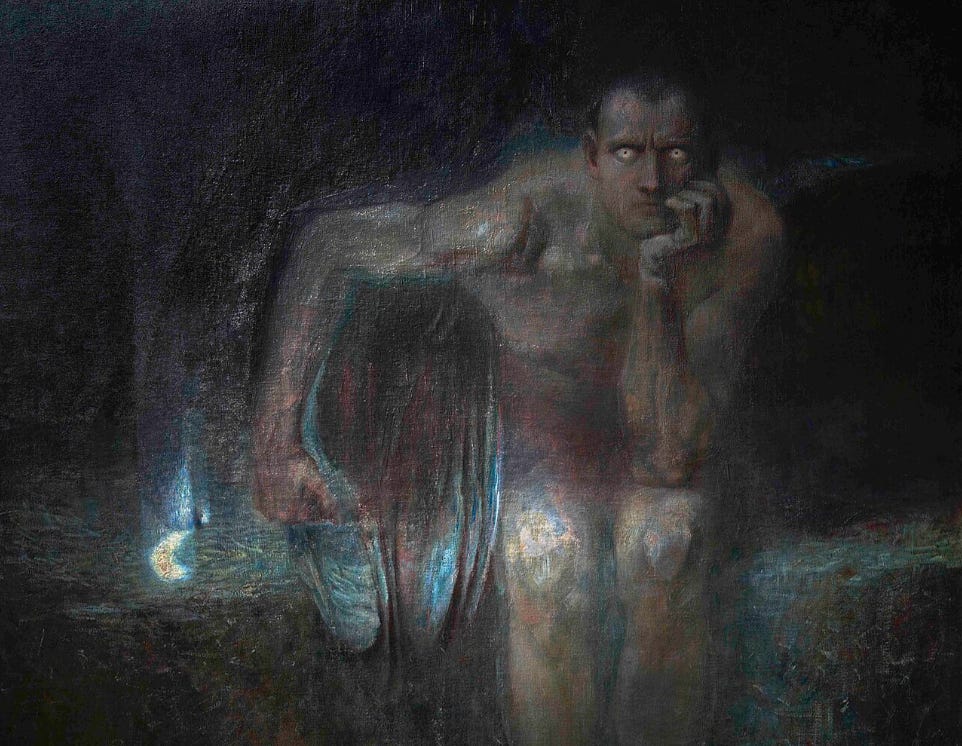
Lucifer | Franz von Stuck, 1890
Overview
Ask what the Qur’an teaches about Heaven and Hell and the answers come quickly. Gardens and couches. Fire and boiling water. Rivers of milk, and a tree whose fruit looks like the heads of devils. But here’s the wrinkle: the Qur’an itself insists those pictures are not the point. This is the last of three parts spent inside the Qur’an. Part 6 asked how the scripture is read. Part 7 asked what it demands in peace and war. Now, Part 8, asks what it says is real, and what it admits it cannot say. This part focuses on the Qur’an’s ontology (ie. its account of what is real): evil and the freedom behind it, death and what follows, and the two destinations the tradition calls the Garden and the Fire.
Assigned Reading
Haleem, Understanding the Qur'an, chapters 7 & 8
Shaytan • the Problem of Evil • al-Dunya & al-Akhirah
barzakh • adalah • al-Jannah • Jahannam • mathal
8.1 | Evil & the Adversary
The Gift of Freedom
In the Qur’an, evil is not a rival power set against God at the beginning of things.
It enters the world through a door God Himself opened.
That door is human freedom.
Surah al-Baqarah narrates the creation of Adam as God’s vicegerent on earth (2:30). The Arabic word is khalifa, a deputy who acts in the owner’s stead. Adam is the one appointed to act, and therefore is capable of both good and of evil (cf. Sec. 6). Adam’s success or failure is then of his own making (2:30, 76:3, 90:10, 91:8–10).
Put simply, the Qur’an does not treat evil as an accident that befalls a passive creature. It treats the human being as a moral agent, and evil as one of the things an agent can choose. Evil is therefore a possibility folded into the gift of freedom itself.
What follows is that the capacity that makes righteousness possible is the same capacity that makes evil possible. One cannot be granted without the other, and the Qur’an grants both together.
Iblis Refuses
Against that freedom the Qur’an sets an adversary of its own: Shaytan, the figure known in the Christian tradition as Satan.
It’s important to point out the Qur’an did not merely borrow a ‘Christian Satan’ from the Bible whole cloth. The Islamic notion of Shaytan bears its own narrative and origin. The scene runs like this. God commands the angels to bow before the newly created Adam. One angel refuses. Iblis will not prostrate himself before a creature of clay when he himself was made of fire. His pride hardens into an enmity toward humanity, and he asks for (and is granted) respite to pursue that enmity until the Day of Judgment (2:34, 7:11–18).
From that initial refusal, Iblis takes up the role of the Shaytan of Islamic scripture: the deceiver, the whisperer, the one who works to lead human beings astray. The Qur’an’s word for that whispering, waswasa, is an onomatopoeia — it’s the seductive hiss of Iblis’ sinful suggestions. In the Qur’an, it is Iblis he who tempts Adam and Eve in the Garden, and through them their descendants ever after.
Yet the Qur’an’s portrait remains somewhat balanced. Shaytan is a deceiver, yes, but he is only that. He can suggest, but he cannot seize. We, for our part, are granted an inborn ability to resist Shaytan. The temptation is real, but so is the resistance. In the Qur’an’s moral universe, nothing about the human situation is left without a defense. The same creation who can be tempted is the creation who can say no.
The whisper can always be refused.
The Problem of Evil: Islamic Edition
Behind the figure of Shaytan lies an older and more fundamental question — one that every theistic tradition eventually confronts. Philosophers call it the Problem of Evil.
If God is wholly good, why doesn’t He prevent suffering?
If God is all-powerful, He is certainly able to. And yet our world suffers. Why?
The problem is philosophical, and belongs as much in the philosopher’s seminar as to the mosque. This series will not adjudicate it. What we can do, however, is briefly describe the two responses that recur across the tradition’s reflection on the question.
The first is an appeal to the limits of human understanding. On this view, God’s wisdom simply exceeds human comprehension, and the believer is asked to accept that the full purpose behind suffering may not be graspable from within our limited point of view. What follows from this premise is that a creature who cannot see the cosmic whole is in no position to declare that the whole is unjust. So, what may appear like unredeemed evil from where we stand may be ordered within a design we are not equipped to survey. This is the appeal to mystery. No one denies that suffering is real. The claim is that suffering’s final meaning lies beyond us.
The second classic Islamic response is the greater-good response. It is more ambitious. Here, the claim is that evil is permitted precisely because it serves a higher end — a world of free agents who can fail is a greater thing than a world of automata who cannot, even though that freedom comes at the price of real suffering. The good, it argues, simply could not be logically reached any other way.
Together, these two answers (the appeal to mystery and the appeal to purpose) are the classical shape of what philosophers call theodicy, from the Greek theos (God), and dikē (justice). The attempt herein is to put God on rhetorical trial and argue the defense. Different thinkers across the tradition have reached for one answer or the other to the question of theodicy, and sometimes for both at once. The task in our nonsectarian reading remains to see what each response is claiming and why.
Whatever weight one gives the problem, the Qur’an does not leave the human being alone with evil and its adversary. Against both the Qur’an sets God’s mercy, His forgiveness, and the standing possibility of redemption. Surah al-Zumar offers one of the scripture’s most expansive reassurances: no sin, however grievous, lies beyond the reach of God’s mercy for the one who sincerely repents (39:53). Indeed, in the Qur’an’s own frame, God’s mercy encompasses all things (7:156).
8.2 | Death, Resurrection, & Judgment
The Near & the Last
Each of the three Abrahamic traditions holds that a life is made meaningful by filling one’s days with good works.
The Psalms tell the Jewish reader to “turn away from evil and do good, so you shall dwell forever” (Psalm 37:27). Matthew enjoins the Christian to “let your light shine before others, so that they may see your good works and give glory to your Father in Heaven” (Matthew 5:16). And the Qur’an promises that “whoever comes [to Judgment] with a good deed will have ten times its worth [to their credit]” (6:160).
In each case, the good done here is redeemed in eternity.
Belief in the Afterlife is a fundament of Islam. Nearly every page of the Qur’an makes some reference to it, and the tradition holds that the world to come was central to Muhammad’s message, as it was to every prophet before him. Again and again, belief in the Afterlife is named in the same breath as belief in God. The two convictions travel together for Muslims.
Then comes the Arabic, and the theology it shapes. Al-Dunya is the life of this world. The word grows from a root meaning ‘near’: this world is, quite literally, ‘the nearer life’. Al-Akhirah is the Afterlife, ‘the last’ or latter life. Arabic does not name the two as places. It names them as positions in a chronological sequence — the near and the last.
The Qur’an binds the two so tightly that its own language makes them nearly impossible to speak of apart. Neither term stands alone. Each is always named in reference to the other. And fittingly, each word occurs exactly 115 times in the Qur’an.
The symmetry itself is a kind of teaching.
The practicing Muslim is therefore called to stay mindful of the Judgment to come. The Fatiha, recited 17 times a day across the canonical prayers, names God “Master of the Day of Judgment” (1:4, a line Part 6 lingered over), while inattention to that Day is marked as the sign of the unbeliever (30:7). To live well in al-Dunya is to live with al-Akhirah always in view.
And the reason for the whole architecture (resurrection, Judgment, eternity) is justice. According to the Qur’an, God did not create the heavens and the earth “without a true purpose — the Hour will certainly come” (15:85). That Hour is the resurrection. The resurrection exists so that the labor asked of human beings is, in the end, justly rewarded. Islam claims people are created with an innate sense of right and wrong, a conscience the Qur’an calls the ‘reproachful soul’, that moves them toward the good and reproaches them for evil. The one judged to have lived well is rewarded in eternity. To Islamic thinking, without a final reckoning, the moral life would be a demand without a resolution.
Resurrection Ontology
The nature of the resurrection is a hotly debated subject within the tradition.
The Sufis, Islam’s mystical dimension (cf. Part 10), have long held the resurrection to be ‘spiritual’, reading every reference to a bodily rising as poetic allusion to a truth that is not, at bottom, physical. Other sources have held it to be ‘bodily’, an actual raising of the person, flesh and all.
The Qur’an offers credence to both possibilities. It calls resurrected bodies “new” creations (56:35, 61). It says that things in the world to come are “like” what they are here, and that its food merely “appears similar” (13:35, 47:15, 2:25). Muhammad’s Companion Ibn Abbas (counted among the tradition’s earliest authorities on the Qur’an’s meaning) maintained this world and the next share nothing at all except the names of things. The words carry over. The substance behind them does not.
The 1100s philosopher Ibn Rushd (a working judge in Cordoba, known to the Latin West as Averroes) resolved the tension by focusing on the reader. Most people need simple, concrete explanations, Ibn Rushd reasoned. While scholars can bear a more complex and abstract eschatology. And so the Qur’an supplies both registers at once. It is a striking early statement of an idea we will meet again in Part 13: that a text can rightly mean different things to different readers, and that the authority to say which is which is itself a question.
The Qur’an’s first audience included deniers who found the whole idea simply absurd. Scattered bones, gathered and made to live again? To them the book answers with an argument, not merely a promise.
Does man think We shall never put his bones together again?
...Yes indeed: We can remold his very fingers. QUR’AN 75:1–4
A fingerprint today is a kind of signature. No two are alike, not even in identical twins. For the modern Muslim: the God who can fashion a thing so fine, so individual, and so unrepeatable once can surely fashion it again. The reasoning turns the skeptic’s own intuition against them. The very intricacy of the human body, which seems at first to make its reconstitution unthinkable, becomes instead the evidence that its Maker could do it twice.
Barzakh & the Day of Judgment
Death, of course, is the natural conclusion of all life.
The Qur’an acknowledges this poetically (”every soul will taste death,” 31:85).
The Qur’an also acknowledges this conclusion as a gateway of return to God (6:61–62).
The first stage of that return is barzakh, an intermediate state between this life and the Afterlife. The word itself means a barrier or a partition. The Qur’an uses it elsewhere for the unseen barrier between two seas, the fresh and the salt, which meet and do not mix (25:53). This is what the dead inhabit — a partition between two waters.
Souls in barzakh already receive a measure of reward or punishment (3:169–171, 16:32, 40:45–46, 71:25). Yet at the resurrection, the whole of that interval will feel “no longer than an hour” (10:45). Barzakh is a threshold rather than a destination. A waiting that, from the far side, will seem to have taken almost no time at all.
The Islamic resurrection itself falls at the End of the World, whose hour is known to God alone (7:187). No prophet was given the date. No believer claims to have it either.
Far less debated than the resurrection’s nature is the Judgment that follows it. Each person is shown a complete record of their deeds: “Read your record; today your own soul is enough to calculate your account” (17:14). The accounting requires no witness beyond the soul itself. No one bears another’s account. No one is spared the reckoning.
Whoever has done an atom’s weight of good will see it, and whoever has done an atom’s weight of evil will see that. QUR’AN 99:7–8
In Islam, Judgment is what gives the moral life its stakes.
It is the reason the choices of al-Dunya finally matter.
And yet (this surprises many first-time readers) the weight the Qur’an gives to the Afterlife never devalues this life. Muslims are commanded not to “neglect [their] rightful share in this world” (28:77). Asceticism is not counted a virtue in Islam, and celibacy is unknown to the Qur’an. Believers are encouraged to take pleasure in life. To learn, to build a family, to bring joy to others. The tradition even recounts Muhammad affirming the value of good-humored joking with relatives (Sahih al Bukhari 81).
This life is to be enjoyed, but never at the cost of one’s soul.
The world is good, and it is not the end. The two truths are meant to be held together.
8.3 | The Hidden Garden
Cosmic Justice
The Ancient Greek image of justice is a familiar one. Lady Justice, blindfolded, a set of scales in one hand and a sword in the other. She captures a deep and widely shared intuition: every deed warrants its reward or its punishment — and the accounts must, somehow, be balanced.
Different traditions give that intuition different names. Hindu eschatology calls it karma. Arabic calls justice adalah. The distinction between them is structural, not necessarily a ranking. Karma is assessed in the background of a life by unseen cosmic forces, an impersonal law woven into the fabric of the universe, running on its own without a judge. Adalah is assessed by God alone, the act of a personal being Who sees, weighs, and decides.
The blindfold marks the difference too. Lady Justice wears it to promise impartiality: she will not see who stands before her. The Qur’an’s Judge makes the opposite promise, yet arrives at the same place. God sees everything and is partial to no one.
Here, cosmic impartiality achieved not by seeing less but by seeing everything.
The reckoning must be deferred because justice in this world is manifestly incomplete. We have all watched evil go unpunished and seen the lives of righteous people cut short. The Qur’an itself acknowledges as much: worldly justice is neither complete nor lasting, because this world is imperfect (42:30, 3:165, 87:17). The balance the Greek scales promise is not, for Muslims, struck here.
And so the full reckoning is carried forward to Judgment Day, after which those who have tipped the divine scales toward righteousness receive an eternal reward. The Garden and the Fire are the tradition’s answer to a problem everyone recognizes: in this life, the accounts simply do not add up. Islam’s response? They will after death.
The Hidden Garden
The Arabic word for eternal Paradise is al-Jannah, literally ‘the Garden’. Its etymology is one of the two keys to Part 8 of this series.
Al-Jannah grows from the native Semitic root J-N-N, ‘to hide, to cover, to conceal’ (the same three-consonant root device Part 7 walked through with S-L-M). What makes the J-N-N root so illuminating is that its entire family of derivatives carries the same thread of hiddenness through it. From J-N-N comes:
• janīn, the embryo (hidden in the womb)
• majnūn, a madman (whose mind is hidden somewhere we cannot follow)
• jinn, beings of fire (hidden from everyday human sight)
There is also an old saying in Arabic: when night falls, jannat al-layl.
The night has hidden everything.
Womb, madness, spirit, nightfall. Each names something present but unseen. Arabic wears its theology in its grammar (Part 7 made the same point with the mu- of Muslim). The same is true for Paradise, Jannah, a hidden garden. A place that is both real and concealed from the living.
Notably, our own English word ‘Paradise’ also comes from the Middle World, starting as Old Persian pairidaēza (‘enclosed garden’) then moving into Hebrew as pardes (the ‘orchard’ of Song of Songs 4:13), then into Greek as paradeisos, which is how it finally arrived in English as paradise. The Old Persian pairidaēza also travelled south into Arabia, where it became firdaws (فِرْدَوْس), which is also a Qur’anic name for Paradise.
Describing Paradise
In the Qur’an, entering Paradise is an auspicious occasion (39:73). The very act of ‘entering’ al-Jannah recurs some 57 times, each occurrence bound up with peace, security, and delight. Light shines before the righteous as they enter, and the angels are there to greet them (57:12, 39:73).
The ontology of Islamic Paradise is elaborate and detailed.
Al-Jannah is as wide as the cosmos (3:133, 57:21). And although ‘the Garden’ in the singular names the single abode of the righteous, the Qur’an also speaks of multiple Jannat, for there is a private garden for each believer and their family. A home of one’s own within the whole. The residents are free to move wherever they wish (39:74), and wherever they go, their homes are peaceful and pleasant (9:72). Within those homes, large extended families relax on couches, hold pleasing conversation, and recall happy memories with shining faces (80:38–39). While spending time with their loved ones, attending servants offer them whatever they desire (76:15–19).
The picture is domestic as much as it is paradisal.
Less a reward earned than a household restored.
But the food and drink of Paradise, the Qur’an is careful to say, are not for sustenance. They are tokens of honor. The true reward of Paradise is not the sensual delight so vividly described but the honor God bestows on the righteous. The position of being welcomed, received, and held in favor by God.
The feast is a meant as a sign. It doesn’t serve a need.
8.4 | Damnation & the Limits of Language
The Valley of Gehinnom
The second etymological key of Part 8 is the name of the Fire, and like the first, it carries us back through the shared vocabulary of the Abrahamic traditions.
The Arabic Jahannam traces to the Hebrew Gehinnom, which is a real place in ancient Israel. Gehinnom (the Valley of Hinnom) is just outside of the walls of Jerusalem. The Hebrew Bible remembers it as cursed ground, the place where evil kings of Judah burned their own children in sacrifice — an atrocity that left the whole valley under a curse (Jeremiah 7:31, 19:2–6). 600 years later, the valley was still known as the ‘burning place’ by the Jewish locals. The lowest point in Jerusalem. Where the city’s refuse was dumped and set alight. A fire that seemed never to be quenched.
Over time, the vision of a smoking, smoldering pit at the edge of the holy city became the image of final cosmic punishment.
Later, in the Gospel era, Jesus warns that the unrighteous risk having their bodies cast into Gehinnom (Mark 9:43–48). Across the Greek of the New Testament, three different terms come to name the same dreadful destination: Gehenna (straight from the Hebrew Gehinnom), Hades (Matthew 11:23), and Tartarus (2 Peter 2:4). Today, all three are rendered in modern English by a single Old Norse word, ‘Hell’ (from Hel, the name of the underworld of Germanic myth).
Over time, geography became theology. By the time the Qur’an speaks of Jahannam, the word already carried centuries of cosmic freight. The Islamic Fire inherits both the name and the smoke of that valley outside Jerusalem.
A Theology of Contrasts
The Qur’anic Jahannam (in parallel with the Christian concept of Hell) offers no respite, mercy, or help to those consigned to it (2:161–162, 4:52). It is a place of “intense heat” (52:27). Its fires are fueled by men and stone (2:24). Its waters are boiling and fetid (14:16). Boiling water is poured over the heads of the damned while the water within their bodies boils, and they are beaten with maces (22:19–21). The Qur’an says many will regret the lives they lived the instant they face this eternal torment — but there will be no second chances (2:167).
Qur’anically, the Fire is nearly always drawn against the Garden.
Where al-Jannah has fruit, milk, and shade, Jahannam offers only the fruit of the Tree of Zaqqum, which springs from Hell’s floor, its fruit like the heads of devils (37:64–65). The damned eat it, drink boiling water on top of it, and are returned to the fire (37:68). The place is named a “torment for wrongdoers” (37:63), and against it the Garden stands as protection: “Which is better, this or the lasting Garden that those who are mindful of God have been promised…?” (25:15).
The full set of contrasts runs deep. Hell is “an evil home, a foul resting place” and Heaven “a happy home and a happy resting place” (25:66–76). The residents of Heaven are spared not only the fire but every “harm,” “fear,” “shame,” “malice,” and “grieving” (39:61, 66:8, 15:47, 10:62). Their food brings no discomfort or intoxication (37:47, 56:19). Their drink brings no idle talk or sin (52:23). There is no end to their gifts, their fruit, or their belonging (38:54, 56:32, 35:35). While the cries of the tormented are silent to those in the Garden (21:102).
And where each soul in Hell suffers alone, the righteous are reunited with generations of their loved ones. The solitude of the Fire is part of its punishment.
One makes one’s home in Heaven forever. The thought of leaving, the Qur’an says, never so much as crosses one’s mind (18:108).
The last and most important contrast is not sensory but spiritual. For all the vividness of the imagery, the Qur’an gives primacy to the spiritual reward over the material. It signals that primacy in the very order of its phrasing. Mention goes first to the righteous “brought nearest to God,” and only then to “the Gardens of bliss” (56:10–11). The command is to enter first “among My servants,” and then “into My Paradise” (89:29–30). The Heavenly spouses are named “good natured” and only afterward are they “beautiful” (55:70).
Each time, the moral or relational good is placed ahead of the sensual one. In a book this attentive to its own language, word order is no accident. The order is the teaching. The physical delights of the Garden are secondary to the nearness they signify.
The reward of Paradise is, finally, closeness to God.
Mathal: Analogical Description
Our Module on the Qur’an (Parts 6, 7, and 8) closes where the tradition itself closes the question: by admitting the limits of its own descriptions.
The 10th-century philosopher al-Amiri explains that the rewards of the Garden must be rendered “in a way which is pleasing,” and that the nature of Paradise “cannot be apprehended except by giving a standard or gauge for it of what human senses have experienced.” In other words, al-Amiri is pointing to the claim that we can only picture Paradise in the borrowed terms of what we already know. Every tradition that speaks of eternity or perfection eventually meets this wall.
What is striking, is how plainly the Qur’an ‘breaks the fourth wall’ as it were, by pointing out the limits of its own use of language.
The Qur’anic descriptions of the Garden are given as mathal — a similitude, analogy, or parable “of what is actually the case” (13:35, 47:15) — because language cannot carry the reality of a perfect and eternal abode. The similitudes are offered, the Qur’an says, “so that they may reflect” (59:21). This is the same book that calls the resurrected bodies “new” creations and says the food of Paradise merely “appears similar” to the food of earth. The Qur’an is uniquely self-aware among Abrahamic scripture.
So, the graphic imagery of the preceding lessons should not be read as reportage. From the boiling water and the Tree of Zaqqum, to the couches and the shining faces — the Qur’an works with what human senses can know, to describe a theological reality that lies beyond its grasp. Islamic tradition holds that no living person has direct knowledge of the Afterlife. The Fire and the Garden are figures for a truth no text can finally hold.
What remains, in the end, is not a cosmic geography for the reader to paw at. Rather, the Qur’an is presented as a way of orienting a life in al-Dunya toward an al-Akhirah that can be named only in analogy, and reached only by the choices made here.
The Garden is hidden. But the road is written.
Last Section: Qur’anic Ethics: War & Tolerance
This Section: Qur’anic Ontology: Evil & the Afterlife
Next Section: Umayyads & Abbasids