

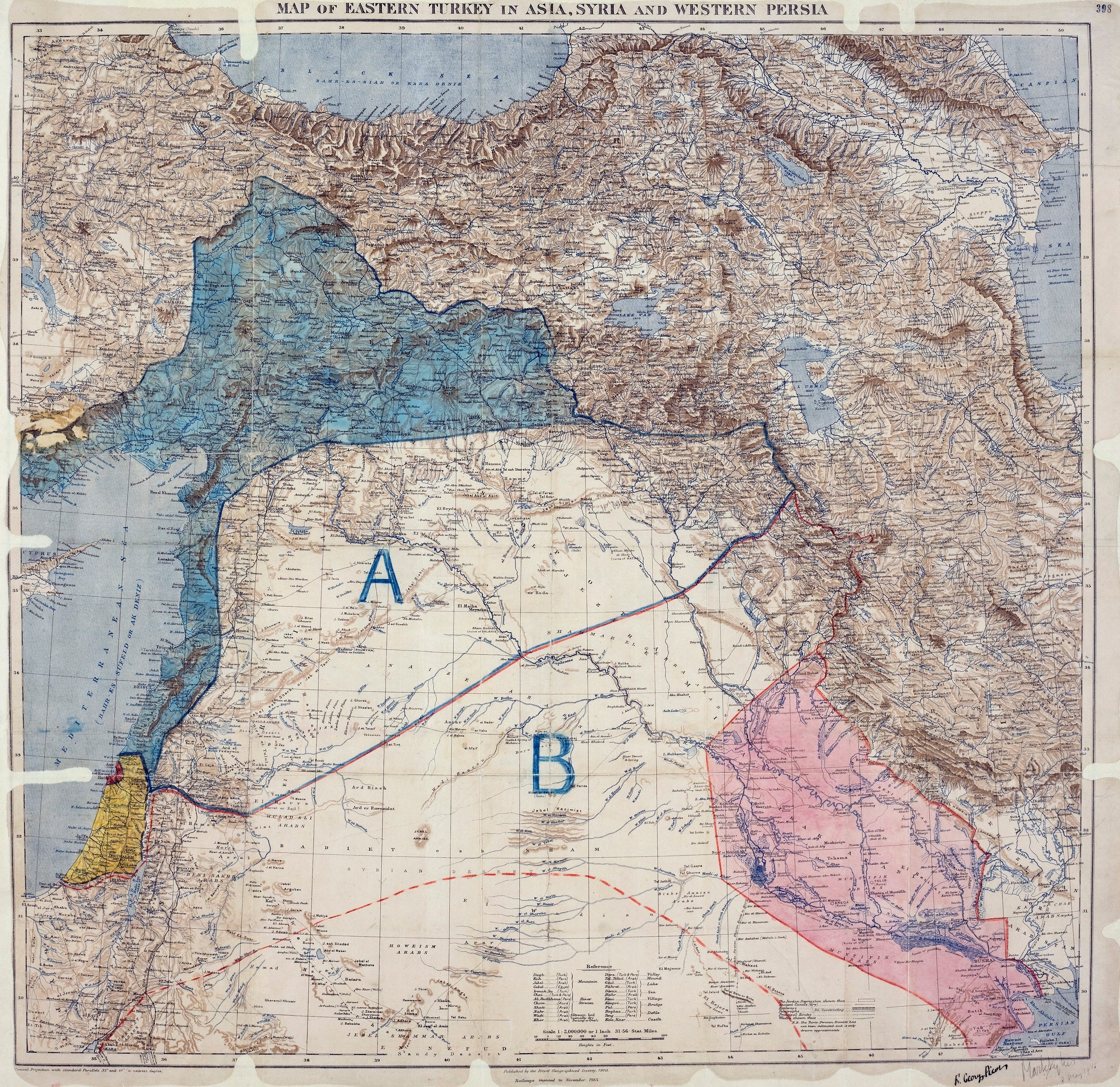
The Sykes-Picot map, signed by Mark Sykes and François Georges-Picot | London, ca. 1916
Source: The National Archives (UK)
Overview
By the end of the last section, a reborn Europe had turned east and caught the great Islamic empires flat-footed. Now the question that shock forced upon the Middle World comes due: once modernity had arrived (its factories and constitutions, its nation-states and its unsettling new goods), what was a Muslim to do with it? Three answers emerged, and they still organize much of Islamic life today. The first says modernity is corrupting Islam, and the faith must be returned to its seventh-century roots: this is Salafism, and in Arabia it took the particular form of Wahhabism. The second says the trouble runs the other way, and Islam itself must be rethought as an ethical system for a modern age: this is Secular Modernism. The third seeks a middle way, embracing modern science and institutions without surrendering the faith: this is Islamic Modernism.
From there we follow modernity into two concrete arenas (the Industrial Revolution and the constitutional struggle in Iran), and then into the wreckage of the First World War, where nationalism, the Armenian Genocide, and the Sykes-Picot Agreement drew the map of the modern Middle East.
Assigned Reading
Ansary, Destiny Disrupted, chapters 13-14
Key Terms for this Section
Salafism • Wahhabism • Secular Modernism • Islamic Modernism
constitutionalism • nationalism • the Armenian Genocide • Sykes-Picot
13.1 | Islam Meets Modernity
Pack It Up & Go Home
By the time the United States Constitution was being signed in the West, the scholars of the Middle World had closed the gates of ijtihad (cf. Part 6), thinking that all the big questions of religion had been answered.
Pack it up. Go home. Religion has been figured out — thanks, everyone!
That was the general attitude some 250 years ago.
For the scholars of that age the great labor of interpretation was finished, and what remained was only to preserve and transmit it. The rules had been settled, so it was thought, for Islam (to them, ‘the world’s greatest religious tradition’), and no one would ever again need to question the entrenched ulama.
But that attitude pretends that religions are stable things — that identities and groups do not change, that context does not matter, that history does not matter. And of course all of these things matter a great deal.
Religions absolutely change.
Context is always part of the picture.
And history is a major force in our lives.
To be sure, 250 years ago the Islamicate world was not settling into stillness at all. It stood on the very edge of several major reform movements. In Delhi, the reformer Shah Wali Allah (1703–1762) had already broken a taboo by translating the Qur’an into Persian (1738).
No Protestant Reformation
The comparison people most often reach for is a misleading one. This was no Protestant Reformation (cf. Part 12). The Christian Reformation had been a response to very specific features of Western Christianity, and Islam shares none of them.
It was a response to the ascendancy of the pope — and Islam has no pope. It was a response to the established medieval Church — and Islam never had a Central Church. It was a response to the Catholic priesthood — and Islam has no priesthood, for the ulama are far more like lawyers than like priests, scholars of a sacred law rather than mediators of a sacrament. And it was a response to the Protestant longing for a direct, unmediated relationship with God — which Islam has claimed for every believer from the beginning.
So the parallel does not really fit. What the Protestant Reformers and the coming Islamic reformers did share was not a doctrine but a predicament: both were reeling from the same earth-shaking force, the arrival of modernity, and each was trying to work out what a person of faith should do in its wake.
In the Islamicate world, that arrival has a date. In July 1798 (1213 AH), Napoleon lands at Alexandria with an army, a printing press, and more than 150 scholars. His Arabic proclamation assures the Egyptians that the French are true Muslims. The Cairo chronicler al-Jabarti reads it and takes its grammar apart, line by line.
Three Short Sentences
Out of that shared predicament, over the next century and a half, came three broad Islamic reactions to the modern world.
• Modernity is corrupting Islam
• Or: Islam is corrupting modernity
• Or: modern thinking should be embraced, together with Islamic values
The first reaction, Salafism, held that modernity had entered the Middle World as an uninvited guest and was now corrupting the true faith of Islam. The second, Secular Modernism, held that modern values were a universal set of principles and that Islam was a relic of the past holding Arabs and Muslims back from their full potential as citizens of the world. The third, Islamic Modernism, took the middle view that modern thinking and Islamic values are compatible and that each had much to learn from the other.
13.2 | 3 Responses: Salafism, Secularism, & Modernism
Wahhab & the House of Saud
The first reaction is most easily recognized in the story of Abdul Wahhab (Muhammad ibn Abd al-Wahhab), who died in 1792. He was born in al-Uyaynah, a sleepy oasis town in the Najd desert, into a family of judges, and when he showed a gift for Qur’anic study he was sent to Medina, the Prophet’s own city, to become an early modern scholar of Islam.
There, Wahhab came across the incendiary works of Ibn Taymiyya (1263–1328). In brief, Ibn Taymiyya had scolded the Islamic community for its weak faith: to his mind, much of the Islamicate world had fallen to the Mongols (cf. Part 11) because it had lost sight of the true faith, and so God had abandoned it. Even the khans who had since converted were, to him, Muslims in name only. The Mongol destruction, on this reading, was God’s own punishment for Baghdad’s sins.
Nothing was wrong with Islam, in other words.
Something was very wrong with Muslims.
The Qur’an itself could be read that way:
God does not change the condition of a people until they change what is in themselves. Qur’an 13:11
That lesson stayed with Abdul Wahhab. When he left Medina for the far more cosmopolitan city of Basra, he was appalled by what he saw: Muslims praying at saints’ tombs and sacred trees — which to Wahhab was idolatry! So he left Basra for the desert and preached to the people back home against it.
The goal of every righteous Muslim, Wahhab maintained, was to live as the Salaf had lived: the first three generations of Muslims, the al-salaf al-salihin or ‘pious ancestors.’ Those who aim, as Wahhab did, for an Islam that harks back to its 7th-century roots are known today as Salafis (his own followers called themselves muwahhidun, ‘affirmers of God’s oneness’, from tawhid, cf. Part 5), and Salafi ideals can be found across the Islamic world as a powerful response to modernity. Only later would his heirs aim the same zeal at the modern world.
Here, though, a careful distinction has to be drawn. The particular set of Salafi beliefs that Abdul Wahhab preached in Arabia came to be known locally as Wahhabism — and the two are not the same thing. The reason to keep them apart becomes clear in what happened next.
Wahhab’s preaching got him into local trouble. He had a woman stoned to death for adultery (on her own confession) and had a venerated tomb leveled, and when a powerful neighbor pressed the town to expel him (1744), he fled to the protection of a minor potentate named Mohammed ibn Saud. Yes, that Saud: the emir of the small oasis town of Diriyah, who meant to rule all Arabia.
Wahhab and Saud struck a pact that still stands today: one man’s line would supply the religious identity of a new kingdom while the other’s would give it a royal identity.
This is why the Kingdom of Saudi Arabia is a Wahhabi Sunni state.
And here is the distinction that matters most for this course: the anti-Western Wahhabi Islam that the Saudi regime for decades exported across the world is the direct result of the 18th-century theology of Abdul Wahhab, and it does not represent all of ‘Islam.’ Nor is it even ‘Sunni Islam.’ Rather it is a specific, ultra-conservative view of Sunni Islam, well funded by the Saudi royal family.
When the Saudis first came to power, they attacked the Shia shrines at Karbala (sacked in 1802), destroyed tombs of the Prophet Muhammad’s Companions at Medina (al-Baqi, leveled in 1806 and again in 1925–26), and demolished a marker pointing to the Prophet’s birthplace. All of it was done in the name of tawhid, the oneness of God (cf. Part 5), and against what they regarded as idolatry. The Ottomans answered in 1818: Egypt’s Ibrahim Pasha, campaigning for the Sultan, destroyed the first Saudi state and leveled Diriyah itself.
Wahhab further taught that the world divided into three kinds of people: true Muslims, ‘false Muslims’, and non-Muslims. Non-Muslims, for the Wahhabis, are largely beside the point. If you are not actively hindering the Muslim community, you are of little concern. The real threat, in this view, is the ‘false Muslim’:
the slacker who does not practice Islam rigorously enough and so corrupts others
the apostate who renounces Islam, a crime for which one can be legally executed in Saudi Arabia today (cf. Part 7)
the innovator (the charge is bid’a, ‘innovation’) who brings in beliefs and practices unknown to the first three generations (a category in which the Wahhabis place Shia and Sufi Muslims alike)
The Secularists
However, the vast majority of the world’s Muslims feel no affinity for Wahhab or for Salafism at all. Some feel exactly the opposite: that Islam itself must be rethought from the ground up. For these Muslims the best path forward in the face of modernity is Secular Modernism.
The Secularist takes the view that ‘religion’ is a social construct, built up out of robust traditions and rituals wrapped around an ancient ethical system.
Where the Salafi said nothing was wrong with Islam but something was wrong with Muslims, the Secularist says nearly the reverse: nothing is wrong with Muslims, but something is deeply wrong with Islam.
For the modern Secularist, the whole idea of a ‘revealed religion’ like Islam (ie. an angel actually speaking to a prophet) was a necessary but now bygone relic of the ancient past, a way of getting ancient people to behave. Now that we have modern values by way of reason, the Secularist argues, the ‘magical thinking’ part of religion needs to fall away, because it holds us back.
So rather than imagine a religion in its purest form ‘back then’, the Secularist treats all religions as aiming at a shared point in an ethical, non-religious future — a time when humanity will no longer need religion and can simply live together by modern values. What matters to the Secularist is therefore not the ancient past but the present struggle against dogmatism, and ethics reached not through faith but through reason.
Because Secularists come from different cultural traditions, the world has Christian Secularists (who may keep a Christmas tree but do not believe in Jesus), and Jewish Secularists (who may light the menorah candles but do not believe in the miracle of Hanukkah), and Muslim Secularists (who may fill their homes with Persian food and music yet, coming from Shia Iran, do not believe that Ali was Wali Allah, ‘the friend of God’ of the Shia call to prayer).
To other people of faith these Secularists may not look like ‘religionists’ at all, and yet they still self-identify, for a variety of reasons, Christians, Jews, and Muslims. Their response grew out of facing the alleged superiority of Western values against their own local traditions. For some self-identified Muslims, then, Islam must be stripped of its ‘magical thinking’, its superstitions, and its faith-based trappings, so that it can live on in modern society as a serious and robust set of traditions compatible with modern life.
Al-Afghani & the Middle Way
The third and final category is a middle path, Islamic Modernism, and it is articulated well by Jamal al-Din al-Afghani (1838–1897). The name means ‘the Afghan’, and it was likely a disguise: he was probably born at Asadabad in Iran, but an Afghan name would’ve let a Shia-born reformer work in Sunni courts.
For al-Afghani, the tragedy of the modern Muslim is that he embraces Western values, as the Secularist would have him do, while ignoring Western science — he reads the Qur’an, listens to pop music, and ignores modern medicine.
That, al-Afghani says, is exactly backward. What the modern Muslim should do instead is read the Qur’an, study modern medicine, and ignore the pop music. Go to their schools, sure, but do not dress like them. Study their sciences, but do not forget your prayers.
For al-Afghani the marriage of modernity and Islamic values is not merely possible. It represents the next evolution of Islam.
Islamic Modernism is thus a way of being modern without being fully Western, a negotiated middle ground between what its adherents see as an out-of-touch Salafism and a too-far-gone Secularism. One need not give up on miracles and revelation, as the Secularists do, nor abandon the city for the desert, as Abdul Wahhab did.
The Islamic Modernists want to live in the city. Some of them even want to make a little of the very noise that drove Wahhab mad — only they want to find an Islamic version of that noise. They want to be successful surgeons and academics who also make it to Jummah on Fridays. They want to be neighbors and friends to non-Muslims, but without surrendering their Islamic values.
Can a modern virtue like democracy, then, be an Islamic value? Al-Afghani thought so, and so did his student Muhammad Abduh, later the Grand Mufti of Egypt (1899), with whom he published a reformist journal in Paris, al-’Urwa al-Wuthqa (1884). They made the case from within the tradition. They called for the gates of ijtihad to be reopened (cf. Part 6), and they read the ancient shura (cf. Part 4) and ijma (cf. Part 6) as modern democratic practices.
Was the shura (the consultative council) not simply a form of direct democracy, like a town-hall meeting? And was ijma not the consensus, not merely of the ulama but of the whole Islamic community? If both were true, then what business did kings have running modern Islamic nations, and was democracy not in fact the best Islamic political practice? Al-Afghani not only thought so. His students carried the case to Cairo, Tehran, and Istanbul.
Wahhab and al-Afghani read the same Qur’an. One found in it a 7th-century pattern to restore, the other a warrant for parliaments. The authority to say which reading is correct is itself a question (cf. Part 8).
13.3 | Constitutionalism & the Majlis
The Shop Window
If you see something beautiful in a shop window, it is natural to want it. That is human nature. And if a beautiful thing from a faraway place is not made in your hometown, you do not usually stop to ask, ‘How could we make these here?’ No one cares where iPhones or coffee cups or designer T-shirts are made. You just know you want one.
That, more or less, is how the culture shock of the 1800s felt to the Islamicate world, and it began with the Industrial Revolution: a run of inventions that came to Europe one after another, from the flying shuttle (1733) to the Bessemer process (1856).
the steam engine (Watt, 1769), which let people move faster than horses
the mechanized factory, which made goods far cheaper
the telegraph (1830s–40s), which carried messages instantly across great distances
the flying shuttle (1733), which doubled the speed of weaving
the Bessemer process (1856), which made steel cheap
Together they gave the West a technological advantage it enjoys to this day.
The interesting point is that these inventions did not all appear first in the West. In 1551 the Ottoman engineer Taqi al-Din (the same astronomer whose observatory came down in 1580, cf. Part 12) described a steam turbine, and then it was forgotten. And China had water-powered spinning machines by 1313. The difference (the reason the Industrial Revolution took hold in the West and not in the East) was cultural, not religious.
Better Mousetraps
Take the steam engine. The Turkish ‘steam engine’ of the 1500s was little more than a curious device for turning grilled meat over a fire. Why was it never used to invent the train? Because the train came out of a specifically Western kind of capitalist competition among private businesses: rival mining companies wanted to move ore to market faster than one another. First came the water pump, then rails to move the ore, then someone mounted a pump-like device on a car to turn its wheels along those rails — and there was the train.
In Ottoman Turkey, by contrast, everything ran on the medieval guild system (cf. Part 12). The major industries were organized by the state, so there was very little competition, and the competitive pressure to get goods to market faster simply did not exist. Because the need for the train did not exist, the train was never dreamt of, and the same held for mechanization and for the modern factory.
There were subtler cultural differences too. There had been no Protestant Reformation in the Islamicate world, and so the social changes we associate with that movement (modern individualism, the rise of independent reason, the dismantling of an entrenched faith-based power structure) did not unfold there in the same way. Without the rise of Western individualism, the Islamicate world did not develop the same appetite for scientific inquiry or the private ownership of businesses that drove modern competition. And these two work hand in hand, for without economic competition even the advances that did appear, the Turkish steam engine or the Chinese machine, were never pushed to their potential.
Why build a better mousetrap when the old one works? The only reason is to build it faster, cheaper, and better than a competitor, and that was the Western situation, not the Eastern one.
Who, then, were the people building better mousetraps in the West? They were the new middle class: a restless bunch who left farm life, parted from their extended families, filled the European cities, lived by clocks and train schedules, formed small nuclear families, and moved from one job site to the next.
That mobility is the key. Their ties to their elders loosened as the workforce kept moving, and they got ahead by staying educated and technologically adaptable.
This was decidedly not the way of the Muslim world, where the elders remained a source of wisdom and pride, families did not scatter, and the young were encouraged not toward adaptability but toward honoring their traditions, their elders, and their leaders. Not that the Middle World never tried the factories: Egypt’s Muhammad Ali built state textile mills in the 1820s and sent student missions to Paris (1826), until an 1838 trade treaty opened his market to cheaper British goods.
So when the West arrived with fast trains, cheap steel, and telegraph machines, few at first demanded to know how such things were made.
That, of course, would change.
Tobacco & the Majlis
The way these new goods reshaped the cultures of the Islamicate world can be seen most clearly in Iran. By the 1840s the Iranian government had resolved to modernize its national industries so as to join in what was happening in the West. It wanted not only the new goods but the means of making them, and it decided, wisely, that the surest path ran through education.
In 1851 the reforming chief minister Amir Kabir opened Iran’s first modern college in Tehran, the Dar al-Funun (‘House of Sciences’), where students studied the sciences, arts, and culture of the West (it grew, in time, into the University of Tehran, where they still do).
But this education soon opened a rift in Iranian society, between a modern, educated intelligentsia and the traditional Iranian folk. The modern Iranians went on to staff the major businesses, the high offices of state, and the officer corps, and they brought with them new, Western, secular ideas about how a state ought to run. One of those ideas was constitutionalism: the belief that a country should live within a stable framework of stated laws, binding ruler and ruled alike.
Without such a framework a citizen lives at the whim of the ruler. Whatever the king says, goes, and the same holds all the way down the chain of royals, each limited only by the one above. As subjects, the people have no real say about justice at all — and the new Iranian educated class was no longer willing to accept that.
They had a particular target. The Qajar dynasty, much like the late Safavids before it, had come to be run by a descending line of hapless aristocrats: Iranian royals of the 1800s notorious for selling off their country’s resources to Western interests for personal gain while living spoiled and privileged lives.
The selling had a famous last straw. In 1890 the shah granted a British subject a monopoly on Iran’s entire tobacco crop (cf. Part 12): its growing, its selling, its very smoking. The answer was the tobacco protest of 1891–92. A fatwa attributed to the leading cleric Mirza Hasan Shirazi declared smoking off-limits until the concession fell, and the whole country complied (by the story, even the shah’s own harem gave it up). Al-Afghani himself had urged Shirazi on by letter. In January 1892 the concession was cancelled.
Clerics and merchants together had beaten a king.
The educated class had had enough, and called for a constitution to limit the king’s powers to spend and to sell, and to give the Iranian people a voice. The ulama split. Many backed the constitution, and clerics led the great protest sanctuaries of 1906. Others, led by Shaykh Fazlullah Nuri, called it un-Islamic and argued that Iran already had a constitution: the Sharia. (In Persian the two camps sat one letter apart: mashruta, ‘constitutional’, against Nuri’s mashru’a, ‘sharia-abiding’.)
The secularists answered that a constitution would give them a parliament, a necessary voice in government. In 1906 (1324 AH), after a long political battle, the Qajar king finally yielded and allowed a parliament to form: the Majlis (the word means ‘a sitting’, the same word Shia Muslims use for the mourning assemblies of Muharram, cf. Part 5). Over the next two years the new parliament won real freedoms, including freedom of speech, freedom of the press, and new civil liberties.
The empires noticed. In August 1907 Britain and Russia, closing out their Great Game (cf. Part 12), signed a convention splitting Iran into spheres of influence between them, a year after the Majlis opened.
In June 1908 the next shah had his Cossack Brigade, under a Russian colonel, shell the parliament building with cannon fire.
So much for modernization.
But the constitutionalists did not stay beaten. In July 1909 they took Tehran, deposed the shah, and restored the constitution (Shaykh Nuri, who had sided with the king, was hanged).
And then the First World War began.
13.4 | Nationalism, the Great War, & Sykes-Picot
Aligarh & the Volksgeist
In India, another modernizer had been working along his own lines. Syed Ahmed Khan was no secularist: he wrote his own commentary on the Qur’an, and he held that the Word of God and the Work of God (revelation and nature) could never conflict.
He had served the East India Company’s courts from 1838 and stayed loyal to the British through the great revolt of 1857 (cf. Part 12). Then he wrote The Causes of the Indian Revolt (1859), telling the British plainly that their own policies had caused it.
Khan traveled to England as an ambassador of goodwill (1869–70), mingled with the British aristocracy, and was eventually knighted (1888) in Queen Victoria’s Order of the Star of India. On his return he founded, in 1875, the school that became the Mohammedan Anglo-Oriental College, later renamed Aligarh Muslim University (1920). Its graduates led the movement that made Pakistan (1947), among them its first prime minister.
This brings us to nationalism itself: the idea that a set of traditions (languages, beliefs, cultural practices) and a shared history, particular to a single people, unite them as a national group and warrant their sovereignty as a nation-state. We tend to imagine nations as a wholly natural category, but in fact the majority of the world’s nations are less than 100 years old.
Today the nation is the universally agreed basic unit of political measure: every nation is governed under international law, its sovereignty guaranteeing that its internal affairs remain its own. Each has one set of laws, one government to make them, one currency, and the military and judicial machinery to enforce the laws and protect the nation’s wealth.
But this is the dry, cut-and-measured side of the story (the science and the math of it). There is also art, and religion, and spirit.
In the 1700s the German philosopher Herder argued that every people (in German, every Volk) possessed its own unique spiritual essence or ‘groupness’, its Volksgeist. Each Volk was its own nation, with its own culture, history, and even ethics. What was right for one might be wrong for another, and it was not for outsiders to judge.
Other Germans, famously, drew the opposite lesson: that judging between nations was not only permitted but implied — that some Völker were simply better than others, stronger, smarter, holier. Both readings would echo through the 20th century.
In India, the Muslim League certainly believed there was a case for a special Volksgeist of Islamicate culture and peoplehood in what would become Pakistan.
The Young Turks & 1915
But what of the rest of the Islamicate world — the Ottomans, of whom we now hear so little? When the Europeans brought modernity, and with it the innovations of modern economics, to the Ottomans, the effect was lethally corrosive: the medieval, clockwork Ottoman bureaucracy was no match for modern capitalism, and the empire died a slow and painful death.
As in India, there were efforts to educate the ablest young Turks into modern thinking, and as in Iran there were secular voices calling for a constitution. In 1908 (1326 AH) the Young Turks forced the Sultan to restore the constitution of 1876 (cf. Part 12). The Sultan who had suspended it was deposed the next year, and by 1913 the modern, secular, nationalist party behind the revolution ruled alone: the Committee of Union and Progress, the CUP.
1876 | the Ottoman constitution
1906 (1324 AH) | Iran’s Majlis opens
1908 (1326 AH) | the Young Turks restore the constitution
1914 | the Ottomans enter the First World War
1915 (1333 AH) | the Armenian Genocide
1916 (1334 AH) | Sykes-Picot · the Arab Revolt
The CUP saw nationalism as the road out of a failing empire. And the empire was indeed in its death throes. After losing Libya (1911) and the Balkans (1912–13), the CUP turned to a Turkish nationalism deliberately thinned of the empire’s old imperial, multiethnic reach. The empire had grown too ‘bloated’ for the Young Turks. They wanted a Turkey rid of its far-flung possessions and, more ominously, of its many minorities.
At that time the Ottoman Empire still controlled most of the Arab East, including the Holy Land and the former Crusader territories, won from the Egyptian Mamluks back in the early 1500s (cf. Part 12).
It is against this backdrop that the Armenian Genocide of 1915 (1333 AH) has to be understood: above all as an act of nationalism, though carried out in a war the Sultan-Caliph had declared a jihad.
During the First World War, Turkish nationalists set out to destroy the empire’s Armenian minority, and the genocide unfolded in two phases. First, on the pretext that the Armenians were secretly supporting Russia in the war, Armenian leaders were rounded up in Istanbul on April 24, 1915 (the date Armenians keep as the day of remembrance), and Armenian men were sent to the front or forced into labor battalions, many of them shot. Then, with the men gone, the elderly, women, and children were deported in forced marches toward the Syrian Desert, given no supplies along the way. Those who survived the march arrived at concentration camps.
As many as 1.5 million Armenians were killed.
Lawrence, Sykes, & Picot
When the Young Turks entered World War I, they had hoped to side with the winner and so bolster their movement and their program of industrial and economic modernization. The trouble was that they backed the wrong side. The Turks sided with Germany, for two reasons: the Germans had the most powerful army on the board, and the Germans were already fighting the Turks’ historic enemies, the British and the Russians.
Now look at it from the British angle. If you are Britain, and you cannot fly over Germany, how do you gain an edge in the Great War? You go through the old, rusty Ottoman Empire: you force the Straits to reach your Russian ally (Gallipoli, 1915), and you guard the Suez Canal and the oil of the Gulf.
Throughout the Middle World the Arabs of the empire had long been clamoring for independence, and when the British arrived they turned this nascent Arab nationalism to their advantage. 100 years ago the two most powerful Arab houses were the Saudis and the Hashemites (the Prophet’s own clan, cf. Part 2), whose Sharif (the title means ‘noble’) then held Mecca for the Ottomans.
By the Treaty of Darin (December 1915), Britain took the Saudi emir’s Najd under its protection, and he spent the war fighting his pro-Ottoman rivals in Arabia. To the Hashemites the British promised more. In the Hussein–McMahon letters (1915–16) they sketched an independent Arab kingdom, and in June 1916 the Sharif raised the Arab Revolt against the Ottomans. To their tents, the British sent none other than the young liaison officer T. E. Lawrence, better known as Lawrence of Arabia.
The British, in fact, ended up promising both the Saudis and the Hashemites much of the same land. After the war, you shall have all of this territory — won’t that be nice! And the promises did not stop there. Part of the British Mandate of Palestine was promised, in the Balfour Declaration of November 1917, to the Jewish-Zionist movement as well (cf. Part 14).
But none of it was ever taken very seriously by Mark Sykes and François Picot, the two Europeans charged with sketching how the former Ottoman lands would be divided among the Allies once the war was won.
The Sykes-Picot Agreement of 1916 (1334 AH) carved up the Middle East not by ethnicity or religion but by imperial interest: ports, railways, the road to India, and soon oil. Britain took roughly half (thank you, Sykes). France took roughly half (thank you, Picot). And Russia was promised the greatest prize of all: Constantinople itself, the city the Czar’s Caesar-title had claimed since Mehmet took it (cf. Part 12), along with the Straits.
The deal was secret, but it did not stay that way. In November 1917 the Bolsheviks published the secret treaties, and the Arabs read in the newspapers what their allies had planned for them.
The First World War ended in 1918 with the British and Arab forces decisively defeating the Turks and destroying the CUP for good. The Ottoman empire itself would be formally ended within four years (cf. Part 14). The former Turkish provinces of the Middle World became strategic points on European maps, to be pawed at and argued over by Western politicians across cigars and brandy.
Once, and only once, somebody asked the people on the map. In 1919 an American commission (the King–Crane Commission) toured Syria and Palestine asking its inhabitants what future they wanted.
Most wanted independence. The report was shelved.
The Arabs who actually lived in these places were, by and large, not consulted at all.
Last Section: Europe & the Gunpowder Empires
This Section: Islamic Responses to Modernity
Next Section: The Islamic World Today