

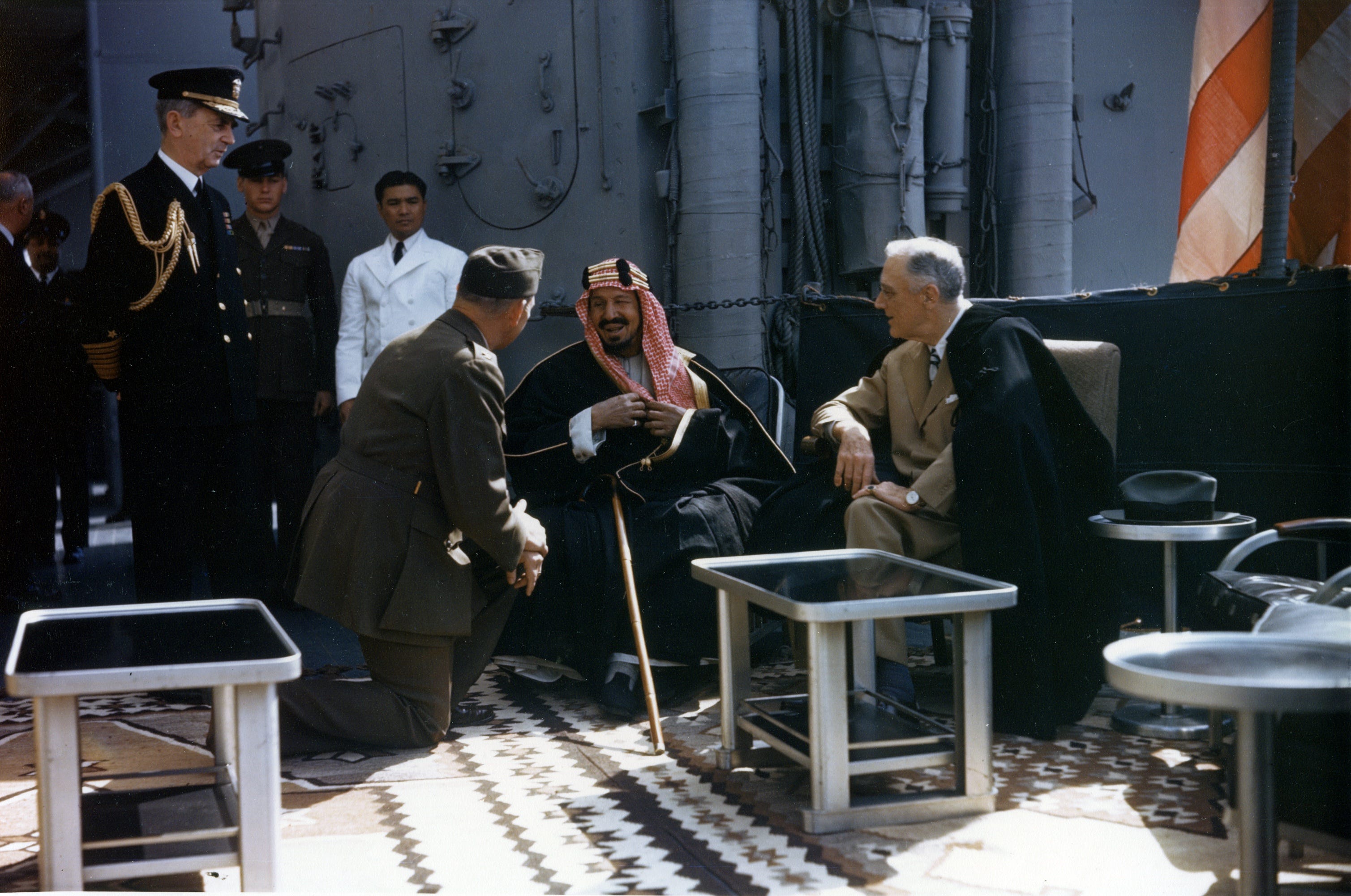
FDR & King Saud aboard the USS Quincy | U.S. Navy photograph, 14 Feb 1945
Source: U.S. Navy
Overview
Our last section left the Middle World in the wreckage of the First World War, its map redrawn by two European diplomats (cf. Part 13). This final section follows what the survivors built on that ground: the modern nations, the secular strongmen who ruled them, and the counter-movements that rose to challenge them.
We begin with the first generation of nation-builders, Atatürk foremost among them, and with the two rival visions that competed with theirs: a united Arab nation, and a restored Caliphate. We trace the role of oil in binding the region to Western power. Then we turn to the land between the Jordan River and the Mediterranean, where two peoples tell two histories, and where our task is not to judge between them but to understand each as its holders understand it. From there we follow Nasser’s rise and fall, the Six-Day War that unmade his world, and the roots of the terrorism that entered Western awareness in its wake.
Assigned Reading
Ansary, Destiny Disrupted, chapters 15-17 & Afterword
Key Terms for this Section
Kemalism • Pan-Arabism • the U.S.–Saudi Alliance • Zionism
Islamist • the Six-Day War • intifada • the two strata
14.1 | New Nations: Atatürk, Pan-Arabism, & Oil
Atatürk & the Secular State
Out of the ashes of WWI, a whole new set of modern countries was created.
1921 | Iraq and Transjordan established under Hashemite princes
1922–24 | the Ottoman sultanate abolished · the secular Republic proclaimed
1932 | the Kingdom of Saudi Arabia
1938 | oil struck at Dammam
1947 | the UN partition plan for the British Mandate of Palestine
1948 | Israel declared · the first Arab–Israeli War
Before the 20th century, no Arab had ever called himself a “Jordanian” or a citizen of “Saudi Arabia.” But nation-states, the Europeans maintained, were the new order of things, and those with money, power, and a vision seized the openings that nationalism offered.
The first to seize them were the Secularists.
The Secular Modernists came forward as a political alternative to the old religious authorities. They could not appeal to religious unity, which would only play back into the hands of the ulama, so they appealed instead to the national spirit (the Volksgeist, cf. Part 13) and the development of their new nations.
The first leader to do this on a grand scale was Mustafa Kemal, called Atatürk, the storied Father of the Turks. Atatürk renounced all Turkish claims to the far provinces of the old empire: he wanted a clear, coherent, defensible territory.
Islamicate imperialism was finished. The Allies had occupied Istanbul itself from 1918 to 1923 (cf. Part 12), and then the end came in sequence: the Ottoman sultanate abolished in 1922, the secular Republic of Turkey proclaimed on 29 October 1923, the Caliphate itself abolished in March 1924 (cf. Part 13).
Much as post-Reformation Europe had done, the modern Turks drove religion into the private sphere. In its place came a parliament, president, and a constitution.
Atatürk’s program is known across the Islamicate world by his name, as Kemalism, and it came to rest on six principles — the ‘Six Arrows’, adopted in 1931:
republicanism • nationalism • populism • statism • secularism • reformism
Other secular modernizers made similar changes: Reza Shah in Iran and Amanullah in Afghanistan drove Western social reforms through at breakneck speed — Reza Shah went as far as banning the veil (the kashf-e hijab decree, ‘unveiling’, 1936). But the latter two, unlike Atatürk, were monarchists, and in truth few of these leaders had much interest in democracy at all.
That is the great puzzle of the age.
Rather than the power and rights of their people, most of these leaders pursued the development of their nations — the roads, dams, power plants, factories, and hospitals.
What the people did not get was the vote, and that held for most of the 20th century.
When the Islamicate world looked at what it lacked, its first impulse was not to demand more freedom. What did its people need with more freedom? They already had the freedom to be Muslims. What they wanted was prosperity.
And so the strongmen held power for decades on the same bargain: they promised Western levels of prosperity while withholding the civil rights the West enjoyed.
Ba’ath & the Caliphate
Not all of the strongmen accepted the idea of separate, competing Arab states. Some looked instead for a rebirth of the Arab people as one continuous nation — more secular than the old Ummah, more inclusive than the carved-up states its members now lived in.
Those who sought this rebirth took their name from the Arabic word for it: ba’ath, ‘rebirth’ or ‘resurrection.’ The Ba’athists held to Pan-Arabism, the conviction that all the Arab states (essentially the whole of the Middle East and North Africa) should form one contiguous Arab nation.
The early Ba’athist vision, articulated by the Christian Arab intellectual Michel Aflaq (who co-founded the party in 1947), was of a secular, socialist utopia bound not by Islam but by the creativity and splendor of the Arab soul — a vision that would change sharply after 1967. The regimes it eventually produced, in Syria and Iraq, have both since fallen (Iraq’s in 2003, Syria’s in December 2024).
So there were the secular nationalists, and there were the Ba’athists, both denouncing the new Arab states as European inventions. But there has always been a third response as well, one that rises out of the older, sterner corners of Islamic thought. Its claim has stayed the same across many names: that Islam must return to the Caliphate — a holy, unified super-nation for all Muslims, here and now.
After the empire fell there came the Khilafat Movement in India (1919–24) and the Sharifian Movement in Arabia (1924). More recently, the terrorist group ISIS proclaimed itself the authentic caliphate (2014) — the newest of them, and the only one built on Salafi ideology (though, as Part 13 showed, most Salafis are entirely non-political). Its territorial ‘caliphate’ fell at Baghuz in 2019. All of them denounced the Sykes-Picot borders (cf. Part 13) and what they called the un-Islamic importation of European ideas into the House of Islam.
Oil & the Unwritten Bargain
By the close of the First World War it was not only the map that had been redrawn but the world economy, and the reason was oil. Once tanks, oil-fired ships, and airplanes had entered modern warfare, it was clear that future wars would be decided by petroleum, and every rising power of the age would need Middle Eastern crude to feed its industrial war machine.
And the Middle East, it turned out, was awash in it.
In 1901 Iranian history turned when a British speculator named William Knox D’Arcy bought from a shortsighted Qajar king the concession to nearly all of Iran’s oil. And who exactly was Mr. D’Arcy? The story goes that the shah answered, “Who cares?” — his pockets now stuffed with cash. In May 1908 D’Arcy’s drillers struck oil, and around the find grew the Anglo-Persian Oil Company — the company we now know as BP, majority-owned by the British government from 1914. By the early 1920s it had made some £40 million from Iranian oil, of which Iran itself had seen roughly £2 million. The pattern repeated in Iraq, where British, Dutch, French, and American firms held a monopoly through the Iraq Petroleum Company and grew rich while the people of Iraq saw little benefit from their own ground.
And then, about a decade later, King Abd al-Aziz ibn Saud, heir of the Mohammed ibn Saud of 1744 (cf. Part 13), was toasting the discovery of oil beneath his own kingdom (1938, at Dammam) — reserves among the largest in the world, black gold beneath the sand dunes, discovered just as the Second World War was opening and the strategic hunger for oil stood at its height.
It was in that moment that President Roosevelt and King Saud reached one of the defining bargains of the 20th century. They met aboard the cruiser USS Quincy on the Great Bitter Lake, in February 1945. No treaty was signed and no paper drawn, yet every Saudi king and every American president since has honored it: so long as the United States has reliable access to Saudi oil, the Saudi government will receive the American technology and military protection it needs to keep the Wahhabi-Saudi royal family in power.
Our author Ansary draws two indirect consequences from this U.S.–Saudi alliance. The first is that the bargain made American military power the guarantor of the Wahhabi reform movement: the most ultra-conservative current in modern Islam now rested, however unintentionally, under the protection of American arms. And because the Wahhabis were now both well funded, by the sale of Saudi oil to the West, and well protected, by American power, they could mount a full-frontal contest against the secular modernists across the Islamicate world.
Set two sides against each other in the Middle East (one ultra-conservative and Islamist, one modern and secular) and ask which side the West chose to underwrite. It was the ultra-conservatives, and the reason was oil. That single choice left the modernists without Western allies, and it is a large part of why secular modernism lost its footing in the Arab world. The United States underwrote secular rulers too (NATO Türkiye from 1952, the restored Shah, Egypt after Camp David) — but the bargain on the Quincy outlasted them all.
14.2 | Israel & Palestine: A Tale of Two Peoples
The Land & the Return
The post-war nationalism that produced Saudi Arabia, Jordan, Iraq, Syria, and Lebanon also took hold in the narrow, contested strip of land between the Jordan River and the Mediterranean Sea — the land of Jesus of Nazareth, of the treasured Al-Aqsa Mosque, and of the ancient Jewish Temple. Before we come to the two modern peoples who claim it, the land’s long history should be laid out, because both competing narratives begin from it.
The Jews had called the land Judah from time immemorial. The word Jew itself derives from Judah. When the Persians and Greeks held it they called it Judea, and the Jews regained it under the Hasmonean kings for something over a century before Rome made it a province. This was the age of Jesus, Paul, and Rabbi Akiva.
In the year 70 the Romans destroyed the Temple on Jerusalem’s Temple Mount. Its single surviving Western Wall is the holiest site of Jewish prayer to this day. Some sixty years later Simon bar Kochba took the Jewish state a third time, and in 135 Rome retook it for good and renamed the province Syria Palaestina — Palestine.
Thereafter the land changed hands with grim regularity. It was a Christian Byzantine province, then taken by the Caliphate in 636, which held it some four and a half centuries and raised the Dome of the Rock and the Al-Aqsa Mosque on the near-empty Mount. Then came 88 years under the Crusaders from 1099 (cf. Part 11). Then, after Saladin, came some seven centuries under Cairo or Istanbul, until the Ottomans lost it to the British in 1917. The people living in the land had not governed themselves since the Bar Kochba revolt of the 130s, and in the meantime two new religious identities and many ethnicities had settled there. So when Britain took up the “Mandate of Palestine” after winning the region from the Turks in World War I, it was not at all clear what should come next.
The modern movement to return Jews to this land has ancient roots, but started in earnest in the 1500s under Joseph Nasi, an Ottoman Jew who took the lease of Tiberias (1561) and welcomed Jews fleeing the Spanish Inquisition. By the 1700s Jerusalem, Hebron, Safed, and Tiberias were renowned as the Four Holy Cities of Judaism. By the late 1800s the Ottomans permitted land sales to Jewish settlers.
In 1896, a Jewish-Austrian journalist named Theodor Herzl published a book called The Jewish State (Der Judenstaat), and the following year, in 1897, he convened the first World Zionist Congress — giving organized form to the idea of Zionism: the belief that the Jewish people have a right to national self-determination in the historic Land of Israel.
Zionism is a textbook case of Herder’s Volksgeist (cf. Part 13). There is no denying a distinct Jewish culture, ethics, history, language, and people with distinct songs, stories, holidays, heroes, art, dress, and food. What was missing in the modern era was land. German nationalism was drummed up in Germany and Japanese nationalism was pitched in the islands of Japan, but when Herzl spoke of taking the Jewish nation back a fourth time, he was speaking of a distant Ottoman province, Palestine, that was only about 6% Jewish in the 1890s.
Two Histories & 1948
Here we reach the heart of the matter, and it requires a particular kind of care. A hundred years ago there was no such thing as an “Israeli” or a “Palestinian” nationality. That fact is the key to the whole difficulty — and the operative word is histories, in the plural, not history. For there genuinely exist two complete and opposing sets of narratives about this region.
This course will lay out both, attributing each to those who hold it, and it will not presume to settle between them. An honest and thorough treatment of the Israeli–Palestinian conflict is far beyond what a short introduction can give. What follows is only a summation.
For Zionists, the birth of the modern State of Israel in 1948 is the story of the Jews at last coming home. In the Balfour Declaration of 1917 the British government promised the Jewish people a national home in a future British Palestine, once it had been won from the Ottomans, and by 1922 the League of Nations had set Britain to that task. Of course, by the 1930s the mandate was filling with Jews fleeing the gathering horror in Europe.
On this telling, the common belief that Britain or Europe simply “gave” Israel to the Jews is mistaken: Jewish immigrants fought the British for the better part of two decades to secure a place to live, and they did so, above all, because the Jewish refugees of Europe had nowhere else on earth to go. It is likewise a misconception, on this view, that modern Jewish immigration was primarily a religious movement. Though it was long spoken of in religious terms, in the 20th century Zionism and Jewish return to the land was a matter of sheer survival.
The United States turned Jews away. Western Europe turned them away. Central and Eastern Europe were murdering a third of the Jewish people on the planet, and religious identity had been outlawed in the Communist East. So those Jews with any family or connection to Palestine fled to it, the homeland of their ancient prayers.
By the end of the war in 1945, despite Britain’s efforts to limit it, the Jewish population of the British Mandate of Palestine stood at about 31% (roughly 553,600 people), and, on the Zionist account, outside of another genocide there was no path forward but to divide the land between the Jews and Arabs living there.
The United Nations, the new post-war body built for exactly such problems, proposed just that (Resolution 181, 29 November 1947): to split what remained of the mandate, after Transjordan (east of the river, had become an independent Arab kingdom the year before in 1946), into two states (about 56% of the land to a Jewish state and 43% to an Arab one), with Jerusalem under an international regime belonging to neither (a corpus separatum, a ‘separate body’). The Jews accepted the partition. The Arabs did not — and here the second narrative begins.
For Anti-Zionists, the 20th-century immigration of Jews into British Palestine was an injustice visited on the Arab world for the sake of something that had happened half a world away, in Europe. Of course the Arabs of Palestine resisted the newcomers. Was this not simply another chapter of the same European colonialism the Arabs of the Middle World had endured for centuries?
On this telling, two layers of outsiders had long dictated Arab lives.
On the one hand, there were the Ottoman Turks: a non-Arab, Central Asian people who happened to be Muslim but who belonged in Arabia no more than the Swedes or the Chinese. The Turks spoke, ate, and dressed differently. They were, in every sense but the religious, foreign occupiers.
On the other hand, there were the Europeans, who had not only arrived as victors after the First World War but had for generations stood behind the Turks as advisors and officers, and who had, a thousand years before, come and taken Jerusalem by the sword. On this view, so what if some of the new colonizers were Jewish? Was that supposed to be an improvement on British Christians or Turkish Muslims? If anything, in the Anti-Zionist narrative, it was worse — because these immigrants did not come asking a favor or come politely. Some among them resorted to terrorism to press their case. The Jews insisted that the land was theirs by right, and that the Arabs already there could go and live somewhere else.
That conviction brought Egypt, Syria, and Jordan into unanimous agreement: the day a Jewish state was declared, the surrounding Arab nations would together move to undo it. And so, on 15 May 1948, the first Arab–Israeli War began, and its result astonished the world.
Israel won!
In Ansary’s woeful words, It was Palestine, not Israel, that became the stillborn child.
The Israelis not only won against the invasion, they gained ground! The newborn pushed the Arab armies back far enough to take West Jerusalem and some 60% of what was to have been Palestine. Of the remaining 40%, Jordan quietly absorbed the West Bank and East Jerusalem, and Egypt took Gaza.
In Gaza an All-Palestine Government was proclaimed in September 1948, which Jordan alone of the Arab states refused to recognize. In December a congress of West Bank notables at Jericho called for union with Jordan instead.
Then there is the refugee question — and it runs in both directions, which is why it has proven so intractable. The war of 1948, which Palestinian historians call the Nakba, the Catastrophe, displaced some 700,000 Palestinians, most of whom were not welcomed into citizenship by the neighboring Arab states and who, with their descendants, have remained stateless refugees.
But over the two decades that followed, some 800,000 Jews left or were expelled from nieghboring Arab countries, and, having nowhere else to go, about two-thirds of them became citizens of Israel. The two ledgers lock together: when Palestinians press for a right to return to their homes from before 1948, Israeli Jews ask whether they too may return to the Arab states their families were driven from.
Today, millions of stateless Palestinians now live in the West Bank, which Israel occupies, and in Gaza.
And that leaves, in the end, three logical options for the future, each with a fatal difficulty. There could be one Jewish state that is not a democracy, in which Palestinians live without the vote — which would be apartheid. There could be one democratic state, in which, within a generation, an Arab majority would vote the Jewishness of Israel out of existence, so that the only Jewish nation on earth would democratically cease to be Jewish — which Israel will never permit. Or there could be two independent states, Israel and Palestine, as the UN proposed in the 1940s: the two-state solution, at once the most popular answer and the most difficult.
The Two-State Question & Gaza
For the two-state solution to work, several agreements would have to be reached that never have been. Justice would have to be met for the losses on both sides. Israel cannot absorb every refugee and descendant who wishes to return without Jews volunteering to become a minority in the only Jewish nation on earth, so the question of a Palestinian right of return (and, in the same breath, a Jewish right of return to the Arab states) would have to find some equitable settlement.
Israel now holds all of Jerusalem and is not inclined to share it. One may reasonably ask what country would readily share its capital with a state it had been at war with for its whole existence, and yet a future Palestine may require exactly that division of Jerusalem, which many religious Zionists flatly oppose.
And there is the question of security: what assurance can Palestinians give that a government Israel makes peace with will not later be replaced by one that uses Palestinian territory as a base against it (the very thing Israel says happened in Gaza after it withdrew in 2005) — and, absent an ironclad guarantee, Israel is unwilling to give up the West Bank it now occupies.
Dozens of further questions attend the conflict, and each side’s right to exist is perpetually put in question. It is worth asking, in a strictly descriptive spirit, why the sovereignty of these two peoples should be doubted when the sovereignty of other modern nations, founded on the same kind of 19th- and 20th-century nationalism, is not. Israel is seen by some as a European colonial project, though about two-thirds of Israeli Jews have family in the Middle East and North Africa. And Palestine is often portrayed in the media as a seedbed of terrorism, though, as its defenders put it, when a population is walled off from the world in what they call an ‘open-air prison’, the quiet voices of reason are easily drowned out by the cries for violence and revenge.
The most recent chapter in this long conflict opened on 7 October 2023, when fighters led by Hamas (the Islamist movement that had governed Gaza since 2007) broke through the perimeter around the Gaza Strip and carried out a large-scale attack on southern Israel, killing roughly 1,200 people, most of them civilians, and taking about 250 hostages back into Gaza.
Israel declared war and launched a sustained military campaign in the Strip, one of the deadliest and most destructive episodes in the conflict’s history: Palestinian health authorities reported tens of thousands of Gazans killed and the majority of the territory’s population displaced, with much of Gaza’s infrastructure destroyed.
A ceasefire took effect on 10 October 2025, and the last 20 living hostages came home that month. A year on it remained formally in place, though deadly incidents continued and its second phase, begun in January 2026, had deadlocked.
The war did not stay contained. Over the months that followed it drew in Hezbollah across Israel’s northern border, pulled Israeli, Iranian, and American forces into direct exchanges for the first time, and gave rise to a long series of partial, and repeatedly broken, ceasefire-and-hostage negotiations mediated by Egypt, Qatar, and the United States. International bodies argued over the conduct of the war in the sharpest terms — some governments and human-rights organizations leveling grave accusations against Israel’s campaign, while Israel and its allies rejected those charges and pointed to Hamas’s practice of operating from within civilian areas — and those arguments broke along the same two histories this section has traced.
Here, as with everything before it, there are two narratives, and the course describes each, without weighing one against the other. In the Israeli narrative, 7 October was an act of war and mass murder against civilians (the gravest single loss of Jewish life since the Holocaust), and the campaign that followed was a war of self-defense meant to dismantle Hamas’s military capacity and bring the hostages home. On this telling, a state that had withdrawn from Gaza in 2005 had been answered not with peace but with the deadliest attack in its history, and could not simply leave that threat in place.
In the Palestinian narrative, the events of 7 October and after cannot be severed from what came before them (the blockade of Gaza, the occupation of the West Bank, and the long absence of a Palestinian state), and the war’s toll on Gaza’s civilians is felt as a catastrophe layered atop the catastrophe of 1948. On this telling, the world’s horror at 7 October passed over the decades of dispossession and statelessness that framed it.
These are not two readings of one agreed set of facts. They are, as this whole section has said, two histories that cannot stand at once. The course’s task is not to adjudicate between them, but to leave you able to recognize each when you meet it, and to understand a little bit why those who hold it hold it as they do.
14.3 | Nasser, Qutb, & the Six-Day War
Nasser & Suez
Back in Egypt, the army officers were furious at the humiliating loss of 1948, and many blamed the king — Farouk, a textbook case of the pampered, out-of-touch royalty that by now plagued much of the Islamicate world. His time was ending, and the secular modernists were moving in.
One morning in 1952 the Free Officers moved fast and, with military precision, overthrew the king in a nearly bloodless coup — two casualties later, and Egypt had a new government. At the head of the movement stood a charismatic officer, Gamal Abdel Nasser. Nasser’s first priority was to get the British out of Egypt. Rebuffed at first by an America that saw no strategic value in Egypt, he turned to the Soviet bloc, which armed him generously — whereupon the Americans, with the Cold War now on, suddenly discovered Egypt’s importance and began to court Nasser.
Washington offered to help build the largest dam project the world had ever seen, at Aswan — music to a secular modernist’s ears. But the courtship curdled. Angered by the Czech arms deal and by Nasser’s recognition of Communist China, the United States withdrew the offer on 19 July 1956, and Britain and the World Bank followed.
But the dam itself was too grand an idea to abandon. Nasser would build it anyway (in the end with Soviet loans and engineers, 1960–70) and electrify Egypt into the next century. He had only to pay for it — so a week after the American withdrawal, on 26 July 1956, he nationalized the Suez Canal, taking it back from the British.
This brought Britain, France, and Israel down on him together in the Suez Crisis of October–November 1956. The British would not lightly surrender the canal’s yearly revenue. The French worried for their trade. And the Israelis joined to reopen the Red Sea route Nasser had blockaded since 1950.
The three took the canal — and then it all came to nothing, because the United States stepped in (with Moscow issuing threats of its own) and made them give it back.
Why? Washington feared the affair would drag the whole Arab world into the Cold War on the Soviet side. So the canal was returned and the invaders withdrew. Israel kept its sea route, the British prime minister resigned in disgrace, and many historians mark this as the moment Britain ceased to be a global superpower.
Qutb & the Brotherhood
Nasser did not care for a world sorted into two Cold-War camps, and he dreamed of a third pole. He built his dam and became, in the eyes of the Arab world, the new champion of a modern, secular, Arab socialism. So he dreamed bigger. With Syria he came nearer than anyone to making the Pan-Arab dream real in the short-lived United Arab Republic (1958–61). With India and Yugoslavia he launched the Non-Aligned Movement, a third force beside the Americans and the Soviets.
And then, by 1965, he was proclaiming the “eradication of Israel” as the national aim of Egypt — a turn that would matter enormously. Three pressures converged on it. First, the United Arab Republic had collapsed in 1961, and when the Ba’athists seized Syria two years later they became Nasser’s rivals. Second, in 1962 Nasser had stumbled into Yemen’s civil war, only to find himself bogged down in a proxy war against Saudi Arabia, which armed the royalists. Third, at home the Muslim Brotherhood had turned against his secularism and become a genuine political threat. Its members had tried to assassinate him (Manshiyya, October 1954).
Nasser’s answer brings this course back to its oldest thread. He had the Brotherhood’s leaders arrested and tortured, and among them was the movement’s foremost intellectual, Sayyid Qutb — the quiet, austere Islamist thinker who revived the ancient division of the world into dar al-Islam, the House of Islam, and dar al-Harb, the House of War (cf. Part 3).
What matters is what Qutb did with it.
The quiet, measured intellectual turned the old doctrine against the secular modernists themselves, calling on the Brotherhood to wage this jihad against the secular Arab governments of Egypt, Syria, Iraq, Jordan, and Lebanon, and to raise a single united Salafi Caliphate in their place. His own key word for them was jahiliyya, ‘ignorance’, the Qur’an’s name for pre-Islamic Arabia (cf. Part 2): in Milestones (1964) he wrote that the modern Muslim world had fallen back into a new jahiliyya — and was to be overthrown.
Nasser had Qutb hanged in 1966 — which, of course, only raised his standing, and the Brotherhood’s, as martyrs for the faith. His writings would go on to shape the Islamist movements of the decades to come. What Qutb represents in this story is not Islam as such, but one modern, radical, Salafi strand of it, an Islamist strand (the adjective naming those who would carry Islam into the public political sphere by force), set against the far larger body of Muslims who wanted no such thing.
Six Days in June
By the spring of 1967 Nasser was besieged on every side: Ba’athists challenging him at home and outshining him in Syria, Salafi Islamists and monarchists funded by Saudi Arabia calling for his head, and a treasury drained by the Yemeni adventure. The hero of the 1950s was becoming the outcast of the 1960s. Nasser had to strike at somebody, and it could not be at any other Arab country, group, or movement.
So he turned all his fury and his fiery rhetoric on Israel, calling in speech after speech for its annihilation, and reimposing the naval blockade — which again shut Israel out of the Red Sea and the routes to the Indian Ocean and Asia, and which Israel had long declared it would treat as an act of war. The other Arab leaders took up his chorus, and for a moment the manufactured crisis gave the Arab world a unity it had lacked.
Then, on 5 June 1967, Israel took them all at their word and struck first.
The war was over in just six days, and its outcome reshaped the region. Most of the Egyptian air force was destroyed on the ground in the opening hours, handing Israel command of the skies for the entire war.
In the south, Israel took the Sinai Peninsula, which it would hold for 15 years (returned in 1982), and Gaza, which it would hold until 2005. To the east it drove into the Palestinian areas Jordan had held since 1948, seizing East Jerusalem and the whole of the West Bank and putting Jews in control of the Western Wall for the first time in two millennia.
And in the north it took the Golan Heights from Syria, the heights that command the Galilee below. Within three days Egypt and Jordan had agreed to a ceasefire, and the war was formally over on 10 June.
Its two aftermaths must be set side by side, at equal weight, because the same six days meant opposite things to the two peoples. For the Israelis, the Six-Day War was a national triumph: after 19 years in which Jordan had barred Jews from the Old City and from the Western Wall of the destroyed Jewish Temple, Israel held its sacred city whole for the first time in 2,000 years. Zionism was renewed across the world, many more Jews immigrated, Christian tourism and the economy surged, and there was even a baby boom.
For the Arabs, the same war unmade the world. Nasser and all he stood for were finished, and after 1967 secular modernism, socialism, and anything that smelled of ‘Westernization’ became anathema to the Arab palate. Into the vacuum came two forces: the new Islamists, who wanted arms to fight the West and Israel in the name of Islam, and the new Ba’athists, men like Saddam Hussein, who wanted arms to fight them in the name of Arab nationalism. Before the 1970s few Americans gave the Middle East much thought. During the 1970s they became sharply, fearfully aware of what came to be called ‘Islamic terrorism.’
14.4 | Histories Talking Past Each Other
The PLO & the Two Strata
In the 1960s the Arab governments had founded the Palestinian Liberation Organization as a way to ‘manage’ the refugees of 1948. Howeever, after the Six-Day War, the Palestinians themselves seized control of it and made it their voice to the world. It was within that shared post-war ordeal that the Palestinians became a nation unto themselves, and among their leaders rose Yasser Arafat, who reshaped the PLO into the Palestinian government-in-exile.
In the 1970s the PLO pressed its case through armed struggle — hijackings and raids that put the Palestinian cause on the world’s front pages. Then, in 1987, the territories rose on their own: the first intifada, a grassroots uprising of strikes, stones, and boycotts that the PLO came to lead but did not start (and the year Hamas was founded in Gaza). In the Oslo Accords of 1993 the PLO recognized Israel and renounced terrorism. A second, far bloodier intifada followed in 2000.
The Ba’athists, emboldened by Nasser’s fall, filled the vacuum in Syria and Iraq, and their leaders (Saddam Hussein among them) sought power as an end in itself — men to whom honor, decency, and even religion were quaint notions. Emboldened too were the Islamists Nasser had jailed and tortured. From the Muslim Brotherhood would splinter ever more violent groups, and the Egyptian offshoot Islamic Jihad would carry a straight line from the Brotherhood to assassination plots to Ayman al-Zawahiri, who would one day lead Al Qaeda (killed by an American strike in 2022).
So what is the draw?
Why terrorism?
The answer turns on the shape of modern Arab society. By 1950 the oil-exporting Arab states were taking up to half of their oil revenues, and enormous wealth poured in. But the strongmen of these undemocratic states did not like to share. The money went first to the party leadership, the jet-setting chieftains with their gold-plated mansions and their fleets of sports cars, and then to a central government that ran costly, inefficient state monopolies.
So yes, a new hospital or school might drop into a neighborhood one day, or a grand new highway named for His Royal Eminence might inexplicably unspool across the desert — but it was never by the people or for the people. Because these governments drew their revenue from outside the country rather than from their own citizens, their leaders eventually stopped listening to those citizens altogether — and the model held even for the states without oil, whose leaders the superpowers simply paid off with ‘developmental aid.’
Out of this, our author Ansary argues, there grew in every major Arab city what he recognizes as the two strata of society: not merely two income levels but two different cultures of people who scarcely met.
The first stratum were the technocrats, educated in the West, who kept the modern state running. They enjoyed mixed-gender society, nightclubs, and Western culture, chose whom they dated and how they dressed, lived by the clock, and built small, mobile, nuclear families.
The second stratum were those left behind by modernity — largely uneducated, poorly nourished, and often ill. They had little contact with the opposite sex outside the extended family, married as their families arranged, dressed in traditional garments, and lived by the rhythm of the five daily prayers, rarely venturing beyond the web of village and kin.
The two strata occupied the same cities, but hardly spoke to each other.
Their neighborhoods had different crime rates and different pleasures. When Westerners came to Cairo or Istanbul or Baghdad, they were steered toward the business district and the Arabs in European suits who were making Europeans rich. Now and then a denizen of the other side would come scurrying past — to carry a visitor’s luggage, shine his shoes, or take away his trash — but between the two strata there was almost never an honest, heartfelt, human exchange of ideas.
And in the second stratum a deep resentment was building.
We now live with the consequences of that rage.
Decades of Violence
This is why, after Nasser and the Six-Day War, a new mosque in the developing world, built with Wahhabi-Saudi oil money and teaching a political Salafi Islam, could speak so powerfully to those the modern state had abandoned. After Friday prayers the Islamist volunteers had blankets and food and candy for the children.
And while the vast majority of those children would grow up to ordinary lives, a few would take up Qutb’s jihadi cause, which promised a person left behind by modernity a way to reclaim a sense of agency. This is the path that has led young men into Islamic terrorist groups.
In 1972 gunmen took 11 Israeli Olympic athletes hostage in Munich and killed them in the name of Palestinian liberation, before the eyes of the world. In 1984 the U.S. embassy annex in Beirut was bombed, killing 24. Over the next two years a wave of Islamist attacks in Paris left 13 dead. In 1993 the World Trade Center was bombed, killing six and wounding over a thousand. Through the 1990s Algeria’s civil war between the state and Islamist insurgents killed tens of thousands. In 1997 gunmen killed 62 people at Luxor in Egypt. In 1998 two American embassies in East Africa were bombed, killing 224. And on 11 September 2001, in a plot devised by Al Qaeda in Afghanistan, nearly 3,000 people were killed and more than 6,000 wounded in New York, Washington D.C., and aboard United 93 over Pennsylvania.
Peace
Since 2001 the toll of casualties has only grown, until many have come to believe that violence against the West is simply a fact of life in the Islamic world. It is not.
The peaceful coexistence of nearly 2 billion Muslims with 6 billion non-Muslims is proof enough that “Islam” is not the problem.
Nor is the trouble a ‘clash of civilizations’ (cf. Huntington, 1996). In his Afterword our author Ansary doubts that either side is even clear about what it means. When Islamists call the West ‘decadent’, the West answers, “We are free” — and these, he observes, “are not opposing contentions, they’re non-sequiturs.” The two sides are talking past each other. “Each side,” he writes, “identifies the other as a character in its own narrative.”
But world history is not a zero-sum game: Islam does not lose if the Jews win, nor win if the Christians lose. There is room enough for all to win. What we are left with, in the end, is a failure to understand the reasoning and the context of the other side: the friction, as he puts it, “generated by two mismatched world histories intersecting.”
And that is where this course has tried to bring you. What I have attempted, across 14 sections, is to hand you some basic vocabulary — a shared set of terms and a shared set of narratives — with which to meet Islam in the future as you might not otherwise have been able to. Islam is a religion. It is also a civilization, a social project, a revelation, a history, and a way of being in the world. I hope you have found it as beautiful and as intriguing as I have. I believe it well worth your continued study.
World peace will not be kindled in a single introductory class. But what I hope has happened for you is that you have come across some ideas that either open a religious tradition you did not know, or open your own tradition in a new light.
So here, at the end, I thank you for your diligence and your time. Please take what you have learned, think about it, grow from it, and use the gifts you develop in yourself to help others.
Salaam. Shalom. Peace.
Last Section: Islamic Responses to Modernity
This Section: The Islamic World Today
The Course: Intro to Islam