

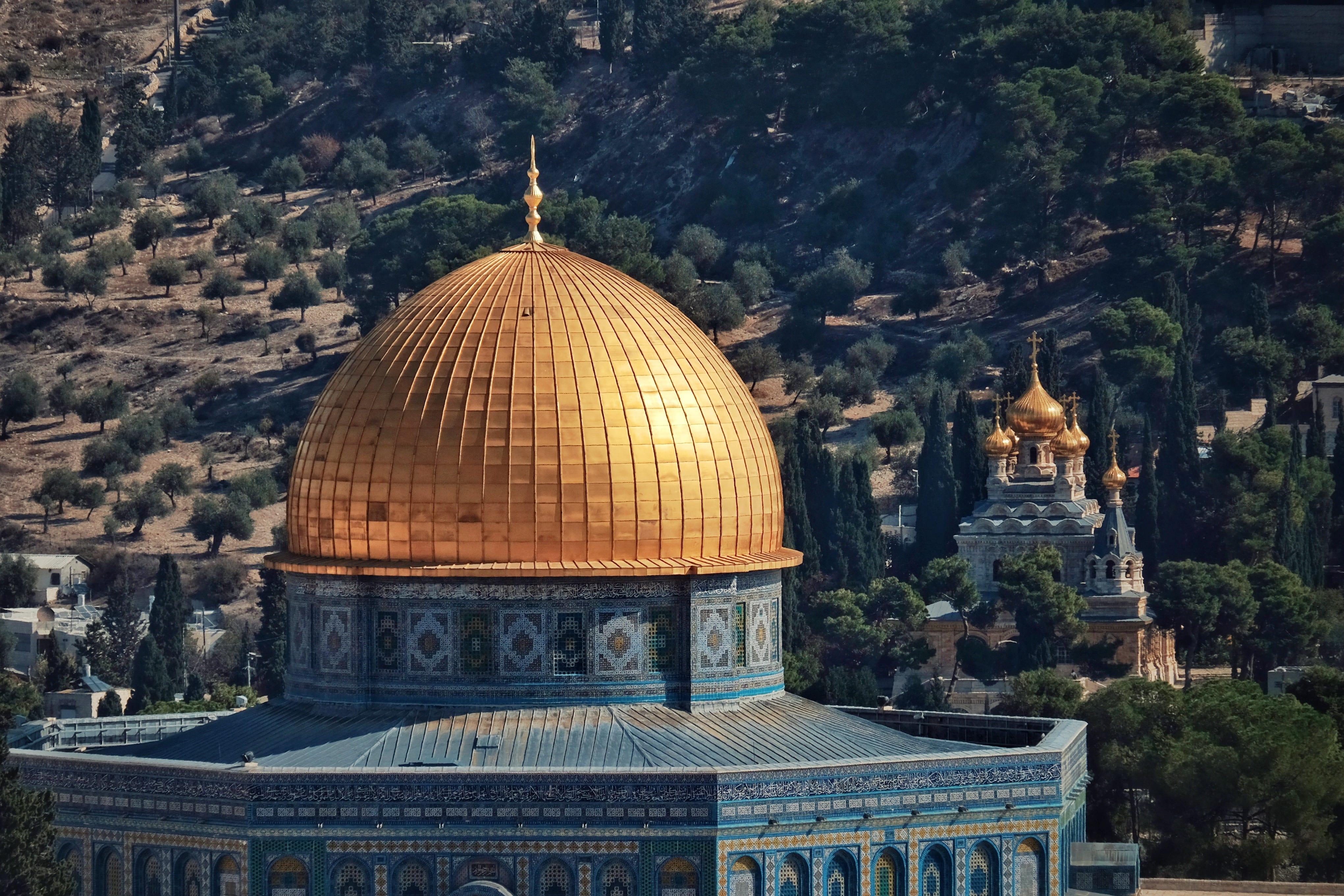
The Dome of the Rock | Jerusalem, 2022
Overview
A murdered election, an Islamicate map that runs from the Atlantic to the Indus, and a brand-new capital drawn as a perfect circle. Part 9 opens Module III, The Golden Age (Parts 9, 10, and 11). Module II read the Qur’an: how it is interpreted (Part 6), what it demands in peace and war (Part 7), and what it says is real (Part 8). Now the Ummah becomes an empire. This Part traces the turn from the elective caliphate to dynasty under the Umayyads, follows the conquest map from Jerusalem to Tours, and watches the Abbasid revolution raise its black banners, ending at the gates of Baghdad.
Assigned Reading
Ansary, Destiny Disrupted, chapters 5 & 6
Damascus • al-Maghreb • the Dome of the Rock
waqf• Abu Muslim • al-Mansur • Islamicate • Baghdad
9.1 | From Ummah to Empire
The Last Shura
Around 676 (56 AH), the shura that convened to debate the next caliph after the Umayyad Mu’awiya (cf. Part 4) was an absolute farce.
In the circle of those gathered to discuss it, one of Mu’awiya’s henchmen openly threatened to kill anyone who dared raise an objection to Mu’awiya’s son, Yazid, becoming the next caliph.
And Yazid did end up as the next caliph. It was under his rule that Husayn and most of his household were killed at Karbala (cf. Part 5), with the seat of power held from Damascus. There would never again be another shura to debate the caliph.
From here on out, the Islamicate empire would be dynastic.
The Prophet Muhammad may have started the Ummah as a religious entity, but as of the leadership of Mu’awiya and Yazid, the Caliphate had become a political empire. The Umayyad empire was the first of many Islamic empires. Some would be Sunni and some Shia. Some Arab, others Persian or Turkish. Some housed in the Middle East, others in places as far-flung as India, Iran, North Africa, or even Spain.
But the Umayyads came first.
The Umayyad Inheritance
Their empire marks the beginning of Islamicate civilization.
Its court language was Meccan Arabic, and its principal ethnicity was Arab. Back in Muhammad’s time, the Umayyads had been the wealthy élite clan whom the Prophet had railed against for their mistreatment of the poor (cf. Part 2). Back then, they ran the city of Mecca. Now, having converted to Islam en masse, their enormous wealth ran not just a city but an empire that spanned continents.
The charitable view is that the Umayyad penchant for wealth made them the perfect inheritors of the Islamic throne. They had the trade networks, the know-how, and the ambition needed to grow the first Islamic civilization across the 7th and 8th centuries.
And, like all the world’s empires, the Umayyads had no compunction about aggressing against their neighbors in a perpetual state of border war. While the Qur’an limits the casus belli (the justifiable grounds for war) narrowly (cf. Part 7), the fact is that the Umayyad dynasty kept pushing at its frontiers through military means. Growing up next to their regional counterparts, the Christian Byzantines and the Zoroastrian Persians, this was simply the political reality of the times.
The machinery of the empire tells the same story. Around 697, the caliph Abd al-Malik (the builder of the famous Dome of the Rock, below) made Arabic the language of imperial administration. In 696–697 he also struck a new gold dinar that carried no images at all, only words quoting the Qur’an. Yet the clerks who kept the empire’s books, from Morocco to Iran, were still largely Greek- and Persian-trained administrators, many of them Christian and Zoroastrian.
3 Empires, 3 Stories
Those three powers were remarkably alike.
In the halls of each king’s court, the dangerous ‘Other’ was warned about, and every ruler reminded his subjects that the sacred peace they enjoyed within their borders was owed in large part to the armies they raised and sent to the frontier.
Christians, Muslims, and Zoroastrians all played this same game — and played it effectively. And each intended, eventually, to rule the others in the name of God.
Each of the three empires had a narrative around which its soldiers gathered. The Zoroastrian Persians praised themselves, rightly, as the most ancient and civilized culture on earth, defending itself against more recent regional upstarts (heirs to a grandeur that reached back long before any of their rivals existed). The Byzantine Christians upheld the gospel and the miracles of Jesus, while remaining tied culturally to the ancient greatness of Rome. Theirs was the story of an empire that had already conquered the world once and been baptized into a new faith.
But the Umayyad Muslims had a far more compelling narrative than history lessons and stories of days gone by. The Muslim forces rallied behind a simple story: a new miracle. They were winning. By leaps and bounds, the Islamicate civilization just kept seeing victory after victory.
And a people who are winning need no ‘ancient pedigree’ to explain themselves.
Critically, all three narratives did the same work: each told a people that history, or God, or destiny had chosen them, and that the empire next door was the threatening godless Other. The Persian looked at his rivals and saw barbarous newcomers. The Byzantine saw heretics and infidels. The Muslim saw a world not yet brought to submission. Three expansionist empires, each certain God was on its side, and one of them (for now) riding a wave of success the other two could not match.
What follows is a description of that wave.
9.2 | Mapping the Conquest: Jerusalem to Tours
Jerusalem, Alexandria, & Persia
First, the Byzantine Christians lost the Levant: Jerusalem itself fell to Caliph Omar in 638 (cf. Part 4). Within a century, the map of the Mediterranean world was redrawn.
• 638 | Jerusalem falls to the Ummah
• 642 | Christian Alexandria falls, and with it, Egypt
• 651 | The last Sasanian king of Persia is killed
• 670 | Kairouan is founded as the forward operating base for North Africa
• 691 | The Dome of the Rock is completed in Jerusalem
• 698 | Carthage (today, Tunisia) is taken
• 711 | The Iberian peninsula (ie. Spain) and the Sindh are invaded
• 732 | The Battle of Tours halts the Muslim advance into France
The famous Temple Mount is the hill where King Solomon had once built the Jewish Temple, and where, in Islamic tradition, the Prophet Muhammad had taken his Night Journey more than a thousand years later. By the 7th century, the Mount had been used as a trash dump under Christian rule. The Mount itself was cleaned up by the Ummah, and around the Foundation Stone was built the glittering Dome of the Rock in 691, under the caliph Abd al-Malik. As the empire expanded, Christians and Jews would live within it as protected communities, and Jerusalem itself would remain a shared holy city for all three traditions.
The Dome still carries its founding inscription, dated 72 AH (691–692), in a long band of gold mosaic, and the choice of text is striking. At the heart of newly conquered Jerusalem, the empire’s first great monument quotes the Qur’an’s words about Jesus:
People of the Book, do not exaggerate in your religion. The Messiah, Jesus, son of Mary, was God’s messenger and His word, given to Mary. So believe in God and His messengers, and do not speak of a Trinity. God is one God. Qur’an 4:171 (paraphrased)
The first great monument of Islamic architecture honors Jesus as God’s messenger.
In gold, on Jerusalem’s Temple Mount.
After Syria and the Levant came the Christian province of Egypt (essential to the Byzantines for grain, for ships, and as the European gateway to Africa). The Ummah mounted a 3-year campaign to wrest the strategic Nile from Byzantine hands, and in 642, with the fall of Christian Alexandria, the once-Coptic province of Egypt passed under full Islamic control. From then on, if drought came to Arabia, the breadbasket of the Nile would guard the Ummah against famine.
Next came Persia. The once-united Persian empire (today, Iran) had already begun to fold, in large part from overextending itself in endless wars with the neighboring Byzantines. By the mid-7th century, the Zoroastrian Persians were economically, politically, and socially unprepared for a major Arab incursion from the south (cf. Part 4). In 628, the Persian king was executed, and no fewer than ten kings replaced him over the next four years!
Civil war tore the thinly-spread empire apart just as the Arab Muslim forces were poised to strike. In 633, the Ummah invaded Persian-controlled Mesopotamia (today, Iraq). By 636, the Persians had lost the entire west of Iran. Sheltered behind the Zagros Mountains, the rest of Persia held out until 651 before it fell militarily.
Still, Persia would always be a special case. Conversion from Zoroastrianism came over centuries. (Iran’s famous Shia identity is a later story, cf. Part 12.) The Persians never embraced Arabic. They kept their own non-Semitic language, their Iranian traditions, and much of their pre-Islamic culture.
In many ways Arab Islam and Persian Islam would always remain distinct. The former spread west from Arabia across North Africa. The latter traveled north and east from Persia into the lands of the Turks, the Central Asians, and India.
That fault line will matter for the rest of the course.
From the Atlantic to the Indus
And so it was that in 661 (40 AH), the Umayyad caliph Mu’awiya was able to hand his family Egypt (the gateway to Africa), Persia (the gateway to Asia), and naval control of most of the formerly Roman Mediterranean. One point deserves emphasis: these lands were controlled by Muslims, but only 10 to 20 percent of the population identified as Muslim at the time.
This was minority rule.
There was a thin governing class atop a vast and largely non-Muslim populace.
By 670, the Tunisian city of Kairouan was serving as a forward operating base for North Africa (in Arabic, al-Maghreb, ‘the west’). By 698 the Maghrebi forces had taken the city of Carthage, and in 708 the Moroccan city of Tangiers fell as well.
Islam was now an Atlantic civilization.
East of Persia, the Turkic-Buddhist region of Transoxiana (today Uzbekistan, Tajikistan, and Kazakhstan) was pried open slowly: first raids, striking Bukhara (673) and Samarqand (675), then conquest in earnest under the general Qutayba ibn Muslim (705–715). From the Far East, China grew alarmed at the prospect of losing authority over the priceless Silk Road and backed the Turkish defenses. The contest was settled only in 751, when Abbasid and Tang armies met at the Talas River and the Chinese were turned back. Transoxiana would belong to the Islamicate world.
South of Transoxiana, the Ummah took the Indian province of Sindh (today part of Pakistan) in 711, and by 714 controlled the entire lower Indus Valley. A word about a word: the name ‘Hindu’ that the Muslim forces used for the local non-Muslims was itself inherited, not invented. Persian speakers had long called the peoples and lands beyond the Indus ‘Hindu’ (from Sindhu, the Sanskrit name of the river), and the conquerors spread that usage. It would be many more centuries before the full extent of Islamicate dominance in India took hold.
Back in the west, the Islamic conquest of Christian Spain came rapidly. The local forces were mostly North African Berbers (Amazigh, as they call themselves), not Arabs, unified from Kairouan to Tangiers. The Maghrebi incursion was dramatic. As in Persia, the fall of Spain was preceded by the death of a monarch: the Germanic Visigoth king Wittiza died in 710, and internal division among the Gothic kingdoms triggered the Islamic conquest in 711. The capital city of Toledo surrendered peacefully, and the local Spanish Jews welcomed the egalitarian Muslims as long-prayed-for liberators.
By 716, most of Iberia (today Spain and Portugal) was under Islamic control (the mountainous north of Asturias never fell). Muslim rule would last, shrinking over the centuries, until Granada, the last emirate, surrendered in 1492. The Islamic advance into Western Europe ended famously at the northern Battle of Tours in 732, when the Frankish general Charles Martel repelled the Muslim forces. Though Spain left Christendom for seven hundred years, France would remain Catholic.
Damascus & the Waqf
The unprecedented wealth that came pouring into Damascus from across the world ushered in an age of prosperity and public works the Middle East had frankly never seen. Lavish building projects (the Dome of the Rock among them) went up, and the blending of Roman, Persian, and Arab sensibilities became the very basis of Islamic art and architecture. Ambitious public works, schools, roads, and charitable endowments were paid for at no cost to citizens.
Beyond the Middle East, an Arab nouveau riche sought its fortune by establishing grand estates in garrison cities throughout the young empire. These motivated families would become the silk-swaddled landed nobility of Islamic society for centuries.
One of the ways the new Islamic lords displayed both their greatness and their piety was by funding a local waqf. The word comes from the Arabic root w-q-f, ‘to stop, to stand’: the endowed property is ‘stopped,’ held out of sale for good (plural awqaf). A waqf was a philanthropic religious foundation that worked autonomously for the good of the community. It was never owned or operated by its donors. It functioned instead as an independent, non-profit charity: collecting donations for the poor, building mosques, and running schools, hospitals, and orphanages.
Critically, once a waqf was founded, its own donor could not shut it down. It was legally self-perpetuating, insulated by design from the whims of the wealthy family that had endowed it. In Europe, charitable efforts of this kind were centrally organized through the Catholic Church, under the Pope and his subordinates. In the Islamicate world, the waqfs were independently and regionally controlled.
It was from the charitable work of the waqfs that local Muslims across the empire could, if they were pious and clever, rise from nothing to become Islamic scholars. Many did exactly that, and the Islamicate world flourished as a result of this focus on education and social development, the very seedbed of the ulama, the scholarly class of the age (cf. Part 10).
9.3 | The Abbasid Revolution
An Arab Aristocracy
The Umayyad empire’s greatness was also its most dangerous liability. As the empire grew in size, so too did the distance between those who could afford to participate in the new civilization and those who could not. Historically, the price of political stability has often been the rich growing richer while the poor grow poorer.
Arabization and Islamification of the local ethnic groups within the Caliphate occurred haphazardly and unevenly. North Africa, for example, Arabized quickly, since there had been no unified culture there to resist it. The Persians, as we have seen, were the most resistant of all. But whatever level of assimilation a local population reached, one thing was clear. From the Atlantic to the Indian Ocean, the Arabs were the aristocrats now.
The Umayyad class structure took shape primarily along religious strata.
At the very top of society were pure-blood Arab Muslims. Within the borders of the Islamicate world, from Morocco to Iran, Arabs were generally treated with royal deference. The second tier were Muslims with one Arab parent. Beneath them came the rest of the world’s Muslims (those with no Arab heritage who nonetheless held to the Prophet’s message).
Then, across a harder line, came the Jews and Christians — the People of the Book. These dhimmi (the ‘protected peoples’ of Part 3) were not treated as co-equals with Muslims, but they held opportunities others did not. And who were those others? In a word, the polytheists and pagans. At least the Jews and Christians knew the prophets and had some sense of what Islam promised. When Muslims spoke of God, the People of the Book understood what was meant! The polytheists had none of that shared background, and so they generally stayed at the bottom rung. Until they converted (to Islam, or at the very least to Christianity), they had virtually no legal rights.
Eventually this classist arrangement produced a growing theological problem. One of the core promises of Islam was that Muslims lived in a brotherhood of equals. The Qur’an had set that standard itself:
God created humanity from a single pair and made it into nations and tribes, so that they might come to know one another. The noblest among them, in God’s sight, is the most mindful of Him. Qur’an 49:13 (paraphrased)
The Islamic origin story told of a simple, rugged people who braved the hot desert sands together and fought valiantly, side by side, for the good of all. The Prophet Muhammad famously slept on a single sheet folded four times, serving as both his mattress and his cover. Caliph Omar was known to sit at his cobbler’s bench and mend his own worn shoes.
Now, though, the Ummah seemed to stand for the perfumed few hoarding most of society’s wealth, while most non-Arabs scrapped for whatever the Umayyads left out for them.
This became a recipe for revolution.
Abu Muslim & the Black Banners
There was a particular sting to this friction. The Arabs now lording it over the empire were mere upstarts in the eyes of many they governed: a desert people grown suddenly and fabulously rich on the spoils of conquest. The Persians, by contrast, were the heirs of one of the oldest and most sophisticated civilizations on earth, a culture that had been building cities and for a thousand years before Mecca’s caravans.
To be ruled as a second-class subject by the nouveau riche was galling enough — to be ruled by nouveau riche who claimed the sanction of God Almighty for the arrangement was intolerable. This is the grievance at the center of the age: not merely poverty, but the humiliation of the once-great made to bow to the newly-arrived.
That grievance did not smolder evenly everywhere. In the Persian east, the anger over Husayn’s death and the massacre at Karbala had never cleared away, and the widening wealth gap between Arab Muslims and Persian Muslims only sharpened it. The Persians saw themselves twice over as underdogs: an ancient people facing an Arab aristocracy, and partisans of the Prophet’s family facing the dynasty that had cut that family down in cold blood.
Never Arab enough, never the right family — always second-class while the Umayyads ruled.
From this discontent, two very different opposition movements took shape. Only one would matter in the end. The Kharijites (the fierce, uncompromising purists of Part 4, who held that any sinning caliph forfeited his office) ultimately fizzled as a political force. Their absolutism was too extreme to build the broad coalition a revolution needs, and they spent their energy in scattered, doomed risings.
The Shia were the real threat. After Karbala they possessed the two things the Kharijites lacked: a concrete grievance the whole east could feel, and a legitimate bloodline claim to the caliphate through the family of the Prophet. They would remain the Umayyads’ most dangerous opponents, and, in the end, the instrument by which the dynasty was finally brought down.
The leader who finally turned that discontent into a revolution was a mysterious figure who went by the nom de guerre Abu Muslim — which means, plainly, ‘a Muslim man’ (more literally, ‘father of Muslim,’ an Arabic byname). The anonymity was deliberate. It is fitting that history barely knows who he really was, because he was, in every sense, a professional revolutionary.
Khorasan, in the Persian east, was the far frontier, distant enough from Damascus that an organizer could work for years without the caliph’s spies catching the scent. From there, Abu Muslim built his movement the way a modern insurgent builds one: patiently, in cells, arming and training a cadre hellbent on purging the Caliphate of Umayyad control, and drawing on the ready reservoir of Shia and Persian resentment.
What is striking is what he did not do. He was studiously vague about who, exactly, would sit on the throne once the Umayyads fell. Name a specific candidate too soon, and every faction with its own preferred claimant would peel away. But keep the question open, and everyone who hated the Umayyads could march under one banner.
So the cadre was told only that the caliphate would be restored to its rightful house —the house of the Prophet. That doctrine, the Hashemite claim, was drilled into them until it became an article of faith. The claim ran through the Banu Hashim, the Prophet’s own clan. The revolutionaries even gave the ambiguity a slogan: al-riḍā min āl Muḥammad, ‘the one acceptable from the family of Muhammad.’
But which one? The slogan, very deliberately, never said.
And here the revolution’s careful ambiguity paid a strange dividend: with no willing descendant of Ali stepping forward to lead, the movement could quietly enlist Abu al-Abbas, a descendant not of Ali but of Muhammad’s uncle. He was a man of the Prophet’s clan, technically, though not of the line the Shia had bled for.
The banners went up black. The Umayyads, for their part, reflexively flew the white banner. What they failed to appreciate, back in Damascus, was that white is the Persian color of death.
• 747 | Abu Muslim raises the black banners
• 750 | The revolution wins and the last Umayyad caliph is run down in Egypt
• 754 | al-Saffah dies of smallpox
• 755 | Abu Muslim is murdered on al-Mansur’s orders
• 762 | Baghdad is founded
Of course, the Abbasid authorities made much of that omen. But in truth, this was not a simple fight over right and wrong. It was about Umayyad hegemony. It was about broken promises. And, of course, it was about Ali’s line, cut down at Karbala.
In 750 (132 AH), the armies of black and white met for the future of the empire at the Great Zab River. Though outnumbered, the black army of Khorasan won a stunning victory that sent the last Umayyad caliph fleeing to Egypt. Within the year, he had been found and executed.
In his place, the Abbasid dynasty was born.
The Red Feast
The Hashemites declared Abu al-Abbas the new, rightful caliph of the Ummah.
Then came a gesture of goodwill. The new regime invited the leading members of the Umayyad clan to a lavish dinner. No expense was spared. The Umayyads laughed with the new Abbasid leadership, draped across plump cushions as servants brought them their every culinary desire.
It was a feast indeed — until it wasn’t. When the signal was given, the servants dropped their waiters’ garb to reveal the armor beneath. This had never been a dinner. It was an execution.
In the aftermath of that bloody affair, Abbas proudly took the name al-Saffah, ‘the Slaughterer’. There’s every indication he relished the infamy, however short-lived: soon after, Abu al'-Abbas contracted smallpox and died. Stepping out from behind the Slaughterer’s shadow to lead was Abbas’s brother, al-Mansur, ‘the one made victorious.’ This was the actual beginning of the Abbasid dynasty.
Fooled you, didn’t I?
Except they were fooled too! One Umayyad escaped: the young princeling Abd al-Rahman, who fled west across North Africa, crossed into Spain, and was embraced as their new leader! From 756 he ruled from Córdoba, where the Umayyad house would outlive its own fall by nearly 300 years.
Al-Mansur left nothing to chance. He set about cutting every loose end, killing off his enemies (both real and imagined). He even sensed a looming threat in the sheer popularity of Abu Muslim, the revolution’s own general.
So al-Mansur threw a campfire dinner for the famous commander and his men. The first night was a rollicking good time! However, by the end of the next evening, Abu Muslim’s throat had been slit and his body thrown in the river. His closest lieutenants and advisors were also killed for good measure. Al-Mansur wanted absolutely no one left who might threaten his claim to the throne.
The new boss was the same as the old boss…
For all of their revolutionary rhetoric out of Persia, the Abbasids generally ran things exactly as the Umayyads had. Both dynasties were run by secular rulers who kept control through spies and secret police rather than through the holy authority of religious scholars.
In truth, the Abbasid élite had little interest in matters of religion. Once they held the empire, they quickly dropped all pretense of any association with Shia Islam. Instead, the scholars already in the halls of power kept their vaunted positions. The Abbasid rulers honestly did not care one way or the other.
If anything, the long-standing distrust of the Shia in the east led the Abbasids to hunt down Shia leadership and kill anyone with even a remote connection to Ali, Fatima, or the imams. This is how the dream of a Shia caliph of Islam died — in the dark, hidden chambers of the paranoid Abbasid palace.
9.4 | Baghdad: The Crown Jewel of the Age
A Capital from Scratch
And yet, for all the treachery, there was also an historic greatness and an unparalleled vision among the Abbasids. Like the Umayyads before them, they presided over an era of prosperity, culture, and art. When al-Mansur needed a new capital, he did not repurpose an old city — he designed one from scratch.
He found the perfect site on the west bank of the Tigris, at the point where it and the Euphrates run closest to each other, joined by canals. There, the Middle World’s most fertile fields spill toward the strategic waters of the Indian Ocean. And in 762 (145 AH), the city of Baghdad was founded.
The chronicler al-Tabari preserves the caliph’s own reasoning at the site:
“This is the Tigris. There is no obstacle between us and China. Everything on the sea can come to us from it.” Al-Tabari, History
The Round City
It was, in its original design, a marvel of geometry. Al-Mansur’s architects laid out a perfectly circular city: Madinat al-Salam, the ‘City of Peace’. It measured about a mile and a half across, ringed by a round wall that medieval accounts make some 98 feet high and, at its base, nearly 145 feet thick. Four great gates pierced the wall at equal intervals, each opening onto a road to a corner of the empire, so that the whole realm seemed to converge on this single point.
Inside, the city radiated outward in concentric rings, and at the dead center (insulated from the bustle by ring after ring of the plan) sat the caliph’s palace and the great mosque, the twin poles of Abbasid power.
Over the next twenty years, Baghdad would become, by many estimates, the largest city in the world — the first on Earth to grow past a million inhabitants since Ancient Rome. Blacksmiths and goldsmiths, florists and cloth merchants, philosophers, poets, and artists all streamed toward the Abbasid capital, the gem of the eighth century
(We’ll pick up on this story in Part 10.)
“Islamicate”
The Abbasids were an Islamicate (cultural) rather than a purely Islamic (religious) empire. This word is a modern coinage (cf. Hodgson, 1974), built on the model of ‘Italianate’: in the style of a civilization, not the religion itself. The Abbasid empire was Islamicate in exactly that sense, run by largely secular rulers, staffed by Muslims and non-Muslims alike, and defined more by a shared civilization than by devotion.
Much of this age is still visible. The Dome of the Rock that Abd al-Malik raised over the Foundation Stone in 691 still crowns the Temple Mount in Jerusalem today, one of the oldest surviving works of Islamic architecture on earth.
The Sunni–Shia divide that ran beneath the Abbasid revolution, and the split between Arab and Persian Islam that opened during these conquests, are not museum pieces. They remain live categories in the modern Middle East and in the scholarship that studies it. And the very distinction Part 9 has drawn (between an Islamicate civilization and an Islamic religion) is a working tool that historians still reach for when they describe the achievements of this world, precisely because so much of what came next was the work of Christians, Jews, Zoroastrians, and Muslims alike, living under one sprawling empire.
Baghdad now stands at the center of that world, poised to become the beating heart of a golden age. Four gates, four roads, the four corners of the empire, all converging on one round city. For the next two hundred years, this is where the roads of the world will run. Until they suddenly don’t…
Last Section: Qur’anic Ontology: Evil & the Afterlife
This Section: Umayyads & Abbasids
Next Section: Islamic Intellectualism & Mysticism