

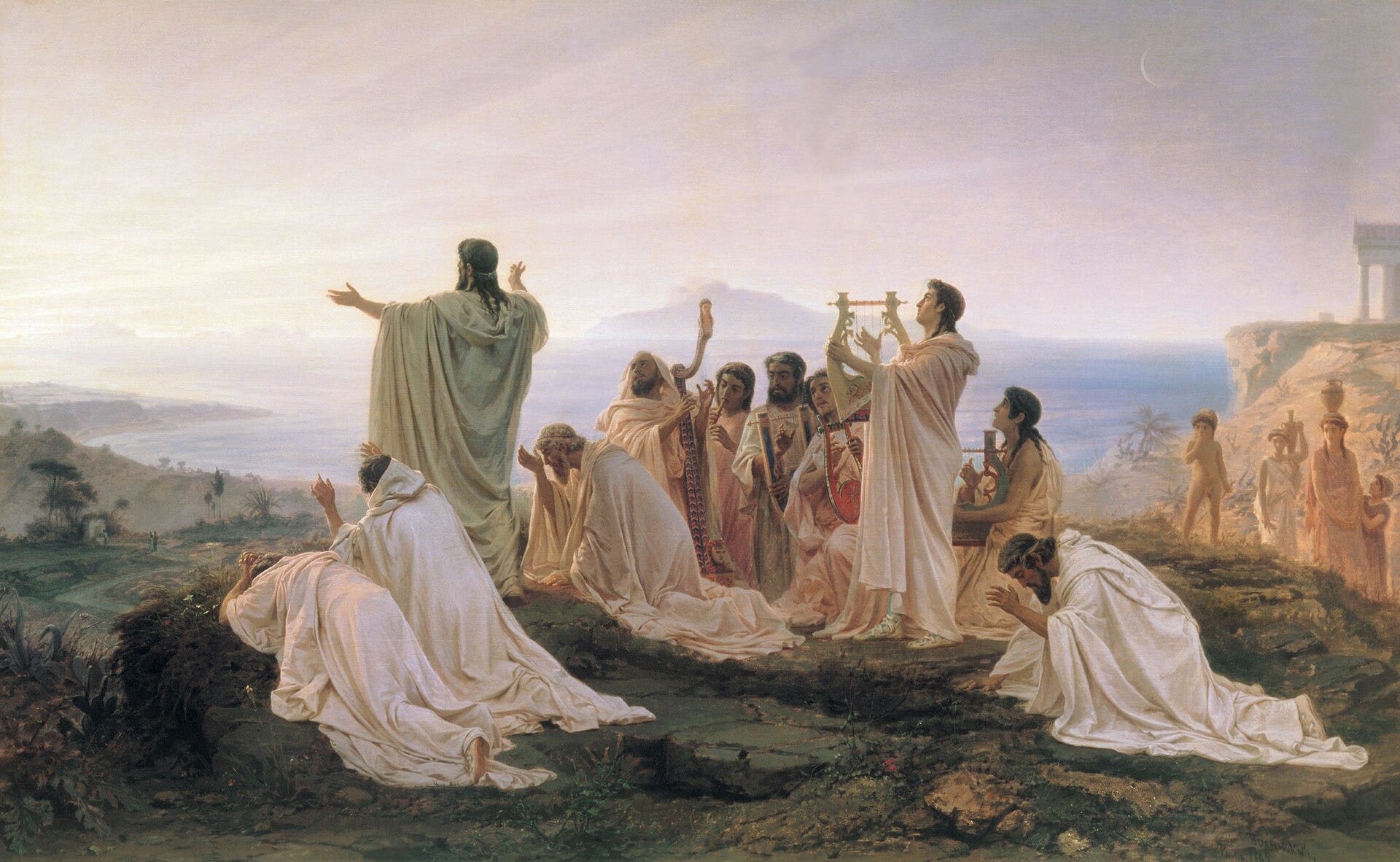
Pythagoreans Celebrate the Sunrise | Fyodor Bronnikov, 1869
Key Terms for this Section
Philosophy · Metaphysics · Ad Hoc Stories · Arché · Epistemology
1.1 | What is Critical Thinking?
Why take this Class?
We all need to think well.
Our lives are guided by and dependent on our decisions. If you’re not being proactive about those decisions, someone else is making your decisions for you. Your position at work. How you spend your afternoons. Who represents your political interests. Most people’s lives could be vastly improved upon by learning how to think better. Is this the right purchase for me? Is this a deal I should make? Is this a person or source I should trust? The missing piece here is wisdom.
Wisdom is exercising knowledge and experience to examine oneself (and/or a situation) to arrive at a more rational and ethical outcome. Wisdom informs our benevolence, experience, and technical skills. A person may be compassionate but lack the wisdom to apply her heart to the right cause. A person may be older but still stuck in outdated thinking. Or a person may have great technique — say, as a chef — but lack the necessary wisdom to run their own restaurant.
If it helps, think of this as a course on intellectual self-defense.
At the end of the day, I want you to be your own person — and I want that independent thinker to think well. The discipline of philosophy holds autonomy and intelligence in very high regard. To this end, this course will have a sharp focus on thinking well for yourself. The world is filled with people who would be very happy to take your time, money, and efforts — often expecting you to thank them for the privilege! We are going to be better than that. We are going to be prepared.
In preparation for your life after college, this course integrates the best theoretical knowledge with practical application. We will comprehensively explore key philosophical concepts and their relevance to everyday life. You will engage with some of Western history’s most famous philosophical ideas, learning how to apply them to real-world scenarios.
In return, your assignments will be your opportunity to develop and present well-structured philosophical arguments in a safe environment. This will involve exploring different methods for framing philosophical questions and crafting cogent responses, allowing you to engage critically with complex issues. Through this process, your ability to think well for yourself will expand as you analyze and articulate nuanced perspectives on philosophical matters. No other course puts you face to face with your own thinking quite as well as an Introduction to Philosophy.
Treading Toward Philosophy
You have no doubt heard the word “philosophy” before. The popular idea of philosophy often comes in the guise of a catchy phrase or a clever bumper sticker like:
• Do to others as you would have them do to you.
• Always look out for #1.
• When in Rome, do as the Romans do.
• All’s well that ends well.
• All you need is love.
But such sayings are more aptly called adages or proverbs. Their purpose is to encapsulate a cultural worldview in a few snappy words. Sadly, for the uninitiated, this is often the only kind of “philosophy” they will ever encounter. There is, however, an academic meta-discipline called “philosophy” that is far more complex than what is generally discussed in public. It is the first academic discipline, it is where the word “academic” comes from, and is the fundament of all other academic disciplines.
Think about it. There is a Philosophy of Biology (ask a medical researcher). There is a Philosophy of Law (ask a law professor). There is a Philosophy of Music (ask a conductor). All academic fields have and make philosophical claims. Ignorance of this fact does not mean philosophy is irrelevant to one’s work — it simply means there will be limitations to one’s potential in that field. The best artists, teachers, and business professionals lean into philosophy as a toolset for achieving well beyond their peers.
The academic discipline of philosophy, which you will participate in for this course, is as rigorous as international law, biotechnology, or particle physics. American philosophers hold academic conferences, belong to professional associations, and compete with one another to publish in the most highly–regarded, peer-reviewed publications (eg. the publishing houses of Harvard, Yale, Oxford, Cambridge, etc.). Professional philosophers attend nationally televised debates, are studied by top filmmakers and authors, are quoted by presidents and prime ministers, and shape political policies around the globe. This is the kind of philosophy we will study in this course.
Throughout our time together, we will learn how some of the greatest minds in the history of Western civilization tackled some of our most fundamental questions. Now, given both the finite amount of time we have together, as well as the fact that this is an introductory course that assumes no previous knowledge of philosophy, I’ve had to make some tough choices about what we will study. We will focus our course on four fundamental philosophical questions: 1) What can we know? 2) What should we do? 3) What is our purpose? And we will end our course with 4) a philosophical discussion on the nature of beauty and representation. These questions will lead to us investigating further questions, such as:
1a. What is the difference between philosophy and other stories about the world?
1b. What is the nature of existence?
1c. Doesn’t science answer all the big questions now?
1d. What is the relationship between one’s subjectivity and truth?
2a. What defines a good moral character?
2b. What compels us to cooperate together?
2c. What obligations do we have to one another?
2d. Do the needs of the many outweigh the needs of the few?
3a. How do I aim for happiness?
3b. Why do I feel so alone when surrounded by people?
3c. What is the meaning of life?
3d. What is the nature of the self?
4a. Why can’t I describe some of my feelings?
4b. Are my judgments socially constructed?
4c. How is current technology changing meaning and representation in our world?
What is Critical Thinking?
This kind of study, reflection, and evaluation creates a certain type of person: the critical thinker. A critical thinker is a more open-minded kind of thinker. This open-mindedness generally arises from being exposed to multiple, divergent viewpoints without a preconceived notion of which view is “right.” Analysis of such diversity exercises both your analytic and creative skillsets, ultimately rendering you a more knowledgeable and self-aware person. Many of these qualities occur naturally in some people, but others must be developed no matter who you are. That is, while some of us may be naturally creative or curious, none of us can say we are naturally knowledgeable. Thus, we cultivate critical thinking with time and study — which is exactly what you’ll be doing as a student in this philosophy course.
1.2 | Critical Thinking in 3 Stages
The study of philosophy actively encourages you to become a critical thinker. At a basic level, we can understand Critical Thinking as the ability to solve intellectual problems or challenges in a logical and rigorous manner. I find William Perry’s 3 Stage Model useful in appreciating and understanding how one becomes a Critical Thinker. His stages begin with passive thinking and end with critical thinking. As you progress through the course, try to recognize yourself within these stages and realize that, with effort, you can progress to the final stage of critical thinking.

Childhood: Passive Thinking
William Perry refers to passive thinking as the “Garden of Eden” stage. In this toddler–like stage, moral and philosophical questions are generally seen in black and white. That’s just the way it is... Actions and statements are either right or wrong, with little room for nuance, negotiation, or compromise. Typically, these claims are based on what legal authorities unilaterally claim (often parents or schoolteachers). However, as every teenager knows, authority figures are imperfect, and the world isn’t made of clear-cut, black-and-white situations. Critical questions often arise out of murky circumstances requiring more nuance than simple, blind obedience. Once we make this adolescent realization, Perry says we move into the second stage, where “anything goes.”
Adolescence: Relative Thinking
In the Anything Goes stage — typically beginning when we’re teens but remaining with many people throughout their lives — we realize authorities are fallible. We decide that if we can’t trust the authorities to be perfect, then no single point of view is better than any other. If there is no absolute right or wrong given by a perfect authority figure, then we can fall to relativism or nihilism (more on this in Module 2). At this stage, we generally find that most things are a matter of opinion. But if that’s the case, then there can be no truths to guide society. What follows from this is the thinking that author Isaac Asimov famously summarized as “My ignorance is as good as your knowledge.” Meaning there are no experts. Everyone with a Facebook account and Internet connection can claim whatever they like, and no one’s opinion is any better than anyone else’s. What a scary thought!
Expertise: Critical Thinking
In the final stage, we understand what it means to think critically when we accede to one simple fact: EXPERTISE EXISTS. As a critical thinker, I’m clever enough to know what I don’t know. I don’t know how to fix an air conditioner. I don’t know how to build a rocket ship. I don’t know how to coach a basketball team — but there are experts who do! The critical thinker acknowledges that some viewpoints are much more informed than others because there are rational, compelling reasons to supporting their claims. Arguments are better or worse because of the strength of their argument. Critical thinking shows us that we are responsible for exploring multiple well-informed perspectives, evaluating reasons for their sources and rigor, and to develop informed conclusions that help us make better decisions.
As a critical thinker, you will be able to see that some arguments are better than others because of the logic and reasoning behind them. You will know why you find something amiss, not simply because it’s what your family believes or what you’ve always been told, but because of logical reasoning. It is with this academic toolset that you will best acquire the lifelong skills necessary to encounter others with similar training on an even footing.
Keep in mind as we proceed that this course isn’t designed to be agreeable. You will read and hear things from the text, your peers, and perhaps your professor that may challenge your preconceptions. That’s not a bad thing. Consider steel at a weapons forge. A blacksmith challenges the integrity of steel repeatedly, beating out impurities and refining it until it is strong enough to withstand the weight of its design. If you surround yourself with others who agree with you, if you never test yourself, your opinions can never be sharpened.
1.3 | Ad Hoc Stories - Thales
For the Love of Wisdom
Philosophy is an ancient Greek concept, meaning the “love of wisdom.” Armed with reason and logic, Philosophy is the foundation of all other disciplines. Philosophy gave us the rich heritage of ideas that brought us out of monarchy and into democracy, from slavery to emancipation, from trial by ordeal to trial by jury, from alchemy to chemistry, from a tutored elite to an educated public, and from rights for only a few to the Universal Declaration of Human Rights. It informed the civil rights struggles of Mary Wollstonecraft and Martin Luther King, Jr., And it informs everything today, from calculus to quantum physics.
Before Philosophy: Ad Hoc Stories
Before the advent of philosophy, ancient people explained the world through ad hoc stories — simplistic, “just so” narratives that addressed critical questions about life and the natural world. In the Iron Age, illness and death were often attributed to the will of Greek gods or malevolent spirits. While providing comfort and a sense of order, these explanations did not seek to rationally understand the underlying causes of phenomena. Instead, they offered simple, culturally acceptable answers for their time. Iron Age Greeks enjoyed ad hoc stories like Hesiod’s Theogony and Homer’s Iliad and Odyssey. These epic poems provided rich narratives of gods and heroes and embedded moral lessons and cultural norms. Hesiod’s Theogony (which delves into the origins and genealogies of the gods) explores themes of justice and order. Homer’s epics illustrate heroic Greek values like honesty, bravery, and intelligent problem-solving while also exploring the ethical consequences of moral choices and actions. These values would resonate with later Greek philosophical inquiry.
By the 500s BCE, some Greek thinkers began to set aside their traditional narratives and sought instead rational explanations for natural phenomena. What makes the sun rise? What pulls the tide in? What are we made of?
These trailblazers preferred reason and evidence over myth and superstition. The earliest philosophers, like Thales, Anaximander, and Heraclitus, pioneered this view, emphasizing the pursuit of rationality rather than blindly accepting cultural tradition. This evolution marked the beginning of systematic philosophy, transitioning from ad hoc explanations to a more logical approach to understanding the world.
The First Philosopher | Thales
Systematic philosophical inquiry begins in the West with Thales (ca. 548 BCE), who lived in the Greek city of Miletus (today on the Turkish coast). His work represents a profound departure from the former mythological explanations of the world. Like many before him, Thales was deeply interested in discovering the fundamental, deep structure of reality. Before Thales, poets and scribes had described the origin and nature of reality in poetry, scripture, and song. But Thales sought something new — a rational description of reality that did not rely on culture or tradition. Thales sought wisdom that would be just as true at home in Greece as in Africa, Europe, or Asia. So, after years of pondering this universal question, Thales made the first recorded philosophical claim. He deduced that water is the fundamental substance or arché of all things.
Much of ancient Greek culture was centered on the search for the “arche” of existence. What is the foundation of reality? Thales’ vote was water.
Thales reasoned that all things are made of tiny elements and that at its core, water must be the arche of life — the origin from which everything arises and into which everything eventually returns. This idea reflects a significant shift from attributing natural phenomena to the will of the gods. Herein, we find Thales seeking a unifying principle explaining the physical world. Thales’ went on to reason that the mundane physical world is separate from the divine world and, thus, comprehensible through human reason. His Greek division of the world into the physical and the essential represents the first steps toward Dualism, which we’ll pick up on in our discussion of Plato (Sec. 2.3).
Later, a student of Thales’ Milesian School named Anaximenes expanded on Thales’ ideas. He proposed that all matter is a form of air (not water) and transforms into different substances through processes of condensation and rarefaction. For Thales, water made sense because all living things require water. But Anaximenes points out that all living things also require air, which appears to be all around us. In this way, these thinkers were using deductive reasoning (rather than cultural traditions) to describe the world. Eventually, the Milesian School held that the same natural laws govern both the earthly and celestial realms. This claim anticipated later scientific discoveries like Isaac Newton’s planetary physics.
After Anaximenes, Empedocles expanded our philosophical understanding further by introducing the metaphysical concept of four fundamental elements — earth, air, fire, and water. This view would remain popular for over a thousand years. And yet, some thinkers dared to go further. Anaxagoras proposed that all things are composed of infinitely small particles. This idea was further developed by Leucippus and Democritus, who introduced atomism, positing that reality consists of indivisible atoms that are always in motion (atomos is Greek for “indivisible”). Democritus’ use of reason laid the foundation for the modern scientific method and our present understanding of the natural world.
Together, these earliest philosophers are collectively known as the Presocratics, as they represent our best philosophical ideas before the intellectual titan, Socrates (470-399 BCE).
1.4 | What is Philosophy? Pythagoras
Math & Reason | Pythagoras
The Presocratic philosopher Pythagoras (ca. 570-495 BCE) represents a pivotal shift in philosophical thought, bridging the materialist approach of his Milesian predecessors with a more abstract, idealist perspective. Before Pythagoras, the Presocratics held materialist views, seeking to understand the world through tangible substances like water, air, and fire. Their philosophy began with observable “stuff” and then abstracted to more general principles about the arche and the nature of existence. This philosophical investigation of reality is known as Metaphysics (lit. meta “beyond” the physical).
However, Pythagoras departed from Materialism and instead embraced Idealism. That is, Pythagoras’ philosophical approach starts with abstract concepts and seeks to apply them to the real world. For Pythagoras, the arche was not made of mere physical stuff like water and earth but of abstract concepts like numbers. His Pythagorean Theorem, one of the most famous contributions to mathematics, exemplifies this approach. By abstracting the concept of right-angled triangles and their properties, Pythagoras demonstrated that mathematical truths have practical applications and can explain our physical world.
Here, with the logic of mathematics, Pythagoras found the kind of universal truth that Thales had first sought about fifty years before him.
Pythagoras developed something of a cult following in Greece, wherein he promoted the idea that numbers and mathematical relationships underpin the grand structure of the cosmos. Math could be used to explain universal truths about music (eg. musical octaves and notes), art (eg. ratio and proportion), and even the constellations of the night sky. This integration of abstraction with empirical observation marked a significant departure from the earlier materialist approaches and laid the groundwork for fields as diverse as architecture, physics, and computer science.
Why Study Philosophy?
In the last two lessons, we’ve seen how philosophy got its start in ancient Greece. Today, the study of philosophy continues to offer value to anyone seeking a deeper understanding of life and the world around them. One of the primary reasons to study philosophy is to gain practical wisdom. This is not talked about often enough in our culture. When we go to college, read a book, or even talk with friends, we tend to limit our understanding of “learning” to technical pursuits. The words technical and technique arise from the Greek word “techné.” Learning the violin is a techné. Running a cash register is a techné. Even solving an engineering problem is a techné. These are pursuits for which a technical manual would be quite handy. But there is another form of knowledge apart from techné called “sophia,” or wisdom. And those who love wisdom are called philosophers — from philo (love) and sophia (wisdom).
Practical wisdom is not limited to a specialized field like being a nurse, engineer, or painter. Rather, wisdom can be applied universally to all of our pursuits. It offers us context and inspiration to guide our decision-making and problem-solving in everyday situations. While techné promises us methods and facts, sophia (wisdom) offers us the tools of analysis and evaluation. It encourages a deeper exploration of fundamental questions about our existence and purpose, leading to a richer and more meaningful understanding of one’s life and experiences.
The Major Branches of Philosophy
Metaphysics (Philosophy of the Real)
• From the Ancient Greek phuskia (physics) and meta (beyond or after)
• What is real? What does it mean to exist? Is there more than the physical?
• “Why is there something rather than nothing?”
Epistemology (Philosophy of Knowledge)
• From the Ancient Greek episteme (knowledge) and logos (reason)
• How can we know? What is knowledge? Truth? Belief? Faith?
• “Of what can we be certain?”
Ethics (Moral Philosophy)
• From the Ancient Greek ethikḗ (moral character)
• What is justice? What is fair? Do character or consequences matter more?
• “Do the needs of the many outweigh the needs of the few?”
Political & Social Philosophy
• From the Ancient Greek politēs (citizen) and polis (city)
• Who gets what? What laws should we have? How should we spend taxes?
• “Since we must live together, what should our government look like?”
Aesthetics (Philosophy of Art)
• From the Ancient Greek aisthesthai (to perceive)
• What is beauty? What is art? Is taste subjective? Why does art matter?
• “Is beauty in the eye of the beholder?”
So, I bid you a heartfelt welcome to your Introduction to Western Philosophy. As the video below posits, the question is not “Why do we study philosophy?” No. Life is structured in such a way that we are condemned to philosophize. We have questions and want to know! The question is, “Will we philosophize well?”
Let’s aim, then, to think well.
Optional Video: introduction to Western Philosophy (auto-generated CC).
This Section: Why Philosophy?
Next Section: Classical Thinking