

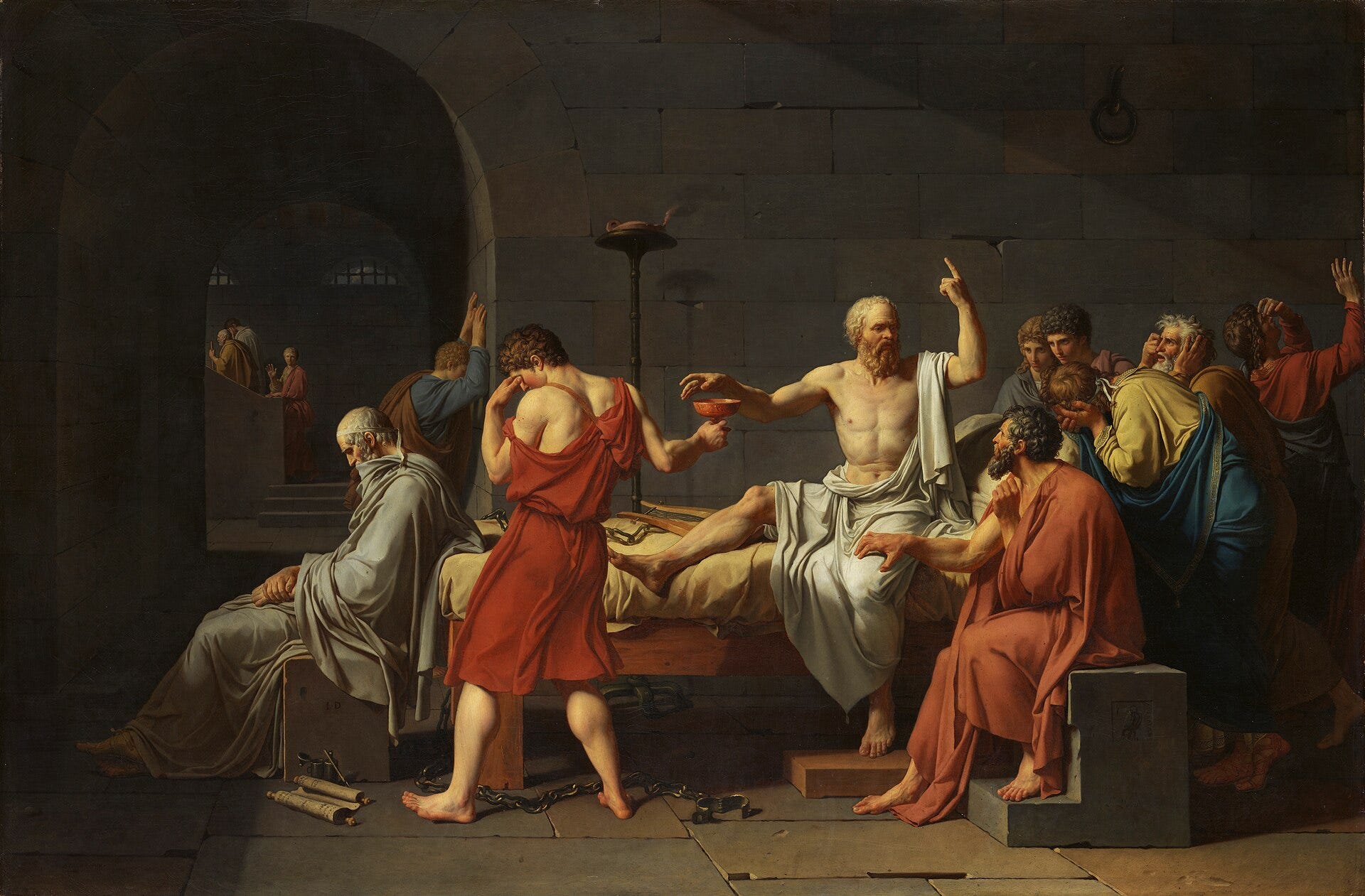
The Death of Socrates | Jacques-Louis David, 1787
Key Terms for this Section
Ontology · World of Being · Allegory of the Cave · Scholasticism · Ockham’s Razor
2.1 | The Same River Twice - Heraclitus
The Late Presocratics
The Presocratic philosophers all developed distinct philosophical claims about the nature of reality (ie. Metaphysics). Despite their differences, they shared several commonalities that laid the foundation for Western philosophy. All these thinkers rejected traditional mythological explanations of the world, viewing ad hoc stories as insufficient for seeking the arché and understanding reality. Instead, they sought to explain the world through natural phenomena and emphasized the importance of reason and observation as tools for uncovering the nature of existence.
Thales, the first philosopher, proposed that water is the primary substance from which all things originate. Anaximenes, a student of Thales, suggested that air is the essential element. Both philosophers were interested in identifying a single underlying principle or substance that constituted the cosmos. Later, Democritus proposed that everything is composed of tiny, indivisible particles called atoms. His atomic theory provided a durable, mechanistic explanation of the universe. Eventually, Pythagoras brought mathematical principles into the discussion, arguing that numbers are the fundamental reality. He posited that numerical ratios explain the structure and order of the universe, introducing a more abstract cosmological perspective.
Ultimately, the Presocratics lived around the same time and came to different conclusions. But what they held in common was a rational pursuit of the truth, rejecting ad hoc narratives as explanations, and focusing on metaphysics. After Pythagoras, the late Presocratics (after the Milesian School) would continue to focus on metaphysical questions with greater and greater elucidation.
Change is an Illusion | Parmenides
The Greek philosopher Parmenides came from a Greek town just south of Naples, Italy. Unlike the early Presocratics who focused on primordial elements (eg. water, air, earth, numbers, etc), Parmenides went even deeper — questioning the very nature of being itself. The philosophical investigation of being is Ontology (Gr. ontos meaning “being”). In his search for the arché, Parmenides asked what existed before any origin or beginning. He proposed that before anything existed, there was “nothingness.” Like Pythagoras before him, Parmenides did not shy away from purely abstract thought.
The first Ontologist, Parmenides contends there are three levels of sensibility. At the earliest level, there is nothing. It follows that we cannot say anything about this level as we cannot sense anything about it. Next is the ontological distinction between what is and what is not. The final level — where we see, taste, touch, and feel — is existence. This is what “is.” It was Parmenides’ claim that the fundamental nature of reality is unity — eternal and true. He argues that what we perceive as change and variety in the world is illusory. Being is singular and unchanging.
You Can't Step in the Same River Twice | Heraclitus
Meanwhile, the Greek philosopher Heraclitus came from Ephesus, a Greek town in the Persian Empire (today, Türkiye). Heraclitus elucidated the Greek concept of logos, another key idea in ancient Greek philosophy and, subsequently, Christianity. Logos has no direct English equivalent. In theological circles, it is used untranslated. Logos has connotations of order, reason, and even text. Biology, for example, means the study (logos) of life (bios). The Greeks recognized that the world has a recognizable order to it: the moon waxes and wanes, the tide goes in and out, children grow up, grow old, and die. While they did not understand the mechanisms behind this order, the Greeks referred to this order as the logos. This is more or less where the Greek search for the arché ends up — with Heraclitus’ claim that the logos represents the deep structure of reality (cf. John 1).
For Heraclitus, the logos is the divine ordering principle of the cosmos. It is reason itself, giving structure to our language, thoughts, and the world. Logos is where we get the word logic, and the Romans derived the word lex (law). It is unchanging, perfect, and universal. However, Heraclitus goes further than Parmenides. While both Presocratic philosophers argue for a static, unchanging reality, Heraclitus argues that this does not accurately represent the world in which we exist. Instead, the Eastern Greek philosopher asserts that while you may think you can visit the same river twice, this is impossible.
To understand this, we must delve into Heraclitus’ notion of flux. While regulated by the logos (eternal and rational), the phenomena of our world (eg. trees, people, cities) are in a constant state of change (ie. flux). Trees sprout, grow, and die in a predictable way (cf. logos), but where they drop seeds, when they blossom, and how they eventually fall happen in unpredictable ways (cf. flux). Famously, Heraclitus claimed, “You can’t step in the same river twice.” This is primarily for two reasons. First, when you return to the river, it has changed. The waters have receded, the stones have moved, and even the sunlight may reflect off its surface differently. But you must also consider that when you return to the river, you have also changed! You’re now older, wiser, and perceive things differently than you did when you were last at the river’s edge.
So, for Heraclitus, there are two levels of reality. Above all is the logos — the underlying rational principle governing everything. But in our lived experience, we generally witness a world in flux — where rivers, governments, and planets are constantly in motion. For Heraclitus, both visions of reality are true.
2.2 | Know Thyself - Socrates
The Father of Western Philosophy | Socrates
It is in the teachings of Socrates — a man who famously never wrote anything down — that philosophy takes its current form. Socrates (ca. 470-399 BCE) was born in Athens, the son of a humble stonemason. He was a combat veteran in the Peloponnesian War, a brutal civil conflict incited by the Athenian élite, where his unit faced defeat in three separate battles. Despite the grim outcomes, Socrates displayed valor, notably saving the life of Alcibiades, an aristocratic general. Upon returning to Athens, Socrates began questioning the values and motivations of the élite class that had sent him to war, setting the stage for his philosophical pursuits.
Fresh from battle and salty about a pointless war, Socrates couldn’t care less about the ultimate nature of reality (ie. metaphysics). He was not part of the tutored, pampered élite. Instead, Socrates broke with the Presocratics to focus on more practical questions. In the Athenian marketplace (ie. the agora), Socrates could be found debating friends, enemies, the young, the old, the downtrodden, and the élite alike. Rather than pontificating on elaborate cosmological theories, Socrates engaged in combative dialogue with people who claimed to have wisdom. In various dialogues (written down by his disciples, Plato and Xenophon), Socrates questioned the élite and powerful of his day to reveal contradictions in their thinking and strip away false beliefs. His “teaching” (note: Socrates claimed to know nothing) was available to all in the Athenian agora. He operated under the premise that dialogue, rather than introspection, was the key to wisdom.
Reading his dialogues, we can get a pretty good picture of the kind of man Socrates was. A stout, unattractive, working-class guy and combat veteran, Socrates claimed the goal of our lives should be to flourish (Gr. eudaimonia) through our personal pursuit of excellence (Gr. arête). Much of his dialogues are devoted to the goal of this flourishing by developing virtues like courage, wisdom, and self-control. Contrary to what some modern readers might guess, Socrates was less concerned that someone was smart and more concerned about the state of their soul (Gr. psyche). Socrates promoted the development of young Greeks along physical (gymnastics), mental (academics), and spiritual (the virtues) dimensions. For the great philosopher, evil arises from ignorance. So, educating the youth was Socrates’ way of keeping Athens healthy and prosperous.
Know Thyself
In Socrates’ time, the powerful and prominent visited the storied Oracle at Delphi to seek guidance. Socrates likewise eventually made his way to the oracle. At the front of the temple, the phrase “Know Thyself” (Gr. Gnothi Sauton) was displayed for all who came to receive the oracle’s wisdom. This phrase has been the credo of philosophers ever since.
In the temple, the Pythia shared with Socrates his personal fortune — she told him he was the wisest man on earth!
However, this declaration puzzled Socrates, leading him to spend years pondering its meaning. He eventually concluded that his wisdom lay in his awareness of his own ignorance — unlike others who falsely believed themselves wise. This realization led to Socrates’ famous mantra: “The unexamined life is not worth living.”
For Socrates, his laser-sharp focus on self-knowledge left no room for metaphysics and the pontification of Athenian sophists jockeying for audiences and political position. To know oneself is to understand one’s moral worth and values. It means challenging our most basic and cherished assumptions. It means ignoring the external validation of others. Socrates had no care for awards, titles, or elections. He simply wanted to know the truth and serve his beloved Athens.
Without grounding ourselves in self-knowledge, we become too vulnerable to the opinions of others. When the crowd speaks ill, we become defensive. When the crowd offers adulation, we become dependent on their approval. But such attitudes often compromise our autonomy, development, and virtue. In this way, Socrates did not explain philosophy. Socrates showed us how to live as a philosopher.
The Platonic Dialogues
Eventually, Socrates’ antagonistic relationship with the Athenian élite got him arrested. He was charged the same way all thinkers who question the status quo are charged — he was accused of 1) corrupting the youth of Athens and 2) not giving the proper honor to the sacred symbols of the Athenian state and its well-monied priests.
The Apology
Socrates surrounded himself with quite the motley crew — élites, the working poor, slaves, the tutored, untutored, older, younger... But his young student Plato was by far the most intelligent. From Plato’s written Dialogues, we have the clearest picture of Socrates. In Plato’s Apology (meaning “Explanation“ in the original Greek), we find an earnest, direct, sometimes funny Socrates, who seems unconcerned with the formalities of the Athenian court.
To the charge of corrupting the youth — Socrates argues that any harm done had been the result of his own ignorance. He explains that his purpose was to question so-called ‘wise men’ in order to reveal their ignorance and fraud. This approach gained him popularity among the Athenian youth, who were inspired by Socrates to also challenge the authorities. This ultimately led to the resentment and embarrassment of the Athenian elite and Socrates’ arrest.
To the charge of impiety — Socrates argues that he is pious in his divine mission given to him by the Oracle at Delphi: to find wisdom wherever possible and unmask the pretenders who claim to know truth but cannot face scrutiny. The state then responds by pointing out that Socrates neglects the Athenian civic religion and sacred totems of the city. Socrates counters that he has a divine inner voice guiding him along his own personal spiritual path.
A patriot, veteran, and father, Socrates famously defends himself by describing the city-state of Athens as a workhorse and likening himself to a gadfly (ie. horsefly) that stings the lethargic state of Athens, provoking it to move forward and complete her valuable work. Socrates believes that embarrassing politicians, confounding priests, and criticizing the élite is his sacred duty. The élite do not agree and find him guilty on both charges. When asked for a suggested punishment, Socrates humorously proposes a ‘punishment’ of free meals for life for services rendered to Athens.
The judges don’t see the humor and sentence Socrates to death.
The Crito
Plato’s dialogue known as The Crito recounts Socrates’ final days in the Athenian prison. Crito was a disciple of Socrates who attempted to persuade his master to escape with him and live in exile. But Socrates was having none of it.
While imprisoned and awaiting execution, Crito visits Socrates. (By the way, Plato is nowhere to be found — the son of élites, some of whom were responsible for Socrates’ guilty verdict — has skipped town.) Crito, on the other hand, bravely arranges an escape plan and offers Socrates the chance to live on. But it’s just like Socrates to take the whole thing and turn it into a teachable moment.
Crito argues with his 70-year-old master, Socrates, presenting several reasons why Socrates should escape. He argues that Socrates’ friends are willing and able to help him live safely in exile and that escaping would prevent the public perception that his disciples had abandoned him. Additionally, Crito contends that Socrates has a duty to his sons to remain alive and support them. Crito also contends that accepting an unjust punishment would itself be an act of injustice.
Socrates counters Crito’s arguments by emphasizing his commitment to Athenian law and to his own virtue. He believes that breaking the law would be an unjust act, regardless of the unjust circumstances of his sentence. Socrates also argues that moral actions should not be determined by popular opinion (the ad populum fallacy) and stresses that wrongdoing harms the soul. As to his children, Socrates says that he must perform his patriotic duty, and in doing so will serve as a proper example of Athenian virtue to his children. Therefore, Socrates reasons it would be wrong to escape, even if he has been wronged, as breaking the law would betray his principles and damage his soul.
In the end, Socrates is given a cup of poisoned wine (hemlock) to drink. As the poison takes effect, Socrates calmly speaks his last words, asking Crito to offer a sacrificial chicken to the god Asclepius. This request is laced with irony, as Socrates did not usually partake in Athenian sacred rituals. By referencing Asclepius, the god of medicine, Socrates humorously acknowledges the hemlock as a kind of “medicine” that frees him from life. His final words reflect his unwavering commitment to virtue and his subtle critique of the accusations against him.
2.3 | Leaving the Cave - Plato
The Allegory of the Cave | Plato
After Socrates’ death, philosophy is forever changed. Absent from Socrates’ side at his execution, Plato (427-348 BCE) later takes his family’s riches and buys an orchard. There, he develops the first Academy. It is a school open to all classes of people (even the sons of Athenian stonemasons). Plato’s Academy becomes the model for Western education and is the source of our word “academic” today. Plato himself becomes the guarantor of Socratic philosophy in Greece and beyond.
To this end, Plato writes his famous Allegory of the Cave. This text is a philosophical metaphor for Plato’s epistemology and his adulation of Socrates. In the Allegory, Plato describes prisoners who have been chained inside a dark cave for their entire lives. These prisoners are confined so that they can only see the wall directly in front of them. Above and behind them is a bright flame, and between the flame and the prisoners, there are élites who cast shadows from the firelight onto the cave wall (basically, like a projector in a movie theater). Having never seen anything else, the prisoners imagine these shadows as the only reality.
One prisoner is freed and slowly and painfully makes his way out of the cave to the outside world above. Initially, the sun’s light is blinding, and the freed prisoner struggles to understand this new reality. As his eyes adjust, he sees the true world, realizing that the shadows on the cave wall were mere illusions — placed there by the cynical élite. However, when the freed prisoner returns to the cave to free the others, he is met with laughter, disbelief, and violence. The cave dwellers are resistant to accepting a reality beyond their own limited experience and kill the enlightened man.
In Plato’s Allegory of the Cave, we see the acquisition of knowledge involves discomfort and resistance (amirite?). It highlights that true knowledge reveals a reality beyond the superficial appearances perceived by the uninitiated. Philosophers who seek to share deeper truths frequently face opposition and punishment from those who are comfortable in their limited understanding and do not wish to change the status quo.
The Theory of Forms | Plato
Working from his Allegory of the Cave, Plato returns the focus to metaphysics and posits two sides to reality — our material world subject to change and decay and an eternal world that is perfect and never changes. These are two sides of the same coin. The top side is known as the World of Being. The bottom side is the World of Becoming.
The World of Becoming is our changeable, material, temporal world. Things grow, have substance, and come to an end. It is apprehensible via the senses — when we see the tree, the rock, or the river, we’re seeing the World of Becoming.
The World of Being is Plato’s perfect reality that sits above our sensible reality — unchanging, ideal, and eternal. In the perfect World of Being, rather than things, there are perfect forms that represent the essences of things down below. The World of Being has perfect beauty, justice, reason, etc. While the World of Becoming is apprehensible via the senses, the World of Being is only apprehensible via reason.
Returning to the Allegory of the Cave, the physical world (cf. the shadows on the cave wall) is an imperfect reflection of the ideal forms above (cf. the world beyond the cave). The beauty, justice, and reason we see in our world are but poor copies of their ideal forms found above.
Here, Plato works from both Parmenides and Heraclitus. Remember that Parmenides argued that reality is ultimately an unchanging, singular unity. However, Plato describes the existence of multiple, perfect forms that give shape to our temporal reality. All our trees have something in common with the ideal tree above. All courts strive to emulate the ideal justice above. So, while Parmenides’ cosmology focuses on one unity, Plato offers a multiplicity of forms from an eternal reality. From Heraclitus, we get the concept of logos as the rational principle of order in an ever-changing physical world. For Heraclitus, the logos and the flux of change are both part of our world. But for Plato, his World of Being is the truer, more perfect, and more complete version of a reality that we only see a shadow of.
Simply put, Parmenides wants us to recognize the unity of all things (there is no change). Heraclitus wants us to recognize that order (logos) and change (flux) are co-equal parts of our world (you can’t step into the same river twice). And Plato wants us to recognize that our world, where things rot and die, is but a shadow of a perfect, eternal world above us (the theory of forms).
The Allegory of the Chariot | Plato
In later years, Plato took his early metaphysics and applied it to describing the soul (Gr. psyche). In this way, Plato’s metaphysics would later shape the religious ideas of the West. Like Thales two centuries before, Plato is a proponent of dualism. Just as there is an eternal World of Being over our temporal World of Becoming, Plato claims an eternal soul transcends our temporal, aging body. But this raises a question for Plato — how does one describe the soul?
Like Socrates, Plato argued that the soul seeks Wisdom, or the Good. But how does the soul seek the Good? Plato likened the soul’s journey to a chariot pulled by two horses. One horse represents our passions. The other horse represents our base appetites. And, to drive the chariot successfully toward Wisdom, both horses need to be steered appropriately.
Too little passion and your ambitions go unrealized. Too much passion, and you’re all over the place. It’s up to the charioteer to tighten or loosen the reins accordingly. The same goes for our appetites — too much, and you become a slave to your physical desires; too little, and you never leave the couch. Again, the charioteer must rein in or indulge the appetites accordingly. So, if one horse is appetite and one is passion, what is the charioteer?
The charioteer is your reason. And remember, reason is the only way to apprehend Wisdom (cf. theory of forms). So, we see Plato once again elegantly allegorizing a philosophical claim about knowledge. Our reason, balancing and fueled by our passions and appetites, charts a path toward Wisdom. This model is known as Plato’s Tripartite Soul.
Later still, Plato would repeat this tripartite model of the ideal soul (flying toward Wisdom) and say it also represented the ideal form of government. In Plato’s Republic, arguably the most important work of Political Philosophy ever written, Plato describes the ideal tripartite body politic.
Plato envisions a government that seeks the flourishing of its citizens (ie. eudaimonia). On one side, he places the workers — who represent the blood and guts of society. On the other side, Plato places the auxiliaries — who represent the heart and passionate defenders of the society. Given free rein, the workers would overconsume and tear the place down. Likewise, without limitations, the auxiliaries would create a police state and turn the Republic into a dystopic nightmare. Instead, Plato envisioned his Republic being led by a wise philosopher-king who could balance society’s appetites and passions so that the city could flourish. Such a king (obviously modeled after Socrates) would possess the highest character, the greatest wisdom, and seek only the Good for his people.
2.4 | The City of God - St. Augustine
Greek Ideas in Israel
Turning to ancient Israel, the Jews who came millennia before Plato talked about God through the language of revelation. Philosophy was a Greek idea. Their primary text, the Torah (ie. Genesis, Exodus, Leviticus, Numbers, and Deuteronomy), does not offer any rational arguments for the God with Whom they share a covenant. And why would it? One uses rational argumentation to convince others of their position, and Jewish law prohibits proselytization.
However, a generation after Plato, Alexander the Great (356-323 BCE) brings Greek philosophy to Israel. European ideas are then imposed upon the Jewish populace for three centuries by occupying Greeks and Romans. It is in this milieu that Christianity develops. Roman Jews in the first-century Christian movement were steeped in both Greek philosophy and Jewish tradition. The Gospel of John, for example, opens with, “In the beginning was the Logos.” Here, Hereclitus’ cosmological concept becomes a bedrock for Christian theology. In Paul’s letter to the Colossians, he nods to Plato, claiming, “These are a shadow of things to come, but the substance belongs to Christ” (2:17).
After Paul and most of the early Christians are killed, the synthesis of Christian teaching and Greek philosophy continued with the early Church Fathers. Justin Martyr (100-165) comprehensively explained Christ as the Greek Logos (cf. John 1). St. Origen (185-253) aligned his understanding of God with Aristotle’s concept of a Prime Mover. And the Cappadocian Fathers (300s) were pivotal in developing the doctrine of the Trinity, using Plato’s tripartite model to describe three persons in one substance.
Neoplatonism | St. Augustine
600 years after Plato’s death, his ideas continued to evolve among his readers. The resulting philosophical school came to be known as Neoplatonism (lit. New Plato). Rooted in Plato’s most challenging dialogue, the Timaeus, was the metaphysical claim that all of existence emanates from an ultimate, perfect source Plato calls “the One.” The “One” is immaterial, eternal, and perfect and came to be how Christians and Muslims described God. Plato’s World of Being further evolved into a transcendent realm where eternal souls aspire to call home called Heaven.
An intemperate man in his youth, the Roman African Augustine (354-430) was horrified by his previous conduct when he converted to Christianity in 386. The latter Saint Augustine came to view the body as a source of sin and wickedness. In Neoplatonism, St. Augustine found Plato’s description of a temporal body and eternal soul agreeable to his theological view. It has since become the preeminent model of the body-soul in Western religion. For St. Augustine, the sinful body is a “cage” for the immaterial soul. While the body seeks carnal pleasures, the soul seeks spiritual union with God through reason and faith.
Further, St. Augustine’s division of body and soul parallels the Catholic reading of the Fall of humanity from the Garden of Eden (cf. Genesis). According to St. Augustine, when Adam and Eve sinned in the Garden, the resulting Fall removed the human soul from its original state of perfection and union with God (much as Neoplatonism describes the soul’s separation from “the One”). As such, the soul longs to return to its original state of divine union. This yearning mirrors the Neoplatonic idea that souls are always striving to reunite with their perfect source.
Before the Fall, St. Augustine reasons the soul was perfect, ageless, and good. But after the Fall, the body became corrupt, depraved, and desirous of temptation. It is the soul, for St. Augustine, that yearns to return home to the Garden.
The City of God | St. Augustine
By the mid-400s, the Roman Empire was in significant decline. One of the few social structures that held strong was Roman Catholic Christianity. This begged the question: if Rome (or whatever came after its eventual fall) was to be Christian, what does a Christian state look like?
While the Hebrew Bible (ie. Old Testament) has many stories of Jewish kings, royal courts, and warring kingdoms, the New Testament bears little in the way of Political Philosophy. The letters of Paul anticipate a relatively immediate return of Jesus, and the latter Christian texts don’t offer much political instruction for their followers in the meantime. It may not seem like a big deal to us now, but the question of Christian Political Philosophy was vital to the crumbling edifice of the Roman Empire. Enter, St. Augustine.
Again drawing on Neoplatonic ideas, St. Augustine conceived of a Christian Political Philosophy so durable that it became the political blueprint of the entire European Medieval period. His central argument rested on the dichotomy of two empires: the City of God and the City of Man. The eponymous City of God represents a perfect kingdom of justice, peace, and eternal salvation under God’s rule. It bear obvious parallels to Plato’s World of Being — where perfection, truth, and wisdom reside. According to St. Augustine, true justice and peace can only be found in the City of God, which will only be fully realized upon Jesus’ return. Until then, the world remains the City of Man — a temporary, fallible, and sinful earthly existence.
The City of Man represents the fallen state of humanity, marked by sin, pride, and moral decay — qualities St. Augustine saw in the crumbling Roman Empire. Drawing on Neoplatonism, St. Augustine argues that earthly empires are inextricably bound to the material, corruptible World of Becoming. In contrast, the City of God belongs to the eternal World of Being, where the divine nature is unchanging and perfect.
For St. Augustine, Christians are called to live according to the values of the City of God, aligning themselves with the divine will and eternal truths despite residing in the imperfect City of Man. This means prioritizing spiritual virtues and moral integrity over earthly ambitions and transient pleasures, much like Plato’s philosopher-king who rules by knowledge of the Forms. He further asserts that Christians must carefully navigate the tensions between these two cities. While they live in the world and engage with its temporal affairs, their ultimate allegiance should be to God’s eternal kingdom.
2.5 | On Scholastic Faith - St. Aquinas
God & Early Medieval Philosophy
The Christian Neoplatonists developed an intriguing systematic theology — combining Classical Platonism and Medieval Catholic theology. St. Augustine (d. 430) reinterpreted early Neoplatonism into a Christian framework, where God creates the world ex nihilo (from nothing) and is the source of all things (cf. Plato’s Timaeus). In early Platonism, the soul ascends via reason toward Wisdom (cf. Allegory of the Chariot). But in St. Augustine’s work 600 years later, the soul ascends to God through reason and faith. And God, for St. Augustine, is eternal, immaterial, and transcendent — like Plato’s World of Forms.
Following in the footsteps of St. Augustine, Boethius (d. 524) delves deeper into the Neoplatonic/Christian synthesis by exploring the concepts of providence and free will. For Boethius, God’s divine plan (ie. providence) gives order and purpose to our world (cf. Heraclitus’ logos). Boethius’ exploration sheds light on the idea that God orders all events in the world as part of a divine plan that eventually ends with the return of Jesus. At first, the concept of free will might seem contradictory to this (ie. how can there be a plan if billions of humans are making their own choices?). But Boethius deals with this seeming contradiction by pointing to God’s omniscience. That is, while God doesn’t cause or determine events, He already knows the outcomes of our choices and plans accordingly.
Finally, John Scotus (d. 877) further develops the relationship between Neoplatonism and Christianity with his views on immanence and transcendence. Scotus uses Neoplatonic ideas to elucidate the nature of God, explaining that while God is close to everything, He remains apart from creation. This philosophical view is called Panentheism — God is everywhere and yet wholly Other.
In sum, much of our modern theological discourse on God’s grace, God’s plan, and God’s presence in everyday events comes directly from early Medieval philosophers integrating Plato, Neoplatonism, and Medieval theology.
Optional Video explaining the importance of Medieval philosophical questions (auto-generated CC).
The Ontological Argument | Anselm
In England, the Archbishop of Canterbury, St. Anselm (d. 1109), set out to prove the existence of God using reason alone. St. Anselm begins with the claim that God is the ‘greatest being one can imagine,’ so that nothing greater can be imagined (ie. if something greater could be imagined, then that would be God). So, whenever there are two competing descriptions of God, it follows the greater description must be true. St. Anselm then claims that because existence is greater than absence, God must exist. And if existence in reality is greater than existing in one’s imagination, then God must existence for real. And so on...
This was the earliest purely philosophical argument for the existence of God in the West. It was not without its detractors. Critics point out that St. Anselm is committing a fallacy of reasoning here by “begging the question.” That is, St. Anselm’s argument already assumes God exists before setting out to prove He exists. As Immanuel Kant (d. 1804) would later argue, existence is not a predicate.
Here, a predicate is a quality of something. If “the apple is red,” then red is a predicate of that apple. Kant’s criticism is that St. Anselm’s argument lacks coherence, because saying something “exists” does not add to the concept of an object. If I say “a thousand dollars” and then I say “a thousand dollars exists,” the concept of “$1000” remains the same. I can add to your knowledge of that money by saying, “I have a thousand dollars in wrinkled bills,” or “I have a thousand dollars worth of silver.” But adding the word “exists” to “a thousand dollars” doesn’t add anything meaningful.
As we’ll see in Section 4, Kant will identify such claims as analytic statements, which do not add meaningful information to our discourse (see Sec. 4.1 for more).
Christian Scholasticism | St. Aquinas
Neoplatonism (ca. 200s-600s) had largely fallen out of favor by the time St. Anselm set forth his Ontological Argument. In collaboration with Islamic and Jewish philosophers, late Medieval Christian philosophers shifted their focus away from Plato and toward Aristotle (see Sec. 5 for more on Aristotle). This gave rise to Scholasticism, a late Medieval systematic integration of theology and philosophy that aimed for logical analysis of theological questions through Socratic dialogue. Where Neoplatonism had been primarily focused on integrating Christian metaphysics and theology with Plato, the later Scholastics were more analytic and rigorous in their efforts — aiming to show the absolute, logical soundness of theology. While Neoplatonism is steeped in mysticism, Scholasticism treats faith and reason as separate but complementary truths.
If the most important early Medieval thinker was St. Augustine, the most consequential late Medieval thinker was St. Aquinas. Both men are ‘Doctors of the Church,’ meaning that in matters of the Christian faith, what they had to say is generally considered correct. St. Aquinas’ central claim was that reason is a gift from God given to us to deepen our faith. St. Aquinas worked tirelessly to harmonize the rationality of Classical Greek philosophy with the grandeur of Medieval Christian theology. St. Aquinas’ magnum opus, the Summa Theologica (lit. the sum of all theology), represents the most ambitious philosophical effort of the Middle Ages. The results of St. Aquinas’ efforts were global in scope. Scholasticism became the dominant intellectual tradition of Europe for centuries. Generations of Christian scholars later traveled the world to teach and share the gospel, believing that faith and reason work hand-in-hand.
2.6 | Cut to the Chase - Ockham’s Razor
Medieval Philosophy's End
In the time of Sts. Anselm and Aquinas, philosophers spilled an ocean of ink over questions of forms (eternal properties) and accidents (ie. changeable properties). In questions like, ‘does the form of a tree or redness of an apple exist independently of the physical objects they describe?’ For centuries, questions like this plagued scholars attempting to foist Classical thinking onto an ever more empirically-minded world. Today, we might consider such debates unnecessary. But in the Medieval world, these arguments and positions were the foundation of the Medieval Catholic Church’s ecclesiastical and political power. For example, the question of form vs accident comes into play with the Eucharist. It was the Medieval Catholic Church’s position that their priesthood alone had the ecclesiastical authority to transform bread and wine into the body and blood of Christ. Here, the body of Christ is the form, while the ‘accidental’ texture and taste of the bread remain the same. When one questioned this theology, one was also questioning the authority of the Medieval Church.
It was William of Ockham (d. 1347) who would be the first to eschew Scholasticism’s unnecessarily complicated claims in favor of a more direct (and more modern) approach to philosophy. Ockham and others like him began to set aside the elaborate metaphysical claims of their predecessors in favor of empirical observation and appeal to natural laws.
Ockham's Razor
William of Ockham was a Medieval English philosopher and theologian best known for an epistemological principle that helped move Europe out of the Medieval period. This principle, called Ockham’s Razor, is generally summarized as, “The simplest explanation is usually the best.” In effect, when we’re presented with multiple, divergent explanations, we must first disprove the explanation with the fewest assumptions and steps.
This principle challenged the prevailing philosophy of the time, often involving overly elaborate explanations for natural phenomena. By advocating for simplicity first, Ockham promoted a shift towards a more empirical and observation-based approach to understanding the world. This shift laid the groundwork for the development of modern scientific methodology, which values parsimony and economy of explanation.
In philosophy, Ockham’s Razor has been used to argue against unnecessary metaphysical constructs. For example, it has been employed to critique theories that invoke multiple types of substances or entities when fewer would suffice. In science, the principle guides researchers to favor simpler, more straightforward theories until complexity is warranted by additional evidence. This has led to more streamlined theories in all scientific fields.
So the next time someone starts to tell you about how aliens built the pyramids at Giza — remember Ockham’s Razor. Before we start praising aliens for our architectural marvels, we first have to disprove the far simpler and elegant answer that humans built them. Which they did...
Everything should be kept as simple as possible, but not simpler. - Albert Einstein
The Structure of Philosophical Claims
Having looked to Ockham’s Razor, and seen the evolution of philosophical debate throughout the Classical and Medieval eras, it’s time to take stock of how a proper philosophical claim is made.
Philosophical claims are structured arguments that consist of premises and conclusions. The premise of an argument is a statement offered to support the conclusion (ie. the reason why someone should agree with the argument). Conversely, the conclusion is the statement that one should accept based on the premises.
Consider this simple argument: “All apples are red. This is an apple. Therefore, this is red.” Here, the premises are “All apples are red” and “This is an apple,” and the conclusion is “This is red.” However, as one might imagine, not all apples are red, revealing a flaw in the first premise. This recognition leads to the next crucial step in philosophical reasoning: evaluating arguments.
Evaluating an argument involves three key criteria: truth, validity, and soundness. Truth asks whether the premises are factually correct. Validity assesses the logical structure of the argument. For an argument to be sound, it must have both a valid structure and true premises.
Truth. First, truth seeks to establish that the supporting reasons are true. If your premise is not true, the rest of your argument is already false. This was the problem in the apple argument above. The premise that all apples are red is not true because sometimes apples are other colors.
Validity. Next, validity asks if the reasons support the conclusion. Most often, this involves questioning our assumptions. A valid argument will be one in which the reasons support the conclusion in a way that the conclusion follows from the reasons offered.
Here’s an example of a sound argument:
All men are mortal.
Socrates is a man.
So Socrates is mortal.
Another consideration is whether we have true premises but still arrive at a false conclusion. Look at this invalid example to see how this works:
The president of the United States must be at least 35 years old. (True)
Chris Evans is at least 35 years old. (True)
So, Chris Evans must be the president of the United States. (False)
Both premises are true. However, the conclusion does not follow from the premise. Therefore, the argument is invalid.
All this being said, I humbly offer you the following advice: having a good argument is not the same thing as convincing others of your argument. Many other factors may interfere with your argument’s effectiveness (psychology, stubbornness, sheer difference in intelligence, etc.). Ultimately, philosophy is about coming to peace with your own views and process — to know you’re doing your best. To know thyself...
Having looked to Ockham’s Razor, and seen the evolution of philosophical debate throughout the Classical and Medieval eras, it’s time to take stock of how a proper philosophical claim is made.
Philosophical claims are structured arguments that consist of premises and conclusions. The premise of an argument is a statement offered to support the conclusion (ie. the reason why someone should agree with the argument). Conversely, the conclusion is the statement that one should accept based on the premises.
Consider this simple argument: “All apples are red. This is an apple. Therefore, this is red.” Here, the premises are “All apples are red” and “This is an apple,” and the conclusion is “This is red.” However, as one might imagine, not all apples are red, revealing a flaw in the first premise. This recognition leads to the next crucial step in philosophical reasoning: evaluating arguments.
Evaluating an argument involves three key criteria: truth, validity, and soundness. Truth asks whether the premises are factually correct. Validity assesses the logical structure of the argument. For an argument to be sound, it must have both a valid structure and true premises.
Truth. First, truth seeks to establish that the supporting reasons are true. If your premise is not true, the rest of your argument is already false. This was the problem in the apple argument above. The premise that all apples are red is not true because sometimes apples are other colors.
Validity. Next, validity asks if the reasons support the conclusion. Most often, this involves questioning our assumptions. A valid argument will be one in which the reasons support the conclusion in a way that the conclusion follows from the reasons offered.
Here’s an example of a sound argument:
All men are mortal.
Socrates is a man.
So Socrates is mortal.
Another consideration is whether we have true premises but still arrive at a false conclusion. Look at this invalid example to see how this works:
The president of the United States must be at least 35 years old. (True)
Chris Evans is at least 35 years old. (True)
So, Chris Evans must be the president of the United States. (False)
Both premises are true. However, the conclusion does not follow from the premise. Therefore, the argument is invalid.
All this being said, I humbly offer you the following advice: having a good argument is not the same thing as convincing others of your argument. Many other factors may interfere with your argument’s effectiveness (psychology, stubbornness, sheer difference in intelligence, etc.). Ultimately, philosophy is about coming to peace with your own views and process — to know you’re doing your best. To know thyself...
This Section: Classical Thinking
Next Section: Scientific Thinking