

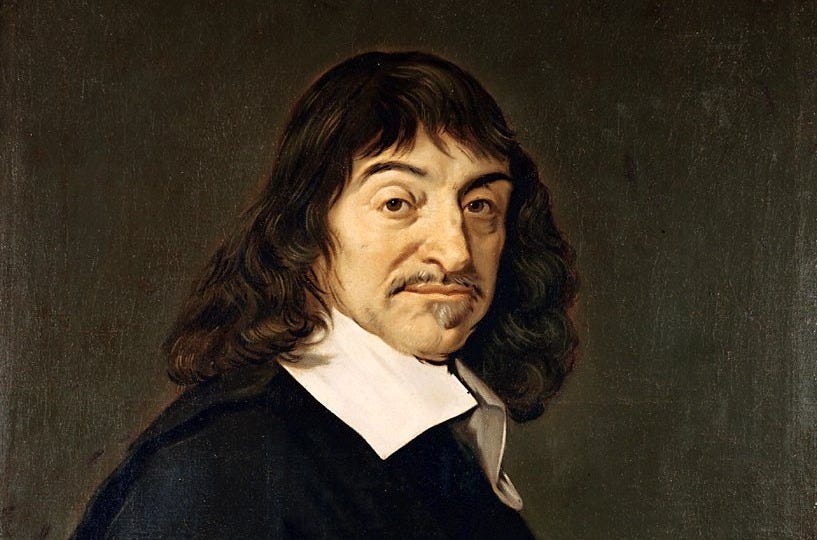
René Descartes | Frans Hals, ca. 1649
Key Terms for this Section
Rationalism · Cogito Ergo Sum · A priori · Empiricism · Falsifiability
3.1 | Rational Thinking - Avicenna & Maimonides
Philosophy South of Europe
Before the 600s, the Arab world had no written literature. While Israelite Jews, Byzantine Christians, and Persian Zoroastrians brought countless texts to Arabia, the Arab world had no books of their own. This changed with the 7th century Qur’an. The prophetic message of Islam spread as a written text from Medina to Baghdad and onward as far east as India and as far west as Spain. This new, flowering Islamic civilization would be a thoroughly literate culture, as their religious miracle wasn’t a land (like the Jews) or a messiah (like the Christians). No, the chief miracle of Islam was the Qur’an. And their thirst for the written word was only beginning.
In the century prior, the Christian emperor Justinian had closed Plato’s Academy (529), ushering in a Dark Age that would spread over Europe for a thousand years. As Europe languished intellectually, the Islamic world to the south became the chief custodians of Western philosophy. They continued to study and add commentary to the works of the Ancient Greeks and laid the groundwork for much of the later development of the Western philosophical tradition we enjoy today.
The 700s-1300s are known to historians today as the ‘Golden Age of Islam’. Al-Kindi (d. 873) was among the first Arabs to contribute to the Medieval study of Classical Greek Philosophy. He worked to harmonize the ideas of Plato and Aristotle with Islamic theology in ways St. Aquinas would mirror 400 years later in Christendom. Al-Farabi (d. 950) applied Plato’s Republic to Islamic governance and claimed philosophy was necessary for understanding the divine truths of Islam. Avicenna (Ibn Sina, d. 1037) used Classical Philosophy to advance medicine. For centuries, his Canon of Medicine was required reading for Jewish, Christian, and Muslim medical students. And Averröes (Ibn Rushd, d. 1198), perhaps the most gifted Islamic philosopher in history, reconciled Aristotle’s philosophy with Islam. His work directly influenced the Christian Scholastics of Europe.
St. Aquinas (cf. Sec. 2.5) borrowed heavily from Islamic philosophers to create his Summa Theologica. His study of Avicenna’s distinction between essence (what something is) and existence (that something is) helped St. Aquinas develop his theological description of God. Likewise, his study of Averröes’ commentaries on Aristotle were crucial to St. Aquinas’ writings. In fact, St. Aquinas often referred to Averröes as “the Commentator” of Aristotle throughout the Summa. High praise, indeed, for a Muslim philosopher in Medieval Christianity’s most celebrated philosophical and theological text.
Avicenna & the Cosmological Argument
Medieval Islamic philosophy posited that all good things, including philosophy, must come from God. This is not at all surprising, given that the 7th century Qur’an uses logic and natural philosophy to describe God’s nature (eg. in reference to ex nihilo creation (52:35), causality (39:62), omniscience (17:85), teleology (21:16-17), and the omnipresence (2:115) of God). Likewise, Islamic philosophers like the Persian Avicenna argued that God’s existence could be rationally proven along Aristotelean lines. This became known as the Cosmological Argument for God.
1,300 years prior, Aristotle posited a metaphysical principle called the “Prime Mover.” In a cosmos constantly in motion, where one object causes another object to move and so on, the Prime Mover is the ultimate cause of cosmic motion. It moves others yet is unmoved (if it could be changed, it would not be the “primary” object). It is the ultimate cause and source of all motion that came before us and will continue long after us.
Avicenna (d. 1037) develops Aristotle’s Prime Mover into the “Agent of Cause,” aligning Aristotelean metaphysics with Islamic theology. In Avicenna’s work, the Agent of Cause creates and sustains the cosmos but is Himself uncreated and unchangeable. In short, the Agent of Cause is God. And Avicenna claims that all cosmic motion can be traced back to God the Creator. However, as with St. Anselm’s Ontological Argument, the Cosmological Argument is not without its detractors. Critics point out the problem of infinite regress — if everything must have a cause, then God must also have a cause, which must also have a cause, etc. In response, some philosophers like David Hume (d. 1776) posit that the cosmos is simply a ‘brute fact’ of reality without recourse to further explanation. Some things simply are.
Additionally, in the last hundred years, quantum mechanics has introduced ideas that challenge our traditional notions of causation. Heisenberg’s Uncertainty Principle (1927) reveals that while we can easily measure the position and speed of large objects (like an airplane), measuring these properties in tiny, subatomic particles (like photons) becomes problematic because the mere act of measuring them disturbs their movement, making their future path unpredictable. As a result, we can’t simultaneously know a subatomic particle’s position and speed. This implies that subatomic particles don’t have definite properties until we measure them — suggesting that causality doesn’t work the way we intuitively think does.
Religious Rationalism | Maimonides
By the end of the 12th century, the hegemony of the Medieval Church was in serious question. Thinkers like Marsilius of Padua (d. 1342), Jean Buridan (d. 1363), and William of Ockham (d. 1347) posed sharp criticisms against the Scholastics’ grip on philosophy. Padua argued for the separation of church and state. Buridan offered theories on motion and force that disproved prominent Scholastic efforts. And William of Ockham (cf. Sec 2.6) appealed to elegant simplicity over the impenetrable sophistry of earlier Medieval scholars.
Inspired in part by Al-Farabi and Avicenna, the great rabbi and philosopher Maimonides (d. 1204) aimed to show the coherence of philosophy with religion from a Jewish perspective. His Mishneh Torah (1180) is the most significant Jewish commentary of the Bible. In this work, Maimonides integrates millennia of Jewish talmudic tradition with philosophical reasoning. He argued that reason and religion are complementary ways of understanding the world, and where our interpretation of the Bible and our rational observation of the world do not align, our interpretation of scripture must be amended. In this way, Maimonides aimed for a rational observance of Biblical commandments, founded on the claim that reason was a gift from God.
That being said, Maimonides went further than St. Aquinas by claiming that God’s nature is beyond human comprehension (ie. beyond Scholastic reasoning). In his Guide for the Perplexed (1190), Maimonides promotes an apophatic or negative theological outlook, wherein one respectfully refrains from describing what God is (which limits God) and speaks only about what God is not. In apophatic theology, one does not say, “God’s thinking is perfect.” Instead, one states, “God is without error.” Apophatic theologians point out that positive statements about God (eg. God loves, God thinks, God feels) anthropomorphize and therefore reduce God. Passages like Psalm 145 (”His greatness is unsearchable”), Psalm 147 (”His understanding is beyond measure”), and Job 38 (”Where were you when I laid the foundations of the earth?”) point to the incomprehensibility of God. If God did not reveal His face to Moses (cf. Exodus 33:20), why would God reveal it to the philosophers?
For Maimonides and a great many modern thinkers to come, the truth was not found in theological certainty but in carefully laid questions that respect the complexity of reality and the limits of human understanding.
Optional Video: Rabbi Jonathan Sacks explains the controversial Maimonides (auto-generated CC).
3.2 | The Birth of Modernity
The Renaissance
Between the 14th and 16th centuries, profound historical changes occurred throughout Europe that culminated in what we today call the modern age. In a period of relative political stability, Italian city-states developed culturally through a patronage system wherein artists, architects, and intellectuals vied for sponsorships from wealthy élites. This culminated in a cultural rebirth (Fr. Renaissance) of Southern Europe. Writers like Dante (d. 1321) and artists like da Vinci (d. 1519) made Italy the cultural center of the Western world. Humanists like Petrarch (d. 1374) and Erasmus (d. 1536) took another look at long-forgotten Greco-Roman ancient texts — not just philosophy but the literature and theater of antiquity — marveled at our past achievements and dared to wonder what humanity might be capable of in a world where we were free to read, believe, and think according to our own personal convictions. And with the invention of the printing press (1440), all of Western Europe would soon be part of this rebirth.
The Beginning of Modernity
Everything about the European worldview changed in those two hundred years. In the classical past, time was viewed as a big circle. Nothing ever changes. You had the job your father had, and his father, and his father, etc. But in the modern world, there was a new word — progress. The modern perspective was one of optimism and continuous improvement. People began to think about technology (eg. the printing press) as a transformative force in our lives.
Back in the classical past, reality was explained through metaphor, narrative, and allegory. As we saw with the Scholastics, philosophical inquiry occurred under the watchful eye of the Medieval Church — whose priesthood generally described the world as a long-recognized story to their illiterate parishioners.* But in the modern world, there was a new word — discovery. There would be a seismic epistemological shift toward precision, observation, and objective proof that would eventually culminate in the Scientific Revolution under Copernicus (d. 1543), Brahe (d. 1601), and Kepler (d. 1630).
And in the classical past, authority had been invested in holy authority figures. If someone had a question, they were expected (often under the threat of violence) to ask a church leader. And bear in mind that there was only one Church at the time, the Medieval Catholic Church, who had a monopoly on questions and answers in Christian Europe. But in the modern world, there was a new focus on the individual to decide for himself what he thought, believed, and voted.
Martin Luther burned the papal bull condemning his teaching and ignited the Protestant Reformation in 1520. Democracy returned to Europe in the Netherlands in 1581. And by 1648, a new world order of nations recreated modern Europe, wherein the people, not the king, were sovereign. In the classical past, it had been a king’s prerogative to maintain stability and order among his subjects. But in this new modern age, there was a new word — freedom.
This is the world in which Cartesian Rationalism developed.
From Scholasticism to Rationalism
Scholasticism was the dominant philosophical view of Europe for nearly 400 years (1100s-1400s). However, with the advent of modernity, the new Humanist and Rationalist philosophers had grown weary of its many issues. First, Scholasticism relies heavily of Church authority to make its claims. But the early modern philosophers felt that truth should be derived from reason and individual understanding. Secondly, scholasticism tends to be excessively complicated and byzantine, lacking in direct observation and scientific parsimony (which as we know, precipitated Ockham’s Razor in Sec. 2.6). As we’ll find in the next section, the Rationalists will instead favor clear and distinct ideas that are self-evident and logically deduced — rather than speculative claims wrapped in ecclesiastical language (cf. Sec. 3.3). Scholasticism was also overly reliant on Aristotle, who more than 1,500 years ago had promoted a view of the cosmos as an organic whole, made of “substances” and “forms” that now proved inadequate to explaining empirical scientific research. Rather, the Scientific Revolution would produce a mechanistic view of the cosmos, emphasizing physical processes and emergent properties rather than essences or teleological purposes.
Rationalism is the epistemological view that reason (not observation or religious faith) is the primary source of knowledge. Leery of the mistakes common to the senses, the Rationalists argued that purely logical reasoning could enable us to arrive at truths independent of empirical observation. While the eyes and ears can often deceive us, the human mind’s ability to attain to reason is without equal. Most Rationalists based this claim in the old Platonic notion of innate ideas — the view that the human mind comes preloaded with certain fundamental truths (eg. logic, simple math, a notion of the self/consciousness). In these ways, the rise of the Rationalists marked the final exit of the Scholastics.
René Descartes (d. 1650) would be the world’s first Rationalist scholar.
3.3 | Leaving the Cave - Plato
Self-Evident Truth | Descartes
Descartes argued that Scholastic methodology had led Europe into intellectual stagnation, as it did not encourage questioning established ideas or developing new theories. Again, this stagnation has a lot to do with the Medieval over-reliance on authority and failure to promote skeptical inquiry. From Emperor Justinian’s closing of Plato’s Academy in 529 until Descartes’ Meditations on First Philosophy in 1641, most of Europe had been mired in a thousand-year-long Dark Age of ignorance, dogmatic obedience, and magical thinking.
With the fall of the Roman Empire, the Medieval Church had become the guardians of European society. The priesthood represented the literate class, who shepherded the illiterate masses in a highly stratified world. Most Europeans were landless peasants who worked land they did not own. Schooling the peasant children who worked their fields was not a priority for the landowning gentry. Besides, before the printing press (1440), books were all written by hand and therefore prohibitively expensive. Most Christian Europeans only ever saw one book in their lives — a bible, chained to the church pulpit, written in Latin (a language no one but priests spoke or understood).
By maintaining a monopoly on literacy, the Medieval Church restricted the ability of everyday Europeans from questioning the social order and ecclesiastical hegemony of the Church. At its most noble, the choice to keep literacy and critical thinking away from regular Europeans was due to a lack of educational infrastructure and the prohibitive cost of handwritten books. At its most cynical, it was a strategic way for the Church to maintain its unquestioned social, political, and economic hold over Europe. In either case, Europeans had largely forgotten how to question by Descartes’ time.
For a thousand years, the Medieval Church’s favorite question was “What is truth?” Pontius Pilate famously posed this question to Jesus at his trial (John 18:38), and was always answered the same way — the truth is whatever the Church says it is. In this way, philosophy stagnated at the height of the Medieval Church’s authority. The central issue for the Scholastic priesthood was whether a parishioner was following Church dogma and ecclesiastical law. To question the ‘truths’ of the Medieval Church was tantamount to questioning the authority of the Church. Ergo, the Dark Ages.
But with the rebirth of Europe (ie. Renaissance), the old order began to fall away. Modernity was bringing new ideas into the conversation — like progress, discovery, and the individual. This brought about new ideas and new ways of thinking. It was René Descartes who finally set Europe on a course away from ecclesiastical authority and toward a new world of modern philosophy. He did this by reframing an age-old question. Instead of asking, “What is truth?” which would invariably arc back to the Church’s well-worn talking points, he asked, “Of what can we be certain?”
This is a fundamentally different question and the first question of the modern age.
When we ask questions to which those in power already have answers, progress becomes impossible. We’re just shoveling coal into the firebox of a locomotive whose tracks were laid long ago and whose train will never see a different station. Descartes recognized this and circumvented the limitations of Scholastic inquiry by asking a new, fundamental question of epistemology. “Of what can we be certain” invites us to rethink how we arrive at certainty. What are our methods for deducing certainty? And what do the preconditions of certainty look like?
The longer Descartes stared at this question, the clearer the utility of a once-forbidden concept became. Whatever this new world of philosophy had in store, doubt would be the key to unlocking modernity’s hidden treasures.
Descartes' Method of Doubt
Ironically, Descartes used the concept of doubt to discover undoubtable knowledge. In his search for philosophical certainty, doubt would lead the way! His zeal for Rationalism reminds one of the first generation of philosophers, the Presocratics, who eschewed Greek ad hoc stories and mythical narratives for logic and reason.
Descartes sought an epistemological foundation for that which could not be doubted. So he started by setting aside everything that he could possibly doubt. Today, we would call Descartes’ adventure one of skepticism or skeptical inquiry. First, Descartes doubted the reliability of the senses. He observed that our senses can be deceived — as in optical illusions or the ambiguity of hearing speech. Since our sensory perceptions are often limited and prone to error, Descartes concluded that they could not be a solid foundation for certainty.
Second, Descartes doubted the reality of the physical world. He considered the possibility that we might be living in a dream world. If he had access to artificial intelligence as we have today, He may have also considered the similar possibility that we live inside an artificial simulation. After all, what proof is there that we are nothing more than a simulation fed by electrodes into a brain in a vat that only thinks it’s seeing and hearing the real world?
Next, Descartes doubted the truth of mathematical knowledge. Perhaps an evil spirit has convinced us that 2+2=4, but actually 2+2=5? Seems implausible, but Descartes wanted to find something for which he could not possibly doubt. And then he found it. Descartes may doubt sensory perception. Descartes may doubt the physical world. Descartes may even doubt mathematical principles. But in all of this, what can he never doubt? He cannot doubt that he is doubting.
Thus, Descartes arrives at a conclusion not built on tradition, priestly teaching, or ad hoc narrative. Descartes cannot doubt that he is doubting. Rationalism thus proves that Descartes exists. Or, as the famous axiom states — Cogito Ergo Sum. “I think, therefore I am.”
Self-Evident Truths
Descartes realizes that his thinking about his own existence is undeniable. The Cogito (”I think, therefore I am”) is the “undoubtable knowledge” he was looking for. What’s more — and this is key — no one, no priest, no Scholastic monk, no landowning baron could logically argue otherwise. Descartes’ existence was an undeniable truth.
Descartes thought harder about this undeniable truth and discovered two attributes to this axiom. First, it is clear. By clear, he means that the cogito is vivid, simple, and unmistakable. The awareness of one’s own thinking about their existence is immediately evident to the thinker. There is no possible confusion about what it means. Secondly, it is distinct. That is, the cogito is separate from all other ideas. It contains within itself the essential properties that make it true. It is not a matter of tradition, faith, privilege, or cultural narrative. It is simply and undeniably true.
Descartes then looks at these two attributes — a clear and distinct philosophical claim — and comes to a paradigm-shifting conclusion. A clear and distinct claim is a self-evident claim. What does he mean by this? Descartes says that all clear and distinct philosophical claims are unmistakably self-evident. That is, such ideas need no external evidence or further proof.
The eventual arrival of “self-evident truths” breaks the world.
Why? Because if a truth is self-evident, it cannot be argued by anyone — not a king, not a priest, not a firing squad. Anyone who argues against a self-evident truth is simply and always flat wrong. Before Descartes, truth was what the Church dictated in the West. After Descartes, truth could be self-evident — and therefore available to everyone.
So when a group of freedom-loving English colonists needed to make a philosophical argument against their former monarch, they used Descartes. When Thomas Jefferson pens the Declaration of Independence, he bases our argument for natural rights in Cartesian Rationalism.
“We hold these truths to be self-evident, that all men are created equal, that they are endowed by their Creator with certain unalienable Rights, that among these are Life, Liberty and the pursuit of Happiness.” (1776)
3.4 | Empirical Thinking | Locke
French Rationalism vs English Empiricism
With “Cogito Ergo Sum “ (I think, therefore I am), René Descartes (d. 1650) creates the first modern epistemological view — Rationalism. Drawing on the Scholastic emphasis on deductive reasoning (ie. particular inference from a general law), Descartes lifts reason up as the preeminent source of knowledge. For Descartes, truths like the nature of reality could be known without sensory experience. This means Descartes subscribes to the notion that we are capable of a priori knowledge. A priori knowledge is knowledge independent of (or ‘prior to’) sensory experience. It is knowledge that can be deduced through reason alone. No empirical evidence needed.
However, across the English Channel, John Locke (d. 1704) was building on a competing epistemological view initiated by the English Lord Chancellor Francis Bacon (d. 1626). A physician and educator by training, John Locke’s worldview was entirely invested in empirical evidence. Like Descartes, Locke was weary of the dogmatic thinking of the Scholastics. In fact, Locke’s formative years saw the Catholic/Protestant English Civil War (1642-51) wreak havoc on the English people — all in the name of religious zealotry. So Locke was uniquely sensitive to the dangers of speculative thinking and the necessity of empirical evidence.
Locke’s empiricism posits the competing epistemological view that measurable observation (not mere reason alone) is the primary source of knowledge. He sharply critiqued his French counterpart by pointing out that basing one’s conclusions about reality on reason alone could lead to unsupportable claims. A claim may seem reasonable, but if it doesn’t match up with our careful observations, it is false. For example, one’s intuitive reasoning may lead us to claim that the sun revolves around the Earth. But, attentive empirical observation shows this to be false. The changing seasons are the result of Earth’s tilted yearly orbit. The positions of stars regularly shift (ie. stellar parallax) as Earth’s position changes throughout that year. And telescopes show Venus waxing and waning in phases like the moon. None of this would happen if the sun revolved around the Earth, but all of this has been empirically measured as our Earth revolves around the sun.
Rather than be limited to reason alone, Locke claimed that empiricism was the key to knowledge. That is, truth is a posteriori — grounded in observation and experience that can then be reasonably considered and discussed. Moreover, Locke claims all ideas originate in either “sensation” (ie. experience via one’s senses) or “reflection” (ie. thinking about one’s sensory experiences). For Locke, the substrate upon which these reflections dance is the ‘blank slate’ of the mind.
Lockean Empiricism: Tabula Rasa
Locke’s empiricism is rooted in the view that the mind at birth is a tabula rasa (or ‘blank slate’) upon which experience is written. For Locke, the direct data of our senses (eg. touch, taste, smell, sight, hearing, etc.) is our most reliable source of knowledge. He insisted that all ideas originate from our sensory experiences or upon reflection of those experiences. This flies in the face of every philosopher from Plato to Descartes, who had argued for innate ideas — the epistemological view that we are born with knowledge. But innate ideas are problematic. First, we seldom find universal agreement in our ideas. Global cultures have profound differences in socialization, education, and life experiences that lead to vastly different ways of thinking. Secondly, Locke points out that the premise that people have knowledge of which they are not yet aware is not meaningfully different than the claim that such people are simply without knowledge. Third, how is this innate knowledge supposed to work? Did George Washington have an innate knowledge of smartphones but just never got around to using it? Do we have innate knowledge of places not yet on our maps? Of deeds by people not yet born? Do you see how much simpler (cf. Ockham’s Razor) it is to posit that the theory of innate ideas is not the most useful way of describing the human mind?
Moreover, Locke was invested in the pedagogical value of tabulae rasae for his students. Why? Because if a student’s learning is dependent on innate ideas, then learning is almost entirely dependent on the knowledge the child was born with. As you can imagine, such a view could be used to disenfranchise those who historically did not have access to education. However, if students are born with a mind resembling a ‘blank slate,’ then what learning takes place has little to do with the student and a great deal to do with the quality of that student’s education. John Locke wanted to see his students aim for a better life through education. His ‘tabula rasa’ theory certainly promotes that.
Empiricism Going Forward
By Locke’s time, empiricism had already been used to great effect for over a century in Italy. Nicolaus Copernicus (d. 1543) was the first to challenge the Medieval Church’s geocentric (earth-centered) model of the solar system by use of reason and mathematical data. And in 1609, Galileo Galilei’s (d. 1642) use of new telescope technology empirically proved Copernicus’ heliocentric (sun-centered) model.
A decade after Galileo, Francis Bacon (d. 1621) publishes his “Novum Organum” (New Instrument), in which he laid out an inductive method (ie. general inference from a specific observation) for observing natural phenomena. His method focused on induction, observation, and experimental proof. Today, we call this the Scientific Method. Long championed in the Islamicate world to the south (cf. Alhazen, d. 1040), Europe’s road to empiricism began with Galileo’s telescope, was put together in Bacon’s notes, and would come to full flower in John Locke’s seminal Essay Concerning Human Understanding in 1690. It was Locke’s philosophical treatise that proved the logical reasonableness of the scientific method. That is to say, modern science proves its data empirically — while philosophy explains the validity of its methods by providing the axioms upon which empiricism works (more on the relationship between science and philosophy will be discussed in Secs. 3.5 and 3.6).
While Locke made friends in the early scientific community, he also had his detractors. Locke faced significant criticism from German polymath Gottfried Leibniz (d. 1716), who argued we are born with some natural inclinations and moral principles that shape our thinking. This contrasts sharply with Locke’s ‘experience alone’ view. However, modern psychology has largely sided with Leibniz. It turns out we do have some innate cognitive structures and predispositions that play a significant role in shaping our thinking and behavior (cf. Sec. 4.1).
After Locke, the Anglo-Irish bishop George Berkeley (d. 1753) advanced empiricism in an even more radical direction. Berkeley challenged the notion of an objective reality altogether, arguing that existence depends on being perceived by a mind. His famous maxim, “To be is to be perceived,” suggests that material objects do not exist independently of our perception of them. For Berkeley, the only realities are minds and their ideas — there is no external world beyond our perception.
While no one today is a strict Lockean or Berkeleyan Empiricist, both of these thinkers will be drawn together later by Immanuel Kant (d. 1804), who will argue that while knowledge begins with experience, it is not entirely derived from it. (cf. Sec. 4.1).
3.5 | Science & Falsifiability - Popper
After the Scientific Revolution
After Bacon and Locke, the field of “Natural Philosophy” takes flight across Europe. The Chemical Revolution begins with Robert Boyle’s (d. 1691) pushback against the old “earth, air, fire, and water” elements (cf. Empedocles, Sec. 1.3) in favor of the advancements made with atoms and chemical reactions. This is the moment that medieval alchemy is replaced with modern chemistry. A century later, Antoine Lavoisier (d. 1794) formulates the Law of Conservation of Mass. Here, Lavoisier disproves the previously held phlogiston theory by proving that, when burned in a closed environment, there is no loss of mass during a chemical reaction.
In physics, Sir Isaac Newton (d. 1727) revolutionizes our understanding of motion and gravity (cf. Principia Mathematica, 1687) by providing a paradigm for physics that stands the test of time for centuries. And in biology, William Harvey (d. 1657) develops the first accurate circulatory system model, disproving the theory that the liver produces blood to cool the body (cf. Galen, d. 216). Over the next two hundred years, a consensus of philosophers and scholars come together to promote Natural Philosophy by debating, testing, and disseminating the new empirical findings that built the modern world.
Science vs Pseudoscience | Popper
Self-styled “naturalists” like Isaac Newton made such tremendous gains in the subfields of natural philosophy that the terms “naturalist” and “natural philosopher” ultimately become useless. What did an 18th-century natural philosopher who studied physical motion have in common with a natural philosopher who studied owls, the weather, or malaria? Their philosophical underpinnings were identical, but their subjects were entirely unique to one another. Through rigorous observation and experimentation, the work of the naturalists had become a techné (cf. Sec. 1.4), a set of techniques and technological endeavors altogether new.
So, a century after Newton, the British Association for the Advancement of Science agreed in 1833 to refer to anyone dedicated to the empirical study of the natural world as a “scientist.” While “science” is derived from the Latin for knowledge, it is an anachronistic error to refer to anyone working before 1833 as a “scientist” (this section does so heuristically). Long after the adoption of the term “science,” many scholars (including Charles Darwin) continued to refer to themselves as “natural philosophers.” But by the early 1900s, the term “scientist” had been fully adopted. After 1833, the specializations in various scientific fields explode in every possible direction.
• 1841: Paleontology (dinosaurs discovered)
• 1846: Astronomy (Neptune discovered)
• 1854: Meteorology (1st national weather service)
• 1859: Biology (”On the Origin of Species”)
• 1862: Geology (Earth is “millions” of years old)
• 1869: Chemistry (Periodic Table of Elements)
• 1900: Medicine (antibiotics discovered)
• 1915: Physics (Einstein posits General Relativity)
Clearly, no single “naturalist” could study all these new fields with equal rigor. Thus, the specialization of the sciences.
So, as the scientists and the rest of philosophy began to work in different buildings on campus, some philosophers (including this author) continued to investigate the philosophical underpinnings of science. In the 20th century, labeling something a “science” became an expeditious way to give validation to a concept. But could *anything* be called a science? Would that not undermine the entire scientific project? This tension came to the attention of the Austro-British philosopher Karl Popper (d. 1994). Popper wanted to differentiate “science” from what he called “pseudoscience.”
Karl Popper considered Albert Einstein’s 1915 Theory of General Relativity the hallmark of science done right. Like Francis Bacon 300 years prior, Einstein’s methodology involved inductive reasoning, observation, and experimental proof. But it was the “proof” part in which Popper took the greatest interest. This is because Einstein’s 1915 theory made a risky prediction that was ultimately proven during the 1919 solar eclipse. In sum, the Theory of General Relativity postulates that starlight will bend when passing the sun due to gravity. Observations made during the eclipse proved it did.
But here’s the thing — the 1919 solar eclipse could’ve disproven Einstein just as easily! With General Relativity, Einstein had made a falsifiable claim. Falsifiability is the philosophical axiom that a scientific theory must make predictions that can be potentially proven false through empirical observation. If evidence cannot potentially disprove a theory, it is unfalsifiable and thus an unscientific claim.
Here, we see that the Theory of General Relativity is good science because there are empirical tests that can clearly disprove the theory. On the other hand, something like astrology is considered a pseudoscience as its predictions are so vague and ambiguous as to be impossible to falsify. For the scientific community, the epistemic difference between Einstein’s theories and astrology comes down to whether or not there is an empirical test to disprove its predictions unequivocally.
For science, pursuing knowledge is not about confirming our views (eg. “This is why our theory is true!”). No. The scientific pursuit of knowledge improves our understanding of the world by constantly attempting to disprove our views (eg. “Here is an empirical test that could disprove our claims!”). Without falsifiability, it simply isn’t science. (See Sec. 3.6 for more on defining science).
Paradigm Shifts in Science | Kuhn
As we think on the history of science, some questions arise. What about the old theories that have now been replaced by new theories? Doesn’t that somehow invalidate our theories now? Because won’t there be even better science in the future? Doesn’t that put to question the “truth” of science?
Well, according to Karl Popper, science is not “true” or “false” in the way we intuitively think of these terms. Rather, science represents provisional information about the world that — yes — in light of new evidence, our ideas about science necessarily change. That is to say the theory of gravity is provisionally accurate, until we come up with a better way to describe the fundamental forces of reality.
In this way, science goes through what American philosopher Thomas Kuhn (d. 1996) calls paradigm shifts. Herein, scientists work within an existing framework of scientific theories that guide their research called a paradigm. For example, in the Medieval period, alchemists worked within the paradigm of “alchemy” in order to turn base metals into gold. We know today that this isn’t possible. But a thousand years ago, this was thought a wise and laudable endeavor. So was alchemy false? Actually, this isn’t a useful category for our consideration. Because alchemy produced tin foil, gold plating, hydrochloric acid, thermometers, poisons, explosives, and whiskey. The distillation process alone gives us reason to thank the alchemists. So, why don’t we teach alchemy in colleges today? Simple: we outgrew it’s usefulness.
Working under the paradigm of “alchemy,” we hit a crisis — the experiments were producing more and more unexpected results. At first, these anomalies were ignored or hand–waved away. But eventually a new scientific paradigm results that is robust enough that it can not only answer all those pesky anomalies but can make predictions that are not disproven for a very long time. Alchemy was eventually replaced by the far more useful paradigm of chemistry. Germ theory replaced putrid air theory for the same reasons. And natural selection replaced Platonic typology. And so forth...
Science is not made of simple “true” or “false” claims. Rather, science makes provisionally true claims until a more useful paradigm comes along that replaces the old paradigm. So, one does not ‘believe in science.’ Science is always evolving. Instead, one accedes to the preponderance of evidence for a scientific claim until that claim is disproved empirically, giving way to a new paradigm shift in scientific thinking and methodology.
3.6 | Philosophy & Science - Hawking
Why Science Can't Overtake Philosophy
By the 1920s, a century after the sciences were so named, a circle of Viennese philosophers and scientists began to promote a view called Logical Positivism. This view asserted that the only meaningful philosophical statements are those verifiable through empirical proof. Note that while empiricism is a broad view of epistemology that states metaphysical claims must be grounded in sensory experience, positivism is a much more narrow view of epistemology that rejects all metaphysical discussion entirely and is committed only to quantifiable claims. As such, the Logical Positivists aimed to apply scientific methods onto philosophy. They imagined a world where wisdom was replaced with modern techné (cf. Sec. 1.4).
The view that the only true statements are those which are empirically verifiable is called the verification principle. With scientific verification, the Logical Positivists hoped to release late modern philosophy of meaningless metaphysical speculation. But it didn’t work. First, as Thomas Kuhn (d. 1996) points out, science is not a linear, logical, cumulative path toward “truth.” Instead, science advances in messy cultural waves called paradigm shifts — influenced by social and historical factors as much as empirical research. The Copernican paradigm shift in astronomy — from thinking the sun revolves around the earth to astronomers proving the earth revolves around the sun — was deeply tied to a struggle between the ecclesiastical power of the Medieval Church and the freedom of astronomers to pursue their research unhindered. Scientists, too, get stuck in their thinking. Many scientists balked at the early 20th-century paradigm shift from Newtonian to quantum mechanics because it requires a shift from a purely deterministic worldview to a probabilistic worldview, which physicists like Einstein (d. 1955) initially dismissed for cultural and philosophical reasons. And though presented in 1912, the view that continents drift along the globe was largely rejected by geologists who were culturally entrenched in a fixed-continent paradigm that would not be shaken until the 1960s.
There were other criticisms of the view that science leads us on a ‘march toward truth.’ While philosophy does indeed seek wisdom and truth, this is not the role of science. Instead, as Karl Popper (d. 1994) points out, science does not progress by being proven true but by proving lesser theories as false. Again, looking at Sec. 3.5, the thinking that science is “true” is wrongheaded. Science is provisionally true where the preponderance of evidence lies. But, at best, science can only tell us what is not the case. Science can never be fully verified, as a future experiment could dislodge that certainty.
Finally, the verification principle itself suffers from a self-refuting paradox. It simply doesn’t work. Why? Because the verification principle claims that the only true statements are those which are empirically verifiable. So, if that’s the case, is the verification principle itself empirically verifiable? No? Then it fails its own standard for “true” statements.
Model-Dependent Realism | Hawking
Working from Kuhn and Popper, the famous cosmologist Stephen Hawking (d. 2018) asserts in The Grand Design (2010) that science is not tasked with uncovering “ultimate truth” but with building useful models that explain our observations and predict future phenomena. This claim comes from Hawking’s epistemic position — “Model-Dependent Realism.” That is, while no single theory can unlock all of reality for us, different models and paradigms can provide useful and scientifically valid interpretations of the world depending on the context in which they are applied.
For Hawking, the job of science is to construct models that are:
Elegant: as seen in concise, powerful equations like Einstein’s E = mc²
Non-arbitrary: they should rely on minimal adjustable parameters
Comprehensive: capable of explaining all known data up to this point
Predictive: offering testable, falsifiable predictions about future observations
Not Pseudoscience: can be disproven when precise predictions don’t occur
Einstein’s 1915 Theory of General Relativity (cf. Sec. 3.5) exemplifies a well-constructed scientific model of reality. First, it’s elegant. It shows how mass and energy affect the curvature of spacetime, which in turn determines the motion of objects. It has only one adjustable parameter (the cosmological constant), which reflects the dynamic, accelerating expansion of the cosmos. It is comprehensive, explaining a range of phenomena from GPS to the way light travels around massive objects. It is predictive, confirmed in the 1919 solar eclipse (cf. Sec. 3.5). And it is falsifiable (ie. not pseudoscience). As late as 2015, the century-old theory was again confirmed when the LIGO experiment successfully used it to detect gravitational waves.
Einstein does not claim to possess ultimate truth. His Theory of General Relativity is not the “true” view of the cosmos. However, it is a highly successful, provisionally accurate, elegant model for predicting gravitational phenomena.
The Limits of Science
As Popper, Kuhn, and Professor Hawking point out, science relies on a philosophical foundation to make its claims. Model-dependent realism shows us that models shape our scientific understanding of reality. Without recourse to logic, axioms, and certain epistemic convictions like empiricism, science cannot do its job.
Further, we have no direct access to ultimate truth in a science lab. Much as they would’ve liked it to, Logical Positivism didn’t outwit or eliminate the need for philosophy. Ask any scientist to prove the validity of the scientific method using only the scientific method (with no recourse to epistemology or metaphysics). It can’t be done. Though large it may loom, science never left its roots as “natural philosophy.” It cannot dictate truth to other branches of philosophy built upon different axioms. That is, science cannot tell us how we should act (moral philosophy), how we should govern (political philosophy), or what is beautiful (philosophy of aesthetics). As an outgrowth of empiricism, science is limited to answering questions that can be verified empirically. It cannot give us value, beliefs, morals, or meaning. What science can give us is hard data and increasingly useful models of our world. For this endeavor, it deserves to be well-funded, protected, and advocated for by every reasoning person.
This Section: Scientific Thinking
Next Section: Thinking Today