

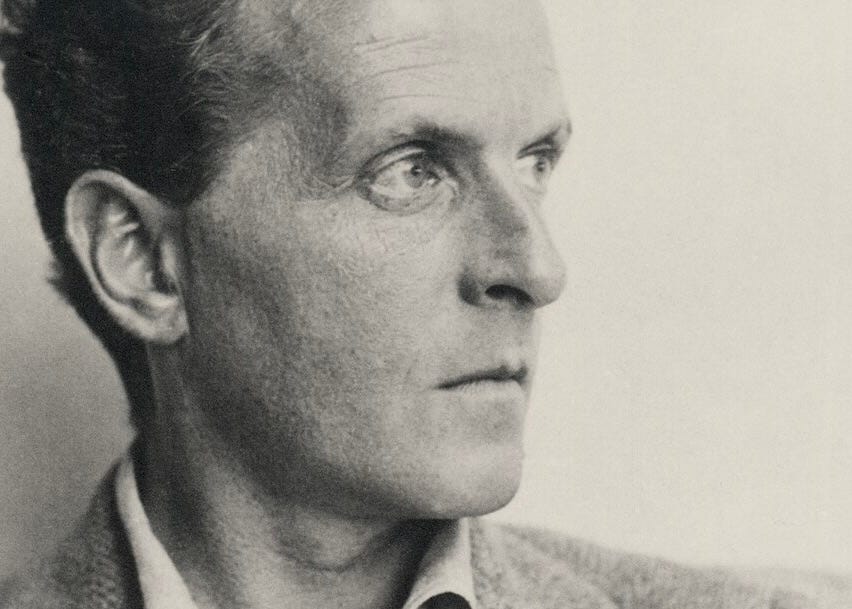
Ludwig Wittgenstein | (1889–1951)
Key Terms for this Section
Thing-in-Itself (Kant) · Phenomenal World (Kant) · Embodiment (Merleau-Ponty) · Language Games · Post-Truth
4.1 | Early Phenomenology - Kant
The Kantian Revolution
The two people who can best lay claim to revolutionizing philosophy in the last 2,300 years have been Aristotle (cf. Sec. 5) and Immanuel Kant. Immanuel Kant fundamentally reorganized philosophy such that, in the 18th century, it shifted focus from ontology to epistemology. That is, since antiquity, philosophy had largely followed Aristotle’s ontological model, which centered around questions of what is (ie. the nature of existence, a thing’s form, its function, etc.). Aristotle’s (d. 322 BCE) views became the foundation of Medieval Scholastic philosophy and theology (cf. Sec. 2.5), wherein thinkers grappled with such questions for a thousand years. However, in the modern period, Immanuel Kant (d. 1804) shifted our focus to questions like what it means to think and how we know things at all.
Why the change?
German Kantian theory refocused philosophy on the human thought process in response to the ongoing 1700s debate between Cartesian Rationalism (Descartes, 1641) and British Empiricism (Locke, 1689). While Descartes held that knowledge is rooted in the mind, Locke countered that knowledge comes from sensory experience. The first crowned the mind as king and doubted our senses. The latter crowned the senses and doubted the mind. Yet both Rationalism and Empiricism operated under the same assumption — that we can access an objective view of reality. Kant would prove them both wrong.
In fact, in less than a decade, Kant would prove many early modern philosophers wrong. His three major criticisms of philosophy are the Critique of Pure Reason (1781), the Critique of Practical Reason (1788), and the Critique of Judgment (1790). Modern philosophers quote these so often that they took on the nicknames the First Critique, the Second Critique, and the Third Critique.
In his First Critique (1781) of early modern philosophy, Kant explores theoretical reason, focusing on how we think about the natural world and the limits of our knowledge. This is the focus of this lesson, 4.1. In his Second Critique (1788), Kant explores ethics, which he considers practical reason, by investigating how we can discover absolute moral laws (cf. Sec 7). And in his Third Critique (1790), Kant bridges the gap between the theoretical and the practical by analyzing our aesthetic judgment and taste (cf. 13.1).
Kant's First Critique (1781)
Kant’s first swipe at early modern philosophy came in 1781 when he successfully argued against both Rationalism and Empiricism. What the rationalists got right was that some a priori knowledge is possible (ie. knowledge without experience). Certain truths (which Kant calls analytic statements), like “all bachelors are unmarried,” can be known simply by the meaning of the words themselves. We don’t need to empirically investigate whether every bachelor is unmarried. This is true simply by the meaning of the words. All apples are fruit. All triangles have three sides. And all bachelors are unmarried. These statements are true because of the relationship between apples and fruit, triangles and three, and bachelors and marriage. Sure, but to paraphrase the Scotsman David Hume (d. 1776), such analytic statements are tautological (ie. they’re just repeating the premise). They don’t expand our knowledge of the world. So, Kant tends to ignore analytic statements.
On the other hand, recall in their empirical criticisms that Locke (d. 1704) claims knowledge comes from perceiving the world. And Berkeley (d. 1753) extends this to claim existence itself depends on the mind’s perception. Those are some big claims! Let’s start with what the empiricists got right. Claims that expand our knowledge but need sensory experience to confirm the claim (like science) are what Kant calls synthetic statements. Kant points out that the empiricists are right insofar as synthetic statements expand our knowledge of the world. For example, “all bachelors are messy” is a synthetic statement because it adds new knowledge to the word “bachelor.” We could investigate this like social scientists and determine if all bachelors are, in fact, messy.
However, Kant rejected the Empiricist claim that experience alone could fully account for knowledge. While knowledge depends on experience, it is not entirely derived from it. Instead, the mind organizes and shapes experience through our mental categories (eg. time, space, and causality). These a priori structures of the mind make our experiences intelligible but also limit our perception and understanding of the world.
Kantian Phenomenology
Wait. Think about that. The a priori structures of the mind make experience intelligible but also limit our perception of the world. So, our perception of reality is limited? Yes, and ever since Kant pointed this out, none of our philosophical categories have ever been the same.
Try to imagine the world outside of our experience of it — filled with things outside of our perception of shape, color, depth, sound, texture, or even conceptual frameworks. Kant refers to such a view as the noumenal world — the world preceding or outside of our perception. In such a noumenal world, where something is not perceived or even considered by us, a thing would be a thing-in-itself (Ger. ding-an-sich). Such a conceptual thing would have its own, objective existence outside of our mental categories, perception, and cognition. This, Kant points out, would be the nature of an ‘objective view’ of the world that the empiricists claim to observe.
But Kant rightly argues that we never actually encounter this noumenal world because our minds actively shape how we experience reality. We, in fact, have no direct access to the world. Such a noumenal world definitively remains forever beyond human perception. And, as Ludwig Wittgenstein (d. 1951) famously says, “Whereof one cannot speak, thereof one must remain silent.” In other words, if we can’t make sense of the noumenal world, then even if it does exist — there is nothing meaningful we can say about it.
What we can speak on is our experience of the world — the tree we see, the music we hear, the justice we are exposed to — the phenomenal world. The phenomenal world is the world as we human beings experience it. This is not a direct reflection of the noumenal world but is instead constructed by our minds. Kant argues that human cognition organizes our sense data (eg. seeing, hearing, feeling) in ways that make that data meaningful to us. Think about it. We don’t see the world the bat sees. We don’t hear the world the cricket hears. We don’t taste the world the octopus tastes. Rather, we perceive the phenomena of the world through the filter of our own subjectivity. Truth, therefore, is always mitigated by our own subjective perception.
The jaw-dropping paradigm shift Kant brings to philosophy is this — no one has access to an unfiltered, objective view of reality. We can only experience the world as it appears subjectively to each of us. And since everyone’s mind constructs their own experience of the world somewhat differently, the perspectives of different people are crucial for us to see the world more fully.
The philosophical study of the ways we perceive the phenomena of the world is called Phenomenology, and it’s been going strong for 200 years.
4.2 | Late Phenomenology - Merleau-Ponty
Intentionality | Husserl
This is how Kant (d. 1804) begins to shift modern philosophy from ontology (what is) to epistemology (what can be known). It turns out what can be known to us is filtered through our own subjective experience. My experience of Texas differs from yours, your neighbors, or their families. Different ages, ethnicities, and social classes bring different experiences, perspectives, and cognitive biases to our interpretation of “Texas.” So, there is no objective view of Texas — no “real Texas” — only the Texas each of us has subjectively experienced.
We must also account for Heraclitus (cf. Sec 2.1), whom we can imagine saying, “You can’t step into the same Texas town twice.” That is, if you leave your hometown for a few years, the town changes, and you also change. In sum, what Kant points out millennia after Heraclitus is an objective view of “Texas” (ie. the noumenal world) is not logically possible. We only have access to a phenomenal view of Texas through our own constantly adjusting mental categories.
Recall now St. Anselm’s Ontological Argument (cf. Sec 2.5), wherein the archbishop distinguishes between objects that exist in the imagination and objects that exist in reality. In the 20th century, Austro-German philosopher Edmund Husserl (d. 1938) points out that St. Anselm is discussing the mind’s ability to think about objects regardless of their realness. Modern philosophy refers to this consciousness tendency as intentionality. Husserl focuses phenomenology on intentionality by asserting that every mental act is always directed at something. There’s no such thing as a ‘neutral state of consciousness.’ As beings capable of consciousness, we are always conscious of something (even if that something doesn’t exist in reality). This advances our concept of rational thought from a self-contained, Cartesian self-awareness (”I think, therefore I am”) to the outward directedness of our consciousness. We do not merely “think” in the Cartesian sense. With various levels of intentionality, we are always “thinking of something.” Husserl shows us that consciousness always has a direction.
Thrownness | Heidegger
Husserl’s teaching assistant and successor, the German philosopher Martin Heidegger (d. 1976), continues to build upon the ways humans know about the world. For Husserl, consciousness is an active, world-constituting pursuit driven by our intentionality. However, Heidegger focuses on a more passive, fundamental aspect of existence. That is, before we actively direct our intentions toward something, we are always already thrown into a world not of our choosing. Heidegger calls this thrownness (Ger. Geworfenheit). Here, Heidegger is pointing to the raw, undeniable givenness of our existence. If the central question of this module is “What can we know?” Heidegger is pointing out that the facticity of our existence already shapes our knowledge of ourselves and the world — our historical context, circumstance, relationships, and responsibilities — before we can even attempt to actively direct our thoughts in a particular direction.
Our context is irresistible. We cannot ignore it. Nor can we wholly adopt the perspective of, for example, a Chinese diplomat from the 14th century or a French nun from the 18th century. We can’t even read their texts without inserting ourselves into them! This is because we cannot help but think from the foundation of (and with the assumptions inherent in) our own time, place, and existence. So, like Husserl, Heidegger also proves we cannot achieve a complete, objective understanding of a thing. Our existential thrownness both shapes and limits what we can know.
Embodiment | Merleau-Ponty
French phenomenologist Maurice Merleau-Ponty (d. 1961) builds on both Husserl’s intentionality and Heidegger’s concern with the limitations of our intentionality (ie. thrownness) by focusing on the role of the body in experiencing the phenomenal world. Our perception and understanding of objects are inseparable from our physical interaction with them. This means that our cognitive intentionality involves more than our mental acts — whether active (cf. Husserl) or passive (cf. Heidegger). Thinking involves our entire body.
Here, Merleau-Ponty discredits the mind-body dualism of Plato and Descartes, who divided the world into two — our physical reality and a kind of disembodied abstract world of reason to which the mind can aspire. But Merleau-Ponty points out that our bodies deeply influence our perception and understanding of the world, in a concept he calls embodiment (ie. ‘embodied cognition’). We don’t just process information in our heads like software. Rather, our body immerses us in the world in ways that fundamentally shape our understanding. In other words, thinking is not just a brain-based activity.
Our metaphors are grounded in physical experiences (eg. I’m looking forward to the future). Our language is influenced by our physical interactions (eg. when we say “kick,” the brain’s motor areas activate as if we were kicking). Our perception of distance varies based on our fitness and pain level. Our memories are more easily recalled when we smell something familiar. When veterans hear sounds that remind them of their deployment, a post-traumatic episode may be induced. The network of bacteria in our gut biome (ie. the ‘second brain’) affect our cognitive flexibility, emotional regulation, and decision-making. In school, teachers often use gestures to reinforce language lessons. Studies show active people retain information better when their movement is less restricted. Facial expressions and body posture affect how we process emotional information. Our decisions are influenced by our sensory experiences (eg. seeing water cues our thirst). And while socializing, we tend to mirror the nonverbal behaviors of those with whom we agree or wish to join. These are just a handful of the examples phenomenologists use when pointing out (see?!) the centrality of the body when it comes to thinking.
All of this to say, the body is not merely a neutral substrate upon which consciousness occurs. The body is part of our cognition. We cannot separate our bodies and lived experiences from our understanding of the world or ourselves. This underlines the importance of the phenomenological project for understanding who we are and what we can know.
4.3 | Language Games - Wittgenstein
Language as Games | Wittgenstein
Having looked at intentionality (the directionality of the mind), thrownness (how our context shapes the mind), and our embodied cognition (how the body shapes the mind), we now turn to how language shapes our mind. Language is our preeminent tool for representing reality. It’s how we make sense of the world. So, it’s critical to understand how language works as we ask what it is we can know. The German Enlightenment poet Johann Herder (d. 1803) first argues that language shapes how people experience the world. For example, many pre-contact Indigenous languages lacked a word for “ownership,” which meant the concept of land belonging to a person or government was absent from their worldview. They had no laws or moral categories like ‘our land,’ ‘their land,’ ‘annexation,’ or ‘trespassing.’ Instead, theirs was an ethic of harmony and necessity.
In this way, language dramatically shapes how we interpret the world. The study of meaning in language and symbols is semiotics. The first semiotician was the Swiss linguist Ferdinand de Saussure (d. 1913), whose work introduces the concept of the sign. According to Saussure, all signs comprise two parts: the signifier (the form of a word or symbol) and the signified (the concept it represents) as part of the deep, underlying structure of language. In other words, the signifier is the word “apple” or a picture of an apple, while the signified is the apple itself.
This ‘underlying structure’ idea of language was known as linguistic structuralism(1920s-60s). Herein, the elements of language are defined by their relation to other elements within a closed, stable structure. Enter, Ludwig Wittgenstein (d. 1951). The Austrian philosopher challenged Saussure’s idea of a fixed, static system of language by arguing that the meaning of words is not inherent but arises from their use within specific contexts. Rather than having a static structure, Wittgenstein represents language as a series of games — each governed by its own rules and practices. Wittgenstein points out that the meaning of a word depends on how it functions in a particular context (ie. game).
For Saussure, language was a static, coherent structure. But for Wittgenstein, language is a dynamic, context-dependent set of constantly shifting games that we use to interact with one another. This mirrors the same emphasis that the phenomenologists place on context. For example, think about how certain words or phrases are used today in the context of meme culture (”it’s giving...”), gaming jargon (”camping”), or DMing (”💀”). Following the rules of these signs in our culture today reifies belonging to a cultural ‘game’ of a particular time, place, and people. Just as “moll buzzer” (1870s), “woofy” (1920s), or “ginchy” (1950s) may now be pastiche, but were on-trend in their day.
Wittgenstein rejected the notion of a universal, underlying structure of language. Instead, he proposed that language’s value and meaning are derived from its practical use in a given time, place, and context in a dynamic he refers to as language games.

Magritte’s 1929 “The Treachery of Images,” where the artist famously declares in French, “This is not a pipe.”
Deconstruction | Derrida
Martin Heidegger (d. 1976) once remarked that it was the philosopher’s job to creatively and rigorously critique the concepts that came before us. He referred to this process destruktion. The French Algerian philosopher Jaques Derrida (d. 2004) put his own spin on this Heideggerian notion in a concept he calls deconstruction. For Derrida, deconstruction is the philosopher’s task to rethink our inherited assumptions to make room for new ideas. To be the Socratic ‘gadfly’ of our discipline.
Derrida’s deconstruction takes on Wittgenstein’s view of language — that meaning is always context-dependent — to say that no text has a single, essential, eternally fixed meaning. He critiques the idea of objective truth in language, asserting that there is no external reference point or “correct” word for any given thing. Unlike Plato’s ancient epistemological view, which presupposes an “Ideal World” from which ideas originate, Derrida argues that all knowledge is mediated through language, echoing Kant’s skepticism (ie. the noumenal world).
Central to Derrida’s claims about language is différance — the notion that words derive meaning only in relation to other words, forming an endless chain of differences. Like Wittgenstein’s “language games,” Derrida contends that words function through creative play. But alas, there is no final or correct meaning. This means language is inherently unstable — words have multiple meanings, which change over time and in different contexts. The evolution of language will never end.
Metanarratives | Lyotard
Given all of this epistemological instability, we come to realize none of us as individuals have access to a completely objective view of the world. Our agency as thinkers is informed and limited by our consciousness (cf. Husserl), context (cf. Heidegger), and bodies (cf. Merleau-Ponty). Our thinking is also limited by the constantly shifting (cf. Wittgenstein), sheer ambiguity (cf. Derrida) of language. Language is irreducibly complex. By its very nature, it cannot be boiled down to ‘what it really means.’ For Derrida, there is no objective truth in language. There will always be slippage, misunderstanding, and différance in our ever-evolving litany of signs.
Taking a step back, the German philosopher GWF Hegel (d. 1831) once described history as the millennia-long process of resolving all of our contradictions until ‘absolute truth’ could be attained (cf. Sec 10). But by the 20th century, philosophers had become incredulous of such totalizing projects or stories. ‘Totalizing’ means attempting to create a comprehensive, all-encompassing narrative that can explain all knowledge, values, and phenomenal experience. This project begins in the Renaissance but reaches its zenith with Hegel (cf. Sec. 10). After Hegel, everyone who tries to reduce humanity to ‘one totalizing story’ is subsequently torn down.
• The Logical Positivists attempted to reduce all knowledge to scientific verification.
• The Structuralists (like Saussure) attempted to reduce all language to an absolute, unchanging structure.
• The Marxists attempted to reduce history to a single story of class struggle (where equality is the answer).
• The Nazis attempted to reduce history to a single story of racial supremacy (where genocide is the answer).
• Today, promoters of the Singularity attempt to reduce history to a single story of emancipation via technology.
Such overarching narratives are referred to as metanarratives by the French sociologist Jean–François Lyotard (d. 1998). A metanarrative is a modern story that attempts to subsume all other stories in an effort to emancipate us with its absolute truth. It’s the story that makes all other stories make sense. Marx, for example, claims that nothing makes sense about history until you see the world through the lens of ‘class struggle’ (cf. Sec. 10.2). For him, class struggle explains religion, economics, war, peace, love, the sciences — everything. In the 20th century, Lyotard became skeptical that one story could account for the great variety of human experiences and phenomena. He referred to the critiques of metanarratives as ‘postmodern’ critiques. That is, ‘the critiques that question the dangerous, totalizing certainty of the 19th and 20th centuries.’
If ever there was a misused or misunderstood philosophical term, it’s postmodernism.
4.4 | Post-Truth World - Arendt
Postmodern Critique | Foucault
Postmodern critique focuses on the contingent, unstable, multi-faceted nature of knowledge to challenge those (like Hegel or Marx in Sec. 10) who attempt to totalize knowledge. Postmodernism is not, itself, a competing, totalizing claim about truth. Rather, postmodern critique stems from those philosophers like Lyotard, who became incredulous that one totalizing story (like Marxism) could explain everything. In this way, it’s best to think of postmodern critique as a set of tools used to resist totalizing claims (like Marxism or any of the bullets listed in the previous section).
One such philosopher is the French historian Michel Foucault (d. 1984). As a student of history, Foucault is critical of how powerful institutions (ie. governments, schools, the media) produce, legitimize, and distribute information in such ways as to reinforce our own self-regulation. Today, such biopower keeps us in self-imposed information silos of social media — echo chambers of increasingly biased, unchecked information. In this milieu, we become passive (rather than critical) consumers of information that reifies existing power structures. Critical thinking and meaningful debate end entirely as we sit back, confident of our poorly-formed views as we’re fed a diet of algorithmic content that never takes us beyond the comfort of our preexisting beliefs.
So here’s how postmodern critique gets misunderstood. Foucault interrogates specific fields of study to reveal their underlying assumptions and power relations. What he’s not doing is claiming there’s no such thing as “truth.” On social media, postmodern critique is often mistakingly portrayed as a form of nihilism — a rejection of truth (cf. Sec. 11). But properly understood, postmodern critique is a soulful search for ‘truth,’ focused on peeling back the layers of ideology that power structures have put into place (in an effort to maintain their power). Modern social norms like heteronormativity, psychiatric health, surveillance, citizenship, and economic productivity were questioned by Foucault in an attempt to reveal how governments, schools, and the media normalize these categories for the sake of social control. But Foucault was no nihilist. He cared deeply about wisdom, truthful reporting, and political justice.
In our 21st-century context, postmodern critique questions social media and media reports that shape public perception to serve those in power. Through repetition, false statements become believable through familiarity. By focusing on dramatic events, less sensational news (eg. local news) is set aside as our cognitive bandwidth is limited. This tendency distorts our view of the world, creating the sense that we’re in more danger than is honestly the case. Again, because of our limited cognition and the algorithmic nature of social media, group polarization becomes amplified — reinforcing biases and political extremism. Add to this the nefarious efforts of enemy nations who use bots to weaponize our social media and pit Americans against each other. Finally, confirmation bias causes us to seek and accept information that aligns with our preexisting beliefs, entrenching power structures that become more powerful the more we become polarized.
Postmodern critique does not argue against the existence of truth. Rather, postmodern critique is concerned with the ways power and media distort our sense of truth.
“My point is not that everything is bad, but that everything is dangerous.” - Michel Foucault
Living in a Post-Truth World | Arendt
The German Jewish political philosopher Hannah Arendt (d. 1975) knew well the relationship between political power and truth, having been arrested in Germany by the Nazis at age 26. From 1941 onward, Arendt lived in New York, became an American, and spent her career critiquing totalitarianism. A totalitarian regime is characterized by the concentration of power by an authoritarian leader or autocrat and the increasingly small circle of people they trust.
Arendt explored how totalitarian regimes maintain power by manipulating the media. In Truth and Politics (1967), she distinguishes between immutable factual truth and subjective political opinion. Arendt warns that when facts become subsumed by propaganda (ie. ideological opinion), totalitarianism is not far behind. Historical facts, scientific findings, and democratic values cannot afford to be overtaken by ideology. The cost, simply put, is the erosion of the public trust in a nation’s democratic institutions. The ultimate result of ideology overtaking a nation’s public discourse is indoctrination — where contradictory empirical evidence no longer changes voters’ minds. Once a nation crosses that line, authoritarianism is generally the next logical step. It was for Germany in 1933.
In the 1990s, “post-truth” became a term American political commentators used to describe our politics. In 2016, it was the Oxford English Dictionary’s Word of the Year. What does it mean? Post-truth is a state of political affairs wherein factual truth (cf. Arendt) has less influence on public opinion than appeals to emotion and ideology. How did this come about? First came the proliferation of competing truth claims across social media. Then, the decline of traditional journalism as a reliable adjudicator of competing truth claims. Next, the proliferation of algorithm-driven media — which filters news, reinforces echo chambers, and fragments the public sphere. Fourth, big data analytics prioritizing persuasion over education and substance. Fifth, the rise of bots (software that mimics human behavior), set up by bad actors and enemy nations to shape our political discourse and turn us on each other. And lastly, the growth of influencers who use emotional appeals to promote their branding rather than focus on factual accuracy. In such a distracting environment, social distrust and a “post-truth” sensibility become the norm.
The Third Option | Frankfurt
Today, the rhetoric of politicians, celebrities, and other media figures is generally geared toward excitement and audience engagement rather than factual truth. Moreover, their audiences share their disregard for the truth — instead focusing on the speaker’s celebrity and symbolic appeal. Here, truth becomes irrelevant in a surprising way. The American philosopher Harry Frankfurt (d. 2023) notes that epistemologically, we used to adjudicate between truth-telling and lying. But in the post-truth world, there is a third category.
In his work, On Bullsh*t (2005), the Princeton professor points out that both the truth-teller and the liar have regard for the truth. The truth-teller aligns her statements with the truth, while the liar recognizes they are lying about the truth. However, the bullsh*tter persuades without regard to truth or falsity. They will mix truth and falsehood openly and randomly — counting on the sheer gravity of their celebrity to persuade the crowd. Before social media, getting caught in a lie could be the end of a politician’s career. But in a post-truth world, an indoctrinated audience will often treat lying with amused indifference. This is how truth and the love of wisdom become irrelevant to a culture.
What becomes of philosophy when the search for truth becomes irrelevant to a society? What can be known at that point?
This Section: Thinking Today
Next Section: Character Ethics