

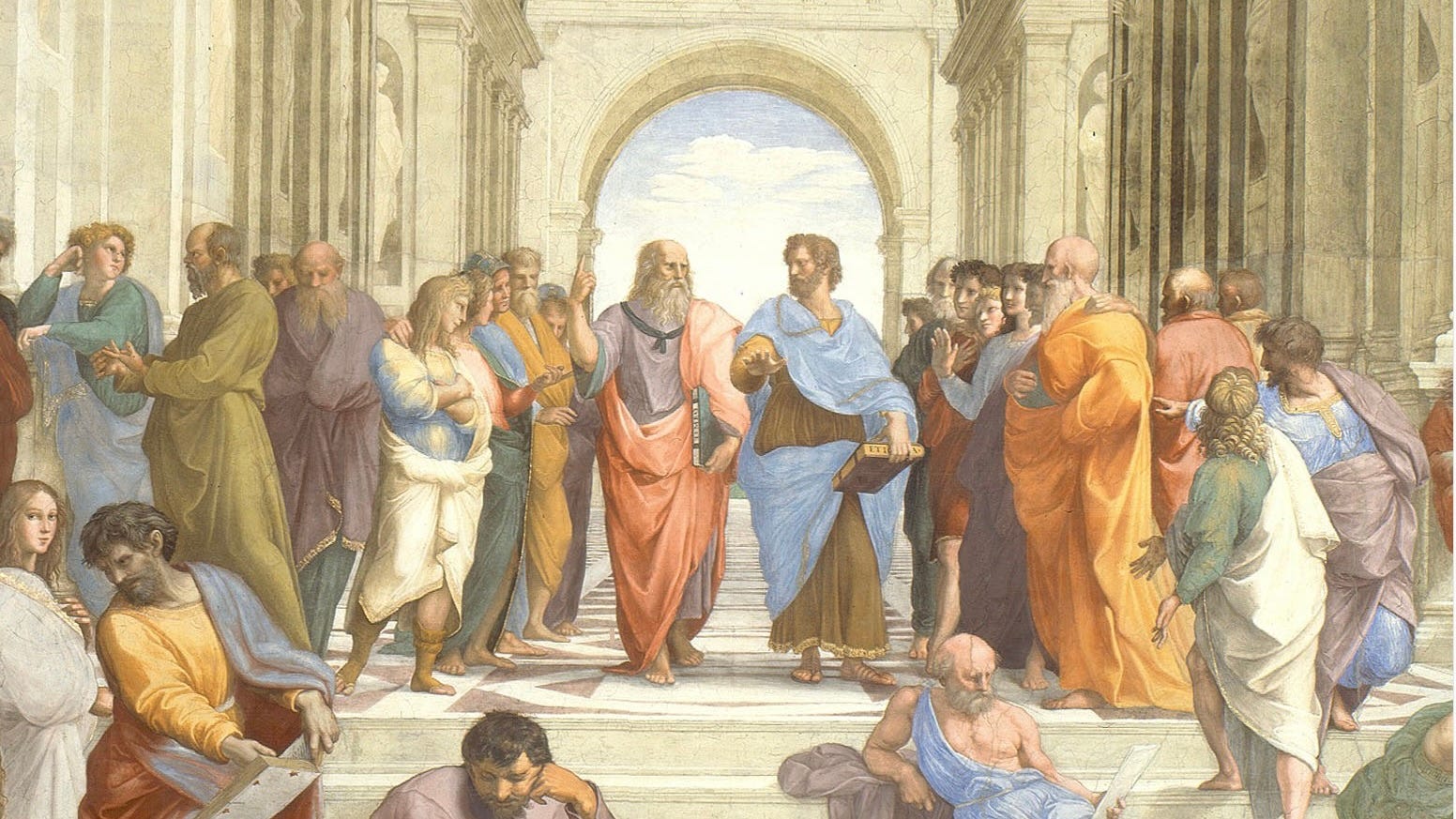
The School of Athens | Raphael, ca. 1510
Here, Plato (left) and Aristotle (right) debate together as
the two pillars of Western thought.
Key Terms for this Section
Arete · Teleology · Golden Mean (Aristotle)
Natural Law · The Seven Basic Goods (St. Aquinas)
5.1 | What is Ethics
What is Ethics?
Having completed our first module, asking, “What can we know?“ we move on to our second module, where our central question will be, “What should we do?“ To answer this question, we turn now to Normative Ethics.
Ethics is the study of moral good. It explores how we live, treat each other, and what makes life valuable. Ethical questions address issues like how we judge right and wrong, how we balance personal needs with consideration for others, and how to resolve moral dilemmas like whether it’s justifiable to steal to feed one’s family or lie to protect someone’s feelings.
Moral philosophers have developed various ethical frameworks to answer these dilemmas. These frameworks offer systematic theories of morality, such as those proposed by Aristotle (Sec. 5), Hobbes (Sec. 6), Kant (Sec. 7), and Mill (Sec. 8). These frameworks guide moral agents — those responsible for acting ethically — by helping them navigate ethical challenges. When we discuss ethics over the next four sections, here are a few things to keep in mind.
First, ethics is not the law. While legal systems are politically determined and subject to change, morality transcends legality. Historical examples like slavery or prohibition illustrate the fluidity of our legal system, while moral judgments are rooted in ethical reasoning. Therefore, recourse to “it’s wrong because it’s illegal” isn’t going to get us very far.
Second, our moral values — derived from our individual, cultural, and societal experiences — are generally insufficient for fully addressing complex ethical issues. Our general principles, like the Golden Rule or “When in Rome, do as the Romans do,” may be helpful in casual settings but fail to provide nuanced answers to difficult dilemmas, such as capital punishment or whether to go to war. Similarly, practical conclusions, like, “I won’t speed today because I don’t want a ticket,” are not comprehensive ethical systems. Also, emotional pronouncements, like avoiding actions that feel wrong, are inconsistent and vary wildly between cultures, individuals, and even our current mood. Therefore, general principles, practicality, and feelings aren’t going to get us very far either.
Third, ethics requires logical justification for our moral actions, as we must justify our actions to our neighbors, friends, and fellow citizens. Philosophers have long debated how to live a good life, what makes actions right or wrong, and why we should act morally. These debates continue today — taking into consideration the interests of individuals, marginalized groups, and broader societal and even environmental concerns. In short, the best grounding for our ethical choices is moral philosophy.
Can Ethics be Argued Objectively? | Kant
In our last section (4.1), we learned how Kant split our view of reality into the noumenal world (things as they truly are) and the phenomenal world (things as we perceive them). While our empirical view of the world comes to us through the subjective filter of our senses, Kant maintains morality arises from pure reason. Like mathematical axioms (2+2=4) or scientific laws (E = mc²), ethicists generally work from the premise that ethical maxims transcend our subjective experiences. This position is called moral objectivism. Let’s take a moment and look at the alternatives to this view...
As moral objectivists, ethicists work to discover and defend moral facts (a moral fact is an ethical claim that can be proven true). Those who take morality seriously are moral realists. Those who don’t are moral nihilists. The moral nihilist claims morality is entirely made-up — that there’s nothing intrinsically wrong with turning all the traffic lights green, or poisoning the water supply, or setting fire to a hospital. As you can imagine, it’s rather difficult to argue rationally for moral nihilism — a belief in nothing. So we’ll be working from the premise that morality is real. That gives us two more things to consider — moral objectivism and moral subjectivism. As previously stated, moral objectivists assert morality exists independent of human desire or decision (cf. Kant). On the other hand, the moral subjectivist asserts that, while real, morality is relative to our individual and/or cultural perspectives.
The Problems with Moral Subjectivism
The moral relativist arises from the adolescent level of relative thinking (cf. Sec 1.2). For the moral relativist, there are no moral experts. Anyone’s view is as good as anyone else’s. The two major branches of moral relativism are moral subjectivism and cultural relativism. Moral subjectivism asserts right and wrong are real but based in personal feelings. This simply does not work. If Bob feels we should have more gun control laws and Maya feels we should have fewer, moral subjectivism says that both are right because that’s how each feels. That clearly doesn’t work. It can’t be morally correct that we both should and shouldn’t have capital punishment, or that we both should and shouldn’t go to war.
The other form of moral relativism is cultural relativism — that right and wrong are real but are based on one’s culture. This too has a rash a problems. If morality is relative to one’s culture, then there are no moral experts. In American history, moral progress has generally been made when a few hero-outliers spoke up against the majority arguing for justice. Lincoln, Susan B. Anthony, MLK, and Caesar Chavez all spoke out against the American majority for the rights of slaves, women, African Americans, and Hispanic workers. But where culture becomes the arbiter of morality, society can do no wrong. Under cultural relativism, moral progress grinds to a halt, both here and elsewhere. If cultural relativism is the case, then when other cultures deny their citizens the rights to vote, pray, publish, or peacefully assemble, we have no place to argue. In other words, human rights around the world dies in the shadow of cultural relativism, if morality is not an objective concept we can all argue about together as a species.
As such, this course will take a moral realist and moral objectivist perspective, wherein ethics is real, can be pursued objectively, and moral agents are ethically responsible for their choices.
5.2 | What is Virtue? - Aristotle
What is Character?
We return to ancient Greece. Having given Plato’s ideas some deserved focus (Secs. 2.2-3), we now turn to his most famous student, Aristotle (384–322 BCE). Why? Because the first book written on moral philosophy was Aristotle’s Nicomachean Ethics. Its first line reads, “Every art and every inquiry, and likewise every action (Gr. praxis) and choice, seems to aim at some good, and hence it has been beautifully said that good is that at which all things aim.” Here, Aristotle focuses on the importance of habit or practice (praxis) in becoming moral. Since ancient Greece, the good has been the goal for which we all [should] aim. Amidst that struggle, our character is revealed.
Our modern concept of character comes from the ancient Greek word kharasso, meaning “to engrave.” Ancient Greeks, like Aristotle, thought of one’s character as the deep mark or impression one makes on one’s own soul. This depth of character accrues over a lifetime of choices. It’s not at the surface — like how beautiful, popular, or on-trend you are. Character isn’t a tattoo, a meme, or shallow virtue signaling. It’s deeper. It’s a fundamental part of you that’s earned by making hard choices that influencers and the crowd often shun. Because seeking popularity (which usually requires embracing a kind of nihilism) is rarely a road to good character. Think of Hollywood actors. It’s unusual to find a celebrity who’s a genuinely good and selfless person. But you might be thinking, I want to be popular! I want to be an influencer! Why? For the vapid validation of a crowd who would turn on you in an instant if it helped grow their own popularity? We are taught these days to follow any dream we can imagine. But we are rarely taught to imagine a more moral version of ourselves. Aristotle asks you to imagine that. Imagine your most moral, virtuous self.
What is Virtue?
Aristotle described the moral exemplars of his time as possessing of arete. The Greek concept of arete is nothing short of the full realization of one’s potential. In a word, it’s excellence. But it’s so much more than that. It’s doing what you were born to do. The most elegant translation we can make of it into English is to call it “virtue” (Lt. virtus).
The virtuous person is a “good” person. A person’s virtue is acquired through a lifetime of practice. No one is born with moral virtue, as aristocrats often claimed. Nor does virtue come easily or quickly, as self-help books often claim now (eg. “30 Days to a Better You!”). No, everyone comes to their virtue (or lack thereof) honestly and over the course of years (cf. character).
What does virtue look like? Aristotle focuses on three chief areas of our moral lives: our reason, our desires, and the actions one takes in light of these two concerns. Aristotle understood that a person’s nature has both rational and nonrational components. We think (ie. reason) about with whom we’ll have a relationship, what career we want, and where we’ll make a life with those things. But we also hunger (ie. nonrational desire) for food, pleasure, and rest. For Aristotle, all this ties into our moral life. We must act with reason, or we become vicious. And we must act from moral desires, or we become weak.
For Aristotle, the vicious person (Gr. kakia) embodies evil — having developed corrupted reasoning and habits due to a lack of exposure to virtue. She believes her actions are justified because she doesn’t know better, making it difficult to change her behavior. While the weak person (Gr. akrasia) has little self-control. Though they desire to be virtuous, they fail to act on those desires.
So virtuous action arises from virtuous reasoning (eg. relationships, jobs) and virtuous desires (eg. dinner, sleep). Also, for Aristotle, no action taken with bad judgment can be called virtuous. If a person drives drunk into a tree and then subsequently gets his life together, the car collision was still not virtuous. Additionally, an action taken from unethical desires cannot be called virtuous. If a person cheats on her spouse and a child results from the affair, as beautiful as a newborn child is, the desire to commit adultery cannot be called virtuous. In this way, reason, desire, and action are central to Aristotle’s understanding of character and living with a focus on moral excellence.
Optional Video: The famous Marshmallow Test is a great example of the virtuous person being habituated toward patience and the good (auto-generated CC).
The Goal of Our Lives
Like most ancient philosophers, Aristotle asserts that all things have an inborn goal or purpose (Gr. telos), in which everything has an inherent function (Gr. ergon). This ancient ontological view is called teleology. For Aristotle, a thing is considered “good” when it fulfills this purpose. A good fire burns hot. A good knife cuts well. So, Aristotle argues, we homo sapiens (Lt. thinking ones) also have a unique function — to think and reason well. Thinking is the thing we do better than anything else in the world, which makes it our defining feature (ie. telos). Our highest goal, therefore, is to contemplate and seek our ultimate intrinsic good — happiness. However, Aristotle’s understanding of happiness goes beyond mere physical or sensory pleasure. There’s a deeper pleasure.
The Greeks had an amazing concept — eudaemonia — which literally means good (eu) spiritedness (daimonia). To live in eudaemonia means to live up to one’s best purpose, one’s best self, one’s best destiny. For Aristotle, eudaemonia is the ultimate purpose of human life, achievable only through living virtuously in moral excellence. While we may desire things like money, food, or friendships to satisfy other needs, happiness is desired for its own sake (ie. intrinsic) and is thus our highest goal. Eudaemonia is not the shallow pleasure found in material things but a profound state of contentment that arises from living a life of virtue. Aristotle asserts that happiness is the result of aligning our lives with moral virtues and that only through consistent practice of these virtues can we truly flourish.
Ultimately, for Aristotle, the purpose of life is not to seek momentary pleasure but to pursue a deeply fulfilled existence. This can only be achieved through a lifelong commitment to virtue and excellence. Flourishing, in Aristotelian terms, means becoming the best version of ourselves, not just in how we think but in how we act — by choosing the Good consistently. This pursuit of eudaemonia is the highest expression of our rational nature and the key to true, lasting happiness.
5.3 | Virtue Ethics | MacIntyre
How to Be Good
Aristotle lays out several preconditions for being virtuous, including education, prudence, and courage. Education is essential for developing moral awareness, enabling us to thoughtfully consider the consequences of our actions. As we are responsible for our choices, education helps us to understand all sides of a moral issue. Prudence, or the ability to make wise decisions, requires critical thinking and the application of wisdom to real-world scenarios. Courage is necessary to translate knowledge and good judgment into action. Without courage, even well-reasoned choices become meaningless.
In addition to the personal traits required for virtue, Aristotle also points out the preconditions for virtuous acts. Moral actions must be deliberate and guided by an understanding of what is morally right, rather than by chance or luck. Virtuous acts are done for their own sake, not for external rewards such as recognition or praise. If an act is motivated by self-interest, it is not truly virtuous but rather a form of self-promotion. Moreover, consistency is essential for virtue. Based on reason, moral actions should not fluctuate over emotions or fleeting desires. A virtuous person consistently chooses the right action in any given situation, regardless of external factors like mood or social pressure. They aim to develop themselves over a lifetime. But how do we know what moral choices to make?
Virtue Ethics | Moral Framework: Aristotle
In the heart of Delphi, the famous Greek temple to Apollo bore the inscription, “Nothing to Excess” (Gr. Meden Agan). Moderation was the keystone to Greek living. Greeks did not understand people who did not take wine, while the guest who drank to excess was shunned for his buffoonery! To drink a moderate amount, on the right occasion, and for the right amount of time — this was the Greek way. As such, Aristotle looked to individual virtues as targets of behavior, to which we must aim between two distasteful vices. On the one hand, there is a vice of too little. On the other, a vice of too much. But between these two vices (of too much and not enough) is the moderate virtue of just right. This is the Golden Mean, the middle ground between two opposing vices to which we focus our moral aims.
For example, consider the virtue of courage. How do we define courage? (Socrates asked this incessantly!) For Aristotle, we can understand courage as the mean between the surplus of recklessness and the deficiency of cowardice. Think of a medieval battlefield on which stand two opposing armies ready to attack each other. As your commander is giving a rousing speech before the battle commences, your friend Arthur races across the field with a rusty old sword, where he is swallowed whole by the opposing army. Was that courage? No. That was reckless. Now reimagine that scenario, only this time your commander finishes his speech, and the whole army begins to march in lockstep. But Arthur throws down his sword and nopes out. Was that courage? No. That was cowardice.
In the situation above, the courageous act would’ve been to fight alongside his unit. If Arthur runs into the enemy on his own, he has a surplus of courage (vice). If Arthur runs away when the fighting starts, he has a deficiency of courage (vice). Therefore, the virtue of courage is found between the vices of cowardice (the vice of too little courage) and recklessness (the vice of too much courage). And here’s a little tip: Aristotle points out that most virtues tend toward one side or the other. Courage usually leans closer to recklessness than cowardice. Generosity, as another example, usually privileges giving too much rather than too little, though both have their faults.
Example Virtues with a Golden Mean
( – ) Balance / Virtue (+)
cowardice —> COURAGE <— recklessness
indulgence —> TEMPERANCE <— can’t hack it
pride —> MODESY <— excess humility
secrecy —> HONESTY <— won’t shut it
apathy —> COMPOSURE <— anxiety
There are also some absolute virtues — like wisdom, prudence, and justice — which have no limits. There’s no such thing as too much wisdom or justice, only their absence. Similarly, there’s absolute vices — like theft, racism, or murder — which are wrong in any amount.
Virtue Ethics Now | MacIntyre
After the Scholastics took on Aristotle’s corpus of work (cf. Sec 2.5), their leading ethicist, St. Aquinas, redirected ethics toward a Medieval, God-centered discussion (cf. Sec 5.4). For roughly a thousand years, Aristotelian Virtue Ethics lay more or less dormant. Enter the Scottish American, Alasdair MacIntyre (born 1929).
MacIntyre rethinks Aristotle’s Virtue Ethics for the 20th century. First, MacIntyre looks to the moral utility of our modern social and communal practices (eg. sports, religious services, boardgames) and shows how these practices have moral value insofar as they cultivate moral character by teaching discipline, perseverance, and cooperation. In order to achieve excellence in these activities, one must aim for virtue. In this way, MacIntyre shows that our social traditions can have a profound impact and influence on our moral cultivation.
MacIntyre also takes a swipe at the promises of modernity (cf. Sec 3.2 & 4.4), by pointing out how the individuated fragmentation of moral reasoning in our modern society leads to moral subjectivism (cf. Sec. 5.1). Against this, MacIntyre stresses that Aristotelian virtues are not subjective qualities one chooses at will but are deeply rooted in historical and cultural traditions (eg. ancient Greece). Here, he calls for a return to a moral philosophy embedded within communities — where virtues like justice, courage, and honesty are practiced not in isolation but as part of a collective political effort to achieve shared goals. This serves a bold corrective to the information silos and echo chambers of our modern public sphere (cf. Sec 4.4).
Lastly, MacIntyre updates Aristotle’s concept of eudaemonia as part of a narrative unity of one’s life. That is, for a person to live in eudaemonia, their life must be understood as a unified and coherent story, wherein virtue serves as the foundation of their life story. A person’s life makes the most sense when seen through the lens of their moral goals. What virtues did they choose to live by? Where did they rise and fall? Such moral reflection on one’s actions and decisions gives purpose, shape, and identity to one’s life. It certainly has for mine.
5.4 | Euthyphro’s Dilemma | Socrates
Natural Theology
Greek philosophers like Aristotle sought rational explanations for natural phenomena. His metaphysical inquires explored causality, teleology, and ontology using ancient Greek reason. For example, when Aristotle argues for a “prime mover,” that which is responsible for the motion and order of the universe, he avoids appealing to stories of the Greek gods (cf. Sec 3.1). This was in contradistinction to the prevailing discourse in neighboring Israel, where the Torah’s representation of God’s nature and purpose in the world was bound up in revelation. As a Jewish, pre-Greek text, the Torah (ie. the first five books of the Bible) offers no rational arguments for God. Such talk would not become relevant until proselytizing traditions like Christianity and Islam had to produce compelling, reasonable claims about God to satisfy would-be converts to their respective religions.
As such, we can trace the rational, philosophical discussion of God back to the arguments of early Christian theologians — Greek readers who were fluent in both Jewish tradition and Greek philosophy. In this way, the Early Church Fathers developed Natural Theology in an effort to explain and defend their beliefs (cf. Sec. 2.4).
Back in Greece, Socrates discusses with his friend Euthyphro the relationship between the Good and the Gods. Socrates poses this question, “Do the gods say things because they’re good? Or are things good because the gods say so?” This classic question of ethics is known as Euthyphro’s Dilemma. This moral dilemma has two opposing philosophical choices or “horns,” which is generally how moral dilemmas go.
Euthyphro's Dilemma | Socrates
Option 1: Does God say things because they’re good?
The first option (or “horn”) of the dilemma posits that God says things “because they’re good.” But this would render God unnecessary to ethics. Why? Because in this scenario, God is recognizing “the Good” and then telling us about it. If this is accurate, it puts morality above God. Similarly, I may recognize that it’s cold outside, but that doesn’t mean I can control the weather. The outside temperature is beyond my ability to control. I can merely report on it.
Option 2: Or are things good just because God said so?
This second horn is represented by a way of framing ethics called Divine Command Theory. In DCT, you know right from wrong simply because God said so. That’s it. So, anything that God says is good. Even something you might find obscene, like child sacrifice. According to DCT, if God said do it, you must do it because you have no real ability to consider morality on your own. So you have no choice.
Now, by the phrase “God said it,” we generally mean something we interpreted in scripture or something a theologian said. Setting aside the infinitude of difficulties and dangers regarding theological translation and presentist bias, it’s worth noting the long history of bad actors claiming to speak for God. For instance, in the late 20th century, one American pastor convinced his congregation to move with him to the jungle, where he then murdered over 900 of his congregants. Reading this, you and I may feel shock and dismay over such an action, but without recourse to reason (ie. without the right to argue with God or His self-appointed messengers), how can we contradict such a pastor? We can’t judge him as evil if DCT suggests we aren’t equipped to judge right and wrong in the first place.
Do the gods say things because they're good? Or are things good because the gods say so? - Socrates
Examining the Two Horns of Euthyphro's Dilemma
We could simply embrace the first horn and posit that God is neither all-knowing nor all-powerful. And some religious traditions hold to this view. This theology usually goes something like this: So that we can exercise free will, God chooses to limit Godself. God could do miracles, but God doesn’t so that we can act as free moral agents instead. As we find in Genesis 18, we can change God’s mind.
Likewise, we could embrace the second horn, and abdicate our reason to God’s scripture. We could attempt to simply, “do as God says.” But there are a multitude of issues with this option. First, which scriptures are we counting as “what God said”? 15% of the world says God’s word is found in the Hindu Vedas. 25% say it’s the Qur’an. 31% say God speaks in the Christian Biblical canon — but while Catholic Christians say that canon has 73 books, Protestants claim 7 books fewer, and Orthodox Christians claim 8 books more. Secondly, even if we were to posit that, say, Protestant Christians have the correct texts, consider the multiplicity of viewpoints among Protestant denominations (eg. Presbyterian, Baptist, Methodist, Church of Christ, etc). And even among those denominations, do people in the same denomination or even the same church believe exactly the same thing? Third, there are additional issues when considering how the Biblical text treats difficult moral issues like slavery.
In some passages, the Bible seems to condemn slavery. Consider the Jewish text which reads, “Whoever kidnaps a person... shall be put to death.“ (Exodus 21:16). Or the Christian text which reads, “Were you a slave when you were called? ...if you can gain your freedom, do so.” (1 Cor 7:21). Yet there are other passages that seem to condone slavery. Consider the Levitical offer, that “You may take slaves ...they may be your property.” (25:45-46). Or the admonishment of 1 Peter, “Slaves, accept the authority of your masters with all deference, not only those who are kind and gentle, but also those who are harsh.” (2:18). Now, we may puzzle over the context of these verses, or claim some theological position later replaced it, or even ignore it as irrelevant to us. But wait… If we’re using our reason to understand the text, then that means we’re not simply “doing what God says.” If the whole point of Divine Command Theory was to negate human moral consideration and interpretation, then it has failed us as a way of understanding both scripture and morality the moment we realize that reading any text is an act of interpreting and deciding what that text means to us. In this way, the very act of our reasoning negates Divine Command Theory as a viable solution to Euthyphro’s Dilemma.
5.5 | Natural Law Theory - St. Aquinas
Medieval Solutions to Euthyphro
A third option eventually arose that claimed by emphasizing God’s perfection, we might outmaneuver the first horn of Euthyphro’s Dilemma. To wit, a morally–perfect God definitionally could not command something evil. And yet, this still seems to put limits on an all-powerful God (cf. God “could not…”). This brings us to the option embraced by the overwhelming majority of Medieval Christians, Muslims, and Jews.
The fourth option is what is now referred to as Natural Law Theory. This theory goes something like this: there is no dilemma for the theist because morality mirrors the deep structure of the world itself. How do we know this? Because God is the Creator of our world, and it is a “good” world (Gen 1:31). And the very God who created our world is also the same God Who authored right and wrong. God is both Creator and Lawgiver of the same closed system. In the West, Judaism, Christianity, and Islam all affirm this claim. And because all theists have easy and equitable access to the creation (unlike their divergent scriptures), we may understand the creation as a nonsectarian, Divine moral guide for living.
Natural Law Theory | Moral Framework: St. Aquinas
As the leading philosopher of the Medieval Scholastic movement (cf. Sec. 2.5), St. Aquinas worked tirelessly to bring philosophy to its fullest flower in Europe, by reconciling the wisdom of the ancient Greeks with his Christian faith. In his work, the Summa Theologica (lit. the Summary of Theology), St. Aquinas cites the work of divergent Aristotelian scholars like the Islamic philosopher Avicenna (d. 1037) and the Jewish philosopher Maimonides (d. 1204), whom themselves had previously brought ancient Greek philosophy to bear in their respective religious communities and are today regarded as intellectual titans of Islam and Judaism (cf. Sec. 3.1).
In proper Aristotelian form, St. Aquinas set out to discuss the purpose and source of our laws in a systematic way (cf. teleology). In the Summa, he defines and expresses the purpose of human laws as “an ordinance of reason for the common good, [and] made by him who has care of the community.” That is, a law must be 1) derived from reason (not passion), 2) serve the common good (not special interests nor merely the wealthy), and 3) take as its goal the care of the community (not destroy the bonds that tie the community together). A just law must have these attributes at the very least.
So, why is Divine Command Theory insufficient for theologians like St. Aquinas? One reason is that our laws must be written “for the common good.” But you cannot know the common good (ie. what others need from you and each other) without reasoning with other people. Different people and different groups have different needs. This is the foundation of political philosophy and all its discontents. So, St. Aquinas, “Doctor of the Church,” sets out to explain what laws are, where they come from, and how we know when they are just. Because, for St. Aquinas, it is a Christian imperative to use one’s God-given reason to adjudicate laws and enact justice.
St. Aquinas finds four sequential levels of law. The first is Providence or the Eternal Law of God. The Eternal Law is the perfect thoughts and plans of God. We have no direct access to such plans (or we would be as gods ourselves), but St. Aquinas deduces the Eternal Law as the source of all other laws. The second level is the Natural Laws of God. This is the level at which we and all creatures participate — from stars to atoms, from the great web of life to house cats. Natural laws (from procreation to death) inform our lives. Yet, as rational creatures, we are not solely bound by them. We are more than animals and natural processes. For this reason, there exist two more levels of law.
St. Aquinas explains that the scripture, or Divine Law, is the revelation of God’s plan for us. These are the written out commandments that we are all expected to follow. Jews, Christians, and Muslims all follow a form of monotheism, the Old Testament prophets, and the Ten Commandments. It was St. Aquinas’ position that these texts (and the Christian canon) must be pored over with a heart of faith and a mind of reason to live morally.
The final level of law is our responsibility to create: Human Law. So, for St. Aquinas, there are two sets of written laws — the first is written by God (ie. Divine Law) while the second is written by us. Human laws govern things like taxes, government regulations, and traffic lights. It is our responsibility to create just laws, which, like Divine Law, must logically follow from Natural Law.
Seven Basic Goods | St. Aquinas
After much intense study of the natural world and society, St. Aquinas claimed to find universal values (ie. he’s a Moral Objectivist) to which every moral agent has rational access. In other words, when we do wrong, we naturally know it deep down. These values are, in fact, what make reasoning and the survival of our species possible. These values are known as the Seven Basic Goods, representing the fundamental values of morality for St. Aquinas.
The basic good of Life. Our natural drive toward self-preservation — that same drive shared by all creatures to survive — shows us the value of life in Natural Law. Its opposite would be murder, which is why Divine Law prohibits murder.
The basic good of Reproduction. Our natural sex drive is the very way we promulgate the species. The Catholic Church’s historic opposition to abortion arises from its understanding of abortion opposing the Natural Law and Divine Law of Reproduction.
The basic good of Education. Once we’ve had children, we must prepare them to engage in the world as moral agents. These first three goods we share with the animal kingdom. But we are also rational animals, so we must;
Seek God. In worship and scriptural study, we are called to observe the Divine Law. Theologians generally maintain that the basic good of Seeking God is necessary for us precisely because we have a knowledge of good and evil (unlike nonhuman animals), and the scripture shows us what is good.
The basic good of Living in Society. Once we are acquainted with the Divine Law, we can live together more harmoniously. After all, we are by nature social creatures. We depend on each other (eg. doctors, engineers, grocers, and police) to survive. To affect this survival, we must work toward Aquinas’ “common good.” This is accomplished by creating just Human Laws. It is imperative then that we do not break those laws.
Avoid Offense. Committing crimes against each other breaks the bonds of our community — which would miss the whole point of ethics. If we are going to live together, we cannot commit crimes against each other. And lastly, we must;
Shun Ignorance. This basic good can be seen in both a negative and positive way. On the one hand, we have a basic moral need to not ignore wrongdoing. On the other hand, we have a basic moral need to be creative and discover new ways of doing things. Our world has real problems. St. Aquinas understood this and implored us to use our observation and intelligence for good.
5.6 | Natural Law & Civil Rights - Rev. Martin Luther King
Martin Luther King, Jr. on Natural Law Theory
In his moving and historic Letter from a Birmingham Jail, the Rev. Dr. Martin Luther King, Jr. posed a simple moral question from behind Alabama bars. How can one advocate breaking some laws and obeying others? In other words, how can we know when we should ethically resist a law, and when we ought to follow one? This was an essential question for a Civil Rights leader, who was sitting in jail for breaking American laws for a struggle with which most Americans did not at the time agree. For both his movement and those who came after him, he needed to make his case clearly. Dr. King points out in his Letter that there are two kinds of laws — just and unjust. Of course, to paraphrase St. Augustine, “an unjust law is no law at all.”
King, Just Laws, & Thou
In his Letter, King asserts that “An unjust law is a human law that is not rooted in... Natural Law.” Here we come to the reverend’s practical use of Christian philosophy. King defines just laws as those that “uplift” humanity and the human struggle, while unjust laws are those that “degrade” humanity. For King, the American legal institution of segregation was unjust precisely because it — as a set of laws degrading Americans — was at odds with Natural Law.
By Natural Law, the reverend was, of course, speaking theologically as well as philosophically. For MLK, the Natural Law is the order of the world ordained by God — the order which God set into motion. King uses the work of the Jewish philosopher Martin Buber to elucidate the two opposing ways we relate to the world. We use an “I – it” relation when we relate to the mere things we use. I use a pen by picking it up and writing with it. But people, made in the image of God and imbued with sacred dignity, do not belong in this category. No, when we relate to people ethically, we are in an “I – Thou” relationship. Because the other with whom I speak is like me, a “Thou.” Thus, King explains that people and things belong on completely different ontological levels of God’s natural order.
For Dr. King, racial hatred and segregation don’t just feel wrong. They are at odds with the natural order of things.
Optional Video: MLK reading the letters from the Birmingham jail (auto-generated CC).
After St. Aquinas
Following St. Thomas Aquinas’ death in 1274, his Summa was left unfinished. Over the next two centuries, major crises began to unfold including the Hundred Years’ War (1337–1453), the Great Famine (1315–1317), and the Black Death (1347–1351). These hardships caused a growing disillusionment with the Church’s ability to maintain societal stability. We will pick up on this modern thread in Sec. 6.1 with our discussion of Thomas Hobbes.
As to Natural Law Theory, the greatest benefit St. Aquinas brings to Medieval morality is his claim that humans are naturally attuned to basic moral values and that we can discern these values through reason, as we ponder the creation. However, as the fallout of the 14th and 15th centuries followed, serious questions about natural law arose. First, if we are so naturally aligned with moral goods, why did the Medieval Church fail to follow them on so many occasions? While ignorance can explain some moral failings, the Church leadership was fully aware of the rules they were breaking. This vexed many a fan of St. Aquinas.
Later, modern critics like David Hume (d. 1776), argue that Natural Law wrongly conflates the “is” of metaphysics with the “ought” of moral philosophy. Hume’s is/ought distinction suggests that we cannot derive moral obligations from mere facts about the world. The two are ontologically distinct categories of thought.
Modern science advocates also point out that Natural Law Theory assumes an anthropocentric view, implying that the universe was made for human beings to understand God’s will. However, much of the universe has no apparent relation to human life (eg. the Andromeda galaxy). Additionally, there are natural elements like arsenic and anthrax that are harmful, challenging Aquinas’ idea of “natural” equating to the “good.” The existence of purely harmful creatures like mosquitoes (which cause immense human suffering with no positive value), complicates the idea that nature is inherently good.
However, all of these concerns will be allayed with the arrival of Social Contract Theory, courtesy of Thomas Hobbes (d. 1679) in Sec. 6.
This Section: Character Ethics
Next Section: Contractarian Ethics