

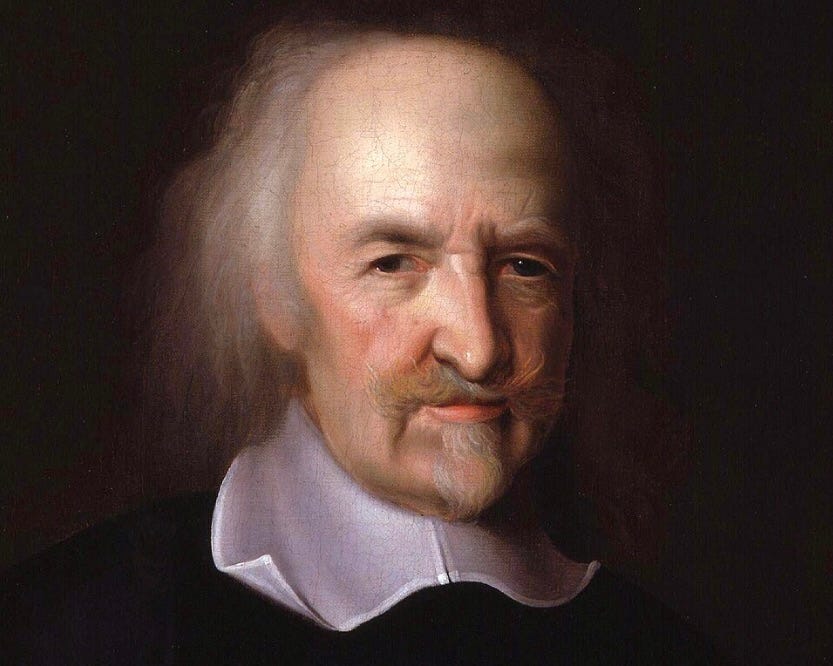
Thomas Hobbes | John Michael Wright, ca. 1669–1670
Key Terms for this Section
State of Nature · Social Contract · Negative Liberty
Positive Liberty · Democracy
6.1 | Our Natural Rights
The European Wars of Religion (1522-1648)
By the end of the Middle Ages, public discontent with the Medieval Church had spiraled faster and further than ever before, as nearly half of Europe perished. The Great Famine and the Black Death (Bubonic Plague) had taken a heavy political toll. The Church’s responses to public discontent ranged from inquisitions (blaming the religious purity of Christians), antisemitism (blaming the Jews), and religious wars (blaming those who defy the Medieval Catholic Church). These responses led to mass disillusionment over the Church’s historic hegemony over Europe. Schisms began to spread, wherein multiple men claimed to be pope. And by the mid-1500s, Protestants like Martin Luther and John Calvin had set Europe on a course to total religio-political reformation.
The Protestant Reformation, which began in 1520, forever complicated religious discourse in Western ethics because, from that moment forward, there would no longer be one universal (Gr. catholicos) religious voice in Europe. As a result, the primary challenge of modern ethics would be to talk about right and wrong without recourse to religious texts, as no one in Europe after 1520 could agree on how to interpret those texts. Appeals to Christian philosophers would now be met with suspicion as Catholics and Protestants eyed each other from across the table and prepared for war.
German knights loyal to Luther opposed the Catholic Church in open combat as early as 1522 (cf. the Knight’s Revolt). By 1531, religious conflict had spread to Switzerland (cf. the Kappel Wars). As Calvin’s ideas spread to France, wars of religion spread throughout the countryside. The most notorious episode occurred on 24 August 1572, when thousands of Protestants were killed at the behest of the ruling French Catholic families (cf. St. Bartholomew’s Day Massacre). Bloodier still was the war between the mighty Spanish Catholic Empire and their Dutch Protestant provinces (cf. Eighty Years’ War, beginning in 1568). Yet the worst of these wars was the Thirty Years’ War, which began in Lutheran Germany and spilled out to modern-day Czechia, Denmark, Sweden, and France. Approximate figures for casualties are as follows:
• Spain (3% of pop.): ¼ million dead
• Denmark, Poland, Sweden, & Switzerland: ½ million dead
• The Dutch (20% of pop.): 1 million dead
• France (15% of pop.): 4 million dead
• Germany (30% of pop.): 8 million dead
By 1642, about 10% of Europe’s population was dead from fighting between different visions of Christianity. The Thirty Years’ War (Germany) and the Eighty Years’ War (the Dutch) were still ongoing. That year, the English Civil War began between those who supported the king’s ‘middle-way’ compromise between Catholicism and Protestantism (Anglicans) and those who thought Anglicanism wasn’t Protestant (or ‘pure’) enough (Puritans). From 1642-1651, 200,000 Englishmen died in the name of religion (about 5% of the population). However, in the last year of fighting, Thomas Hobbes publishes a text that will profoundly transform the English and later American view of politics — the Leviathan (1651).
Rule by Consent
The philosopher Thomas Hobbes (d. 1679) was a conservative Englishman raised in the Anglican tradition. Seeing that the European Wars of Religion would soon be at his doorstep, the 52-year-old scholar moved to Paris in 1640. From there, his daily horror was reading news from home — where thousands upon thousands of young, proud Englishmen were killing each other over religion — as had happened for a century on the European continent. In his exile, Hobbes wrote one of the most important texts of the 17th century.
Hobbes’ Leviathan (published in 1651, just ten years after Descartes’ groundbreaking 1641 Meditations) addresses fundamental questions of political philosophy. His central concern revolves around the extent to which subjects should obey their king (particularly those kings who govern poorly) and under what conditions it would be justifiable to revolt. Before completing his book, the Anglican King Charles I is beheaded (1649) by his Puritanical opposition. This strongly influences Hobbes’ sociopolitical views. Hobbes doubles down on his defense of the monarchy as a safeguard against anarchy. But Hobbesian monarchism is borne of practicality, not religious belief. He rejects the old Divine Right of Kings — which states European monarchs rule with God-given authority and are therefore beyond reproach. Instead, Hobbes proposes that political authority ought to arise from the consent of the governed, whose government exists for the mutual protection of the governed.
Let’s take a moment to contrast this thinking with St. Aquinas (d. 1274). The premodern Scholastics claimed that moral order is inborn in all moral agents in a system of Natural Law. That is, moral principles are derived from nature and reason. Herein, St. Aquinas posits that humans understand moral truths through rational reflection of the creation — as God’s moral intentions are embedded in nature. Our contract is our covenant with God. But, in the aftermath of the historic Wars of Religion, Thomas Hobbes (d. 1679) takes a very different approach to political philosophy. He doesn’t start from divine providence and creation like St. Aquinas. Instead, Hobbes says that our moral principles are derived from our fundamental natural rights as free subjects. In modern politics, our moral contract is with one another — regardless of our personal religious beliefs.
If Hobbes’ talk of fundamental natural rights sounds familiar, it might be because it was quoted a century later in our Declaration, “We hold these truths to be self-evident, that all men are created equal, that they are endowed by their Creator with certain unalienable rights,* that among these are life, liberty, and the pursuit of happiness.”
*Unalienable is an archaic word, meaning ‘cannot be taken away’
Natural Rights We All Possess
It’s no secret that, when writing the Declaration of Independence, Thomas Jefferson (d. 1826) borrowed heavily from English philosophers John Locke (cf. Sec. 6.3) and Thomas Hobbes. In fact, many of our most cherished political ideals come from early Modern English philosophy. In Hobbes’ Leviathan, we find familiar claims to Natural Rights that, a century later, will be repeated across the pond in America’s founding documents. Among Hobbes’ many beliefs concerning Natural Rights are his claims that all men (back then, society privileged men in all things) share a natural right to seek peace and to defend that peace with arms. Hobbes also claimed we have as much freedom as we can offer another person, that everyone has shares in those rights equally, and that everyone should be judged equally under the law. Hobbes believed we all had a right to seek and abide by agreements and contracts. We also have the natural right (going all the way back to St. Aquinas) to live peacefully in a shared society. In our social conduct, we ought to favor mercy over revenge, and not live in hate over others not like us — if we’re to be good students of the English Civil War. Lastly, we should acknowledge that all men are created equal (yes, England said it before we did). And, as equal men, we ought to share in common what cannot be divided among us equally (eg. a lake, the sky, or a public park). These are the natural rights assumed by all English citizens living in the American colonies in the century after Hobbes.
6.2 | Social Contract Theory - Hobbes
Why do We the People need Government?
So Hobbes points out that we all have the same basic human needs and the same ability to harm each other when those needs aren’t met. Why do we harm each other in this way? Hobbes says it’s because humans are naturally selfish (ie. psychological egoism). Some may say we help the needy out of love, but Hobbes says we do so because we fear the same could happen to us. So, what is a group of self-serving, equally harmful, equally needy humans to do with each other? Simple: we form a government. Because without a government, we’d kill each other to gain the resources we need. In a Representative Democracy such as ours, we elect folks to meet with other representatives from other areas of our body politic (Smith County, Texas, or the U.S. in general) to vote on policy and laws. These policies and laws have one primary Hobbesian goal — to ensure we have what we need: security, freedom, and peace.
The State of Nature | Hobbes
Imagine the condition you’d be living in without a government. There would be no laws or law enforcement, so every criminal urge now goes unabated. There are no judges or courts to adjudicate justice or prevent fraud. Without regulatory laws, there’d be no city power, accredited schools, or bank withdrawals. Public electricity and credit no longer exist. Even the cash in your pocket has no agreed-upon value. Without electricity or law enforcement, there are no more grocery stores or department stores. Without regulatory agencies, there are no experts to consider what is edible, medicinal, or dangerous. So, pick your analogy. It’s the Purge. The Last of Us. The Apocalypse. Whatever you call it, a society without a government collapses instantly. Your smartphone has no Internet connection, and your wall socket has no power. There’s no fuel to get you anywhere else, and any sense of trust on public roads is gone. And getting law and order back, even after a very brief absence, might take decades or longer — because who chooses the rightful successor to the government that failed?
Hobbes calls this nightmarish way of life the “State of Nature.” Unlike St. Aquinas, Hobbes looks to the wilderness outside the city gates and sees a battlefield wherein everyone fights everyone else for scraps. Hobbes famously describes this lifestyle as, “solitary, poor, nasty, brutish, and short.” Whatever your views of current American politics, I can assure you that our troubles today are a mere shadow of the social abyss we would endure without a functioning government. In this, we find the Hobbesian paradox — without laws, we have no freedom.
So, we find in Hobbes the desire to build modern cities and laws as a retreat from the state of nature. Sure, we may be naturally quite selfish and violent. But Hobbes promises that if everyone trades up some of their freedoms (like the freedom to kill someone in revenge) to the state, then we all collectively end up safer and happier. For Hobbes, cooperation is the key to a moral and healthy society.
Social Contract Theory | Framework: Hobbes
Thomas Hobbes grounds ethics in practical necessity. You’re not good because of some command from above (cf. Natural Law Theory). Hobbes says you’re good because otherwise, the city would cast you out into the wilderness (ie. the state of nature). This is called Social Contract Theory — that is, morality arises from the rational agreements we make to cooperate out of our practical need to survive. In this way, Hobbes centers moral philosophy on the concept of mutual benefit. Herein, we follow laws and moral rules because they enable us to live together in a stable society. For example, we obey traffic laws not because of holy writ but because society enforces them. If we break these rules — steal, lie, or cheat — society punishes us, excluding us from the benefits of social cooperation.
Why make this move? Why make an appeal to mutual benefit instead of theology? Again, Hobbes is living at the end of the European Wars of Religion and the end of the religiously motivated English Civil War. From 1520 onward, it will not be the case again in Europe that [nearly] everyone follows the same Church in the same way. After the Protestant Reformation, the idea of a God-given moral code that could be applied universally no longer held. So, Hobbes responds that the social good will be dependent on forming social contracts between citizens.
In modern democracies like the U.S., we elect representatives to create laws that will ensure our security, freedom, and peace. Citizens implicitly agree to follow these laws (ie. the consent of the governed) by continuing to live here.
Hobbes identifies two main ways to enforce our social contract — through legal institutions and public opinion. Legal institutions include police, courts, and lawmakers who ensure compliance with laws. However, social norms also play a powerful role in maintaining order. Public opinion, particularly through social media, acts as an informal but significant enforcement mechanism. Individuals who break social norms — even if they don’t violate the law — face consequences like public shaming, canceling, or damage to their reputation.
Social Contract Theory benefits from the rules being mutually beneficial. It’s therefore obvious why someone would want to offer their cooperation (ie. they see the benefit). Hobbes’ theory also acknowledges that when one party breaks the contract, it justifies others not adhering to the contract anymore with them. SCT also limits the demands of morality, ensuring that they are reasonable while providing justification for civil disobedience when the government fails to uphold fairness.
However, Social Contract Theory has notable disadvantages, which Kant will bring into focus (cf. Sec. 7.2). Critics argue that when members of a society disagree, it’s unclear whether the minority must conform to the majority. The theory also heavily relies on self-interest and reciprocity, but this leaves out vulnerable groups like infants, nonhuman animals, or oppressed populations, who cannot reciprocate. Every society has members who are without, and Hobbesian mutual benefit says nothing about what is right for them. This marginalization raises concerns about the inclusivity and universality of Social Contract Theory as an ethical framework.
6.3 | Negative Liberty - Locke
The concept of freedom (Lt. libertas) has been championed in England since at least the 13th century. Back then, a group of English royals — through a series of impressive political machinations — had the English king sign the famous 1215 Magna Carta (Lt. “Great Charter”). Prior to the Magna Carta, whatever the king said was law. But, after 1215, no one in England would be above the law — no matter who he or she was. The Charter also promised that every Englishman would now have a legal right to a fair trial and that no one would be taxed again without representation. As for that representation, knights and freemen were gathered from each city in England to speak (Fr. parle) with the king. This gathering became known as the Parliament.
Over the next 400 years, English liberty continued to evolve, with some favoring more power for the government to secure the people and others vying for more personal freedom. This culminates in the 1642 English Civil War, which had a direct influence on the writing of Hobbes’ 1651 Leviathan. Today’s Anglosphere — including Australia, Canada, New Zealand, the UK, and the US — all owe a tremendous debt to the political philosopher Thomas Hobbes (d. 1679). With his 1651 Leviathan, he set the framework for political discourse for his time, for us, and for untold generations to come.
Negative Liberty: Hobbes' Leviathan (1651)
Hobbesian conceptions of liberty fall into a category of political thought today called “Classical Liberalism.” Liberalism has obviously evolved from the 17th century to today. So we distinguish the liberalism of the 17th and 18th centuries (when “liberals” owned slaves and their wives couldn’t own land or vote) from contemporary liberalism by appending Classical to the former. Briefly, the spectrum from the political center-right to the political center-left is effectively: Progressivism <- Liberalism -> Classical Liberalism (See Sec. 6.6 for a full breakdown of the political spectrum).
In Center-Right, Classical Liberalism, freedom (ie. “liberty”) was conceived of as a kind of negation of authority. In modern political philosophy, Negative Liberty is freedom from external restraint and the interference of others. It is the “freedom from” things like political coercion and government control.
When Conservatives say “freedom,” this is generally what they mean.
For English thinkers like Thomas Hobbes (d. 1679), John Locke (d. 1704), and John Stuart Mill (d. 1873), it is the government’s job to prevent chaos and maintain social stability. This means individuals must cede (only) the minimum level of authority necessary for the protection of the state. As a monarchist, Hobbes claims that a powerful authority (ie. a king) is required to maintain said social stability. Excepting his monarchal views, Hobbes’ ideas shaped all the democratic governments to come after him. The hallmarks of early modern Conservative Political Thought — God, King, and Country — are taken directly from Hobbesian theory.
Negative Liberty: Locke's Two Treatises on Government (1690)
Forty years after Hobbes’ work, John Locke’s Two Treatises on Government (1690) made significant contributions to the concept of negative liberty. Locke claimed that natural rights always precede government authority. Because of this, the government’s primary role is to protect our natural rights above all else. The younger Locke took the elder Hobbes seriously but did not always agree with his predecessor. Whereas Hobbes found that a strong monarch was needed to maintain order, Locke argued that a democratically elected government was superior to a king because a democracy rules by the consent of the governed. Locke even went so far as to claim that if the government — who only has the job because we grant our consent — fails to protect our natural rights, we are then allowed to rebel against it. And, of course, in 1776, that’s just what a bunch of revolutionaries did in the American colonies. 🇺🇸
For Locke, among our most cherished natural rights is the right to private property. For Locke, freedom means nothing if you cannot pursue your own wealth and happiness. In this way, Locke blazed a trail for the 18th-century Americans coming after him, who would one day use his laudable ideas to create their founding documents in the greatest political experiment ever conceived. The United States.
Negative Liberty: Mill's On Liberty (1859)
Finally, John Stuart Mill’s 1859 On Liberty made what has probably been the most lasting and profound contributions to the negative conception of liberty (ie. Classical Liberalism). Mill argues that no one can rightfully be deprived of personal liberty or property. In fact, his views on both property rights and the law bear a distinct Lockean flavor. Because, as Locke would say, if a law does not promote the general welfare, then it is an unjust law. Here, Mill is seeking to maximize happiness in Britain, so he’s looking for ideas that will have the widest, most optimific appeal (cf. Sec. 8.3). His noble efforts will culminate in the first wave of Feminist efforts in his and his wife’s later work, On the Subjection of Women (1869). In this and other works, we see Mill balancing his Utilitarian views with his insistence that individual rights be protected.
Mill promotes not just freedom from coercion but from censorship. For the British Parliamentarian (1865-68), freedom of speech is a fundamental right of democracy and must be upheld as a matter of national security and public trust. For society to grow and progress, all citizens must be free to express dissenting opinions and vote. These ideas from Mill have influenced the development of democratic systems all over the world and have helped millions to secure their individual freedom, human rights, and freedom from undue coercion and restraint.
6.4 | Positive Liberty - Rousseau
Having surveyed three Classical Liberal thinkers (ie. the political Center-Right), we now turn to a brief survey of Progressivism (ie. the Center-Left). After the end of Western slavery in the late 19th century, the concept of freedom continued to evolve. By the turn of the 20th century, Mill’s individualistic approach was too limiting for those at the bottom of the economy. With the rise of industrialization, the lack of legal regulation led to massive worker exploitation (cf. Sec. 10.2). Consequentially, workers began to unionize, claiming that freedom (from wage exploitation and unsafe working conditions) must be won through collective political action. Such collective action is evident, too, in the government interventions of World War I (1914-18). Here, individual sacrifices were made for the collective freedom of all in the allied nations (eg. France, the UK, Russia, the US). From the 20th century onward, freedom would be a collective responsibility as authoritarians and strongmen vied to overthrow Western democracy (cf. Sec. 6.6).
The Great Depression (1929-39) also illustrated the shortcomings of negative liberty. The economic collapse of the West revealed how regular folks could be ‘free from interference’ yet still lack the means to achieve the very basic needs of food, housing, and economic security in an industrialized society. This led to massive welfare reforms in many Western countries, where social safety nets were put in place to ensure that everyone — especially those most vulnerable in society — has what is necessary. Finally, the various advocacy movements of the 20th century — including women’s voting, labor reform, and Civil Rights marches — marked a shift in American political discourse toward collective, positive conceptions of freedom. Positive Liberty is having the resources required to pursue one’s most optimal social purpose. It is the “freedom to” live with things like publicly-funded education, public healthcare, and a welfare safety net in case tragedy strikes and you lose everything.
When Progressives say “freedom,” this is generally what they mean.
Rousseau: The Social Contract (1762)
The beginnings of Positive Liberty can be traced back to 18th-century French philosopher Jean-Jacques Rousseau (d. 1778). In Rousseau’s 1762 The Social Contract (largely unrelated to Hobbes’ SCT), the French social theorist argues that the general will of the people must be the basis of all political decisions. By general will, Rousseau is gesturing to the autonomous will of the people to make their own choices. For Rousseau, a democratic government should be based entirely on the general will — not the influence of social élites, special interest groups, or corporations. From well-funded government services (ie. taxes), all citizens should have their natural rights protected and their basic needs met. The standard Center-Left position is that modern countries are so prosperous that our basic needs are not that great of a challenge anymore (eg. 1 in 10 homes in America sits unused). Foremost on Rousseau’s list of basic needs is public education. This is a standard point of focus for Progressive politics today. Rousseau claims that a publicly-funded education for children could not only cultivate a child’s ethics and creativity but enable that child to achieve their best possible self. Rousseau would go on to impact many modern political thinkers, particularly on the principles of social equality, democratic participation, and human rights.
Dewey: Democracy & Education (1916)
Half a century after Mill (d. 1873), the American educator John Dewey (d. 1952) contributed greatly to the positive concept of liberty. Like Rousseau before him, Dewey was enthralled by the relationship between freedom and education. His 1916 Democracy and Education claims that the two concepts are inextricably intertwined (cf. Foucault in Sec. 4.4) and that learning and practical problem-solving are crucial to the maintenance of any democracy. Here, Dewey emphasizes critical thinking and social responsibility in education — arguing that it is essential for citizens to be well-informed in order to make intelligent, practical political decisions.
Dewey’s concept of democracy is interesting. He sees democracy as a constant process of (re)construction, wherein political power is constantly rebalanced to serve the needs of the next generation. For Boomers, broadcast television raised new questions about government censorship that the Constitution doesn’t include. For Gen X, genetic engineering raises bioethical questions never before considered. For Millennials, smartphones raise questions about our rights to privacy and protection from government surveillance. For Gen Z, artificial intelligence raises questions about algorithmic media bias and job insecurity. And for Gen Alpha, augmented reality is raising new existential questions about embodiment, addiction, and transhumanism. These challenges could not be enumerated in the Constitution and, therefore, are ours to adjudicate as we rebalance our democracy and reevaluate our rights and responsibilities.
Dewey saw it as the job of government to ensure that all people share in the promise of social equality. As new concerns and technologies arise, Dewey points to the importance of public life and collective action in facing these challenges — arguing that all citizens need to participate in politics and the affairs of public life in order to achieve a healthy democracy. For Dewey, the pursuit of positive liberty was not only about individual rights but about the progress of society as a whole.
Rawls: A Theory of Justice (1971)
Finally, the American John Rawls’ 1971 A Theory of Justice took as its focus the concept of justice as fairness. That is, while many argue that justice is primarily about restoring something taken (ie. an eye for an eye), Rawls (d. 2002) saw the concept of distributive justice as the worthier view (ie. ensuring everyone has enough). Rawls argues that all individuals have inherent and equal dignity (cf. Kant in Sec. 7.4). From equal dignity, Rawls says we arrive at our equal rights. For Rawls, no citizen is left out in a just and prosperous society.
From his focus on equality, Rawls then cast his focus on vulnerable social groups and felt he had a solution to the old flaw in Hobbes’ Leviathan. His answer? A Thought Experiment he called the Veil of Ignorance. The idea behind the Veil of Ignorance is to imagine people creating a society and its laws — but without already knowing their social status, wealth, talents, gender, or any other characteristic that could potentially influence the decision-making process. This Veil ensures that individuals do not make biased or self-serving decisions that could harm or disadvantage vulnerable members of society. Rawls claims that by creating a society behind a Veil of Ignorance, we are more likely to agree to principles of justice that promote fairness, equal opportunity, and equal protection for all members of society.
For example, if before we were born we knew we had a 1 in 77 chance of living in a wheelchair, most of us would argue for wheelchair ramps and disabled parking in our society. Or if we had a 1 in 17 chance of hearing impairment, a 1 in 43 chance of blindness, or a 1 in 5 chance of needing psychiatric assistance — we would argue for universal rights to these things before we landed in that society. These, by the way, are the actual numbers for American society today. Economically, what if we considered that there’s a 1 in 3 chance of your family having less than $500 in savings? Rawls looks at numbers like these and argues for basic wealth redistribution (ie. taxes) such that everyone’s basic needs are met.
Rawls then presents us with two principles of justice — the Principle of Equal Liberties, which advocates for all individuals to have the same basic human rights, and the Principle of Equal Opportunity, which calls for equal access to social opportunities, such as housing and education. His point herein is not that everyone should have the same thing. That’s impossible. Rather, the Rawlsian perspective is that society is at its healthiest and most prosperous when the government ensures everyone has the same freedoms and opportunities to excel. For Progressives like Rawls, the nation that puts its most qualified people at the top (rather than nepo babies and the children of élites) is the most moral and prosperous place to live in.
6.5 | Political Philosophy Spectrum
In Secs. 6.3 & 6.4, we’ve seen the historical shift of Liberalism from Negative Liberty (Hobbes, Locke, and Mill) to Positive Liberty (Rousseau, Dewey, and Rawls). When political power goes unchecked, under the Horseshoe Theory of Politics, leaning either too far left or right, it can descend into authoritarianism. We will dive into authoritarianism in our next lesson (Sec. 6.6), but for now, we’ll say that authoritarian politics occurs when an individual or group exercises unchecked political power — often with little to no regard for individual rights and freedoms. As we drift from the Center-Right to the Far-Right, we eventually find authoritarian leaders practicing Fascism, wherein traditional power structures and cultural values are violently forced onto the people while promoting unchecked power in the hands of a single leader. Or, as we drift from the Center-Left to the Far-Left, we eventually find authoritarian leaders practicing Communism, wherein social equality is violently enforced through the radical, unchecked redistribution of private property. Either way, authoritarianism is at the extreme end of both left and right politics.
The opposite of authoritarianism is democracy (Gr. demos + kratos — rule by the people). Democracy operates under a social contract (eg. the U.S. Constitution), wherein political power is vested in the citizens of the state. In a representative democracy such as ours, we elect representatives (eg. members of congress) to vote and make laws on our behalf. All enemies of authoritarianism, in all its forms, should therefore make every effort to ensure fair, accurate, and widely available voting opportunities for a public that has been given truthful, verifiable information about political candidates.
One of the primary goals of a representative democracy is to ensure that power does not consolidate into an élite, authoritarian few. To counter this predilection, we send our representatives to meet and argue for our local needs, from our local vantage point, to the larger body politic (typically a state or national capital). The resulting arguments — so long as they’re done in good faith — are evidence of a thriving democracy. So what does the spectrum of political philosophies look like today?
Center-Right: Hobbes & Conservatism
Modern Center-Right politics is a political ideology that seeks to balance personal liberty with traditional values — such as faith, nationalism, and social conservatism. Center-Right politicians generally promote limited government intervention in our personal lives (cf. traditional values) while promoting economic freedom for the wealthy élite. They often support smaller governments, preferring less assistance, a large military, and lower taxes for the wealthy. While Center-Right politics affords equal protection for all groups, it often opposes the proactive enforcement of DEI (Diversity, Equity, Inclusion) policies or other measures aimed at addressing historic or current inequalities.
Libertarian: Mill & Classical Liberalism
Libertarianism, rooted in the ideas of John Stuart Mill, is a Centrist political philosophy that values personal liberty above all other political concerns and seeks to defend liberty against both state and religious authority. Libertarians argue that government intervention in our lives should be kept to an absolute minimum, allowing individuals to make their own choices without interference. This includes minimal government assistance and reduced taxes and government spending (with which Conservatives generally agree). Libertarians also emphasize the protection of minority groups from the rule of the majority, promoting equal protection for all individuals (with which Progressives generally agree). Overall, Libertarianism seeks to limit the power of the government in favor of individual autonomy and freedom, often advocating for laissez-faire economic policies and individual responsibility.
Center-Left: Rawls & Progressivism
Modern Center-Left politics is a political ideology that emphasizes balancing personal liberty with social awareness, fairness, and distributive justice. This ideology promotes government intervention in the economy (eg. taxes, subsidies, and welfare) to ensure social justice while allowing the maximization of freedom in our private lives and matters of personal taste. The Center-Left favors a larger government than the Conservatives, with more assistance for vulnerable groups and fewer military actions. Additionally, they promote the imposing of heavier taxes on the wealthy élite to flatten out the growing difference between rich and poor. Center-Left politics also seeks to protect minority groups from majority rule, making efforts to eliminate discrimination and protect universal human rights.
6.6 | Against Authoritarianism - Haidt
Having surveyed the political Center-Right (cf. Hobbes), Libertarian (cf. Mill’s Classical Liberalism), and Center-Left (cf. Rawls) positions, we now examine how those political philosophies descended into authoritarianism — and the philosophers who argued against those regimes.
Authoritarianism & the Left | Chomsky & Zizek
In the 20th century, Mao Zedong (d. 1976) overthrew the Democratic leadership of the Republic of China (RoC) and installed an authoritarian, Maoist-Communist regime. His Little Red Book (1964) becomes required reading in the new People’s Republic of China (PRC). The Little Red Book addresses 25 political topics over 267 quotations from Mao. It covers the centrality of the Maoist-Communist government and encourages the use of violence to suppress all political opposition to the ruling party. Famously, Mao’s text threatens Democracy with the notion that “political power grows out of the barrel of a gun.” Quotes like this were used to consolidate Mao’s power over the Chinese people.
In response, Noam Chomsky’s 1988 Manufacturing Consent levels harsh criticisms at the authoritarian nature of Mao’s leadership and the propaganda machinery that supported it. Chomsky (born 1928) argues that authoritarian regimes like Mao’s rely on propaganda to maintain their power and control of the population and that media (later on, this includes social media) plays a crucial role for the state in shaping public opinion and suppressing dissent (cf. Foucault in Sec. 4.4). Chomsky contends that Mao’s authoritarian regime distorted reality such that a cult of personality arose around Mao — rendering the chairman’s broad political authority unquestionable. This is the nature of authoritarian leadership and the primary method by which authoritarians seize democratic control from the people.
Slavoj Zizek’s more recent The Year of Dreaming Dangerously (2012) also takes aim at Maoist authoritarianism and the cult of personality that had been created around him. Zizek argues that Mao’s leadership had a total disregard for human life and that the Chinese Communist Party was ultimately a vehicle for Mao’s personal ambitions rather than the will of the Chinese people (cf. Rousseau’s general will). Zizek argues that Mao’s propaganda machinery created a false consciousness among the Chinese, wherein citizens were slowly convinced that Mao was incapable of making mistakes — or when his miscalculations were made obvious, they were simply hand-waved away by state-sponsored media. Such authoritarian, ideological control over a people has been used countless times throughout history to suppress dissent and maintain the power and control of an authoritarian élite.
Authoritarianism & the Right | Orwell & Arendt
On the political Right, we witnessed Authoritarianism rear its ugly head under the Italian leadership of Benito Mussolini (d. 1945). In his Doctrine of Fascism (1932), Mussolini, like Mao, emphasizes the centrality of the state and the subordination of the individual citizen to it. As Hitler’s most important European ally, Mussolini gleefully claims that the 20th century will be “the century of authority, a century tending to the “right”, a Fascist century.” Much like his Nazi counterparts, Mussolini envisioned a fascist, totalitarian state in which the government exercised total control over the country — including control over the economy, suppression of anti-authoritarian books and films, and the political domination of minorities (eg. Jews, Romani, people of color, religious minorities, and LGBTQ citizens). In this way, authoritarians like Mussolini claim that individual rights and freedoms must be suppressed for the state to flourish.
George Orwell’s 1938 Homage to Catalonia criticizes authoritarianism and Rightist fascism from his firsthand wartime experiences fighting the Spanish Nationalists (who allied with Hitler and Mussolini). As with Leftist Authoritarianism in China, Orwell (d. 1950) saw the Right in Spain brutally suppressing all political dissent in an effort to maintain the authority of the political élites. Orwell decried their violent tactics as a clear threat to the values of democracy and human rights. The political concept “Orwellian“ comes from Orwell’s critical writings — giving expression to “alternative facts,” “indoctrination,” and “police state.”
After Orwell, Hannah Arendt’s 1951 The Origins of Totalitarianism is a postwar summation of the authoritarian threats that had plagued 20th-century Europe. Her text took particular aim at both Mussolini and Hitler, their antisemitism, and their disruption of Western democratic processes. Arendt (d. 1975) argues that authoritarian totalitarianism occurs when the traditional structures that hold society together break down. People no longer feel like they ‘belong’ and ‘loyalty’ to one another begins to collapse in the face of rapid modern social change. In the wake of such change, the authoritarian élite manipulates the people — through media and violence — to engender the sense of belonging they feel is missing. Like John Stuart Mill long before her, Hannah Arendt’s work emphasizes the importance of individual freedom and the dire need for strong democratic institutions to protect against the rise of authoritarianism.
In Opposition to Authoritarianism: Haidt's The Righteous Mind (2012)
Jonathan Haidt’s 2012 The Righteous Mind (which I wholeheartedly recommend) argues that left and right politics are equal and opposite responses to authoritarianism, differing in how they each prioritize certain moral values. Haidt (born 1963) points to the fact that humans have evolved to be social creatures whose survival depends on group solidarity. This has led to the development of longstanding moral intuitions that guide our behavior and judgments. He identifies six fundamental moral values that are shared by all cultures: care/harm, fairness/cheating, liberty/oppression, loyalty/betrayal, authority/subversion, and sanctity/degradation.
According to Haidt, the Political Left tends to prioritize the values of care/harm, fairness/cheating, and liberty/oppression, while the Political Right tends to prioritize the values of loyalty/betrayal, authority/subversion, and sanctity/degradation. He argues that these different moral priorities are shaped by different cultural and historical experiences and that they reflect different responses to the problem of authoritarianism.
Other theorists working in Political Philosophy have posited that Center-Right voters are often driven further toward the Right out of feelings of disgust. Interestingly, there seems to be data to support the conclusion that Conservative thinkers are more prone to react to a “yuck factor” than their Progressive counterparts. Progressive thinkers have pointed out that this is why Progressives seem to have more tolerance for unexpected, unusual, or unique social situations. Meanwhile, other theorists have posited that Center-Left voters are often driven further to the Left out of feelings of envy. Conservative thinkers have pointed out that this is why Progressives seem to have more to say about the economic imbalance between the super-rich and the rest of us.
In summary, the Political Right and Political Left are both reactions against authoritarianism. Mao overcorrected with an interpretation of Communism that led to the starvation and deaths of millions. Stalin reacted similarly in the Soviet Union. In Europe, Hitler and Mussolini overcorrected with Fascist policies that inaugurated the utter destruction of democracy and the rule of law in Europe and cheered as innocent millions died in genocidal murder.
As we turn the page on this Ethics and Political Philosophy lesson, let us consider the real dangers of authoritarianism, the need to hear from voices and subjective experiences outside of our own echo chambers, and the shared desire of all fair-minded people to see our country succeed. While not everyone is fair-minded nor speaking from good faith arguments (cf. Post-Truth in Sec. 4.4), it is the case that a sustained, long-term victory against the ‘state of nature’ cannot be had without upholding the social contract of our shared participation in the democratic process.
So go take part in our shared democracy and vote!
https://teamrv-mvp.sos.texas.gov/MVP/mvp.do
This Section: Contractarian Ethics
Next Section: Deontological Ethics