

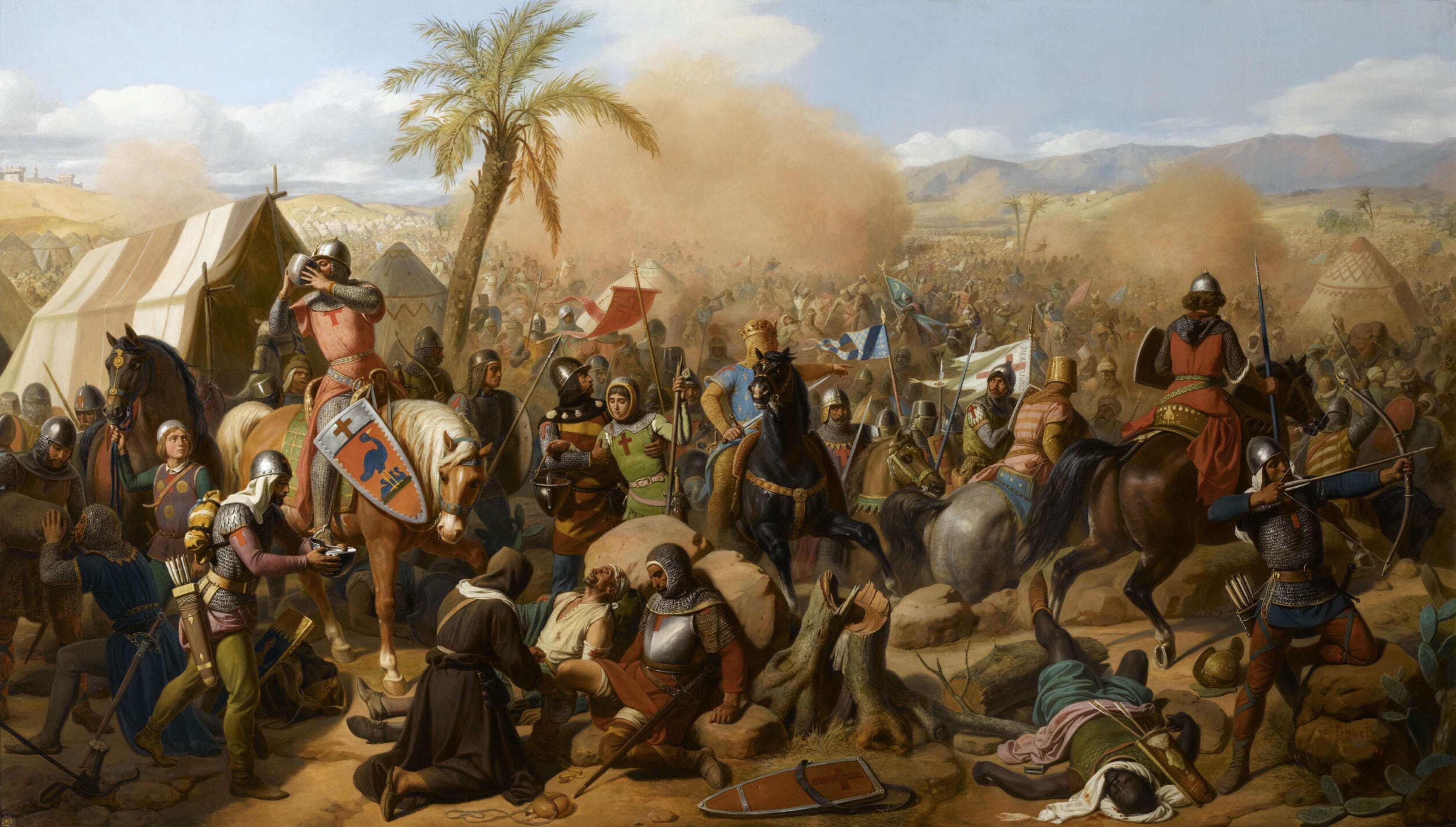
Battle of Ascalon in 1099 | Jean-Victor Schnetz, 1847
Key Terms for this Section
Monasticism · Rule of St. Benedict · Crusades · Indulgences
Scholasticism · St. Aquinas · Modernity · The Reformation
11.1 | How the West Kept the Faith
Benedict & the Rule | 480-547
In 410 CE, the Germanic Goths take Rome (cf. Sec. 9.4).
Romans who still honored the old gods blamed the Christians, and St. Augustine answered them in The City of God. Within a lifetime the western Roman Empire had come apart, but it did not take the Church down with it. The West left the Church standing — very nearly the only Roman institution still standing. As kingdoms rose and fell across the old imperial map, the church kept its Latin, its letters, and its reach, and bishops became the men who fed cities and negotiated with invaders.
• 410 | The Germanic Goths sack Rome
• 476 | The last western emperor is deposed
• c. 529 | St. Benedict founds Monte Cassino
The Medieval Church did not descend on Europe to smother a golden age. It inherited a continent that had already fallen, and it held that continent together.
The institution that did more than any other to hold the West together was the monastery, and the monastery as the West would know it takes its shape from one man and one document. The concept of the monasticism was older than St. Benedict — the practice of withdrawing from ordinary society into a disciplined community avowed to God. It had grown up in the deserts of Egypt and Syria among hermits seeking God through radical renunciation. What Benedict of Nursia (d. 547) did was tame that desert impulse into something an ordinary person could live for a lifetime.
In the same years that Justinian closed Plato’s Academy in Athens (cf. Sec. 9.4), Benedict founded a monastery on a hilltop at Monte Cassino, south of Rome. There he wrote a short book of instructions for communal religious life, and the Rule of St. Benedict became the foundational document of Western monasticism for 1,000 years.
The genius of the Rule is its moderation. The motto of the movement was ora et labora (Lt. “pray and work”), and the balance is the point. The monk’s day is divided between the reading of sacred texts, manual labor in the fields and workshops, and the Divine Office, the fixed hours of communal prayer that structure the day from before dawn to nightfall. The Rule takes its count from the Psalms, “Seven times a day I have praised you” (Psalm 119:164), and adds a night office to the seven:
• Vigils (the night office)
• Lauds (daybreak)
• Prime
• Terce
• Sext (midday)
• None
• Vespers (evening)
• Compline (before sleep)
Benedict binds his monks by three vows that are themselves a quiet argument against the age’s chaos: stability (you stay in this community, you do not wander), obedience, and conversion of life (the lifelong reshaping of the self toward God). At the head of the community stands the abbot (from abbas, “father”), who governs not as a tyrant but as the father of a household. And the door of the house is open:
Let all guests who arrive be received as Christ, for He Himself will say, ‘I was a stranger and you took Me in.’ Rule of St. Benedict 53, qtd Matthew 25:35
Out of that ordinary, moderate, sustainable pattern grew an institution of astonishing consequence. The Benedictine monastery became the West’s school, its library, its hospital, its inn, and its model farm (often all at once, and often the only one for a hundred miles). When the reformers of Cluny set out in 910 to renew monastic discipline, they were tending the most important engine of European life.
Monks & the Scriptorium
In an age when almost no one could read, the people who could were overwhelmingly monks and the clergy the monasteries trained. And in the scriptorium (the monastery’s writing room) monks spent their working hours doing the single most consequential thing anyone in early medieval Europe did with a pen:
They copied books.
There was a special kind of care and physicality to the work. A scribe wrote on parchment, animal skin scraped and stretched, with a quill and ink by the light of the window. Around 700 the monks of Wearmouth-Jarrow, in northern England, copied a single Latin Bible, the Codex Amiatinus, on more than 1,000 leaves. It took the skins of some 500 cattle, and it weighs over 75 pounds.
Bible and prayer book, yes, but also Cicero, Virgil, and Aristotle’s logic, the pagan classics of a civilization that had fallen. Most Latin classics that reached the modern world survived because a monk, somewhere, copied them out by hand and a monastery kept them on a shelf. The Greek East went on copying its own manuscripts (Plato, Homer, most of Aristotle), but the Latin West had lost its Greek, and much of that learning fell out of circulation there for centuries (cf. Sec. 10.3).
Latin antiquity survived through the monks. The institution so often caricatured as the enemy of learning is the reason there was any learning left to fight over.
The Parish & the Seven Sacraments
If the monastery was the West’s mind, the parish was its heartbeat, the local church that framed the life of everyone who was not a monk. Herein, the medieval church framed every stage of a person’s life. How?
The instrument was the set of ritual moments the church called the sacraments (Lt. sacramentum, drawn from sacer, “set apart”), sacred acts that marked the passages of a Christian life. By the High Middle Ages the church had settled on 7.
• Baptism
• Confirmation
• The Eucharist (Communion)
• Penance (confession)
• Matrimony
• Holy orders
• The anointing of the sick (last rites)
Read them in order and you are reading the arc of a life: born into the church, fed at its altar, forgiven at its confessional, married at its rail, and anointed at its deathbed.
In 1215 the Fourth Lateran Council made confession once a year, and Communion at least at Easter, a duty for every adult Christian (canon 21). From cradle to grave, an ordinary European’s life had the shape the parish church gave it.
In the Middle Ages, religious life in Europe was this: universal, public, and obligatory.
Key Terms for this Lesson: Monasticism · The Rule of St. Benedict
11.2 | Popes, Crusades, & the Sword
Pope & Emperor | 800-1122
• 800 | Leo III crowns Charlemagne
• 1077 | A king in the snow at Canossa
• 1095 | Urban II preaches at Clermont
• 1099 | The First Crusade takes Jerusalem
On Christmas Day, 800, Pope Leo III crowned the Frankish king Charlemagne the first emperor of what became known as the “Holy Roman Empire” (cf. Sec. 9.4). The embrace of pope and emperor built the medieval West. But it left one question open:
Who was in charge, the man with the crown or the man who placed it on his head?
For centuries, kings and emperors had appointed bishops as a matter of course. The church was woven into the state, and a bishop was a great landholder and royal servant as much as a pastor. In the 1000s, a reforming papacy decided that this had to end, and the collision that followed is called the investiture struggle: the fight over whether a king or the pope had the right to “invest” a bishop with the symbols of his office.
Its sharpest moment came between Pope Gregory VII (d. 1085) and the German king Henry IV. In a set of stark claims historians call the Dictatus Papae (Lt. “the pope’s dictates”), Gregory asserted that the pope may depose emperors, and that he himself may be judged by no one. When Henry defied him, Gregory excommunicated him and released his subjects from their allegiance. In January 1077, Henry crossed the Alps and stood for three days in the snow outside the castle of Canossa, barefoot by the chroniclers’ account, doing penance until the pope agreed to lift the ban.
The struggle dragged on for decades and was settled by compromise at the Concordat of Worms in 1122. The church would invest a bishop with the ring and staff of his spiritual office, and the emperor would touch him with the scepter for his lands. The papacy had staked its claim and, for a time, made it good: the church was not the servant of kings but their judge. This is the papacy at its medieval height, an institution that could summon a continent.
The Crusades | 1095-1204
At Clermont, on November 27, 1095, Pope Urban II (d. 1099) preached the sermon that set the West in motion, calling Europe’s trained, armored knights to march east and take the Holy Land from its Muslim rulers:
“All who die by the way, whether by land or by sea, or in battle against the pagans, shall have immediate remission of sins… Let those who for a long time, have been robbers, now become knights… Let those who go not put off the journey, but rent their lands and collect money for their expenses.” Urban II at Clermont, 1095
The crowd, the chroniclers say, roared back Deus vult, “God wills it.” Urban sold it not as a war but as a pilgrimage, with remission of penance for all who went in true devotion. That promise was an early form of what the church called indulgences (grants of relief from the temporal penalty owed for sin), offered here on an unprecedented scale. For many, that promise stirred sincere piety (crusading was ruinously expensive, and lords sold their lands to go). For others, it blurred into license to pillage.
The marchers wore a little red cross stitched to the shoulder and called themselves pilgrims, men who had ‘taken the cross.’ Later centuries would name their journeys from that cross: the Crusades, from the Latin crux.
Notably, the first victims were not Muslims.
In 1096, crusader bands under Count Emicho massacred the Jewish communities of Speyer, Worms, and Mainz along the Rhine. Then, on July 15, 1099, after a 40-day siege, the walls of Jerusalem were stormed. By the account of the Damascus chronicler Ibn al-Qalanisi, the Jews of the city were herded into the central synagogue, and the synagogue was set on fire. By the Christian testimony of the chronicler Raymond of Aguilers, the blood of civilians ran knee-deep in the streets of the Holy City.
That is the war the Latin West remembered as a holy pilgrimage. But one cannot speak of “the Christian perspective” on the Crusades, because there were two completely different Christian views. To the Latin West, God wills it. To the Greek Christians of Constantinople, the crusaders were unruly and dangerous. The judgment was vindicated in 1204, when the Fourth Crusade stopped at the Orthodox capital of Constantinople, destroyed the holy places of fellow Christians, and sacked the ancient city so thoroughly that it never fully recovered.
Christians had put the capital of Eastern Christendom to the sword.
In 2004, Pope John Paul II asked the Orthodox Patriarch Bartholomew I, “How can we not share, at a distance of eight centuries, the pain and disgust.” The Patriarch accepted the apology: “The spirit of reconciliation is stronger than hatred.”
And to the Muslims of the Middle East, the Crusades looked smaller still. The only western kingdom of any repute to the Islamicate world was that of the Franks, so the Arabic word for a Westerner, a European, a Crusader, settled on al-Franj. Around 1100, Paris held no more than 50,000 people. In contrast, Baghdad at that time held a million citizens with libraries, public fountains, and houses of worship for all.
In July 1187, at the Horns of Hattin, the Kurdish sultan Saladin (d. 1193) destroyed the crusader kingdom’s army in a single day, and that autumn he took Jerusalem by siege. A ransom was set (10 dinars a man, 5 a woman, and a smaller sum for a child), and when the ransoms were paid, the prisoners were freed. Saladin and his brother freed many more without payment.
The West never took Cairo or Baghdad, much less Mecca or Medina. What cultural exchange there was ran almost entirely in one direction. The Franks carried home exotic spices, satin, silk, cotton, olive soap, better medicine, better food, and, in rare cases, better ideas. The Arabs remembered the broken treaties and plunder.
Cathars & the Inquisition
The same church that could summon an army against a distant enemy could also turn the sword on dissent at home. In the 1100s and 1200s a movement the church called the Cathars spread through southern France, teaching a dualist faith the church judged heretical. Against them a pope called a crusade within Europe itself, the Albigensian Crusade (1209–1229), whose campaigns devastated the Languedoc. At Béziers, in its first summer, the crusaders killed the town’s people, Catholic and Cathar alike.
Out of that same anxiety about heresy grew the medieval Inquisition, a set of church courts charged with identifying and examining suspected heretics, staffed from the 1230s largely by Dominican and Franciscan friars. Its procedure was, by the standards of the age, a legal one (inquiry, testimony, the demand that the accused recant), and it could hand the condemned to secular authorities for punishment. Its most infamous chapter, the Spanish Inquisition of 1478, belongs to a later world and is Section 13’s story.
Key Terms for this Lesson: The Crusades · Indulgences
11.3 | Scholasticism: A Cathedral of the Mind
The University & the Disputation
Learning in the early medieval West had lived in the monastery and, later, in the cathedral schools attached to the great churches. In the 1100s those schools began to grow into something genuinely new: the university. Bologna, Paris, and Oxford were the first, and the word itself tells the story. A universitas (Lt.) was a guild, a sworn corporation of masters and students, modeled on the trade guilds of the medieval town. The early universities were largely clerical, protected and chartered by popes, emperors, and kings (Bologna’s key charter came from the emperor Frederick Barbarossa in 1158).
At Paris the arts students sat on bundles of straw in the lecture halls of the Rue du Fouarre, “Straw Street,” while a master read aloud from a text and explained it. A lecture was literally a “reading” (Lt. lectio).
The university produced a method of teaching that ancient dialectic had only foreshadowed: the disputation. A master would pose a question, marshal every authority and argument on each side, and then resolve it by reasoned distinction. Medieval thinkers did not fear contradiction among their authorities. They went looking for it.
The theologian Peter Abelard (d. 1142), whose theory of the atonement Section 9 met (cf. Sec. 9.4), compiled a famous book, Sic et Non (“Yes and No”), that simply lined up the church fathers contradicting one another on 158 questions, and left the reader to reason toward resolution.
Aristotle & Aquinas
The intellectual explosion of these centuries had a specific cause.
For most of the early Middle Ages the Latin West had only a fraction of Aristotle, chiefly his logic. South of Europe, in the Islamicate world, the opposite happened. At Baghdad’s House of Wisdom, works of Plato, Aristotle, Plotinus, and the Greek physicians were rendered into Arabic, and commentators the West would come to call by Latinized names carried that Aristotle further: Avicenna (Ibn Sina, d. 1037) and Averroes (Ibn Rushd, d. 1198), a judge in Córdoba.
The Greek philosophy Europe had largely lost came back to it through Arabic, by way of translators in reconquered Spain, and it arrived, setting European thought alight (cf. Sec. 10.3). Other translators went straight to the Greek. In the 1260s a Dominican brother, William of Moerbeke, translated Aristotle directly from Greek manuscripts found in the Christian East.
The recovered Aristotle was a problem and an opportunity at once. Here was the most powerful system of reason the ancient world had produced, handed to the Christian West by Muslim and Jewish scholars, and it did not always agree with Christian doctrine. What was the church to do with it?
The most influential answer came from Thomas Aquinas (d. 1274), a Dominican friar and the towering figure of Scholasticism, the systematic theology of the medieval schools, which sought to understand the faith through disciplined reason. Aquinas’ conviction was that faith and reason are not enemies but allies, because both come from the same God. Reason cannot contradict faith, and where they seem to conflict, we have misunderstood one or the other. He read Aristotle in Moerbeke’s translations and called Averroes by the honorific “the Commentator.”
His masterwork, the Summa Theologiae, is built as one vast disputation: hundreds of questions, in nearly 2,700 articles, each article posed with the strongest objections first, then answered, then the objections met one by one. Its most famous article asks whether God exists, and it opens by arguing that He does not:
Objection 1. It seems that God does not exist; because if one of two contraries be infinite, the other would be altogether destroyed. But the word ‘God’ means that He is infinite goodness. If, therefore, God existed, there would be no evil discoverable; but there is evil in the world. Therefore God does not exist.
Summa Theologiae I, q. 2, a. 3
The objection stands first, at full strength. Only then comes the authority (“On the contrary, It is said in the person of God: ‘I am Who am,’” Exodus 3:14), and only then Aquinas’s own answer: “The existence of God can be proved in five ways.” These are the Five Ways, five arguments from the evidence of the world:
• from motion
• from causation
• from contingency (possibility and necessity)
• from the gradations of perfection
• from the order of nature
And he captured his whole project in a single sentence that the tradition has never forgotten: “grace does not destroy nature but perfects it” (ST I, q. 1, a. 8). For Aquinas, to study the natural world with the tools of reason was not to threaten faith but to trace the handiwork of God. He took the Aristotle that Muslim scholars had preserved and baptized the ancient pagan with Christian ink.
Gothic Stone & the Black Death | 1194-1351
While the schoolmen were building cathedrals of argument,
the masons were building cathedrals of stone.
The Gothic cathedral is theology you can walk into.
At Chartres, rebuilt after a fire in 1194, the builders drove the walls upward and dissolved them into glass, because for them light was the nearest thing on earth to the presence of God. Some 150 of its medieval windows survive, and the great rose window floods the interior with colored light meant to lift the mind from the visible to the invisible. A Gothic cathedral could take a century or more to build (generations of masons laboring on a structure none of them would see finished). It was an argument in stone for the same conviction Aquinas argued in words: that the created order, rightly shaped, points beyond itself to its Creator.
The medieval synthesis had its limits, and the church itself sometimes drew them. In 1277 the bishop of Paris condemned 219 propositions associated with a radical reading of Aristotle, a reminder that the embrace of reason had boundaries the church would police. A few of those propositions brushed against Aquinas’s own positions, but his standing recovered and then rose. He was declared a saint in 1323 and named a Doctor of the Church in 1567, and his system became the closest thing Catholic theology has to an official philosophy.
Then the world the schoolmen built met a catastrophe no argument could answer. The Black Death (1347–1351) killed a third or more of Europe and shook the medieval order to its foundations.
Out of that shaken world, scholars called humanists began to go back to the ancient texts the monks had preserved, reading them with fresh eyes and a new hunger for the human and the earthly. Their movement became the Renaissance. And a German goldsmith was about to build a machine that could print a book faster than any monastery of scribes: the printing press, the technology that would make one monk’s argument, in 1517, impossible to contain.
Key Terms for this Lesson: Scholasticism · Thomas Aquinas
11.4 | Modernity & Reformation
Modernity & the Church | 1309-1517
Modernity represents an historical shift in how people know things — a turn toward evidence you can see, conviction you hold for yourself, and authority you are willing to question. Going forward, the printing press meant that texts no longer passed only through the hands of the clergy who copied and read them aloud.
• 1378 | The Great Western Schism begins
• 1450s | Gutenberg prints his Bible at Mainz
• 1517 | Luther’s Ninety-Five Theses
• 1521 | Luther refuses to recant at Worms
Johannes Gutenberg developed his press in the 1440s, and at Mainz his great Bible came off the press around 1455, in perhaps 180 copies (49 survive). A literate townsman could now own a book, read it himself, and reach his own conclusions. Once ordinary people could read the sources for themselves, the question was only a matter of time: who has the authority to say what the text means?
The late-medieval church gave that question plenty of fuel. For most of the 1300s the popes lived not in Rome but in Avignon, under the shadow of the French crown. Then came the Great Western Schism (1378–1417), when rival claimants (after 1409, three of them) each declared himself the true pope and excommunicated the others.
The Englishman Wycliffe (d. 1384) wanted scripture in the common tongue. The Czech priest Hus was promised safe conduct to a church council at Constance and then burned at the stake in 1415. The demand for reform came from inside the tradition — a full century before Luther.
The church knew it had problems long before a monk in Wittenberg named them.
But name them he did, and Christianity was changed forever.
Luther & Calvin | 1517-1563
The spark was an old practice put to a new use. Indulgences, as Lesson 11.2 introduced them, were the church’s remission of the punishment still due after a sin was forgiven. Behind them lay the teaching that a soul not yet ready for heaven was purified in a state called purgatory, and that time in purgatory could be remitted through the church’s grant.
By the 1500s indulgences were being sold to raise money, in part for the rebuilding of St. Peter’s in Rome, and a Dominican preacher named Tetzel was marketing them in Germany with slogans that made forgiveness a transaction. Martin Luther (d. 1546), a monk and professor at the University of Wittenberg, was appalled. In 1517 he drew up the Ninety-Five Theses, a set of scholarly propositions attacking the sale of indulgences, posted by the custom of the university as an invitation to debate.
“27. They preach man who say that so soon as the penny jingles into the money-box, the soul flies out [of purgatory]…
86. Why does not the pope, whose wealth is today greater than the riches of the richest, build just this one church of St. Peter with his own money, rather than with the money of poor believers?” The Ninety-Five Theses, 27 and 86
What turned an academic quarrel into a revolution was the printing press. Within months the Theses had been reprinted across Germany, and Luther found himself the leader of a movement: the Reformation.
Let’s be clear: Luther had set out to reform the church, not to leave it.
But events, and his own convictions, carried him past reform.
Summoned before the emperor at the Diet of Worms in 1521 and ordered to recant, Luther refused, in words tradition renders “Here I stand. I can do no other.” At the core of his teaching were two claims that cut against the whole medieval sacramental system: sola fide (Lt. “by faith alone”), that a person is saved by faith and not by works or purchased merit, and sola scriptura (Lt. “by scripture alone”), that scripture, not the church’s tradition or the pope’s authority, is the final rule of Christian truth. Both claims handed the individual believer, Bible in hand, an authority the medieval church had reserved to itself.
Luther’s courage in facing the empire is rightly remembered.
So is the darker turn of his later years.
When German peasants rose in revolt in 1525, partly in his name, Luther wrote a tract urging the princes to strike them down without mercy, and in 1543 he wrote viciously against the Jews. On April 18, 1994, the Evangelical Lutheran Church in America declared of those writings, “As did many of Luther’s own companions in the sixteenth century, we reject this violent invective” (ELCA Declaration).
Once the principle of sola scriptura was loose, no one could control where it led. If scripture alone was the authority, then every sincere reader might reach a different reading. Zwingli (d. 1531) in Zürich and, above all, John Calvin (d. 1564) in Geneva built the Reformed tradition on Luther’s foundation.
Calvin, a French lawyer who had fled France for his faith, set out his system in the Institutes of the Christian Religion (1536), then settled in Geneva and spent his life asking Christians to answer to it. At its center stands the absolute sovereignty of God. Nothing in creation, not even a person’s salvation, lies outside God’s will. From that follows predestination, the doctrine that God, from eternity, has chosen who will be saved. Section 9 met the same lawyer’s mind in his account of the atonement (cf. Sec. 9.4). In Geneva the church was governed not by bishops but by pastors and lay elders — a model the Presbyterians still carry in their name (Gr. presbyteros, “elder”).
More radical reformers, the Anabaptists, rejected infant baptism and any alliance of church and state, and paid for it in blood, most notoriously when a militant faction seized the city of Münster (1534–1535). In England the break came for reasons of state as much as doctrine. King Henry VIII, denied a papal annulment, made himself head of an English church that would settle into a deliberate via media (Lt. “middle way”) between Rome and the Reformers (cf. Sec. 13). By 1600 much of northern Europe was Protestant, and Protestantism was already many churches, not one.
The Catholic church answered with a renewal of its own. The Council of Trent (1545–1563) reaffirmed Catholic doctrine against the Reformers but also reformed the abuses that had given them their opening. It abolished the office of the indulgence-sellers (1562), disciplined the clergy, and founded seminaries to train priests. A new order, the Jesuits, carried Catholic teaching across Europe and around the world. The Catholic Reformation was a genuine renewal, and it is why the Reformation divided Western Christianity rather than replacing it.
War & Peace | 1572-1648
For more than a century, Western Europeans fought in some of the bloodiest wars the continent had ever seen. In France, Catholics massacred Protestants in the streets of Paris on St. Bartholomew’s Day in 1572. Worst of all was the Thirty Years’ War (1618–1648), which turned the German lands into a killing ground and carried off as much as a third of the German population.
What ended it was not a winner but an exhaustion — formalized in the Peace of Westphalia in 1648. The peace recognized three confessions (Catholic, Lutheran, and Reformed), protected private worship within limits, and enabled princes and, eventually, allowed common people believe differently and still live as neighbors.
The modern question of how a society holds together without one shared faith grows out of that peace.
And so the deepest change of all. The Reformation took the religion Lesson 11.1 described, universal, public, and obligatory, and, over the centuries that followed, made it local, private, and voluntary — a matter of the individual conscience. That transformation is the Reformation’s true legacy, more than any single doctrine. It is the map of the world Section 13 will find waiting when denominational Christianity crosses the Atlantic into the great American Experiment.
Key Terms for this Lesson: Modernity · The Reformation
Recommended Sources
• The Rule of St. Benedict, trans. Timothy Fry (RB 1980)
• Jonathan Riley-Smith, The Crusades: A History
• Josef Pieper, Scholasticism: Personalities and Problems of Medieval Philosophy
• Diarmaid MacCulloch, The Reformation: A History
• Brad S. Gregory, The Unintended Reformation
Last Section: Islam
This Section: Christianity, Pt. 2
Next Section: Religion & Modernity