

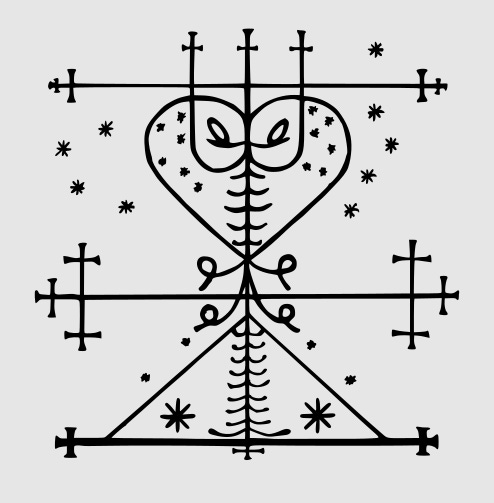
Veve for Mama Brigitte | Wikimedia Commons, 2007
Key Terms for this Section
Emancipation · Antisemitism · The LDS Church
Secularism · Vodou · Syncretism · Partition · State Shinto
12.1 | Modern Jewish Identity
Emancipation & the Haskalah
We open where Section 11 closed, in a Europe reorganizing itself after the wars of religion (cf. Sec. 11.4), and we follow one people through the modern age.
• 1791 | France makes its Jews full citizens
• 1818 | The Hamburg Temple opens
• 1894 | Captain Alfred Dreyfus is convicted of treason
• 1897 | Herzl convenes the First Zionist Congress at Basel
For most of the Middle Ages, a Jew in Christian Europe lived under a settled disability (cf. Sec. 2.4): barred from most trades or from owning land. In 1500s Venice, Jews were confined to a walled ghetto, a tolerated outsider rather than a citizen.
But the modern age began to take those walls down.
The logic of Westphalia pointed, slowly and unevenly, toward a radical new idea:
that a Jew might be a full member of a nation-state, as nation and religion were now two separate categories.
This is emancipation, the granting of equal civil and political rights to a group the law had once excluded. It arrived first with the French Revolution: in 1791 the French National Assembly declared the Jews of France full citizens, the first such grant in Europe. The terms had been set in the debate two years before, when the deputy Stanislas de Clermont-Tonnerre told the Assembly:
We must refuse everything to the Jews as a nation and accord everything to Jews as individuals… They must be citizens individually.
Clermont-Tonnerre to the National Assembly, 23 Dec 1789
Where the armies of the Revolution and then Napoleon marched, the ghetto walls came down behind them, and the question that had defined Jewish life for 1,000 years — how does a people survive as a permanent outsider? — was suddenly replaced by a stranger and more modern one: how does a people survive as an insider?
No one had felt that question more sharply than Moses Mendelssohn (d. 1786), the Berlin philosopher who became the emblem of the Haskalah, the Jewish Enlightenment.
Mendelssohn’s project was to hold two things at once, to be a full participant in modern German culture AND to fully be a Jew (cf. Sec. 2.4), and he built a bridge for it. He translated the Torah into German, printed in Hebrew letters (1780–1783), so that Jewish readers could enter the wider intellectual world without leaving their own texts behind. His was a characteristic Haskalah wager: that Jewish identity and modern citizenship could be combined rather than traded against each other.
Jewish Observance & Modernity
Because there was no single answer, modern Judaism did not remain one thing. It became several, and the branches an American Jew chooses from today (cf. Sec. 8.4) were born in this emancipation-era argument.
One answer was to modernize the tradition itself. In 1818 a new congregation in Hamburg, the Hamburg Temple, shortened the service, added the vernacular and the organ, and rewrote prayers for a return to Zion that its members no longer expected to be literal. Its 1819 prayer book shows the change at work. Before the morning Shema, the traditional prayer asks God to gather the scattered people home, and the Hamburg editors kept the four corners of the earth but cut the part about returning to Israel.
They made the same kind of change to the prayers for restoring the Temple’s sacrifices. Out of that impulse grew the modern German movement called Reform Judaism, which under scholars like Abraham Geiger (d. 1874) read the tradition through the new historical-critical scholarship and treated Jewish law as evolving rather than fixed.
A second answer was to refuse that move. The Orthodox Jewish response, articulated by Samson Raphael Hirsch (d. 1888), insisted that the Torah’s authority was not up for renegotiation, while holding that a fully observant Jew could still live in our world.
A third, American answer split the difference. The Conservative Jewish movement associated with Zacharias Frankel (d. 1875), accepted historical scholarship but kept Jewish law binding, seeking a middle path between Reform’s freedom and Orthodoxy.
Modernity did not secularize Judaism away. It multiplied Judaism’s forms.
Dreyfus, Basel, & the Shoah | 1894–1945
Emancipation was a promise, but for millions it was not kept.
Even as the walls came down, a new and modern hatred rose to meet the newly enfranchised Jew — no longer justified in the old religious terms alone but recast in the pseudo-scientific language of race. In 1879 the German agitator Wilhelm Marr popularized a clinical-sounding word for it, antisemitism, precisely to give an old prejudice a modern face.
Its most famous case put the whole promise of Jewish emancipation on trial.
In 1894 a French army captain named Alfred Dreyfus, a Jew, was convicted of treason on forged evidence and sent to a penal colony. It took until 1906 for France to clear his name. If an officer of the most emancipated nation in Europe could be condemned for his ancestry, what exactly was emancipation worth? Further east the question was bloodier still, as waves of pogroms (organized mob violence) swept the Jewish communities of the Russian Empire.
The modern age had promised the Jew a home in the nation.
But a great many concluded it would never be delivered.
Under Nazi Germany, the modern state turned its full bureaucratic and industrial power to the murder of Europe’s Jews, and roughly six million were killed in the genocide known as the Shoah. Its memory is kept on Yom HaShoah (cf. Sec. 8.3). It belongs in this lesson for one reason. The Shoah is the definitive refutation of the comfortable idea that modernity is simply the story of reason replacing barbarism. The most modern state in Europe produced the most systematic barbarism in history. Whatever modernity is, it is not the automatic triumph of enlightenment over darkness.
The Holocaust changed the minds of many Jews. If the nations of Europe would not make the Jew at home, then the Jews would become a nation again themselves.
Zionism is the belief that the Jewish people constitute a nation entitled to a national home in the historic land of Israel. Its decisive organizer was the Viennese journalist Theodor Herzl (d. 1904), who had covered the Dreyfus Affair for his newspaper and later said it made him a Zionist. In 1897 Herzl convened the First Zionist Congress at Basel, and wrote afterward in his diary the line history remembers: “At Basel I founded the Jewish State.” He added, “Perhaps in five years, and certainly in fifty, everyone will know it.”
The founding of the modern State of Israel in 1948 is the far end of a road that began at Basel with Herzl.
Key Terms for this Lesson: Emancipation · Antisemitism
12.2 | New American Religions
2nd Great Awakening & the LDS Church | 1800s
Across the modern Atlantic, the question changes. In Europe, modernity pressed on an ancient faith and multiplied its forms. In the young United States, modernity did something the Old World rarely allowed. It let people create new religions.
• 1790s–1830s | The Second Great Awakening sweeps the frontier
• 1830 | Joseph Smith publishes the Book of Mormon
• 1844 | The Great Disappointment
• 1851 | Holyoake names secularism
In the first decades of the 1800s a wave of intense, emotional, camp-meeting Protestantism, the Second Great Awakening, swept the American frontier. Nowhere burned hotter than a stretch of western New York so scorched by successive revivals that contemporaries called it the “burned-over district.”
The American Revival spirit helped to make religion in America a matter of personal, voluntary, enthusiastic choice rather than inherited membership. And once faith is something a person chooses and feels rather than something a person is simply born into, the doors open to entirely new choices. Through that door, in the burned-over district and beyond, walked America’s religious innovations.
The most consequential of them began with a vision. Joseph Smith (d. 1844), raised in the burned-over district amid competing revivals, recounted that as a boy he had gone to the woods to ask God which church was true and received, in what his tradition calls the First Vision, an answer that none of them was:
“I was answered that I must join none of them, for they were all wrong; and the Personage who addressed me said that all their creeds were an abomination in his sight…” Joseph Smith | History 1:19
Smith later described being led by an angel to a set of buried golden plates, which he translated and published in 1830 as the Book of Mormon. Since 1982 the book has carried the subtitle Another Testament of Jesus Christ, and it tells of ancient peoples in the Americas. In 1830, the same year, Smith organized the Church now known as The Church of Jesus Christ of Latter-day Saints (also known as LDS Church or Mormons).
Persecution drove the LDS Church steadily westward, and after Smith was killed by a mob in Illinois in 1844, Brigham Young (d. 1877) led the main body across the plains to the Great Basin of Utah, where the Church built a homeland and flourished.
Early Latter-day Saint practice included plural marriage, which drew intense legal and social conflict with the wider United States. The Church’s president then issued the Manifesto of 1890 withdrawing official sanction for new plural marriages, opening the path to Utah statehood. At the end of 2025 the Church reported 17,887,212 members worldwide (2025 Statistical Report).
It is the most successful of the new faith traditions the era produced.
Adventists, Witnesses, & Christian Science
Revival’s most combustible fuel was prophecy, and the calendar became a test of faith.
A lay preacher named William Miller, working the numbers of biblical prophecy, announced Christ’s return, and his movement settled on October 22, 1844. When the day passed like any other, his followers called it the Great Disappointment.
Most movements would have ended there.
Instead, some of Miller’s followers reinterpreted the date as a heavenly event rather than an earthly one, and out of that reinterpretation (shaped by the visions and prolific writing of Ellen G. White, d. 1915) grew the Seventh-day Adventist Church, with its distinctive Saturday sabbath and its lasting emphasis on health and the body.
At Battle Creek, Michigan, the Adventist sanitarium run by Dr. John Harvey Kellogg put that emphasis on the menu, and the flaked cereal he and his brother developed in the 1890s put it on America’s breakfast table.
A separate movement came from the same prophetic ferment: the Bible Students gathered by Charles Taze Russell (d. 1916) and his Watch Tower magazine (1879). In 1931, under his successor Joseph Rutherford, they took the name Jehovah’s Witnesses from Isaiah 43:10 (“You are my witnesses, says the Lord”). On the name Jehovah itself, see Sec. 7.3. The movement became known for its door-to-door evangelism, its own translation of the Bible, and, in one much-litigated matter of conscience, its refusal of blood transfusions.
What unites them is the pattern: a failed prediction or a fresh reading of scripture becomes, in the open American market of faith, the seed of a durable new tradition.
A different current answered a different need: not the end of the world but the suffering in it. Mary Baker Eddy (d. 1910), after her own recovery from injury, taught that sickness was fundamentally an error of the mind to be healed through right understanding of divine reality. She set it out in Science and Health (1875) and organized her following as Christian Science in the 1870s and 1880s. Around and beyond it spread the looser New Thought movement, with its confidence in the mind’s power over circumstance — a “mind-cure” optimism of the 1800s whose echoes run straight through American positive-thinking culture to the present day.
Here modernity’s inventiveness turns inward, toward the self and its healing.
Secularism | 1851
And modernity produced one more option: standing outside organized religion altogether. This was not simply unbelief. It was a position, argued and organized like any other in the American marketplace. Its roots ran back to the deism of an earlier generation, Thomas Paine’s insistence on reason over revelation (cf. Sec. 2.4, 13.2), and it found champions like the orator Robert Ingersoll (d. 1899), “the Great Agnostic,” who filled lecture halls making the case against creeds.
In 1851 the British reformer George Jacob Holyoake (d. 1906) coined the word secularism for it: not the mere absence of religion, but a considered stance that human life should be guided by reason and this-worldly concern, taking its place among the options rather than replacing them.
For most of the 1900s, serious thinkers predicted that this one option would replace the rest. In 1968 the sociologist Peter Berger told the New York Times that by the 21st century “religious believers are likely to be found only in small sects, huddled together to resist a worldwide secular culture.”
In 1999, in The Desecularization of the World, he took it back: “The assumption that we live in a secularized world is false.” The world, he wrote, “is as furiously religious as it ever was, and in some places more so than ever.”
Where the modern era’s critics said religion would simply disappear, what actually appeared was one more choice on the shelf. The modern era did not empty the shelf. It stocked it.
Key Terms for this Lesson: LDS Church · Secularism
12.3 | Syncretism & Reform
Islamic & Hindu Reform | 1828–1928
We now leave America and go global. The modern encounter was not Europe’s and America’s alone. Every major tradition eventually had to answer modernity.
• 1828 | Ram Mohan Roy founds the Brahmo Samaj in Calcutta
• 1875 | Dayananda Saraswati founds the Arya Samaj
• 1893 | Vivekananda speaks at the World’s Parliament of Religions in Chicago
• 1928 | The Muslim Brotherhood is founded in Egypt
Long before the Ottoman caliphate was formally abolished in 1924 (cf. Sec. 10.3), the Muslim world had begun answering modernity, and the answers ran the full spectrum.
At one pole stood a modernist current: the activist Jamāl al-Dīn al-Afghānī (d. 1897) and his student Muhammad Abduh (d. 1905) argued that Islam and modern science were not enemies, that a Muslim could embrace modern learning without abandoning the faith, and that the tradition’s own resources called for reasoned renewal.
At another pole stood a Salafi current (Ar. salaf, “predecessors,” the earliest generations of Muslims, cf. Sec. 10.3), which held that the cure for the community’s weakness was a return to the practice of the first Muslims, stripping away what it judged to be later corruption. Its stricter forms, associated with the earlier teaching of Muhammad ibn Abd al-Wahhab (d. 1792), became influential in Arabia.
Between and around these, new organizations formed to carry Islam into modern mass politics, the Muslim Brotherhood, founded in Egypt in 1928, is the largest of them. And at the far secular pole stood the Turkish republic of Mustafa Kemal Atatürk, which abolished the caliphate and built an explicitly secular state on European lines.
India met the same pressure from modern learning, missionary Christianity, and colonial rule (cf. Sec. 4.3), and produced its own spectrum of reform. In Bengal, Ram Mohan Roy (d. 1833) founded the Brahmo Samaj in 1828, a reform society that drew on modern reason and the Upanishads alike and campaigned against the practice of widow-burning (sati), which colonial law banned the following year.
In 1875 Dayananda Saraswati founded the Arya Samaj, calling Hindus back to the Vedas in a reforming spirit that paralleled, in its “return to the sources” logic, the Salafi current in Islam.
And on September 11, 1893, the monk Swami Vivekananda (d. 1902) carried a confident, modern Hinduism onto the world stage at the World’s Parliament of Religions in Chicago. He opened, to a roar from the audience:
Sisters and Brothers of America, It fills my heart with joy unspeakable to rise in response to the warm and cordial welcome which you have given us… I am proud to belong to a religion which has taught the world both tolerance and universal acceptance. Swami Vivekananda, Chicago, September 11, 1893
The service-oriented Ramakrishna Mission he founded (1897) turned Hindu spirituality outward toward hospitals and schools. Reform, revival, and global outreach: the Hindu answers to modernity rhyme with the Muslim ones.
Under modern pressure, the world’s traditions did not fade.
They reformed, revived, and remade themselves.
Vodou & the Haitian Revolution | 1791–1804
The starkest case of a tradition remade under modern pressure was forged in modernity’s cruelest institution. When West Africans were carried across the Middle Passage into slavery in the French Caribbean colony of Saint-Domingue, they were forcibly baptized as Catholics. And yet, their indigenous traditions held. How?
Rather than surrender their ancestral spirits, they hid them in plain sight behind the masks of the Catholic saints. The result is Vodou: a tradition in which the African spirits called the lwa are honored under the images of Catholic saints.
• Damballa, the serpent spirit | St. Patrick
• Erzulie, the spirit of love | the Virgin Mary
• Papa Legba, guardian of the crossroads | St. Peter
All of them serve under a supreme creator the tradition calls Bondye (Fr. bon Dieu, “good God”). What looked to a slaveholder like obedient Catholic devotion was the preservation of an entire African spiritual world.
And that survival turned into revolution.
In August 1791, a Vodou ceremony in the forest at Bois Caïman helped ignite the uprising that became the Haitian Revolution, the only slave revolt in history to found a nation, producing in 1804 the second independent nation in the hemisphere. Vodou traveled with its people, notably to New Orleans, and became part of the American religious mixture.
And precisely because it was born of the enslaved and the colonized, Vodou has been caricatured more grotesquely than perhaps any tradition in this course — often reduced in pop culture and film to “black magic,” dolls and curses, and, in some rhetoric, cast as a literal pact with the devil. When in fact, Vodou is a coherent religious system of devotion, healing, and community, not the horror-movie invention that Hollywood and hostile rumor made of it.
A priest (houngan) or priestess (mambo) leads the ceremony in the peristil, the temple’s open hall, around its center post, the poto mitan, through which the lwa arrive. For each spirit a vèvè, its sacred emblem, is traced on the floor in cornmeal.
A tradition the modern world tried first to erase and then to mock has instead endured, and still shapes Haitian life in the 21st century. In April 2003 the Haitian government officially recognized Vodou as a religion, declaring it “an essential part of national identity.”
Syncretism: Santería, Candomblé, & Kabir
Vodou is perhaps the most dramatic instance of the modern era’s signature religious move, and that move has a name. Syncretism is the fusion of elements from two or more religious traditions into a new and coherent whole. It was not unique to Vodou or to Haiti: enslaved and colonized peoples across the Atlantic world produced parallel traditions (Santería in Cuba, Candomblé in Brazil), each masking African spirits behind Catholic saints in its own way.
Nor was syncretism strictly modern. Its great pre-modern emblem is the North Indian poet Kabir of the 1400s, revered across Hindu, Muslim, and Sikh lines for verse that pointed past every sectarian boundary to the one divine reality.
In Rabindranath Tagore’s 1915 translation, Kabir’s God says simply,
“I am neither in temple nor in mosque.”
Syncretism names one of the most common things religions do when worlds collide, and the modern age, which collided more worlds than any before it, made it the era’s characteristic form.
Key Terms for this Lesson: Vodou · Syncretism
12.4 | Religion & the Modern State
Partition & Hindutva | 1923–2019
We close the section with the modern institution that once claimed it would make religion obsolete: the sovereign nation-state.
The clearest case of religion and the modern state colliding came at the birth of two nations. When British rule over India ended in 1947 (cf. Sec. 4.3), the subcontinent was divided (or, partitioned) into a majority-Hindu India and a majority-Muslim Pakistan, along a hastily drawn boundary known as the Radcliffe Line, which cut the Punjab, the Sikh homeland, in two (cf. Sec. 4.4).
As the partition lines were announced, one of the largest and fastest mass movements of people in modern history began, as Hindus and Sikhs fled toward India and Muslims toward Pakistan. The displaced are usually numbered at 12 to 15 million (some estimates run to 20 million). The migration turned to slaughter as communities that had lived side by side fell on one another. The death toll is genuinely uncertain, with estimates ranging from 200,000 (the British figure of the day) to 2 million.
The logic that drove Partition, the “two-nations” claim that Hindus and Muslims constituted distinct nations that could not share one state, was urged by its advocates as the only guarantee of Muslim security, and rejected by its critics, including Gandhi, as a betrayal of a shared Indian civilization.
Gandhi’s campaign of ahimsa (Sa. “non-harm”) had helped win independence. He spent his last months fasting to stop riots, in Calcutta in September 1947 and in Delhi in January 1948. On January 30, 1948, twelve days after the Delhi fast ended, Gandhi was assassinated by a Hindu nationalist who believed he had been too conciliatory toward Muslims seeking partition.
The idea that India is essentially a Hindu nation has a name and a lineage. In 1923 the nationalist V. D. Savarkar (d. 1966) published the definition of Hindutva (“Hindu-ness”), arguing that a true Indian is one for whom the subcontinent is both fatherland (pitribhu) and holy land (punyabhu), a definition that positioned Muslims and Christians as outsiders to the nation. In 1925 the Rashtriya Swayamsevak Sangh (RSS) was founded as the movement’s disciplined organizational core.
The dispute that has most tested this idea in recent decades centers on the town of Ayodhya, where a mosque built in the 1500s, on a site many Hindus hold to be the birthplace of the god Rama, was demolished by activists in 1992, touching off deadly rioting. In 2019 India’s Supreme Court awarded the site for the construction of a Hindu temple, and the temple was consecrated on January 22, 2024.
Imperial Japan | 1868–1945
No Asian culture has had a more storied encounter with modernity than Japan.
The story begins in the 16th century when Spanish and Portuguese missionaries arrive in Japan. By 1620, amid fears of increasing Western influence on the island nation, Christianity is outlawed. After the Christian uprising of 1639, the emperor enacted the Sakoku Policy, which completely prohibited contact with the outside world. This isolation lasted for more than two centuries.
This all changed in 1853 when US Navy Commodore Matthew Perry arrived in Tokyo Bay with four terrifying modern warships, demanding the opening of Japan to American commerce. Not yet a modern nation, the Japanese were forced into negotiations and signed an unequal treaty with the West. This “Black Ships“ episode was a moment of national embarrassment for Japan, who felt like a helpless people facing a vast mechanized empire.
The Japanese responded to their encounter with modernity with focus and determination. By 1889, Japan had adopted the Meiji Constitution, and was the first industrial Asian nation, rapidly transforming its economy, military, and infrastructure. The 1920s witnessed the rise of State Shinto, a Japanese imperial religion emphasizing loyalty to the divine emperor and Japan’s expansionist policies.
By 1936, their path to World War II was clear when Japan signed a treaty with Nazi Germany. Bombing, invading, and terrorizing their way across China, Imperial Japan officially entered World War II with their attack on Pearl Harbor in 1941.
During naval battles, State Shinto practice included the sending of suicide bombers into U.S. Naval ships (called kamikaze fighters — divine wind in Japanese). A bloody, four-year campaign in the Pacific ended in 1945 when the U.S. detonated two atomic bombs over Hiroshima and Nagasaki.
All of this is prologue to the post-war Japan we all now know and recognize.
Japan emerged from the 1960s with the second-largest modern economy in the world. By the 1980s, Japanese products and media were selling throughout the modern world. The new, postwar image of Japan was one of non-threatening, approachable kawaii (cuteness). Cultural icons like Hello Kitty, Pokémon, and the ever-present peace-sign pose in photos became reflective of Japan’s soft power and their uniquely successful response to modernity. While the original mission to Christianize Japan was largely unsuccessful (less than 1% of Japan is Christian today), the Japanese took the secular markers of Western modernity and made it their own.
The Law of Return & the First Amendment
In 1948, the Jewish national dream of Lesson 12.1 became a modern state.
Israel’s Law of Return (1950) grants any Jew the right to immigrate and claim citizenship, binding the state to the people in a way no purely secular nationalism would. Internally, the new state settled into a negotiated arrangement (often called the “status quo”) between its religious and secular citizens over matters like the sabbath, marriage, and religious authority, an arrangement still constantly argued over. So…
• Modern Japan built a new state religion to prop up its imperial ambitions
• Modern India was partitioned into different nations by their competing religions
• Modern Israel tied its Law of Return to religion (still, 20% of Israelis are not Jewish)
But another new, modern state did something even stranger.
It did none of those things.
The United States (1776) declined to establish any religion at all. It’s citizens could belong to whatever religion they wanted, start a religion, or have no religion whatsoever. Forever enshrined in the First Amendment, there is neither a requirement for nor prohibition of religion in our nation.
We’ll pick up on the story of Religion in America in Section 13, next.
Key Terms for this Lesson: Partition · State Shinto
Recommended Sources
• Michael A. Meyer, A History of the Reform Movement in Judaism (OUP, 1988)
• Richard L. Bushman, Joseph Smith: Rough Stone Rolling (Knopf, 2005)
• Kate Ramsey, The Spirits and the Law: Vodou and Power in Haiti (U. of Chicago, 2011)
• Metcalf, A Concise History of Modern India (Cambridge University Press, 3rd ed., 2012)
• Helen Hardacre, Shinto: A History (Oxford University Press, 2017)
Last Section: Christianity, Pt. 2
This Section: Religion & Modernity
Next Section: Religion in America