

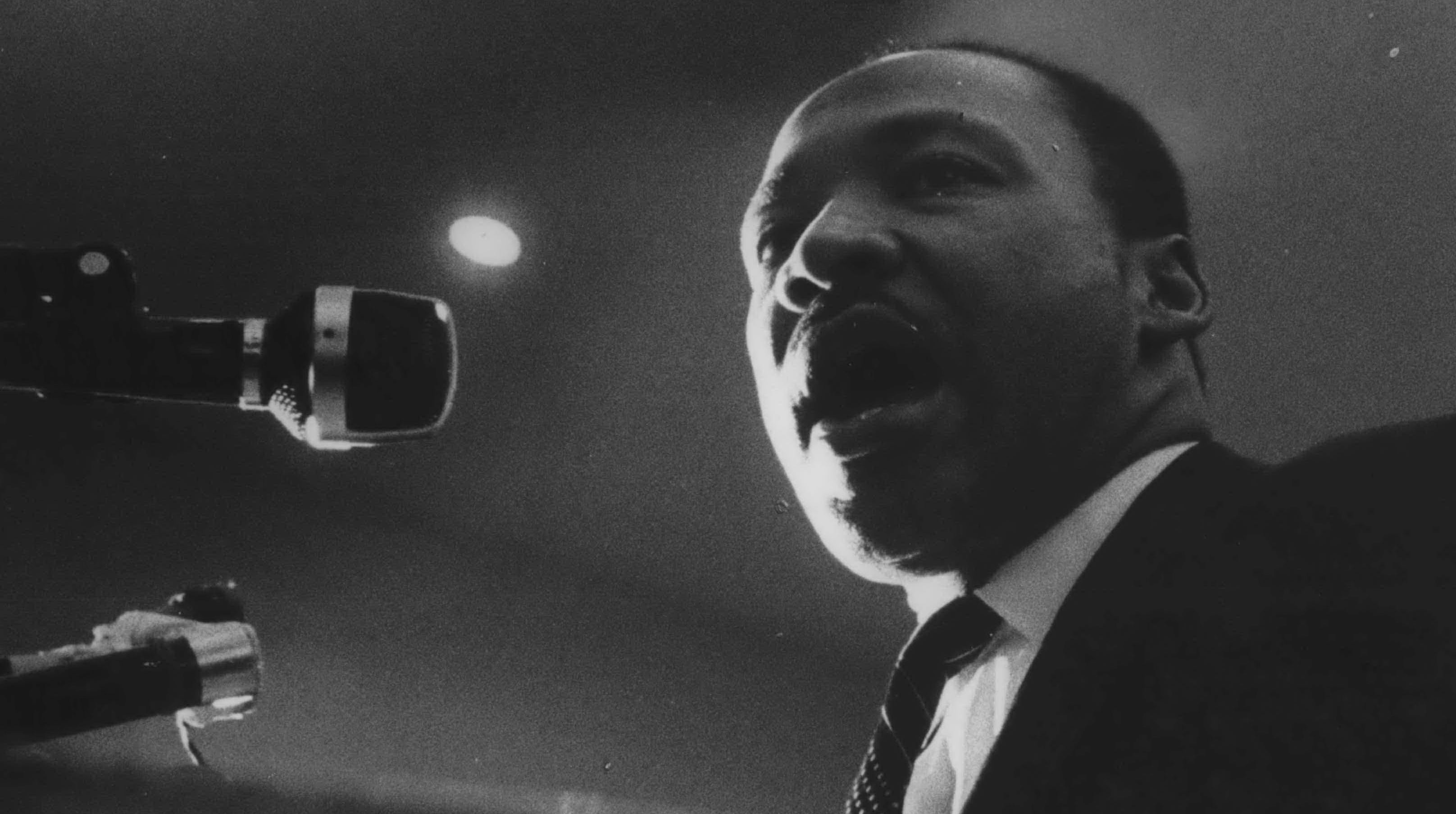
The Rev. Dr. Martin Luther King Jr. | Cleveland, Ohio, April 26, 1967

Key Terms for this Section
The Puritans · Disestablishment · The First Amendment · The Founders’ Settlement
The Black Church · The Social Gospel · Civil Religion · Nondenominationalism
13.1 | Puritan: England & New England
Henry VIII, Elizabeth, & the Puritans | 1534–1620
The story of American religion begins in the modern English Reformation (cf. Sec. 11.4).
• 1534 | Henry VIII breaks with Rome
• 1588 | Elizabeth defeats the Spanish Armada
• 1620 | The Mayflower lands at Plymouth
• 1636 | Roger Williams founds Providence
In 1534, King Henry VIII of England breaks with the Roman Catholic Church and starts his own. Remember that marriage is one of the Seven Sacraments supervised by the Catholic Church (cf. Sec. 11). Well, Henry (d. 1547) didn’t like being assigned in marriage to the daughter of his Spanish enemies and the widow of his late brother, so he asked for an annulment. He also fancied another woman, Anne Boleyn. When the Catholic Church refuses the annulment, England joins the Germanic kingdoms in Luther’s Protestant Reformation — for reasons more dynastic than doctrinal.
King Henry’s heirs vacillate between Protestantism and Catholicism. Then, in 1588, the world is turned upside down when Henry and Anne’s daughter, Queen Elizabeth, defeats the mighty Spanish Armada. Spain’s grip on the Atlantic loosens, and the little island nation of England begins its long rise to rule it.
However, England still cannot rule itself. King Henry’s novel idea, to have a “Church of England“ apart from Roman Catholicism, was on shaky ground. The idea of an English Church (ie. Anglicanism) was for English Catholics and Protestants to meet in the middle, the via media (Lt. “middle way”). But this frustrated the conservative elements at both ends of the controversy. It wasn’t Roman enough for hardline Catholics, and it wasn’t Reform enough for hardline Protestants. The English Catholic hardliners were called Recusants, while the Protestant hardliners came to be known as Puritans.
The Puritans are the English Protestants who wanted to ‘purify’ the Church of England of Catholicism entirely. They wanted to be rid of the ‘smells and bells’ in English churches, advocating for plain dress, simpler worship, and strict adherence to the Bible on the Calvinist model (cf. Sec. 11.4). Yet most Puritans still held out hope that England would change.
The most conservative faction believed England was irrevocably lost. Rather than reform England, these Puritan Pilgrims sought instead to “separate“ themselves from the Church of England and start again elsewhere. They first moved to the Protestant Netherlands (1608), but the Pilgrims never felt at home among the Dutch. Rather than return to England, they chartered a ship, the Mayflower, to take them to the New World in 1620.
Plymouth, Massachusetts Bay, & the Covenant | 1620–1660
Before going ashore, the 41 adult men aboard signed the Mayflower Compact (November 1620), a brief agreement to govern themselves as a “civil body politic” under God. The Pilgrims’ colony was Plymouth.
A larger and better-financed migration followed a decade later. In 1630, a fleet of 11 ships carried non-separating Puritans to found the Massachusetts Bay Colony, and their leader John Winthrop (d. 1649) preached, aboard the flagship Arbella or just before sailing, the sermon that gave American self-understanding its most durable image:
For we must consider that we shall be as a city upon a hill. The eyes of all people are upon us. John Winthrop, A Model of Christian Charity, 1630
The phrase is Jesus’ (cf. Matthew 5:14), and Winthrop did not mean it as a boast. He meant it as a warning. A people bound to God by covenant (cf. Sec. 7.1) would be watched, and judged, by how faithfully they kept it. The Puritans understood themselves as a new Israel, and they built their society to match.
Older textbooks call the result a ‘Puritan theocracy,’ but the word overclaims. Ministers did not rule. Magistrates did, and the two offices were kept formally separate. It is more exact to call Massachusetts Bay a covenanted commonwealth — a society that treated its covenant with God as the foundation of its law.
Rather than uplifting ‘religious freedom,’ the Puritan government was quite intolerant of anyone who did not subscribe to their strict views of dress, worship, and socialization. They outlawed theaters, dancing, and Christmas. To maintain order, criminals were put into stocks and publicly whipped. And while the colony did vote on laws, only landowning men in good standing with the Puritan church could cast votes.
One Puritan minister, Roger Williams (d. 1683), had enough.
Minister Williams claimed that of the Bible’s commandments, those which govern society (eg. murder, theft, lying) were the state’s rightful business, while those commandments that deal with personal religious conviction should be left to the conscience of individual Christians. He despised Emperor Constantine for ever giving Christians the idea of making Christianity a “state religion” (cf. Sec. 9), as he felt that forcing religious belief was anathema to having faith. In The Bloudy Tenent of Persecution (1644) he called for a “hedge or wall of separation between the garden of the church and the wilderness of the world” — a century and a half before Jefferson borrowed the phrase. In this way, Roger Williams became the first American to advocate for the Separation of Church and State.
His political views got Williams banished from Massachusetts. So, in 1636, he founded Providence and the Colony of Rhode Island, the first American colony founded on freedom of religion, on the principle he called soul liberty. Over the next few years, religious minorities like Quakers, Baptists, and Jews made Rhode Island their home.
This is the first American argument for disestablishment. Disestablishment is the principle that the state should establish, tax-support, and enforce no church at all.
Williams was not alone in his exile. Anne Hutchinson (d. 1643), who held that salvation came by God’s grace directly and questioned the authority of the colony’s ministers, was tried and banished in 1638. And when Quaker missionaries arrived to challenge the established order, the colony hanged four of them in Boston, among them Mary Dyer on June 1, 1660.
The Puritans who fled a church that punished dissent built a commonwealth that punished it just as readily.
Salem & the Confessional State | 1492–1692
The severity reached its most famous extreme in 1692, in the village of Salem. When a group of girls fell into fits their community read as bewitchment, the colony’s courts (witchcraft was a capital crime on the books) set in motion a wave of accusations that swept up scores of people, most of them women. Before it ended, 19 people were hanged and one old man, Giles Corey, was pressed to death under stones for refusing to enter a plea.
The trials collapsed when the accusations reached the socially powerful and Governor Phips dissolved the special court. Within five years the colony was repenting in public. In 1697 Judge Samuel Sewall stood in church while his confession of error was read aloud, and 12 of the jurors signed a statement asking forgiveness.
New England’s coercion was real, but it was mild beside the model it defined itself against. In 1492, the Catholic monarchs of Spain expelled the Jews who would not convert, and the Spanish Inquisition (founded 1478, cf. Sec. 11.2) turned its machinery on the conversos, those of Jewish and Muslim ancestry suspected of secretly keeping their old faith. This was the confessional state at full strength: one faith, enforced by the sword, with no dissenters permitted at all. The alternative to the coming First Amendment was not neutrality. It was this.
The expulsion has an American coda. Among the Sephardi Jews scattered by 1492, a small community reached the Dutch colony of New Amsterdam (later New York) in 1654 — the first Jewish community in what would become the United States (cf. Sec. 8.4).
Key Terms for this Lesson: The Puritans · Disestablishment
13.2 | Disestablishment & the First Amendment
Establishments & the Great Awakening | 1730s–1741
By the middle of the 1700s, the colonies were anything but a single faith.
• 1741 | Whitefield preaches to 30,000 in Philadelphia
• 1790 | Washington writes to the Jews of Newport
• 1791 | The First Amendment is ratified
• 1797 | The Senate ratifies the Treaty of Tripoli
Most colonies had an established church, a tax-supported official religion,
but not the same church.
• New England | Congregational (the heirs of the Puritans)
• The South | Anglican (the Church of England)
• The middle colonies | No single establishment (Pennsylvania welcomed dissenters)
A colonist crossing from Virginia to Massachusetts to Pennsylvania passed through three religious orders. Across all of them, in the 1730s and 1740s, swept the Great Awakening, a wave of revival preaching carried by the English evangelist George Whitefield (d. 1770) to enormous open-air crowds. Benjamin Franklin, who heard him in Philadelphia, paced off the crowd and reckoned Whitefield could be heard by more than 30,000 people at once.
The Awakening made religion a matter of personal, felt conversion rather than inherited membership, and it cut across the established churches. The truest faith, colonists learned, was chosen, not assigned. (Its 1800s successor, the Second Great Awakening, is Section 12’s story, cf. Sec. 12.2.)
Washington, the Founders, & Deism | 1790–1820
A century after Roger Williams, in 1790, the Jews of Newport, Rhode Island, wrote to President George Washington and asked the Father of this new country what was to happen to American Jews. What was Washington’s answer? He wrote back to that congregation (at the oldest synagogue in North America) with the following stirring words:
The Citizens of the United States of America have a right to applaud themselves for having given to mankind examples of an enlarged and liberal policy… happily, the Government of the United States, which gives to bigotry no sanction, to persecution no assistance, requires only that they who live under its protection should demean themselves as good citizens, in giving it on all occasions their effectual support… May the Children of the Stock of Abraham who dwell in this land continue to merit and enjoy the goodwill of the other Inhabitants, while everyone shall sit in safety under his own vine and fig tree, and there shall be none to make him afraid. Washington to the Hebrew Congregation of Newport, 1790
The vine and the fig tree are the prophet’s (cf. Micah 4:4).
While our picture of the American Founders is often one of pious religiosity, many of them were either ambivalent or outright opposed to the concept of revealed religion. Our first president, George Washington, rarely attended his Episcopalian church (cf. the Church of England), rarely spoke of Jesus by name, declined to take communion, and when asked to publicly affirm his Christianity he declined to do so. Our second and sixth presidents, John Adams and his son John Quincy Adams, held Unitarian beliefs, affirming the Godhead in some general sense but denying the divinity of Jesus.
Our third president and author of the Declaration of Independence, Thomas Jefferson (d. 1826), held Deist views, as did Ben Franklin and Thomas Paine (cf. Sec. 12.2). James Madison (d. 1836), the Father of the Constitution, kept his private beliefs almost entirely to himself. Deism is the belief in a distant, non-intervening, non-Biblical ‘Creator’ who designed the universe, established its natural laws, then left us alone. Deists specifically deny the divine claims of prophets or any revealed religion.
President Jefferson even took it upon himself to cut the miracles out of the Gospels (with a razor and paste — the Smithsonian still holds the volume) and form his own Jefferson Bible based on his Deistic beliefs. Its full title is The Life and Morals of Jesus of Nazareth (1820), and in it he excised all mention of supernatural events or the divinity of Jesus.
At the other end of the spectrum stood orthodox believers like John Witherspoon (d. 1794), the Presbyterian minister who signed the Declaration. Devout Christianity was as present at the founding as skeptical Deism.
When the Founders set forth to develop a modern 18th-century nation, they did so against the backdrop of the 1600s’ religious schisms and wars (cf. Sec. 11.4). The French Wars of Religion (1562–1598) killed as many as 3 million. The Thirty Years’ War (1618–1648) killed perhaps a third of Germany. And the Puritan-driven English Civil War (1642–1651) had torn Mother England in half. Going back to the Puritans (from whom the Adams family hailed), America had been built of people leaving religious persecution. Consequently, there appears no particular religious motive on the part of the American Founders apart from religious liberty for Americans.
Tripoli, Virginia, & the First Amendment | 1786–1833
Interestingly, the question of whether America should be identified as “Christian” was put to the Senate as early as 1797. In the Mediterranean Sea, American merchant ships were being seized by the Muslim Barbary states of North Africa. To assure a Muslim power that religion gave no cause for war between them, Article 11 of the Treaty of Tripoli opens:
As the Government of the United States of America is not, in any sense, founded on the Christian religion; as it has in itself no character of enmity against the laws, religion, or tranquillity, of [Muslims]… it is declared by the parties, that no pretext arising from religious opinions, shall ever produce an interruption of the harmony existing between the two countries. Treaty of Tripoli, Article 11, November 4, 1796
The treaty, negotiated under President Washington, was ratified unanimously by the Senate (23–0) on June 7, 1797, and signed by President Adams three days later.
Whether the Founders meant to build a Christian nation or a secular one is a question the era argued and did not settle. Both readings can be defended from the record: the same generation that ratified Article 11 without a dissenting vote also opened its sessions with prayer and spoke easily of Providence. The point is that there were sides, and the Founders knew it.
Because they disagreed, they chose not to decide the question by force, and the model for that choice was worked out in Virginia. When the state debated whether to tax its citizens for the support of Christian teachers, James Madison answered in 1785 with his Memorial and Remonstrance, arguing that religion belongs to conviction and conscience, not to the magistrate, and that a state which could establish one church could establish any. The argument carried. On January 16, 1786, Virginia enacted Jefferson’s Statute for Religious Freedom, which held “that Almighty God hath created the mind free” and forbade compelling any citizen to support or attend any worship whatever. Jefferson counted it among the three accomplishments carved on his tombstone.
A year after Washington’s letter to Newport, the First Amendment to the U.S. Constitution echoed the words of Roger Williams: “Congress shall make no law respecting an establishment of religion, or prohibiting the free exercise thereof” (December 15, 1791). The First Amendment is the constitutional provision whose two clauses forbid a national church (the Establishment Clause) and protect the practice of every faith (the Free Exercise Clause). Together they made the Founders’ Settlement.
The Founders’ Settlement is the founding generation’s answer to a nation of many faiths: rather than establish one church or settle the ‘Christian nation’ question, they built a state that would take no side. Every European power still had an established church. The American republic chose to have none.
Jefferson gave the arrangement its enduring image in a letter to the Baptists of Danbury, Connecticut (January 1, 1802), describing the First Amendment as “a wall of separation between Church and State” — Williams’s phrase, now written into the nation’s self-understanding. The settlement was not finished overnight. The states kept their own establishments for decades (Connecticut until 1818, New Hampshire until 1819), and Massachusetts did not fully disestablish its Congregational churches until 1833. But from its inception to the present day, there has been no state religion of the United States, no religion to which Americans must belong, and no government interference with the reasonable exercise of one’s private religious beliefs.
Key Terms for this Lesson: The First Amendment · The Founders’ Settlement
13.3 | The Social Gospel & the Black Church
The Invisible Institution & the AME Church | 1787–1895
The nation the Founders built had no established church, and into that open ground American Christianity grew two reforming voices.
• 1816 | Richard Allen organizes the AME Church
• 1865 | Lincoln’s Second Inaugural Address
• 1907 | Rauschenbusch publishes Christianity and the Social Crisis
• 1963 | King writes the “Letter from Birmingham Jail”
Christianity came to enslaved Africans as their masters’ religion, and they made of it something their masters never intended. The revivals of the Great Awakening (cf. Sec. 13.2) reached the enslaved as they reached everyone else, and the Baptist and Methodist styles (adult baptism, plain preaching, emotional worship) took deep root in the quarters.
But the worship that mattered most happened out of sight. Historians call it the invisible institution: the religious life of the enslaved, conducted where the master could not see. In brush arbors and clearings they met to pray in what were called hush harbors, and there they sang the spirituals. A song like “Go Down, Moses“ (first printed 1861) carried a double register, voicing both the soul’s longing for heaven and the body’s longing for freedom in this world. And they read their own story into a particular book. Where the master’s Christianity dwelt on obedience, the enslaved fixed on Exodus, the God who hears a people’s groaning and brings them out of bondage (cf. Sec. 8.3), and made it the lens through which the whole Bible was read.
Where Black Christians could worship openly, they built institutions, and those institutions outlasted slavery itself. In Philadelphia, the former slave and Methodist preacher Richard Allen (d. 1831), together with Absalom Jones, led a walkout from St. George’s Methodist Church after Black worshippers were pulled from their knees and told to move to the gallery (1787 by the traditional account, 1792 by some historians). They formed the Free African Society (1787), and in 1816 Allen organized the separate congregations into the African Methodist Episcopal Church, the AME, the first fully independent Black denomination in America, with Allen as its first bishop.
After emancipation the exodus of freedpeople from white-controlled churches swelled the Black denominations enormously. The National Baptist Convention, organized in 1895, became the largest of them.
The Black Church is the independent congregations and denominations built by African Americans, and the oldest set of institutions African Americans built and controlled in this country: at once house of worship, school, mutual-aid society, and training ground for leadership. In a society that barred Black Americans from most of civic life, the church was the one wholly owned institution.
Revival, the Same Bible, & the Social Gospel | 1801–1920s
In reaction to the Deism of the 1700s (cf. Sec. 13.2), which spoke of a remote and uncaring ‘Creator,’ the 1800s witnessed a “reawakening” of Protestant faith that started in Kentucky and spread across America: the Second Great Awakening (cf. Sec. 12.2). In hours-long revivals, preachers brought intense focus to one’s personal relationship with Jesus (cf. Solus Christus, Sec. 11.4), often described while “giving testimony“ about one’s conversion from a life of sin — a key feature of the growing Evangelical movement. This era saw the popularization of hymns still sung today, like Amazing Grace (1779), What a Friend We Have in Jesus (1855), and Blessed Assurance (1873).
In many ways, Christianity as we commonly see it in the American South today has its roots in the Second Great Awakening.
A zeal for social reform followed. In the North, abolitionism, temperance, and women’s rights followed the revivals. In the South, Black congregations found solace in each other and in traveling preachers whose message of emancipation bore deep into the African-American psyche. And the nation’s central sin forced a reckoning that split American Christianity down the middle, because both sides claimed the same God. The Baptists, Methodists, and Presbyterians cracked apart along the same line as the country. No one named it more soberly than Abraham Lincoln in his Second Inaugural Address (March 4, 1865): both sides “read the same Bible, and pray to the same God; and each invokes His aid against the other.”
After Southern Reconstruction (after 1877), when economic disparity and racial tension had reached new heights, post-Awakening preachers shifted their focus from the sinful individual to underserved communities. In the early 1900s, the Social Gospel message was that our race-torn society must heal through Christian political reform. At that time, it was the Progressive movement who wanted Christianity in American politics. For Conservatives, religion was a private matter.
The Social Gospel is the message that Christian principles should guide not only individual conscience but also the structure of society. Its advocates preached what they called “social salvation” and set themselves to “Christianizing the social order,” emphasizing the collective sins of American society and criticizing the greed of capitalist, secular Conservatives and the inequality it wrought. Social Gospel Baptists like Walter Rauschenbusch (d. 1918) railed against what he perceived as the evils of capitalism:
The essential purpose of Christianity was to transform human society into the kingdom of God by regenerating all human relations and reconstituting them in accordance with the will of God. Walter Rauschenbusch, Christianity and the Social Crisis, 1907
Its critics answered that the church’s business was the soul and not the social order, and that the movement had confused the gospel with a political program. The argument ran on for decades. The goal of the Social Gospel movement was the reconciliation of American society through Christ, and its energies went into labor rights, education reform, and the settlement houses that served the immigrant poor.
Mays, King, & the Black Pulpit | 1954–1963
The Social Gospel’s legacy persisted into the 1960s with Civil Rights preachers like Benjamin Mays (d. 1984), Martin Luther King Jr. (d. 1968), and Adam Clayton Powell Jr. (d. 1972). King belonged to both of this lesson’s voices, the Social Gospel’s conscience and the Black Church’s pulpit. He was a Baptist pastor and the son and grandson of Baptist pastors. The family’s pulpit was Ebenezer Baptist Church on Auburn Avenue in Atlanta, and King’s own first charge (1954) was Dexter Avenue Baptist Church in Montgomery. He was educated at Morehouse under Mays, taking in the Social Gospel inheritance directly.
His most famous piece of writing, the “Letter from Birmingham Jail“ (April 16, 1963), is a pastoral epistle, addressed to fellow clergymen who had called his work unwise and arguing its case in the theological register of the Black pulpit — a letter from a cell, in the genre of Paul’s letters from prison (cf. Sec. 9.2). His public oratory was the preaching tradition carried onto the national stage: the cadence, the call-and-response, the peroration built from Scripture.
That tradition had already traveled beyond any one sanctuary. From the 1920s the Black pulpit went out over the radio, and gospel music, from Thomas A. Dorsey‘s Chicago choirs to Mahalia Jackson, reached homes far from any one congregation (cf. Sec. 14.3). The campaigns, marches, and legislation of the civil-rights movement belong to the American history curriculum. What belongs here is King the preacher, and the tradition of the Black pulpit that produced him.
Key Terms for this Lesson: The Black Church · The Social GospelThanks for reading scribespark! Subscribe for free to receive new posts and support my work.
13.4 | The Cold War & the Rise of Nondenominationalism
Historical Criticism & the Fundamentalists | 1835–1910
The 1900s opened with a fight inside Protestantism over how to read the Bible.
• 1910 | The Presbyterian General Assembly names five "essential" doctrines
• 1954 | "Under God" enters the Pledge of Allegiance
• 1965 | The Immigration and Nationality Act
• 1979 | Jerry Falwell founds the Moral Majority
From the beginning of the Enlightenment, European scholars have pored over ancient texts in an attempt to discover their origins, authors, and histories. Their scholarly methodology came to be known as Historical Criticism. Ancient works like the Odyssey, the Epic of Gilgamesh, and the Ramayana have been picked apart to discover the sensus literalis historicus (Lt. the original, historical meaning) of each text. Their methods include source criticism (identifying a text's sources), form criticism (analyzing a text's genre and setting), redaction criticism (discerning where a text shows edits and why), and tradition criticism (tracing the changes that arise from writing down an oral tradition). It is the same descriptive method this course has used since Week One (cf. Sec. 1.2).
In 1800s Germany, scholars like David Friedrich Strauss (The Life of Jesus, 1835) and later Julius Wellhausen (1878) turned these tools on the Bible itself. Intense study of scripture had taken place for centuries, but that study was generally done through a theological lens (ie. assuming the text is a sacred and perfect object). The German critics claimed that studying the Bible absent of theological assumptions revealed new information about the cultural and historical setting of Western religion.
When these findings made their way to 1800s America, they were met with great controversy. Presbyterian and Methodist ministers who incorporated the new scholarship into their sermons were put on trial for heresy. Some left the church in protest. Others doubled down on the traditional tenets of their denomination. The controversy split American Protestantism in two. The faction that advocated for adapting Christianity in light of new scientific and scholarly discoveries was labeled "modernists." The faction that insisted upon the timeless validity of the Protestant faith was labeled "fundamentalists." Christian Fundamentalism advocates adherence to the fundamental tenets of traditional Christian doctrine, resisting modernist interpretations.
In 1910, a line was drawn in the sand of American Christianity. That year the Presbyterian General Assembly named five "essential" doctrines, and a 12-volume series of essays called The Fundamentals (1910–1915) gave the movement its name. The five were:
• The Bible is inspired by the Holy Spirit and is without errors of any kind
• Jesus is the Son of God, born miraculously to a virgin
• Jesus was crucified to atone for the sins of the world
• The body of Jesus was resurrected, literally raised from the dead
• The miracles of Jesus are historical facts
From this Fundamentalist–Modernist split the modern map of American Protestantism was drawn. The churches that made peace with the new scholarship became known as the Mainline. The Mainline is the set of historic Protestant denominations that view Christianity primarily through the lens of reason: the Presbyterian Church (PCUSA), the Episcopal Church, the United Methodist Church, and the United Church of Christ. By the mid-1900s, the moderate wing of self-identified Fundamentalists took the name Evangelicals. Evangelicals are the Protestants who view Christianity primarily through the lens of tradition and personal conversion: the Presbyterian Church in America (PCA), the Assemblies of God, and the Southern Baptist Convention. In our part of the world, the second is often assumed to simply be Christianity. (The Mainline's decline since 1970 is Section 14's story, cf. Sec. 14.1.)
Red Scare, Civil Religion, & the Religious Right | 1952–1979
In the aftermath of World War II (1945), the geopolitical world was dominated by the Cold War between America and Soviet Russia. From the 1950s onward, American politicians came to define their patriotism in opposition to perceived Communist values. Where the Soviets valued cultural expression aligned with the state, Americans valued freedom of expression. Where the Soviets valued centralized economic planning, Americans valued a market economy. And where the Soviet state was officially atheist, American politicians rallied behind Christian totems (cf. Sec. 1.4).
In the first half of the 1900s, it was Progressive politicians who wore Christianity on their sleeve. In the latter half, it would be Conservative politicians who invoked the name of Jesus. In Washington, fears of godless Communist spies fueled a "Red Scare" in American media. Atheism became synonymous with being anti-American. Conservative politicians like Joseph McCarthy fueled a nationwide panic over alleged Communist sympathies that resulted in hundreds of Progressive intellectuals, writers, and actors being "blacklisted" (ie. cancelled).
President-elect Eisenhower caught the mood on December 22, 1952: "our form of government has no sense unless it is founded in a deeply felt religious faith, and I don't care what it is." In 1954, the phrase "under God" was added to the Pledge of Allegiance, and in 1956, "In God We Trust" became the official motto of America.
• 1892 | "one Nation indivisible"
• 1954 | "one Nation under God, indivisible"
This is civil religion. Civil Religion is the diffuse public faith that binds a nation with sacred language without belonging to any church or creed, invoking a God generic enough to belong to everyone. The sociologist Will Herberg (d. 1977) named the era's shape in Protestant–Catholic–Jew (1955): three acceptable ways of being religiously American, three doors into one civic faith. The evangelist Billy Graham filled stadiums with his crusades from 1949 onward (for his broadcast ministry, cf. Sec. 14.3).
The 1964 presidential election represented a sea change in politics. When asked about his religious views, the Conservative candidate Barry Goldwater demurred, maintaining as a Conservative that his private beliefs were no one's business. Goldwater lost in a landslide. Conservative politics had changed. In 1968, Conservative candidate Richard Nixon wore his Christian identity on his sleeve and carried the election.
After President Nixon (1974), the relationship between American Conservatism and American Christianity intensified. Not only did Conservative politicians become more vocal about their faith, but American Christianity became more socially conservative in outlook. Second-wave feminism, the gay rights movement, and the legalization of abortion (1973) became hot-button issues among a rising number of Conservative Christians. In 1976, Newsweek proclaimed "the year of the evangelical." In 1979, Jerry Falwell (d. 2007) founded the evangelical Moral Majority, which united with President Ronald Reagan in the 1980s to form what its supporters called the "Religious Right." Falwell's movement aimed to unite Christian denominations under the banner of the Republican party, and the "Evangelical Vote" is now courted by every serious American politician.
Nondenominationalism & the New Americans | 1965–2020
The deepest change was structural. American religion increasingly stopped organizing itself by denomination at all. The megachurch rose — congregations of thousands built on a "seeker" model that set aside old denominational markers for contemporary worship, accessible preaching, and a come-as-you-are welcome. Willow Creek Community Church in South Barrington, Illinois (1975), built its services around the question of what would draw the unchurched in.
Out of this came nondenominationalism. Nondenominationalism is the turn by which churches belong to no denomination and answer to no larger body, competing for members in an open market of faith. Nondenominational Evangelical Christianity became the new norm. In the 2020 U.S. Religion Census, nondenominational churches counted about 21 million adherents in 44,319 congregations, more than any single Protestant denomination (the Southern Baptists, next in line, had about 3.4 million fewer). This is the American terminus of the logic Section 11 traced out of the Reformation (cf. Sec. 11.4): a marketplace of belief in which no church is established and every congregation must attract its own adherents.
The market's newest suppliers came by ship and plane. The Immigration and Nationality Act of 1965 ended the old national-origins quotas and opened the country to migration from Asia, Africa, and the Middle East, and with the new Americans came their faiths. The mosque, the Hindu temple, and the Sikh gurdwara joined American religious life in numbers the Founders could not have imagined (cf. Sec. 4.4, 5.4, 10.4). What began as a nation of Protestant establishments had become, by the 2000s, the most religiously various society in the developed world.
There is no single American religion. There is an American religious market.
Key Terms for this Lesson: Civil Religion · Nondenominationalism
Recommended Sources
• Sydney E. Ahlstrom, A Religious History of the American People (Yale U.P., 2004)
• Jon Butler, Awash in a Sea of Faith: Christianizing the American People (Harvard, 1990)
• Raboteau, Slave Religion: The "Invisible Institution" in the Antebellum South (OUP, 2004)
• George M. Marsden, Fundamentalism and American Culture (Oxford U.P., 2006)
• Meacham, American Gospel: God, the Founding Fathers, and the Making of a Nation (Random House, 2006)
Last Section: Religion & Modernity
This Section: Religion in America
Next Section: Religion Today