

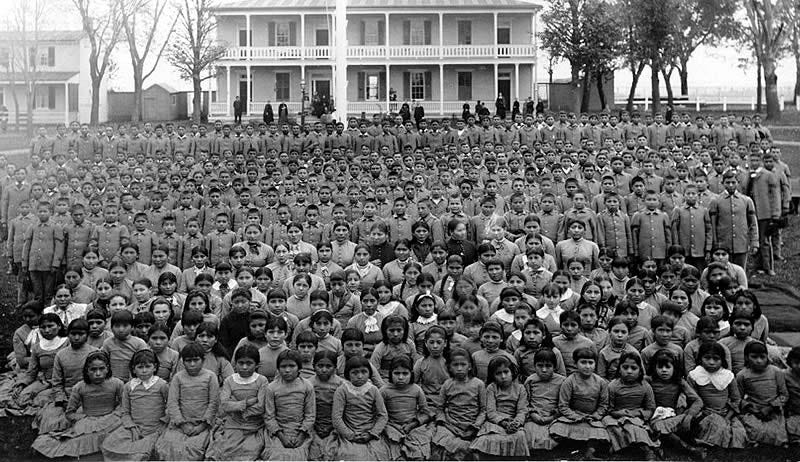
Pictured: Students at the Carlisle Indian Industrial School, PA (ca. 1900)
Key Terms for this Section
Diné · Diné Bikéyah · Hocho/Hozho · Walking in Beauty · The Blessingway
The Old Paper · The Long Walk · Native American Church
3.1 | The People & the Land
The Diné
The American Indian nation known in English as the Navajo resides in the southwestern region of the United States. With over 300,000 members, two-thirds of whom live in Arizona and New Mexico, the Navajo are the second largest American Indian nation in North America (the Cherokee are the largest) and maintain the largest contiguous reservation of land. Although this course will primarily use the term “Navajo,” this people self-identifies as the Diné, meaning “the People” in their own language. Diné is a complex philosophical term, built from the Navajo words for “up” and “down” — an interplay between the grounded and the transcendent — a people rooted in the earth even as they reach toward higher goals and spiritual insights.
As to “religion,” many Navajo view the Western concept as too narrow to capture the full reality of their way of life. Ceremonies, social customs, and daily activities are woven into one integrated whole: farming, weaving, and caring for livestock may all carry spiritual dimensions, with no separate “religious sphere” cordoned off from the rest of life. When some Navajo leaders speak of a “Navajo Religion” in official or legal contexts, they do so as an external label, adopted to fit the categories of U.S. law.
Note: as a non-proselytizing community, their ceremonies, ritual objects, and totems are intended solely for the Navajo community and are not casually shared with outsiders.
Optional Video: Cultural video explaining Navajoland (auto-generated CC).
A Place-Based Tradition
Navajo traditions are profoundly tied to the land.
In their sacred oral traditions, the Navajo trace the origin of all humanity to their particular homeland, known in the Navajo language as Diné Bikéyah (The Land of the People). In English, this area is frequently called Navajoland or the Navajo Nation. This land includes four sacred mountains, which Navajo tradition treats as alive — Blanca to the east, Mount Taylor to the south, the San Francisco Peaks to the west, and Mount Hesperus to the north.
In Navajo culture, these mountains are revered as powerful totems that guide and protect.
Like other significant religious sites around the world (eg. the Western Wall in Jerusalem, St. Peter’s Square in Vatican City, or the Ka’ba in Mecca) these mountains are considered sacred. To treat these peaks as ordinary, profane features of the landscape is viewed by the Navajo as taboo. (cf. Sec. 1’s totem and taboo.) This reverence is tied to the mountains serving as sources of jish — medicine bundles containing sacred earth, used in Navajo ceremonies and symbolizing the spiritual power believed to flow from these places.
The number four is a powerful Navajo totem. There are four sacred mountains, four sacred colors (black, white, yellow, and blue/turquoise), four sacred plants (corn, beans, squash, and tobacco), and four cardinal directions — elements that anchor the Navajo sense of place and ritual and recur throughout Navajo storytelling, art, and ceremonial life.
Because the tradition is place-based, being on or near Diné Bikéyah is more than physical geography: it means participating in a cosmic order where each mountain, color, and plant has its own spirit or significance. The cultural identity of the Navajo cannot be easily separated from the land they inhabit.
In terms of historical context, anthropologists link the Navajo language to a broader linguistic family extending from present-day Alaska through western Canada into the Southwest. The Diné likely began migrating from the north some 500 to 900 years ago. In their new homeland they learned from neighbors like the Pueblo — adopting techniques for farming, building, and weaving — while developing their own unique identity and customs. Before contact with early modern Europe, the Diné enjoyed a largely pastoral life: herding, hunting, and gathering, sustained by close ties to the land. As such, they had little need for the administrative writing of centralized empires — a fact that will shape in Lesson 3.3, when we ask why the Diné have no written scripture.
Spanish Contact, 1492–1680
European contact with the Americas began in 1492 with Christopher Columbus, whose arrival is often described as a discovery, though American indigenous people largely experienced it as a plague of illness, followed by subjugation. In the 1500s, the head of the Roman Catholic Church was Rodrigo Borgia (styled as Pope Alexander VI), who commanded the monarchs under his sway to conquer and colonize lands overseas, to bring the other side of the world under Spanish and Portuguese authority. Following these directives, Spain led the earliest imperial efforts westward, establishing colonies and claiming resources in what came to be called the “New World.”
By the late 1500s, the Spanish Empire had turned its attention to an area they named Nuevo México. When the Franciscan missionaries arrived, they encouraged (and in many cases coerced) indigenous peoples to adopt Christianity and abandon their longstanding cultural heritage. Among the indigenous nations affected were the Navajo, who took up arms in their resistance to forced assimilation. Some Navajo were enslaved or killed, and their cultural practices were largely suppressed.
Census records show that in 1600, around 80,000 indigenous people lived in the New Mexico region.
By 1680, only 17,000 remained.
In that year, several indigenous communities including the Navajo united in what became known as the Pueblo Revolt of 1680. This uprising expelled the Spanish from the region, however briefly. The 1680 Revolt is referred to by contemporary Navajo as the “first American Revolution.” However, Spanish forces returned about twelve years later with increased military strength and reclaimed control over the region. When Mexico later won its independence from Spain, the Mexican government inherited oversight of the Navajo but offered little to improve their conditions. By around 1820, the Navajo population had been reduced again to approximately 10,000. Following the Mexican-American War of 1846–1848, the United States assumed legal rights to New Mexico, a shift that brought further challenges for the Navajo.
Through all of it, the land stayed at the center of Diné life.
What holds life in balance on Navajoland is the next lesson’s question.
Optional Video: A Navajo Woman explains what it means to be Navajo.
Key Terms for this Lesson: Diné · Diné Bikéyah
3.2 | Walking in Beauty
Orientation Through Narrative
Navajo traditions place special emphasis on complementary forces that maintain balance in the world.
These twin forces — such as Sky and Earth, Feminine and Masculine, or Night and Day — create a cosmic duality that is interwoven throughout Navajo daily life and spiritual practice. They symbolize how the world holds opposing yet interdependent energies.
For the Navajo, maintaining balance means ensuring that all these forces remain in harmony.
This idea of balance goes beyond casual observation and informs the core of Navajo identity. Rather than seeing good and evil as purely moral or abstract categories, the Navajo often interpret their twin orientation as conditions of harmony or disharmony in the world. When these forces become unbalanced, life enters a state of conflict. Restoring equilibrium is crucial to communal well-being, personal health, and the relationship between the Navajo people and their homeland.
For scholars, while “religion” often separates mundane routine from the sacred, Navajo practices integrate the sacred with all aspects of life. This seamless connection becomes clear when examining the concepts of Hocho and Hozho, which speak to the interplay between harmony and disharmony.
Think back to Sec. 3.1. Some traditions organize themselves around creeds: to join is to affirm a set of doctrines, and the natural first question is what do you believe? But the Diné world is organized differently. Its central concern is balance, and its natural first question is how do you move through the world? Neither arrangement is a deficient version of the other; they are simply different architectures of the sacred. The scholar’s job is to describe each in its own terms. A student who comes to the Diné asking for a “statement of faith” will leave empty-handed. But a student who asks what keeps a life, a family, and a land in harmony will find the whole tradition opening up. This is what scholars mean when they describe the Diné tradition as an orientation rather than a belief system.
Harmony & Disharmony
At the core of Navajo cosmology is the idea that the world is ideally ordered in a way that fosters well-being for all.
The Navajo identify threats to this order as Hocho (ie. the evil of disharmony) and regard it as something that can emerge from a variety of dark sources: whether it involves a person, a rival community, or even the Holy People. This disharmony can also arise when longstanding Navajo taboos are broken: such as mocking ceremonies, blocking doorways, or whistling at night. Hocho is found in ugliness, bad luck, and conflict. In terms of scale, it can appear in both everyday moments and in major spiritual events. Navajo communities risk inviting strife, sickness, or confusion when violating their sacred ritual norms. In a broader sense, Hocho can even be an internal condition: sparked by negative thoughts or harmful intentions. Navajo ceremonies, guided by an awareness of how easily the world can slip into disorder, exist to realign individual Navajo members onto the right path. Once the source of any disharmony is identified, sacred healing rituals help restore stability and drive away Hocho so that a harmonious state returns.
Meanwhile, on the positive side of Navajo cosmology is Hozho (ie. harmonic goodness).
The restoration of harmony.
Sacred Navajo practitioners (ie. medicine men) perform prayers, give offerings, and perform elaborate ceremonies to vanquish the evil among them. A medicine man will diagnose and heal a patient while singing these prayers. The Navajo recipient of these sung offerings is called the one–sung–over. The goal is for the Diné to live in harmony once again with the world. Hozho is not merely an intellectual idea; it is felt in communal gatherings and daily acts of respect directed toward nature, elders, and sacred totems. By cultivating these practices, the Navajo claim they avoid slipping into disharmony — embracing a life of balance and wholeness.
Optional Video: Medicine Man explains Walking in Beauty (auto-generated CC).
Walking in Beauty with the Holy People
The Navajo concept of Walking in Beauty is central to understanding how Hocho and Hozho come together in daily practice. Building on the notion of Hozho, Walking in Beauty is more than a mindset. It is an ongoing commitment to living in harmony with the earth, with other people, and at peace with oneself. Maintaining balance in thought, speech, and action ensures that a Navajo life aligns with the order of the cosmos. This perspective is rooted in the understanding that all aspects of existence are interconnected, so personal choices can ripple through human, animal, and spiritual realms. Gratitude, reverence, and mindfulness help strengthen Hozho, while the ceremonial Beautyway Prayer purifies negativity within individuals and communities.
Walking in Beauty often involves the Navajo’s Holy People (Diyin Dine’é): immortal superbeings dwelling in the four sacred mountains of Navajo lore. Unlike ancient Greek or Norse notions of gods, the Holy People irresistibly serve at the behest of medicine men. They act as conscious conduits to the sacred harmony that pervades the four worlds of Navajo cosmology.
Among the Holy People are:
• Father Sky and Mother Earth, whose partnership illustrates the sacred union and balance of sky and earth
• The Changing Woman (their daughter) revered for her creative power in bringing humanity into existence
However, not every one of the Holy People is benevolent.
• The Coyote, for example, is mischievous and symbolizes chaos or greed
Recognizing both helpful and harmful superbeings acknowledges the moral complexity of the world and the constant need to maintain balance. Through prayers, offerings, and proper ritual actions, medicine men and other practitioners call upon benevolent Holy People to drive away evil, restore order, and keep the community in line with the natural laws that uphold life.
Balance can be lost, and balance can be restored. Who restores it — and by what means — is where we turn next
Key Terms for this Lesson: Hocho/Hozho · Walking in Beauty
3.3 | Medicine & Spoken Text
Medicine in the Hogan
Navajo Medicine is a sacred practice that integrates ritual, community values, and a profound respect for both the physical body and the sacred. Central to this tradition are Navajo Medicine Men, who guide healing in a traditional structure called a hogan: built from wood and sealed with mud, with a single doorway oriented to the east to align with the dawn and invoke feelings of renewal. During each ceremony, the medicine man calls upon powerful spiritual forces through song, drawing the Holy People into direct engagement with those in need of healing or protection.
The form that engagement takes depends on the need. Navajo Medicine answers in three major ceremonial traditions: the Holyway, the Evilway, and the Lifeway. The Holyway ceremony invokes blessings and beneficial energies, restoring balance when someone is experiencing a spiritual or emotional void. Evilway rituals focus on driving away negative influences or malevolent forces causing personal distress, communal disharmony, or persistent misfortune (disturbances often linked to a breach of Hozho).
When a person’s physical well-being requires attention, Lifeway medicine addresses the ailments of the body, drawing on established herbal practice, traditional remedies, and diagnostic insight. While rooted in ancestral wisdom, these procedures do not exclude modern medical approaches: the Navajo see little contradiction in combining traditional healing with modern medical care, and a Navajo working as an emergency medical technician may carry the same guiding principle of service that has defined healing in Navajo culture for generations. Together, Holyway, Evilway, and Lifeway ceremonies affirm the belief that body, mind, and spirit are interwoven, and that balance in one domain can strengthen harmony in all others.
Optional Video that explains how a Diné becomes a medicine man (auto-generated CC).
The Blessingway & Sand Painting
The Blessingway is the most popular form of traditional Navajo medicine, and its signature is prevention rather than cure.
Its objective is bestowing and nurturing prosperity upon the Navajo being honored, and it is traditionally performed at pivotal life stages: like childbirth, coming of age, and Navajo weddings. A Medicine Man officiates, connecting the earthly plane to the Holy People, while rituals, prayers, and chants weave familial and communal ties into the spiritual fabric surrounding the honoree: blessings of safety for mother and newborn, moral grounding for a growing adolescent, cooperation and lasting devotion for two families joined. Rather than waiting for hardship to arise, the Blessingway fortifies the spirit against future disruption, aligning the participant’s path with Hozho.
While the Blessingway fortifies in advance, sometimes there is a more immediate need.
Sand Painting is said to provide a direct and immediate passageway for spiritual energy between the physical world and the realm of the Holy People. Created with colored sands, ground minerals, and cornmeal (each hue chosen for its symbolic potency), a Sand Painting is considered a living thing. The one-sung-over sits or stands at the painting’s center, magnifying the bond with the Holy People, who travel through the painting and respond to the medicine man’s songs and prayers as he applies designs layer by layer, at times placing sand directly onto the patient’s body.
These ceremonies address both physical and spiritual concerns by reinforcing the Navajo interconnectedness of nature, community, and the unseen forces that shape their lives. The medicine man’s prayers can target whatever has unsettled the one-sung-over, whether it is fear, sorrow, pain, or a more complex misalignment related to Hocho. In doing so, the ceremony embodies the Navajo worldview that sees the sacred and the everyday as inseparable. The process concludes when the painting is erased, returning the sand to the earth, a gesture that symbolizes the transitory nature of the ceremony and the renewal it aims to achieve.
The Spoken Text & the Old Paper
So, we have sacred sites, a kind of priesthood, and ritual. So where’s the scripture?
Every tradition we will meet in Modules 2 and 3 has its shelf of sacred books. The Diné do not.
Recall the pastoral life of Lesson 3.1: herding, hunting, gathering. Extensive writing is a technology of centralized nation-states — tax rolls, law codes, administrative records — which the Diné never grew to need. What they built instead is a complete system of oral transmission. Sacred narratives of the Holy People, clan histories, and moral teaching pass from elder to apprentice, face to face, so that melody, gesture, and nuance (everything a page might flatten) survive intact. For the Diné, the land itself is read as a kind of text: shifting weather patterns, migrating game, and the changing landscape guide decisions about grazing and the timing of ceremonies, an ever-present teacher and sacred record. And the oral tradition has proven adaptable on its own terms. Many Diné today embrace the recording or publishing of particular narratives, not as a surrender of the spoken word, but as an affirmation of their right to define and share their heritage themselves. But sacred teaching still passes person to person. Face to face.
Optional Video that explains the Navajo language (auto-generated CC).
Given all this, you might expect the Diné to hold no written thing sacred at all. However, one document stands apart.
In Navajo history, the 1868 treaty between the Navajo Nation and the United States is called The Old Paper. It marks the turning point that allowed the Navajo to remain on or return to their homelands and retain essential aspects of their culture, and some Navajo regard it as a holy covenant (cf. Genesis). For the Navajo, this is no mere political agreement; it is a spiritual confirmation of their people’s relationship to their land. Though the Diné favor oral transmission for sacred teaching, the Old Paper is treated as a special totem of the People, set apart from all other text. It remains a guardian of Navajo identity whose provisions are upheld not merely for political reasons but for spiritual integrity. A tradition whose scripture is spoken sanctifies exactly one piece of writing — and it is a covenant of land.
“...the United States agrees that no persons except those herein so authorized to do... shall ever be permitted to pass over, settle upon, or reside in, the territory described in this article.” — from Article II
How the Old Paper came to exist is revealed in our final lesson on the Diné.
Key Terms for this Lesson: The Blessingway · The Old Paper
3.4 | The Reservation & Diné Life Today
The Long Walk & the Return • 1864–1868
When the U.S. Army arrived in Navajoland, tensions were already high between the Navajo and the U.S. government.
By the mid-1800s, horses and firearms had become more prevalent in Navajo culture, and changing circumstances led to sporadic conflicts with American settlers and U.S. military. During the American Civil War (1861-65), the U.S. Army turned its attention westward after driving out Confederate troops who had briefly occupied parts of New Mexico. In an effort to more directly oversee indigenous populations, American authorities decided to relocate the Navajo to a reservation area far from their homeland.
This policy culminated in what is now known as the Long Walk of 1864. Approximately 10,000 Navajo were compelled to journey roughly 300 miles, escorted by soldiers who sometimes enforced the march under dire conditions. Historians record accounts of severe hardship. Some Navajo, weakened by age, illness, or pregnancy, struggled to keep pace. Tragically, there is testimony that the Navajo who could not continue were treated violently and in some cases shot. Upon arrival, the community faced unfamiliar terrain, limited supplies, and increased exposure to diseases. Their numbers had diminished during the ordeal. About 50–70% of the Navajo nation died during these few years in captivity.
However, the exile did not hold. Following the end of the Civil War, Washington policymakers reassessed the relocation strategy, and the surviving Navajo were permitted to return to their homeland. In 1868, the U.S. signed a treaty with the Navajo (the document now called the “Old Paper,” cf. Sec 3.3) which grants the Navajo a reservation of land and safe refuge in perpetuity. In short, the U.S. has promised the Navajo the land forever.
Optional Video that explains The Long Walk (auto-generated CC).
Policy, Peyote, & the Native American Church
Today, the Navajo Nation occupies about 17 million acres, encompassing the four sacred mountains.
However, the decades after their 1868 return brought federal policies that brought significant hardships on Navajo land and customs. The Dawes Act of 1887 divided tribal lands into individual allotments, cutting against historic communal property practices integral to Navajo tradition. Government-sponsored boarding schools required many Navajo children to adopt White-American customs and language. Federal livestock reductions in the 1930s disrupted their pastoral economy. But then, the current shifted: the Indian Reorganization Act of 1934 promoted tribal self-governance and the renewal of cultural practices, and later legislation like the American Indian Religious Freedom Act (1978) and the Native American Graves Protection and Repatriation Act (1990). These continued enhancements bolstered legal protections for Navajo ceremonies and sacred sites that are still enjoyed today.
As the Diné rebuilt their lives after their 1868 return — restoring herds, reestablishing kinship ties, and resuming sacred ceremonies — a practice called Peyotism found growing acceptance among them. Peyote, a small spineless cactus with psychoactive properties, had been used ceremonially by Indigenous peoples for centuries. Its prominence among the Diné grew in the decades after 1868. Adherents held that consuming peyote tea in carefully structured rituals facilitated direct communion with the Holy People. Though hallucinogenic, the Navajo understood peyote as a cultural medicine, supplied by the earth to clarify spiritual vision. Some Americans objected to peyote’s psychoactive qualities, and local and federal officials sought to restrict or ban its use, citing concerns about addiction and social disorder. Navajo practitioners answered in the vocabulary of religious freedom. Some Navajo drew cultural parallels between peyote and the Christian eucharist wine shared in communion: a sacrament symbolizing union with the sacred.
Neither the argument nor the practice stayed local.
By 1918, Peyotism had spread well beyond the Navajo Nation, connecting diverse Indigenous groups across North America, and out of this intertribal network the Native American Church took shape, integrating Christian elements with peyote-centered ceremony. Early leaders, including the Comanche figure Quanah Parker, spoke publicly about the compatibility of Christian teachings and peyote ceremonies. For many Diné, some of whom had already encountered Christian missionaries and mission schools, the NAC offered a distinctly Indigenous Christian practice rather than a wholesale adoption of European forms: group-based ceremony, Native language, and reverence for ancestral tradition alongside the Christian teaching spreading among their young. Its Navajo expression came to be called the Peyote Ceremony of Diné Nation. Participants in these services might recite the Lord’s Prayer, sing Navajo chants, read selected Bible passages, and share testimonies of visions or healings. To outsiders, the blend could be surprising; to adherents, it exemplifies Diné sovereignty over their own people — in matters both religious and political.
“The white man goes into his church house and talks about Jesus.
But the Indian goes into his tipi and talks to Jesus.”
Quanah Parker (NAC)
Diné Religious Life Today
Today, in many Navajo households, you may find a very pluralist religious landscape under one roof: a traditional Blessingway marking a birth or a wedding; a Protestant or Catholic service on Sunday; followed by a nighttime Native American Church meeting with singing, drumming, and communal prayer.
The hogan and the sand painting remain in living use, and Lifeway healing runs alongside the modern clinic. Federal law (cf. AIRFA and its 1994 amendments) secures the ceremonial use of peyote, and the Navajo Nation’s sovereignty allows it to regulate and protect that use on its own lands. Elders often teach that fidelity to Hozho includes respect for the different spiritual paths within the nation. All share the responsibility to protect Navajoland, honor family connections, and uphold reciprocity and generosity. Hozho is the frame the paths share.
In closing, again about a question we raised at the beginning of this question. If a scholar asks “what do the Diné believe?” the tradition stays closed. This is a question uninformed by Navajo culture. However, when a scholar asks, how the Navajo order life, land, and community? the tradition is able to respond in terms it recognizes.
Optional Video that explains Navajoland politics (auto-generated CC).
Key Terms for this Lesson: The Long Walk · Native American Church
Recommended Sources
Thomas Maroukis, The Peyote Road
Tall Woman: The Life Story of Rose Mitchell
Gary Witherspoon, Language and Art in the Navajo Universe
Last Section: What is Religion?
This Section: Diné • The Navajo Tradition
Next Section: Hinduism & Sikhism