

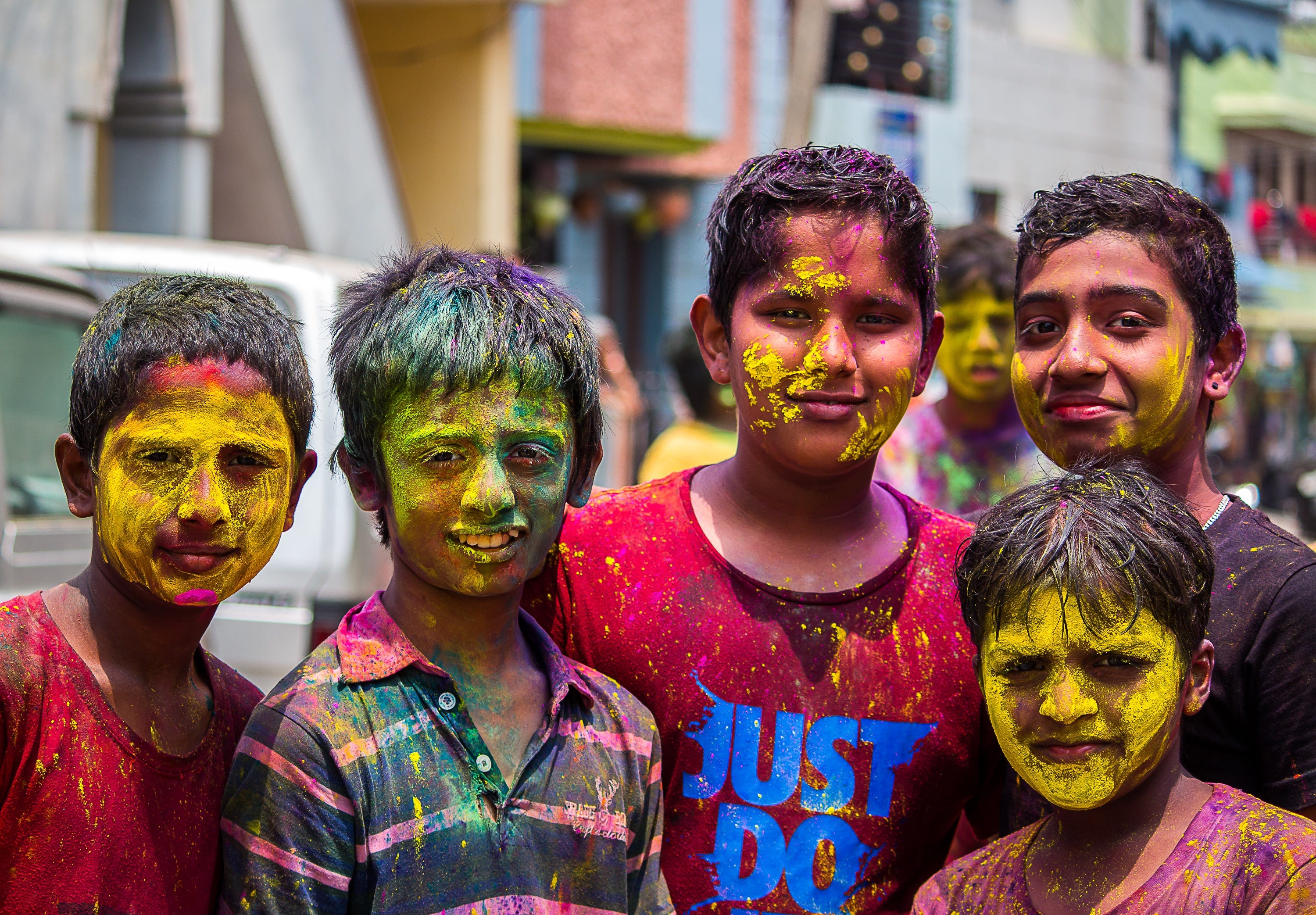
Pictured: Kids taking part in the Holi Festival in India (2022)
Key Terms for this Section
The Vedas · Brahman & the Avatars · Maya & Samsara · Karma & Moksha
Bhakti Marga · The Bhagavad Gita · Sikhism · The Khalsa
4.1 | God in India
Hindu India
This week our course crosses into the East.
Leaving behind the American plains of the last section, we come to the Indian subcontinent: two great river systems — the Indus to the northwest, the Ganges spilling east across the northern plain — walled off from the rest of Asia by the Himalayas, the highest mountains on Earth. In the far northwest, where five rivers braid together, lies the Punjab (cf. Sec. 4.4).
• 1500s BCE | The Vedic Age. Aryans compose hymns honoring the sky, earth, fire, and other forces thought to sustain cosmic order. During this period, we see a shift from Dyaus-Pitr (cf. Sec. 2.2) to the ever-expanding (Sanskrit: brh) nature of reality, nominalized to Brahman
• 600s BCE | The Ascetic Age. As the Upanishads emerge, attention turns to Maya, Samsara, and Moksha (cf. Sec. 4.2) During this period, Siddhartha Gautama founds Buddhism, advocating for self-discipline as the path to spiritual liberation (cf. Sec. 5)
• 400s BCE - 700s CE | Buddhist India. Emperor Ashoka commands the Buddhist dharma to be proselytized across all of India and the world. During this period, Hindu Epics like the Mahabharata and Ramayana are written (cf. Sec. 4.3)
• 1520s - 1700s | Islamic India. The Mughal Empire, founded in the 1520s, fused Persian and Indian folkways in architecture and the arts. India’s colonial period will end when they win their independence from Britain in 1947 (cf. Sec. 4.3). During this period, the Taj Mahal is built. The label “Hindu” comes to prominence as a way for Muslims to distinguish Muslims from non-Muslims.
Now that we have our bearings, you’ll recall in Sec. 2.4 that the designation of “Hindu” is a modern one (I recommend Pennington’s 2005, Was Hinduism Invented?). In fact, the religious category of “Hinduism” arose as a matter of colonial identification. That is, when Muslim imperials showed up in the 1500s, they came to identify the locals of India with the Indus River Valley. They derived the word “Hindu” from “Indus.” Later, when the British Empire arrived in the 1700s, they continued the tradition. Thus, the first designation of “Hinduism” as a religion came from Britons like Sir William Jones (founder of the Royal Asiatic Society) in the 1780s.
Today, a billion people live inside a “religious tradition” that only came to call itself a religion after the United States declared its independence from Britain! Without a single founder, text, or creed, Hindu tradition has flourished for thousands of years. So where did it begin? Around 4,500 years ago, a branch of the proto-Indo-Europeans split east and west. Some settled the Iranian plateau and gave rise to Persian culture. Others pressed northeast, arriving in Northern India.
From Northern India, the nobles (Sanskrit: arya), set forth the duties (Sa. dharma) of their ancient society.
As the concept of writing travelled east from Mesopotamia, the Aryans (nobles) began writing their ideas for society down. Fun fact: neighboring Persia (a Greek name) was called Aryanam — meaning Land of the Aryans — the source of the modern name Iran. This oral tradition spoke of devas (cognate of Dyeus, the Sky-Father in Sec. 2.2) and increasingly of Brahman.
1200s-700s BCE | The Vedas & the Upanishads
By the 1200s BCE, the Aryans had compiled a collection of four priestly texts called the Vedas — the Rig Veda, Yajur Veda, Sama Veda, and Atharva Veda. The Vedas are the world’s oldest scripture in continuous use. More than mere ritual instruction, the Vedas represent India’s first reflections on the mystery of existence.
The truth is one; the wise call it by many names.
Rig Veda
Carrying out Vedic ceremonies requires a keen understanding and ritual discipline. The mantras and hymns specify offerings and invocations meant to sustain a harmonious bond between worshippers and the sacred. Fire, the primary conduit to the divine, is a consecrated meeting point of mortal and eternal. By carefully tending this fire and chanting Vedic verses, Hindu priests invoke blessings for prosperity, well-being, and cosmic alignment. These practices weave spiritual devotion into everyday life, bridging the earthly and the transcendent.
Respect for the Vedas transcends cultural and linguistic differences, anchoring Hindus across regions in a shared sacred heritage. The Vedas offer not only liturgical guidance but also moral insight, prompting reflection on the enduring mysteries of existence and humanity’s place within the larger cosmic order.
Additionally, by the 700s BCE, Hindu thought took an inward turn.
A new body of texts, the Upanishads (the culminating layer of Vedic literature) shifted attention from the mechanics of ritual toward the inner self. Their central question is the relationship between atman, the innermost self, and Brahman, the ultimate reality. Their radical answer, which this section unpacks, is that the two are one. This was an age of seekers and ascetics; from the same soil grew two movements that broke from the Vedic priesthood entirely — those of Siddhartha Gautama and of Mahavira, whom we take up as Buddhism in Section 5. For now, hear the Upanishads in their own voice:
There is a light that shines beyond all things on earth, beyond all of us, beyond the heavens, beyond the highest, the very highest heavens. This is the light that shines in our hearts. Chandogya Upanishad
Written in Sanskrit, these texts are traditionally taught as direct revelations from God, conceived of in Hindu thought as Brahman—the all-encompassing spiritual reality. It’s also the place where most Western misreading of Hindu thought begins.
Optional Video: An ancient Vedic hymn (no CC).
God in India
One of the great tasks of scholarship is to dig through years of bias, which can accumulate over centuries of theological debate and one-upmanship, to arrive at a fresh perspective on a complex concept. Such is the case of the concept of God — a Germanic word (org. Gott) — Whom the ancient Hebrews referred to as El (אֵל), the Greek-speaking Christians as Theos (θεός), and Arabic speakers as Allah (ٱللَّٰه). In Indian Sanskrit, the name of God Almighty is Brahman (ब्रह्मन्), from the root bṛh- meaning to grow. In both East (ie. Hindu thought) and West (ie. Judaism, Christianity, Islam), God is understood to be the Almighty Creator and Lawgiver. Much is the same in our outlooks — cosmologically, morally, etc.
The most important distinction between Eastern and Western conceptions of God is that the Western traditions generally share a panentheistic view: that God is imminent in the creation but also transcends it. By contrast, the classical Hindu wisdom tradition promotes a pantheistic stance, teaching that God is the creation. In the Hindu view, God is not merely present in the rain. God is the rain, God is the people under the rain, God is their democratic beliefs, their love, their sorrows, etc. God is all those things. In the oft-repeated words of the Vedic text: “All is Brahman.”
This takes us to our second point: the Hindu Avatars. In Hindu texts, God is described as having many avatars. Puzzled by the concept, the earliest Western translators erroneously rendered “avatars” as “gods.” Here’s why that doesn’t work (and why you probably understand avatars better than the early translators did!).
Today, in computer games, an on-screen character is called an avatar (yes, it’s the same ancient Sanskrit word). Now, if an avatar “dies,” the player controlling the avatar is fine. Like, if I’m playing a Mario NES game and I jump Mario into a hole, my avatar may die — I might even say “hey, I died!” — but I assure you, I’m fine. Likewise, in Hindu texts, avatars are manifestations of the One God, Brahman. They come into the world to teach moral lessons. But it’s critical to keep in mind that Brahman controls the avatars; they have no existence without Him. The avatar concept doesn’t imply multiple independent gods but rather distinct forms of the same Divine Reality.
In the Vedas, Brahman’s avatars are diverse expressions of one God, guiding humanity through different narratives. The primary avatars are Vishnu, Shiva, and Shakti. Vishnu is God’s avatar who sustains. Shiva is God’s avatar who destroys and transforms. And Shakti is the avatar of God who creates. These three avatars — the Creator, the Sustainer, and the Destroyer — all represent the pantheistic cosmic order of Hindu thought.
So, when exploring Hindu texts, it may be useful to reframe the story as someone playing a video game...
Imagine there is a room in which a gamer is playing a video game. The gamer is Vishnu, who is playing a video game called “Earth,” in which his avatar, Krishna, is trying to convince the game’s NPCs that the game isn’t real life. Why would he do this? Because it turns out that the room itself, the gamer, and the game are all Brahman.
Optional Video: a short history of India
Key Terms for this Lesson: The Vedas · Brahman & the Avatars
4.2 | Hindu Cosmology & Practice
The World: Prison & Release
So if all is Brahman — if the coffee, the coffeeshop, and the customer are one reality — then why does the world feel like a crowd of separate things?
Hindu thought answers with a single word: illusion.
The emancipatory promise of Hinduism is that understanding the deep nature of reality will free you. Put simply, the Hindu tradition says that everything is interconnected and holy because ‘All is Brahman.’ The trouble is, we mere mortals have a rather difficult time understanding this as we are imprisoned by the illusion of reality. How?
Well, if all is Brahman, then the physical world (as we perceive it) is not reality at all but is instead a kind of illusory projection of Brahman. This illusory world is called Maya (माया). That is to say, the things that fill your daily life — from digital videos to paychecks — are not distinct entities in a distinct and physical “world.” Rather, they are all part of Brahman.
And so are you.
And so am I.
And so is everything.
Hindu thought reframes a guy ordering a coffee from a barista as Brahman experiencing Himself. What follows from this Hindu teaching is that the world we think we perceive is actually a prison of falseness (ie. Maya). Within this framework of Hindu cosmology, the ultimate goal is to transcend this illusory realm, breaking free from the confines of Maya.
But escaping Maya is difficult. Even death cannot escape it.
This is due to samsara — the Hindu cycle of reincarnation. In Hindu thought, existence is defined by the continual process of birth, death, and rebirth (cf. Vishnu, Shiva, and Shakti). While Westerners sometimes fetishize the notion of reincarnation, within Hindu culture, samsara is recognized as a profound existential challenge. Instead of perpetuating this cyclical existence, the ultimate goal of Hinduism is to seek liberation from samsara. In India, one transcends our worldly limitations by seeking reunification with the ultimate reality, Brahman.
Karma — meaning action in Sanskrit — is the cosmic relationship of one’s moral actions and their consequences. Given the foundational claim that “all is Brahman,” there is no cosmic judge presiding over one’s actions at the end of it all. In Hinduism, you are Brahman, and your actions are Brahman because all is Brahman. So, your karma operates as a kind of Newtonian system of cause and effect — much like the ripples in a pond after a stone is thrown in. Good deeds produce positive karma in the universe, leading to a favorable state in the next life, while negative actions yield unfavorable consequences. This perspective shifts the focus from seeking the approval of a Divine judge to recognizing the repercussions inherent in one’s choices.
Yet, according to Hinduism, there is a way out of samsara. Moksha is the ultimate goal of Hindu thought. It is the liberation from samsara (ie. the unending cycle of reincarnation). Those who attain moksha achieve a state of spiritual freedom where they are released from the cycle of birth, death, and rebirth. Moksha represents a profound union with the ultimate reality, Brahman — akin to a raindrop merging back into a vast sea. While there are various interpretations and teachings on moksha within Hinduism, the core aspiration is realizing a state of blissful unity with God. This desire for reunion is exemplified in the many stories of Brahman sending His avatars into the world, offering humanity guidance on the path to spiritual liberation.
Optional Video explaining samsara and karma (auto-generated CC).
Hindu Yogas & Margas
So how does one break free? Hindu practice recognizes many paths, led by two kinds of theological practitioners.
A yogi teaches a physical practice toward union (yoga) with Brahman.
A guru teaches a philosophical path (marga) toward moksha,
thus joining with Brahman.
Hindu tradition names three great yogas.
Raja Yoga (Sa. the “Royal Union”) seeks union with Brahman through meditation and mastery of the mind. The goal of Raja Yoga is mental health and a deep sense of inner peace. Hatha Yoga (Sa. the “Union of Force”) pursues that union through body and breath, the postures of the studio yoga now practiced across the West. When an American talks about doing yoga, they generally mean Hatha Yoga. Tantra Yoga (Sa. the “Weaving Union”) turns to the esoteric. White Tantra is a solitary practice focused on self-cultivation. Red Tantra involves intimate partnership with another. Both tantric forms of Hinduism emphasize attenuating oneself to mystical energy (Sanskrit: prana) in an effort to gain transcendence.
There are also three historic margas, or philosophical paths.
The first is Karma Marga (Sa. the “Path of Karma”). This Hindu path focuses on one’s dharma (fulfilling one’s duty), and is bound up with the traditional social order known as the caste system.
The caste system is ancient. The Rig Veda names four broad classes: the Brahmins (priests and scholars), Kshatriyas (warriors and rulers), Vaishyas (merchants and farmers), and Shudras (laborers). Over the millennia, those divisions grew more elaborate. Under modern British rule, those social classes were codified in law, with official rules and separate electorates hardening social divisions that had once been more fluid. Modern India’s constitution bans caste discrimination outright, though reactions vary widely today. Some Indians treat caste as a relic of the past, but the majority of Indians still weigh it in questions of marriage and community. The debate remains a live one in the nation’s politics and public life.
The second path arose with the Upanishads. Jnana Marga (Sa. the “Path of Wisdom”) is the way of the ascetic: who renounces marriage, possessions, even his name, for a life of study and meditation. It is a demanding road with few travelers. Buddhism will evolve out of the Jnana Marga tradition — a story we take up in Section 5. And the final, modern path is Bhakti Marga (Sa. the “Path of Devotion”). This is the path most Hindus actually walk. Open across caste and gender as the others are not, bhakti asks not for renunciation or arcane knowledge but for love — devotion to a chosen form of God (ie. avatar).
Puja & Pilgrimage
For most Hindus, acts of devotion (ie. the Bhakti Marga) are daily and concrete. At home, puja (Sa. worship) is offered to the family’s chosen avatar of God: a small altar bears an image of an avatar (eg. Ganesh, Rama, Krishna, etc.) where the family offers sweets, flowers, and incense, often with simple chants. The auspicious day for worship is a Thursday (cf. Muslim practice on Friday, Jews on Saturday, Christians on Sunday, etc.). Away from home, Hindu pilgrimage draws adherents to sacred rivers and towns. The most important pilgrimage site is the Ganges River, whose waters are holy to Hindu practitioners. On the calendar, there are great Hindu festivals, like Diwali, the festival of lights, and Holi, the festival of color. In this way, Bhakti is not a doctrine to be argued but a devotion to be practiced — in the kitchen, on the riverbank, or in the streets of modern India.
Today, in an Indian city, you might see a jnana yogi meditating in public, deep in his ascetic discipline. You may also see a bhakti commuter drop alms in his bowl on the way to work. Here, the renouncer and the householder feed one another in a spiritual symbiosis unique and thriving in India.
Optional Video explaining how to have a Puja at home (auto-generated CC).
Key Terms for this Lesson: Maya & Samsara · Karma & Moksha · Bhakti Marga
4.3 | Hindu Epics & Modern History
400s-200s BCE | Hindu Epics & Songs
In the 400s BCE, Sanskrit poets composed The Mahabharata, which stands as one of the two greatest epics in the Hindu tradition. Its vast narrative integrates legendary tales, moral puzzles, and reflections on divine intervention. Here, we encounter dramatic accounts of how different families contend with questions of righteousness, destiny, and duty. The text also describes complex rituals and divine manifestations, adding layers to the Hindu understanding of God’s presence in the world. With a total length exceeding the Bible, the Iliad, and the Odyssey combined, The Mahabharata’s richness covers many facets of dharma and human struggle.
There are two forces: fate and human effort — all men depend on and are bound by these. There is nothing else. The Mahabharata
Optional Video: An explanation of the Mahabharata (auto-generated CC).
The most famous passage of the Mahabharata is the Bhagavad Gita, literally the “Song of the Lord.” On the eve of battle, the warrior prince Arjuna freezes: the enemy ranks are full of his own family, and he cannot bring himself to fight. His charioteer is the avatar Krishna, and the dialogue that follows is among the most beloved in world literature. Krishna’s counsel is subtle: do your duty, but without attachment to its fruits. Act rightly, and let go of your expectations.
It was from Krishna’s revelation of his own cosmic, terrible majesty that the twentieth century borrowed its most haunting line. Watching the first atomic bomb detonate, the physicist J. Robert Oppenheimer recalled the Gita:
“Now I am become Death, the destroyer of worlds.”
Optional Video: An explanation of the Bhagavad Gita (auto-generated CC).
The second epic, the Ramayana, dates to the 200s BCE and is twice the length of the New Testament. It follows Prince Rama and his devoted wife, Sita, through exile and trial, and it holds up the ideals of loyalty, courage, and just kingship. Rama is the model ruler, even-handed with prince and peasant alike, while his wife Sita is the model of faithfulness. Retold for centuries in dance, drama, and theater, the Ramayana has carried Hindu identity across the whole of the Indian diaspora.
Mughal India
These epics fed a popular movement in India.
During the medieval period, a wave of heartfelt devotion (the Bhakti Marga we met in Sec. 4.2) swept across Hindu India, embracing the avatars as living presences who descend to restore cosmic harmony. It did not rise alone. Islam had reached India by the 700s, and Islamic mysticism grew through the Sufi orders — who likewise sought an esoteric union with God. Bhaktis and Sufis alike transcended the established hierarchies of their day through poetry, music, and shared devotion. The Mughal court, at its height, gave that pluralism room to breathe.
The Mughal Empire was founded in 1526, when a Muslim ruler (descended from the line of Genghis Khan) defeated the Hindu ruler of Delhi. Early on, the Mughals valued India’s pluralist religious landscape (Bhakti, Buddhist, Muslim, etc.). Akbar the Great (d. 1605) abolished the jizya (a special tax on non-Muslims), invited scholars of every faith to debate at his court, and appointed Hindus to high office. His successor Jahangir (d. 1627) continued these policies, welcoming non-Muslim theologians and supporting the upkeep of Hindu temples. It is no accident that Sikhism (cf. Sec. 4.4) flourished in the Punjab during exactly these years. After Jahangir, however, the empire fragmented into rival kingdoms of divergent temperament: some rulers advanced Hindu practice, and others imposed strict religious regulation.
British India
The Mughal decline opened the door to a new power. The British East India Company (the world’s first corporation) had arrived for trade in 1608, when India was the second most powerful economy on Earth. But as commerce deepened, so did the Company’s political grip over a fragmenting subcontinent. As a matter of practicality, the British let Christian missionaries preach where the Company operated. Before long, corporate and missionary interests moved into alignment and the Christian mission in India became a de facto arm of the Company.
After the Sepoy Mutiny of 1857, Britain annexed India as a Crown colony. The missionary enterprise increasingly viewed the native Indian people with an imperial paternalism — the notion that India was Britain’s child in need of proper raising. European soldiers and missionaries would often cast Indians as “heathens,” steeped in superstition and in need of salvation. This attitude persuaded them that their occupation was for India’s own good. Officially, the British government claimed a policy of religious neutrality. Unofficially, missionary schools, charities, and institutions worked to stifle Hindu identity and practice. By 1900, India had fallen from the 2nd largest economy in the world to the 9th. The largest was now the little island nation of Britain. This was the cost of imperialism to India.
And the damage ran deeper than economics. The British introduced separate electorates by religious community and governed by a deliberate policy of “divide and rule,” inflaming Hindu–Muslim tensions rather than easing them. Many Indians, seeking advancement, took on the dress, language, and faith of their rulers (today, there are about 35% more Christians in India than there are Sikhs). At the same time, British Christians founded hospitals and universities that serve India still, and many campaigned for the rights and education of Indian women, including an end to the practice of widow self-immolation (Sanskrit: sati). Like so many political narratives, there isn’t just one side to the story.
Optional Video that explains Britains role in India (auto-generated CC).
By the twentieth century, Indians were increasingly demanding self-rule with an Indian head of state. Their conviction was that Indian problems deserved Indian solutions. In 1947, after a largely peaceful independence movement led by Mahatma Gandhi, India became a sovereign nation. But independence came at a price: the Muslim-majority northwest broke away to form its own state: the Islamic Republic of Pakistan, in a Partition that redrew the map of the Punjab and left, to this day, one of the most tense borders in the world.
Key Terms for this Lesson: The Bhagavad Gita
4.4 | The Sikh Tradition
The Punjab and Guru Nanak
Returning now to the Punjab, in the northwest of the subcontinent, we see five Himalayan rivers water a fertile, hard-fought plain.
The Persian panj-ab literally means five waters. Today, this area marks the border between Hindu India and Islamic Pakistan.
By the 1000s, Islam (then over 300 years old) had taken firm root in the Punjab. Some Punjabis took pride in their centuries of Islamic heritage, while others resented what they saw as a foreign Arab and Persianate culture. The Punjab, in short, was never one monolithic story or people. Some have seen it as rightfully Muslim land, others as part of traditional Hindu India — and today there are politically separate Indian and Pakistani Punjabs in two different countries.
But there was once a vision of a united Punjabi culture.
That vision belonged to a 15th-century guru (Sa. teacher) named Guru Nanak, who found religious truth in both Hindu and Islamic thought. Around 1499 he began to teach a new, pluralistic path called Sikhism (Sa. “one who learns”). Nanak’s teaching emphasized the oneness of God and the equality of all human beings, regardless of caste. His message drew in many who were weary of the us-versus-them divisions that had long marked Punjabi life. From Hindu tradition Nanak kept karma and reincarnation, but he rejected its priests, its idols, and its asceticism. From Islam he took belief in one Almighty God, and where Islamic custom forbade alcohol he agreed. But where it prescribed fasting and pilgrimage to Mecca he did not — for if God is everywhere and equally so, then no single place or ritual can hold a monopoly on the divine.
So what does this revelation ask of its followers? Nanak’s answer was strikingly practical. Sikhs still summarize it as three pillars. Naam japna: keep God in constant remembrance (Sikhs call God Waheguru meaning “Wonderful Teacher”), and their scripture opens with the declaration Ik Onkar, “There is one God.” Kirat karni: earn your living honestly, by your own labor; the tradition honors farmers and laborers (eschewing ascetics who don’t work). And, Vand chakna: share what you earn with those in need. Prayer, work, and generosity. A faith built not on withdrawal from the world but on disciplined engagement with it.
Today, about 25 million people identify as Sikhs, roughly the same population as Texas. It is the 9th largest religion in the world.
Optional Video: Religion Scholars explain Sikhism (auto-generated CC).
The Gurus & the Khalsa
Nanak was the first of ten Sikh gurus. His teaching was passed down in a line of successors. The fifth teacher, Guru Arjan, gathered the community’s sacred writings into a single scripture (and died in Mughal custody in 1606). The tenth, Guru Gobind Singh, took up leadership after his own father, Guru Tegh Bahadur, was executed in 1675, and it was he who would remake the community entirely. When Gobind Singh died, the line of human Gurus closed: authority passed to the scripture itself, the Guru Granth Sahib, which Sikhs honor as their final and permanent Guru.
The Guru Granth Sahib is unlike any other scripture this course will meet. It is almost entirely poetry: around 1,430 pages of hymns composed to be sung, arranged by their musical settings. And alongside the Gurus’ own compositions stand hymns by Hindu devotional poets and Muslim Sufis. To Sikhs this is not borrowing; it arises from their founding conviction that truth belongs to God alone, and may be spoken by anyone. Treated as a living Guru, the scripture is ceremonially opened each morning, rests beneath a canopy, and holds the seat of honor in every Sikh gathering.
In 1699, Guru Gobind Singh founded the Khalsa, the community of initiated Sikhs. Those who joined took new shared surnames, Singh (“lion”) for men and Kaur (“princess”) for women, dissolving the old caste surnames in a single stroke of equality. The Khalsa also took on outward marks of commitment. Two of them are the reason Sikhs are the most visible religious minority in America: uncut hair, kept beneath a turban (called a kesh), and the kirpan, a small ceremonial sword. These belong to a set of five articles of the faith, worn together and known collectively as the Five Ks.
The five K articles each carry a meaning. Kesh, the uncut hair, accepts the body as God made it. The kangha, a small wooden comb, keeps that hair ordered (ie. discipline, not neglect). The kara, a steel bracelet, circles the wrist the way the tradition pictures God: one unbroken ring, without beginning or end, worn on the hand that acts. The kachera, simple cotton breeches, signify self-restraint and readiness. And the kirpan obliges its bearer to defend the weak; a sword carried not to threaten but to protect. Worn together, the Five Ks make the commitment visible, daily, and shared.
Gurdwara Life
The heart of Sikh practice is the gurdwara, the house of worship that is also the home of the Guru Granth Sahib. Worshippers cover their heads and remove their shoes before entering. Inside, the community sings hymns drawn from the scripture. But the gurdwara’s most striking feature sits off to one side, in the kitchen. Every gurdwara runs a langar: a free communal meal, cooked and served by volunteers, open to anyone at all, of any faith, any background, any caste, who sits together on the floor as equals to eat. This is not a charity program bolted onto the religion; it is the religion. The langar takes Nanak’s founding insight — the oneness of God, and the equality of all people — and makes it something that feeds all people.
Sikhs began arriving in the United States from the Punjab in the early 1900s, working in America’s fields and mills. In 1912, they built the country’s first gurdwara in Stockton, California. Today, there are roughly half a million American Sikhs. Sadly, their visibility has also made them targets of mistaken identity. Their turbans are sometimes read as a mark of threat. On the morning of August 5, 2012, that danger turned lethal: a gunman entered the gurdwaraLinks to an external site. in Oak Creek, Wisconsin, and opened fire, killing six worshippers; a seventh later died of his wounds. The congregation had been preparing langar when the shooting began. In the days that followed, the community reopened the building, resumed the langar, and fed the very neighbors and first responders who had come in the aftermath.
Optional Video: Sikh officer serving in the US military (auto-generated CC).
Key Terms for this Lesson: Sikhism · The Khalsa
Recommended Sources
Gavin Flood, An Introduction to Hinduism
Wendy Doniger, The Hindus: An Alternative History
Brian Pennington, Was Hinduism Invented?
The Bhagavad Gita, trans. Laurie L. Patton
Eleanor Nesbitt, Sikhism: A Very Short Introduction
Last Section: Diné • The Navajo Tradition
This Section: Hinduism & Sikhism
Next Section: Buddhism