

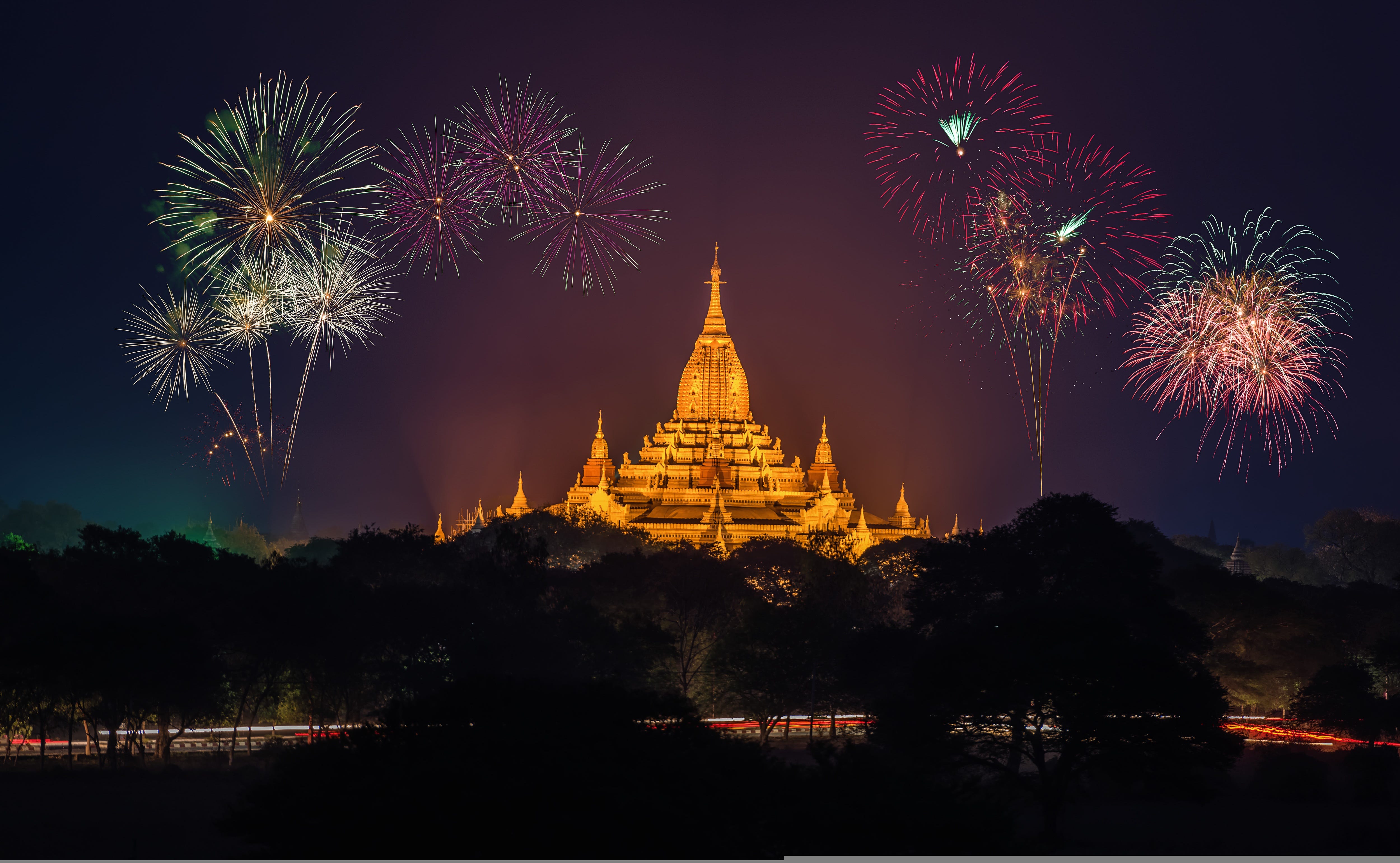
Pictured: Buddhist pagoda illuminated with fireworks, Myanmar (2016)
Key Terms for this Section
The Buddha · The Four Sights · The Three Fires · The Four Noble Truths
Theravada & Mahayana · Emperor Ashoka · The Three Jewels · Mindfulness
5.1 | The Prince & the Palace
A Tradition Born from Hindu Philosophy
In our survey of the Hindu yogas and margas, we marked the road of wisdom— the Jnana Marga — and noted that a new tradition would one day grow out of that soil. In this section, we meet the one who came from that tradition and started a worldwide movement.
• 600s BCE | The Ascetic Age
As the Upanishads emerge, attention turns to Maya, Samsara, and Moksha
• 500s BCE | The Age of the Buddha
As the Upanishads emerge, attention turns to Maya, Samsara, and Moksha
• 200s BCE | Buddhist India
Emperor Ashoka commands the Buddhist dharma to be proselytized across the world
• 100s CE | Buddhism enter East Asia
The Buddhist dharma is discussed with Confucianist and Daoist masters in China
Around 2,600 years ago, something shifted in India. With the writing of the Hindu Upanishads, India became restless with a philosophical preoccupation: samsara, the unending cycle of birth, death, and rebirth.
If existence itself was a wheel, then the goal of a life could no longer be to merely perform one’s dharma correctly, one had to be escape. Liberation became the age’s obsession. People wanted not only release from samsara, but from every prison that Maya holds inside it. The Upanishads had already pressed the deepest questions onto the tradition — the nature of reality, the self (atman), and its relation to God (Brahman). Now teachers took those concepts into new moral frontiers. Gurus wandered the roads promising an end to every kind of confinement — an end to ignorance, an end to poverty, an end even to the caste system itself.
History calls these seekers the shramanas, the “strivers.”
Strivers in the Axial Age
These folks were the renouncers who left household life to test the limits of their liberation. Their growing world made such testing possible. By the 500s BCE Northern India was urbanizing with new cities, new trade routes, and ambitious kings. The old village order that Vedic ritual served was loosening its grip, and into that opening walked rival teachers with rival methods: fasting, trance, radical nonviolence, philosophical debate. This is known as the Axial Age, wherein Confucius and the Daoist masters were teaching in China, the prophets of Israel were writing Jewish scripture, and the first philosophers were arguing in Greece.
In the last section, we learned that the Jnana Marga had taught that liberation is won by knowing — renounce comfort, find a teacher, turn the mind inward until illusion gives way. The seekers of the Ascetic Age were that path’s children. The Seekers kept the tools of the jnanis: the forest retreat, the guru, the long discipline of meditation. But they pressed its central question harder than their parents had. The Upanishads had answered that beneath the shifting self lies the atman — permanent, untouched, one with Brahman. To know yourself truly is to find God. Out of this same line of inquiry, the Buddhists will draw the opposite conclusion: look inward long enough, he will teach, and you find no permanent self at all — only change, all the way down. And once the eternal atman goes, the older scaffolding goes with it: the authority of the Vedas, the mediation of priests, the claim of caste on identity.
Buddhism does not begin as a rejection of India’s questions. It begins as a new answer to them.
Optional Video: Religious Scholar explains Buddhism (auto-generated CC).
The Awakening
The following account is carried from the tradition’s own theologically-shaped story.
Siddhartha Gautama was a prince whose birthdate remains uncertain. The scholarly consensus agrees he lived, taught, and established a monastic community in India in the 500s BCE. His story begins with The Four Sights — a narrative that is as well-known in the East as the nativity of Jesus is in the West. Raised in a lavish palace by a father who ruled the Shakya clan (in present-day Nepal), Siddhartha experienced only comfort and opulence. Wine, women, and song were his for the asking. Yet he found himself longing for more than material indulgence, so, when he was about 29 years old, he ventured beyond the palace walls.
During his excursions, Siddhartha encounters The Four Sights: an elderly man, a sick man, and a corpse, each shattering his youthful assumptions about living forever without suffering or pain. Young Siddhartha realizes that aging, illness, and death affect everyone — even princes. The fourth sight was a Hindu ascetic — a Jnana yogi — who lived simply in pursuit of enlightenment. Confronted with such stark contrasts, Siddhartha saw that wealth and comfort could never end his craving.
Rejecting palace life, Siddhartha becomes a seeker. He embraces austerity in the hope of discovering a solution to life’s struggles. For six years, he adopted an extreme bodily discipline: meditating intensely and subsisting on minimal food. Until one day, while listening to the twang of a stringed instrument carried on the breeze, he was hit with a sudden realization.
If the strings are too tight, they’ll snap. If the strings are too loose, they won’t play.
Taking this as a metaphor for spiritual practice, Siddhartha abandons the extremes of Jnani asceticism. Although his companions initially rebuke him (more on them later), he remained steadfast in his insight that liberation comes through a Middle Way between indulgence and self-mortification.
Undeterred, Siddhartha sits beneath a tree (the Bodhi Tree) and vows not to rise until he attains enlightenment. Beset by three enchanting women (cf. the Three Fires) and confronted by a Great Demon, he emerges victorious. In that moment, Siddhartha awakens and becomes The Buddha (the “Awakened One”). Siddhartha had achieved nirvana — liberation from the prison (palace?) of desire, hatred, and ignorance. After 49 days of contemplation, he resolves to share his teaching with others. His former companions become the first sangha, which soon grew and spread his message beyond the forests of northern India and, eventually, across the world.
That is the origin story of Buddhism, in a form a child can remember.
Look closely and you can see the teaching folded inside the tale. The first three sights — age, sickness, death — are a compressed argument about impermanence: no wall is high enough, and no pleasure durable enough, to keep them out. The Fourth Sight answers the first three: a person who has stopped running. Even the lute string carries doctrine — the Middle Way is not a compromise between two good things, but a rejection of two ways to waste a life.
Key Terms for this Lesson: The Buddha · The Four Sights
5.2 | The Four Noble Truths
The Buddha as Physician
The awakened prince eventually found the five companions who had walked out on him. What he offered them was not a set of avatars to worship or doctrines to affirm. It was a way of seeing — an account of what is wrong with human life and what can be done about it. To grasp his point, it helps to borrow a frame the modern tradition often uses.
Imagine you are ill.
You finally agree to go to the doctor because you’re ready to acknowledge that you are suffering (Pali: dukkha)
The doctor diagnoses the origin (Pali: samudaya) of your suffering.
The doctor then gives you a prognosis: your suffering can end (Pali: nirodha).
Finally, you are given a prescription for treatment to remove your suffering, consisting of eight practices and lifestyle changes.
Beneath the “diagnosis” sits three observations that the Buddhist tradition calls the marks of existence. The first is that everything assembled comes apart — bodies, empires, and stars. The physicist will tell you that everything answers to entropy and is slowly falling apart. The Buddhist will tell you this universal entropy includes the self, our moods, our ideas, and our consciousness. Impermanence (Pali anicca) is the first mark of existence. The second is that whatever is impermanent cannot fully satisfy us — the tighter your grip, the more it chafes you. That chafing, that irritating, frustrating itch that can never be scratched away is dukkha, the first Noble Truth.
The third is that even the observer — the collection you call “the self” — is not exempt from the first two marks of existence. This stands in contrast to the self (the “atman”) that the Upanishads promised their Hindu readers. In Buddhist thought, finally, there is ‘no true self’ (Pali: anatta). The Buddha instead argued that the collection I call “me” is a brief, temporary arrangement of assembled parts — thoughts and flesh that is constantly changing, growing, dying — and will one day return to nonexistence.
Ok, what are the higher metaphysical truths beyond this? I must know!
So a monk named Malunkyaputta once pressed the Buddha on the great metaphysical riddles. Is the universe eternal? What becomes of an awakened one after death? He threatened to leave the sangha unless he got answers! The Buddha replied with a parable. Imagine a man struck by a poisoned arrow who refuses treatment until he learns who shot it, from what clan, with what kind of bow, and with feathers from which bird. He would die, the Buddha said, with his questions still unanswered. The point was not that the riddles are unworthy. It was that they do not stop the bleeding. On questions that do not bear on liberation, the Buddha kept a famous silence. Instead, the Buddha kept a laser focus on one universal problem: suffering, and its end.
Extinguishing the Three Fires
During his vigil under the Bodhi Tree, three fires appeared allegorically to the Buddha.
These ‘fires’ appeared as enchanting women (cf. his former life at the palace), meant to entice Siddhartha off the path of Enlightenment. Buddhism recounts these as The Three Fires who stand in for greed, ignorance, and hate, as these are three forces that entice the novice away from the path.
Greed fosters a craving for possessions and pleasures, binding people to a repetitive cycle of dissatisfaction. Ignorance is the willful refusal to see reality as it is, keeping the mind trapped in illusions about the self and the world. Hate manifests in hostility and anger toward discomfort or those who provoke it, fueling harm and destruction.
For the Buddha, the spiritual goal was to extinguish these Three Fires from one’s life. The Pali word for extinguish is nirvana. In this way, nirvana is the result of extinguishing greed (wanting too much), hate (wanting too little), and ignorance (mindful growth) from one’s life. The Buddhist tradition acknowledges this as the path to liberation.
Optional video: on Buddhism’s Four Noble Truths
The Four Noble Truths
Working backwards, as one who had achieved nirvana, the Buddha distilled his core understanding of suffering into The Four Noble Truths of liberation.
Dukkha (Pali: suffering). Life contains suffering. Contrary to popular claims, Dukkha does not mean “life is suffering.” The Buddha observed that life contains joy and pleasure and many other experiences. But recognizing suffering’s presence, whether from illness, heartbreak, or any limitation, is an essential catalyst for compassion and transformation.
Samudaya (Pali: cause). The origin of suffering is our desire and attachments. The relentless craving for fleeting ephemera (eg. possessions, relationships, achievements) creates ongoing discontent. This teaching highlights how clinging to impermanent things prevents lasting peace. By recognizing the futility of chasing what cannot endure, one begins loosening the chains of dissatisfaction.
Nirodha (Pali: cessation). The end of suffering is possible by relinquishing our pathetic grasping and self-centered cravings. When people move beyond greed, hate, and ignorance, they can approach nirvana — a liberation from the internal fires that bind them. Nirodha reveals that life does not have to be an endless cycle of frustration and loss; with insight, freedom can be attained.
The Buddha’s route to the cessation of suffering is the Eightfold Path.
The Eight-fold path includes Right View, Right Intention, Right Speech, Right Action, Right Livelihood, Right Effort, Right Mindfulness, and Right Concentration. Each element develops moral integrity, mental discipline, and clarity of understanding. People who pursue this path aim to curb harmful impulses, cultivate compassion, and transform their relationships with the world around them.
Key Terms for this Lesson: The Three Fires · The Four Noble Truths
5.3 | The Dharma Across Asia
Theravada Buddhism (Elders) | Most Conservative
The dharma (teachings) begin in one river valley and end up on three-quarters of a continent. Southeast, into Sri Lanka and Southeast Asia (300s BCE), went the older, monastic form. East along the Silk Road, into China (100s) and onward to Korea (372) and Japan (538), went a more expansive form. And north, over the Himalayas into Tibet (600s), went a third.
The teaching’s first great patron was an emperor with blood on his hands. Emperor Ashoka conquered most of India. Yet, after the carnage, he turned away from violence and made the Buddha’s dharma the guiding principle of his empire. He had edicts carved on pillars and rock faces across his realm, urging nonviolence, compassion, and social harmony — public sermons in stone. Convinced the teaching could heal the world, Ashoka dispatched emissaries across the world. For its first five centuries the dharma was not written at all. Like the Diné traditions we studied in Section 3, early Buddhism was a living oral tradition. Monks and nuns memorized the Buddha’s discourses and preserved them by group recitation, until Ashoka’s era brought the first written compilations. Those texts eventually sorted themselves along the three great “vehicles” the tradition still travels.
Optional Video: History of Buddha & Emperor Ashoka (auto-generated CC).
Theravada Buddhism, often called the “Teaching of the Elders,” traces its lineage back to the earliest transmissions of the Buddha’s teaching. Predominant in Sri Lanka, Thailand, Burma, Cambodia, and Laos, Theravada upholds itself as the unaltered guardian of the original Buddhist doctrine. About 40% of Buddhists worldwide follow Theravada, which emphasizes maintaining rigorous monastic discipline as the surest path to nirvana. Monks dedicate themselves to meditation, the study of the Pali Canon, and adherence to strict ethical precepts. Historically, only men could be ordained, reflecting a traditional view that women must accumulate merit over multiple lives before achieving full liberation.
Daily life in Theravadan societies often revolves around monastic communities. Lay supporters offer food, clothing, and funds to sustain the sangha. These gifts generate spiritual merit that, according to Theravada teaching, can improve a person’s circumstances in future lifetimes. Although laypeople might not expect to reach nirvana in this life, their service nurtures wholesome qualities like generosity, strengthening bonds within the community. Monks reciprocate by providing moral guidance, performing blessings, and preserving the original Buddhist teachings recorded in the Pali Canon. For Theravada followers, devout observance of the canon and the preservation of monastic ideals ensure that the Buddha’s words remain intact, even as Buddhism spreads across diverse cultures.
The blessed One who awoke himself is worthy, accomplished in both knowledge and conduct. The Pali Canon
Just as the rock is not shaken by the storm, so the wise are not affected by praise or blame. The Dhammapada
Mahayana Buddhism (Greater Wheel) | Most Popular
Practiced in eastern regions like China, Korea, Japan, and Vietnam, Mahayana Buddhism accounts for the majority of Buddhists worldwide.
Its hallmark is an inclusive belief that all people can attain enlightenment, not just those in monastic life. Mahayana stresses compassion as integral to wisdom and highlights the role of Bodhisattvas — enlightened beings who choose to remain in samsara to help others achieve liberation. This belief in universal salvation sets Mahayana apart from the more austere outlook of Theravada.
A broad range of texts referred to as “sutras” informs Mahayana thought. Some well-known examples include the Lotus Sutra and the Heart Sutra, which reinterpret core doctrines, insisting that the Buddha’s nature can manifest in countless forms. Many communities focus on a local Bodhisattva, like Amitabha of Pure Land Buddhism. Practitioners recite Amitabha’s name and focus on rebirth in the Pure Land — a realm to the West, free from life’s negative influences — where one can advance toward perfect enlightenment. In places like China and Japan, artistic and architectural projects reflecting Pure Land devotion have flourished for centuries.
The Dharma spoken by the Buddha is like a great cloud, whose rain touches all people, each one bearing fruit. The Lotus Sutra
Form is emptiness, emptiness is form. The Heart Sutra
Another influential branch of Mahayana is Zen Buddhism (Chan in China, Seon in Korea). Zen underscores direct insight into the nature of the mind, often through silent meditation called zazen. Practitioners engage with koans (ie. paradoxical riddles) like “What is the sound of one hand clapping?” to break habitual patterns of thought. Zen teachings emphasize living fully in the present and seeing beyond conceptual labels, a style evident in the spare aesthetics of Japanese rock gardens and traditional tea ceremonies. Over the generations, Mahayana Buddhism’s adaptability and wide-ranging practices have enabled it to resonate with people from different cultural and social backgrounds, fostering communities that balance devotion, study, and everyday mindfulness.
All things are like a dream: a phantom, a drop of dew, a flash of lightning. Meditate on them like this. The Diamond Sutra
Vajrayana Buddhism (Diamond) | The Tibetan Tradition
Vajrayana Buddhism (ie. Tibetan Buddhism) comprises about 5% of the global Buddhist population. Despite these smaller numbers, it attracts significant worldwide interest. The 14th Dalai Lama, the exiled spiritual leader of Tibet, has become a notable figure in discussions of global ethics and interfaith dialogue. This tradition shares Mahayana’s core emphasis on compassion and the Bodhisattva ideal but incorporates additional practices derived from tantric rituals, mantras, and symbolic visualization. Vajrayana is called the “Diamond Vehicle” to suggest its transformative power — like a diamond, it is said to cut through illusions swiftly.
In Tibet and Himalayan regions like Bhutan and parts of Nepal, Tibetan Buddhism has shaped local culture for centuries. Monastic institutions serve as both centers of learning and community support, teaching advanced forms of meditation and philosophy that blend textual scholarship with esoteric ceremonies. Teachers called lamas guide students through initiation rites and empowerments, introducing them to mandalas, spiritual visualizations, and mantra recitation. These methods aim to harness human energies and direct them toward enlightenment, accelerating spiritual progress when used responsibly.
Tibetan Buddhism also displays a distinctive system of lineage transmission, exemplified by reincarnated lamas (tulkus). This tradition hinges on the recognition of spiritually advanced people who choose to be reborn to continue serving their communities. Within Tibetan culture, the Dalai Lama, Panchen Lama, and others are seen as upholding and renewing these lineages. Political realities, particularly in the context of Communist China, have complicated the preservation of Tibetan Buddhism. Yet Vajrayana remains a living force in the Himalayan world, enriched by centuries of devotion and folk tradition. Even beyond its native homeland, Tibetan Buddhism is cherished for its vibrant iconography, profound contemplative techniques, and message of compassion for all beings.
Optional Video: Religious Scholar explains Tibetan Buddhism (auto-generated CC).
Key Terms for this Lesson: Theravada & Mahayana · Emperor Ashoka
5.4 | Modern Buddhist Practice
The Three Jewels
Tradition holds that the Buddha, moved by how hard life would be for those he left behind, gave his followers three things he had never had himself. These are the Three Jewels: the life of the Buddha to contemplate (cf. Sec. 5.1), the Dharma (his teaching), and the Sangha (the worldwide community of Buddhists). To become a Buddhist, a person says with conviction: “I take refuge in the Buddha, the Dharma, and the Sangha.” The rest of Sec. 5.4 is what those three jewels look like when they are lived.
The Dharma shapes how communities pursue ethics, mental discipline, and wisdom. The Buddha encouraged people to investigate his ideas rather than accept them uncritically, and that investigative spirit still runs through the tradition. Its ethical ground are the Five Precepts: to refrain from killing, stealing, lying, sexual misconduct, and intoxication. Its method is meditation, practiced differently in each vehicle. Theravada attends to the breath, Zen sits in silent zazen, and the Tibetans work with visualization and mantra. Each of these aim toward the same end: steadying the mind so that impermanent thoughts and feelings can be watched without being obeyed. And its horizon is wisdom: the slow recognition that clinging to a permanent self, in a world where nothing is permanent, is the very engine of suffering.
The third jewel is the one you see out in the world.
In Thailand, Sri Lanka, and Burma, sanghas anchor daily life: monks give counsel and lead chanting, while laypeople offer meals, robes, and support — a reciprocity in which each side deepens the other’s practice. Buddha’s Birthday celebrates his birth, awakening, and death at a single festival. Full-moon and new-moon days renew vows and precepts. And the Robe Offering binds monastics and laity in mutual generosity.
Optional Video: Scholar of Religion explains Buddhist meditation (auto-generated CC).
Buddhism & the Modern State
In more modern times, Buddhism has come up against threats from Communist leaders. When the Communist government came to power in China in 1949, it took control of Tibet and moved to bring Tibetan Buddhism under state authority. In 1959 the 14th Dalai Lama, Tenzin Gyatso, left Tibet for India, where a Tibetan government-in-exile has resided since. In 1995 he identified a young boy as the Panchen Lama, the tradition’s second-ranking figure; Chinese authorities detained the child, and the question of the lineage’s continuity remains unresolved. Vietnam saw its own collision. In 1963 the government of Ngo Dinh Diem placed restrictions on Buddhist observance in the south; that June, a monk named Thich Quang Duc set himself on fire at a Saigon intersection, and photographs of the act circulated worldwide. The Diem government fell to a military coup months later.
The same century that shows Buddhism suffering under states also shows it wielded by them. In Myanmar in the 2010s, nationalist movements led in part by Buddhist monks fueled violence against the Muslim Rohingya minority; a military campaign beginning in 2017 drove more than 700,000 Rohingya across the border into Bangladesh, where over a million now live in refugee camps. In Sri Lanka, currents of Sinhalese Buddhist nationalism have likewise set the majority tradition against religious minorities. The point is not to single Buddhism out, but to hold it to the same standard as every tradition in this series: a tradition large enough to be persecuted is also large enough to persecute, and both belong on the record.
Optional Video: Scholar of Religion explains Sino-Tibetan Relations (auto-generated CC).
Buddhism in America
Buddhism has come to America in waves. It first came with immigrants: Chinese and Japanese laborers building American railroads and working the fields of the Old West. Then came the Vietnamese, Thai, and Cambodian communities after the 1965 reform of immigration law. American Buddhism had a kind of revival through converts and readers of Japanese Zen Buddhism (eg. D.T. Suzuki’s books made Zen a household word in the 1950s). American convert Alan Watts carried it further, and the 14th Dalai Lama became one of the most recognized moral voices on Earth. Buddhist thought had another surge in the 1980s.
A scientist named Jon Kabat-Zinn founded a stress-reduction program at the University of Massachusetts Medical School, adapting Buddhist meditation into a secular, 8-week course he called Mindfulness-Based Stress Reduction. Mindfulness — with much of the ‘religious’ lingo lifted out of it — has since become a fixture of American mental health, corporate wellness, and popular phone apps. Today roughly 4.4 million Americans (about 1.3% of the country) identify as Buddhist, and countless more borrow the practices without the label. Western audiences have embraced the tradition while making it their own — which, in fact, has been happening since the dharma first left India two thousand years ago.
Key Terms for this Lesson: The Three Jewels · Mindfulness
Recommended Sources
Tenzin Gyatso (the 14th Dalai Lama), Freedom in Exile
Shunryu Suzuki, Zen Mind, Beginner’s Mind
Thích Nhất Hạnh, Vietnam: Lotus in a Sea of Fire
Jan Willis, Dreaming of Me: An African American Woman’s Spiritual Journey
Walpola Rahula, What the Buddha Taught
Last Section: Hinduism & Sikhism
This Section: Buddhism
Next Section: Chinese Religion