

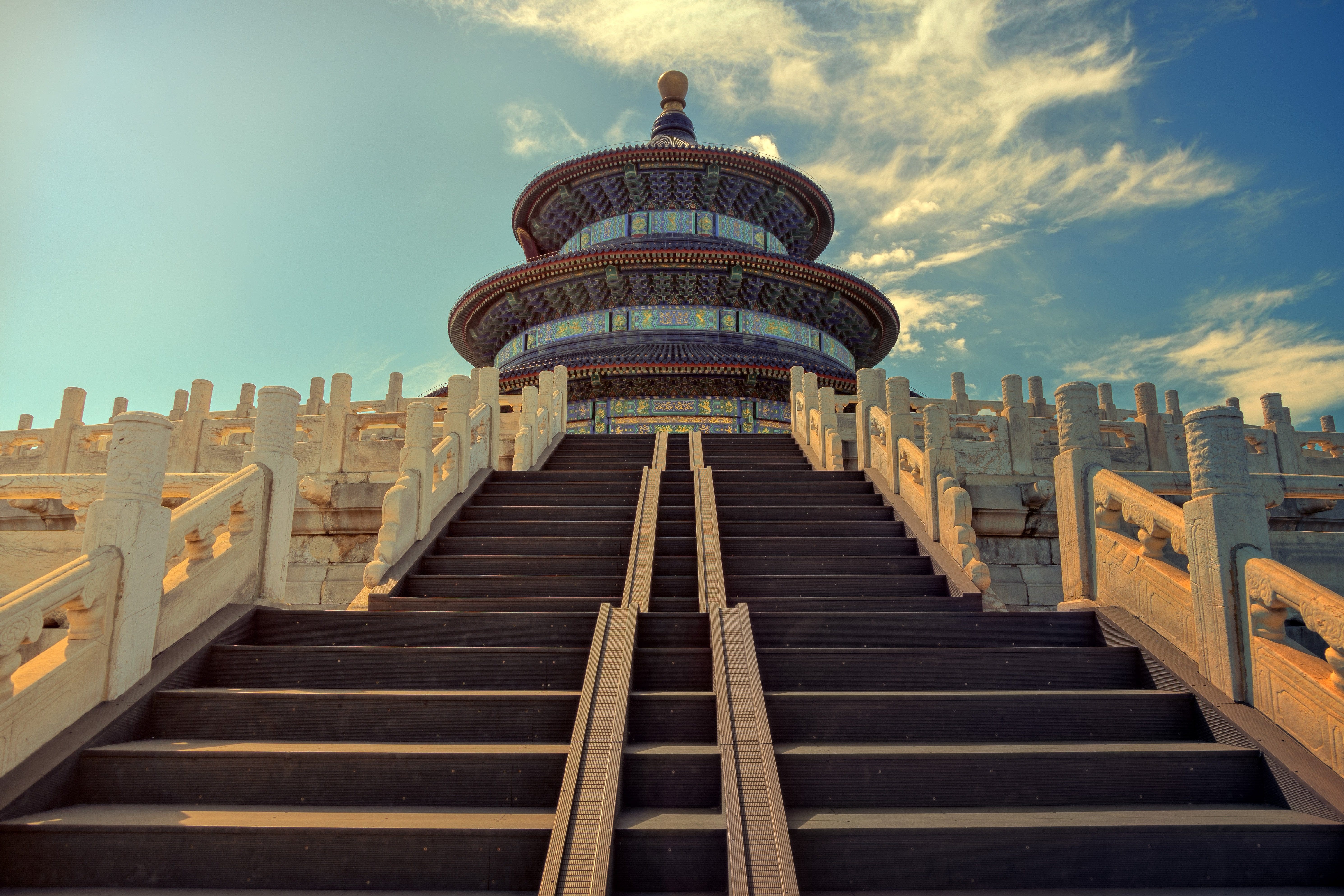
Pictured: Temple of Heaven, Beijing (2018)
Key Terms for this Section
The Dao · Wuwei · The Five Relationships · Ren & Li
The Mandate of Heaven · Neo-Confucianism · Qi · New Confucianism
6.1 | The Dao & Wuwei
China's Legendary Beginning
Last week the Buddhist dharma reached China.
However, it did not enter in an empty room.
Buddhism fell into conversation with two teachers already at work in the Chinese imagination, and from that meeting came what the Chinese call the Three Mountains of Wisdom: the Buddha alongside Laozi and Confucius. This week we visit the other two mountains.
A note on spelling: this course renders Chinese in pinyin — so you will read Dao not Tao, Laozi not Lao Tzu, Qi not Ch’i.
• 1046 BCE | The Zhou Dynasty. King Wu founds China’s earliest historically verified dynasty; the Yi Jing (Book of Changes) takes shape
• 500s BCE | The Axial Age. (late Zhou) Confucius teaches the restoration of social harmony; the Daodejing is compiled
• 206 BCE | The Han Dynasty. Emperor Wu adopts Confucianism; the Five Classics of Confucian thought are canonized in 136 BCE
• 100s CE | Buddhism Arrives. The dharma reaches China along the trade routes, carrying its promise of nirvana
• 960 | The Song Dynasty. Neo-Confucianism revitalizes Confucian teaching by absorbing Daoist and Buddhist ideas
• 1313 | The Four Books replace the Five Classics as Confucianism’s core curriculum
What follows is China’s own sacred narrative of its origins. The legendary history the culture tells about itself, not a chronicle of dated events.
In the Chinese account of the beginning, everything starts in a primordial chaos. From that formless state emerges Pangu, who separates the universe into the receptive and active forces known as yin and yang. As his body grows and disintegrates, it becomes the world: his breath the wind, his eyes the sun and moon, his limbs the mountains. Heaven and earth remain out of harmony, so Nüwa, a half-serpent being, mends the sky with five-colored stones, and alongside her husband Fuxi she fashions the first people from clay. Fuxi reigns as the first sovereign, credited with a gift that echoes through the whole of Chinese culture: the Eight Trigrams, stacked sets of broken (yin) and solid (yang) lines that became the basis of the ancient Yi Jing (the Book of Changes). A later sage-figure, Shennong, is said to have given humanity agriculture and the first herbal medicines (a thread we pick up in Lesson 6.4). These narratives are not verifiable history; they are the culture’s way of saying that heaven and earth, male and female, chaos and order are held in a single balance — the balance the tradition will come to call the Dao. It was in the middle years of the Zhou, around the 5th century BCE, that the eighty-one chapters of the Daodejing were compiled into the form we have today.
Embracing the Mystery
The Daodejing, the foundational text of Daoist thought, begins:
道可道 非常道
“Dao k’e dao fei ch’ang dao”
So what does this text mean? The Daodejing is an esoteric text, which is to say it does not lend itself to a clear and obvious reading. Sure, we can take each of these ideograms and, one by one, transliterate them. I can gesture toward 道 and call it “Dao,” but that’s just the phonetic sounds associated with this ideogram. None of these ideograms have a straightforward translation into English. The best we can do is to offer a variety of ways to understand each ideogram and then place those meanings together. For instance, 道 (Dao) can imply “way,” “path,” or even the Platonic concept of “logos.” While 可 (k’e) can mean “can,” “enable,” or “permit,” and 非 (fei) commonly negates something, like “not” or “opposed.” The Chinese 常 (ch’ang) can signify “constant,” “eternal,” or “absolute.”
Scholars have rendered this opening verse in different ways:
A way that can be walked is not The Way.
Words and names are not the Way.
The Dao that can be told is not the eternal Dao.
My own translation is:
道可道 非常道 “The way that can be explained is not the Eternal Way.”
Dao Jing, Ch. 1, verse 1
While simple translation eludes us, it’s fair to point out that that’s part of the point. The Dao defies clear explanation. Rather than offering a rigid set of doctrines, the Daodejing encourages its readers to dwell in wonder, approaching wisdom as an experience. The Dao isn’t something you label and pick apart. It’s something you feel. So let’s embrace the mystery and find out what we can say about it as scholars.
The Daodejing is traditionally attributed to the ancient sage Laozi (Ch. the “Old Master”), though its dating is uncertain; it was probably compiled in the 500s BCE by multiple sages. It comes in two parts: the Dao Jing (the Book of the Way, chapters 1–37) and the De Jing (the Book of Power, chapters 38–81). It is, incredibly, the second-most-translated book of all time, behind only the Bible. One block of verse may serve us as an example of the tradition’s attempt to point at what it insists cannot be pointed at:
Look for it, and you cannot see it. It’s beyond form and color. Listen for it, and you cannot hear it. It’s beyond sound. Reach for it, and you cannot grasp it. It’s beyond shape. Above, it isn’t bright; below, it isn’t dark. Unbroken continuity, unnamed and unceasing. It returns to nothingness, the shape of no-thing. Dao Jing, Ch. 14
For my money, the closest popular analog to the Dao today may be the Force of the Star Wars films. The Force is “an energy field created by all living things” that “surrounds us, penetrates us, and binds the galaxy together.” A fictive Jedi knight whose “ally is the Force” is, in effect, living in harmony with the Dao. There are other analogues as well. In India, the Dao has similarities with Brahman insofar as it is the ultimate reality beneath everyday appearances. In Greece the Dao can be compared favorably with the logos, the ordering, reasoning principle of world. In Jewish mysticism the Dao shows parallels with the Ayn Sof, the infinite, unknowable aspects of the Divine.
What sets the Dao apart is that it is a process, not a product. You can name a bowl of soup — “Hey, that’s clam chowder!” — while love is something you feel and can never quite pin down. The Dao is like love (a process), and unlike soup (a thing): constantly shaping reality, different at each encounter, glimpsed in nature the way you recognize the light in a friend’s eyes without being able to describe exactly what they feel. Such is the Dao.
Yin, Yang, & Wuwei
The two forces whose interplay is the Dao’s movement are yin and yang.
Yin is the receptive aspect: night, softness, stillness, the earth; in the Yi Jing it is the broken line.
Yang is the active aspect: day, hardness, motion, the sky; the solid line.
They are interconnected, mutually necessary, and never found without each other. Critically, just so there’s no misunderstanding, yin and yang are NOT good and evil. Both are essential and necessary. In Daoism, evil arises from an imbalance of yin or yang; good is when the two move in accordance with the Dao. The famous yin/yang symbol is a picture of balance, each half already carrying a seed of the other.
Closely tied to the Dao is De (once spelled “Te”), usually translated “virtue.” Joined together, “Daode” (道德) is the Chinese word for ethics. But De is not a checklist of rules. Rather, De is the quiet power that arises naturally in a person aligned with the Dao.
Proper, moral engagement with the Dao occurs when folks minimize overthinking and allow circumstances to unfold without forcing an outcome. A popular, though apocryphal anecdote illustrates this principle.
During the Space Race, American engineers realized that normal pens would not work in zero gravity because ink relies on downward flow. According to the story, NASA spent large sums of money and countless hours inventing a pressurized “space pen.” The Soviet cosmonauts, facing the same problem, simply brought pencils.
Real or contrived, the story makes a compelling point. Working organically, without a lot of unnecessary contrivances, often yields simpler, more elegant results than forcing a more complicated solution.
In Daoist teaching, this approach is called Wuwei. Literally “non-action,” Wuwei is not laziness or passivity. Rather, it describes action so closely aligned with the flow of life that it feels effortless. Daoist texts explain that by restraining our impulse to control every detail, we leave room for situations to develop organically. Just as the pencil in the old anecdote functioned without elaborate contraptions, Wuwei suggests that much of our best thinking and doing emerges when we step back and trust the larger currents at play.
At the heart of Wuwei is the cultivation of spontaneity. Rather than plotting out every step, Daoists encourage a quiet openness that allows one to see opportunities as they arise. The Daodejing explains that the Dao has no fixed plan — it can strike like lightning or roll in like soft fog. Attempting to harness it through detailed schemes is a fool’s errand. Athletes describe a similar state of being “in the zone,” where their actions feel fluid and unforced, and time seems to blur. Whether shooting a basketball or composing a poem, one experiences a sense of flow that emerges when over-analysis drops away.
Key Terms for this Lesson: The Dao · Wuwei
6.2 | Confucius: Bond & Virtue
The Rectification of the Names
Confucius lived in the turbulent centuries of the late Zhou, when the dynasty’s old order was fraying and rival states continually challenged one another across China. Into that disorder Confucius brought a single, steadying aim: to restore social harmony. Where the Daoist looked past our society to the rhythms of nature, Confucius focused straight at our society and asked why it had come apart.
His answer was that we had forgotten who we are to one another.
Confucius was born near Qufu in the small state of Lu, held minor offices, and taught any student willing to learn. Tradition says his fee could be as little as a bundle of dried meat. For years he wandered from court to court, seeking a ruler who would govern by his way. Spoiler: none did. In the end, Confucius died believing he had failed. But his students gathered his sayings into the Analects, and within a few centuries China gave him the title Kong Fuzi, “Master Kong,” Latinized by later translators as Confucius.
He remains the most influential teacher in 5000 years of Chinese history.
He was not alone in asking how to mend the age. The late Zhou became an era of wandering teachers, remembered as the Hundred Schools of Thought, when rival courts collected advisers the way they collected territory. The Legalists answered with law and punishment: make the penalties harsh enough, and order will follow. The Mohists answered with impartial care for everyone alike. The Daoists, (cf. Sec. 6.1) answered by stepping back from politics altogether. Confucius’s answer began somewhere more intimate: with the names we have for one another.
Confucius taught that we live in disharmony because we’ve forgotten our roles, or “names.” In what he called the Rectification of the Names, he argued that society holds together only when each person understands and honors the particular bonds they stand within. Get the names right — parent, child, ruler, subject, friend — and harmony follows. Confuse them, and the whole structure falls apart. From this insight he drew five essential relationships.
The Five Relationships
The Five Relationships are, for Confucius, the path back to a stable society. Each is a bond of reciprocal duty. Each side owes the other something, and each is distinct and cannot be confused with another.
Ruler | Subject
The ruler must protect and provide for all subjects equally, ensuring their well-being and security; in return, subjects serve with loyalty and contribute to society. A virtuous leader safeguards the interests of all citizens, while citizens follow the laws and add to the common good. (This bond will matter again in Sec. 6.3, where it grows into a whole political cosmology.)
Parent | Child
The foundational bond of society. Parents are entrusted to nurture, guide, and educate their children through both discipline and unconditional love. Children are supposed to respond with respect, obedience, and gratitude.
Spouse | Spouse
A bond of mutual love, respect, and support, in which each partner is tasked with provision, protection, and devotion, cherishing and honoring the other, forsaking all others.
Elder Sibling | Younger Sibling
A relationship of guidance and protection, the elder offering wisdom and the younger offering respect. But, unlike parents, elder siblings do not hold disciplinary authority. The bond is like a babysitter’s: care and protection, without the parent’s role.
Friend | Friend
A bond of equality and mutual understanding — companions on life’s journey who support and rely on one another, offering emotional support without the formal obligations of family or marriage.
The Five Virtues & a Confucian Life
If the Five Relationships are the structure,
the Five Virtues are the character that fills them.
Ren (仁), often translated empathy or benevolence, lies at the core of Confucian ethics. It is the internal feeling of love and compassion toward others, especially those in need. In his Analects, Confucius held that those who lose this sense of empathy have essentially lost their humanity. Ren is the inner virtue.
Li (礼), or propriety, is its outward expression. Li is found in proper social conduct, from great rites and ceremonies down to everyday courtesy. Confucianism prizes these social forms, even at the expense of personal gain, as the means of maintaining harmony and showing respect for others. If Ren is the feeling within, Li is the form it takes externally in the world. The two are a matched pair, inner virtue and outer form.
Xiao (孝), or filial piety, is the reverence a person owes their family, and above all their parents. Confucius stressed repaying our parents’ kindness with the utmost respect and care, and this reverence extends to grandparents and to one’s dead ancestors. One must never bring dishonor to one’s family. Xiao is the root from which the other bonds grow. The first virtue learned.
Two further virtues round out the set. Zhi (智), wisdom, is the capacity to discern right from wrong and so to act on the goodness one feels. And Yi (义), justice, is the art of balancing reciprocity with mercy, of letting go of personal vengeance and instead choosing the best outcome for the community as a whole.
The person these virtues build has a name. In the old aristocratic order, they were a junzi (literally a “lord’s son”). In Confucius’ teaching, a junzi is something you become: the common person made noble by their excellent character. Being a junzi is open to anyone who cultivates ren and li with enough patience.
A century after Confucius, the tradition’s second sage grounded those virtues in human nature itself.
Mencius (Mengzi, d. 289 BCE) argued that the virtues are not grafted onto us but grow from seeds native to the heart, and he offered a famous test: anyone who suddenly sees a child about to fall into a well feels alarm before any thought of reward, reputation, or blame. That flash of feeling, he taught, is the seed of ren, proof that goodness needs cultivating, not better bloodlines.
Confucianism’s ideals are lived and carried in the everyday rites of family life.
Chief among those ideals is ancestor veneration (jìng zǔ, 敬祖): families across China and the diaspora honor their forebears through offerings, incense, and memorial rites, a direct expression of Xiao that treats each generation as standing on the shoulders of those who came before. The same reverence shapes the milestones of a life. The hairpin ceremony (ji li) marked a girl’s coming of age, historically around fifteen, when a respected elder arranges her hair before the gathered family. The capping ceremony (guan li) marked a young man’s, around twenty, when an elder places a cap on his head to signal his readiness to serve family and society. While Modern China has largely moved past these rites, some families keep them as a living link to a deep Confucian heritage. In each, the message is the same one Confucianism returns to again and again: the family is the primary educator, shaping character from childhood and preparing the next generation to carry its obligations.
The reverence a child owes a parent, the loyalty a subject owes a ruler — Confucius claimed they scaled all the way up, from the household to the empire itself. In the next lesson we watch that scaling happen, as Daoist and Confucian ideas meet a third arriving teaching and together shape how China imagined power, heaven, and the right to rule.
Key Terms for this Lesson: The Five Relationships · Ren & Li
6.3 | Heaven, Earth, & the State
Dao & the Mandate of Heaven
Daoist thought has played a considerable role in shaping governance across China’s history, especially with their ideas involving cosmic order and legitimacy. Remember how we talked about the Dao guiding the balance of Heaven and Earth? Well, to understand how this relates to Chinese politics, it helps to keep in mind that “Heaven” (Ch. Tian) in ancient Chinese culture differs markedly from Biblical depictions. Rather than a distant divine realm, Heaven (Tian) in Chinese culture is woven together with Earth (Ch. Di) in a cosmic equilibrium. In ancient Chinese cosmology, Heaven and Earth reflect two halves of the natural world, each complementing the other within a grand, interlocking system. Early rulers looked to these cosmic forces for guidance, claiming that if the cosmos is in harmony, then society should aim for the same.
Tian in Chinese Culture
天地
Tiandi | Heaven & Earth
天命
Tianming | Mandate of Heaven
Accordingly, the Mandate of Heaven (Ch. 天命) emerged as a traditional Chinese political doctrine indicating the right for a leader to rule.
The Mandate suggests that a good leader governs with Heaven’s approval, which is proven by the prosperity and stability under that ruler’s domain. If unrest or calamities persist, it can be interpreted as a sign that the ruler has lost the mandate. From a Daoist perspective, a wise leader remains aligned with the Dao by promoting a fair distribution of resources, avoiding corruption, and responding thoughtfully to the needs of the people. If a leader strays from this path, natural and social disruptions may ensue, signaling a discord that legitimizes the rise of a new ruling house. Over centuries, many dynasties in China justified their ascension by claiming the previous rulers had abandoned virtue, thus forfeiting the Mandate of Heaven. Daoist wisdom further suggests that the sovereign must cultivate personal virtue to safeguard this cosmic approval, recognizing that any lapse could bring imbalance. In this worldview, moral conduct and political authority become inseparable, binding the ruler’s behavior to the cosmic framework of yin and yang.
While the Mandate of Heaven addresses how power is gained or lost, Daoism also shaped imperial expectations for governance itself. The Emperor was not merely a political figure but a caretaker of cosmic harmony, obligated to observe signs in the natural world (eg. eclipses, unusual weather, and famines) and interpret them as feedback on his rule. Maintaining the realm’s stability depended on ensuring balanced relations among social classes, economic activities, and even the environment. If a ruler acted cruelly or neglected the welfare of the people, the cosmic balance might tilt, inviting disasters that showed Heaven’s displeasure. From this perspective, government policy was was an extension of the Dao, meant to harmonize the realm’s operations with the broader pattern of nature.
Within this framework, administrators and advisers were tasked with offering counsel that upheld moral integrity. A minister who reminded the Emperor to act gently and justly did so not only for political reasons but also to honor the cosmic order. Meanwhile, taxation and military campaigns had to be justified by appealing to the broader principle of maintaining stability for the people. Ambition and greed risked disturbing the delicate scale of yin and yang, so Daoist advisers often called for restraint, frugality, and benevolence. By the same token, complacency and passive governance could cause stagnation and invite decay, so a ruler had to stay alert and decisive.
Confucian Thought & the State
If Daoism gave the throne its cosmology, Confucianism gave it a bureaucracy.
Under the Han dynasty (206 BCE–220 CE), Emperor Wu adopted Confucianism as the guiding philosophy of the imperial government, and Confucian ethics became the training of every official. In 136 BCE the Five Classics were canonized as the core of that learning, and among them sat the Yi Jing, living its remarkable double life: the same Book of Changes whose trigrams reach back to Fuxi in Daoist legend now stood as the first of the Confucian classics. Mastery of these texts became the path into government through civil-service examinations, a system that would shape Chinese life for 2,000 years.
Then, in the 100s CE, a third current reached China along the trade routes: Buddhism, carrying its promise of nirvana. For a time, Confucianism took a backseat as Chinese Buddhism flourished. Then, under the Tang dynasty (618–907), Confucian learning revived and the examinations were restored. Judaism, Christianity, and Islam also arrived along the ancient Silk Road, establishing small communities in a multi-ethnic and pluralist society.
That habit, of holding several views at once is captured in the famous story of the vinegar tasters. Three masters taste from a single vat of vinegar. The Confucian frowns: it is sour, as life is sour, in need of correction and order. The Buddhist grimaces: it is bitter, as existence is bitter with suffering to escape. But Laozi smiles. To the Daoist the vinegar is neither good nor bad; it is simply what it is, and the sage’s task is to taste it as it comes and live in harmony with its nature. One vat, three tastes, three teachings.
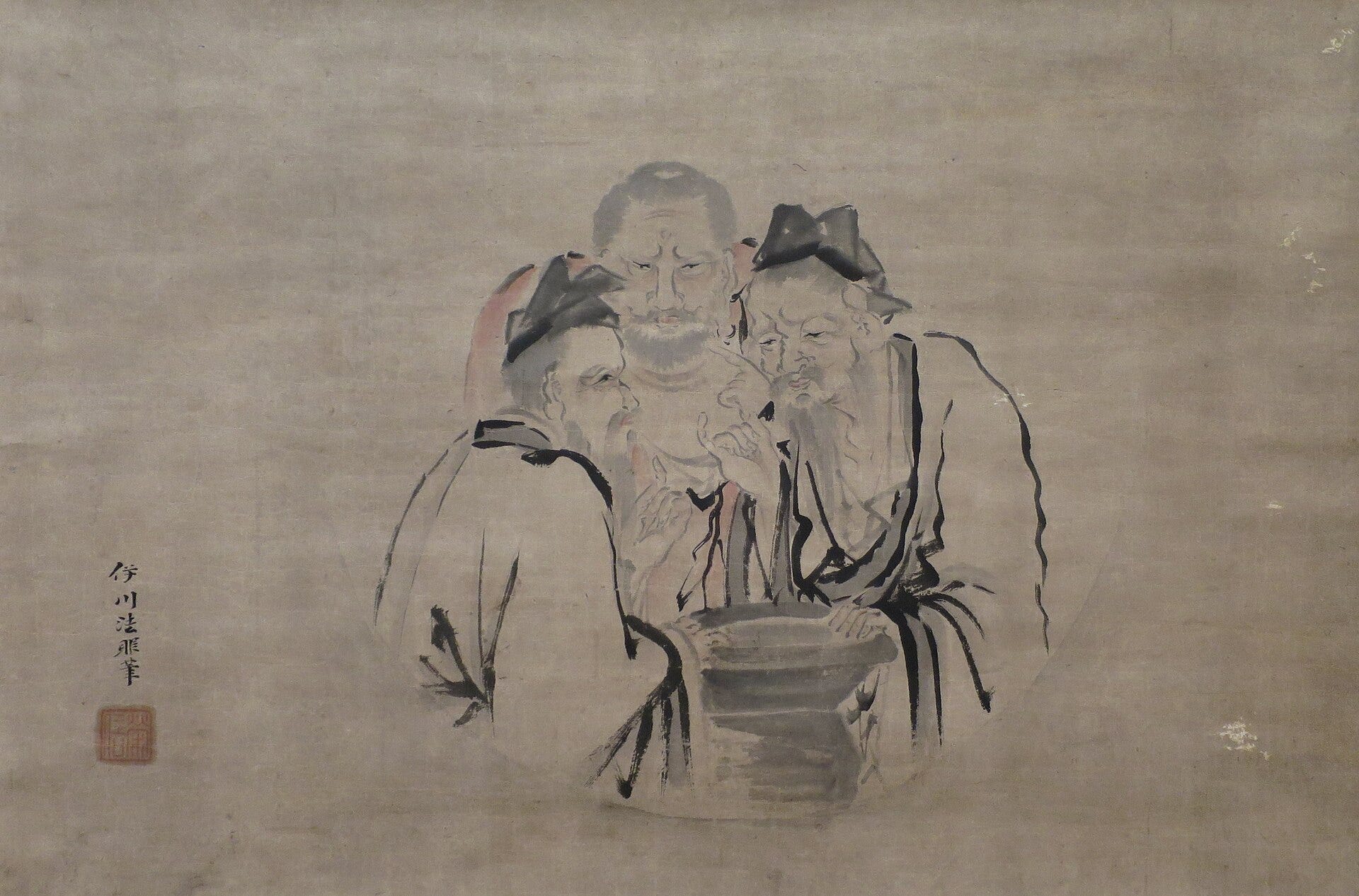
The Vinegar Tasters. Edo Period Japan.
Neo-Confucianism
From that centuries-long conversation came a genuine synthesis.
Beginning in the Song dynasty (960–1279), a movement we call Neo-Confucianism revitalized classical Confucian teaching by absorbing what it found useful in Daoism and Buddhism. Its foremost figure was Zhu Xi (d. 1200), who recast the Daoist wuwei as spontaneous virtue: refine your character through study and reflection long enough, and right action begins to flow effortlessly. This synthesis (alongside other contributions) became the state ideology of the Song and the new basis of its civil service examinations. In 1313, the older Five Classics were formally replaced at the center of the curriculum by the Four Books, among them the famous Analects, the collected sayings of Confucius.
Learning without thought is labor lost; thought without learning is perilous.
Analects (Book 2, Ch. 15), Confucius
Take the wisdom teaching quoted above. Memorizing facts with understanding them is a waste of time. However, trying to reason without knowing the facts is dangerous and fruitless. These are the kinds of teachings that Chinese Civil Service workers had to study.
The examinations for texts like the Analects were the sole path to government office, which made mastery of the approved texts the only road to power. The same tradition that could counsel a ruler toward gentleness could also close every other door to advancement. A cold reminder that no tradition in this course is only its best self.
Heaven’s mandate, Confucius’ bonds, the Buddha’s promise, Zhu Xi’s synthesis... In China, these have not stayed in separate rooms. A single person, across a single life, might bury a parent with Confucian rites, seek the Buddhist temple in grief, and keep a Daoist eye on the balance of things. In the final lesson we follow those living practices into the present.
Optional Video: Scholar of Religion explains Neo-Confucianism (auto-generated CC).
Key Terms for this Lesson: The Mandate of Heaven · Neo-Confucianism
6.4 | Modern Chinese Practice
Qi & its Practices
Imagine a stone dropped into calm water. The splash is the meeting of two forces: yin, the receptive bend inward, and yang, the outward rush of energy. As the ripples spread and the water settles, a pattern of activity and stillness emerges. In Daoist thought, nature unfolds continuously like this in a mystical flow of Qi (氣). Qi (chi) is the vital energy that animates ying and yang (the opposing forces in all living and nonliving things), weaving them into a cosmic dance. Because qi can be balanced (or unbalanced), those observant of Daoist tradition attempt to practice working with qi in a variety of ways.
The best known is Tàijí (Tai Chi), a Daoist artform of slow, deliberate movement.
Practitioners align their breathing with each measured gesture, shifting weight from one leg to the other and turning gently at the waist (like water circling a stone) so that qi moves freely throughout their bodies. Often practiced outdoors in parks and gardens, Tàijí looks tranquil but trains real agility. Outside of Daoism, Tàijí is widely recognized for benefiting circulation and stress levels.
A related practice, Feng Shui, attends not to the body but to space: the idea that the placement of objects, furniture, and pathways can help or hinder the flow of qi through a home or workplace. An open, ordered room is said to welcome fresh currents of qi, while a crowded, disordered space can stifle them.
Communism & the New Confucianism
Modernity certainly brought challenges to China and its religious identity. The late Qing dynasty (1644–1912) faced Western challenges to Confucian authority, the Opium Wars, and the Taiping Rebellion. Then, during the recent Maoist era (1949–1976), China’s religious traditions became targets of the Communist state: Confucian temples were destroyed, scholars were persecuted, and the teaching was denounced as a relic of the old order. Here, the Chinese traditions we’ve studied appear as victims (much as Tibetan and Vietnamese Buddhism did last section) of a suppression campaign carried out by a modern government. After Mao’s death the pressure eased and a revival followed. In the twentieth century, thinkers such as Xiong Shili, Mou Zongsan, and Tu Weiming developed what became known as the New Confucianism, seeking to carry Confucian ethics into modern China alongside modern Western concepts and worldviews.
As a living movement, New Confucianism centers on moral self-cultivation, developing virtues like benevolence, propriety, and wisdom in daily life. Together with ethical leadership and cultural renewal, these virtues adapt classical Confucian values to the demands of modern life. Its advocates argue that these ideals can coexist with modern democratic life, and the movement gives particular attention to the well-being of all members of society, calling on those in positions of influence to lead as moral examples.
It is not the official ideology of the Chinese state, which remains Communist, but it has gained real traction among intellectuals seeking cultural grounding in a fast-changing society.
The Art of War
The greatest influence Daoist political thought has had on the modern world may be, perhaps surprisingly, in military strategy.
During the Warring States Period, continuous conflict across China propelled philosophers to consider how best to resolve warfare efficiently. The most enduring text of this era is The Art of War, attributed to Sunzi (Sun Tzu). Daoist threads of wisdom run through his teachings, beginning his text with the question, “Which ruler has the Dao?” Sunzi argued that moral integrity and a deep understanding of the Dao could make all the difference in war. In warfare, the goal was to triumph swiftly with minimal harm, a reflection of the Daoist ideal to act in harmony with nature rather than forcing outcomes through brute violence. He upheld qualities like wisdom, honor, compassion, courage, and discipline — Daoist principles that value balanced and ethical conduct.
Sunzi’s guidelines proved influential far beyond ancient China. Modern generals who have studied The Art of War note how it addresses planning, adaptability, and unity of command. The text instructs leaders to deceive opponents when necessary, maneuver decisively, and maintain clarity of purpose to avoid a protracted struggle. Some modern military figures like Gen. Norman Schwarzkopf and Gen. Colin Powell drew upon Sunzi’s insights during the First Gulf War (1990-91), to ensure a speedy victory. American business and law schools also incorporate these teachings, reflecting the view that the balanced strategies of The Art of War can apply to competition in many spheres. By rooting conflict resolution in ethical principles, Sunzi’s legacy resonates with the broader Daoist commitments to maintaining balance, suggesting that even in the midst of discord, one should strive for actions that reflect the flexible, harmonious flow of the Dao.
Key Terms for this Lesson: Qi · New Confucianism
Recommended Sources
To be filled in…
Last Section: Buddhism
This Section: Chinese Religion
Next Section: The Biblical World