

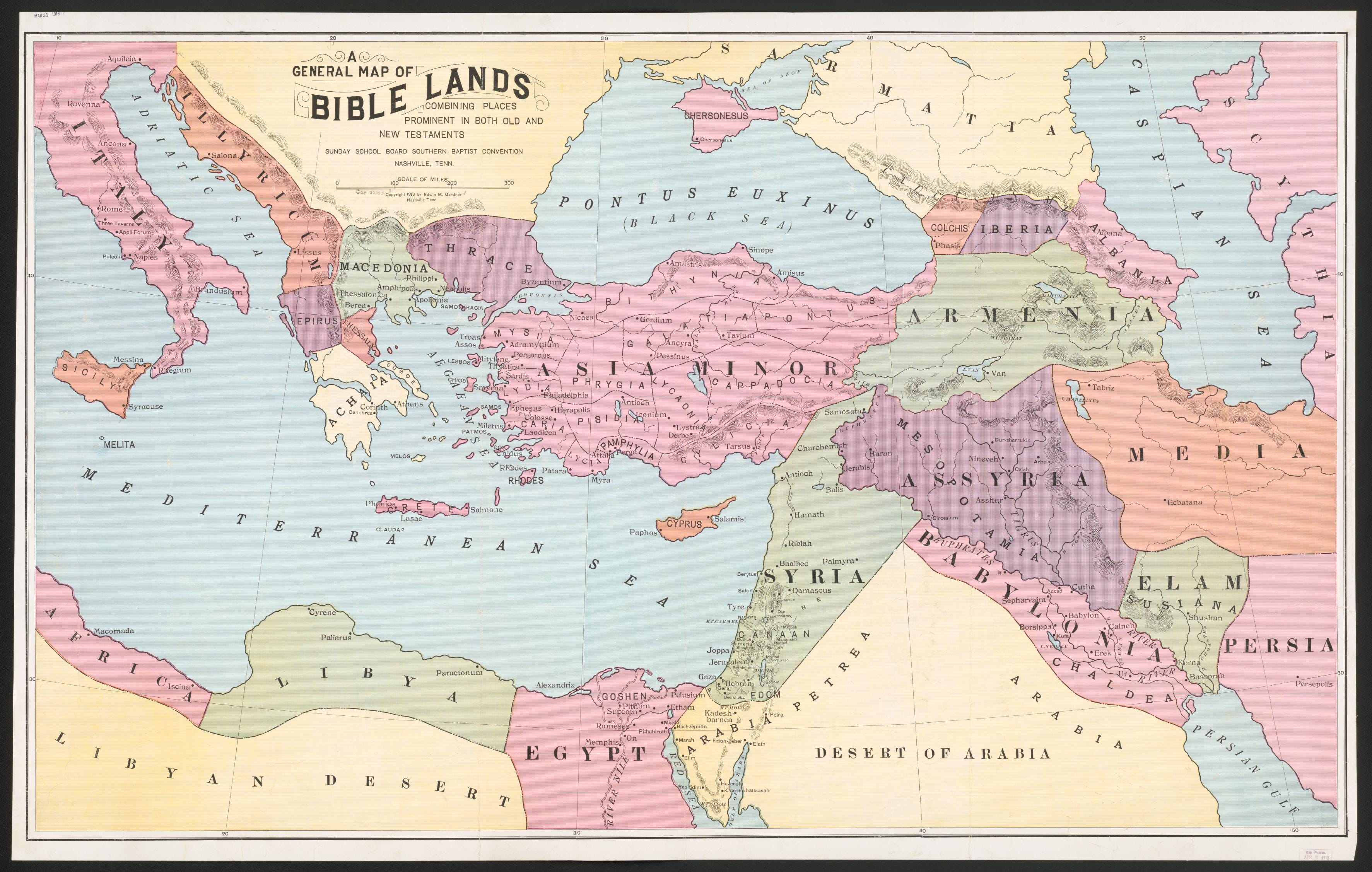
Map of Bible Lands | Library of Congress, 1913
Key Terms for this Section
Covenant · Canaan · The Babylonian Exile · The Torah
Monotheism · The Second Temple · Apocalypse · Messiah
7.1 | Before Israel: Mesopotamia & Egypt
Law & Covenant
Welcome to Module III. Our course now moves into the Ancient MENA: the Middle East & North Africa.
To the east lies Mesopotamia (~Iraq)
To the west lies Egypt, the Nile, and North Africa
Between those two civilizations was the ancient land of Canaan.
The former Canaanite territories are found in modern Israel, Lebanon, Palestine, and parts of modern Jordan & Syria.
• 1754 BCE | The Law Code of Hammurabi creates a covenant between Mesopotamia and the god Shamash
• 1500s BCE | The earliest mention of Canaan in the archeological record
• 1200s BCE | The Collapse of the Bronze Age creates opportunities for smaller groups to rise
• 1208 BCE | The earliest mention of Israel in the archeological record (on an Egyptian victory stele)
• 800s BCE | The earliest mention of the House of David in the archeological record
Israel and the surrounding area is the location of the Hebrew Bible, the stories of Jesus Christ, and remains fundamental to the Islamic tradition. Israel is mentioned over 40 times in the Qur’an, over 70 times in the New Testament, and over 2,000 times in the Hebrew Bible. Outside of scholarship, many folks will treat the Biblical scripture as something floating above the modern Middle East. For them, the Bible is filled with timeless stories that one either takes on faith or not. This course speaks from the opposite view. In every lesson, we will meet something pulled from the ground (a stone, a scroll, a coin) that pins a page to a place and date.
About 3,800 years ago, in Mesopotamia (~Iraq), the Code of Hammurabi was cut into a tall stone pillar (a stele) and set up for all to see. Its 282 laws make up one of humanity’s earliest legal frameworks. But the laws are only half the monument. Alongside them, King Hammurabi kept a covenant, a sacred two-way agreement, between his people and Shamash, the Mesopotamian god of justice. The king promised to honor Shamash, uphold justice, and protect the weak. In return, the god Shamash pledged his divine protection and support.
That bargain mirrored the politics of the age. A small vassal state offered its allegiance to a great king in exchange for protection, and a king offered his own state the protection of a patron god.
It is the same shape the Bible will eventually give to the relationship between God and Israel.
Flood, Creation, & Patriarch
Collective punishment by the gods appears in Mesopotamia’s most famous literary work, the Epic of Gilgamesh, written in the 1700s BCE.
A great flood is sent to punish humankind’s wrongdoing. One virtuous man is warned, builds an ark, and saves his family and some animals. When the waters subside, a dove finds land, and the survivor is rewarded.
You probably know this story. In Gilgamesh the survivor is Utna. In Genesis he is later called by the Hebrew name Noah. Both narratives spare the faithful few from divine judgment, and they share the same core images: watery chaos, the ark as refuge, and renewal after the waters recede. Each keeps its own distinct features. But the recurring flood motif points to shared cultural currents across the ancient Near East.
The Mesopotamian Epic of Creation runs the same way. Primordial waters are ordered by divine acts, a god is slain so that humanity can be formed from his blood, and a hidden sacred garden is reserved for the gods. The Hebrew book of Genesis also has creation emerging from a watery void and a psychodrama set in a sacred garden. But there is one massive difference between the earlier Mesopotamian narratives and the later Hebrew one. Where the Mesopotamian gods quarrel, scheme, and war among themselves, Genesis presents one God acting alone, with divine moral purpose.
Much of the setting and plot of Mesopotamia’s cultural narratives is shared with what will one day become Israel. No where is that more evident than in the story of the Israelite patriarch, Abraham. In Genesis, Abraham and his family are led out of Mesopotamia, from Ur of the Chaldeans (Ur Kaśdim), into the Land of Canaan (ie. Israel). Abraham’s Mesopotamian setting shows in more than his hometown. The covenant Abraham makes with God in Genesis 17 is the same two-way, Hammurabian bargain we just read. In this “everlasting“ covenant, Abraham’s children are promised the Land of Canaan forever, and that God in turn will protect those children, the Israelites.
Cana'an & the Emergence of Israel
The ancient Land of Canaan is first attested in the 1500s BCE. Canaan takes in all of modern Israel (Shechem, Jerusalem), Palestine (Jericho, Bethlehem, Shiloh), and parts of Jordan (Gilead, Rabbah), Lebanon (Tyre, Sidon), and Syria (Hazor, the Golan). Its indigenous people were the Canaanites, and their language was an early member of the Semitic language family. Modern Hebrew, Aramaic, and Arabic all descend from it. As we saw in Section 1.2, the early Israelites emerged from within this Canaanite world and its many gods — among them Ba’al the storm god, Asherah the queen consort, the agrarian god Dagon, the war goddess Anat, and Mot, the god of death. All of these gods (‘ilm, cognate with the Hebrew Elohim) were subordinate to El, the chief god of the Canaanite pantheon.
South of Canaan lay the New Kingdom of Egypt (ca. 1570-1069 BCE). The Hebrew Bible preserves a cultural memory of Israel’s God, Yahweh, arriving from Seir, a southern region between Egypt and Canaan.
The LORD came from Sinai, and dawned from Seir upon us.
Deuteronomy 33:2
In the 1300s BCE, about a century before any mention of Israel, Egyptian records describe Seir as the homeland of the Shasu people, a nomadic Midianite tribe whom Egypt enslaved. According to Egyptian history, the Shasu (meaning ‘those who walk’) worshipped a god named Yahu. There’s no scholarly consensus on where the name Yahu comes from. Still, the name Yahu (with no Canaanite origin) and the story elements of enslavement, Midianites, and walking rhyme with alluring precision with the later Book of Exodus. In Exodus, the figure Moses (an Egyptian name) marries a Midianite woman, then leads his people out of Egyptian enslavement through the Seir and into Canaan at the behest of Yahweh.
Over the next century, natural disasters and invasions brought the Bronze Age civilizations to utter ruin.
The next era of history will be known as the Iron Age (1200-500 BCE).
At the outset of the Iron Age, when Egypt withdraws from Canaan, a power vacuum opens, and in the central hill country a highland culture begins to present itself as distinct from its Canaanite neighbors: its language is Hebrew, its God is Yahweh (YHVH), and its name for itself is Israel. That people would endure for thousands of years and eventually call their religion Judaism.
It’s during the Iron Age that the Biblical tradition tells of Israelite tribes consolidating into two kingdoms, each with its own priestly keepers of memory. In the larger Northern Kingdom, Levite priests preserved and passed down the stories of Moses’ flight from Egypt with his family and his people’s journey to Canaan. In the Southern Kingdom, Zadokite priests preserved and passed down the Mesopotamian-rooted stories of Abraham and his family leaving Ur for Canaan. Carried across generations, these two streams of memory would later form the backbone of the texts of Genesis (Abraham) and Exodus (Moses).
Key Terms for this Lesson: Covenant · Canaan
7.2 | Babylon: Kingdom, Temple, & Exile
The House of David
Within four centuries of the Bronze Age Collapse, the archaeological record attests to an Israelite dynasty called the House of David. The words turned up in 1993 on a broken slab of basalt at Tel Dan, in northern Israel, carved by an enemy king boasting of the Davidic kings he had killed. The biblical narrative gives David humbler beginnings. He grows up under King Saul, who is at war with an Aegean people settled on the coast around present-day Gaza, the Philistines. The shepherd boy ends the Philistine threat by killing their champion, Goliath, with a slingshot, is claimed by divine providence, and is made king. As Israel’s leader, David moves the capital from Hebron to Jerusalem, thereafter the ‘City of David.’ Jews today still consider Jerusalem the capital of Israel for this reason. Once he is anointed (Heb. mashiach, messiah) as king, David becomes a formidable warrior who spends his reign fighting the Philistines, and late in life plans a permanent Holy Temple in Jerusalem.
• 800s BCE | The earliest mention of the House of David in the archeological record
• 722 BCE | Assyria takes the Northern Kingdom, consolidating power in the south
• 586 BCE | Babylon (Iraq) takes the Southern Kingdom, causing the Babylonian Exile
• 538 BCE | Persia (Iran) ends the Exile; the Jewish written record begins
Because David is said to have “blood on his hands,” Jewish tradition holds he is not fit to build the Temple. The task falls to his son Solomon, who builds a Temple whose stone walls, quarried steps, and complex subterranean chambers are still preserved. This is the Great Temple of Solomon (ca. 957-586 BCE), whose focal point is the Holy of Holies (Kodesh HaKodashim), which once held the Ark of the Covenant — the golden chest containing the Ten Commandments. This remains the holiest place on earth for the Jewish People.
The First Temple fell when it was destroyed by the invading Babylonians in 586 BCE.
Exile & the Jews
After the Temple’s destruction, the Babylonian Empire (~Iraq) resettled a substantial number of Israelites eastward in Babylonian lands in an event known as the Babylonian Exile. The captives remembered what they had lost:
By the rivers of Babylon,
there we sat down, and we wept
as we remembered Zion (Israel).
There on the poplar trees
we hung our harps,
when our captors asked us for songs,
our tormentors demanded joyous music.
“Sing us one of the songs of Zion!”But how can we sing the Lord’s song
in a foreign land?
If I forget thee, Jerusalem,
may my right hand wither.Psalm 137:1-5
During their time in Babylon, the old tribal differences among Israelites began to fade. The Ten Tribes of the Northern Kingdom had long since assimilated or drifted from history. It was the Tribe of Judah that had held the recently sacked Southern Kingdom, and for this reason those who faced this exile were henceforth called Judeans — and later, with the rise of Rome, the Jews.
The Torah Written Down
The end of the Babylonian Exile marks the beginning of Jewish History, as the priests who were taken to Babylon begin to compile and write down the many oral traditions of the Israelites. These written traditions and laws became known as the Torah — the books of Genesis, Exodus, Leviticus, Numbers, and Deuteronomy. The exile made the writing urgent: it became incumbent on the Jews to tell their stories, first to satisfy their captors and, more importantly, to preserve their own values and identity within a sprawling empire. And the earliest physical trace of that scripture pays off this lesson’s second artifact: the Ketef Hinnom silver scrolls, dated to about 580 BCE — two tiny rolls of silver inscribed with the Priestly Blessing, the earliest surviving fragment of any biblical text.
Consider the summaries of some of the Torah’s key figures below,
noting how exiled writers found relevance in these stories for preserving Israelite identity.
Summaries of some of the Torah’s Key Figures
Adam • God loves us and created a “good” world.
Noah • God protects the righteous and destroys the wicked.
Abraham • God has promised us our former territory in Canaan.
Isaac • God will provide for us in our hour of need.
Jacob • The fragmented tribes of Israel are brothers.
Joseph • In-fighting among the tribes will only hurt us.
Moses • God has delivered us from imperial bondage before (ie. Egypt).
Joshua • Despite the odds, God will give us victory over our enemies.
These sixth-century stories were written in Hebrew, a Semitic language, and because the Akkadian of Babylon and the Hebrew of the Israelites were both Semitic, the two peoples could understand one another. Many Akkadian words entered the Hebrew Torah as a result of the exile: for example, the words for overseer, silver, decree, steal, burn, anger, and hope. Even the Babylonian ziggurats left their mark, becoming the Jewish story of hubris and the frailty of empire in the Tower of Babel.
Key Terms for this Lesson: Babylonian Exile · the Torah
7.3 | Persia: Temple & Torah
Cyrus, God’s Anointed
After the fall of the Babylonian Empire by the victorious Persians, Jewish scripture pays an astonishing compliment to a foreign king. The Persian Cyrus is the only non-Jew whom the Bible calls God’s messiah, God’s anointed.
“Thus says the LORD to his anointed, to Cyrus, whose right hand I have grasped, to subdue nations before him...” Isaiah 45:1
It was the Persians who broke the Babylonian chains binding the Israelites, and the Bible frequently presents Cyrus as God’s chosen instrument, liberating the Jewish people, funding their return, and supporting the rebuilding of the Temple.
• 538 BCE | Persia ends the Exile; the Jewish written record is codified (ie. the Torah)
• 516 BCE | The Second Temple is completed, paid for by the Persian Empire
• 458 BCE | The Jewish-Persian prophet Ezra brings the Torah to Jerusalem
• 332 BCE | Alexander the Great arrives, bringing Hellenism to Israel
Not since the pharaoh held sway over Israel had the Jews seen a leader like the Persian king, Cyrus. His own people called him the King of Kings: one king over many kingdoms. And a people who can envision one king for the world can envision one God for the world. Since the time of the Persian prophet Zoroaster (Persian: Zarathustra), Persia had turned from the pantheon of proto-Vedic culture to Zoroastrianism, a monotheistic tradition honoring God Almighty with the title Ahura Mazda (”Lord of Wisdom”). The careful reader will notice the word ahura (lord) from Section 2.2. Zoroaster is celebrated as the prophet responsible for reframing the shared pantheon of the Indo-Iranian region (cf. Sec. 4) into a cosmic battle of good and evil supernatural forces.
Today, Zoroastrianism is a monotheistic religion still practiced in India and Iran. Monotheism is a modern classification (cf. Henry More, 1660), representing a spectrum of belief centered on one God. It is a spectrum insofar as most forms of monotheism hold inclusive space for multiple forms or personae of God (eg. avatars, the holy spirit, etc.), lesser gods, divine children, angels and demons, etc. While monotheistic, the Zoroastrianism the Jews would have encountered during the Persian period (538-332 BCE) also included:
• a six-era Creation narrative
• a world genealogy founded on three sons
• the revelation of God’s word on a mountain to their prophet
• the world framed as a cosmic battle between good and evil (cf. dualism)
• God has angels, yazatas, who fight the forces of darkness, devas
• a prophesied future savior, born of a virgin, who redeems the world
• a belief in a final battle for the world in the End Times
• a belief in compensatory justice in an afterlife (ie. heavenly rewards)
• a belief in a general resurrection and uniting with God
Before the Babylonian Exile, rival gods vied for the Israelites’ attention. In Section 1, we identified the early Israelites as monolatrists, acknowledging other gods while generally holding Yahweh* supreme. Pre-Exile Yahwist prophets like Elijah had to contend with prophets of Ba’al and Jews who turned from Yahweh (eg. 1 Kings 18). The archeological record reflects this: studies that dig below the 500s BCE layers of Israel find a variety of idols and indigenous practices. However, all of that ends after the 500s BCE. When the Jews begin living under Persian rule, the archeology reflects an Israel laser-focused on monotheism.
The Second Temple & the Torah
Now rebuilt with Persian funds, the Second Temple was completed in Jerusalem in 516 BCE and has forevermore been the focal point of Jewish worship. This is the Temple that King Herod will one day refurbish and that Jesus will walk in (cf. Sec. 8 & 9). It will stand for nearly six centuries before its destruction at the hands of the Romans.
During the Second Temple period, the Persian-Jewish scribe Ezra brings the written Torah from the Persian court to Jerusalem and establishes a Jewish culture of literacy that mirrors Persian literary practice. From tales of palace intrigue (eg. Esther) to apocalyptic visions of the future (eg. Daniel), the mode and style of Persian storytelling is found throughout the Jewish text. We even find parallels in Royal Persian inscriptions.
Thus says King Cyrus of Persia: The Lord, the God of heaven, has given me all the kingdoms of the earth, and he has charged me to build him a house at Jerusalem, which is in Judah. Let any of those among you who are of his people (may their God be with them!) go up to Jerusalem in Judah and rebuild the house of the Lord, the God of Israel; he is the God who is in Jerusalem.
Ezra 1:2-3(Line 12) He [God] took a righteous king, his favorite, by the hand, he called out his name: Cyrus, king of Anšan; he pronounced his name to be king all over the world. (Line 32) ...”I returned to [their] sanctuaries the gods who had lived therein... I gathered all their inhabitants and returned to them their dwellings.”
The Cylinder of Cyrus
We also find Persian concepts and vocabulary in Post-Exilic practice. The Persian word for a walled garden, pardes, enters the Bible as “paradise,” the same word that, centuries later, Jesus speaks from the cross to the man beside him: “Truly I tell you, today you will be with me in paradise” (Luke 23:43). And the iconic sacred flame alight in Zoroastrian temples finds an echo in the eternal lamp (the ner tamid) that still burns in every synagogue today. In these ways, the Jewish people became a literary community with a written sacred scripture, forged in a Persian world and sharing themes with the wisdom traditions prized across it.
Persia & Cosmic Conflict
Interestingly, before the Exile, the God found in the Torah does not contend with an Evil Other — unlike the Persian framing of the world as a battle between light and dark. Most of the Torah’s stories involve either God’s own test (eg. the sacrifice of Isaac) or humanity’s own inclination toward wickedness (eg. the Flood). Herein, God is described as both ‘wounder and healer‘ and ‘bringer of disease and life.’ In the Jewish telling, there is no power or character opposing God Almighty in any supernatural sense. The famous serpent in the Garden of Eden, for Jews, is simply another “beast of the field.”
However, before the Exile, there is a member of God’s Heavenly court called “the adversary“ (Heb. ha-satan) who challenges humanity. But his challenge is that of a duty-bound prosecutor challenging an accused person, in an effort to discover the truth (cf. Job 1). Pointedly, this figure operates by God’s command. The Hebrew word for the adversary (ha-satan, השטן) is used in a myriad of other contexts. King David is called an adversary (satan) to the Philistines, just as a rival adversary (satan) is later raised up against his son, Solomon.
However, after the Exile, the Bible will show sharper distinctions between the forces of light and darkness.
Ancient Persian scripture envisioned history as a cosmic struggle between the Lord of Wisdom and the Spirit of Destruction, ending in the triumph of good. In turn, the Jewish writings of the later Persian and Greek eras (Daniel, Chronicles, Enoch) portray cosmic conflict with the same vividness. These latter texts give names and elaborate descriptions to angels and demons. In the Hebrew Chronicles (a later Greek-era text), there is a figure named Satan, who will later serve as the chief antagonist of the New Testament and Quran.
*Note on the Jewish name of God: while modern scholars may write YHVH as “Yahweh,” this pronunciation is not used in Jewish practice. Observant Jews respectfully avoid pronouncing “YHVH” altogether, and often say “HaShem“ (Hebrew for “the Name”) when referring to God casually, or “Adonai“ (”Lord” in Hebrew) in sacred contexts like synagogue worship. The term “Jehovah“ is a later medieval Christian attempt to vocalize YHVH, and is also not used by Jews.
Key Terms for this Lesson: Monotheism · the Second Temple
7.4 | Greece & Rome in the Holy Land
From Hebrew to Greek
In ancient Greece, across the Mediterranean from Israel, the philosopher Plato (d. 348 BCE) described the afterlife in ways that would later share deep similarity with Christian and Islamic thought.
In Plato’s Republic, a Greek warrior dies in battle, is revived, and reports what he saw beyond death: a judgment of souls (Gr. psychē) in which the good are rewarded and the wicked punished. Pointedly, this is a Greek story not found in the Hebrew Bible. Jewish tradition does not split a person into a temporal body and an immortal soul. The Torah instead speaks of the nefesh (נפש), ‘the breath of life,’ the whole living creature, body included. This is why traditional Jewish practice permits burial but not cremation: the body is part of the divine breath of life. Where the Greek imagined an immortal soul surviving the body, the Hebrew Bible pictured mortals descending down to Sheol, ‘the grave,’ from which no one returns and where, the Psalms say, the dead give God no praise.
• 332 BCE | Alexander the Great arrives, bringing Hellenism to Israel
• 200s BCE | The Hebrew Bible is translated into Greek for Hellenized Jewish readers
• 63 BCE | The Roman Empire takes control of Israel
• 31 BCE | Augustus Caesar becomes emperor of Rome
• 70 CE | During the Roman-Jewish War, the Romans destroy the Second Temple
However, with the coming of Hellenization (ie. the colonial spread of Greek culture and language) into Israel in the 300s BCE, Greek ways of seeing the world began to shape the literature and imagination of the region.
For example, the Greeks had an underworld, Hades, and a heavenly abode, Uranus (lit. the sky). In the Greek works of Plato, the good dead go to a celestial realm in the sky (Uranus) while the unjust suffer in the pit (Hades). 300 years after Plato, when the New Testament is written in Greek, Hades and Uranus will be the final destinations of the dead. Around 1380, the Wycliffe Bible translates Hades as “Hell” (from ‘Hel,’ daughter of Loki) and the sky realm Uranus/Ouranos as “Heaven” (from ‘Heofon,’ the Old English word for sky).
The Greek word demon enters the Bible’s vocabulary in a similar way. When the Hebrew Bible is translated into Greek, the monolatric phrase “other gods” (‘ilm) gets translated as daimon, the Greek cognate of the Persian deva (cf. Sec. 7.3). The Psalmist then warns (in translation):
All the gods of the nations are daimons, but the L-RD made the heavens.
Psalm 96:5
During the Hellenistic period, ‘demons’ become recognized as the evil intermediary beings fighting God’s ‘messengers’ (angels in Greek). This is repeated by the Apostle Paul when he tells the Corinthians that pagan offerings go to ‘demons,’ and not to God. Other Greek concepts like logos (the rational principle of the universe), agape (unconditional love), and soteria (salvation) become the philosophical bedrock of Christianity. The word christos (anointed), from which the religion is named, is also Greek.
Greek Bibles & Frameworks
In the 200s BCE, a group of Jewish scholars in Ptolemaic Egypt (tradition says there were seventy) produced a Greek translation of the Hebrew Bible called the Septuagint (lit. the ‘Seventy’). Later, with the advent of Christianity, most second and third generation Christians were not Jewish and could not read Hebrew. But nearly all of them could read or understand Greek. For this reason, the Septuagint became the lens through which most Christians read the Hebrew Bible.
Now, long before the Greeks, Israel’s prophets had described a coming age of peace: a righteous king from David’s line, a ruler who ends war, and a day when nations “beat their swords into plowshares.” That hope was native to the Hebrew Bible. What the Greek world added was a genre. Greek culture prized apocalyptic literature, an ‘unveiling’ (Gr. apokalypsis) of secret knowledge about the end of history, and the Hellenized-Jewish writers of the era recited their ancient hope in this new idiom. The visions of Daniel and, later, the Christian Book of Revelation both belong to the Greek apocalyptic genre, both unveiling a final reckoning.
It is out of this marriage — the native hope of Israel and the apocalyptic visions of the Greeks — that a first-century expectation of a Jewish Messiah (Hebrew for anointed one) arose. Desires for a Israelite Messiah ran the gamut. Some hoped for a holy warrior. Others hoped for a healer. We will pick up this thread again when we introduce Jesus of Nazareth in Sec. 9.1.
The Roman Worldview
While the Egyptians, Babylonians, and Greeks each took their turn on the world stage, the Romans proved the greatest colonial power of the ancient world. Theirs was a hierarchical society, with clear distinctions between the élite, freemen, foreigners, and slaves, and a vision of ‘empire without end’ (imperium sine fine), as the Aeneid famously promised them. From Rome, the legions would conquer and exploit every territory they could keep, extracting tribute, labor, and taxes from local populations. Largely henotheists (we prefer our gods but don’t discount the existence of others), the Romans nonetheless expected cultural assimilation wherever they could impose it.
One of the principle ways the Romans maintained control over occupied territory was through ideology.
In any empire, one must hold power over a people’s economy, military, politics, and ideology (cf. Michael Mann). The first three are managed through labor, violence, and institutions. Ideology is harder. Symbols are difficult to control.
We return now to the time of Julius Caesar, who, returning from Gaul with an economy-disrupting flood of slaves and plunder, was honored with a triumph in Rome. Hail, Caesar! For one day, Julius Caesar was declared a living god, and the common people loved him for it! An Imperial Cult began to grow around him, legitimizing his rule. But it did not save him. Caesar was assassinated by senators who missed their power. After his death in 44 BCE, the Senate voted to declare Julius Caesar a god in perpetuity (his official deification followed in 42 BCE) to placate his supporters. Caesar then left behind his right-hand man, Marc Antony, and his adopted son, Octavian, and soon the two set their armies against each other for the throne. Antony’s claim was simple: he had been Caesar’s closest companion on every battlefield. Octavian had no armies and no experience. He had a name. Octavian was Julius Caesar’s adopted son. So, as Julius Caesar had been named a ‘god,’ Octavian began styling himself publicly as the “Son of God.” He had coins minted and everything.
After defeating Marc Antony, Octavian took the title Augustus Caesar and kept the title ‘Son of God.’ Throughout the empire, Augustus was heralded as the Lord and Savior of the world, on the theory that symbolic control over ideology could pacify restless territories. This bit of imperial propaganda survives on a coin from Augustus’s reign.

On the left, we see “Augustus,” and on the right, we see “Divi Filius,” which is Latin for “Son of God.”
Now, since the time of the Persians, Israel had developed a Savior narrative. One day, an anointed leader (messiah) would arrive to vanquish evil and redeem the world. From the Greeks, Israel had learned to write of their salvation in an apocalyptic register. However, Rome was quick to respond to such seditious teachings with torture and crucifixions. In an effort to maintain their power, the Romans kill Jesus of Nazareth in the 30s, Peter and Paul in the 60s, and, in 70 CE, the empire burns the Second Temple to ash.
Out of this catastrophe came two of the world’s most enduring religious traditions. A Jewish life centered on rabbis and Torah rose to succeed the practices of the Second Temple called Rabbinic Judaism (Section 8). And the followers of the crucified Nazarene became Christianity (Section 9). Six centuries after Jesus, a popular uprising of Arab believers, united with Jews and Christians, will begin the advent of Islam (Section 10) in Arabia and across the MENA.
Recommended Sources
The Cambridge History of Judaism
Roland de Vaux, Ancient Israel: Its Life and Institutions
Peter Green, The Hellenistic Age
Walter C. Kaiser Jr., A History of Israel: From the Bronze Age through the Jewish Wars
Last Section: Chinese Religion
This Section: The Biblical World
Next Section: Judaism