

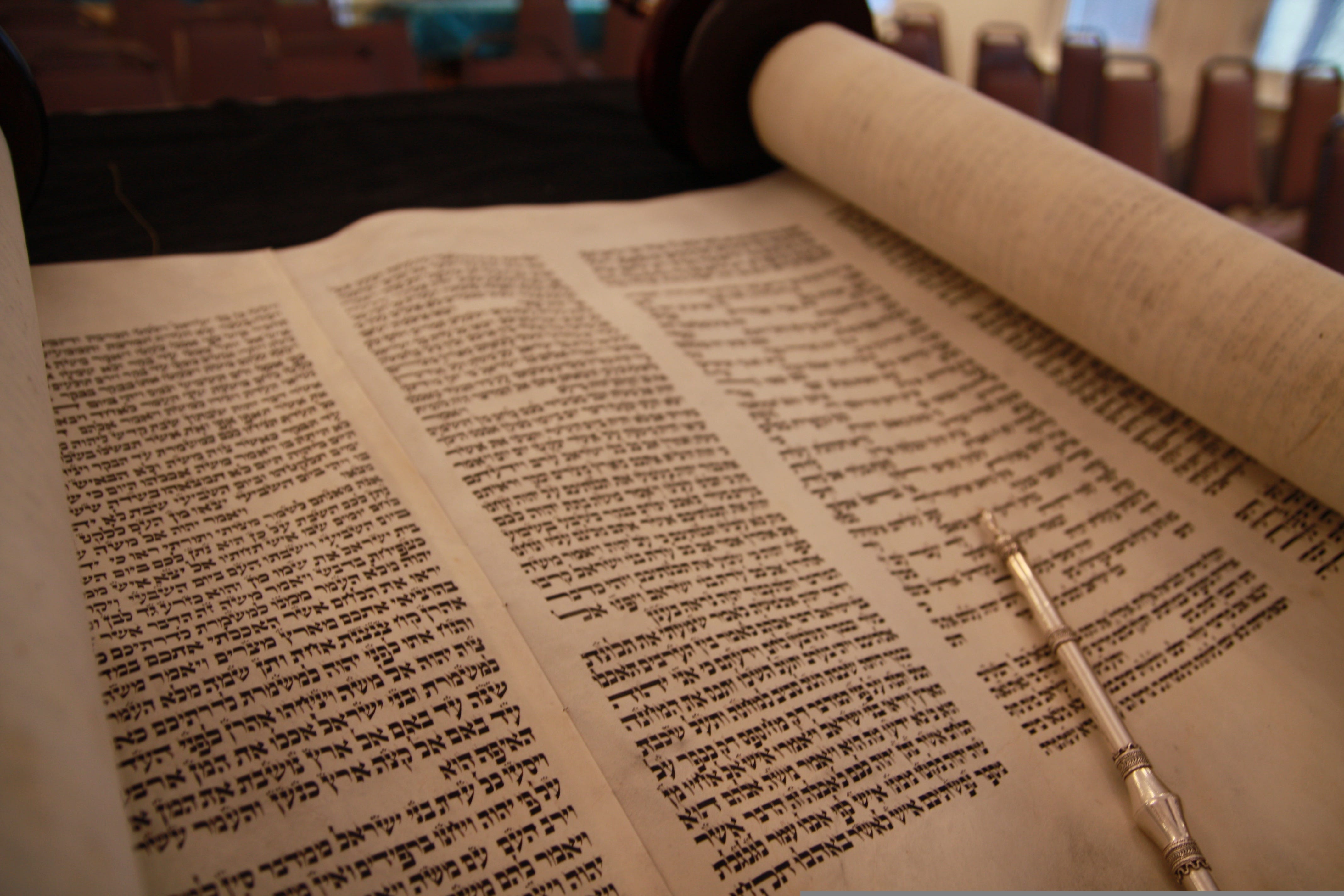
Torah Scroll | showing Exodus15:22-16:36, 2019
Key Terms for this Section
Rabbinic Judaism · Talmud · Israel · Mitzvot
Passover · The High Holy Days · Shabbat · Tzedakah
8.1 | From Temple to Talmud
Greece, Hellenism, & the Maccabean Response | 332-63 BCE
When Alexander the Great and his Macedonian-Greek armies take Persia in 332 BCE, the response in Israel split in two. Over the next century and a half, the split hardened into two political factions.
• The Jewish Sadducees (wealthy urban elites)
embrace Greek assimilation for their own material gain
• The Jewish Pharisees (rabbis out in the countryside among the people)
resist Hellenization much longer
The Pharisees are the faction from which Rabbinic Judaism arises. The Pharisees (the later Apostle Paul among them) are the party of the people, and the tradition this lesson describes is theirs.
• 332 BCE | The European Alexander the Great arrives, bringing Hellenism to Israel
• 167 BCE | The Maccabean Revolt of the Jews against Greece
• 70 CE | The Fall of the Second Jewish Temple during the First Jewish-Roman War
• 132-5 | Bar Kochba leads the 2nd Jewish-Roman War, the last revolt until 20th century
• 500s | The completion of the Talmud, the official rabbinical commentary on the Torah
Greek influence ran deep, from the Greek names given to Jewish children to the development of gymnasiums. The gymnasiums were a particular scandal in Israel. Like the Greek public bathhouses, the gymnasium was a place to be undressed (that’s literally what the word means in Greek). Due to the European ridicule of Jews in bathhouses and gymnasiums, some Jewish families stopped circumcising their boys. Hebrew lessons began to disappear. Eventually, the Hellenic influence in Israel became so great that the Greeks placed a statue of Zeus in the Temple. That statue was the last straw...
He extended the glory of his people. Like a giant, he put on his breastplate; he bound on his armor of war and waged battles, protecting the camp with his sword. 1 Maccabees 3:3
In 167 BCE, Judah Maccabee (Heb. ‘Judah the Hammer’) wages a guerrilla war against Greek rule and takes the Temple back! The Greeks retaliate by defiling the Temple with pig’s blood, a powerful taboo in Jewish culture. The Maccabees eventually win, take the Temple back, cleanse and rededicate it. The Hebrew for ‘Rededication’ is Hanukkah. Jewish independence is forever after celebrated by that holiday. By 140 BCE, the Maccabees had founded the Hasmonean dynasty, and local self-rule returned for the second time to Israel since the days of King David. Ezra’s Great Assembly was replaced by the Sanhedrin, a council of rabbinic sages who could now weigh in on civil matters the Greeks used to decide for Jews.
Over a short time, however, the Hasmoneans grew corrupt and Hellenized too, and their dynasty fell under its own weight.
Rome & the Burning of the Temple | 63 BCE - 135 CE
Rome takes Jerusalem in 63 BCE, under Pompey (Julius Caesar’s brother-in-law), and thereafter rules through intermediaries.
These puppet-kings, Herod the Great (37- 4 BCE) chief among them, were Jewish traitors who chose personal enrichment over the Jewish rule of Israel. The reaction was powerful. Against Roman imperialism (and Jewish collaboration!) rose the Zealots, a faction of Israelite fighters who, like the Maccabees of old, sought to defeat their imperial masters by force.
Their struggle became the First Roman-Jewish War (66-73 CE). It ends with the Roman destruction of the Temple in 70 CE. Today, the Western Wall, an outer retaining wall of the original temple mount complex, remains the focal point of Jewish prayer today. For Jews, the losses in the Roman-Jewish war were the most cataclysmic loss in their history until the Holocaust.
A last revolt flared in 132 CE, when Simon bar Kochba rose against Roman plans to remake the Temple Mount a shrine to Jupiter!
Bar Kochba’s first victories with the Zealots won a third brief span of local self-rule for the region, and his followers hailed him as the Messiah. However, within 3 years, Rome crushed the uprising (135 CE), and Bar Kochba was killed. From there, Israel became a possession of several different empires. The land became a Roman province (135), a Byzantine province (390), then it became a district ruled from Baghdad (636) until European Crusaders took it (1099). Then it became a colony ruled from Cairo (1187), then the Turkish Empire had it for four centuries (1517) until the British took it from the Turks in the First World War (1917). Then, in May 1948, home rule returned to the Levant for the fourth and final time with the founding of the State of Israel.
Scattered by several successive empires, the world’s Jews formed into three distinct flavors: Ashkenazi (European), Sephardi (Spanish and North African), and Mizrahi Jews (Middle Eastern). Today about half the world’s Jews live in Israel, the majority of whom have Mizrahi heritage. Most of the other half of the world’s Jews — the Jewish Diaspora — live in the United States.
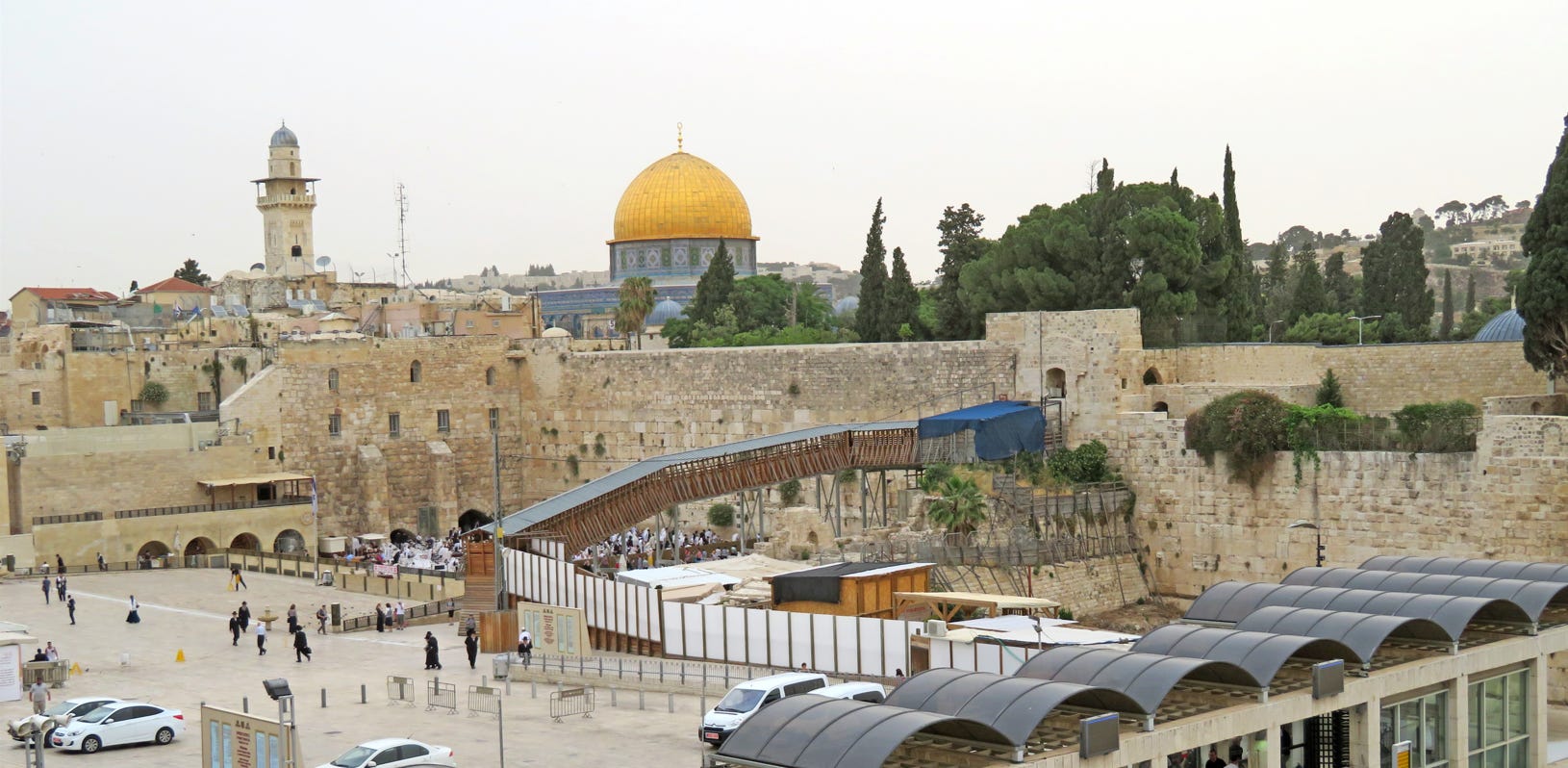
The Western Wall (2020), part of the Temple Mount complex
with the Islamic Dome of the Rock atop it, where the Temple once stood.
Rabbinic Judaism: Bible & Talmud
With the Temple gone from the City of David, Jewish life turned to the Pharisaic tradition in the countryside.
• The Temple in Jerusalem was succeeded by synagogues (Gr. assemblies).
• The Temple priesthood was succeeded by rabbis (Hb. revered).
• The Temple sacrifices were succeeded by the study of the Torah
In these ways, after the Temple, Rabbinic Judaism was born: focused on Torah study, rabbinic tradition, and synagogue attendance.
At the center of Rabbinic Judaism is the Hebrew Bible.
The Hebrew Bible is built of 3 layers.
• The Torah (Hb. Guidance): the first 5 scrolls of the Bible
• The Nevi’im (Hb. Prophets): 8 scrolls of prophetic insight for Israel
• The Ketuvim (Hb. Writings): 11 other scrolls poetic, megillot, and histories
The text of the Hebrew Bible is almost entirely ancient Hebrew (98.8%), with the remaining 1.2% composed in Aramaic. Within its Hebrew: 4% of that vocabulary (320 words) comes from other languages. 133 words from Egyptian (eg. pharaoh), 85 Persian (eg. decree), 85 Babylonian (eg. palace), 7 Greek (eg. lute), 5 Hittite (eg. armor), 3 Hurrian (idolatrous priest), and 2 from India (eg. ape and peacock).
Hebrew, like Arabic, is also written right-to-left, like this example from Deut. 6:4
שמע | ישראל | יהוה | אלהינו | יהוה | אחד
indivisible | Lord | our God, “El“ | Lord | Israel | hear
“Hear, O Israel: the Lord our God is One.”
Particular focus is given to Hebrew here because the Torah is presented overwhelmingly in Hebrew, known in Rabbinic Judaism as the “Leshon HaKodesh” (the Holy Language). For many believers, to study the word of God requires one to invest in the language that God revealed Godself in. Within the Bible there are riddles, word play, puns, and acrostics that can only be revealed with Hebrew study.
• In Genesis, Isaac (Yitzhak) comes from “laughter” (tsachak). When his 90-year-old mother learned she would have Isaac, she laughed.
• Word play: The serpent, the most crafty (arum) of all creatures, tests Adam and Eve while they are naked (arummim).
• Another: God shows Jeremiah an almond branch (shaked) as a sign that God likewise watches (shokad) over Israel.
• Psalm 119 is an acrostic of the Hebrew alefbet: 22 stanzas in praise of Torah study, starting in Hebrew A, B, G, D...
While riddles and puns are fun, rabbis take Torah study quite seriously.
After the fall of the Temple (70 CE), the rabbis spend the next 400 years developing the Talmud — an enormous body of Biblical commentary that adjudicates on serious questions posed by Jews. The first layer of the Talmud was the Mishnah, completed around 200 CE. It carried rulings on rabbinical questions from Torah study. For example, while the Torah commands Jews to leave part of their harvest to the poor (Deut. 24:19), the Mishnah adds that these gleanings are for Jews and non-Jews alike. Why? Because Jews should “promote the ways of peace” for the sake of social harmony and human dignity (Peah 4:9).
Over the next 300 years, Torah commentary continued with even more real-world questions and answers in an additional layer of Talmud called the Gemara. For example, the Torah commands the return of lost property (Deut. 22:1), and the Mishnah later responds — yes, but if you can’t find the owner, you can keep the item. However, a story of a rabbi living in Iraq added another layer of commentary summarized below.
A rabbi hires workers to transport barrels of wine for him. While moving, the workers break a barrel and lose its wine. Under the law, the workers are expected to compensate the man for the lost wine. But because these workers are poor and cannot pay for the wine, they are asked to give up their cloaks instead. However, a sage later adjudicates the situation and tells the owner to give the cloaks back. Why? Because Proverbs says to “walk in the way of good people” and the Mishnah likewise says we should seek the “ways of peace.” Further, because the workers had worked all day, the sage ordered the owner to pay them their full wages and return their cloaks. Here, the Gemara establishes “acting beyond the letter of the law,” because true ethics often requires a compassionate bending of the law in order to prioritize human dignity. (Bava Metzia 83a)
In sum, the Talmud is essentially the Mishnah (ca. 200 CE) and the Gemara (ca. 500 CE).
Representing layers of adjudication of Jewish life after the Temple, the Talmud remains the cornerstone of Rabbinical Judaism.
Key Terms for this Lesson: Rabbinic Judaism · The Talmud
8.2 | Peoplehood & the Path
A People called Israel
While Christians and Muslims find their traditions primarily through believing the right things, Jewish identity is less about believing than it is about belonging. Jews were a people long before they had any sort of creed. Remember, the Hebrew Bible has no word for ‘religion.’ Instead, the ancient Israelites called themselves after a man renamed Israel. His descendants, the Jews, have been called a tribe, a nation, and even a race. However problematic those labels are, one underlying point remains: a person’s Jewishness comes from their parents, not their beliefs.
A person can fully believe every word of the Hebrew Bible, or be unobservant and ignorant of the scripture. Their beliefs have no bearing on their identity as a Jew.
Outside of the corridors of religion, the Jewish People have their own languages, foods, calendar, clothes, texts, art, music, land, history, traditions, totems, taboos, humor, customs, and holidays. They are a small people, about 16 million or so (about 0.2% of the world). Yet they have changed the world immeasurably. In the last century, Jews discovered general relativity (Einstein) and psychoanalysis (Freud). They invented aspirin (Eichengrün) and the defibrillator (Zoll), Google searches (Page & Brin), USB flash drives (Moran), and word-processing (Berezin). They gave the world the ballpoint-pen (Bíró), instant cameras (Land), Barbie (Handler), and Levi’s jeans. Jewish comic book writers gave us the moral tales of Superman, Spiderman, and the X-Men. Jews founded Paramount, Universal, and Warner Bros Studios. There have been 8 Jewish-American supreme court justices. And, since WWII, there have been about 30 Jewish heads of state outside of Israel, including the presidents of Mexico, Ukraine, and Switzerland, as well as the prime ministers of France, Belgium, and Austria.
In the 1950s, a Jew cured the world of polio then gave the vaccine away for free. If he’d sold it, he’d be worth billions. He chose to save lives instead. And though they make up 0.2% of the world’s population, Jews represent 22% of all Nobel Prize laureates. Outside of religion, the impact of Jewish creativity, intelligence, and leadership is hard to compare.
Then there is also a Jewish religious tradition, called Judaism. The ways ancient Jews framed the moral landscape — with covenant, scripture, forgiveness, the sabbath, and a God without image — remain fundamental to over half the religious adherents and foundational to Western civilization. After all, Jesus, his disciples, and the apostle Paul were also Jews and identified as such.
So where did this identity begin? The name carries the ethos. Israel comes from the story of Jacob, Abraham’s grandson, who wrestles through the night with a mysterious figure at a river crossing and will not let go:
“You shall no longer be called Jacob, but Israel, for you have struggled with God and man and prevailed.” Genesis 32:28
Israel means, literally, to struggle with God.
And struggle turns out to be central to Jewish life rather than a lapse from it: questioning, arguing, wrestling with the tradition to reach a deeper truth. Abraham argues with God to spare the city of Sodom for the sake of its righteous few. Moses, who answers God’s call with a single word (“Hineni,” Here I am), goes on to argue God out of destroying the people at the foot of Sinai. Like Abraham, Moses changes God’s mind. The name Israel has attached itself to a person, a people, a land, and a modern state, but it has never lost the verb inside it.
For Jews, to wrestle with God is not a failure of faith. In the Jewish tradition,
it is the definition of faith.
Covenant & Mitzvot
Underneath the peoplehood is the covenant, the “everlasting“ bond traced from Abraham between his descendants and God Almighty. Its sign, given in Genesis 17, is circumcision, a mark on the body of a people ‘set apart.’ That covenantal otherness will matter a great deal to Paul and the story of early Christianity (Sec. 9). Today, Christians read the Jewish covenant primarily in one of two ways. Some hold to dual-covenant theology, in which God’s covenant with the Jews still stands alongside the Christian one. For example, the Catholic Church has held, since the Second Vatican Council in 1965, that God’s covenant with the Jews still stands. Others hold to replacement theology, in which the newer covenant under Christ supersedes God’s covenant with Abraham.
From a Jewish perspective, the covenant with God made through Abraham is absolute.
For each Jew, the choice of how to follow that covenant is a deeply personal decision. But, regardless of their choice, a Jew is a Jew, whether or not she is observant of the Jewish religion. In Judaism, the choice to observe the Hebrew Bible’s tenants is not about escaping eternal punishment (Jews do not have this concept) but about living a blessed life that honors thousands of years of Jewish tradition. Those who do choose to observe must decide how closely they follow traditional Halacha. Literally “the Path,” Halacha is generally translated “Jewish Law” — the sum of all Jewish wisdom and tradition, centered on the 613 mitzvot (Hb. commandments) of the Torah. These commandments turn chiefly on repentance, prayer, and charity in the service of repairing a world broken by sin.
That “repair of the world“ (Hb. tikkun olam) is the great work of Rabbinic Judaism.
It’s the “why” of modern Judaism.
Righteousness for the Nations
One question remains: if Halacha is binding only to Jews, what of everyone else? To Jewish thinking, the commandments given to Adam and Noah are binding on all people, since all are “children of Adam.” These are the Seven Laws of Noah:
• Prohibition of murder | Sanctity of human life
• Prohibition of theft | Honesty and the balance of private property and public good
• Prohibition of idolatry | Worship belongs to God alone — not to power or fame
• Prohibition of sexual immorality | Fidelity and the family
• Prohibition of blasphemy | Reverence toward God
• Prohibition of cruelty to animals | Humane stewardship of the natural world
• Establishment of courts of justice | A fair system of law for every people
Non-Jews who keep these seven are, in Jewish tradition, counted righteous. Halacha binds Jews only. The nations have their own path to righteousness, a universal moral framework, and what it asks of them is conduct.
Key Terms for this Lesson: Israel · Mitzvot
8.3 | They Tried to Kill Us: History & Holidays
As Judaism bills itself as a “religion of life,” a tour of the empires who tried to end the Jewish people doubles as a tour of Jewish holidays! Or, as the late, great comedian Alan King once opined:
They tried to kill us. We won. Let’s eat!
Jewish-American comedian Alan King, summarizing all Jewish holidays in 9 words
Ancient Egypt | Passover, Shavuot, & Sukkot
In the Book of Exodus, Passover is liberation from Egyptian bondage, the Israelites’ escape from Pharaoh’s rule. Its central ritual is the Seder, a meal that follows a prescribed order of prayers, symbolic foods, and readings from the Haggadah, the book that dramatically retells the Exodus at the dinner table.
On the plate sits a roasted shank bone for the paschal lamb, bitter herbs for the bitterness of slavery, and matzah, the unleavened bread of a people who left in too much of a hurry for the dough to rise. Everyone at the Seder table recounts the ten plagues, spilling a drop of wine for each. The youngest child asks why this night is different from all other nights. The answer takes the rest of the evening.
Two more festivals grow out of the same story. Shavuot marks the giving of the Torah to Moses at Mount Sinai, the covenant between God and Israel made law. Its customs include all-night Torah study, dairy treats, and the reading of the Book of Ruth, the story of a Moabite woman who chose to make the Jewish people her own.
Additionally, Sukkot remembers the 40 years in the wilderness at the fall harvest. Families build a temporary hut (a sukkah) with a roof loose enough to see the stars through, share their meals in it for a week, and wave Four Species: a palm frond, myrtle, and willow bound together, held with a citron.
Together, Passover, Shavuot, and Sukkot are the three ancient Temple festivals, the pilgrimages on which, while the Temple stood, the whole of Israel shared when they went up to Jerusalem.
Persia & Greece | Purim & Hanukkah
Purim remembers a plot to annihilate the Jews of ancient Persia, and its undoing by the cleverness of Queen Esther and her cousin Mordecai. The whole Book of Esther (ie. the whole megillah) is read aloud in the synagogue, and every time the villain Haman’s name is read, the congregation drowns it out with noisemakers.
Gifts of food go to friends and gifts of money go to the poor. Children come in costume, and the adults are told, by the Talmud’s own instruction, to drink until they can no longer tell the hero from the villain. It is the one day of the Jewish year given over to laughter.
As stated in Sec. 8.1, Hanukkah remembers the Maccabean Revolt against the Greeks in the 100s BCE. When the Maccabees took back the defiled Temple and rededicated it, the tradition holds, they found only one day’s worth of pure oil for the Temple lamp, and it burned for eight. That is the miracle the holiday keeps.
Each night for eight nights, one more candle is lit on the menorah, a nine-branched candelabrum, from the ninth candle, the shamash (the ‘helper’), whose only job is to light the others. Families exchange gifts, spin a four-sided top called a dreidel, and eat what can be fried in oil: potato pancakes (latkes) and jelly doughnuts (sufganiyot).
Hanukkah is a minor holiday in the tradition’s own ranking (this surprises many students). It became a major one in America, where it sits across December from Christmas.
Days of Awe & Mourning
On Tisha B’Av (Hb. 9th of the month of Av), Jews mourn the destruction of the Temples in Jerusalem: the first, by Babylon (586 BCE), and the second by Rome (70 CE). Tradition states the destruction happened on the same day of the year. Other catastrophes have gathered onto the date since. Observant Jews fast on Tisha B’Av for 24 hours, sitting on the floor (as mourners do), and read the Book of Lamentations by candlelight. The synagogue dims its lights, and the curtain is taken down from the Ark that holds the Torah scrolls.
However, not every holiday remembers an empire.
Rosh Hashanah and Yom Kippur stand at either end of the ten High Holy Days, when Jews reaffirm the covenant between God and the Jewish people. Rosh Hashanah is the Jewish New Year, opened by the shofar, a ram’s horn, blown in the synagogue in long and broken blasts. What follows are the Ten Days of Awe — given to introspection, repentance, and the renewal of one’s commitments to God and to one’s neighbors. The liturgy pictures a Book of Life, opened on Rosh Hashanah and sealed on Yom Kippur, and the greeting of the season asks that one be inscribed in it for a good year.
The tradition holds that a wrong done to another person cannot be forgiven by God until it has been set right with that person, so the ten days are spent intentionally repairing the relationships in one’s life. Yom Kippur, the Day of Atonement, closes them with a full day’s fast, prayer from morning to nightfall, and the reading of the Book of Jonah, the story of a reluctant prophet and a city that repented.
The final holiday is Yom HaShoah, Holocaust Remembrance Day, established after the birth of the modern State of Israel.
It is the day of collective mourning and reflection on the atrocities of the Holocaust, during which six million Jews were systematically murdered by the Nazis and their collaborators from 1939 to 1945. This solemn day commemorates the strength and resilience of Jewish survivors and honors the memory of those lost. Activities include memorial ceremonies, candle-lighting, survivor testimonies, and educational events to ensure that the horrors of the Holocaust are never forgotten and that future generations understand the importance of tolerance, empathy, and vigilance against discrimination and genocide.
This video shows Israelis on Yom HaShoah getting out of their cars and standing together at the sound of the bomb sirens. This moment is shared across Israel in an act of solidarity against the unprecedented genocide perpetuated by the Holocaust.
Run the tour back and a pattern stands out: the Jewish year is a map of the empires Jews have outlived — Egypt, Persia, Greece, Babylon, Rome, and Nazi Germany. The holidays remember. But memory is only half of a Jewish life. The other half is practice: the weekly rest of Shabbat and the daily round of the mitzvot.
For that, we turn to lesson 8.4.
Key Terms for this Lesson: Passover · The High Holy Days
8.4 | A Modern Jewish Life
Jewish Practice | Shabbat & Tefillah
It’s sundown on Friday.
A Jewish wife lights two candles, covers her eyes, and says the blessings. Someone lifts a cup of wine and blesses it, then uncovers two loaves of braided bread (challah) and blesses those. There is a meal with speaking parts. And no one is looking at a phone.
This is the beginning of Shabbat, the sacred day of Jewish rest and the most important holiday on the Jewish calendar. It comes every week! In the Genesis narrative, God made the world in 6 days and rested on the 7th, sanctifying it as a day of rest for all humanity. Shabbat begins at sundown Friday and ends at nightfall Saturday, a 25-hour pause from the demands of everyday life for reflection, family, synagogue, and community.
Work and commerce are set aside. Devices are put away. For six days, Jews work to “repair the world.” But on the 7th they rest inside a weekly foretaste of the Messianic Age — the “World to Come” — when everyone has enough (Micah 4:4), no one studies war anymore (Isaiah 2:4), there are no more weapons (Ezekiel 39:9), and peace is held in unbroken perpetuity (Isaiah 11:6–9).
The blessings and prayers recited on Shabbat must be done with intention (Hb. kavanah): with sincerity, focus and personal commitment. Intention sits at the core of all Jewish prayer (Hb. tefillah). Observant Jews perform tefillah (prayer) three times each day — morning, afternoon, and evening — asking God for success, wisdom, forgiveness, healing, justice, righteousness, and peace. The prayers are proscribed in a specific set of actions, following a Jewish prayer book (Hb. siddur).
Jewish Life | Ritual & Charity
Observant Jewish communities also maintain a mikveh: a ritual bath for spiritual purification. According to Torah, the bath must draw from a natural water source such as rainwater (Lev. 11:36). This ritualized washing was around long before Christians took up the practice (cf. John the Baptist). Torah is also the source of kashrut: the Jewish dietary laws describing kosher food. These mitzvot govern which foods are permitted and how they are prepared: meat and dairy kept separate, and certain meats such as pork and shellfish prohibited. Many modern Jews keep kosher as a mode of intentional living, bringing a spiritual dimension to the ordinary act of eating and affirming the holiness of daily life.
Of course, the search for holy and righteous living goes beyond the dinner table.
The search for righteousness is a specific goal for Jews, insofar as the word righteousness in Hebrew (tzadik) is a cognate of tzedakah, or charity. For Jews, righteousness and charity are connected at the level of grammar. Tzedakah is the Jewish obligation to act righteously toward those in need. It is the Torah’s duty to do justice. It is bound up intimately with one’s accountability to their community. The well-being of each is bound to the welfare of all. Tzedakah asks that one give, and that one teach others to give, and it binds everyone, rich or poor alike.
Jewish Movements in Brief
With the coming of modernity and the European Enlightenment, Jewish communities had to decide how they would carry their traditions forward. As Jews often do, they argued and they argued well.
Broadly, two families of responses emerged.
Jews who hold that ancient Halacha remains binding on modern Jews are known as Orthodox. Jewish Orthodoxy itself has two broad divisions of its own: the Haredi, who seek a full separation from modern culture, and the Modern Orthodox, who try their best to balance full ritual observance with modern life. About 9% of American Jews are some form of Orthodox.
The other camp, the majority of Jews who embraced modern change, are today’s Progressive Jews.
Progressive movements read Halacha more dynamically. Among progressives, Reform Judaism stresses personal choice in ritual observance (ie. some eat bacon and some don’t). Conservative Judaism seeks a balance of tradition and choice. The smaller Reconstructionist and Renewal movements offer newer perspectives still. About 37% of American Jews are Reform, 17% Conservative, and 4% belong to the smaller other movements in progressive Judaism.
However, it must be stressed that although these different movements have vastly different views on piety, no movement questions another’s place as a contributing member of the Jewish family. Walk into any synagogue, in Brooklyn, Tel Aviv, Dallas, or London, and the room looks very nearly the same. At the front stands the ark, within it is a Torah scroll. There is a ner tamid (eternal lamp) and Jewish prayer books set out for the congregation. The congregation faces Jerusalem. And on Friday night the Shabbat candles are lit in remembrance of God’s word.
Key Terms for this Lesson: Shabbat · Tzedakah
Recommended Sources
• Joseph Telushkin, Jewish Literacy
• The Jewish Study Bible (Oxford University Press)
• Robert Alter, The Literary Guide to the Bible
• Jonathan Sacks, Covenant & Conversation
• Abraham Joshua Heschel, The Sabbath
Last Section: The Biblical World
This Section: Judaism
Next Section: Christianity, Pt. 1