

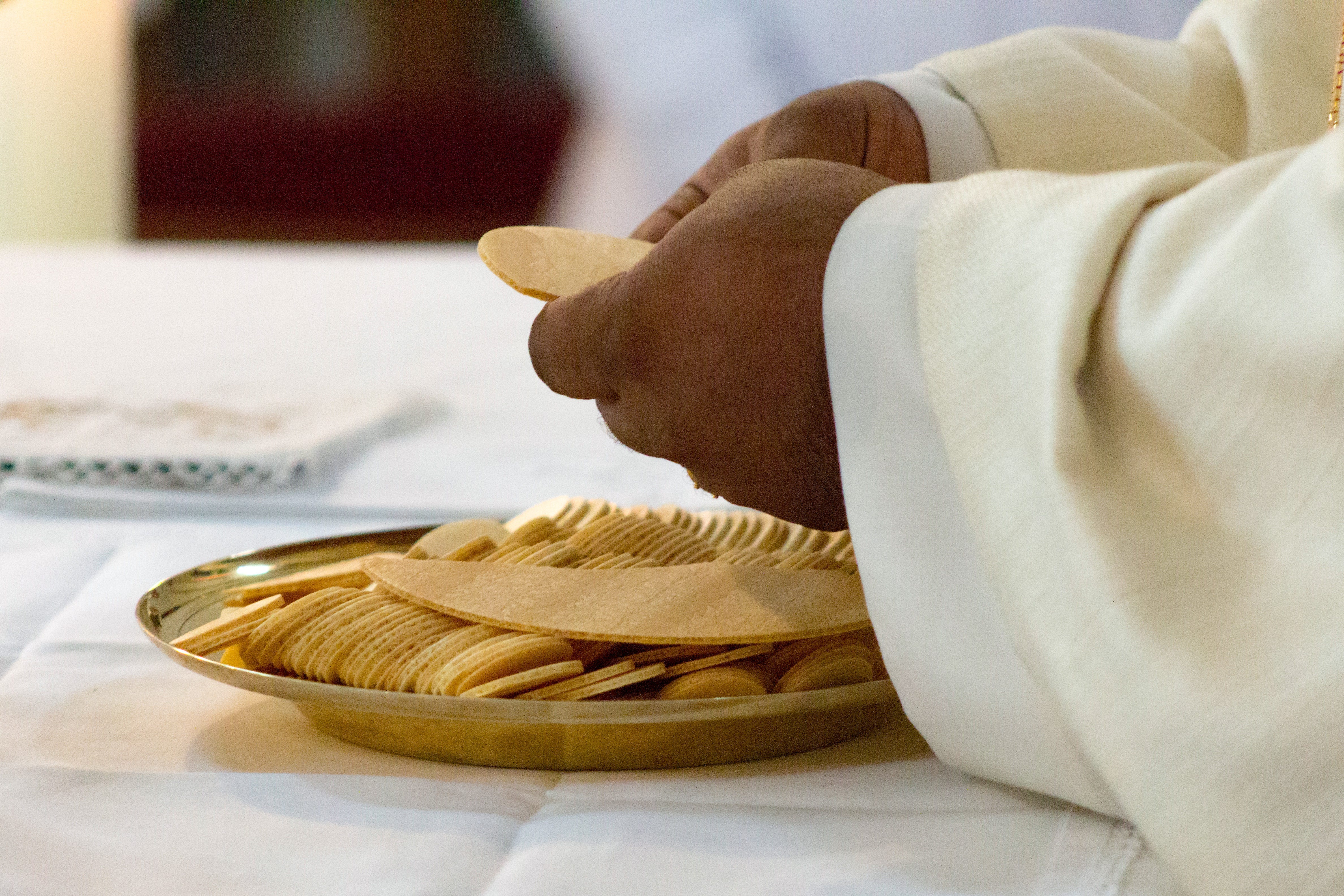
Celebration of the Eucharist | 2020
Key Terms for this Section
Christ · Epistle · Gospel · Ecclesia
The Nicene Creed · Trinity · Canon · The Great Schism
9.1 | Galilee & the Messiah
A Jewish Movement in Galilee
2,000 years ago, in a Roman-controlled, impoverished district in the north of Israel, a rabbi from the small village of Nazareth gathers a following of women and fishermen. It is the Jewish historian Josephus who is the first outsider to take note of this rabbi, six decades after his death (c. 93 CE), when he describes James’ execution as “the brother of Jesus, who was called Christ.” The first Romans to mention this rabbi (Pliny around 112 and Tacitus about 115) do so three generations after the events of his life. Rome hardly took any notice of Jesus during his lifetime.
And yet more than half of humanity today belongs to a tradition that honors him —
Christians as Lord. Muslims as prophet. Both call him Messiah (cf. Sec. 10).
• 6 CE | Judas of Galilee calls tribute money to Caesar a betrayal of God
• ca. 33 | A Roman prefect has Jesus of Nazareth tortured to death by crucifixion
• 40s | Barnabas and Paul teach Jews and Gentiles together. First called "Christians."
• ca. 49 | James and Peter agree with Paul: Gentile believers need not be circumcised
• 70 | The Second Temple in Jerusalem falls during the First Roman-Jewish War.
Christianity did not start out as a Western European religion, written in Greek and centered on Rome. That all comes much later. The movement eventually called Christianity began as a grassroots movement of Jews in the Roman-occupied Galilee. This first generation had no Christian Bible (and did not discuss having one), no church building, and no priesthood to define correct belief (Gr. orthodoxy). Many doctrines that are today considered essential to Christianity (eg. Original Sin, a formal theory of atonement, even Christmas) would take centuries to develop.
Put simply, the first followers of Jesus were Jewish.
Jesus certainly counts himself among the Jews. And as we zoom in on the activities of that first generation, we find his followers in Jewish activities, for Jewish reasons, following Jewish prophecies, led by a Jewish rabbi. When John baptizes, he is performing an immersion (Gr. baptisma) akin to a Jewish mikveh (cf. Sec. 8.4). When Jesus and his followers quote “scripture,” they are quoting the Hebrew Bible. Jesus often speaks of “the Law and Prophets...“ This is the Torah and Nevi’im of the Hebrew Bible we discussed in Sec. 8.1. Jesus quotes or alludes to the Hebrew Bible dozens of times in the Gospels, including the Psalms and all five Torah scrolls (particularly Exodus). In fact, he begins his public ministry reading Isaiah 61 in a synagogue.
Three social pressures we’ve already discussed shape this generation of Jews: the ongoing Roman occupation of Israel, the Jewish hope for a Messiah to end that occupation, and a Hellenistic apocalyptic expectation for a new beginning. The inner circle of Jesus arose out of those first-century pressures.
• Fishermen like Peter & Andrew and James & John were being taxed to the bone
• Philip & Nathanael hope for a Messianic future King of Israel “as the Nevi’im foretold”
• Mary of Magdala came a fish-salting town under the same economic pressures
• Jewish tax collectors like Matthew impoverished fellow Jews at the behest of Rome
• While Simon was a Zealot, fighting for Israelite independence from Rome
As a symbol of commerce and regional pride, fish became a powerful totem for early Christians. It represented everything the Jews of that region worked for, and what the Romans took from them to feed their occupying army. By the 200s, the ichthys fish will be the predominant totem of Christianity, centuries before the Latin cross.
The Christ
Herod the Great establishes a port at Caesarea (lit. ‘Caesar’s city‘) on Israel’s coast, later home to Rome’s governors. In Galilee, his son Herod Antipas rebuils Sepphoris, just four miles from Nazareth. Wealth flowed into these cities, leaving rural villages like Nazareth economically drained. Heavy taxation and Roman violence prompted a variety of political responses among the Jews.
Section 8 already introduced the Pharisees, Sadducees, and Zealots.
• The Sadducees collaborate with Rome, negotiating Jewish regional autonomy
• The Pharisees (out in the countryside) criticize Romans and Sadducean collaboration
• The Zealots assassinate Romans and collaborating Jews, aiming for Israelite independence through armed struggle
Here, in Section 9, we add two more factions to the board.
• The Essenes retreat to the desert, away from Roman and Sadducean influence
• The messianic movements hope for an anointed leader who will end the occupation
Some messianic and Zealot ideals overlapped: both hoped for a heroic figure (like Joshua, King David, or Judah Maccabee) who could lead a successful rebellion against Rome. The Zealot ideals of Judas of Galilee held that paying taxes to Caesar was a betrayal of God, Israel’s only king. In the spirit of fighting men like King David, the Zealots arm themselves and kill in defense of Israel, fighting the ongoing Hellenization of the Holy Land.
But under the yoke of imperial subjugation, the Biblical prophets had also leaned into the notion of radical pacifism — swords beaten into plowshares, a king who breaks the bow and speaks peace to the nations, and nations looking to Jerusalem for moral guidance. Later tradition gathered these hopes around a coming Messiah (Heb. mashiach, ‘anointed one’), in Greek Christos, the Christ. In that Messianic Age, the exiles return, their fortunes are restored, and the Jewish People know everlasting joy.
This is the context of the story of Jesus of Nazareth, whom Christians claim as the Messiah of Jewish prophecy. Jesus proclaims the Kingdom of God before the Romans have him tortured and killed, mocking him as ‘King of the Jews‘ — a rival to their Lord, Caesar (cf. John 19:12).
Born to a Jewish mother, Mary, Jesus was raised in the Jewish tradition of the Second Temple period (circumcised, studied Torah, and keeping its festivals). At about 30 years old, Jesus seeks out the ministry of John the Baptist. John is an apocalyptic figure admired by Jesus. John draws Jews out of the Hellenized cities of Israel, back to the purity of the Judean desert to proclaim a message far removed from the Roman mode of civilization. John’s message is that the Kingdom of God is here — in radical opposition to the Empire of Caesar (cf. Sec. 7.4).
For his defiance, John is beheaded by Herod Antipas, Rome’s client, who feared his popularity among Jews.
But John’s arrest does not end the Kingdom Movement. Jesus takes up the message. Whereas the crowds went out to John, Jesus goes to them, sending out (Gr. apostello) those he teaches to spread the message. After the Romans kill Jesus, his all-Jewish movement calls itself “the Way,” while opponents call it “a sect of the Nazarenes.” After Jesus is killed, the movement continues to meet in Jerusalem under Peter and, later, Jesus’ aforementioned brother, James (cf. Sec. 9.2).
The Letters of Paul | 47-64 CE
The earliest Christian writings describing Jesus are teaching letters, or epistles (Gr. epistolē), written by a Pharisee outside of Jesus’ inner circle, a man who never met Jesus in life, the Apostle Paul. Paul claims to have been sent (Gr. apostello) by the resurrected Jesus in a mystical revelation. He makes it very clear that he “did not confer with any human, nor did [he] go up to Jerusalem to those who were already apostles before [him]” (Gal. 1:16–17), for three years. Instead, Paul claims his authority (ie. apostleship) comes directly from his mystical encounter with the Christ.
Throughout his epistles, Paul never mentions a virgin birth or any of Jesus’ miracles. Paul’s Jesus is simply “born of a woman, born under the law.” What Paul does emphasize is that Jesus is the prophesied Messiah and Son of God. Rejecting Caesar’s world of idolatry, strife, and envy, Paul envisions the Kingdom of God succeeding Rome with righteousness, peace, and joy. He attributes Jesus’ death to “the rulers of this age.” Of his fellow Jews, the Pharisee Paul heaps endless praise.
For Paul, everyone in the world can now be united in the Kingdom of God through their faithfulness (Lt. fides) to Jesus. His epistles outline Jesus’ movement as dedicated to morality, faithfulness, and an apocalyptic sense that Jesus would soon return. But, most radically, Paul’s Jesus welcomed everyone into the Kingdom of God, not just Jews. By the mid-first century, Paul’s message had spread across the eastern Mediterranean, carrying the treasonous conviction that Caesar did not hold ultimate authority over the world.
Today, while some of Paul’s letters are lost, the surviving letters of Paul and his associates make up nearly half the books of the New Testament canon.
Key Terms for this Lesson: Christ · Epistle
9.2 | The Church in a Roman World
Paul & Jerusalem Meet | ca. 50 CE
At home in the Roman Empire, the Pharisee Paul interacts with Gentiles (non-Jews) who seek a relationship with the God of Israel but do not wish to commit to full Jewish practice (above all, circumcision). The covenant's mark (Sec. 8) carries real social cost: in a culture where Roman masculinity was paramount, circumcised men face ridicule for their covenant with God, and for most Gentiles the demands of the Jewish law were simply too much. So we have records of Gentiles who attended synagogues, were interested in the God of Israel, yet remained non-Jews. The book of Acts calls them Phoboumenoi, the "God-Fearers." Paul's message to them was simple: through Jesus, you do not have to become Jewish (ie. bound to the "works of the law") to belong to God's Kingdom.
So Paul stood up and with a gesture began to speak: “Fellow Israelites and others who fear God: listen!” Paul, Acts 13:16
Following Paul’s mystical encounter with Jesus, he goes off to Arabia for 3 years. After Jesus’ death, the remnant of the old Nazarene movement was in Jerusalem, initially led by Peter. However, over time, the Jerusalem leadership moved to Jesus’ more Torah-observant brother, James. The two sides meet in Jerusalem, where James outlines four requirements, in line with the Noahide Laws (Sec. 8.2), that Gentile converts must follow, but says “not to trouble” them with the rest of Torah. The peace is uneasy. When Peter later visits Antioch, Paul “opposed him to his face” for withdrawing from eating with non-Jews. Still, Paul’s ecclesia (Gr. ekklesia, ‘assembly,’ the word English Bibles translate ‘church’) and James’ Jerusalem church remain in fellowship. Within decades, their movement is known as Christianity.
The Synoptic Gospels | 70-85 CE
The 20 years after the Jerusalem Council were decisive.
Paul leaves for his third mission, writing epistles to the Corinthians, Galatians, and Romans. Paul is eventually arrested and shipwrecked, writing more epistles from prison. Around 64 CE, Peter and Paul are executed under Emperor Nero in Rome. The First Jewish-Roman War begins two years later in 66. And the first Gospel story of Jesus is committed to writing.
When the Romans declared victory over another devastated city, runners carried the “good news“ back to the Empire. That announcement was called an evangelion. It was Caesar’s word: an inscription of 9 BCE calls Augustus’ birthday the beginning of “good news” for the world. Paul and then Mark take this word for Jesus. The Old English translation of evangelion is gōdspel, our Gospel.
Thus, the Gospels are the Christian message of the good news of Jesus Christ.
Written against the backdrop of the Temple’s destruction, the Gospel of Mark is the first Gospel written. While dozens of gospels were written, only four are in the New Testament canon: the Gospels of Mark, Matthew, Luke, and later John.
The Gospel of Mark (or gMark) is short, direct, and written in plainer Greek than Paul’s schooled prose. Like Paul, this first Gospel omits Jesus’ birth and childhood. Instead, it opens with John the Baptist, and Jesus comes from Nazareth to be baptized by him. Unlike Paul’s letters, gMark’s Jesus is a healer and exorcist (performing 4 exorcisms and over a dozen other miracles). gMark’s Jesus also shows great concern for the poor, urging a rich man to sell what he owns and telling his disciples to feed the hungry crowd.
Jesus, looking at him, loved him and said, “You lack one thing; go, sell what you own, and give the money to the poor, and you will have treasure in heaven. Then come, follow me.” Gospel of Mark 10:21
The Gospels of Luke and Matthew each use gMark’s foundation but adapt it for distinct audiences. gLuke tends to emphasize poverty and marginalized women, while gMatthew frames the story of Jesus in the context of Jewish royalty. These two gospels hold the only birth narratives (Lat. nativitas) of Jesus in the New Testament. In gLuke, the angel Gabriel announces to Mary (Jesus’ mother) that she will give birth to the Messiah (in gMatthew an angel tells her betrothed, Joseph, in a dream). In gLuke, Mary lays her newborn in a lowly manger. In gMatthew, Jesus receives kingly gifts from visiting Persian priests.
Blessed are you who are poor, for yours is the kingdom of God. Gospel of Luke 6:20
The first three gospels (Mark, Luke, and Matthew) are known as the synoptic Gospels, as they can be “seen together“ (Gr. synopsis). All three share a similar portrait of Jesus’ last week: his arrest, trial, and crucifixion under the mocking Roman charge of “King of the Jews.” As the Romans torture Jesus to death, gMark and gMatthew show the soldiers making him a parody of imperial power, dressing him in a purple robe, crowning him with thorns, and (in gMatthew) putting a scepter in his hand.
The soldiers of the governor took Jesus into the governor’s headquarters, and they gathered the whole cohort around him. They stripped him and put a purple robe on him, and after twisting some thorns into a crown they put it on his head. They put a reed in his right hand and knelt before him and mocked him, saying, “Hail, King of the Jews!” Gospel of Matthew 27:27-29
Though gMark ends with an empty tomb, gLuke and gMatthew each add extended resurrection narratives. Women are the first witnesses at the tomb, and both accounts culminate in Jesus' physical reappearance among his followers. gLuke also describes Jesus later ascending into heaven.
The Gospel & the Romans | 100 CE
About three decades after the Jewish Temple’s destruction, the Gospel of John emerged with a markedly different perspective. About 90% of gJohn is found nowhere else in the Gospels. Why? Because 35 years after Jesus’ death, the second generation of Christians lived through the Roman-Jewish War (66–70). That was the audience of the Gospel of Mark. gMark’s generation was a mix of fewer Jews and more Gentiles, with dwindling access to the disciples (tradition places the disciple John in Ephesus into the 90s). While gMark and gLuke tend to lean more toward a Gentile audience, gMatthew leans more Jewish. However, the third generation of Christians was mostly Greek-speaking Gentiles, with no ties to the vanished Temple or the disciples.
The text of gJohn has no Jewish genealogy, birth story, or baptism. Instead, gJohn portrays Jesus as the Logos, a word at home in Greek philosophy. gJohn’s unique approach reflects an audience with a predominantly Greek worldview. In gJohn, Jesus speaks in long discourses and metaphors rather than the Jewish parables of the synoptic Gospels. This final gospel narrative stresses Jesus’ cosmic mission as Savior of the World rather than focusing on his Jewish ties to King David’s lineage (cf. gMatthew) or Jewish struggles against Caesar’s occupying empire (cf. gMark).
Lastly, while the synoptic depiction of Jesus shuns grandiose titles, gJohn’s Jesus speaks declaratively and unreservedly about his divine role. In seven “I am” sayings, the Gospel of John proclaims Jesus as “The Light of the World,” “The Good Shepherd,” “The Way, the Truth, and the Life,” and so on.
Jesus said to him, “I am the way and the truth and the life.
No one comes to the Father except through me. Gospel of John 14:6
For another century, the Christian movement remains small and largely hidden (less than 1% of all Romans).
A few times in those first centuries, Rome turned on the Christians. Why? Well, Rome could tolerate almost any god. After all, Jews had lived throughout the Roman Empire successfully, with an ancient exemption from sacrificing to Rome’s gods. Gentile Christians had no such standing. They shunned the Imperial Cult of Caesar, often at the edge of a sword, the mouth of a lion, or the flame of a torch. In imitation of Christ, they prayed for those who persecuted them and died without resistance.
Under Emperor Nero, when a fire broke out in 64 CE, Nero made the Roman Christians scapegoats for the blaze and had the believers killed in his gardens and circus (Tacitus). Persecution then flared locally for two centuries, turning empire-wide under Decius (250) and in the Great Persecution of Diocletian (ca. 303). However, within ten years, the Roman view of Christianity would be dramatically reversed.
Key Terms for this Lesson: Ecclesia · Gospel
9.3 | Constantine & the Creed
The Constantinian Shift | 313
For three centuries the Christians had been a small, sometimes hunted minority.
Their fortunes turned when a warlord had a dream.
• 312 | Constantine takes the Roman throne under the sign of the Christ (XP)
• 313 | The Edict of Milan: Christianity becomes legal across the empire
• 325 | The Council of Nicaea: the Son is “of one substance” with the Father
• 367 | Athanasius’ list: The 27 books of the Christian New Testament are decided
• 380 | Nicene Christianity: Theodosius makes Christianity the Rome’s official religion
In 312 CE, on the eve of battle at Milvian Bridge outside Rome, the warlord Constantine (d. 337) saw a sign of the Christ. He saw a sign blazing in the sky with the words “Under this sign, you shall conquer.” A dream then told him to mark his shields. Constantine awoke and painted the first two Greek letters of Christ (XPISTOS), the chi-rho (“XP”), on them.
He won the battle, the day, and soon after, the entire Roman Empire.
Following Constantine’s dramatic victory, he declared in the Edict of Milan that Christian identity and worship were legal. His changes had an enormous theological effect on Christianity known as the Constantinian Shift. While the early Church Fathers argued for Christian pacifism (cf. Sec. 9.2), Constantine recast the Christian God as the God of Military Victory. Moreover, Constantine began favoring Christians for high-ranking positions, Roman governorships, and even judicial roles. The emperor also took major funding from pagan temples and put it toward building massive Christian structures in tribute to his victory. When the requirements for pagan ritual in the Roman military ended, the enriched Roman Christian bishops decreed that, from now on, any Christian who refused to serve in the Roman legions could be excommunicated. Over the next century, half the empire joined the religion of their emperor. Led by Christian military officers, pagan ritual was banned entirely from the legions. By 416 CE, the Roman military was an exclusively Christian organization.
In short,
when the Roman empire became Christian, European Christianity largely became imperial.
Several Christianities
Outside of 4th century Rome, there had been different local Christianities with their own texts. Here are a few of the larger communities...
• The Ebionites (Hb. Poor Ones) traced their lineage back to the Nazarene Movement led by James (cf. Sec 9.2). Following their Gospel, they taught Jesus was Messiah but not God. They viewed Jesus as ‘adopted’ by God at baptism. Adoptionism was a popular theology among early Jewish-Christians. After the destruction of Jerusalem and the Temple in 70, many Ebionite Jewish-Christians fled east across the Jordan, toward Arabia, and carried their message there.
• The Marcionites taught Jesus was a divine manifestation of the God of Love, unrelated to the God of the Hebrew Bible. The lasting effect they had was their insistence on the development of a superior “New Testament” for Christian use.
• The Modalists (ie. Sabellianism) were nontrinitarian Christians who taught that Jesus was a ‘mode’ of God, not a divine persona, because God is inherently One. The Ebionites and other pre-Nicene Christian groups also did not subscribe to the later Nicene concept of the Trinity.
• The Gnostics (ie. mystics) taught Jesus was a divine being who only appeared human to give humanity secret knowledge of its own divine nature. Among their scriptures was the Gospel of Thomas (parts of which may predate gMark). Their movement eventually went east into Persia.
• The Arians, the most popular rival to the Nicene caucus, taught Jesus was God’s Son, created by God and subordinate to God. The theology of Arius travelled north and west of Rome, where it gained traction among the Goths in France and Spain well into the 500s.
• And there was the Roman Church, who had the support of the emperor. The Church in Rome, who traced their lineage to Peter, taught that Jesus was both fully human and fully divine. This claim is foundational to the theology of the Trinity.
The Nicene Creed | 325-381
Turning back to Constantine: in 324, Constantine defeated his co-claimant to the throne in the Roman East. In this way, Constantine unified the fracturing empire politically. But the people’s hearts were still divided.
So in 325, Constantine called on all Christian bishops throughout the empire to meet at Nicaea (today, a city in Türkiye). There, the divisions among Christians were debated and decided on. Out of that debate came the Nicene Creed, the central statement of correct Christian belief, backed by the Roman emperor and intended for all of Christendom.
The Nicene Creed (325)
We believe in one God, the Father Almighty
• against Marcionism: there is only one God; no inferior Jewish God
Maker of all things visible and invisible.
• against Gnosticism: same God of both the spiritual & physical realms
And in one Lord Jesus Christ, the Son of God, begotten of the Father.
• against Ebionites: Jesus as the begotten, not adopted, Son of God
Begotten, not made, of one substance with the Father
• against Arius: Jesus is Creator, not part of the creation
Who for us, and for our salvation...
• against Gnosticism: salvation not based in secret, mystical knowledge
...came down and was incarnate and was made man.
• against Gnosticism: Jesus as fully human, not just spirit
He suffered, and the third day he rose again, ascended into heaven.
• against Marcionism: Jesus went through true, human suffering
From thence He shall come to judge the quick and the dead.
• against Ebionites: Jesus has divine authority to judge us in the Afterlife
And [we believe] in the Holy Spirit.*
• against Modalism: the Holy Spirit as a distinct personality, not a mode
In the Council’s wording, Jesus is “of one substance” (Gr. homoousion) with God. For Nicene Christians, Jesus the Son shares God’s very being (ie. “begotten, not made”). *However, the first draft of the Creed ends simply on the Holy Spirit. By the 360s, a new heresy had developed which taught that the Holy Spirit was a kind of ministering angel subordinate to God. So, in 381, the Nicene Creed was expanded. Part of that expansion explained that the Holy Spirit “with the Father and the Son together is worshipped and glorified.” This is the theology of the Trinity, that God is three consubstantial persons: the Father, the Son (Jesus Christ), and the Holy Spirit.
The 381 Creed, authored at the First Council of Constantinople, also affirms belief in “one holy catholic and apostolic church.” Note here that the Greek word ‘catholic’ simply means universal in this case. The four marks of the Church thereafter are:
• One: There is only one true Church
• Holy: The One Church is set apart (ie. sacred) by God for a special purpose in the world
• Catholic: The One Holy Church is universal (Gr. katholikos) — for all people
• Apostolic: The One Holy Catholic Church is derived from Jesus and the bishops
Key Terms for this Lesson: The Nicene Creed · Trinity
9.4 | Canon & Schism
Christian Canon | 367-397
After the Nicene Creed had been decided in 325, Christian theologians spent the next seventy years debating Marcion’s notion of a unified Christian scripture. For the first three centuries of Christianity, each regional church had largely curated its own scripture. There were dozens of gospels and scriptures beloved by diverse communities of believers.
Syrian Christians taught from the Didache and the Clementine Writings. Christians in Egypt read the Gospel of the Egyptians, often alongside the more esoteric Apocryphon of John and the Gospel of Mary. Christians in Rome read the Shepherd of Hermas which served as an allegory of repentance. Christians in Israel read the Apocalypse of Peter. In Greece, the church at Corinth read 1 Clement aloud. And in France, Christians learned from the writings of Irenaeus of Lyons, who cited the Shepherd as scripture.
Before there was a unified Church, there was little need for a unified canon. But that changed after the Council of Nicaea.
A canon is a set of texts agreed to be authoritative for a community. Over the centuries, agreed upon criteria for a Christian canon began to surface in theological debates. A Christian text could be considered scripture if it had apostolicity (roots in the apostles), catholicity (used by the whole church, not one region), and orthodoxy (agreement with the rule of faith).
By the mid-200s, the four gospels of Matthew, Mark, Luke, and John had been more or less decided upon (first championed by the aforementioned Irenaeus). In 367, the bishop Athanasius was the first to list 27 particular books as belonging to the Christian canon. North African bishops then held a Synod in Hippo (an African port city) in 393 to decide on the canon officially.
The gathered bishops kept the Greek ordering of the Hebrew Bible (the Septuagint’s, cf. Sec. 7.4), placing the prophetic writings at the end (in the earlier Jewish canon, the Nevi’im are in the middle of the Bible). The four Gospels then headed the New Testament, followed by the Acts of the Apostles, Paul’s Epistles, and then the General Epistles. The decided arrangement was thematic rather than chronological. A later meeting at Carthage, in 397, confirmed the list, including the long-disputed Book of Revelation.
Some adherents who revered non-canonical texts objected, but under Roman authority, the official list prevailed. Eventually, the Western churches coalesced around this canon, while older communities, like those in Syria or Egypt, held onto their books (eg. the Didache) as edifying scripture.
Today, there are several authoritative lists of Christian canon, though near universal consensus on the inclusion of the same 39 Old Testament texts and 27 New Testament texts.
Roman Canon, 397: 73 books
(39 Hebrew + 27 New Testament + 7 Deuterocanonical books)Syriac Canon, 411: 61 books
(39 Hebrew + 22 New Testament, omits Rev., 2 Peter, 2 & 3 John, and Jude)Armenian Canon, 506: 77-79 books
(39 Hebrew + 27 New Testament + 11-13 Intertestamental books)Ethiopian Canon, 640 (fall of Egypt): 81 books
(39 Hebrew + 27 New Testament + 15 additional books, eg. 1 Enoch)Orthodox Canon, 692: 76-81 books
(39 Hebrew + 27 New Testament + 10-15 Greek additions, eg. 3 Maccabees)Protestant Canon, 1534 (Luther Bible): 66 books
(39 Hebrew + 27 New Testament; Apocrypha set apart, later dropped)
Original Sin & Atonement
After centuries of serious debate over scriptural authority, Western Christian theology began to stabilize with the writings of St. Augustine of Hippo (d. 430). Among his influential ideas was the theology of Original Sin, the claim that humanity inherits a sinful disposition from Adam and Eve’s original disobedience. This fundamental theological view posits that baptism and God’s grace are essential to overcoming one’s moral corruption (ie. you can’t be a good person without God). With the Christian doctrine of Original Sin in place, the atonement of sin became a critical question for the Church.
While there was no question how the Romans crucified Jesus, the ultimate, theological reason why he was crucified was far from settled. The Early Church Fathers like Irenaeus and Origen championed Ransom Theory: claiming that humanity was held captive by Satan due to our sinful nature and the crucifixion set us free. But later theologians would argue this made Satan too powerful. A later Medieval theologian, Anselm of Canterbury (d. 1109), introduced Satisfaction Theory, where Christ repays the honor owed to God that humanity could not. This set the stage for Peter Abelard (d. 1142), who systematized the long-held Moral Influence Theory idea that Jesus’ suffering was a vivid demonstration of divine love meant to inspire moral change in believers. Finally, in the modern era, two new theological views arose. The lawyer John Calvin (d. 1564) described Penal Substitution Theory, asserting that Christ bore the penalty owed by humanity for sin, thus satisfying God’s justice so that believers would be saved from eternal damnation. Later, the Dutch jurist Hugo Grotius (d. 1645) developed Governmental Theory, arguing that Christ’s death served as a profound demonstration of divine justice, showing us by example that forgiving sin does not compromise the moral order of society.
We will further explore the theology of Martin Luther and John Calvin in Section 11.
Medieval Church & Schism
In 410 CE, the Germanic Goths sack Rome. Constantinople then becomes the preeminent Christian city in the world.
In 431, the Church of the East (ie. Persian and Indian Christians) splits off from the imperial Church over theological and political differences. In 451, the Oriental Orthodox Church (incl. the Egyptian Coptic, Syriac, and Armenian churches) does the same. What’s left of the Church in the 500s are the Latinate Western Christians (answering to Rome) and the Greek Eastern Christians (answering to Constantinople).
In 527, Emperor Justinian takes the Constantinopolitan throne, seeking to recapture lost territories and strengthen Christianity’s clout. He closes Plato’s Academy (529), marking the beginning of the Middle Ages. He also creates the famous Justinian Law Code (with principles like contract law, property rights, and procedural fairness), fusing the old Roman laws with the growing body of Christian law.
In the 600s, the Muslim world begins to show up on Christian maps (cf. Sec. 10). In 711, a Muslim army crosses from North Africa and takes Spain from the Christian Goths, developing Islamic culture in Spain for nearly 800 years. For much of the Middle Ages, Mediterranean power would be balanced between:
Eastern Christians: the Byzantine Empire centered in Constantinople (Türkiye)
Eastern Muslims: the Abbasid dynasty centered in Baghdad (Iraq)
Western Muslims: the Umayyad dynasty centered in Córdoba (Spain)
Western Christians: the Latin Church centered in Rome (Italy)
Despite constant antagonism from neighboring tribes, the Bishop of Rome continues to press his advantage. Having established missions in Ireland (400s) and England (600s), Rome presses on with successful missions to Germany in the 700s and Northern Europe in the 800s. On Christmas Day, 800, the Bishop of Rome crowns king Charles of the Franks as the first emperor of what became known as the “Holy Roman Empire.” Charlemagne (Fr. Charles the Great) then provides Rome with converts and tax revenue, while Rome provides Charles with an authentic claim to the long-lost Roman throne of Caesars and emperors. Constantinople was not amused.
What was once One Church was now a bitter rivalry between the Latinate West and the Byzantine Greek East. The title “Pope” (Papa) had been an honorary title of respect for senior bishops. Leo the Great (d. 461) was the first to build a legal argument that the Bishop of Rome held supreme authority over the Church (cf. Matt 16:18). Pope Gregory the Great (d. 604) then rebuked Constantinople’s patriarch for the title “universal bishop.” After the crowning of Charlemagne by Pope Leo III (d. 816), it was clear that Rome no longer needed Constantinople.
In 1054, the inevitable finally happened.
What began as a theological dispute ended with the legates of the Roman Pope and the Patriarch of Constantinople excommunicating one another from Christendom. Afterward, the Christian West recognized the Pope as the undisputed head of the one holy catholic and apostolic Church. The Western Church came to be known as the Roman Catholic Church.
Meanwhile, the patriarch of Constantinople continued to work with other cities’ patriarchs as his office had always done, believing they continued to serve Christendom with the “correct beliefs” (Gr. orthos doxa). The Eastern Church came to be known as the Orthodox Church. The earth-shattering split between the Catholic West and the Orthodox East became known as the Great Schism of 1054.
Key Terms for this Lesson: Canon · The Great Schism
Recommended Sources
Robert Louis Wilken, The First Thousand Years: A Global History of Christianity
Bart D. Ehrman, The New Testament: A Historical Introduction
Kallistos Ware, The Orthodox Way
Robert Louis Wilken, The Spirit of Early Christian Thought
Larry W. Hurtado, Destroyer of the gods: Early Christian Distinctiveness in the Roman World
Last Section: Judaism
This Section: Christianity, Pt. 1
Next Section: Islam