

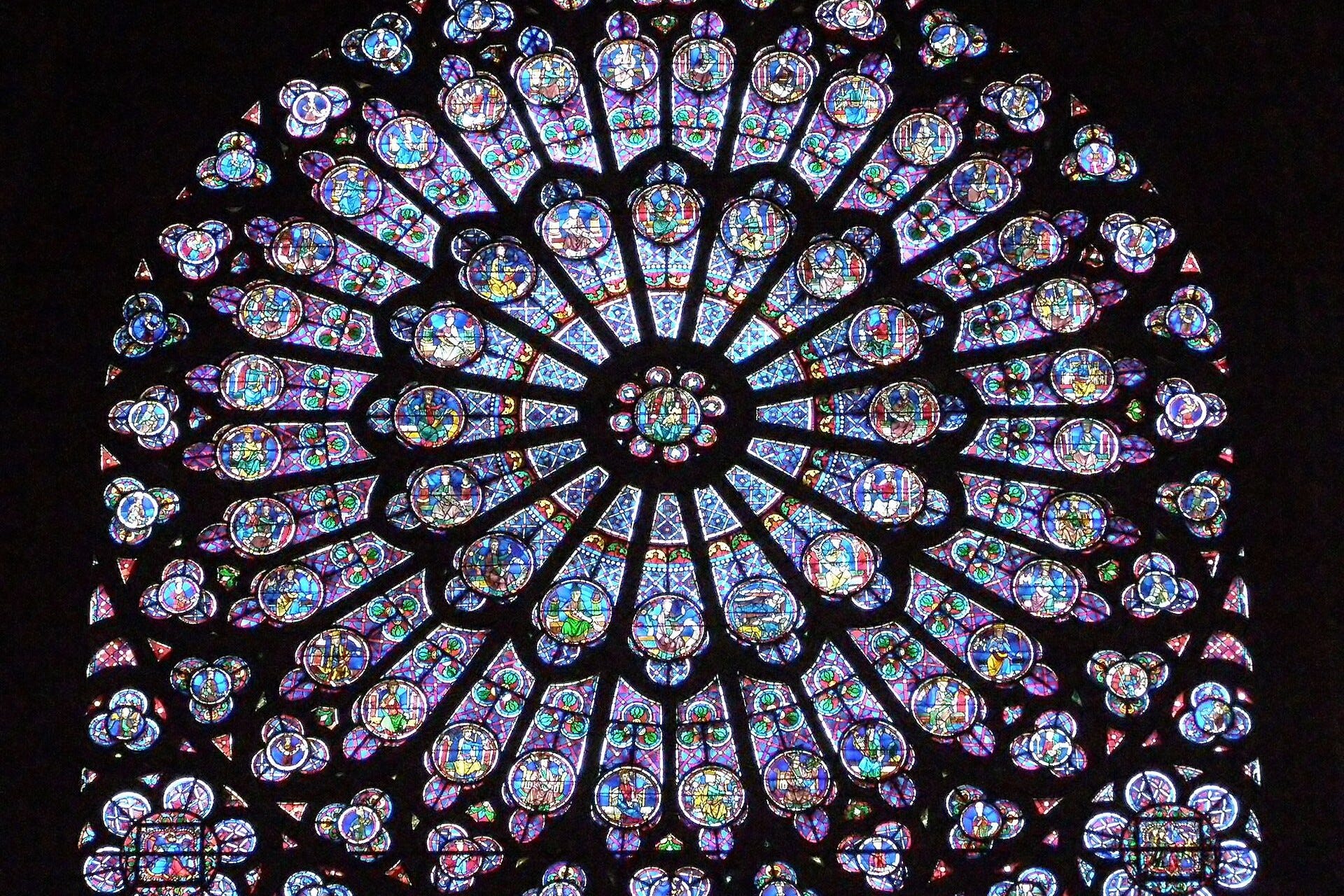
A Rose Window of Notre-Dame | Paris, 13th century
Notre-Dame Cathedral | Photo Credit: Wikimedia Commons
Overview
This is the one section of the course whose greatest object is the place itself. On Saturday morning we will stand inside Notre-Dame, and four of the five ideas below were invented in it or for it; Westminster Abbey is its English answer. Five ideas organize this section, and each is an exam term.
Key Terms
Gothic · Flying Buttress · Stained Glass · Scholasticism · Notre Dame School
Timeline
• 1144 | Suger’s choir at Saint-Denis is consecrated
• 1163 | Paris begins Notre-Dame
• ca. 1200 | Léonin and Pérotin sing at Notre-Dame, and the university is born
• 1215 | King John seals Magna Carta
• 1245 | Henry III begins rebuilding Westminster Abbey
Gothic | Suger & the Theology of Light
The Romanesque church was built of stone to last, but its thick walls allowed only small windows. In the 1140s, builders in France found a way to raise the walls higher and open them to light. It began with an abbot. Suger ruled the royal abbey of Saint-Denis, just north of Paris, where the kings of France were buried and where pilgrims came to honor the relics of Saint Denis. Suger rebuilt it. His new choir, consecrated before the king in 1144, ringed the altar with chapels whose walls were almost all window. This was the beginning of the Gothic, the style of the High Middle Ages, built with pointed arches, ribbed vaults, and walls of glass. The name was an insult. Renaissance critics called the style “Gothic,” as if the barbarian Goths had built it. Abbot Suger had a “theology of beauty.” He drew it from the writings of Pseudo-Dionysius, a Neoplatonist whom his age believed to be Saint Denis himself. In Suger’s view, the closer you get to light, the closer you get to God. Saint-Denis is not on our route, but its treasury is: the Revolution carried it to the Louvre. Suger’s Eagle in Room 502 is an ancient vase of purple stone that the abbot had mounted with the head and wings of a gilded eagle; look for his own Latin inscription around the neck. Two rooms on, the abbey’s manuscript of Dionysius is a Greek copy of the very writings Suger loved, a gift to Saint-Denis from the emperor in Constantinople; look at its cover, set with carved ivory. Within a generation, every bishop wanted a Gothic church. Paris began Notre-Dame in 1163, and work on it went on for about a century. Stand in front of the west front of Notre-Dame before you go in, and read it from the ground up: three carved doorways, a row of kings, a rose window, and two towers. The same Paris workshops carved smaller things. In the Louvre, King Childebert is a limestone king more than six feet tall from the abbey of Saint-Germain-des-Prés; look at how he stands free of any column, a statue learning to be a person again. The Gothic crossed the Channel with a king. Henry III rebuilt Westminster Abbey from 1245 in the French manner, with the tallest nave in England, to honor Edward the Confessor; look up as you enter, and follow one stone rib from the floor to the crown of the vault.
Flying Buttress | The Cane That Holds the Wall
The pointed arch carried the weight of the stone vault down more steeply than the round Roman arch, and stone ribs gathered that weight onto a few points. But a high vault still pushes outward, and thin walls cannot hold it alone. The flying buttress is an arched brace outside the building that carries the outward push of the vault down to a pier of stone. The flying buttress is like the cane holding up the structure. Notre-Dame’s, built around 1180, are among the first, and they let the walls rise and open. To see them, do what few visitors do and walk around the building. From the garden behind the east end of Notre-Dame, the church looks like a ship with its oars out; count the arches springing from the outer piers to the top of the wall, and notice that every one of them is doing work. Westminster has them too. On the north side of the Abbey, and over the cloister on the south, Henry III’s masons threw the same arches across the aisle roofs to hold up the tallest vault in England. A town built a cathedral over generations because the cathedral was the center of its whole life. It had an area similar to a town square, where the community gathered. It was a center of education, with schools and later universities attached. It held church courts, which were sometimes more trusted than civil courts. It cared for the sick, orphans, and the poor. Pilgrims came to honor relics and bought badges and little flasks to carry home (an ancestor of the souvenir), and their gifts helped pay for the building. The relics themselves were kept in caskets like the British Museum’s Becket casket in Room 40, made of gilded copper and blue enamel in Limoges about 1200 to hold a relic of Thomas Becket, the archbishop murdered in Canterbury Cathedral in 1170; look on the front for the knights with drawn swords and the archbishop at his altar. In front of the high altar at Westminster, Henry III laid a floor fit for such relics: the Cosmati pavement of 1268, made by craftsmen from Rome out of thousands of pieces of purple and green stone and glass; look for the great circles looped inside a square.
Stained Glass | Windows of Light
Stained glass is colored glass set in lead strips to make pictures in a window, so that light itself carries the image. To see a window properly, you stand inside the church with the sun behind it. The viewer is literally bathed in light, looking at a scene from scripture or the life of a saint. The purpose of the windows was to teach and edify. Back in 600 CE, Gregory the Great had written that pictures do for those who cannot read what books do for those who can. At Chartres, along the bottom of dozens of windows, the donors appear at work: bakers, butchers, shoemakers, and money-changers. We will not see Chartres. We will see three of the greatest windows in the world. The rose windows of Notre-Dame, one over the west door and one at each end of the crossing, were made between about 1225 and 1260, and all three came through the fire of 2019. The anchor image above is one of them. Stand under the crossing and turn from the north rose to the south: each is more than forty feet across, a wheel of stone so thin that the wall seems to be made of colored light. Look for the center of each wheel, where Mary or Christ sits, and then follow the rings outward through prophets, kings, and saints. Gothic decoration often served two purposes at once. The gargoyles that jut from the walls are, functionally, spouts for rain water, carrying it away from the foundation. Some read their monstrous faces as a sign that evil flees from the sacred. Louis IX, the king who reigned while those roses were made, built a chapel in Paris that is almost nothing but glass, the Sainte-Chapelle, and one of its treasures is in the Louvre’s Room 503. The ivory Virgin and Child of the Sainte-Chapelle, carved about 1260, is sixteen inches of the same court style: look at the curve of her body, which follows the curve of the elephant’s tusk, and at her smile. A cathedral was a building, a book, and a town square in one, and it was worth a hundred years.
Scholasticism | Faith & Reason
For six centuries, Western Europe knew Aristotle mostly through a few books of logic. Then, in the 1100s, the rest arrived. Aristotle came back to the Latin West partly from the Greek and partly through the Arabic, with the commentaries of Muslim philosophers attached. The books arrived just as a new institution was taking shape. Teachers and students in Paris, Bologna, and Oxford formed guilds of learning, and by 1200 the university (Lt. universitas, a whole body or guild) had been born. There was a new demand for an educated class of lawyers and officials to manage the growing towns and kingdoms. Scholasticism was the method of the medieval schools: the systematic integration of theology and philosophy through the logical analysis of questions. Scholasticism treats faith and reason as separate but complementary paths to truth. If the most important early medieval thinker was Augustine, the most consequential late medieval thinker was Thomas Aquinas. Thomas was a Dominican friar and a master at the University of Paris. Like the other schoolmen, Aquinas called Aristotle simply “the Philosopher.” His Summa Theologica represents one of the most ambitious philosophical efforts of the Middle Ages. Every article follows the same form. It asks a question. It lists the strongest objections against Thomas’ own answer. Then he gives his answer and replies to each objection in turn. The scholastic method begins by taking the other side seriously. The university of Paris grew up on the hill across the river from Notre-Dame, the hill where we will eat lunch on Sunday, and its masters carried their training everywhere. One of them, Stephen Langton, left his Paris classroom to become archbishop of Canterbury and helped shape Magna Carta, sealed by King John in 1215 and kept at the British Library; look at the single sheet of close Latin, in which a king is told, clause by clause, what the law forbids him to do. The Arabic science that came with Aristotle is in the British Museum’s Room 40. The brass astrolabe of 1326 is the oldest dated one made in Europe; set it beside the astrolabe from the Islamic gallery in your mind, and you are looking at a lesson learned.
Notre Dame School | Voices Added to the Chant
The chant of Charlemagne’s churches was monophony: one melodic line. But music in this period was changing. When two or more independent melodic lines sound at once, the music is polyphony (Gr. many voices). Organum is the earliest kind of Western polyphony, in which one or more voices are added to a Gregorian chant. In 1163, Paris began its great new cathedral, Notre-Dame. Its singers became the most important composers of the age. The Notre Dame School was the circle of composers at the cathedral of Notre-Dame in Paris, ca. 1160–1250, who developed organum into a large and rhythmic art. We know their names from an English student who wrote about them around 1275. He calls Léonin “the best composer of organum” and credits him with the Magnus Liber Organi, the Great Book of Organum, two-voice settings of the chants for the great feasts of the church year. His successor, Pérotin, wrote for three and even four voices. Why add voices? To make the greatest feasts sound as splendid as the new cathedral looked. In Notre Dame organum, the lowest voice is the tenor (Lt. tenere, to hold): it holds the chant in long notes, while the upper voices move above it in quick, repeating rhythms. The old chant is still there, the foundation under everything, stretched so long that a single syllable can last for minutes. Later composers gave the upper voices words of their own, and the result was the motet. No object in a case can show you this, because the instrument was the building. The choir of Notre-Dame is the room this music was written for, finished in 1182 while Léonin was at work; stand at the crossing, look east down the choir to the apse, and picture a handful of men singing from one great book on a stand. The stone vault that the flying buttresses hold up is also what makes a note last. In Paris, around 1200, the architecture and the music were one invention: both took something single and old, a wall or a chant, and opened it into many parts that hold each other up.
Go Deeper
Culture & Values, 8th ed., Chapter 10, The High Middle Ages (pp. 303 to 339).
Where to Find These Artifacts
London
• Westminster Abbey, Henry III’s Gothic church: Westminster Abbey
• Cosmati pavement: Westminster Abbey, before the high altar
• Becket casket: British Museum, Rm 40, Medieval Europe, Case 10
• Astrolabe of 1326: British Museum, Rm 40, Medieval Europe, Case 10
• Magna Carta: British Library, Treasures Gallery
Paris
• West front of Notre-Dame: Notre-Dame Cathedral
• Flying buttresses of Notre-Dame: Notre-Dame Cathedral, east end
• Rose windows of Notre-Dame: Notre-Dame Cathedral, crossing & west wall
• Choir of Notre-Dame: Notre-Dame Cathedral
• Suger’s Eagle: Louvre, Richelieu 1, Rm 502, Case 15
• Virgin & Child of the Sainte-Chapelle: Louvre, Richelieu 1, Rm 503, Case 15
• Manuscript of Dionysius from Saint-Denis: Louvre, Richelieu 1, Rm 504, Case 10
• King Childebert: Louvre, Richelieu 0, Rm 203, Gothic Sculpture
Module III • Cathedrals & Masterpieces
Sec 10 • High Middle Ages
Sec 11 • Late Middle Ages
Sec 12 • The Renaissance
Course Page: Humanities: Study Abroad | London & Paris