

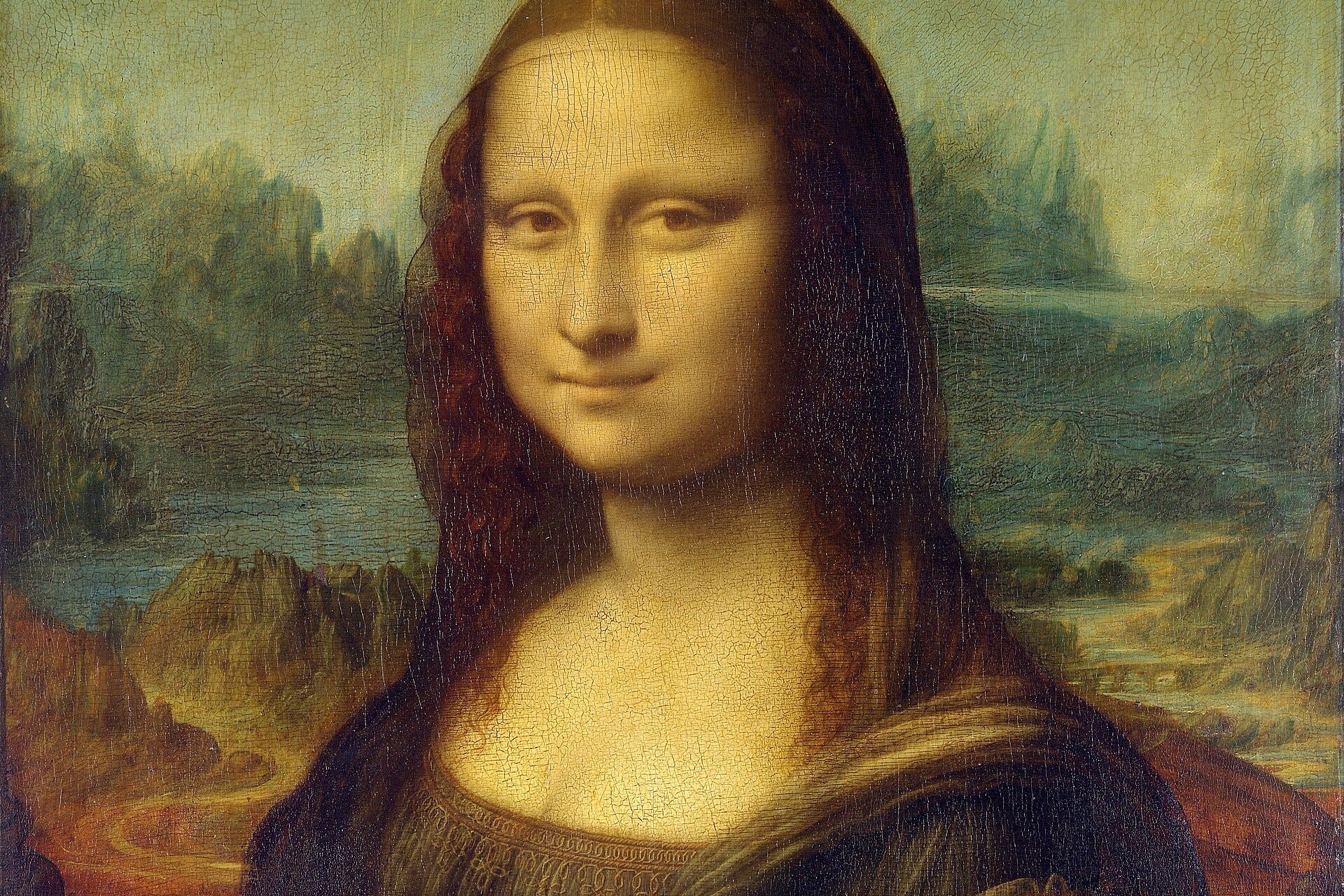
Mona Lisa | Leonardo da Vinci, Florence, begun ca. 1503
Louvre | Photo Credit: C2RMF via Wikimedia Commons
Overview
In the fifteenth century, Italians went back to the books and ruins of Greece and Rome and came away with a new confidence in what a human being could know and make. That confidence hangs in the National Gallery and the Louvre, often in the same painter’s hand. Six ideas organize this section, and each is an exam term.
Key Terms
Humanism · Linear Perspective · Oration on the Dignity of Man · Sfumato ·
the High Renaissance · In Praise of Folly
Timeline
• 1435 | Alberti writes down the rules of perspective
• 1486 | Pico writes the Oration on the Dignity of Man
• 1503 | Leonardo begins the Mona Lisa
• 1511 | The Praise of Folly is printed in Paris
• 1520 | Raphael dies in Rome
Humanism | Back to the Sources
Humanists like Petrarch and Erasmus took another look at long-forgotten Greco-Roman ancient texts, not just philosophy but the literature and theater of antiquity. They marveled at our past achievements and dared to wonder what humanity might be capable of. In 1333, Petrarch found a forgotten copy of Cicero’s speech for the poet Archias, which praised the studia humanitatis, the studies of humanity. Humanism is the Renaissance movement to recover the languages, books, and ideals of Greek and Roman antiquity, and to educate citizens through the studies of humanity: grammar, rhetoric, poetry, history, and moral philosophy. Their motto was ad fontes, to the sources. The humanists kept the old liberal arts but gave them a new center. The universities trained students in logic for the disputations of Scholasticism. The humanists trained them to write and speak like Cicero. Humanism was a revolution in education before it was a philosophy. In the Louvre, a fresco that Botticelli painted for a villa outside Florence turns that education into a ceremony: in A Young Man Being Introduced to the Seven Liberal Arts, a woman leads a young Florentine by the hand toward a circle of seated women, the Liberal Arts themselves; look for the objects they hold, each the tool of her art. Then came Greek. In 1397, Florence hired the Byzantine scholar Manuel Chrysoloras to teach it. When Constantinople fell to the Ottoman Turks in 1453, Greek scholars and their books came west. Within two generations the new learning had crossed the Alps. In Paris, Jean Clouet’s portrait of François I shows the king who appointed royal lecturers in Greek and Hebrew in 1530; look at his hands, one resting on the hilt of a sword and the other holding a glove, a soldier who wished to be seen as a man of taste. In London, Holbein’s The Ambassadors sets two young Frenchmen, a diplomat and a bishop, on either side of a shelf of the new learning: a celestial globe, sundials, a book of arithmetic, a lute, and a hymnbook. Look for the lute’s broken string, and then notice the long smear across the floor between the two men. We will come back to it.
Linear Perspective | The World as the Eye Sees It
Florence began its new cathedral, Santa Maria del Fiore, in 1296. In 1367 the city approved a plan for an eight-sided dome some 140 feet across, about as wide as the Pantheon in Rome, and it was to stand without the flying buttresses of the Gothic north. No one alive knew how to build it. Florence built a cathedral when they did not know how to build the roof because they trusted that their own genius would find a way, and the man who found it looked back to Rome to do it. Filippo Brunelleschi was a goldsmith who went to Rome, Vasari says, to measure the ruins. In 1420 he won the competition for the dome, and the dome was closed in 1436. Brunelleschi also worked out how to paint the world as the eye sees it. Linear perspective is the system of drawing in which parallel lines meet at a single vanishing point, so that a flat picture shows depth as the eye sees it. Leon Battista Alberti wrote down the rules in 1435, and painters across Italy learned them. In the Louvre’s Salon Carré, a few steps from Cimabue’s wall of gold, Fra Angelico’s Coronation of the Virgin sets heaven at the top of a staircase; look at the steps of colored marble, each one narrower than the one below it, climbing to the throne. In the same room, Uccello’s Battle of San Romano shows a Florentine captain leading a counterattack; look at the lances, tilting down one after another like the hands of a clock, and at the horses on the right, seen from behind and shortened as they turn away from you. In London, Piero della Francesca’s Baptism of Christ is the work of a painter who later wrote his own book on perspective; look behind Christ for the man pulling his shirt over his head, and beyond him for the robed figures who grow smaller with every step into the valley. Crivelli’s Annunciation, with Saint Emidius is perspective as a show of skill; look down the street on the left, where every cornice and paving stone runs toward one point, and then find the apple and the gourd at the bottom edge, which seem to hang out of the picture into the room. The smear on Holbein’s floor is the same science turned inside out. Stand at the right edge of The Ambassadors and look back along the panel, and the smear becomes a skull.
Oration on the Dignity of Man | No Fixed Seat
Giovanni Pico della Mirandola was a young count who studied canon law at Bologna, Aristotle at Padua and Paris, and Hebrew with Jewish teachers, and who read Plato with Ficino’s circle. In 1486, at twenty-three, he published nine hundred theses drawn from Latin schoolmen, Arab philosophers, Greek Platonists, and Jewish mystics. He offered to pay the travel of any scholar who would come to Rome and debate him on any of them. Pico offered to debate all of Rome because he believed that every school, Plato’s and Aristotle’s, Christian, Jewish, and Arab, held a part of one truth, and that a free mind could gather them into one. The pope condemned all nine hundred, and Pico fled to France, where he was briefly held. He came back to Florence under Lorenzo’s protection. Pico wrote a speech to open the debate, and it was never delivered. The Oration on the Dignity of Man is Pico’s speech arguing that human beings, alone among creatures, have no fixed place in the world and may make of themselves what they choose. Pico imagines God speaking to Adam: “We have given you, Adam, no fixed seat, no form of your own, no gift peculiar to you, so that whatever seat, whatever form, whatever gifts you yourself shall choose, you may have and possess them by your own wish and judgment.” Adam, Pico’s God goes on, may sink to the beasts or, by his own soul’s judgment, rise to the divine. No object in London or Paris belonged to Pico, but a boy who grew up in Lorenzo’s household in those same years carved the idea in marble. In the Louvre, Michelangelo’s Dying Slave and Rebellious Slave were made for the tomb of Pope Julius II and never used. One figure sinks into sleep and the other twists against his bonds; look behind the Dying Slave’s leg for the rough shape of an ape, which Michelangelo left half cut in the stone. In London, Michelangelo’s The Entombment was also left unfinished; look for the bare patch at the lower right, where the kneeling Virgin was never painted, and at the body of Christ, carried upright like an athlete’s. In both cities the human body is the subject, and the stone and the panel still show a maker choosing what it will become.
Sfumato | Painting as Research
Leonardo da Vinci is often called the genius of the Renaissance. Trained in Florence, he went to Milan in 1482 to serve its ruler, and there he painted the Last Supper on the wall of a convent dining hall. Giotto had given painted bodies weight. Leonardo wanted to know how that weight was carried, and he studied the bones and muscles beneath the skin and the proportions of the body. His notebooks, some 7,000 pages in mirror script, also hold flying machines and plans for an ideal city. Yet fewer than twenty paintings by his hand survive. Leonardo finished so few paintings because, for him, painting was a form of research, and the research was never done. He kept his portrait of a Florentine merchant’s wife, the Mona Lisa, with him for years, softening it. Sfumato, from the Italian for smoky, is Leonardo’s technique of blending tones so softly, without hard outlines, that forms seem to emerge from shadow, as at the corners of the Mona Lisa’s mouth. In 1516 he crossed the Alps to serve François I and carried the portrait with him, which is why it hangs in Paris. You will see it from behind a barrier; look at the corners of the mouth and the eyes, and try to find a line. Leonardo painted The Virgin of the Rocks twice, and we will see both. The earlier version is in the Louvre’s Grande Galerie; look for the angel’s hand, which points across the picture at the infant John. The later version is in the National Gallery; the pointing hand is gone, and the figures rise out of a darker, colder cave. Near the Paris version hang two paintings he kept until his death. In The Virgin and Child with Saint Anne, look at the blue mountains behind the figures, which dissolve into air. In Saint John the Baptist, there is almost nothing but sfumato: a smiling figure and a raised finger coming out of the dark. In London, the Burlington House Cartoon is a full-size drawing in charcoal and chalk on eight sheets of paper joined together, kept in a small dim room of its own; look for Saint Anne’s raised hand, which Leonardo left as a bare outline.
High Renaissance | The Brief Summit
Raphael, a painter’s son from Urbino, came to Florence in 1504 to learn from Leonardo and Michelangelo. In 1508, Pope Julius II called him to Rome to paint the rooms of the papal palace, while Michelangelo painted the ceiling of the Sistine Chapel nearby. The High Renaissance is the brief summit of Renaissance art, from about 1495 to 1520, when Leonardo, Michelangelo, and Raphael brought the Classical ideal of balance, proportion, and calm to its fullest expression. Raphael’s School of Athens gathers the philosophers of Greece under coffered vaults like those of ancient Rome. At the center, Plato points upward to the Forms and Aristotle holds his hand level over the earth. Raphael is said to have given Plato the face of Leonardo. When Raphael died on Good Friday, 1520, at thirty-seven, Rome buried him in the Pantheon itself. What he learned in Florence hangs in the Louvre. In La Belle Jardinière, painted in 1507, the Virgin and the two children form a triangle, the stable shape Leonardo had taught him; look for it, and for the calm it gives the picture. In his portrait of Baldassare Castiglione, the sitter turns three-quarters toward you with his hands folded, the pose of the Mona Lisa, painted about ten years after Raphael first saw her. In London, The Madonna of the Pinks is small enough to hold in two hands; look at how mother and child pass the flowers between them. Raphael’s portrait of Pope Julius II shows the patron of both Raphael and Michelangelo as a tired old man. Look for the acorns on the posts of his chair, the emblem of his family, whose name means oak, and for the beard, which he grew in mourning for a lost city. The summit reached England in the hands of a Florentine. Pietro Torrigiano had trained beside Michelangelo in Lorenzo’s sculpture garden and is said to have broken his nose in a quarrel. He made the tomb of Henry VII and Elizabeth of York in Westminster Abbey, with effigies of gilt bronze on a chest of black marble; look through the grille for the angels seated at its corners, Italian figures in the middle of an English Gothic chapel.
Praise of Folly | Laughing Toward Wisdom
Desiderius Erasmus of Rotterdam was a wandering scholar and author, a canon regular and a priest. Often called the prince of the humanists, he argued we should combine classical learning with Christian living, in what he called the philosophy of Christ. He studied at Paris and spent three years in Italy, the home of the new learning. Riding north over the Alps toward England in 1509, he thought of his friend Thomas More, whose name sounds like the Greek moria, folly, and in More’s London house, he later said, he wrote a book in a week. The Praise of Folly is Erasmus’ satire in which Folly gives a speech in her own honor, holding up the foolishness of every rank, scholars and churchmen included, so that readers might laugh their way toward wisdom. He resolved, he told More, “to make some sport with the praise of folly,” but “such toys are not without their serious matter.” Written largely as a joke, it ran through dozens of editions in his lifetime, and the first of them was printed in Paris in 1511. The book belongs to both of our cities, and so does its author’s face. In London, Holbein’s Erasmus rests his hands on a closed book; look at its edge, lettered in Greek with the words for the labors of Hercules, a phrase Erasmus used for his own scholarly work. In Paris, Holbein’s Erasmus Writing shows him in profile, eyes lowered to the page. Folly’s targets hang nearby. In the same room of the National Gallery, An Old Woman by Quinten Massys, a friend of Erasmus, shows an aged woman dressed in the fashions of her youth and holding a rosebud; she is often read beside Folly’s mockery of old women who still play the coquette. In the Louvre, Bosch’s Ship of Fools was painted about a decade before Erasmus wrote; look for the nun and the friar singing with their mouths open toward a cake on a string, and for the fool in cap and bells who sits apart, drinking, the only one aboard who is dressed for the part. Then Erasmus went to the sources himself. In 1516 he brought out the first published Greek New Testament, with his own Latin translation beside it. The humanists’ road had run from Cicero’s speech for a poet to the Greek of the Gospels.
Go Deeper
Culture & Values, 8th ed., Chapters 12 and 13, The Fifteenth Century and The High Renaissance (pp. 373 to 459).
Where to Find These Artifacts
London
• Holbein, The Ambassadors: National Gallery, Rm 4
• Piero della Francesca, The Baptism of Christ: National Gallery, Rm 66
• Crivelli, The Annunciation, with Saint Emidius: National Gallery, Rm 59
• Michelangelo, The Entombment: National Gallery, Rm 2
• Leonardo, The Virgin of the Rocks: National Gallery, Rm 51
• Leonardo, The Burlington House Cartoon: National Gallery, Rm 51a
• Raphael, The Madonna of the Pinks: National Gallery, Rm 61
• Raphael, Pope Julius II: National Gallery, Rm 2
• Holbein, Erasmus: National Gallery, Rm 54
• Massys, An Old Woman (The Ugly Duchess): National Gallery, Rm 54
• Tomb of Henry VII & Elizabeth of York: Westminster Abbey, Lady Chapel
Paris
• Botticelli, A Young Man Being Introduced to the Seven Liberal Arts: Louvre, Denon 1, Rm 706
• Jean Clouet, François I: Louvre, Richelieu 2, Rm 822
• Fra Angelico, The Coronation of the Virgin: Louvre, Denon 1, Rm 708, Salon Carré
• Uccello, The Battle of San Romano: Louvre, Denon 1, Rm 708, Salon Carré
• Michelangelo, Dying Slave: Louvre, Denon 0, Rm 403
• Michelangelo, Rebellious Slave: Louvre, Denon 0, Rm 403
• Leonardo, Mona Lisa: Louvre, Denon 1, Rm 711
• Leonardo, The Virgin of the Rocks: Louvre, Denon 1, Rm 710, Grande Galerie
• Leonardo, The Virgin and Child with Saint Anne: Louvre, Denon 1, Rm 710, Grande Galerie
• Leonardo, Saint John the Baptist: Louvre, Denon 1, Rm 710, Grande Galerie
• Raphael, La Belle Jardinière: Louvre, Denon 1, Rm 710, Grande Galerie
• Raphael, Baldassare Castiglione: Louvre, Denon 1, Rm 712, Grande Galerie
• Holbein, Erasmus Writing: Louvre, Richelieu 2, Rm 809
• Bosch, Ship of Fools: Louvre, Richelieu 2, Rm 815
Module III • Cathedrals & Masterpieces
Sec 10 • High Middle Ages
Sec 11 • Late Middle Ages
Sec 12 • The Renaissance
Course Page: Humanities: Study Abroad | London & Paris