

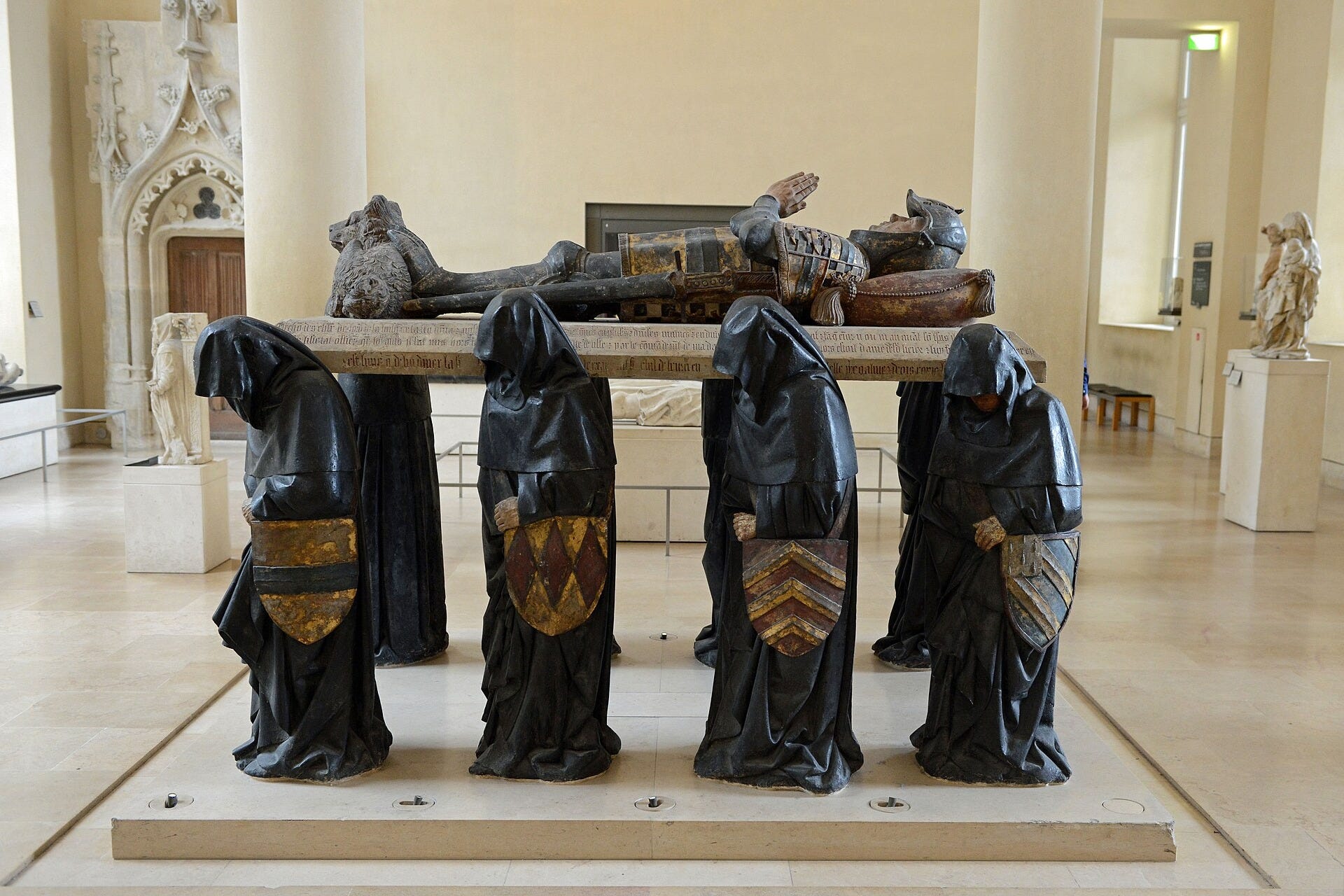
The Tomb of Philippe Pot | Burgundy (France), ca. 1480
Louvre | Photo Credit: Son of Groucho via Wikimedia Commons

Overview
The fourteenth century brought famine, a war of a hundred years, and a plague that killed a third of Europe, and out of it came painters who gave bodies weight and poets who wrote in the language of the street. Its kings are buried at Westminster and painted in the Louvre. Five ideas organize this section, and each is an exam term.
Key Terms
Naturalism · Hundred Years’ War · Black Death · Frame Narrative · Canterbury Tales
Timeline
• ca. 1305 | Giotto paints the Arena Chapel
• 1337 | The Hundred Years’ War begins
• 1348 | The Black Death reaches Florence, Paris, and London
• ca. 1387 | Chaucer begins the Canterbury Tales
• 1429 | Joan of Arc lifts the siege of Orléans
Naturalism | Giotto Gives Bodies Weight
In the 1200s, Italian painting was rooted in the Byzantine style: gold grounds, flat bodies, and faces of solemn calm, the manner Italians called the maniera greca, the Greek way. The Louvre’s Salon Carré opens with it. Cimabue’s Maestà is a wall of gold some fourteen feet tall, the Virgin enthroned among six angels; look at how the angels are stacked up the sides of the throne, one above another, as if space were a ladder. Painting changed with the next generation. In Siena, Duccio kept the gold of Byzantium, but he showed the emotional states of his subjects through their faces and gestures, and he set them in rooms and streets with a new sense of space. The National Gallery has a piece of his great altarpiece for Siena’s cathedral: in Duccio’s Annunciation look at the arches behind Mary, which make a room she could actually stand in. The painter Giotto di Bondone was a revolutionary figure because of his break with the past. Dante, his contemporary, put the change into three lines: “In painting Cimabue thought that he / Should hold the field, now Giotto has the cry.” Giotto was highly concerned with the depth in his paintings, illustrating volume through the use of light and dark. His goal was to imitate nature with his paintings. Naturalism is the representation of figures and settings as they appear to the eye, with weight, space, light, and feeling. Both cities have him. Beside the Cimabue in the Louvre hangs Saint Francis Receiving the Stigmata, from Giotto’s workshop; look at the saint’s knee pressing into the rock, and at the little scene below in which he preaches to the birds. In the National Gallery, Giotto’s Pentecost sets the apostles in a walled room while passers-by lean in to listen. In Giotto’s Lamentation at Padua, two mourners sit with their backs to us, so that we would stand behind them, inside the scene. The figures have backs because they have bodies, and the picture has a near side because it has a far one. The new feeling reached Paris in silver. The Louvre’s Virgin of Jeanne d’Evreux, given by a queen of France in 1339, is a mother who looks at her child while he reaches up to touch her face.
Hundred Years’ War | Two Crowns, One Throne
In 1328, the king of France died without a son, and the crown passed to his cousin, Philip VI. But the king of England, Edward III, was the dead king’s nephew through his mother, and he held lands in France as the French king’s vassal. In 1337, Philip declared those lands forfeit. Edward defied him, and in 1340 claimed the French throne itself. The Hundred Years’ War (1337–1453) was a series of wars between the kings of England and France over the French crown and the English lands in France. We will meet both sides in person. Edward III lies among the royal tombs of Westminster Abbey, a gilded bronze king with a long beard; look for the small bronze figures of his children along the side of the chest. The English won the famous battles. At Crécy in 1346, common archers with the longbow brought down the knighthood of France, and at Poitiers in 1356 the king of France himself was taken prisoner. That king is in the Louvre. The portrait of Jean le Bon is a small panel of a man in profile against gold, painted about the time of his capture, and it is the oldest portrait of a single person to survive from France; look for the words above his head, which simply say who he is. His son Charles V won most of France back and turned the Louvre from a fortress into a palace. The statue of Charles V probably stood on the Louvre’s own gate, and under the Sully wing you can walk the moat of his medieval Louvre; look for the marks the stonecutters cut into the blocks, small hearts among them. The war’s last act belonged to a farm girl, Joan of Arc, who in 1429 led the French army to lift the siege of Orléans, and was captured the next year and executed in 1431. France painted her for centuries afterward. In the Louvre, Ingres’s Joan of Arc stands in armor at the coronation of the king she made, and on the walls of the Panthéon her story is told in scenes, among them Joan before Orléans. By 1453, England kept only the port of Calais. The two kingdoms came out of the war as nations, each with a language, a story, and an enemy of its own.
Black Death | A Third of Europe
In October 1347, Genoese galleys from the Black Sea put in at Messina, in Sicily. By spring 1348 the sickness was in Florence. By summer it was in England. The Black Death was the plague that swept Europe between 1347 and 1351 and killed, by most estimates, between a third and a half of its people. It traveled with the fleas of rats, and, in its pneumonic form, from person to person on the breath. How did Europeans react? Some chose to flee, like the characters in the Decameron, to a less populated area. And some looked for someone to blame. In town after town, Jews were falsely accused of poisoning the wells, and they were killed. Pope Clement VI issued two bulls in 1348 declaring the Jews innocent: the plague, he wrote, was killing Jews too. Then the dying stopped, and the survivors discovered what their labor was worth. Labor shortages led to higher wages for any who could work. In 1381, a new tax on every head set off the Peasants’ Revolt, and a crowd of thousands marched on London to ask the boy king Richard II to end serfdom. That boy is in both of our London stops. In the National Gallery’s Wilton Diptych he kneels in a robe of gold before the Virgin and a company of angels, every one of them wearing his badge of the white hart; at Westminster Abbey the tomb of Richard II shows him in gilded bronze beside his queen, Anne of Bohemia, who died young in 1394. After 1348, the plague changed what Europe painted. A theme already old, memento mori (Lt. remember that you will die), became the century’s own. The Danse Macabre, or Dance of Death, is a painted or printed procession in which skeletons lead the living of every rank in a single dance toward the grave. The earliest one we know of was painted on a cemetery wall in Paris in 1424. That wall is gone, but its mood fills the Louvre. The tomb of Philippe Pot, the anchor image above, is a dead knight carried on the shoulders of eight hooded mourners nearly the size of living men; walk around it and try to find a face. Upstairs, in The Knight, the Young Woman, and Death, a skeleton catches a girl’s dress in its teeth as her lover rides off with her. And in the British Museum’s Room 1 a small ivory memento mori shows a dying man on one side and, on the other, his skull.
Frame Narrative | A Story That Holds Stories
Dante Alighieri was a Florentine, a poet, and, for two months in 1300, one of the six men who governed his city. The Divine Comedy is Dante’s poem of a journey through Hell, Purgatory, and Heaven. And it is written in Italian. A learned poem was supposed to be a Latin poem. But he wrote the Comedy in the Tuscan of Florence so that it could be read by the people who had no Latin: by women, by merchants, by the city. Giovanni Boccaccio wrote the earliest life of Dante. But his own great book turned from Heaven to earth. The Decameron was written in the years after the plague, around 1349–1353, and it opens with the plague in Florence. Seven young women and three young men meet in the church of Santa Maria Novella, agree to leave the dying city, and withdraw to a villa in the hills, where each tells one story a day for ten days, a hundred tales in all. A frame narrative is a story that contains other stories, like the storytellers’ retreat that holds the hundred tales of the Decameron. The tales are of every kind, comic, tragic, and romantic, told in a garden while Florence buries its dead. Rather than the divine comedy of Dante, which addresses human morality, we have the human comedy of Boccaccio. It is one of the first great works of prose fiction in a European vernacular, and later storytellers built frames of their own. You have already met the idea in paint. A frame is what Giotto gave the Arena Chapel, forty scenes held in one room, and what Duccio gave his altarpiece, of which the National Gallery’s Annunciation is the first small scene in a row. The Louvre has the idea in ivory. The Tristan and Iseult panel in Room 503 comes from a jewelry box carved in Paris about 1340, in Boccaccio’s own lifetime, and the box was a frame: each side told a different love story. On this one, look for the lovers at the fountain, and then for the face of the jealous King Mark, hiding in the tree above them and betrayed by his reflection in the water. Beside it, a couple plays chess under a tent. The owner who lifted the lid had, like Boccaccio’s ten young people, a story for every day.
Canterbury Tales | Pilgrims on the Road
One of the later storytellers was English. Geoffrey Chaucer, a London merchant’s son, was a highly placed civil servant of the king, and the king’s business took him twice to Italy. Then, around 1387, he began his own frame. The Canterbury Tales (ca. 1387–1400) is Chaucer’s unfinished collection of stories told by some thirty pilgrims riding from an inn in Southwark, across the river from London, to the shrine of Thomas Becket at Canterbury. The host proposes two tales each on the way out and two on the way home. Twenty-four survive, and the pilgrims never reach Canterbury. The Canterbury Tales shows a cross-section of the social hierarchy: a knight and his squire, a prioress, a monk, a merchant, a clerk of Oxford, a miller, a parson and his brother the plowman, and Chaucer himself. Each tells a tale in his own voice, from the knight’s romance to a priest’s fable of a rooster and a fox. And Chaucer wrote it in English, the London English of his day, when French was still the language of law and Latin of learning. “Whan that Aprill with his shoures soote / The droghte of March hath perced to the roote,” it begins. We will see where his pilgrims were going and where he ended. The British Museum’s Becket casket in Room 40 was made to hold a relic of the very saint they rode to honor; look again at the knights with their swords, and remember that every one of Chaucer’s travelers knew that scene. Chaucer himself is at Westminster Abbey. He was buried there in 1400 because he had worked for the king and lived beside the church, and Chaucer’s tomb became the first grave of what is now Poets’ Corner; look for the grey marble canopy against the wall, and then at how many writers chose to lie near him. His knight would have known the Louvre’s Tristan and Iseult by heart, for this was the kind of romance a knight told. The three poets of this section made the same choice, and two national literatures came of it. Dante, Boccaccio, and Chaucer each wrote in the language of the street, for the people who walked it.
Go Deeper
Culture & Values, 8th ed., Chapter 11, The Fourteenth Century (pp. 341 to 371).
Where to Find These Artifacts
London
• Duccio, The Annunciation: National Gallery, Rm 58
• Giotto & workshop, Pentecost: National Gallery, Rm 65
• The Wilton Diptych: National Gallery, Rm 51
• Tomb of Edward III (royal tombs): Westminster Abbey
• Tomb of Richard II & Anne of Bohemia: Westminster Abbey
• Chaucer’s tomb: Westminster Abbey, Poets’ Corner
• Becket casket: British Museum, Rm 40, Medieval Europe, Case 10
• Ivory memento mori: British Museum, Rm 1, Enlightenment, Wall Press 156
Paris
• Cimabue, Maestà: Louvre, Denon 1, Rm 708, Salon Carré
• Saint Francis Receiving the Stigmata: Louvre, Denon 1, Rm 708, Salon Carré
• Virgin of Jeanne d’Evreux: Louvre, Richelieu 1, Rm 503, Case 30
• Tristan & Iseult panel: Louvre, Richelieu 1, Rm 503, Case 22
• Portrait of Jean le Bon: Louvre, Richelieu 2, Rm 835
• Statue of Charles V: Louvre, Richelieu 0, Rm 209
• The medieval Louvre: Louvre, Sully -1
• Ingres, Joan of Arc at the Coronation of Charles VII: Louvre, Denon 1, Rm 700
• Tomb of Philippe Pot: Louvre, Richelieu 0, Rm 210
• The Knight, the Young Woman, & Death: Louvre, Richelieu 2, Rm 809
• Joan of Arc murals: Panthéon
Module III • Cathedrals & Masterpieces
Sec 10 • High Middle Ages
Sec 11 • Late Middle Ages
Sec 12 • The Renaissance
Course Page: Humanities: Study Abroad | London & Paris