

The Gospel of Mark | Part 1 | Part 2 | Part 3 | Part 4 | Part 5
λῃστής lēstēs • from leia, “plunder”: one who takes by force
Modern Bibles often translate this to “robber,” “bandit,” or “thief,” which can be misleading. Rome used lēstēs the way empires still use the word insurgent: not a pickpocket, but a man who defies the imperial order. The Jewish historian Josephus, writing after the war, calls the revolutionaries lēstai. It is the empire’s word for those who rebel. Freedom fighters. Rome did not crucify mere shoplifters…
Central Question for Part 4
Why did Rome kill Jesus?
We are now three Sundays into gMark, with two Sundays to go.
On our first Sunday, we picked a fight with gMark’s plagiarized promise of “good news,” lifted from Caesar’s monuments. On our second Sunday, we watched the Kingdom arrive: without manger or star, we found a man irrupting out of the Judean desert. And in our last lesson, we followed a Gospel obsessed with seeing Jesus, until a blind beggar saw him clearly and followed the Messiah on the Way.
I told you then where the Way goes: it goes to Jerusalem. Well, today, we arrive.
At the Temple. During the Last Week of Jesus’ life.
Now, recall at the beginning when we pointed toward the Gospel’s dual use of schizō — to rip — the Greek verb used to describe the heavens torn open at the baptism and the curtain torn open at Jesus’ death. Today, in our penultimate Markan lesson, we will bear witness to that closing tear. I also asked you last time to consider how the Gospel writer cuts the various narrative threads together. Today, we will see how that skillset pays off theologically.
Finally, from our last lesson together, recall that for a first-century Jew, a crucified Messiah was a contradiction in terms — and that we said we would pick that thread back up when we reached the machinery of the crucifixion. Well, today we have reached it. This will be the heaviest of our five Sundays for this series. Today, you will see a single Greek word, lēstēs, bring the final Week of Jesus’ life to a remarkable and dramatic conclusion.
First, we begin with a tree. And I warn you: this story will seem to make no sense…
Part One · Where They Hide
It’s a Monday. Jesus is on his way into the city, and he’s hungry. He sees a fig tree with leaves and approaches it looking for fruit. Yet he finds only leaves. So he curses it!? “May no one ever eat fruit from you again.” This poor tree, condemned for being empty of fruit...
And if that were all there were to the story, we might just shrug and move on. I mean, prophets do strange things, right? But the gospel writer adds a small explanatory note, the kind a careful author includes when he wants to be certain you catch it — it was not the season for figs.
Let’s think about why the gospel writer tells us this. gMark did not have to include it. In fact, when gMatthew retells this scene a generation later, the line about the season is gone, and the omission makes sense: it can make Jesus look unreasonable. But gMark leaves this detail in there, because the author wants it to bother you. A detail that fits the narrative can too easily slide right past us; but a detail that troubles you is worth coming back to. So let’s look closer. Because, as you may have guessed, this story isn’t really about trees.
On the following day, when they came from Bethany, [Jesus] was hungry. Seeing in the distance a fig tree in leaf, he went to see whether perhaps he would find anything on it. When he came to it, he found nothing but leaves, for it was not the season for figs. He said to it, “May no one ever eat fruit from you again.” And his disciples heard it.
Then they came to Jerusalem. And he entered the temple and began to drive out those who were selling and those who were buying in the temple, and he overturned the tables of the money changers and the seats of those who sold doves, and he would not allow anyone to carry anything through the temple. He was teaching and saying, “Is it not written, ‘My house shall be called a house of prayer for all the nations’? But you have made it a den of robbers.”
And when the chief priests and the scribes heard it, they kept looking for a way to kill him, for they were afraid of him because the whole crowd was spellbound by his teaching. And when evening came, Jesus and his disciples went out of the city.
In the morning as they passed by, they saw the fig tree withered away to its roots. Then Peter remembered and said to him, “Rabbi, look! The fig tree that you cursed has withered.” Jesus answered them, “Have faithfulness toward God. Truly I tell you, if you say to this mountain, ‘Be taken up and thrown into the sea,’ and if you do not doubt in your heart but believe that what you say will come to pass, it will be done for you. So I tell you, whatever you ask for in prayer, believe that you have received it, and it will be yours.
“Whenever you stand praying, forgive, if you have anything against anyone, so that your Father in heaven may also forgive you your trespasses.” MARK 11:12-25
Now notice the cut here that I alluded to at the beginning; the editor’s hand is hard at work from our last lesson. The effort is quite bold here. The gospel writer starts the fig tree story: fruitless. He interrupts it, mid-action, for a completely different story: Jesus in the Temple. Then the story resumes: cut to Tuesday morning and the tree is withered to its roots. Scholars call this an intercalation — one story sandwiched inside another — and by now you know this gospel writer never builds one idly. The two halves interpret each other. Whatever is in the middle explains what’s on either side.
And what’s in the middle? The Temple.
Here, the editor’s hand has done real theological work: the fig tree is the Temple. The barrenness, the curse, the withering. To read either story by itself empties the narrative of its theological gravity.
Now, before we go on, I want to make sure we’re not guilty of a shallow or problematic reading of a passage deserving of nuance. The easy reading would be that: the Temple was corrupt, greedy priests were fleecing the faithful, and then Jesus storms in to shut it down. Good riddance. Now we have something better!
This reading is not only bad history but problematic theology, insofar as it has been a jumping-off point for centuries of antisemitic accusation and stereotyping.
Here is what the Temple was to Jesus’ circle: the Beit HaMikdash, the Holy House of God, the beating heart of the Jewish people. The one place on earth where heaven and earth met, where prayer and sacrifice and memory and identity lived together in one house of stone. So if the scene is not about Jesus condemning mismanaged money, then what is it? It’s something older, darker, and far more Jewish in its native context.
Listen again to the line the writer gives Jesus, because it is in fact a quotation, and the source changes everything. “My house shall be called a house of prayer for all the nations.” That’s from Isaiah 56, a verse that gathers foreigners to the Holy House in Jerusalem. “But you have made it a den of robbers,” Jesus proclaims. A den of lēstai. But that phrase originally came from the prophet Jeremiah, who stood at the gates of the Jewish Temple six centuries earlier and similarly wept over its state.
Where gMark uses the Greek in his “den of lēstai,” Jeremiah, of course, uses the Hebrew “den of paritsim.” The word parits comes from a Hebrew root meaning to break through. So, the parits of Jeremiah that Jesus is quoting is a breaker — a violent man who smashes what is lawful. When Jeremiah was translated into Greek, this word was rendered into our Greek key term for this lesson: lēstēs. What’s critical to our reading today is that neither parits nor lēstēs means anything like ‘a petty thief.’ And, importantly, a “den” is not where men do their breaking. A den is where such men run and hide after they’ve broken things. So, Jesus’ charge here was not “this Jewish House of God is worthless.” It was quite the opposite: this house is holy, but you are treating it like a common hideout! You wrong the widow and the orphan out in the world, then duck inside God’s house, put on your prayer robes, and think yourselves protected from judgment!
Jeremiah said all this long before Jesus. He called his people breakers (paritsim), and did so from within the tradition and cadence of the Jewish Temple.
In Jesus’ time, the money changers were not some fraud needing to be overturned; they were necessary to the Temple’s operation. Pilgrims arrived carrying every possible coinage, while the Temple tax was payable in one standard of silver; in this way, the changers turned the empire’s money into money the Temple could accept.
For those who could not afford to buy a sheep with their exchanged money, the Torah had long authorized doves or pigeons as affordable alternatives (Lev. 5:7; 12:8). According to gLuke, the dove alternative was, in fact, the offering Mary made after giving birth to Jesus (2:24). This whole endeavor of the money exchanged for Temple sacrifices had been a cultural norm for centuries. Again, following Jeremiah’s logic, when Jesus calls the Temple a “den of robbers,” the “den” is not where the crime happens. The “den” is where the breakers hide after the crime. When we see Jesus overturn the tables, he is not cleverly exposing a Jewish financial scam; he is staging Jeremiah’s prophetic warning inside the House of God by stopping the Temple’s operation to shine a powerful and righteous light on where the breakers chose to hide.
So, no. Jesus is not hungrily yelling at random trees and cursing Jewish price-gouging.
Instead, we find Jesus quoting Jeremiah as his way to Biblically grieve how ‘fruitless’ the Temple leadership had grown. The fig tree was a prophetic sign, one of the oldest idioms of Jewish wisdom. What makes this moment prophetic? Remember that this scene is set around the year 30, while gMark is written around the year 70, and by then the Holy Temple is gone — burned and desecrated by the Roman state. So when gMark’s community reads Jesus quoting Jeremiah in those same courts, they heard a warning they knew had come true, and it echoed their own grief. Let me say that a different way: the story resonated with those presently agonizing over the destruction of their families, homes, and Temple from Imperial Rome. The gospel does not say that God was finished with the Jewish People. The Temple in Jeremiah’s time also fell — and the Jewish People grieved then, and endured, and live on today.
Read carefully, the Gospel of Mark is a lament in parallel. While Jesus (ca. 30 CE) mourns what the house’s keepers had become, gMark’s reader (ca. 70 CE) similarly mourns that the House of God now lay in ashes.
Thus, the imperial violence in Roman Judea comes to the modern reader in two guises: their destruction of the Jewish Temple, and their torture and crucifixion of Jesus of Nazareth. So let us zoom in on Jesus’ arrival to the Holy City the previous day. Because, little known to most armchair historians today, there was not one procession into Jerusalem that day.
There were two.
Part Two · Two Processions, One City
You already know the first procession. Many of you as kids, dressed in your best pastel outfits, gathered together to wave palm fronds on a beautiful Sunday in spring.
This, of course, is in glorious commemoration of Jesus’ Final Week, when he rides down the Mount of Olives, from the east, on a borrowed donkey, while people spread cloaks on the road and shout about the coming kingdom of their ancestor, David. Palm Sunday. The Church has celebrated that scene for two thousand years. But most modern readers remain ignorant of the second procession, which is attested to by Josephus (Jewish War 2.223–224; Antiquities 20.106–107). The following is what Easter pageants generally miss, but what any pilgrim arriving for Passover would have seen in the context of Jesus’ arrival.
That same day, on the west side of the city, came a second procession: Pontius Pilate, the Roman governor, riding up from the coast at the head of a column of deadly imperial cavalry. He made that ride every Passover. This was Roman policy. As Passover celebrates a people God freed from an earlier empire, Pilate knew this was the week Jerusalem was most likely to foment an insurrection, led by Jews singing about peace, freedom from tyranny, and the freedom to worship and honor their God.
So Pilate wanted his soldiers seen. Let’s picture his imperial strategy. Roman steel, gallant warhorses, and the ruby red Roman banners of eagles signaling the power of the West. While from the east, a Galilean peasant rode atop a borrowed donkey. Two kingdoms, in one city, on the same afternoon. The entirety of Jesus’ Last Week is the collision between these two worldviews.
In contradistinction to Roman West, from the east we see a staged performance that quotes Zechariah: a king “humble and riding on a donkey,” who cuts off the chariot and commands peace to the nations. A different kind of king, and a procession built to say so. The authorities sense the ideological danger immediately.
They come to Jesus in the Temple with the blunt instrument first: “By what authority are you doing these things?” There is our word from Week 2, exousia, and the question is a trap: if he claims God’s authority, it’s blasphemy; if he claims none, the palm-waving crowd melts away. So he answers with a question about John’s baptism that they cannot afford to answer either way, and they retreat with “we do not know.” Beaten in their own arena, in one move.
However, their next line of questioning is sharper…
Then they sent to him some Pharisees and some Herodians to trap him in what he said. And they came and said to him, “Teacher, we know that you are sincere and show deference to no one, for you do not regard people with partiality but teach the way of God in accordance with truth. Is it lawful to pay taxes to Caesar or not? Should we pay them, or should we not?” But knowing their hypocrisy, he said to them, “Why are you putting me to the test? Bring me a denarius and let me see it.” And they brought one. Then he said to them, “Whose head is this and whose title?” They answered, “Caesar’s.” Jesus said to them, “Give to Caesar the things that are Caesar’s and to God the things that are God’s.” And they were amazed at him.
MARK 12:13-17
Notice who springs this one: the Pharisees and the Herodians, together.
The same strange pairing that first plotted against him back in Mark chapter 3. Religious authority, hand in hand with Rome’s puppet kings. Take note that this pairing is the machinery of the Last Week — not “the Jews,” an old slander this series has refused from the first Sunday and refuses still, but an alliance of the powerful, the preacher and the politician, each with its own reason to want Jesus gone.
“Is it lawful to pay taxes to Caesar, or not?”
Say yes: Jesus is a Roman collaborator.
Say no: Jesus is a rebel zealot, and taken to Pilate by sundown.
So Jesus flips the coin over. Whose image is this? Whose inscription? Caesar’s, of course. And the inscription on that denarius named Tiberius, son of the divine Augustus. A self-proclaimed Son of God. The very title gMark stole in his opening line, jingling around in everybody’s pocket. As sure as you know Washington is on the dollar, Jesus’ audience knows the inscription on a denarius. “Give to Caesar the things that are Caesar’s, and to God the things that are God’s.”
The crowd is amazed; Jesus has slipped through their trap again.
But what, exactly, belongs to God? The coin bears Caesar’s image, so give it to Caesar. But everyone in that courtyard was raised on the first page of Genesis, and knew whose image they bore. He is not dodging the question of allegiance. He is detonating it. Caesar can keep his silver. But the people — all the beautiful tribes and folkways of this marvelous, good world — never belonged to Caesar, or to potentates or politicians, and never will.
So the preachers can’t trap him, and the politicians can’t buy him. And Rome cannot abide a man drawing crowds singing of Passover freedom who teaches that, like Pharaoh, Caesar has no claim on them, their children, or their scripture.
From an imperial standpoint, something had to change this course of events before a full-on insurrection was at hand.
So, again, here is what the armchair historian often misses: Crucifixion was never Rome’s preferred method of execution. Rome had faster, simpler ways to kill. Rather, crucifixion was Rome’s most successful method of communication. A message, or rather a warning, written in human flesh and displayed beside a public road — where the greatest number of people would be forced to walk past and read it.
The body was stripped naked: shame was part of the warning.
Left to suffocate slowly, often for days: duration was part of the warning.
Denied a grave, left to the birds and wild animals: erasure was part of the warning.
This time-consuming procedure was deliberately reserved for slaves and rebels and lēstai. Empires are deliberate teachers. And this was their lesson: for anyone who imagines a king other than Caesar — Look. Learn. And go home and tell them what you saw.
This. From our third Sunday together, this is why Peter choked on the concept of a “crucified Messiah.” For the Jews living under this terrible European occupation, Messiah meant God’s triumph over imperial violence. It meant united families. It meant everlasting hope. While the Roman cross was the empire’s tool for erasing hope.
This Last Week, two parades came to Jerusalem on a collision course.
One had weapons of steel, flags, and coin; the other had women, fishermen, and a rabbi on a borrowed donkey.
Part Three · King of the Judeans
It’s now Wednesday night, two days since Jesus cursed the fig tree.
Jesus is at a dinner in Bethany, and a woman approaches him with an alabaster jar of perfume worth most of a year’s wages. She breaks it open and pours all of it over Jesus’ head. The room is appalled: what a waste; it could have been sold and given to the poor! Jesus stops them cold. Leave her alone. She’s done a beautiful thing. She has anointed my body before its burial.
Listen closely for the wisdom in Jesus’ response. She knows. All the male disciples have been told three times, plainly, and cannot absorb it. While this unnamed woman has understood it completely, and answers in the purest way that love speaks: extravagantly and without shame. And Jesus says of her what he says of no one else in the Gospel of Mark — wherever the good news is proclaimed in the whole world, what she has done will be told, in memory of her. Now count the cuts. Before her: the plot to kill Jesus. After her: Judas leaves to sell him out. Another literary sandwich. Another intercalation. With betrayal on both sides, this woman’s faithfulness glows in the middle. The woman who saw gets a monument built out of the Gospel itself.
It’s now the following night, Thursday evening. And Jesus shares a Last Supper with his friends.
While they were eating, he took a loaf of bread, and after blessing it he broke it, gave it to them, and said, “Take; this is my body.” Then he took a cup, and after giving thanks he gave it to them, and all of them drank from it. He said to them, “This is my blood of the covenant, which is poured out for many. Truly I tell you, I will never again drink of the fruit of the vine until that day when I drink it new in the kingdom of God.” MARK 14:22-25
You all know this meal.
This congregation gathers around it every Sunday; the chalice is the emblem of your church. So look closely at the night where its iconography began. Jesus is not presiding in a sanctuary. He’s at supper with the same flawed, half-seeing friends who have misunderstood him at every turn — one of whom has already taken money to turn on him. Still, Jesus hands them the bread and the cup. The open table of this Gospel, the one that seated tax collectors, and the working poor, and sinners, and turncoats remains open. But listen to the rest of his message, “I will never again drink of the fruit of the vine until that day when I drink it new in the kingdom of God.” This is Jesus reserving a table for a future date. The Last Supper does not stop at the cross; it passes through it to the Kingdom waiting on the other side of righteousness.
Late that Thursday night, between the open table and the cross, lies a garden.
In the garden, the Gospel of Mark presents us with a very human Jesus who does not want to die. He throws himself on the ground, distressed and agitated, and begs: Abba, Father, for you all things are possible; remove this cup from me. I see here a young man, holy and true, but still frightened and honest about his fear of imperial violence — what Rome — what steel, flag, and coin — were about to do to his human flesh. He asks God for it to pass. Then Jesus sets that ask down. Because it’s not about what Jesus wants in that moment but what God requires. I imagine Jesus wants to laugh with his friends; he wants to continue to wrestle with scripture, to stand at the shore and watch the sunrise over the Galilee. He wants to visit with his mother; maybe start a family of his own.
But he sets all that aside to return to the disciples, his half-blind friends, who still cannot truly see what is happening or why. Of course, they're asleep.
Then, in the dark, the soldiers come for him. Jesus calls out, “Have you come out with swords and clubs to arrest me, as though I were a lēstēs?” See now whose mouth owns this word. It’s no longer Jeremiah’s. It’s not Rome’s. This is Jesus’ word now.
Peter, the Rock, follows Jesus as they take him away. Brave at first, closer than the other disciples, but as night bleeds into Friday morning, he denies even knowing Jesus. The faithful know he will deny him three times. It is then that Peter breaks down and weeps. But remember the proverb we read together: the path of the righteous is like the light of dawn.
They compelled a passer-by, who was coming in from the country, to carry his cross; it was Simon of Cyrene, the father of Alexander and Rufus. Then they brought Jesus to the place called Golgotha (which means Place of the Skull). And they offered him wine mixed with myrrh, but he did not take it. And they crucified him and divided his clothes among them, casting lots to decide what each should take.
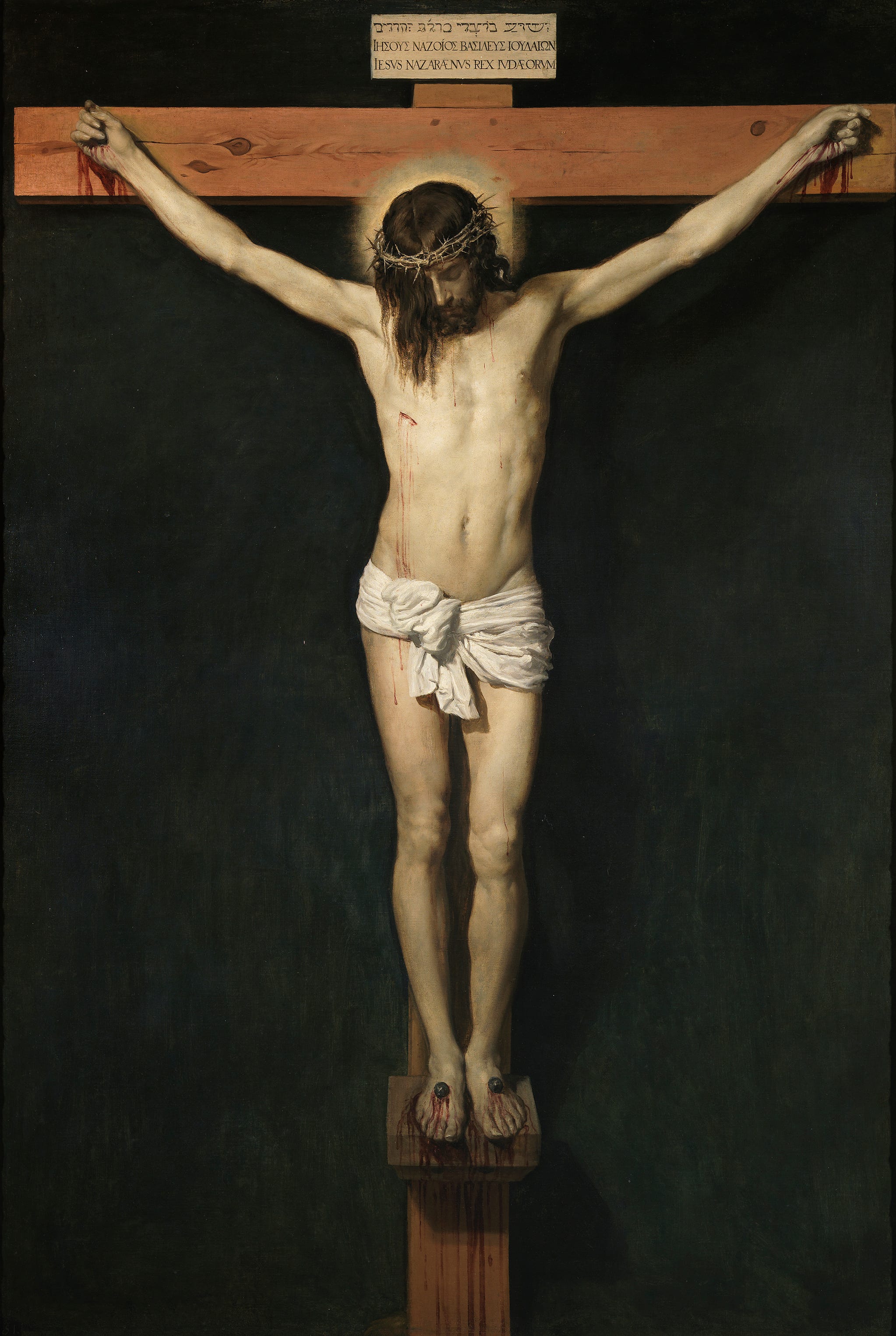
It was nine o’clock in the morning when they crucified him. The inscription of the charge against him read, “The King of the Judeans.” And with him they crucified two rebels, one on his right and one on his left. Those who passed by derided him, shaking their heads and saying, “Aha! You who would destroy the temple and build it in three days, save yourself, and come down from the cross!” In the same way the chief priests, along with the scribes, were also mocking him among themselves and saying, “He saved others; he cannot save himself. Let the Messiah, the King of Israel, come down from the cross now, so that we may see and believe.” Those who were crucified with him also taunted him.
When it was noon, darkness came over the whole land until three in the afternoon. At three o’clock Jesus cried out with a loud voice, “Eloi, Eloi, lema sabachthani?” which means, “My God, my God, why have you forsaken me?” When some of the bystanders heard it, they said, “Listen, he is calling for Elijah.” And someone ran, filled a sponge with sour wine, put it on a stick, and gave it to him to drink, saying, “Wait, let us see whether Elijah will come to take him down.” Then Jesus gave a loud cry and breathed his last. And the curtain of the temple was torn in two, from top to bottom. Now when the centurion who stood facing him saw that in this way he breathed his last, he said, “Truly this man was God’s Son!” MARK 15:21-39
It’s Friday morning, and Rome is openly mocking Jesus.
They mock him with a purple robe (like Caesar).
They mock him with a kingly crown, made of twisted thorns.
And they mock with salutes: Hail, King of the Judeans!
This is their joke, and if you’re a Roman, it’s hilarious. This Jewish peasant from nowhere pretends to the throne of our great master of steel, flag, and coin!
Then, they make it ‘official,’ in writing. On a placard above Jesus’ head, the titulus which ‘communicates the warning’ for everyone forced to walk by.
What is the warning? Messiah? False prophet? No. “King of the Judeans” (the Greek is Ioudaioi — which can be rendered “Judeans” or “Jews” in English). The Romans did not crucify Jesus for religion. They crucified him for sedition. The Empire of Caesar killed Jesus because the Kingdom of God is a rival kingdom — and Jesus is a rival king to the empire of steel, flag, and coin.
As he hung on the Roman cross, a dying testament to Roman authority, two others were crucified beside him. The term gMark uses for these men is, again, lēstai. Shouted in the Temple, taken up in the garden, now hanging on two crosses framing the murder of Jesus. It is the thread that binds the third act of gMark to completion. Whatever Jesus was to Rome, the Romans had a category for it: he was the kind of threat you kill publicly and brutally, between two others just like him, so that no one ever dares to defy Caesar or his empire.
And it gets even darker.
Go back to when James and John asked for seats at the left and right hand of Jesus. He responded with great concern, “You do not know what you are asking” (10:38). It turns out, the left and right seats next to Jesus are crosses. The road to the Kingdom was always thus.
And it gets even darker.
Near the end, Jesus screams in raw, untranslated Aramaic. Words from the deepest reservoir of his feeling: Eloi, Eloi, lema sabachthani? “My God, my God, why have you forsaken me?” To the Jewish ear listening that horrible day, these are the words that open the 22nd Psalm — poetry that begins in the pit and climbs, line by aching line, until all the ends of the earth shall remember and turn to Adonai. A dying Jew, praying his ancestors’ prayer, cries out the opening line of a psalm that knows the way through. The forsakenness is real. But so is the psalm that does not end in forsakenness.
Posterity will serve him; future generations will be told about Adonai and proclaim his deliverance to a people yet unborn, saying he has done it. PSALM 22:30-31
And then, at three o’clock on Friday afternoon, Jesus dies.
In that moment, gMark describes the schizō — the second rip — of the veil of the Temple from top to bottom. As we explored in our first lesson together, the gospel writer reserves this verb for two uses: the baptism and the Temple veil. What that finally means I will cover on our final Sunday together. For now, notice again who proclaims Jesus as the Son of God — our Roman centurion from that same Sunday. Jesus may have been sentenced to death, but the executioner’s own verdict proclaims the victory of a tortured Galilean over his own imperial flag.
So, why did Rome kill Jesus?
The fig tree was never about the tree. The “out of season” detail explains the Temple scene afterward: this is prophetic judgment from within a beloved tradition, under imperial pressure. It was Jeremiah’s grief, not Judaism’s repeal. And both powers read Jesus’ threat with clever acumen. That is why the cross follows. Jesus is not killed for being kind, or wise, or inspiring. He is killed because the Kingdom Jesus announces threatens the world of steel, flag, and coin. Rome’s problem wasn’t that they didn’t understand Jesus. I am confident that Rome understood him better than most nations ever will. Rome’s problem was that it was Rome — built on the backs of the poor, the widows, and the orphans of power and prestige.
Caesar’s image was on the silver, so the silver went back to Caesar. But God’s image — the tselem elohim of Genesis — is found in the face of your mother, in the face of your child, in the face of the other you wish to conquer and the enemy you refuse to acknowledge. And God’s image is found in your beautiful face as well.
The Gospel of Mark asks: whose image do you bear? Whom do you serve? The widow answered with her last two coins. The woman at Bethany answered with a broken jar. And for those who dare to leave the glitz and distraction of Caesar’s palace, the eucharist you share each Sunday likewise points you, through the cross, to the Kingdom of God — where all things are made new.
---
The Gospel of Mark · 4th of 5 Sundays: Jerusalem, Temple, Empire & the Last Week.
We gather one last time next Sunday, August 9: Terror, Amazement, & the Ending