

The Gospel of Mark | Part 1 | Part 2 | Part 3 | Part 4 | Part 5
γάρ gar • “for/because”: a small connective that reaches forward
Gar is a hinge, joining one thought to the next: this happened, because of that — and in Greek it rarely ends a sentence, because “because” needs something to come after it.
It is the last word of the Gospel of Mark.
Central Question for Part 5
Why doesn’t gMark end the story?
Hello!
Two comments this morning for anyone new, because it shapes how I read this text: I am a Jewish philosopher and historian, and I’ve spent much of my career examining the Middle World, particularly the first century. On this final occasion of our five-part series, I offer this single personal comment: I take what this text describes axiomatically for my own life. What is called herein the Kingdom of God — a world without war, run on God’s terms instead of Caesar’s, ever-present wherever two come together in peace — I hold this with my whole heart. I come to the kingdom as a Jew, but then, that’s also how the apostles came to it as well. It’s the reason I hope I am able to hand you something surprising from the text. Especially this morning, at the end.
In our first four Sundays together, we picked a fight with gMark’s opening sentence (the “good news,” the “Son of God”), as they were first engraved on monuments to the divine Caesar, then hung on a crucified Galilean Jew. We then witnessed the Kingdom arrive — without manger, angel, or star — irrupting from the wilderness, seeking John the Baptizer. Then we read a Gospel obsessed with sight — who sees, who’s blind, and who only half-sees — that ended with a blind beggar who saw clearly and followed. And, in our fourth lesson, we arrived at Jesus’ Last Week, in Jerusalem, and watched two powers — the Roman politicians and the Temple priesthood — see this Galilean as a threat that ended in Roman mockery on a Roman cross.
And here is our key word for the morning — the last of the five we’ve gathered on this walk: evangelion, the empire’s declaration of victory, which gMark reverses; exousia, the authority which Jesus illustrates by doing; horaō, the Greek verb for not just seeing with one’s eyes but perceiving a thing’s true nature, and lēstēs, a word which is often translated thief but in the first century was closer to insurgent. And today, perhaps the strangest key term of this series: Gar. It’s small. Depending on its usage, it can mean “for,” or “because.” It’s the kind of word you’d probably never notice — a little hinge that joins one thought to the next: this happened, because of that. It is, in Greek, almost always a word in the middle of a sentence, because “because” needs something to come after it. So I want you to hold onto that “because” — that gar. Because gMark is going to do something with gar that, as far as we can tell, practically no one in the ancient world ever did on purpose. He’s going to end his entire gospel with it. He’s going to stop his scroll — the first story of Jesus — on the word “because,” and we’re going to investigate why and what follows from it.
Now, a fellow scholar might stop me right there and say a handful of ancient texts do trail off on gar — and that’s fair; I’m not claiming it’s grammatically impossible. My point is, nobody ends an ancient story this way. You don’t close the most important account you will ever write on a word that is still reaching for the next phrase. That is the move gMark makes — and that broken-off sentence is the puzzle the whole morning will be built on.
Part One · The Women’s Terror
In this series, we generally begin each lesson with something strange, but I believe this one takes the cake. The oldest copies of this earliest gospel end mid-sentence. The text on our oldest copies ends on the word “because.”
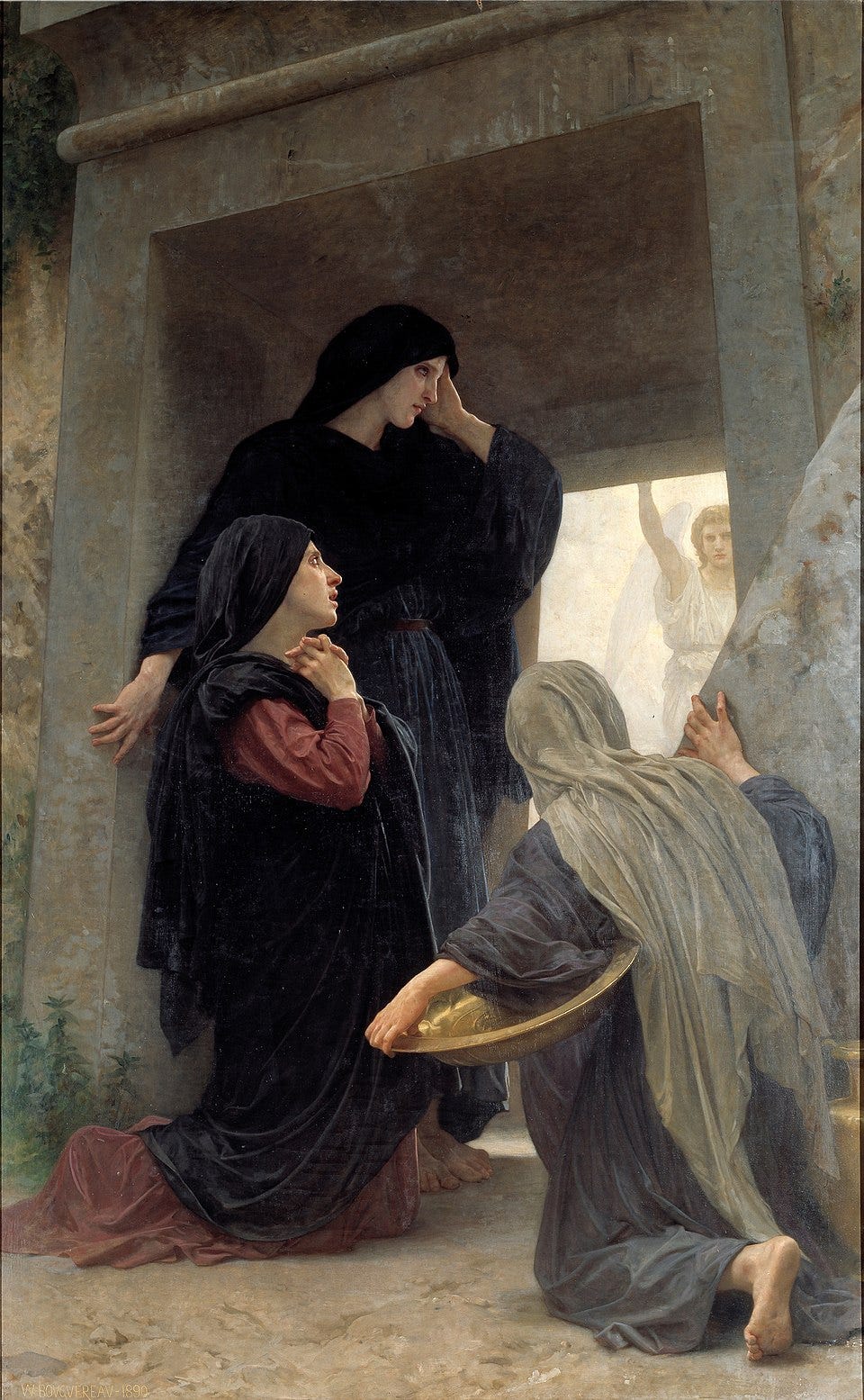
The women go to the tomb. A man dressed in white tells them Jesus has been raised and sends them to go and tell the others. Instead, they run away terrified and say nothing to anyone. No appearance of the risen Jesus in this earliest gospel. No reunion with the disciples. No “go therefore into all the world.” The women flee in silence, the sentence breaks off on the word “because,” and the Gospel of Mark simply… stops. The earliest, best manuscripts we have give you nothing after that. And the question I want to sit with on our last morning together is this: why doesn’t gMark end the story?
There were also women looking on from a distance. Among them were Mary Magdalene, and Mary the mother of James the younger and of Joses, and Salome, who followed him when he was in Galilee and ministered to him, and there were many other women who had come up with him to Jerusalem. MARK 15:40-41
When the Sabbath was over, Mary Magdalene and Mary the mother of James and Salome bought spices, so that they might go and anoint him. And very early on the first day of the week, when the sun had risen, they went to the tomb. They had been saying to one another, “Who will roll away the stone for us from the entrance to the tomb?” When they looked up, they saw that the stone, which was very large, had already been rolled back. As they entered the tomb, they saw a young man dressed in a white robe sitting on the right side, and they were alarmed. But he said to them, “Do not be alarmed; you are looking for Jesus of Nazareth, who was crucified. He has been raised; he is not here. Look, there is the place they laid him. But go, tell his disciples and Peter that he is going ahead of you to Galilee; there you will see him, just as he told you.” So they went out and fled from the tomb, for terror and amazement had seized them, and they said nothing to anyone, for (gar) they were afraid. MARK 16:1-8
Let’s start with who is standing there. Mark has been building toward this moment for sixteen chapters, and most readers will walk right past it.
Who’s at the cross? Not the twelve. The twelve are gone.
Judas sold him out and is shortly thereafter found dead.
Peter, the Rock, denied Jesus three times before the rooster finished crowing.
And at the arrest, gMark tells us flatly, “all of them deserted him and fled.” (14:50)
The men with the names — the men who’d asked the Christ for thrones and position, the inner circle — they all ran.
Then who stayed? gMark gives us a list: Mary Magdalene, Mary the mother of James and Joses, and Salome — and, the text adds, many other women who had followed him from Galilee (15:41). The women stayed. They stayed through the violence of the crucifixion. They watched where the body was laid. And at first light after the Sabbath, while the men are completely absent from the story (gMark won’t even tell you where they’ve gone), the women are walking to the tomb of an enemy of the state, with spices in their hands to honor their crucified Messiah.
Now notice the rhyme gMark builds into this scene. Just days earlier in this story — it’s one of the last things gMark shows you before the arrest — a woman at Bethany pours a jar of costly perfume over Jesus’s head. The men in the room called it a waste. And Jesus defended her with a strange sentence: she has anointed my body beforehand for its burial (14:8). This unnamed woman anointed Jesus for the grave while he is yet alive. And now, here, these women come to anoint his body in the grave. But this time, the body is gone. One woman prepared him for burial before he died; these three women arrive to finish the burial and find there’s no body to anoint. So, the women in this earliest gospel arrive at the truth, over and over again, while the men keep missing it. Here, at the end, we’re seeing the pattern repeated.
Now, let’s focus again on the tomb. The stone (a huge one — they’d worried the whole walk over about moving it) is found already rolled back. And inside, a young man in a white robe. gMark doesn’t call him an angel, by the way; gMatthew will, later. But this earliest telling of the story simply identifies him as a young man, dressed in white, just sitting there. And he says to the women, “Do not be alarmed. You are looking for Jesus of Nazareth who was crucified. He has been raised. He is not here.”
Now, listen closely because this gets missed by the crowd who says “gMark has no resurrection.” The Gospel of Mark absolutely proclaims the resurrection. It’s right there, in our oldest manuscripts: he has been raised. The announcement is made (the evangelon, if you will) at the empty tomb. So when I tell you Mark “ends without a resurrection appearance,” it’s important that you hear my exact word: appearance. What gMark gives us is the announcement. What gMark withholds is the seeing. He never lets you lay eyes on the risen Jesus. gMatthew, gLuke, and gJohn — they all bring you face to face with the risen Jesus: in a garden, on a road, on a beach over breakfast. But this earliest gospel refuses those reassurances.
Here, the resurrection is declared. It is never displayed.
So let’s turn our attention to the announcement itself; it’s full of amazing insight if we slow down and read it carefully. Go, tell his disciples (the disciples who ran) and Peter (16:7). And Peter. The young man names him specifically. Peter, who swore three times he’d never even met Jesus — and the very first message from the empty tomb makes a point of including him by name. Here, I am reminded of the prophet Isaiah.
O Israel: Do not fear, for I have redeemed you.
I have called you by name, you are mine. Isaiah 43:1
Here, after the crucifixion, Peter is called by name. Qarati veshimcha. “I have called you by name.” The denier is not written off; he is sent for! A few weeks ago in this Gospel, Jesus healed a blind man in two touches — the first left the man ‘seeing people as walking trees,’ while the second touch made him whole. That miracle was gMark’s picture of Peter — he sees Jesus’ title right (“Messiah”), but his sight is blurred. Peter doesn’t see Jesus clearly yet — in Lesson 3 we discussed why Peter can’t fathom a crucified Messiah. Like the half-healed man before him, Peter is waiting on that second touch. It arrives with being called by name from the tomb.
Now Jesus has risen. Peter is redeemed. And his sight is made full.
And where is Jesus going? To Galilee — back where the whole thing started, Mark chapter one, the wilderness and the lakeshore. In gMark, the risen Jesus doesn’t go up; he goes back — back to the beginning, back to where the apostles were ‘first called,’ as if to say: we start again, from there, and you’re all invited again, even those who denied me.
But the women… the women have it. They feel, and act on, and understand the good news of this Gospel in ways that leave the men behind. And in the last chapter, they have a direct command to carry it. So let’s look at the last sentence of the text. “They went out and fled from the tomb, for terror and amazement had seized them; and they said nothing to anyone, for they were afraid” (16:8). They said nothing. To anyone. They were told to go and tell, and they ran, and they were silent, because they were afraid.
Here, gMark pays off something that has been building since the first chapter. All through this Gospel, the truth keeps getting hushed. The demons name Jesus, and he silences them (1:34). He heals, and tells people to say nothing (1:43-44). Peter names Jesus the Messiah, and is ordered to keep it quiet (8:29-30). The truth of this Gospel seems too much to speak out loud — pressed down, redirected, silenced. And now, at the empty tomb, the command comes full circle. Now that it is accomplished, the young man says to the women, don’t be silent. Go and tell!
For the whole Gospel the order was to hush the truth. Here, at the end, that order is rescinded, and the new order is to carry the truth forward. Yet the women — who have followed more faithfully than anyone else — are also struck silent. Not by Jesus’ command, nor for fear of their lives. They are struck silent because they are asked to do something that no one had ever done before. Their moment brings to mind the scene in Stanley Kubrick’s 2001: A Space Odyssey, when the ape throws a bone — the first tool — and the shot transitions into a spaceship thousands of years later. The women at the tomb, those closest to Jesus’ death, cannot wrap their heads around this cosmic encounter, and a hush falls over them. As they stand at the edge of tomorrow, glimpsing darkly at the future, gMark says they are seized by “terror and amazement.”
The Greek word we translate here as terror is tromos. It denotes physical trembling, not just a state of mind. And the word here rendered as amazement is ekstasis. It is the root of our word “ecstasy.” In Greek, it literally means to stand (stasis) outside (ek) of yourself. This is not an emotion, like joy or sadness. It’s less definable than that. You feel ecstasy when you experience transcendent moments beyond rational measure. You can feel it gazing at a field of stars or witnessing the birth of a child. I could spill a lifetime of ink in an attempt to explain what it is to be a mother, and I would fail. It is simply beyond the mind’s ability to measure. Instead, you experience it. The ecstasy of a swift ocean current carrying your boat, of seeing the first flight in the sky, or gliding through a light field of burning stars. This is the state of amazed silence that the bravest of Jesus’ followers found themselves in at the empty tomb.
They simply did not have the words. And gMark ends the passage with the Greek “gar.” Because. Then nothing.
So here’s what we have so far: after every man debating titles and thrones had run, the women saw Jesus, understood what he was doing, and stayed with him through his violent and tragic end. A discussion last week with a close friend emphasized this point for me: the cross was always going to be Jesus’ end. Rome would have it no other way. Then the resurrection comes, and the gospel ends with trembling, ekstasis, and finally, gar.
This word, “because,” ends gMark with a sentence fragment. The question I pose today is whether “gar” is the gospel writer’s mistake, or maybe — just maybe — it’s the point.
Part Two · The Broken Sentence
Now, your first instinct, and it would be a reasonable one, may be that something must be wrong with this text. No story can end on “because.” Maybe a page got lost. The last leaf of the scroll tore off. The Gospel writer died before they finished. Surely the real ending is missing and what we have is an accident. Right? Well, I want to take that instinct seriously, because for 200 years, serious scholars have argued exactly that. But to weigh that idea, you have to see what's actually printed in the back of your own Bible. If you have a Bible with you now, look at the last page of gMark — or do so when you get home.
But he said to them, “Do not be alarmed; you are looking for Jesus of Nazareth, who was crucified. He has been raised; he is not here. Look, there is the place they laid him. But go, tell his disciples and Peter that he is going ahead of you to Galilee; there you will see him, just as he told you.” So they went out and fled from the tomb, for terror and amazement had seized them, and they said nothing to anyone, for they were afraid. MARK 16:6-8
[And all that had been commanded them they told briefly to those around Peter. And afterward Jesus himself sent out through them, from east to west, the sacred and imperishable proclamation of eternal salvation. Amen.] Intermediate Ending
At the end of modern copies of the Gospel of Mark, there are brackets. Maybe a line across the page. A footnote, in small type, that says something like: the most ancient authorities bring the book to a close at the end of verse 8. The scholarship is printed clearly. The editors knew exactly what I’m about to tell you, and they flagged it — and who reads the footnotes? Listen, class, read the footnotes! They’re where honest scholars leave the truth.
So what are those footnotes flagging? Well, it turns out we have two great treasures, worthy of an Indiana Jones movie — the two oldest manuscripts that preserve the complete Gospels: both from the 4th century. One is called the Codex Sinaiticus; the other, Codex Vaticanus. Got that so far? The Sinai (because that’s where it was written) and the Vatican (because we have no idea where that one was written, but it ended up in the Vatican). Both of these manuscripts, independently, end the Gospel of Mark at chapter 16, verse 8. For they were afraid. The twelve verses that follow in some Bibles — the resurrection appearances, the snake-handling, the going into all the world — those twelve verses are not in the oldest copies. They were added later.
And let me show you one of my favorite details in Markan scholarship. In Codex Vaticanus, the scribe finishes gMark at verse 8, writes the closing flourish that indicates the end of a book… and then leaves the rest of that column, and the entire next column, blank. Empty. Ok, you may say, what’s the big deal? Well, nowhere else in this manuscript’s entire New Testament corpus does the scribe waste writing space on expensive, hand-made, animal skin parchment like this. The scholarly consensus is that this scribe had heard other endings, but didn’t have a copy whose provenance they trusted, and thus couldn’t bring themselves to invent the verses or pretend they didn’t exist. So — as the women witnesses did four centuries before him — the scribe left the tomb in respectful silence.
Ok, that’s a nice explanation of the Vatican manuscript, but it doesn’t answer where the longer, later ending of gMark came from. Well, the longer ending is still ancient. Scholars date it to the Church Father Irenaeus quoting it in 180 CE. But the evidence that it isn’t part of the original text is strong.
A few key points:
The longer ending was a known issue, even in the ancient world. In the early 300s, Eusebius wrote that accurate copies of gMark end at “for they were afraid,” and Jerome, the Latin translator of the official Greek New Testament, agreed.
The literary seam between verses 8 and 9 doesn’t knit: verse 9 restarts with an out-of-place “he” pronoun, then re-introduces Mary Magdalene (as if she hadn’t been named 3 verses earlier), and the other women of verses 1–8 vanish.
The 12 verses of the longer ending use 17 words not found anywhere else in gMark
It’s missing all of gMark’s usual tics, for example the overuse of the word “immediately” (euthys). In the 16 brief chapters of gMark, there are 41 immediately’s. Here, there are none, and no other Markan tells or tics.
The longer ending is a digest of scenes from later gospels: Mary in the garden (gJohn 20), the Emmaus road (gLuke 24), the great commission (gMatthew 28), the ascension (gLuke 24). This patch simply gathers what the Church already knew.
Lastly, the patches don’t even agree with each other: beyond the shorter and longer endings, the Codex Washingtonianus (5th c.) carries a third expansion stuffed inside verse 14.
So, who were the people writing the longer ending of gMark? In a word, they were part of the Ancient Church. They were people who loved the Gospel of Mark — loved it enough to copy it by hand, word by word, for years — and who got to verse 8, to three trembling women and a sentence fragment that ended on “because,” and could not bear it. It was too abrupt, too different from the later gospels. It left them standing at an open grave with no risen Lord in sight. So they completed the story with the ending they were sure it deserved. They supplied the appearances gMark withheld. They wrote in the reunion. They let you finally see Jesus. The longer ending is the Ancient Church smiling knowingly, with other gospel writings sitting next to them. So, please understand. The longer ending isn’t a scandal in your Bible; it’s a fingerprint of the Ancient Church’s love and affirmation of the faith.
Having said that, as a fellow traveller on the Way, I want to offer an alternative for the modern reader. Maybe the open sentence at the close of gMark isn’t a flaw or an omission needing a tidy fix. Maybe it was left open for us. Maybe it’s a gift.
Part Three · You Are the Ending
So, scholarship tells us the original ending of gMark ends at verse 8 with the word “because,” and the women trembling in “ekstasis.” And we’ve watched the gospel writer, these past six weeks, using brilliant literary tools and devices to bring their story of Jesus to vivid reality. Irony. Intercalation. Intertextual quoting. This text is clearly the author’s magnum opus. This gospel has 661 verses, 600 of which were later copied in gMatthew and 350 copied in gLuke. Of the copied verses, roughly half of gMark’s verses are repeated verbatim — each phrase and Greek conjugation held firm.
So, what can we possibly make of the broken sentence at the book’s end?
Let’s read it one more time in modern English.
So they went out and fled from the tomb, for terror (tromos) and amazement (ekstasis) had seized them, and they said nothing to anyone, for (gar) they were afraid.
MARK 16:8
I posit that the unclosed sentence at the end of gMark is not a problem for theology. Instead, I propose that the unclosed sentence is theology.
Six weeks ago, we started with a violent tear in the world. gMark’s schizō happens in two moments: When the heavens are torn open at the baptism (at the beginning), and when the Temple curtain is torn in two at Jesus’ death (when it all seemed to end).
Now pay attention to precisely when the Temple curtain tears. It tears the instant Jesus feels most abandoned by God. “Why have you forsaken me?” God hears, then rips the veil apart. Why? The holy room behind the veil stood empty. The famous Ark of the Covenant: gone for at least 600 years. When the Roman generals forced their way into the Beit HaMikdash, they were astonished to find no idol, no carving, nothing. The Holy of Holies was God’s vestibule for Israel. But it did not ‘contain’ God. The Israelites knew no room could contain the uncarved, unfathomable Infinite. God was not shut in, so the ripping of the veil had nothing to do with letting God out.
So, why? Well, remember back at the beginning of gMark, the “torn open” sky? The text never repairs it. Where gMark says the heavens were ripped open, the text leaves the sky unsealed above us. Unfinished. And at the close of the story, the Temple veil between God and the people is likewise ripped open and left unrepaired. God doesn’t close that either.
And finally, here, at the very end, gMark tears its own story wide open, leaving the final sentence ending in an unrepaired rip. Unfinished. Do you see it?
I therefore claim that the form of the Gospel is the key to this earliest Gospel.
The heavens above us, the veil between us, and the story in front of us are torn open. Grace has flowed out, from above, in between, and ahead of us — and gMark refuses to seal it back in. The last word of this Greek text, “gar” — “because” — is a word that reaches forward. It demands something of the reader! It is the most perfect unfinished word with which this gospel could end. No “Amen.” No “The End.” The writer ends on a word leaning toward a sentence not found on the page. Because the next sentence wasn’t theirs to write.
Think about it. The first person to carry this news was not Peter; he ran. It was not the men; they hid. The Gospel’s final word entrusts the story of Jesus to the women who stayed. The Church has argued for two thousand years about the place of women. But the Gospel of Mark is quite clear.
Now put these three beats together.
The heavens and holy veil are ripped open and never closed
The last word of the text reaches for a sentence not yet written
The people trusted to carry the good news forward are the women who stayed
And there the text stops. The next sentence isn’t written down. Why?
Because, my friends, you are the ending to the Gospel of Mark.
The first word of the Gospel is archē — beginning. “The beginning of the good news of Jesus Christ” (1:1). This text represents some of the earliest chapters of the Church. But you are also writing a chapter of the Church, aren’t you? To follow the Way of Jesus is to take up the pen and craft the next sentence. Because… why?
And this is no easy task. Those closest to Jesus’ death — the brave women at the end — they became lost in “terror and amazement.” They lost their nerve. The Way leads through the cross, a burden these women knew all too well. And they went silent. The text is handed to you anyway. Across two thousand years of men refusing to be their brother’s keepers, choosing instead to exalt the steel, flag, and coin of empire.
What will you choose when offered power and position over your brother and sister? If you turn away from Caesar and toward the Kingdom, how will you respond if confronted? Will you run? Will you deny that you’ve heard the words? Or, with pen in hand, will you choose hope and grace?
In closing this series, I am reminded of something the late Chief Rabbi Jonathan Sacks once said. Rabbi Sacks was a tzadik — a master teacher of the spiritual. He said:
Optimism is the belief that things will get better. Hope is the faith that — together — we can make things better. It takes no courage to be an optimist, but it takes a great deal of courage to have hope. The Dignity of Difference, 2002
I’m not asking you to go home and imagine that “justice will come rolling down like water and righteousness like an ever-flowing stream” (Amos 5:24). I’m no optimist, and I don’t truck with those who shrug away our troubled world and say, “No, this is just fine. I’m sure everything will work out on its own.” Similarly, gMark gives us no reason to be optimistic. The text offers no reunion scene to assuage our doubts — no guarantees for the future of the Kingdom of God. No, the Gospel of Mark has a far more honest ending. With its last broken word, gMark invites you into the Kingdom to come and make it true. You hold the pen now. In answer to our fifth and final question — Why doesn’t gMark end the story? It is an unfinished story because the Gospel of Mark is holding the door open for you. I invite you to walk through it, in the shared hope that together we can bring forth the justice, righteousness, and the kingdom the prophets promised long ago.
Thank you.
The Gospel of Mark · 5th of 5 Sundays: Terror, Amazement, and the Ending of Mark. This concludes our five Sundays together in the earliest Gospel. The whole series lives right here. Thank you.