

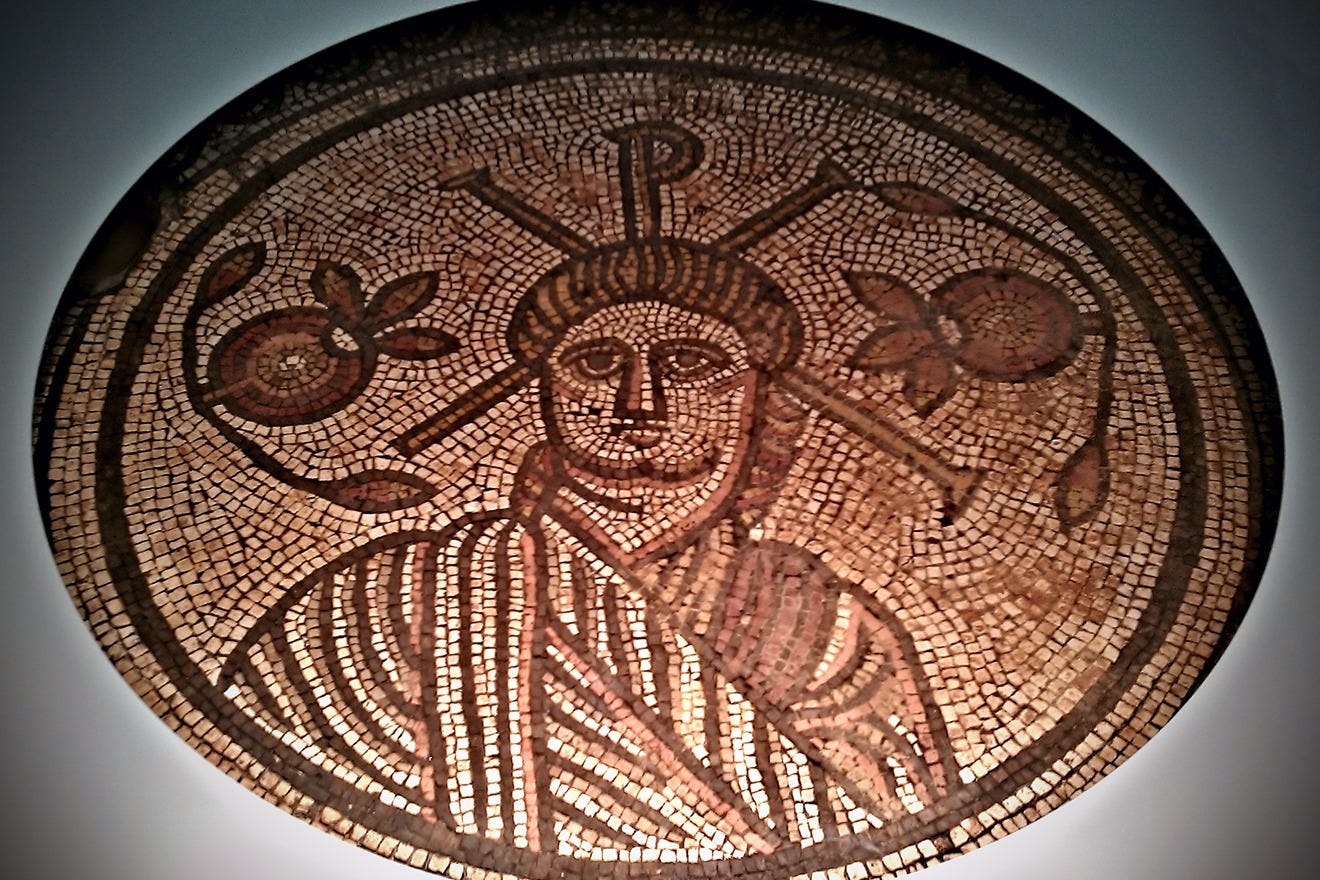
The Hinton St Mary Mosaic | Dorset (England), early 300s CE
British Museum | Photo Credit: Andres Rueda via Wikimedia Commons

Overview
The first Christians left almost nothing to look at, and then, within a century of Constantine, they left silver, ivory, and mosaic from Britain to Constantinople. This section lives in two rooms of the British Museum, Rooms 49 and 41, with five treasures in the Louvre and a saint’s church on a Paris hill. Four ideas organize this section, and each is an exam term.
Key Terms
Epistles · Gospels · Chi-Rho · Edict of Milan
Timeline
• ca. 50 CE | Paul writes his first letters
• 64 CE | Nero blames Rome’s Christians for the Great Fire
• 312 CE | Constantine wins at the Milvian Bridge
• 313 CE | The Edict of Milan
• 537 CE | Justinian dedicates Hagia Sophia
Epistles | Letters to the Churches
2,000 years ago, in Galilee, a Roman-controlled district in the north of Israel, a teacher from the small village of Nazareth gathers a following of women and fishermen. The movement eventually called Christianity began as a movement of Jews. After all, Jesus was a Jew, and so were his first followers. Jesus sent his followers out: “Go ye therefore, and teach all nations.” They are the apostles (Gr. apostolos, “one who is sent”), led at first by Peter in Jerusalem. The most traveled of them was Paul, a Pharisee who had once persecuted the Church, until, as Acts tells it, the risen Jesus stopped him on the road to Damascus. A Roman citizen, Paul could move with ease through the empire. In three long journeys, Paul planted churches across Asia Minor and Greece, preaching first in the synagogues, where the Jews already knew the one God of Israel. The faith traveled on Rome’s own roads. By the 50s CE, Paul’s churches were scattered from Antioch to Corinth. They were small house-gatherings of Jews and Gentiles, and they had questions: about meals, about marriage, about what to do while they waited for Jesus to return. Paul could only be in one city at a time, and often he was in none of them, but in prison. So he wrote. Paul’s teaching letters are called epistles (Gr. epistolē, “a message sent”). Thirteen of the New Testament’s 27 books are letters that bear Paul’s name, and among them are some of the oldest writings in the New Testament. The letters were not read in private. They were read aloud to the gathered church, then passed on to the next one. A letter, read aloud to a room of believers, carried his voice where he could not go. And because the churches copied and shared them, the letters outlived the rooms they were written for. Room 41 of the British Museum has Paul himself, carved about 430 CE on an ivory panel from a small casket. On the left he sits reading from a scroll while a young woman named Thecla listens from the window of her house; on the right, a man raises a stone to throw at him. Look at Paul’s high forehead and pointed beard, the face Christian artists had already agreed to give him, and notice that he is shown doing the one thing the epistles were written to do: teaching someone he has never met. The Louvre shows what became of his letters. On an ivory diptych of two apostles, carved in the 400s, two men face each other beneath a medallion of Christ, and each holds a book; turn to the back, where a later owner scratched a board for a dice game into the ivory.
Gospels | Good News in Four Portraits
The Greek euangelion means “good news.” The Old English translation of euangelion is gōdspel, our Gospel. Thus, the Gospels are the Christian message of the good news of Jesus Christ. The Church received four Gospels, bearing the names of Matthew, Mark, Luke, and John. Each paints its own portrait of one life. Matthew frames the story of Jesus in the context of Jewish royalty, opening with his descent from Abraham and David. Mark is short and direct, moving “straightway” from scene to scene. Luke tends to emphasize the poor and the women who followed Jesus. John opens with the Logos, a word at home in Greek philosophy. The Gospels tell how Jesus was crucified in Jerusalem under the Roman governor Pontius Pilate, and Christians confess that he rose again on the third day. Christians copied these books in a new format. Instead of the scroll, they favored the codex, pages bound at the spine, the ancestor of every book you own. Such books were dressed like treasures. The Louvre’s Maastricht book cover, made around the year 1000, is a precious case for a Gospel book with the Crucifixion at its center and the symbols of the four evangelists around it; look for the man, the lion, the ox, and the eagle. In the next room, an ivory of the Miracles of Christ, carved about 400 CE, stacks three Gospel stories one above another: a woman touches the hem of his cloak, a paralyzed man walks off carrying his bed, and a herd of pigs plunges into the water. The oldest complete New Testament to survive, the Codex Sinaiticus, was copied around 350 CE. It belongs to the British Library, which shows it in the Treasures gallery from time to time but does not promise when, so it is not linked here. For three centuries Christians did not picture the story’s central scene. We find our earliest Christian art in the catacombs, the underground cemeteries outside the walls of Rome, and there, again and again, a young shepherd carries a lamb across his shoulders. Why a shepherd and not a cross? In the catacombs, the dead were laid to rest in hope, and the cross was still Rome’s way of executing criminals. The first Christians painted the hope they held, a shepherd bringing the lost sheep home. The cross became common in Christian art only after Constantine ended crucifixion as a punishment. Room 41 holds one of the first times an artist dared it. The Crucifixion ivory, carved in Rome about 420 to 430 CE, sets two deaths side by side: on the left Judas hangs from a tree with his purse of silver spilled beneath him, and on the right Christ stands on the cross, nailed by the hands, while Mary and John watch and a soldier reaches up with a spear. Look at Christ’s face. His eyes are open and his body does not sag, because the carver is showing the Gospels’ claim and not an execution: this is a man who is not defeated by what is being done to him.
Chi-Rho | The Sign on the Shields
The Christians were few. In the mid-100s CE, Christians in the empire probably numbered fewer than 50,000 among some 60 million Romans. Why persecute so few? Rome could tolerate almost any god. Jews held an ancient exemption from Rome’s sacrifices. Gentile Christians had no such standing, and they would not offer the pinch of incense before the emperor’s image. Some died rather than sacrifice. The Greek word for “witness” is martys, and the Church remembers them as martyrs. For three centuries the Christians had been a small, sometimes hunted minority. Their fortunes turned when a warlord had a dream. In 312 CE, Constantine marched on Rome against a rival emperor, Maxentius, whose army was larger than his own. On the eve of the battle at the Milvian Bridge, the Christian teacher Lactantius records, Constantine was directed in a dream to mark the heavenly sign on the shields of his soldiers. The sign is the Chi-Rho, the first two letters of Christ in Greek. He won the battle that day, and in 324 CE, the entire Roman Empire. Within a generation the sign had reached the far edge of that empire, and Room 49, the Roman Britain gallery, holds it three times over. The Hinton St Mary Mosaic, the anchor image above, was the floor of a villa in Dorset: a fair-haired, clean-shaven man looks straight up at you with the Chi-Rho behind his head and a pomegranate on either side. If he is Christ, as most scholars think, he is one of the oldest portraits of Christ anywhere; look for the two letters, the X and the long P, crossing behind him like a halo. On the wall nearby, the Lullingstone wall painting comes from a house in Kent where one upstairs room was made into a chapel; look for the Chi-Rho in red inside a wreath of leaves and flowers, set between two painted columns. In the case between them is the Water Newton treasure, the oldest church silver known from the whole Roman Empire, buried in a field in Cambridgeshire. Its silver plaques are thin triangular leaves, exactly the kind that pagans hung in their temples as thanks to a god, except that these are stamped with the Chi-Rho; look at the gilded medallion with the Greek letters alpha and omega on either side, the first and the last. The silver bowl with them carries the name of the man who gave it, Publianus.
Edict of Milan | The Church Above Ground
In 313 CE, Constantine and his fellow emperor Licinius agreed at Milan that “the Christians and all others should have liberty to follow that mode of religion which to each of them appeared best.” The Edict of Milan gave Christians full liberty of worship across the empire, and churches had their confiscated property restored. After the Edict of Milan, the church came above ground. For its new churches, Constantine chose not the Roman temple, built as a home for a god’s statue, but the Roman basilica, a long public hall for law courts and business. The basilica was built to hold a crowd. Its long nave led the eye down the rows of columns to the apse, where the bishop sat and the altar stood. Constantine went on to found a new Christian capital on the Bosporus, Constantinople. In 380 CE, the emperor Theodosius made Nicene Christianity the official religion of Rome. The old gods did not vanish overnight, and one object in Room 41 was made in the very year of that law. The Projecta Casket is a silver wedding chest from Rome: on its lid the goddess Venus dresses her hair in a seashell, and along the rim an inscription wishes the couple, Secundus and Projecta, a life in Christ. Look for both, the goddess and the prayer, on one lid. In 532 CE, riots in Constantinople burned the city’s great church to the ground. The emperor Justinian, with his empress and co-ruler Theodora, rebuilt it in under six years. Hagia Sophia is Greek for “Holy Wisdom.” Its dome, about 100 feet across, sits on a ring of forty windows, so the light seems to come from beneath it. For nearly a thousand years, it was the largest church in the world. Two ivories from Justinian’s city show what the Edict had made possible. The Archangel ivory in Room 41 is the largest Byzantine ivory panel to survive, an angel with a staff and an orb standing at the top of a flight of steps; look at his feet, which do not quite rest on the steps, so that he seems to float in front of the doorway. In the Louvre, the Barberini Ivory shows an emperor on a rearing horse, probably Justinian himself, with conquered peoples bringing tribute below; look above him, where two angels hold up a medallion of Christ. In the same room, the Harbaville Triptych is a folding ivory altar made in Constantinople four centuries later, with Christ enthroned between Mary and John the Baptist above rows of apostles and saints; look at their faces, each one different. Three centuries after Nero, the emperor rides under Christ’s blessing. Paris has its own witness to these centuries. The Panthéon was built as the church of Sainte-Geneviève, the patron saint of Paris, who lived as Roman rule in Gaul was ending; look on its walls for the painted story of her life.
Go Deeper
Culture & Values, 8th ed., Chapter 6, the beginnings of Christianity (pp. 199 to 213), and Chapter 7, Byzantium (pp. 215 to 239).
Where to Find These Artifacts
London
• Ivory panel of Paul & Thecla: British Museum, Rm 41, Europe 300-1100, Case 8
• Crucifixion ivory: British Museum, Rm 41, Europe 300-1100, Case 8
• Hinton St Mary Mosaic: British Museum, Rm 49, Roman Britain
• Lullingstone wall painting: British Museum, Rm 49, Roman Britain, wall
• Water Newton plaque: British Museum, Rm 49, Roman Britain, Case 18
• Water Newton bowl of Publianus: British Museum, Rm 49, Roman Britain, Case 18
• Projecta Casket: British Museum, Rm 41, Europe 300-1100, Case 7
• Archangel ivory: British Museum, Rm 41, Europe 300-1100, Case 14
Paris
• Barberini Ivory: Louvre, Richelieu 1, Rm 501, Case 7
• Harbaville Triptych: Louvre, Richelieu 1, Rm 501, Case 10
• Maastricht book cover: Louvre, Richelieu 1, Rm 502, Case 6
• Ivory diptych of two apostles: Louvre, Richelieu 1, Rm 501, Case 1
• Ivory of the Miracles of Christ: Louvre, Richelieu 1, Rm 501, Case 1
• Panthéon (church of Sainte-Geneviève): Panthéon
Module II • Scripture, Faith, & Empire
Sec 6 • Ancient Israel
Sec 7 • Early Christendom
Sec 8 • Early Islam
Sec 9 • Holy Roman Empire
Course Page: Humanities: Study Abroad | London & Paris