

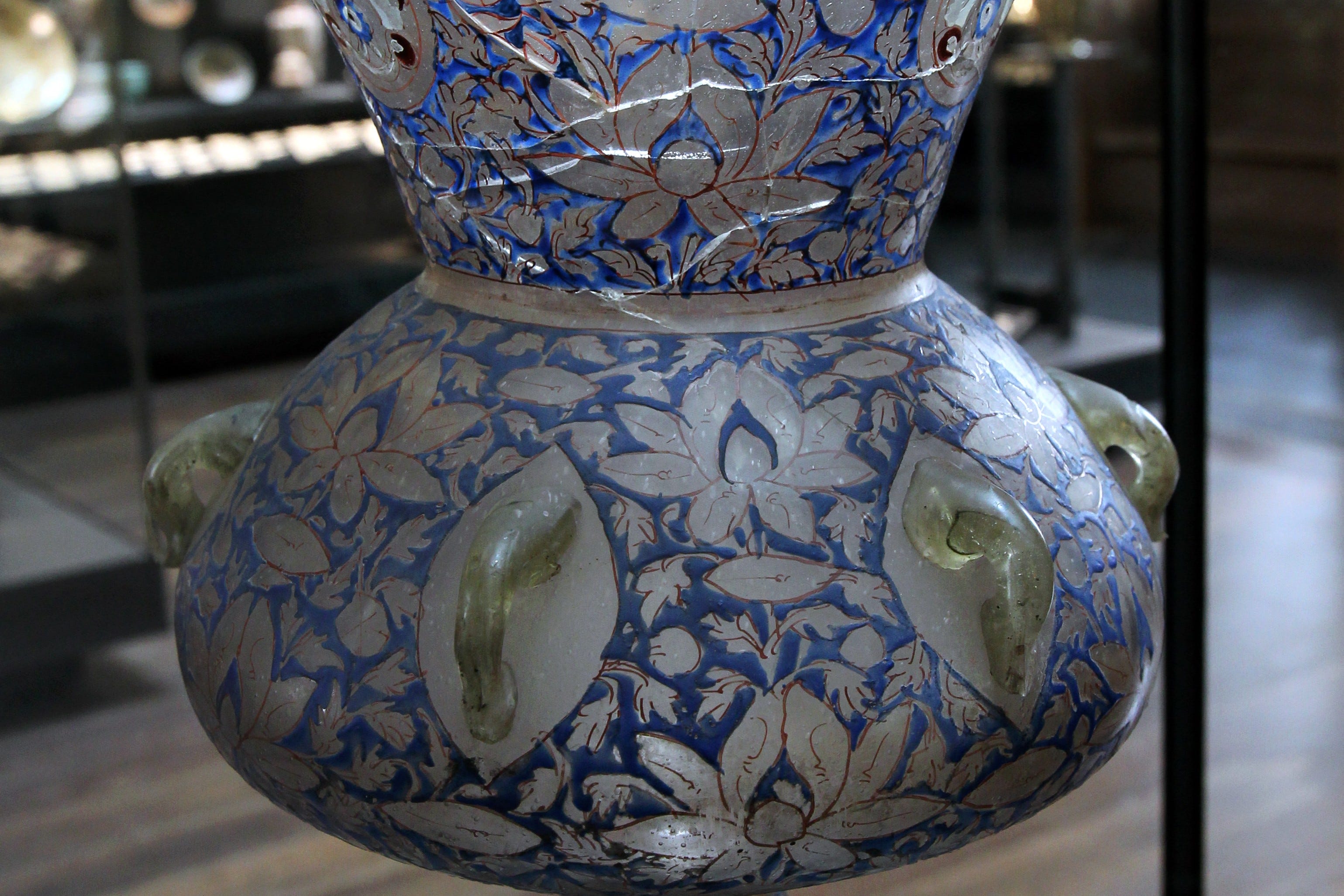
Mosque Lamp with Lotus Flowers | Egypt, ca. 1350 CE
British Museum | Photo Credit: Wikimedia Commons
Overview
The Louvre’s Islamic galleries are closed for renovation, so this section belongs to London: the British Museum’s gallery of the Islamic world, Rooms 42 and 43, with two crystal vessels in Paris. Five ideas organize this section, and each is an exam term.
Key Terms
Qur’an · Mosque · Calligraphy · Arabesque · House of Wisdom
Timeline
• 610 CE | Muhammad receives the first revelation
• ca. 650 CE | Uthman sends out one written Qur’an
• 691 CE | The Dome of the Rock is completed
• 762 CE | Baghdad is founded
• 785 CE | The Great Mosque of Córdoba is begun
Qur’an | The Recitation
The Arabic word Qur’an does not mean “book.” It means Recitation, from the same root as the first command that, Muslims hold, the angel gave Muhammad in 610 CE, iqra’, “Read!” or “Recite!” Taken from their etymological bases, the Jewish Torah is a teaching. The Gospels are good news. And the Qur’an is a recitation. The Qur’an was heard before it was ever read as text. Islamic tradition holds that it was “sent down” in installments across 23 years of Muhammad’s ministry. With each installment, Muhammad recited the new verses to his Companions, who memorized them, recited them to others, and wrote some of them on whatever lay to hand: pieces of bone, scraps of leather, the flat ribs of palm leaves. At the Prophet’s death, there was no Qur’an between two covers. Around 650 CE, the caliph Uthman set scholars to checking the written verses against the memories of the surviving Companions, and a single authoritative written edition was sent across the empire. Its 114 chapters, the surahs, run (after the short opening) mostly from longest to shortest. Each surah is made of verses called ayas, “signs.” And because Muslims hold that the Arabic is the revelation, any translation is regarded as an interpretation: useful, common, and secondary. In worship, the Qur’an is recited in Arabic from Indonesia to Ohio. A hafiz (“guardian”) has memorized all 114 surahs. There are millions alive today, many of them children. Room 42 of the British Museum shows how that memorizing was done. The Qur’an in its leather case comes from West Africa, written by hand in brown and red ink about a century ago, and it was never bound. Its pages are loose so that a teacher could hand them out among his students, a few leaves to each, and gather them back into the case at the end of the lesson. Look for the circles in the margins, which divide the text into 60 parts for reciting, and you are looking at a book made to be said aloud.
Mosque | The Place of Prostration
The building where Muslims gather is the mosque (Ar. masjid, “place of prostration”). A mosque is not a church: it holds no altar and no sacrament, only a congregation at prayer. The model for all later mosques was Muhammad’s own house in Medina: a walled courtyard with a roof of palm fronds on palm-trunk columns along one side. A mosque’s layout is typically functional and spare. All prayer faces the Ka’ba in Mecca, the direction called the qibla. A niche in the qibla wall, the mihrab, marks that direction. Beside it stands the minbar, the stepped pulpit for the Friday sermon, and outside rises the minaret. Worshippers leave their shoes at the door. There are no pews and no chairs, only carpet, and the congregation prays in rows, shoulder to shoulder. You cannot visit a mosque in the British Museum, but Room 42 holds the two things that stood at its heart. The mihrab tiles from Kashan, in Iran, are two parts of a niche made of glazed tile about 1300 to 1350, shimmering with the metallic glaze called lustre; look for the pointed arch, which once told a whole congregation which way Mecca lay. In front of a mihrab hung a lamp. The verse most loved on a mosque’s walls, and on the glass lamps that once hung in them, is the Qur’an’s own image of light: “Allah is the Light of the heavens and the earth. The similitude of His light is as a niche wherein is a lamp. The lamp is in a glass. The glass is as it were a shining star.” A niche, a lamp, and a verse about both: the mihrab and the light hung before it carry the Qur’an’s own words. The mosque lamp with lotus flowers, the anchor image above, was made in Egypt about 1350 of glass painted with enamel and gold; look for the glass loops on its shoulder, where the chains were fastened, and imagine it lit from inside by a small dish of oil. Its neighbor, the lamp of Tuquztamur, was made for an officer of the sultan of Egypt, who paid for it as a gift to God and wanted his name on it.
Calligraphy | Words as Ornament
In the mosque and on the page of the Qur’an, Muslim art shows no human figures. Some 360 idols, tradition says, had once stood around the Ka’ba, and Muhammad had cleared them out. To keep anything in a house of prayer that might draw worship away from God was, to most Muslim scholars, unthinkable. So the artists of the mosque turned to the one thing they held most sacred: God’s word. Calligraphy (Gr. kalli, “beautiful,” and graphia, “writing”) became the highest art of the Islamic world, and the calligrapher the most honored artist. The great early Qur’ans were written in Kufic, a stately, angular script. In 10th-century Baghdad, the vizier Ibn Muqla set the rounded scripts in proportion, measuring every letter by the rhombic dot of the pen. The writing that Mesopotamia and Egypt had pressed and carved for records and rites became, in Islam, the ornament itself. There are no narrative scenes from holy scripture, only the holy scripture itself. Both kinds of script are in Room 42. The limestone tombstone of Yusuf, carved in 1161, is a pillar with nothing on it but his name and a prayer in Kufic; look at how the letters stand upright and square, like a row of buildings. Now go back to the mihrab tiles and read the border, or at least follow it with your eye. The flowing blue letters are one of the rounded scripts, and they spell out the Throne Verse of the Qur’an, which says that God’s throne extends over the heavens and the earth; the smaller band inside names the judge who paid for the niche. A few streets north, the British Library keeps Sultan Baybars’ Qur’an, written in Cairo between 1304 and 1306 in seven volumes; if the Library has it out, look at the letters, each one laid in gold and outlined in black, six lines to a page. The Louvre has one piece of Islamic writing you can still see while its Islamic galleries are closed. The rock-crystal ewer in Room 502 was carved in Cairo around the year 1000 from a single block of clear crystal, and it came to Paris as a treasure of the abbey of Saint-Denis; look just below the neck for the line of Kufic, which wishes “blessing and happiness to its owner.” In the next case, the Vase of Eleanor of Aquitaine is a pear-shaped vessel of rock crystal, probably cut in Persia, that a Muslim king of Zaragoza gave to Eleanor’s grandfather; look at the honeycomb cut into the crystal, and at the Latin verses on the base, in which a French abbot lists everyone who owned it.
Arabesque | Pattern Without End
Around the words grows pattern. The arabesque is an ornament of interlacing vines and leaves, often set beside geometric stars, that repeats without end, and its makers built it with compass and straightedge, out of the same geometry the House of Wisdom studied. A pattern can be extended in every direction past the edge of the wall. As the caliphs grew rich, the mosque grew great. In Jerusalem, on the Temple Mount, the caliph Abd al-Malik raised a shrine, the octagonal, golden-domed Dome of the Rock, the oldest surviving great work of Islamic architecture. In Damascus, his son al-Walid I built the Great Mosque on the site of a Christian church. Byzantine craftsmen covered the mosque’s walls with gold mosaics of rivers, trees, and palaces. Not one person or animal appears in them. Far to the west, the most famous Umayyad survivor of the Abbasid revolution, Abd al-Rahman I, fled to Spain and began the Great Mosque of Córdoba in 785 CE. Its hall became a forest of some 850 columns, many of them reused Roman shafts, carrying two tiers of arches, horseshoe below and round above, striped in red brick and white stone. The arabesque outlived all the caliphs. Room 43 shows it eight centuries on, in the Iznik tile panel, four tiles made in Ottoman Turkey in the late 1500s for the wall of a mosque or a palace. Split leaves curl around lotus blossoms in cobalt blue, turquoise, and a red so thick it stands up from the surface. Look at the edges of the panel. The stems do not stop there; they run off the tile, and the next four tiles would have picked them up and carried them on. That is the idea in one square foot: a garden with no center and no end, which is how these artists pictured the work of a God who cannot be pictured.
House of Wisdom | The Translators of Baghdad
At the center of the Abbasid world stood the round city of Baghdad, founded in 762 CE. Its very centrality is why it became one of the greatest repositories of knowledge on the planet: the Oxford of its day, the place to which scholars carried the writings and inventions of distant lands. Did the Hindus have a better number system? Adopt it. The Arabs had arrived with a single book, the Qur’an, and an enormous appetite for more. Under the caliph Harun al-Rashid and his son al-Ma’mun, that appetite found a home in the caliphal library and research center remembered as the House of Wisdom (Bayt al-Hikma). In al-Ma’mun’s Baghdad, the works of Plato, Aristotle, Euclid, Ptolemy, and the Greek physicians were rendered into Arabic. To al-Ma’mun’s court, knowledge was a treasure worth its weight in gold, wherever it came from. The translators themselves were largely Christians. From its first page, the Golden Age was the work of Christians, Jews, Zoroastrians, and Muslims alike. In the West, few could still read Greek, and much of that learning fell out of circulation for centuries. Among the scholars of al-Ma’mun’s Baghdad was the mathematician al-Khwarizmi. The Arabic for “completion” is al-jabr, and so his title gave us algebra. A second book of his taught readers to calculate with India’s numerals, and its opening words turned his name into our algorithm. Six of our brightest stars still answer to Arabic names: Aldebaran, Altair, Betelgeuse, Rigel, Vega, Deneb. Those stars are on the astrolabe in Room 42. An astrolabe is a flat brass model of the sky. Turn its pierced top plate and the star pointers sweep over the lines engraved beneath, and from the height of one star a user could tell the hour, the times of prayer, and the direction of Mecca. The Greeks invented the instrument, and the scholars of the Islamic world perfected it. This one was made around 1240 by a man who signed himself “the Astrolabist,” and it is inlaid with silver and copper; look for the constellations drawn as people and animals. Figures had no place in the mosque. In the sciences, they were welcome.
Go Deeper
Culture & Values, 8th ed., Chapter 8, Islam (pp. 241 to 269).
Where to Find These Artifacts
London
• Qur’an in a leather case: British Museum, Rm 42, Islamic World, Case 17
• Mihrab tiles from Kashan: British Museum, Rm 42, Islamic World, Case 2
• Mosque lamp with lotus flowers: British Museum, Rm 42, Islamic World, Case 5
• Mosque lamp of Tuquztamur: British Museum, Rm 42, Islamic World, Case 6
• Tombstone of Yusuf: British Museum, Rm 42, Islamic World, open display
• Iznik tile panel: British Museum, Rm 43, Islamic World, open display
• Astrolabe: British Museum, Rm 42, Islamic World, Case 10
• Sultan Baybars’ Qur’an: British Library, Treasures Gallery, when the Library has it out
Paris
• Rock-crystal ewer: Louvre, Richelieu 1, Rm 502
• Vase of Eleanor of Aquitaine: Louvre, Richelieu 1, Rm 502, Case 15
• Closed for renovation: the Louvre’s Islamic Art galleries (Denon)
Module II • Scripture, Faith, & Empire
Sec 6 • Ancient Israel
Sec 7 • Early Christendom
Sec 8 • Early Islam
Sec 9 • Holy Roman Empire
Course Page: Humanities: Study Abroad | London & Paris