

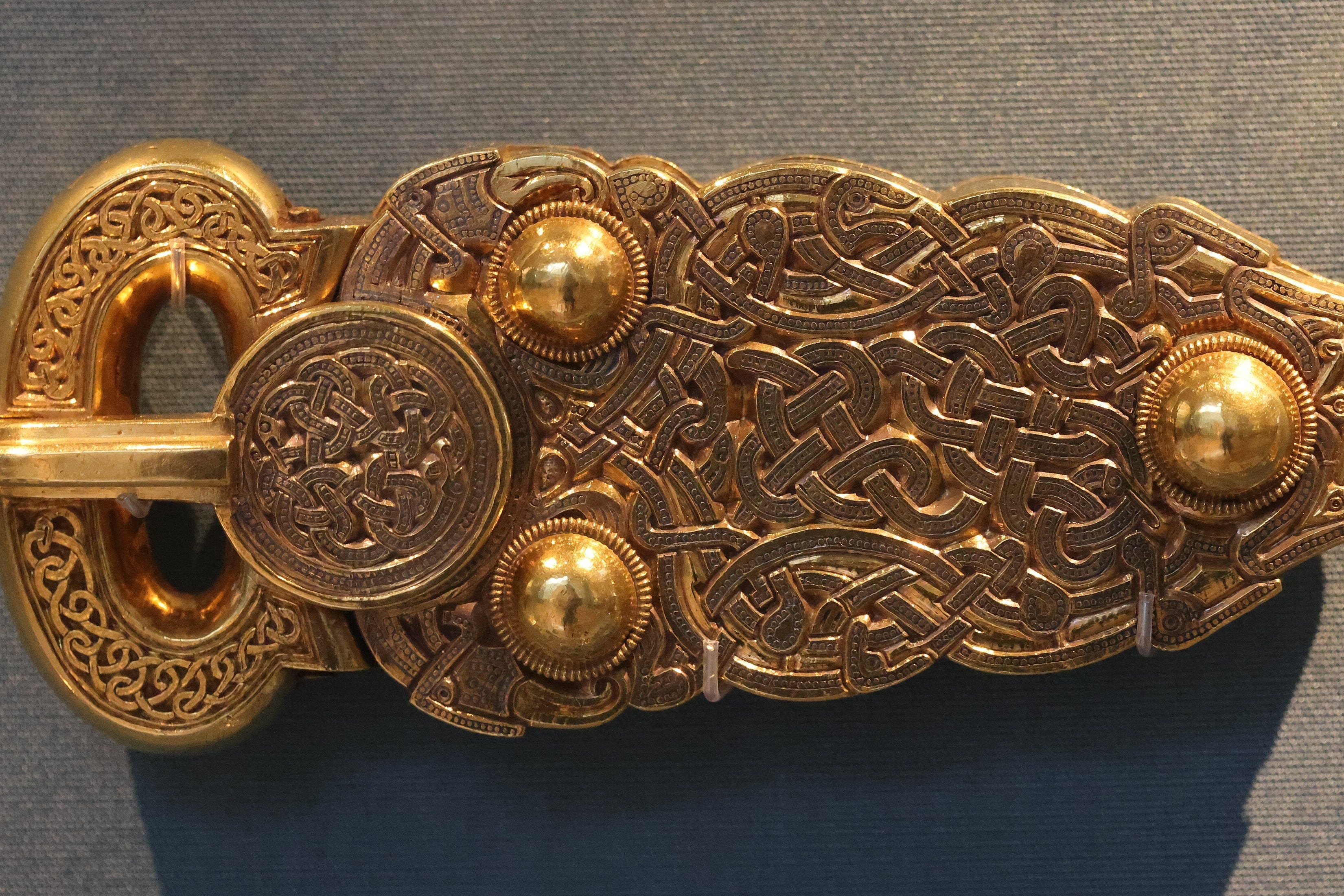
The Great Gold Buckle | Sutton Hoo (England), early 600s CE
British Museum | Photo Credit: Geni via Wikimedia Commons

Overview
After Rome fell in the West, its gold passed to warrior kings and its learning to monks, and in the year 800 a Frankish king took its crown. This section runs from a ship burial in Room 41 of the British Museum to Charlemagne in the Louvre to the first stones of Westminster Abbey. Five ideas organize this section, and each is an exam term.
Key Terms
Beowulf · Heroic Code · Illuminated Manuscript · Holy Roman Empire · Romanesque
Timeline
• ca. 625 CE | A king is buried in his ship at Sutton Hoo
• 800 CE | Charlemagne is crowned emperor in Rome
• 843 CE | The Treaty of Verdun divides his empire
• 962 CE | Otto I is crowned emperor in Rome
• 1065 CE | Edward the Confessor’s Westminster Abbey is consecrated
Beowulf | The Poem & the Ship
Across the Germanic North, kings and warriors heard the deeds of their ancestors sung in the hall by a scop (OE. shaper), an oral poet much like Homer’s singers. Almost all of that singing is lost. One great poem came through. Beowulf is the longest epic poem in Old English, 3,182 lines, and it survives in a single manuscript copied around 1000 CE. That book nearly burned in a London library fire in 1731, and its edges are still scorched. It belongs to the British Library, which shows it in the Treasures gallery from time to time but does not promise when, so it is not linked here. The poem was written in England, by and for the Anglo-Saxons, but it is set in their ancestors’ homeland, in Denmark and southern Sweden in the 500s. The Danish king Hrothgar builds a great hall, Heorot. A monster of the moors, Grendel, raids the hall by night for twelve years. Across the sea, a young warrior of the Geats hears the news. Beowulf sails to Denmark with fourteen companions and meets Grendel in the dark with his bare hands. Fifty years later, Beowulf is the old king of the Geats. A dragon wakes over a stolen cup and burns the land. Together with young Wiglaf he kills the dragon, but Beowulf is mortally wounded. Its world is real in another way. In 1939, at Sutton Hoo in Suffolk, archaeologists uncovered the burial of an East Anglian king, laid in a 27-meter ship around 625 CE with his helmet, his sword, and a gold buckle. The poem opens with a ship funeral much like it, a dead king laid “on the breast of the boat” with “a heaped hoard” beside him. That hoard is in Room 41 of the British Museum. The Great Gold Buckle, the anchor image above, is nearly a pound of gold; look into its surface until the tangle sorts itself into snakes and long-jawed beasts biting one another. The poet was a Christian, writing of his pagan ancestors, and one box in the same room does what he did. The Franks Casket, carved from whalebone in the north of England in the early 700s, sets a pagan legend and a Gospel scene side by side on its front panel; look for the smith Weland at his forge on the left and the three Magi bringing gifts on the right, framed by runes in Old English.
Heroic Code | Gold, Loyalty, & Fame
The poem’s world runs on the heroic code, the bond of gift and loyalty between a lord and his warriors. The Roman historian Tacitus had described it among the Germanic tribes centuries earlier: the chief fights for victory, and his companions fight for their chief. The lord gives treasure, land, food, and a place in the hall. The warrior gives courage and, if it comes to that, his life. Fame (OE. lof) is the reward that outlives both. That is why the good king gives away his gold. A hoard kept in the treasury buys nothing. A ring given in the hall buys loyalty. Hrothgar warns Beowulf of the opposite king. Heremod of the Danes grew proud, and “no bracelets gave he to Danes as was due.” He ended alone, cut off from his own men. The dragon is the code’s last image: a hoard guarded for its own sake, and useless. Beowulf’s men break the code at the end, and Wiglaf keeps it. The poet’s language is a craft of its own. Old English verse is built on the kenning, a short compound metaphor that names a thing by a picture of it. The sea is the “whale-road.” The body is the “bone-house.” A king is a “ring-giver,” named for the very act that made him good. The king buried at Sutton Hoo was a ring-giver, and the case in Room 41 shows what he had to give. The Sutton Hoo purse lid once covered a leather pouch of gold coins from Frankish Gaul; the leather has rotted away and left the gold frame with its plaques of red garnet. Look for the bird of prey seizing a duck, and for the man standing between two beasts. The shoulder clasp is one of a pair that fastened the king’s armor, each hinged on a gold pin; look at the rounded ends, where two boars cross one another, their backs made of garnets cut to fit like panes in a window. None of this was made to be hoarded. It was made to be worn in the hall and seen by the men who would be asked to die for the wearer. The Franks kept the same code across the Channel. In a great hall a sword had a name and a history, and the Louvre has one: Joyeuse, the sword that legend gave to Charlemagne, hangs in Room 502.
Illuminated Manuscript | The Word Made Picture
A defining art of the age of Charlemagne was the illuminated manuscript, a book copied by hand and decorated with color, and often gold, so that its pages seem to give off light (Lt. illuminare, to light up). These books were written on parchment (animal skins) in the monastery’s scriptorium, its writing room, and most of them held sacred texts like the Gospels or the Psalms. Charlemagne’s own Dagulf Psalter was bound in carved ivory, and the two covers of the Dagulf Psalter are in the Louvre’s Room 501; look for King David writing the Psalms and then singing them among his musicians, and on the other panel Saint Jerome correcting the text. One of the finest came from the edge of the known world. The Book of Kells is a Latin copy of the four Gospels, made around 800 CE by Irish monks, probably begun at the monastery of Iona off the coast of Scotland. An older cousin, the Lindisfarne Gospels, is credited to Eadfrith, bishop of Lindisfarne. Almost every page of the Book of Kells is alive. Its painters wove spirals, knots, and ribbon-like animals into the letters, a style shared with Irish metalwork and with the gold of Sutton Hoo. On its most famous page, the Greek letters chi and rho begin Matthew’s account of Jesus’ birth and fill the whole page. Like the Muslim calligraphers of the same centuries, the Irish monks made the sacred word itself into the picture. The Book of Kells is in Dublin, and the Lindisfarne Gospels belong to the British Library, which does not promise when they are on show. But you can see where the style came from. Go back to the Great Gold Buckle and the shoulder clasp in Room 41 and look at them as a monk of the next century would have: the knotted beasts on the buckle are the same beasts that fill the borders of a Gospel page, and the clasp’s panel of stepped garnets, row on row inside a border of interlace, is laid out exactly like the pages of pure pattern that open each Gospel. Scholars call those carpet pages. The goldsmith’s design for a pagan king became, within a hundred years, the monk’s design for the word of God.
Holy Roman Empire | Charlemagne’s Crown
In 476 CE, a Germanic general deposed the last emperor in the West. Rome’s empire did not end that day. It moved east. Constantinople kept the Roman name, the Roman law, and the Roman throne, while the old western provinces broke into kingdoms ruled by Germanic peoples: Goths, Lombards, Burgundians, and Franks. The Franks held Gaul (~France). Pepin’s son Charles is Charlemagne, Charles the Great, and his name gives his dynasty its name, Carolingian. By 800 CE, Charlemagne’s empire included most of Western Europe. Charlemagne received a papal coronation in Saint Peter’s Basilica in Rome on Christmas Day, 800 CE, by Pope Leo III. He was the first emperor in the West in more than three centuries. The pope gained a sword. And Rome gave Charles an authentic claim to the long-lost Roman throne of Caesars and emperors. The Louvre has him on horseback. The bronze statuette of Charlemagne in Room 501, only about ten inches tall, shows a Frankish king with a moustache and a crown, an orb in his hand, riding as Roman emperors rode in their statues; it may be Charlemagne or his grandson Charles the Bald, and look at how small the horse is beside the man. Next door in Room 502 are two things made in his name long after his death. The arm reliquary of Charlemagne, a gilded box made about 1165, when a German emperor had him declared a saint, once held a bone of his arm. And the sword called Joyeuse, which legend gave to Charlemagne, was carried at the coronations of the kings of France for centuries; look at its gold hilt, pieced together over many generations. Charlemagne’s realm was not yet called the Holy Roman Empire. The Holy Roman Empire names the realm of the German kings crowned emperor in Rome, beginning with Otto I in 962 CE. Charlemagne is its father in memory. Otto is its founder in fact. After Charlemagne, his grandsons divided the empire at Verdun. One of their sons owned the Lothair Crystal in Room 41, a disc of clear rock crystal engraved with the story of Susanna, the woman falsely accused and saved by a just judge; look for the Latin words in the center, which say that Lothair, king of the Franks, ordered it made. Then came the raiders: Vikings from the north, Magyars from the east. Kings were far away. Local lords were close. Out of that need grew feudalism, land given in exchange for loyalty. A vassal knelt, placed his hands between the lord’s, and swore to fight for him. The whole order sits on one chessboard in Room 40. The Lewis Chessmen were carved from walrus ivory around 1150 to 1200, probably in Norway; look for the king with his sword across his knees, the bishop beside him, and the knight on his small horse.
Romanesque | Churches of Stone
Charlemagne modeled much of what he did on ancient Rome, and his palace at Aachen was no different. The Palatine Chapel at Aachen, consecrated in 805 CE, was modeled after San Vitale in Ravenna, a church of the emperor Justinian’s age. Two centuries later, the roads filled. In the 1000s, pilgrimages became popular as travel became safer. Thousands of pilgrims walked each year to the shrine believed to hold the apostle James at Santiago de Compostela in Spain, and to Rome. Monasteries along the way needed churches that could hold them. The style of these churches is called Romanesque, “Roman-like,” for its round Roman arches and heavy stone vaults. Builders laid the old Roman basilica plan in the shape of a cross, then roofed it in stone. Heavy stone arches and vaults gave the church a fireproof stone roof. In a church lit by candles, a wooden roof could burn, and many did. A stone roof demanded thick walls, and thick walls allowed only small windows. That brought a notable lack of interior light. This drove much of the decoration outside. Over the main doorway, the portal, carvers filled the tympanum, a half-moon of stone, with scenes for the pilgrims to read before they entered. In England the Romanesque is called Norman, and the first great Norman church in England stood where we will stand on our first morning in London. Edward the Confessor built a new abbey at Westminster in the round-arched style of Normandy and saw it consecrated at Christmas 1065, days before he died. Two centuries later Henry III pulled most of it down to build the Gothic church we will walk through, and he did it to honor Edward, whose shrine still stands behind the high altar. Look, as you go, for the round arches of the oldest rooms off the cloister, which are what remains of the Norman abbey. The same taste shaped small things. Turn the Lewis Chessmen around and look at the backs of the thrones: the scrolls of leaves and the beasts biting their own tails are Romanesque carving, the doorway of a pilgrim church at the size of your thumb. In the Louvre, Suger’s Eagle is the taste at its richest: an ancient vase of purple stone that the abbot of Saint-Denis had fitted, before 1147, with the head, wings, and claws of a gilded eagle. Remember the abbot’s name. He is about to invent the Gothic. Within a few generations, builders in France would find a way to raise the walls higher and open them to light. But the Romanesque church came first, built of stone to last, and big enough to welcome the world.
Go Deeper
Culture & Values, 8th ed., Chapter 9, Charlemagne and the rise of medieval culture (pp. 271 to 301).
Where to Find These Artifacts
London
• Great Gold Buckle, Sutton Hoo: British Museum, Rm 41, Europe 300-1100, Case 1
• Sutton Hoo purse lid: British Museum, Rm 41, Europe 300-1100, Case 1
• Sutton Hoo shoulder clasp: British Museum, Rm 41, Europe 300-1100, Case 1
• Franks Casket: British Museum, Rm 41, Europe 300-1100, Case 2
• Lothair Crystal: British Museum, Rm 41, Europe 300-1100, Case 3
• Lewis Chessmen: British Museum, Rm 40, Medieval Europe, Case 5
• Edward the Confessor’s abbey & shrine: Westminster Abbey
Paris
• Statuette of Charlemagne: Louvre, Richelieu 1, Rm 501, Case 3
• Arm reliquary of Charlemagne: Louvre, Richelieu 1, Rm 502, Case 5
• Joyeuse, the coronation sword: Louvre, Richelieu 1, Rm 502, Case 30
• Suger’s Eagle: Louvre, Richelieu 1, Rm 502, Case 15
• Covers of the Dagulf Psalter: Louvre, Richelieu 1, Rm 501, Case 5
Module II • Scripture, Faith, & Empire
Sec 6 • Ancient Israel
Sec 7 • Early Christendom
Sec 8 • Early Islam
Sec 9 • Holy Roman Empire
Course Page: Humanities: Study Abroad | London & Paris