

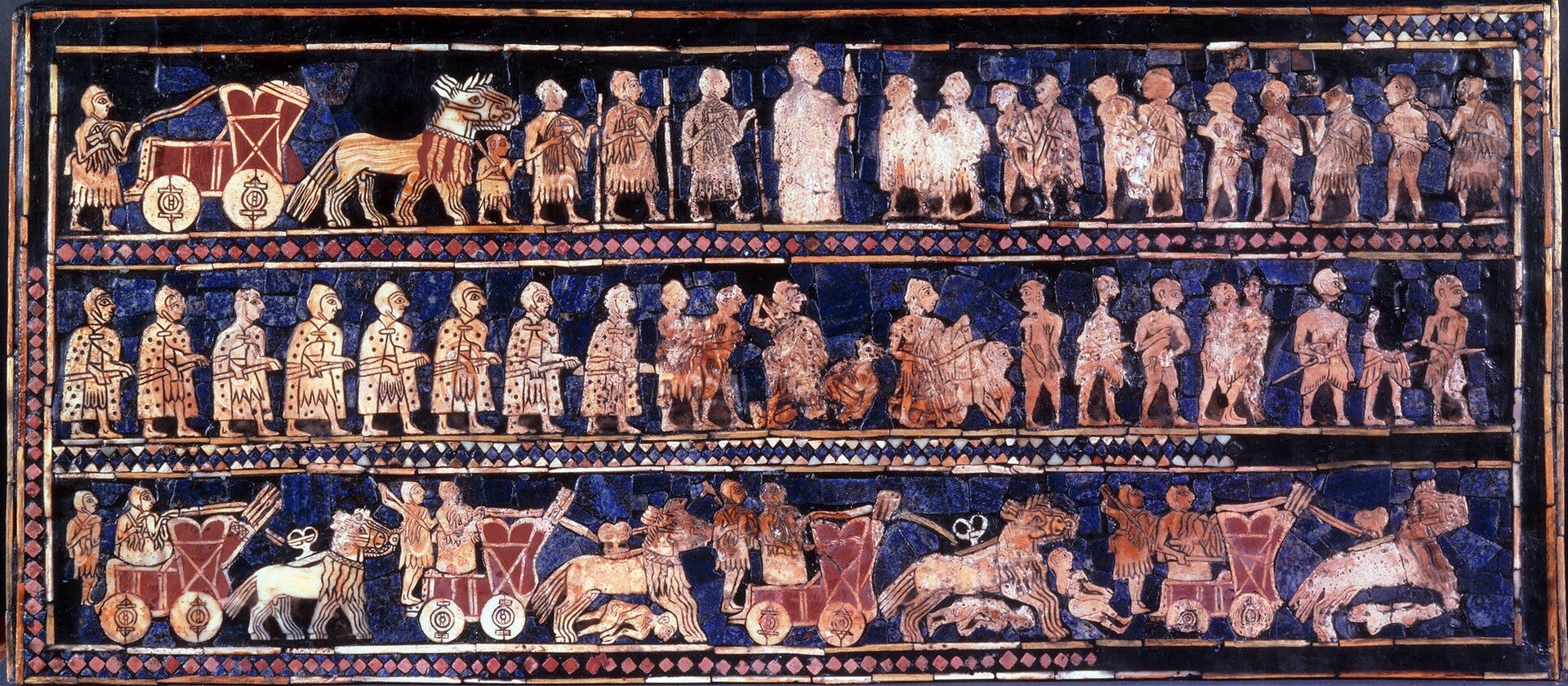
The Standard of Ur, War Side | Ur (Iraq), ca. 2500 BCE
British Museum | Photo Credit: Wikimedia Commons
Overview
This section covers two kinds of people: those who lived before writing, and the first people who wrote. Their objects are in the British Museum and the Louvre. Four ideas organize this section. Each is an exam term, and each heading below names the objects you will stand in front of.
Key Terms
Prehistory · Bronze Age · Stele · Epic of Gilgamesh
Timeline
• ca. 11,000 years ago | The Ain Sakhri lovers are carved
• ca. 3200 BCE | Writing begins in Sumer
• ca. 2700 BCE | Gilgamesh rules Uruk
• ca. 1750 BCE | Hammurabi's laws are cut in stone
• ca. 645 BCE | Ashurbanipal hunts lions at Nineveh
Prehistory | Before Writing
The oldest thing on our tour is a pebble. The Ain Sakhri lovers is a piece of calcite about four inches tall, carved about 11,000 years ago by people living near Bethlehem, and the British Museum describes it as the oldest known sculpture of two people making love. Look for the way the carver let the shape of the stone make the two bodies. Historians call this earliest period of humanity prehistory because it comes before recorded history (before there was a written record of events). Even though there are no “prehistoric texts,” we can still look to the record of archaeological evidence for clues to their stories. A single tool or ornament can reveal much about the priorities and customs of its original community, even when no written language exists to explain its purpose. The Jericho skull is a real human skull, plastered over to look like a living face and kept in a house in one of the first towns; look at how carefully the nose and cheeks were built up. The Louvre's Ain Ghazal statue is a plaster figure about three feet tall from the same world of first towns, one of the oldest large human figures anywhere; notice its wide, outlined eyes. The Susa beaker painted with ibexes is village pottery from just before writing; find the ibex and the horns that curve into near circles. Prehistory itself ends with writing. The small clay tablet from Uruk records an accountant's count of goods in the first generation of writing, and everything after it is history.
Bronze Age | Metal & Trade
The Bronze Age is the era when tools and weapons of bronze replaced those of stone. Iron and copper were plentiful, but tin was not. However, copper and tin, if heated together in a fire as hot as a pottery kiln, would melt and form bronze, an alloy of roughly 9 parts copper to 1 part tin. It was much harder than copper alone, far less brittle than stone, and could be shaped into almost anything. After about 3000 BCE, the army that had bronze weapons and sufficient numbers was generally the army that won. The tin had to come from far away (some of it from as far as Afghanistan). So the Bronze Age was also an age of long-distance trade. That trade is visible in the Standard of Ur, a wooden box inlaid with shell, red limestone, and lapis lazuli carried 1,500 miles from Afghanistan. One side shows war (chariots, prisoners, the king), the other peace (a banquet, with a musician playing a lyre), each in three rows read from the bottom up. No one knows what it was for. Its discoverer guessed at a banner on a pole, and the name stuck. The lyre in the next case came from the same royal graves; look for the bull's head on the front. The Mold Gold Cape is the same wealth in Wales. It was hammered from a single ingot of gold and found in 1833 crushed around a skeleton in a burial mound. Whoever wore it could barely lift their arms, so it was never for work; stand close and notice how thin the gold is.
Stele | Kings in Stone
Southern Mesopotamia is a flat plain of river mud. There is no stone to quarry, no mountain to climb, and no forest to cut, which is a problem when your gods live on mountaintops. So the Mesopotamians built their own. The core of the Ziggurat of Ur is millions of sun-dried mudbricks, and every few courses, the king's name is stamped into the bricks. The mountain is signed. One of those bricks is in the British Museum; look for the stamp with Ur-Nammu's name. What stone Mesopotamia had was imported, so it was reserved for the king. A stele is a ceremonial, human-sized flat stone, set upright and carved with words or pictures. The Victory Stele of Naram-Sin shows the king wearing a horned crown, the crown of a god, climbing a mountain and standing on the bodies of his enemies beneath symbols of the gods. He is drawn twice the size of his soldiers. The Stele of Hammurabi is the same idea in a lawyer's hands: a 7-foot pillar of black basalt, with the king at the top receiving the measuring rod and ring of kingship from the seated sun god Shamash, and 282 laws cut below. Both steles were carried off to Iran as war loot, and French archaeologists dug them up around 1900. Today they stand in the Louvre, in rooms next to each other. Nearby is Ebih-Il, a temple official from the city of Mari carved in a fleece skirt with his hands clasped in prayer; look at his eyes, inlaid with shell and lapis. In London, a foundation tablet from the city of Larsa is cut with Hammurabi's name; it was buried under a temple so the god would know who built it.
Epic of Gilgamesh | King Who Couldn’t Keep His Friend
The Epic of Gilgamesh is one of the oldest works of literature ever found. Archaeologists believe Gilgamesh was a real person who ruled from the city of Uruk, and legends about him became the poem. The Sumerians told his stories first. Around 1200 BCE a Babylonian scholar gathered them into one Akkadian poem on 12 clay tablets, and that is the version we read. In brief, the first half of the story is Gilgamesh meeting and befriending a wild man named Enkidu, a man of the steppe made by the gods to be his equal. They have adventures together: they kill the forest giant Humbaba and the Bull of Heaven. For that, the gods decree that Enkidu must die, and he sickens and dies in his friend's arms. The rest of the story is about Gilgamesh coping with death by attempting to gain immortality and questioning the meaning of life. He crosses the waters of death to find Utnapishtim, the one man the gods made immortal, who tells him how he survived a great flood sent to punish humankind: one virtuous man is warned, builds a boat, and saves his family and the animals. You probably know this story. In Gilgamesh the survivor is Utnapishtim. In Genesis the survivor is Noah. Most of the poem was lost for more than 2,000 years, until a British Museum assistant named George Smith read the flood tablet in 1872 and announced it to a stunned London. That tablet is the one in the case: a broken slab of clay the size of a paperback, covered in wedge-shaped writing, from the library of King Ashurbanipal at Nineveh. Ashurbanipal is downstairs too. The Assyrians to the north, who had stone, carved it: the lion hunts of Ashurbanipal, now in London, are the finest animal sculpture of the ancient world. Look for the dying lioness dragging her paralyzed hind legs.
Go Deeper
Culture & Values, 8th ed., Chapter 1, Beginnings (pp. 3 to 42): the prehistoric and Mesopotamian sections. The Egyptian section is Tuesday's.
Where to Find These Artifacts
London
• The Ain Sakhri lovers: British Museum, Rm 51, Ancient Europe, Case 2
• The Mold Gold Cape: British Museum, Rm 51, Ancient Europe, Case 8
• The Jericho skull: British Museum, Rm 59, Ancient Levant, Case 1
• The Standard of Ur: British Museum, Rm 56, Mesopotamia, Case 17
• The lyre from Ur: British Museum, Rm 56, Mesopotamia, Case 19
• Hammurabi's foundation tablet: British Museum, Rm 56, Mesopotamia, Case 24
• The flood tablet: British Museum, Rm 55, Mesopotamia, Case 16
• The brick of Ur-Nammu: British Museum, Rm 1, Enlighten. Gallery, Wall Press 68
• The lion hunts of Ashurbanipal: British Mus., Rm 10a, Assyria: Lion Hunts, Sec C
Paris
• The Stele of Hammurabi: Louvre, Richelieu, Rm 227, Near East
• The Victory Stele of Naram-Sin: Louvre, Richelieu, Rm 228, Near East
• The beaker painted with ibexes: Louvre, Richelieu, Rm 232, Near East, Case 2
• Ebih-Il: Louvre, Richelieu, Rm 234, Near East
• The clay tablet from Uruk: Louvre, Richelieu, Rm 236, Near East, Writing case
• The Ain Ghazal statue: Louvre, Sully, Rm 303, Near East
Module I • The Ancient Galleries
Sec 1 • Prehistory & Mesopotamia
Sec 2 • Ancient Egypt
Sec 3 • India & China
Sec 4 • Ancient Greece
Sec 5 • Ancient Rome
Course Page: Humanities: Study Abroad | London & Paris